Business Analysts and Artificial Intelligence AI, Future

Business Analysts and Artificial Intelligence AI Future
Business Analysts and Artificial Intelligence AI, future

Artificial Intelligence (AI) is fundamentally shifting the role of the Business Analyst (BA) from a focus on routine data processing and documentation to more strategic, human-centric activities. While AI excels at identifying patterns and automating labor-intensive tasks, it currently lacks the contextual awareness and emotional intelligence required to manage complex stakeholder relationships.

Core AI Applications for Business Analysts

AI functions as a high-speed “copilot” that streamlines the traditional BA lifecycle.

  • Requirement Generation: AI can process meeting transcripts to draft an initial list of requirements, user stories, or a Business Requirements Document (BRD).
  • Data Analysis & Forecasting: Machine learning algorithms can identify subtle trends in large datasets and move analysis from descriptive (what happened) to predictive (what might happen).
  • Visual Modeling: Tools can now generate process flows, data models, and architecture diagrams from simple text descriptions, drastically reducing time spent on manual formatting.
  • Information Elicitation: Analysts can use AI to quickly extract key details from vast document repositories or prepare for stakeholder interviews by anticipating potential questions.

Skills That Remain Uniquely Human

As AI handles the “grunt work,” the most valuable BA skills are those that cannot be easily automated.

  • Strategic Thinking: Connecting big-picture organizational goals to specific technical solutions and defining the “why” behind an initiative.
  • Stakeholder Management: Navigating office politics, facilitating discussions to resolve disagreements, and building trust across teams.
  • Creative Problem Solving: Tackling ambiguous business challenges where there is no clear historical data for an AI to learn from.
  • Critical Evaluation: Fact-checking AI outputs to ensure they are accurate and free from “hallucinations” before they influence business decisions.

The Shift from “AI4BA” to “BA4AI”

A new perspective emerging in the field is that BAs shouldn’t just use AI, but should lead the organization’s AI adoption.

  • Guiding Implementation: BAs act as strategic enablers, ensuring that AI projects solve meaningful problems rather than just chasing technological trends.
  • Managing Risk: Analysts play a critical role in addressing ethical concerns, bias detection, and security risks associated with AI-driven systems.
  • Bridging the Gap: They serve as the essential link between technical AI teams and non-technical business leaders to ensure projects deliver tangible value.

Future Career Outlook

The consensus among industry experts is that AI will transform—rather than eliminate—the BA profession. The market for business analytics is projected to grow significantly through 2031. Analysts who successfully integrate AI into their workflow to enhance productivity are expected to replace those who do not.

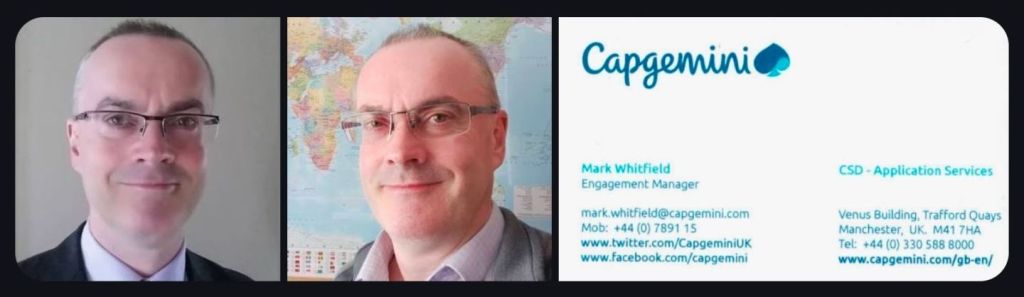
Mark Whitfield IT Project Manager, Brief Summary

Mark Whitfield is a highly experienced, SC-cleared Senior Project Manager and IT professional with over 31 years of experience in both public and private sectors, specializing in software development, cloud migration, and IT systems delivery.

He is currently associated with Capgemini (since 2016) and runs a project management resource website, PROject Templates.

Joined Capgemini in 2016 having worked at ascending points in software development lifecycle projects for over 31 years

Key Qualifications & Experience:

  • Roles: Senior Project Manager, Engagement Project Manager, Delivery Manager, and former programmer.
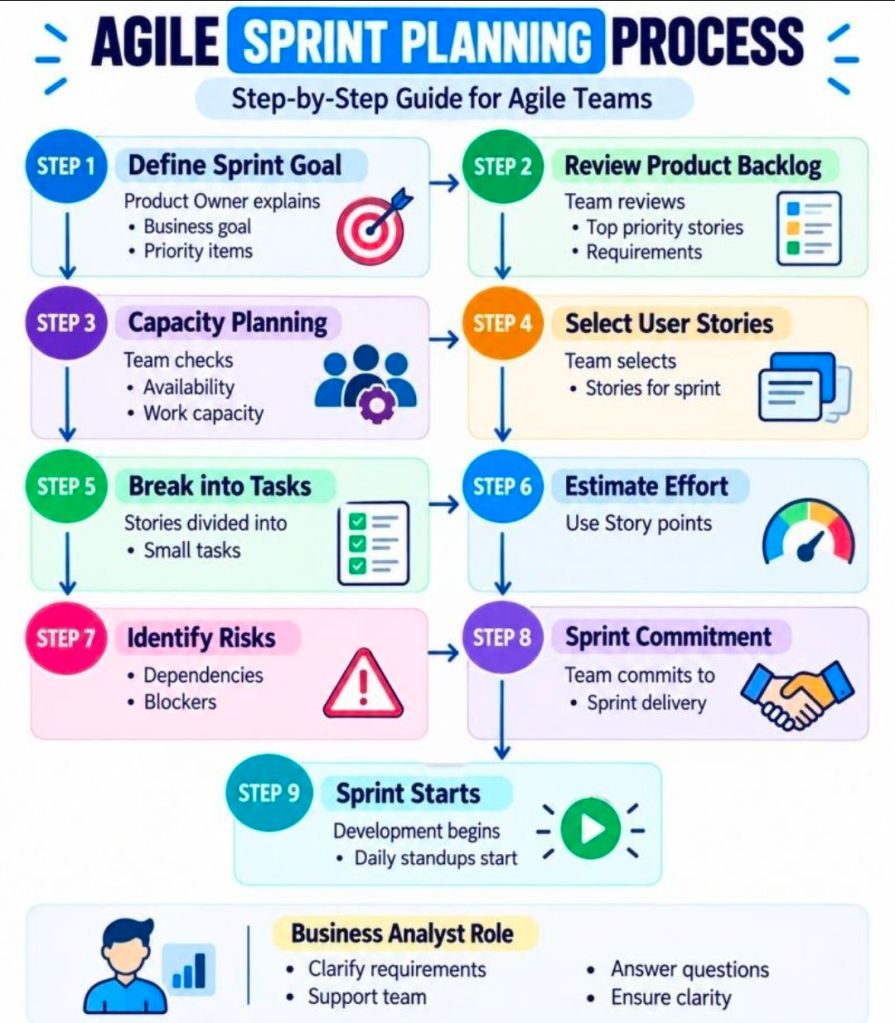
  • Methodologies: PRINCE2 Practitioner, skilled in both Waterfall and Agile (SCRUM) approaches.
  • Sector Experience: Extensive experience in finance and banking, including ATM software swap-outs, cloud migration (Azure, AWS, Power Platform), and POS monitoring systems.
  • Background: Graduated in Computing in 1990; worked as a developer (COBOL, SQL, Tandem / HPE NonStop) before transitioning to project management.
PRINCE2 Practitioner, skilled in both Waterfall and Agile (SCRUM) approaches

Professional Highlights:

  • Delivered major projects for clients such as Barclays, Bank of England, HSBC, Royal Mail Group, UK & Welsh Government, Heathrow, and Jaguar Land Rover.
  • Led complex IT infrastructure projects and business transformations.
  • Maintains mark-whitfield.com, offering over 200 project management templates, trackers (RAID, budget, benefit, cost etc.), and many plans for Agile / Waterfall projects including 30+ Plan On a Page (POaP) and MS Project MPP examples (click on Blog above for a summary).
  • Provides specialized templates for PRINCE2 7th edition and MS Project (MPP).
December 2022 – C&CA UK’s Communications & Engagement Award Winner – Cloud & Custom Applications – Capgemini UK
November 2017 – Advanced Engagement Management Course – Level 2 Exam
June 1990 – Higher National Diploma in Computer Studies (DISTINCTION – overall top) – BIHE
June 1990 – Higher National Diploma in Computer Studies, Distinction

Read more…

Degree 53 was a Manchester-based digital agency specializing in user experience, design & software development

Degree 53 is a Manchester-based digital agency specializing in user experience (UX), design, and software development, primarily for the online gambling and sports betting industries.

Founded by Andrew Daniels in 2013, the agency has built a reputation for developing high-stakes transactional mobile apps and websites for major operators like Betfred and Scientific Games.

Following its acquisition by Bally’s Corporation in 2021, it now serves as the Sports Product Studio for Bally’s Interactive, focusing on North American gaming products.

Comprehensive Evaluation Timeline

  • 2013: Founding and Launch
    • Andrew Daniels, a former Betfred employee, founded Degree 53 Limited on May 21, 2013, with initial backing from Betfred founder Fred Done.
    • The agency initially established its office at The Sharp Project in Manchester.
  • 2015: Regulatory Milestone
    • In April 2015, the agency secured a Remote Gambling Software license from the UK Gambling Commission, a rare credential for a digital agency that allowed them to build bespoke transactional gambling platforms.
  • 2016 – 2017: Rapid Expansion
    • In 2017, the agency moved to a new HQ in Steam Packet House, Manchester, after recruiting over 30 new staff members, bringing its total headcount to 75.
    • The firm diversified its portfolio during this period, developing products for non-gambling clients like Vibe Tickets.
  • 2020: Sharp Gaming Spin-Off
    • Founder Andrew Daniels launched Sharp Gaming, a B2B gambling technology business, with £25 million in investment from Fred Done.
    • While Sharp Gaming focused on full-stack platform services, Degree 53 continued its focus on UX and front-end development under new Managing Director Richard Wagstaff.
  • 2021: Acquisition by Bally’s Corporation
    • On October 27, 2021, Bally’s Corporation acquired Degree 53 to bolster its internal technical unit for the launch of products like Bally Bet 2.0.
    • The team of 54 experts was integrated into Bally’s Interactive but remained based in their Manchester studio.
  • 2024 – 2026: Consolidation and Leadership Changes
    • The agency remains an active subsidiary of Bally’s. Recent regulatory filings indicate leadership transitions, such as the appointment of Raja B-Sheikh as a director in August 2025.

Summary of Key Services

  • Bespoke Development: Building native mobile applications (iOS, Android) and responsive web platforms.
  • UX/UI Specialization: User-centered design approach, including mapping customer journeys and conducting user testing.
  • Industry Expertise: Complex system integrations, data feed management, and API development specifically for the betting, gaming, and lottery sectors.

Key Areas Summarised

  • Core Focus: High-quality digital solutions for complex, regulated industries.
  • Key Services: UX/UI Design, Native iOS & Android Apps, Web Development, API Integrations, and Digital Strategy.
  • Strengths: Strong focus on user journey and engagement, particularly in betting platforms. They are noted for bringing high-quality digital solutions at competitive prices.
  • Impact: A significant player in the Manchester digital scene, moving to larger premises to accommodate growth from 50 to 75+ staff between 2014 and 2017.
  • Acquisition: In 2021, Degree 53 became the Sports Product Studio for Bally’s Interactive, supporting its North American expansion.

Key Clients and Projects

  • Betfred/Totesport: Mobile betting apps and websites.
  • Bally’s Interactive: Currently developing sports products.
  • Vibe Tickets: Developed a secure ticket-selling app.
  • Sofology: ‘My Account’ functionality.
  • Other projects: Ready for School, Football Acca, Horse Tracker.
Degree 53 logo Manchester Based
Degree 53 Logo

Key Company Facts

  • Acquisition: Acquired by Bally’s Corporation in October 2021 to advance its global sportsbook and mobile platforms.
  • Specialties: Mobile app development, UX/UI design, Bespoke .NET development, and API integrations.
  • Major Clients: Historically has worked with Betfred, Scientific Games, and Gamesys brands like Rainbow Riches.
  • Office Location: They are currently based at 60 Spring Gardens in Manchester city centre. Previous locations included Steam Packet House and The Sharp Project.

Mark Whitfield involvement 2014 – 2015 :

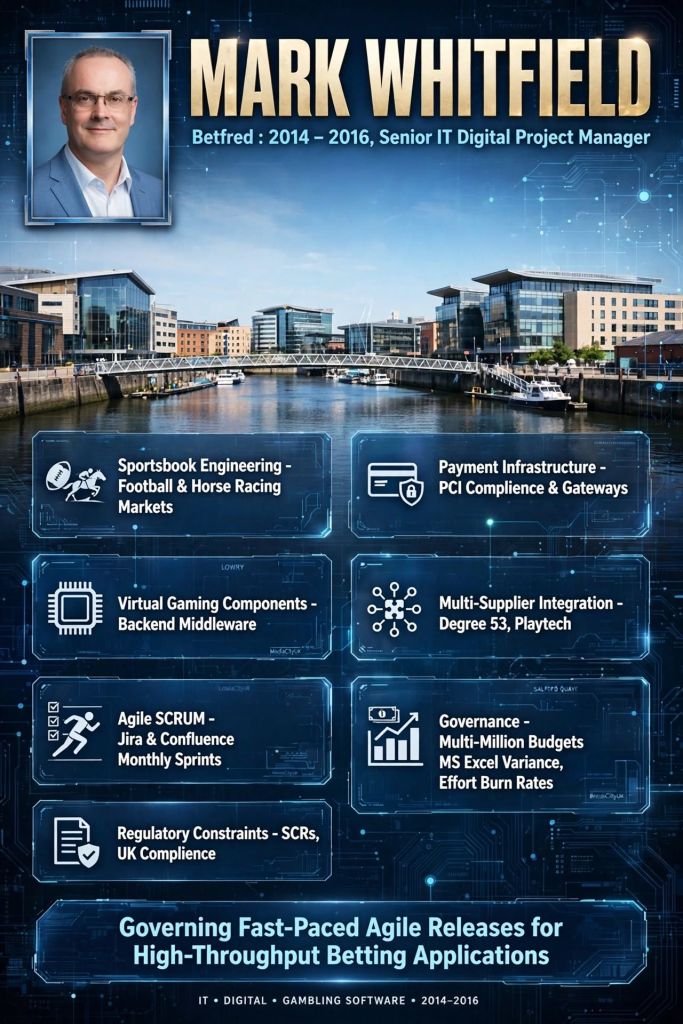
In late 2014, I joined Betfred as a Senior IT Project Manager in the Gambling and Casinos industry delivering multiple projects for both Betfred online and mobile (iOS, Android and Windows) using the Agile SCRUM framework. Project deliveries covered payment gateways and methods, sportsbook for football and horse racing amongst others and the online virtual (computer generated) gaming components.

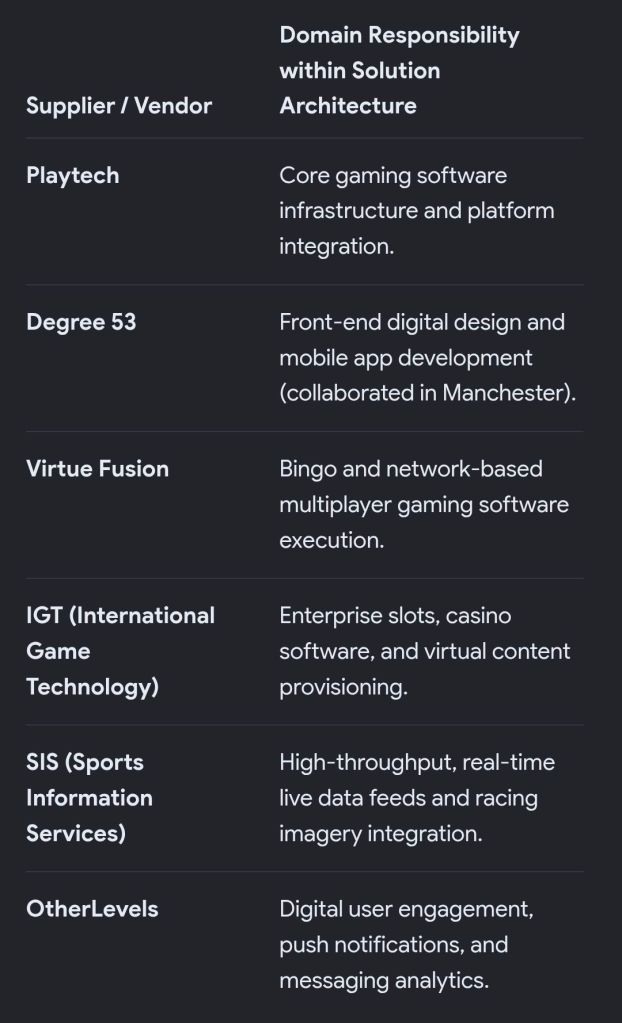
As a major part of this allocation, I also linked into Degree 53 for project/ app status and aid in the setting of priorities for their Betfred specific software delivery.

Degree 53 was a Manchester-based digital agency specializing in user experience (UX), design, and software development
at Degree 53 Manchester office, 2015

Projects varied in size and cost and extended over multiple phases requiring the management of many software suppliers, each delivering different aspects of the solution from fraud detection, frontend, middleware, payment services and mobile apps.

Mark Whitfield, SC Cleared Senior Project Manager, Manchester

Mark Whitfield is a highly experienced, SC-cleared Senior Project Manager and Engagement Manager specializing in complex IT software development lifecycle (SDLC) projects, digital transformation, and cloud migrations.

Currently based in Greater Manchester, UK, he has over 31 years of experience in the IT industry, working with major blue-chip companies across various sectors, including UK Government, retail banking, aerospace, and utilities.

He is a certified PRINCE2 Practitioner, skilled in both Agile SCRUM and Waterfall methodologies.

Website Links:

Professional Biography:

Mark specializes in bridging technical teams and business stakeholders, delivering complex IT systems under challenging conditions.

His career spans from early roles as a developer on Tandem Mainframe Computers (HPE NonStop) to senior management positions focusing on cloud resources, API integrations, and CRM platform implementations.

  • Key Skills: Project Planning, Stakeholder Management, Financial Forecasting, Risk Management (RAID), Agile Scrum, PRINCE2, ITIL.
  • Key Strengths: Cloud Migration (Azure/Dynamics 365), Payment Systems (ATM/POS), and API-led connectivity.

Detailed Career Timeline:

  • Nov 2023 – Feb 2024 (UK Government – Capgemini): Acted as Client-Side Technical Delivery Manager for a £1m+ Fish Export Service (FES) to CHIP project, facilitating Azure-based API updates for UK-Northern Ireland trade.
  • Nov 2022 (UK Government – Capgemini): Managed two Microsoft Dynamics 365 Azure Cloud projects, including a £0.4m Dynamics 2016 migration and a £0.54m CRM platform discovery/build.
  • Feb 2022 (UK Utility Industry – Capgemini): Managed a £0.5M project migrating legacy document management systems to an Azure-based Enablon product.
  • 2020 (UK Gov – Capgemini): Senior PM for a £375k Agile proof-of-concept (POC) project migrating legacy applications (MS Access/Oracle) to Microsoft Azure and Dynamics 365.
  • Oct 2018 – June 2019 (MuleSoft): Served as Delivery Manager overseeing 5+ UK accounts for MuleSoft Anypoint Platform (API-led connectivity) implementations.
  • Oct 2017 (Automotive Industry – Capgemini): Managed a £430k Digital Readiness project and a £670k Customer Portal/Online Sales project (Agile).
  • May 2017 (Local Govt – Capgemini): Led a £400k telecommunications project (CCaaS) for the Support for Mortgage Interest (SMI) program.
  • Jan 2017 (Aerospace/Def – Capgemini): Senior Project Lead for two £1.3M projects with high-governance and gated deliverables.
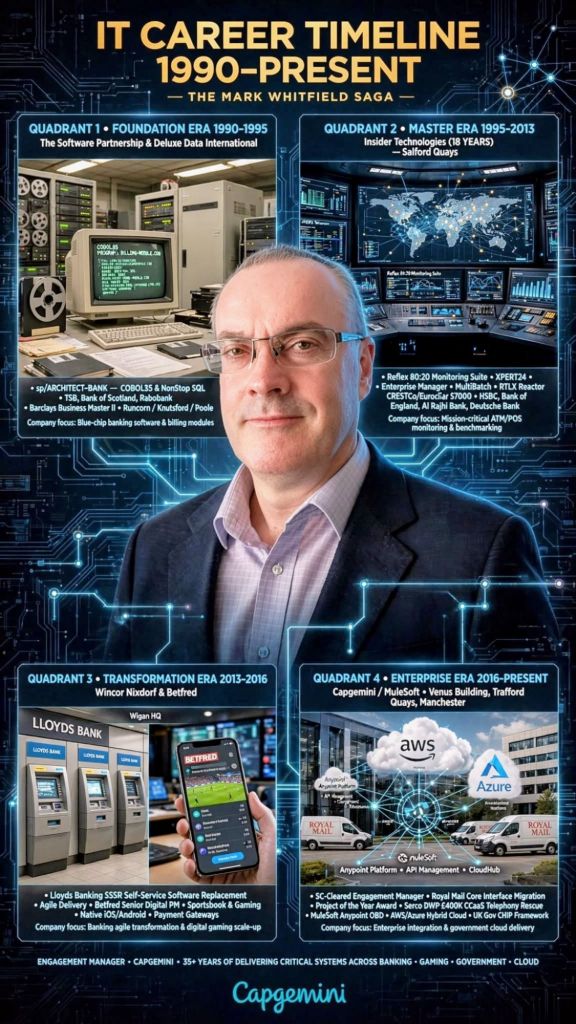
  • Jan 2016 – Present (Capgemini UK): Joined as an Engagement Manager (A8), working on projects including Apple iOS app development for UK Air Traffic (NATS) and a £4.3M data center migration for Postal Services.
  • Dec 2014 – Jan 2016 (Betfred Limited): IT Senior Digital Project Manager for online/mobile payment gateways and sports book platforms.
  • Sep 2013 – Dec 2014 (Wincor Nixdorf): Senior Project Manager for a £5+ million ATM/POS software swap-out at a UK retail bank.
  • 2013 (Retail Banking – Riyadh): Delivered an RTLX transaction tracking project (BASE24 Classic) at a Saudi Arabian bank.
  • 1995 – 2013 (Insider Technologies): Worked on Strategic Technical Initiatives and bank-facing projects on the HPE NonStop platform (Tandem) for products Reflex 80:20, Reflex ONE24, RTLX and XPERT24.
  • 1990 – 1995 (The Software Partnership/Deluxe Data): Commenced career as a programmer specializing in electronic banking software on Tandem Computers (HPE NonStop), sp/ARCHITECT-BANK

Education:

  • 1988 – 1990: Higher National Diploma (HND) in Computing, Distinction/Overall First, Bolton Institute of Higher Education (now University of Greater Manchester from 2024).

Mark Whitfield, SC Cleared Senior Project Manager, Manchester

Mark Whitfield is a highly experienced, SC-cleared Senior Engagement Project Manager

Mark Whitfield is a highly experienced, SC-cleared Senior Engagement Project Manager at Capgemini UK (2016–present), specialising in complex Agile and Waterfall digital transformations, cloud migrations (Azure/AWS), and application modernisation.

Based in Manchester, he has delivered high-value projects for government, automotive, and aerospace sectors, often acting as a key client-side technical lead. 

Key Capgemini Projects and Account Experience (2016–Present)

  • UK Government – Fish Export Service (£1m+): Served as Technical Delivery Manager (Nov 2023–Feb 2024), leading two Agile Scrum teams to build a CHIP inspection portal, extending APIs in MS Azure cloud.
  • UK Government – MS Dynamics Cloud Migration (£1m+): Managed start-up and delivery of Azure Cloud projects (Nov 2022), including migrating 12 Dynamics 2016 apps to Dynamics 365 Online.
  • UK Utility Industry – Cloud Migration (£0.5m+): Led the transition from a legacy document management system (EQS) to Microsoft Azure product Enablon.
  • Automotive – Digital Transformation (£1m+): As Engagement Manager (Oct 2017), managed a £670K Customer Portal/New Car Online Sales project and a £430K Digital Readiness project at the Aston Agile Delivery Centre.
  • Postal Services – Migration Project (£4.3m): Acted as PM for a major migration of 1100+ interfaces between data centres in 2016.
  • Aerospace & Defence – iOS App Delivery: Led Agile delivery of new Apple iOS apps for a UK-wide air traffic organisation, handling sensitive military and public-facing data. 

Specialised Skills and Roles

  • Roles: Engagement Manager (A8), Senior Project Manager, Technical Delivery Manager, Delivery Manager.
  • Certifications: Registered PRINCE2 Practitioner, Certified Engagement Manager (Capgemini Advanced EM Course), Agile SCRUM, ITIL, and AZ-900 Azure Fundamentals.
  • Expertise: Software Development Lifecycle (SDLC), Cloud Migrations (Azure/AWS), MuleSoft Anypoint Platform, Refactor/Re-host/Re-platform patterns.
  • Recognition: C&CA UK’s Communications & Engagement Award Winner 2022 for Cloud & Custom Applications. 

Previous Experience

  • MuleSoft (Oct 2018–June 2019): Augmented as a Delivery Manager, managing up to 5 UK accounts using Outcome Based Delivery (OBD) for API-led projects.
  • Betfred (2014–2016): Senior Digital Project Manager for online/mobile gambling platforms.
  • Wincor Nixdorf / Insider Technologies (1995–2013, see below also): Focused on HPE NonStop/BASE24 banking software and legacy ATM software replacement, including projects for Lloyds Banking Group and in Saudi Arabia. 

Mark is recognized for being a “no-ego” leader, proactive with detail, and highly effective at managing complex stakeholder environments, often providing a “barrier” for developers against challenging clients, according to colleague feedback. 

Mark Whitfield worked at Insider Technologies Limited (ITL) for 18 years, from 1995 to 2013. During his tenure, he progressed from technical roles to Manager of Strategic Technical Initiatives, serving as a Project Manager, Pre-sales Technical Consultant, and Team Lead. 

Below is his work focus broken down by era and project type for Insider Technologies Limited, Salford Quays:

Early Era: Technical Foundations & Product Support (1995 – Early 2000s)

Whitfield’s initial focus was heavily technical, providing hands-on support and development specifications for the company’s core HP NonStop (Tandem) banking products. 

  • Core Technical Support: Provided 24×7 technical support for major financial institutions including the Bank of EnglandRoyal Bank of Scotland, and Euroclear (formerly CRESTCo).
  • Security & Cryptography: Supported Thales e-SECURITY products (Security Resource Manager and SafeSign) running on NSK, Windows, and Unix platforms, focusing on cryptographic functions like MACcing and PKI verification for banking applications.
  • Developer Management: Acted as a manager for developers, providing technical details and specifications for implementation on NonStop development projects. 

Middle Era: Product Development & Design (Mid-2000s – 2008)

During this period, his role expanded into technical design and product management for new software solutions. 

  • XPERT24 Product Launch: Produced the technical design documents and program specifications for XPERT24 (XPNET Performance Monitoring and Tracking).
    • Designed it to monitor the XPNET layer of BASE24, specifically tracking ATM/POS transaction interchange counters.
    • Authored the supporting marketing literature and technical user manuals.
  • R&D Initiatives: Led research and development for BASE24 (P)TLF log file analysis, integrating the Windows-based product Sentra to provide graphical front-end interfaces.
  • HSBC Implementation (2008): Headed the team that successfully delivered mainframe ATM and POS monitoring software to HSBC bank

Late Era: Strategic Initiatives & Major Bids (2008 – 2013)

In his final years at ITL, he focused on large-scale business transformation and high-value project management. 

  • Strategic Technical Initiatives: Served as the Manager of Strategic Technical Initiatives, bridging the gap between sales and technical delivery.
  • LloydsTSB ‘OISS’ Replacement: Managed a major bid to replace the legacy “OISS” operations tool at LloydsTSB (which monitored 5,000 ATMs) with ITL’s Reflex ONE24 product.
    • Responsible for gap analysis, technical assessment, and project costing.
  • Architecture & Design Partnerships: Worked closely with joint architects at Alliance & Leicester (now Santander) on the design and development of what would become a primary product set.
  • Product Portfolio Oversight: Managed the lifecycle of primary products including Reflex 80:20Reflex ONE24, and the more recently introduced MultiBatch.

Project Management Templates bundle with free upgrades

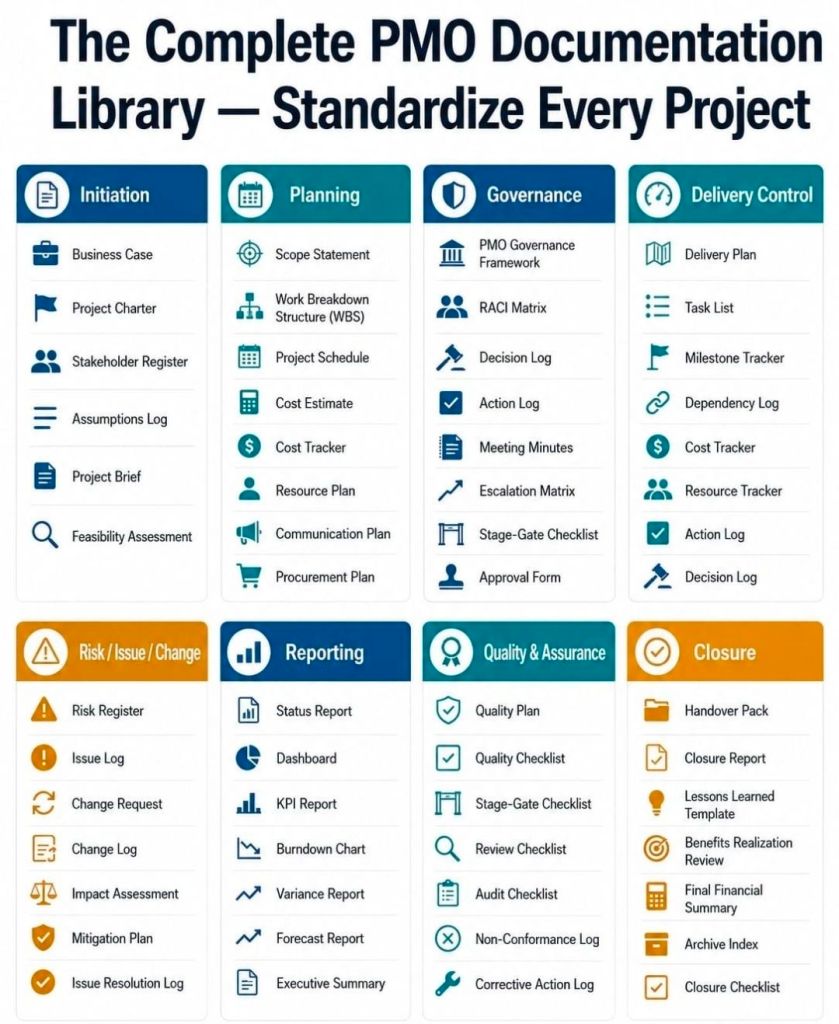
Mark Whitfield’s Project Management templates are a comprehensive, editable suite of over 200 documents designed for Agile, Waterfall, and PRINCE2 methodologies, based on over 30 years of project delivery experience. Available through his website (click banner link above), Etsy, Flevy and Eloquens, these templates are designed to be used across the project lifecycle—from initiation to closure—and include lifetime free updates and additions. 

Many POaP Plan On a Page examples

Full Overview of Mark Whitfield Template Bundle

The bundle, priced at around £38.00 (as of April 2026), provides tools for MS Excel, Word, PowerPoint, and MS Project (.mpp). 

1. Planning & Scheduling

  • MS Project (MPP / MSP): Includes full PRINCE2 7th Edition, Agile Scrum, and SDLC (Software Development Life-cycle) plans.
  • Excel Detailed Plans: Includes Gantt chart tracking for users without MS Project.
  • Plan on a Page (POaP): Over 30 PowerPoint examples for executive summaries. 
Example Plan On a Page POaP

2. PRINCE2 & Governance

  • Full set of over 200 documents including Project Initiation Document (PID), Business Case, Work Packages, Risk Management Strategy, and Configuration Item Records.
  • Reporting: Highlight reports, exception reports, and end-stage reports. 
PRINCE2 Delivery Plan in MS Excel Example

3. Tracking & Risk Management

  • RAID Logs: Comprehensive trackers for Risks, Assumptions, Issues, and Dependencies (includes simple and detailed versions).
  • Finance Trackers: Simple and full project finance trackers (forecasting, actuals, variance, rate lookups).
  • RACI Matrix: Resource Responsibility Assignment Matrix. 
Many Project Budget / Financial Tracker examples

4. Execution & Delivery

  • SDLC: Detailed Software Development Life-cycle plans.
  • Deployment/Runbook: Execution and release planning documents.
  • Agile: Burn down and burn up charts. 
Example Agile Scrum Burn Down Chart

Detailed Timeline by Project Life Cycle

Templates provide detailed MS Project (.mpp) and Excel schedules that map out the standard project life cycle over time. The plans include notes and color-coded tasks (black: standard task, blue: artifact creation, brown: decision/event, purple: artifact update). 

Example MS Excel Delivery Plan

1. Project Startup / Initiation Phase 

  • Tasks: Project Mandate, Project Brief preparation, Appoint Project Board, Define Project Approach.
  • Key Templates: Project Brief, PID, Business Case, Project Board Structure. 

2. Planning Phase

  • Tasks: Develop the PID, Create Detailed Gantt Plans, Create Budgeting/RAID Logs, Setup Communication Strategies.
  • Key Templates: Detailed MS Project Plans (Waterfall/Agile), RACI Tracker, RAID Log. 

3. Project Execution / Control Phase

  • Tasks: Weekly Status Reporting, Risk Management, Managing Product Delivery, Stage Assessments.
  • Key Templates: Highlight Report, Issue Register, Daily Log, Financial Tracker. 

4. Project Close Phase

  • Tasks: Handover, Project Evaluation, Lessons Learned, Finalize Costs, Close Project.
  • Key Templates: End Project Report, Lessons Log, Benefits Realization Plan. 

Summary of Key Features

  • Fully Editable: Designed to be tailored to specific project needs (PRINCE2 Principle 7).
  • Access: Compatible with Desktop, Tablet, Smartphone, and Cloud (Microsoft Teams/SharePoint).
  • Support: Free lifetime upgrades (and additions) to the latest template package after purchase. 
  • Click on link in website banner above to purchase full templates bundle

Project Management Templates bundle with free upgrades.

Senior IT Project Manager & Project Templates author – Mark Whitfield

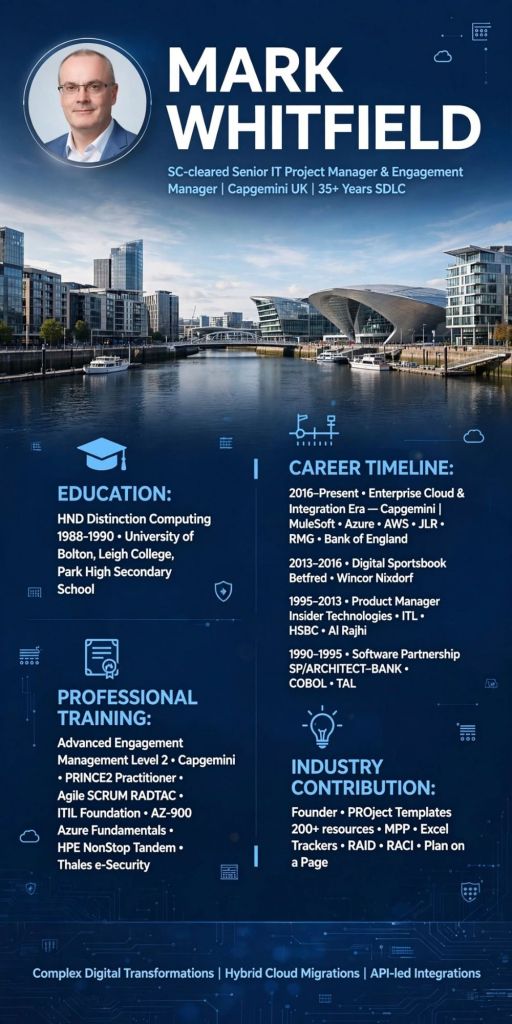
Mark Whitfield is a highly experienced SC-cleared Senior IT Project Manager and Engagement Manager with over 30 years of experience in the software development lifecycle (SDLC), specializing in Agile and Waterfall delivery for financial, automotive, and public sector clients. He has a strong background in HP NonStop (Tandem) systems and currently works for Capgemini. 

Mark Whitfield, Senior IT PM and Project templates author

Comprehensive Career Timeline

Early Career & Foundations (1988–1995) 

  • 1988–1990: Completed Higher National Diploma (HND) in Computing at Bolton Institute of Higher Education (BIHE).
  • 1990–1994: The Software Partnership (Runcorn): Programmer specializing in electronic banking software (sp/ARCHITECT-BANK) on Tandem Computers.
  • 1994–1995: Deluxe Data (formerly TSP): Lead Analyst/Programmer, focusing on software investigation, design, coding, and on-site installation for clients like TSB, Bank of Scotland, and Rabobank. 

Development & Technical Specialization (1995–2013) 

  • 1995–2013: Insider Technologies Limited: Spent 18 years progressing from Senior Development Engineer to Project Manager for Strategic Technical Initiatives.
  • Key Roles: Managed Reflex 80:20 and Reflex ONE24 product development, technical pre-sales, and consultancy. Developed diagnostic software for monitoring payment systems (BASE24).
  • Notable Project: Managed a bid to replace legacy ATM tools at LloydsTSB (5000 ATMs) with Reflex ONE24. 

Banking & Digital Project Management (2013–2016) 

  • 2013–2014: Wincor Nixdorf: Project Manager in the Professional Services Banking Division, managing a £5m+ work stream for Lloyds Banking Group’s Self-Service Software Replacement (SSSR) programme.
  • 2014–2016: Betfred: Senior Digital Project Manager for the Online and Mobile Division, delivering payment gateways and sportsbooks for iOS, Android, and Windows. 

Senior Engagement Management (2016–Present)

  • 2016–Present: Capgemini UK: Engagement Project Manager responsible for delivering both Waterfall and Agile digital projects.
  • 2016 (Approx.): Assigned to a UK-wide Air Traffic organization (NATS) for Apple iOS app delivery.
  • 2018–2019: MuleSoft (Secondment): Served as a Delivery Manager for the Anypoint Platform.
  • Current Focus: Cloud Migration (Hybrid) of 130 apps for UK Government. 

Client & Colleague Recommendations

Mark Whitfield is noted for being a detail-oriented manager who provides a strong barrier between developers and difficult clients, while maintaining a friendly, professional, and diplomatical approach. 

  • Agile Management: “Mark provided an excellent barrier between us (developers) and a difficult client…ensuring that we followed the agile principles” — Callum Marriage (Developer).
  • MuleSoft/Capgemini Engagement: “Customers loved him. His was extremely detailed oriented and understood the often-complex needs…never became flustered in high pressure situations” — Delivery Manager, MuleSoft.
  • Betfred (2015): “I would highly recommend Mark for his ability to successfully multi-task under significant pressure… [he] produced a very comprehensive handover document” — IT Compliance Analyst, Betfred.
  • Capgemini/JLR Project: “Mark was able to do a good planning, with the correct resources, on time delivery and with good relationship between stakeholders” — Head of Integration Development

Key Areas of Expertise

  • Methodologies: PRINCE2 Practitioner, Agile SCRUM, ITIL, ISO9001:2008.
  • Tools: MS Project, MS Excel/Office, RAID logs.
  • Technical Background: HP NonStop (Tandem) Systems, BASE24, C++, TAL, COBOL.
  • Industries: Financial/Banking, Aerospace & Defence, Government, Automotive, Gambling. 

Mark Whitfield’s website (mark-whitfield.com) serves as a professional portfolio and resource hub for his 30+ year career as a SC-cleared Senior IT Project Manager. It offers over 200 editable project management templates for Agile, Waterfall, and PRINCE2 methodologies, alongside career insights and project experience. 

Website & Content Overview

  • Project Management Resources: The site, often known as PROject Templates, provides downloadable templates for planning, scheduling (Gantt charts), project initiation (PID), and project control.
  • Methodology Focus: Resources are tailored for PRINCE2 (including Agile Scrum), and Agile/Waterfall delivery methods.
  • Career Portfolio: Features his work history as a Senior IT Project Manager, including roles at Capgemini, Betfred, and various financial institutions.
  • Technical Specialization: Highlights expertise in HP NonStop systems, digital projects, and payment/transaction systems.
  • Professional Background: Mentions his experience with major clients such as Jaguar Landrover, Heathrow, Royal Mail, and various banks. 

The site is designed for project managers looking for templates to speed up project documentation and for clients looking to review his career accomplishments. 

Senior IT Project Manager & Project Templates author – Mark Whitfield

Templates sold on this website are designed for Microsoft Office (Excel, Word, PowerPoint) and MS Project (MPP) and are used for tracking and planning software development lifecycle (SDLC) projects. 

Template Breakdown

The templates, often sold in a bundle, include over 200+ editable items aimed at project delivery. Key components include: 

  • Project Planning (MS Project & Excel): Detailed Waterfall project planners with Gantt views, Agile Sprint plans, and Plan on a Page (POaP) examples.
  • RAID Logs (Risk, Action, Issue, Dependency): Comprehensive Excel trackers for managing risks, issues, assumptions, and dependencies.
  • Financial & Resource Management: Project finance trackers (forecasts, actuals, variance) and resource trackers for tracking team members and costs.
  • Project Governance (Word & PowerPoint): Project initiation documentation (PID), status reports, RACI matrices (responsible, accountable, consulted, informed), and project organization charts.
  • Agile/Scrum Tools: Burn-down and burn-up charts, story dependency trackers, and Kanban templates.
  • Closeout: Lessons learned logs and benefit realization analysis trackers. 

Where to Buy

  • Official Website: mark-whitfield.com (PROject Templates) is the primary source, offering a bundle with free lifetime upgrades.
  • Etsy: Mark Whitfield’s templates are available for purchase here, particularly for those needing alternative payment methods.
  • Eloquens: He maintains a channel on Eloquens for downloading professional templates. 

The templates are fully editable, allowing users to tailor them to specific project requirements. 

Mark Whitfield, Website Author – Background and Career Timline

Mark Whitfield is a Senior IT Project Manager and Engagement Manager with over 30 years of experience in the software development lifecycle (SDLC). He is currently a SC-cleared Engagement Manager at Capgemini UK. 

Professional Background by Era

  • 1990–1995: Early Programming (The Software Partnership/Deluxe Data)
    • Role: Programmer/Lead Analyst.
    • Focus: Developed electronic banking software (sp/ARCHITECT-BANK) on Tandem Mainframe Computers (now HPE NonStop).
  • 1995–2013: Senior Development & Product Management (Insider Technologies)
    • Role: Progressed from Senior Programmer to Project Manager for Strategic Technical Initiatives.
    • Focus: Developed platform health and diagnostic modules for the “Reflex” monitoring product.
  • 2013–2014: Project Management (Wincor Nixdorf)
    • Role: Project Manager, Professional Services – Banking Division.
    • Focus: Managed the Wincor Nixdorf workstream for Lloyds Banking Group’s Self-Service Software Replacement (SSSR) programme.
  • 2014–2016: Digital Project Management (Betfred)
    • Role: Senior Digital Project Manager, Online and Mobile Division.
    • Focus: Delivered payment gateways, sportsbooks, and virtual gaming components for iOS, Android, and Windows.
  • 2016–Present: Senior Engagement Management (Capgemini)
    • Role: Engagement Manager (A8), Custom Bespoke Solutions.
    • Focus: Leading digital transformation and cloud migration projects for public and private sector clients. 

Technologies & Frameworks

  • Project Methodologies: Agile SCRUM, PRINCE2 (Practitioner), Waterfall, ITIL, and ISO QA.
  • Mainframe & Infrastructure: HPE NonStop (Tandem), IBM ESB, UNIX shell scripting, and Cloud (MS Azure/AWS).
  • Programming & Databases: C/C++, MS SQL, Java, COBOL85, TAL, TACL, and SCOBOL.
  • Tools: MS Project, MS Excel/Office, MuleSoft Anypoint Platform, and Jira. 

Major Projects & Customers

  • UK Government: Managed a £13.5m cloud migration of 130 applications and the £1m+ Fish Export Service (FES) to CHIP portal.
  • Royal Mail Group (RMG): Managed a £4.3m data centre migration project involving over 1,100 interfaces.
  • Lloyds Banking Group (LBG): Led a £5m+ self-service software replacement project.
  • Other Notable Clients: Jaguar Land Rover (JLR), Heathrow, NATS (Air Traffic Control), Barclays, HSBC, Deutsche Bank, and Euroclear. 

Awards & Education

  • Awards:
    • C&CA UK’s Communications & Engagement Award (2022) at Capgemini UK.
    • Project Recognition Award from Wincor Nixdorf for achievements on the LBG SSSR project.
  • Education:
    • HND in Computer Studies (Distinction) from the University of Greater Manchester (formerly BIHE), 1988–1990.
    • A-Levels in Computer Science and Biology from Leigh College. 

Project Management Templates

Whitfield provides a library of over 200 editable resources through his site, PROject Templates, designed for Agile, Waterfall, and PRINCE2 7th Edition delivery. Key items include: 

  • Plan on a Page (POaP): Over 35+ executive-level summary slides.
  • Detailed Project Plans: Templates in MS Project (MPP) and Excel for SDLC tracking.
  • RAID Logs: Comprehensive registers for risks, actions, issues, and dependencies. 

Mark Whitfield Background and Career Timline

Project Phases, Scrum Master & Project Manager Checklist

Project Phases, Scrum Master & Project Manager Checklist

Mark Whitfield IT Project Manager Training Focus

Mark Whitfield, an IT Project Manager specializing in HP NonStop systems, has a career and training history that spans over three decades, from his academic beginnings in the late 1980s to advanced cloud certifications in the 2020s. 

Early Career & Foundations (1988–1995)

During this era, Whitfield focused on core computer science and specialized mainframe systems while working for The Software Partnership (TSP) and Deluxe Data

  • 1988–1990: Completed a Higher National Diploma (HND) in Computing at the Bolton Institute of Higher Education (BIHE). Modules included Computer Systems Architecture, Programming Methodology, and Data Processing.
  • May 1993: Tandem Guardian Principles Course.
  • September 1994: VPS 7000/9000 Series and VPS Application Development (VOS 4.3).
  • June 1995: HP NonStop (Tandem) Performance Analysis and Tuning.

Development & Technical Specialisation (1995–2005)

Working primarily with Insider Technologies Limited, this period was marked by software development training in languages like C++ and initial forays into project management. 

  • November 1995: HP NonStop TAL Programming.
  • March 1997: C / C++ Programming at Comtec Computer Training.
  • October 1998: Managing Multiple Projects, Objectives, and Deadlines at SkillPath.
  • February 1999: Successful Project Management at SkillPath.
  • May 2000Microsoft Project ’98 Certification (Orange Belt) at the IIL UK Education Centre.
  • February 2001: Sales and Marketing training (In-House).
  • March 2004: MultiBatch NSK Job Scheduling Product.
  • February 2005: Web Services and SOA. 

Web Development & Security Focus (2006–2010) 

This era shows a shift toward web-based technologies and specialized security products. 

  • January 2006: PRINCE2 Project Management Foundation.
  • February 2006: NetObjects Fusion.
  • March 2006: Cryptography (In-House at Thales e-Security).
  • December 2006: Thales e-Security SafeSign Product.
  • January 2007: Developing Web Applications Using Microsoft Visual Studio .NET.
  • March 2009: Querying Microsoft SQL 2000 with Transact SQL (M2071) at QA Training.
  • May 2009: Writing for the Web and Website Visibility & Promotion at iTrain Education.
  • November 2009: Thales e-Security HP NonStop Security Resource Manager (SRM). 

Agile & Advanced Management (2011–Present) 

In his current era at companies like Betfred and Capgemini, Whitfield has prioritized professional certifications in management and cloud infrastructure. 

  • May 2011: Agile SCRUM Training (RADTAC) and PRINCE2 Practitioner Certification (ILX Group).
  • June–July 2011: Java and Google Android programming using the Eclipse IDE.
  • January 2012: ITIL Foundation Course.
  • July 2014: Advanced Microsoft Excel 2013.
  • November 2017Advanced Engagement Management Certification (Level 2) at Capgemini.
  • February 2022AZ-900 Microsoft Certified Azure Fundamentals.
  • July 2024: Microsoft Excel Refresher 2024 via Udemy. 

Mark Whitfield IT Project Manager Training Focus

Mark Whitfield Senior SC Cleared IT Project Manager

Mark Whitfield is a Senior, SC cleared IT Project and Engagement Manager with over 30 years of experience, specializing in the software development lifecycle (SDLC) for large-scale digital and financial payment systems. 

Mark Whitfield is a Senior, SC cleared IT Project and Engagement Manager

Professional Experience by Year

  • 2016–Present: Capgemini UK (Manchester)
    • Role: SC cleared Engagement Manager (A8), Custom Bespoke Solutions.
    • Key Projects: Leading high-value digital transformations and cloud migrations for UK Government applications, automotive (Jaguar Land Rover), and aerospace (Air Traffic Management iOS apps).
  • 2014–2016: Betfred Limited (UK)
    • Role: IT Senior Digital Project Manager, Online and Mobile Division.
    • Key Projects: Managed multiple Agile SCRUM projects for payment gateways, sportsbooks, and virtual gaming components across iOS, Android, and Windows platforms.
  • 2013–2014: Wincor Nixdorf Limited (UK)
    • Role: Project Manager, Professional Services – Banking Division.
    • Key Projects: Managed a £5M+ workstream for Lloyds Banking Group’s Self-Service Software Replacement (SSSR) program, migrating legacy HP NonStop systems to AIX-based Oracle technologies.
  • 1995–2013: Insider Technologies Limited
    • Role: Project Manager – Strategic Technical Initiatives / Senior Development Engineer.
    • Key Projects: Led the development of diagnostic products like Reflex 80:20 and RTLX for global banks including HSBC and Al Rajhi Bank in Saudi Arabia.
  • 1990–1995: The Software Partnership (later Deluxe Data/FIS)
    • Role: Senior Programmer / Lead Analyst.
    • Key Projects: Developed electronic banking software (sp/ARCHITECT) for major banks like Barclays and TSB on Tandem/HP NonStop mainframes. 
Led the development of diagnostic products like Reflex 80:20 and RTLX

Education

  • Higher National Diploma (HND) in Computer Studies (1988–1990)
    • Institution: Bolton Institute of Higher Education, BIHE (now University of Greater Manchester).
    • Achievement: Graduated with Distinction (overall first in class across 2 years).
  • A-Levels in Computer Science and Biology (1985–1988)
    • Institution: Leigh College. 

Awards and Key Certifications

Higher National Diploma (HND) in Computer Studies (1988–1990)
  • Communications & Engagement Award Winner (2022): Awarded by Capgemini UK for Cloud & Custom Applications.
  • Project Recognition Award (2014): Awarded by Wincor Nixdorf for successful delivery of the Lloyds Banking Group SSSR project.
  • Microsoft Certified: Azure Fundamentals (AZ-900) (2022).
  • Certified Engagement Manager (2016): Level 2 Certification through Capgemini.
  • Registered PRINCE2 Practitioner (Since 2011).
  • Agile SCRUM Certified (Since 2011).
  • ITIL Foundation Certified (Since 2012).

Mark Whitfield Senior SC Cleared IT Project Manager

Creative Arts BA (Hons) at Bangor University is a full-time course that integrates film, media, journalism, and creative writing

The Creative Arts BA (Hons) at Bangor University is a three-year, full-time course (UCAS code: WPQ3) that integrates film, media, journalism, and creative writing. It is designed to balance theoretical study with practical, hands-on production. 

Creative Arts BA (Hons) at Bangor University is a full-time course that integrates film, media, journalism, and creative writing

Year 1: Foundations

In the first year, students must complete 120 credits to build a base in both creative practice and academic theory. 

  • Compulsory Modules: A primary core module is Adventures in the Creative Arts (20 credits), which introduces multidisciplinary approaches to the field.
  • Core Skills: You will begin developing production techniques in areas such as audio and visual production, print journalism, and digital media.
  • Theoretical Grounding: Introductory modules cover film theory and cultural studies to enrich your research and analytical skills. 

Year 2: Specialisation & Development

The second year allows for deeper engagement with specific creative industries. 

  • Elective Choice: Students can tailor their studies to their interests, choosing between practice-based modules (e.g., screenwriting, documentary filmmaking, journalism practice) or academic-focused modules (e.g., media regulation, history of film).
  • Professional Engagement: You are encouraged to build professional networks through regular visits from filmmakers, journalists, and designers.
  • Optional Years: After Year 2, you may opt to take an International Experience Year or a Placement Year to work with a professional organisation. 

Year 3: Synthesis & Final Project

The final year focuses on high-level production and a significant independent project. 

  • Final Year Project: Instead of a traditional long-form essay, you can demonstrate your progress through creative outputs such as a fictionalised response, an online exhibition, a vlog, or a professional portfolio.
  • Advanced Practice: Modules continue to cover specialized topics like digital journalism, visual culture, and global media.
  • Professional Showcase: Students often participate in the annual media showcase held at the Pontio Arts and Innovation Centre, providing exposure for their work. 

Teaching & Facilities

  • Learning Methods: Instruction is delivered through lectures, small seminar groups, interactive workshops, and one-to-one supervision.
  • Facilities: Students have access to industry-standard equipment via an extensive loan service (video/stills cameras, digital recorders) and dedicated creative spaces.
  • Assessment: Progress is measured via coursework, presentations, essays, and practical submissions (e.g., short films, scripts, or digital media pieces).

Creative Arts BA (Hons) at Bangor University is a full-time course that integrates film, media, journalism, and creative writing

Bangor University History Timeline by Era and Year

Bangor University (Welsh: Prifysgol Bangor) is a public research university in North Wales, originally founded as the University College of North Wales (UCNW) on 18 October 1884. Established through a historic public campaign, its foundation was uniquely funded by local quarrymen and farmers who contributed their own wages to ensure access to higher education for the people of North Wales. 

Today, it is a prominent institution with over 10,000 students and 2,000 staff members, recognised for its research excellence and strong Welsh cultural identity. 

Comprehensive Timeline of Bangor University

Era 1: Foundation & Early Years (1881–1899) 

  • 1881: The Aberdare Report recommends creating two university colleges in Wales, one for the south and one for the north.
  • 1883: A committee selects Bangor over 12 other towns (including Wrexham and Rhyl) to host the new college.
  • 1884 (18 October): The University College of North Wales officially opens in the Penrhyn Arms, an old coaching inn, with 58 students and 10 staff members.
  • 1884Mary Ellen Williams becomes the first student to enrol; female students notably make up one-third of the initial population.
  • 1885: The institution receives its Royal Charter.
  • 1893: Bangor becomes a founding constituent college of the federal University of Wales, ending its initial practice of conferring degrees through the University of London. 

Era 2: The College on the Hill (1900–1939) 

  • 1903: The city of Bangor donates a 10-acre site at Penrallt for a new building.
  • 1907King Edward VII lays the foundation stone for the “Main Arts” building.
  • 1911: The iconic Main Arts Building (the “College on the Hill”) is officially opened by King George V.
  • 1926: The Science Departments, which had remained at the old Penrhyn Arms, move to new purpose-built facilities funded by the North Wales Heroes Memorial

Era 3: Wartime & Mid-Century Expansion (1940–1999) 

  • 1940s (WWII): The university’s Prichard-Jones Hall is used to safeguard national art gallery paintings from enemy bombing.
  • 1942Neuadd Reichel, a hostel for male students designed by Percy Thomas, opens on the Ffriddoedd site.
  • 1960s: Rapid expansion follows the Robbins Report, including the completion of the “New Arts” wing (1968) and the establishment of new departments like Social Theory (1966).
  • 1967: The Bangor Normal College hosts lectures by the Maharishi Mahesh Yogi, attended by The Beatles.
  • 1977St Mary’s College, a women’s teacher training college, merges with the university.
  • 1996: The Normal College (founded 1858) officially merges with the university, which is renamed University of Wales, Bangor

Era 4: Independence & Modern Era (2000–Present)

  • 2003Storm FM, the official student radio station, begins broadcasting.
  • 2007: The institution gains independent university status and adopts its current name, Bangor University.
  • 2009: The university celebrates its 125th anniversary and begins awarding its own degrees independently of the University of Wales.
  • 2015: The Pontio Arts and Innovation Centre and St Mary’s Student Village open.
  • 2018: The M-SParc science park on Anglesey is completed.
  • 2024: The university celebrates its 140th anniversary and opens its independent North Wales Medical School with its first intake of 80 students.
  • 2025: A £10.5 million donation leads to the redevelopment and renaming of the Albert Guday Business School

University of Greater Manchester Bolton formerly Bolton Institute BIHE LinkedIn

University of Greater Manchester Bolton formerly Bolton Institute BIHE LinkedIn

Group link: https://www.linkedin.com/groups/51224

Website Author IT Career Timeline Breakdown

Mark Whitfield is a highly experienced IT professional with a career spanning over 30 years, transitioning from a technical programmer to a senior digital engagement and project manager. His expertise is rooted in HPE NonStop (Tandem) systems and has evolved to encompass complex Agile and Cloud delivery across diverse industries. 

Early Technical Era (1990–1995)

Following his graduation in Computing in 1990, Whitfield began his career as a Programmer at The Software Partnership (later Deluxe Data). 

  • Focus: Electronic banking software, specifically sp/ARCHITECT-BANK on Tandem Mainframe Computers.
  • Key Work: Developed code for major banks including TSB, Barclays, and Rabobank. This included early digital innovations like voice-driven phone banking and inter-account transfers before the internet was widespread. 

Growth and Product Management Era (1995–2004) 

Whitfield joined Insider Technologies Limited (ITL) in 1995 as a Senior Programmer

  • Focus: Platform health and diagnostic software for HPE NonStop systems.
  • Key Projects:
    • Co-developed diagnostic plug-ins for the Reflex monitoring suite.
    • Managed the first HP OpenView Operations (OVO) Smart Plug-In certification for the NonStop platform in 2002.
    • Consulted for CRESTCo (Euroclear) in 1997, conducting benchmark testing on new S7000 nodes. 

Strategic Leadership and Project Management Era (2005–2014) 

During this decade, he transitioned into IT Project Management, focusing on high-value financial transaction tracking. 

  • Focus: Waterfall and Agile project delivery for payment systems and banking infrastructure.
  • Key Milestones:
    • 2011: Led a massive transaction tracking project at Al Rajhi Bank (Saudi Arabia), parsing terabytes of tape-archived data into a normalised SQL database.
    • 2013–2014: At Wincor Nixdorf, managed a £5+ million project for Lloyds Banking Group to migrate ATM driving responsibilities from legacy systems to AIX-based Oracle technologies. 

Senior Digital Engagement Era (2014–Present)

Since 2014, Whitfield has focused on senior-level digital transformation and engagement management. 

  • Betfred (2014–2016): Served as Senior Digital Project Manager for online and mobile platforms (iOS/Android), managing fraud detection and payment gateway integrations.
  • Capgemini (2016–Present): Joined as an Engagement Manager (SC cleared).
    • Focus: Managing large-scale Agile and Waterfall digital projects across aerospace, defence, and government sectors.
    • Notable Projects: Leading a £13.5m programme to migrate 130 UK government applications to the cloud (AWS/Azure) and delivering real-time airspace monitoring apps for air traffic organisations. 
Mark Whitfield IT Career Timeline Breakdown

HND Higher National Diploma Overview and Historical Timeline by Year

Higher National Diploma (HND) is a Level 5 vocational qualification in the UK, equivalent to the first two years of a university bachelor’s degree. Designed to provide industry-specific practical skills, it typically takes two years of full-time study or three to four years part-time. 

Higher National Diploma HND in Computer Studies (3)

Historical Timeline of the HND

The HND has evolved from a niche engineering credential into a globally recognised vocational standard. 

The Early Era: Origins and Industrial Focus (1920s–1950s)

  • 1920: The Higher National Diploma was first introduced in England and Wales alongside the Ordinary National Diploma (OND) and Higher National Certificate (HNC).
  • 1921–1923: Initial subject frameworks were established, starting with Mechanical Engineering (1921) and Electrical Engineering (1923).
  • 1930s: The qualification expanded into Building (1929) and Commerce (1939) to support a growing industrial economy.
  • Post-WWII: The 1944 Butler Act reorganised secondary education, but HNDs remained the primary route for advanced technical training in colleges. 

The Expansion Era: Growth and New Governance (1960s–1970s)

  • 1960s: HNDs gained prominence in polytechnics, addressing critical skills gaps through a practical approach to higher education.
  • 1968–1969: Awards for HNDs saw a massive 665% increase compared to a decade prior, beginning to rival university “ordinary degrees” in popularity.
  • 1972–1974: Under Margaret Thatcher (then Education Secretary), the Haselgrave Report recommendations led to moving qualifications from the City and Guilds to two new bodies: the Business Education Council (BEC) and the Technician Education Council (TEC)

The BTEC and Modernisation Era (1980s–2000s)

  • 1983: BEC and TEC merged to form the Business and Technician Education Council (BTEC), which became the primary awarding body for HNDs.
  • 1990s: BTEC merged with the University of London Examinations Board to form Edexcel (now part of Pearson).
  • 1980s–90s: The curriculum diversified rapidly into modern sectors such as computing, business, catering, and performing arts.
  • 2000s: Global expansion accelerated; for instance, the HND was formally introduced in Cameroon in 2002
Higher National Diploma HND in Computer Studies (1)

The Contemporary Era: Frameworks and Global Standard (2010s–Present)

  • 2013–2014: Despite a decline in public sector colleges due to the rise of Foundation Degrees, HND student numbers at private providers grew from 13,000 to 30,000 in just one year.
  • 2018: Major global curriculum updates were implemented to integrate digital literacy, sustainability, and entrepreneurship into traditional vocational subjects.
  • 2020s: Current HNDs are positioned at Level 5 on the Regulated Qualifications Framework (RQF) and are delivered in over 60 countries. 

Key Characteristics of the HND

  • Academic Standing: Equivalent to Level 5 (Year 2 of a Degree).
  • Progression: Over 95% of UK universities allow HND graduates to “top up” to a full bachelor’s degree, often entering directly into the final year.
  • Assessment: Focuses on practical projects, case studies, and work placements rather than just theoretical exams. 

HND Higher National Diploma Overview and Historical Timeline by Year

Higher National Diploma HND in Computer Studies (2)

Mark Whitfield HP NonStop Tandem experience & Project Management Templates

Mark Whitfield is an experienced IT Project Manager and software developer who has spent over 22 years specialising in HP NonStop (formerly Tandem) systems. He is currently an Engagement Project Manager at Capgemini

Career & Expertise

Whitfield’s career in HP NonStop began in 1990 and includes significant technical and leadership roles across the financial and technology sectors: 

  • Software Development: Early in his career, he worked as a programmer for The Software Partnership (later Deluxe Data/FIS), focusing on electronic banking software like sp/ARCHITECT on Tandem mainframes.
  • Insider Technologies (1995–2013): He spent 18 years at Insider Technologies as a Senior Development Engineer and Project Manager. His work involved:
    • Developing monitoring and diagnostic software such as Reflex 80:20Reflex ONE24, and RTLX (Real-Time Log Extraction) for payment systems.
    • Managing the first HP OpenView Operations Smart Plug-In certification for the NonStop platform.
    • Designing XPERT24, a performance tracking product for ACI’s XPNET layer.
  • Capgemini (2016–Present): As an Engagement Project Manager, he has led digital projects for major clients in the automotive, government, and aerospace sectors, including a cloud migration for UK Government applications. 

Technical Contributions

  • Publications: He has authored articles for globally published journals like The Connection (2013), discussing topics such as querying terabytes of legacy transaction log data from NonStop mainframes.
  • Project History: He has managed high-value projects, including a £5 million initiative to migrate legacy HP NonStop software to AIX-based technologies for a large UK retail bank.
  • Training: He is trained in various NonStop-specific technologies, including TAL (Transaction Application Language), COBOL85PATHWAY, and NonStop SQL

Whitfield also maintains a professional website, mark-whitfield.com, where he provides project management templates and resources related to HP NonStop and Tandem systems. 

Mark Whitfield provides a comprehensive bundle of over 200 editable project management templates designed for Agile, Waterfall, and PRINCE2 methodologies. These templates are based on over 30 years of project delivery experience and are available for purchase via his official website or Etsy shop. 

Key Template Categories

The bundle includes a wide variety of tools across different formats (Excel, PowerPoint, Word, and MS Project): 

  • Planning & Scheduling:
    • Plan on a Page (POaP): Over 30 PowerPoint slide examples for executive-level summaries.
    • Detailed Project Plans: MS Project (MPP) and Excel templates for SDLC, PRINCE2 7th Edition, and Agile Scrum projects.
    • Gantt Charts: Built-in tracking views for both MS Project and Excel.
  • Tracking & Control:
    • RAID Logs: Comprehensive logs for tracking Risks, Actions, Issues, and Dependencies, plus additional tabs for Change Requests and Lessons Learned.
    • RACI Matrix: Templates to define project roles and responsibilities (Responsible, Accountable, Consulted, Informed).
    • Finance Trackers: Tools for internal and external forecast vs. actual costs, including margin and variance tracking.
  • Agile Specific Tools:
    • Burn Down & Burn Up Charts: Excel-based alternatives when tools like Jira are unavailable.
    • Agile Story Dependency Tracking: Specifically for managing dependencies between agile stories and external suppliers.
  • Reporting & Governance:
    • Status Reports: Weekly and monthly templates in Word and PowerPoint formats.
    • Stakeholder Analysis: Power/interest mapping and engagement plan templates.
    • Benefits Realisation: Plans to track project outcomes against initial business goals. 

Purchase Benefits

  • Lifetime Upgrades: Once purchased, all future additions and updates to the template package are provided for free.
  • Compatibility: Templates are designed for Microsoft Office 365 but also include Excel versions compatible with earlier software.
  • Support: The package typically includes walkthrough Word documents to guide users on how to use each major template.

Mark Whitfield HP NonStop Tandem experience & Project Management Templates

Cost Estimating vs Cost Planning

Cost Estimating vs Cost Planning

In professional project management and construction, cost estimating and cost planning are complementary processes that occur at different stages to ensure a project remains financially viable

1. Cost Estimating: “What will it cost?”

Cost estimating is a technical assessment used to predict the expenditures for a project. 

  • Early Stages: Estimates might be “rough orders of magnitude” based on square footage or historical data (e.g., cost per hotel room).
  • Later Stages: Estimates become precise “tender figures” used by contractors to bid on work, factoring in current market rates for labour and materials.
  • Function: It answers the question: “Is this specific plan affordable?”. 

2. Cost Planning: “How do we stay on budget?”

Cost planning is a strategic framework that manages a project’s financial health from start to finish. 

  • Iterative Process: It is a “living document” that is updated as the project moves from concept to detailed design.
  • Allocation: It breaks down the total budget into “elemental” targets (e.g., spending £X on the foundation and £Y on finishes).
  • Control: If an estimate for one part of the project exceeds its target, the cost plan guides the team to adjust the design or find savings elsewhere to keep the overall project on track. 

Standard Professional Guidance

The Royal Institution of Chartered Surveyors (RICS) provides the New Rules of Measurement (NRM 1), which standardises how these processes work together: 

  1. Order of Cost Estimate: Establishing the initial viability of a project.
  2. Elemental Cost Plan: Breaking the estimate down into functional parts.
  3. Cost Checking: Continually comparing design changes against the cost plan to prevent overspending.
Cost Estimating vs Cost Planning

Agile Framework Executive Summary Overview Snapshot

Agile Framework Executive Summary Overview Snapshot

Project Management, Pre-Contract vs Post- Contract Phase

Project Management, Pre-Contract vs Post- Contract Phase

Research Machines Limited, Link Timeline History by Era and Device

Research Machines (now RM plc) has a long-standing history as a primary provider of technology for the UK education sector. Founded in 1973, the company transitioned from a hobbyist component supplier to a leading manufacturer of educational microcomputers and networking systems. 

Overview of Research Machines “LINK”

The LINK designation primarily referred to the RM Link 480Z, introduced in 1982. It was designed as a lower-cost, diskless network station that could “link” into a chain, typically using a more powerful 380Z as a file server. This system was one of three chosen for the UK government’s 1982 Educational Scheme. 


Timeline History by Era and Device

The Founding Era (1973–1976)

  • 1973: Founded as Research Machines Limited in Oxford by Mike Fischer and Mike O’Regan.
  • 1974: Operated under the name Sintel, a mail-order supplier of electronic components for hobbyists. 

The Z80 Era (1977–1984)

  • 1977: Launched the RML 380Z, an 8-bit microcomputer based on the Zilog Z80 processor. It typically ran the CP/M operating system and was often housed in a distinctive large black metal case.
  • 1982: Introduced the RM Link 480Z.
    • Purpose: Designed as a diskless network node for schools.
    • Networking: Used the proprietary CHAIN Network or Z-Net to connect to a 380Z file server.
    • Hardware: Featured a Z80 CPU and up to 256 KB of bank-switched RAM. Early models had black metal cases, later replaced by cream plastic. 

The Nimbus & PC Transition (1985–1990s) 

  • 1985: Launched the RM Nimbus PC-186, using the Intel 80186 processor. While not fully IBM-compatible, it could run early versions of Microsoft Windows (up to 3.0).
  • 1986: Released the RM AX (using the Intel 80286), often used as a file server for Nimbus networks.
  • Late 1980s: Introduced the M Series (PC-286/386) and S Series (PC-386 and later), which were fully IBM PC compatible. 

The PC Era & Diversification (1994–Present)

  • 1994: Floated on the London Stock Exchange as RM plc.
  • 1997: Introduced the C Series of computers for schools.
  • 2003: Launched the F Series (blue chassis) pre-installed with Windows XP.
  • 2010: Released a new line of black and silver RM computers for Windows 7.
  • Current: RM has pivoted from hardware manufacturing to becoming a global EdTech solutions provider, focusing on digital assessment (RM Ava) and managed IT services.

Research Machines Limited, Link Timeline History by Era and Device