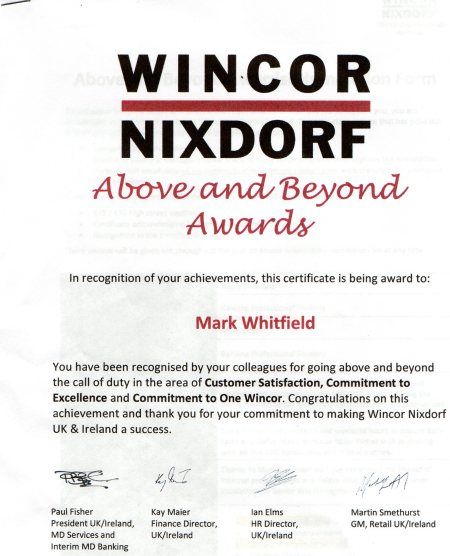
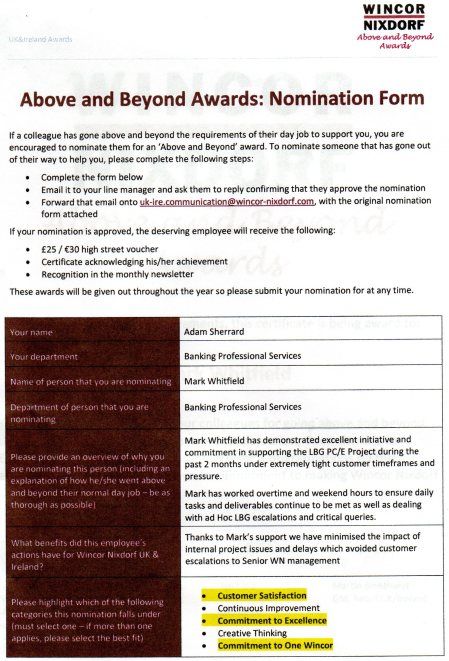
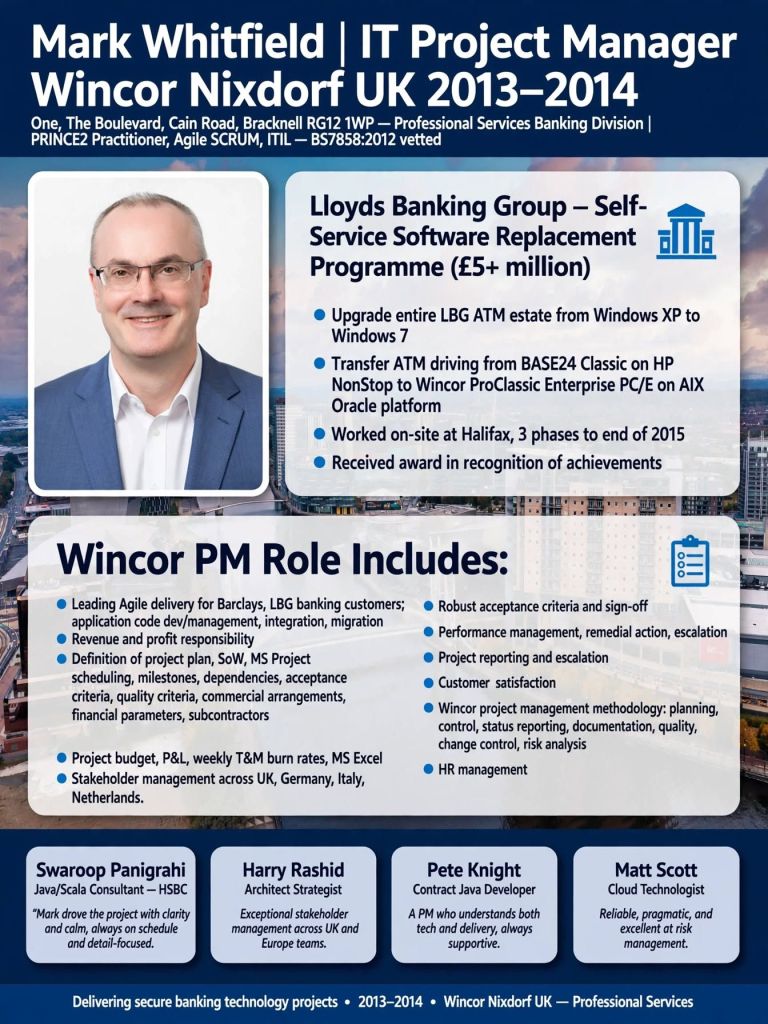
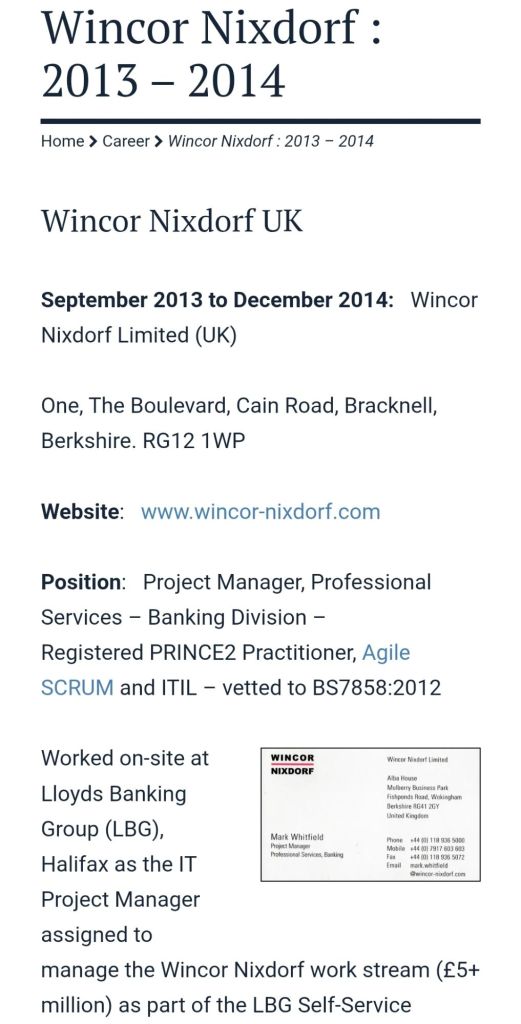
During his tenure as an IT Project Manager at Wincor Nixdorf (Banking Division) from 2013 to 2014, Mark Whitfield focused on large-scale retail banking software modernisation and multi-vendor hardware migrations.
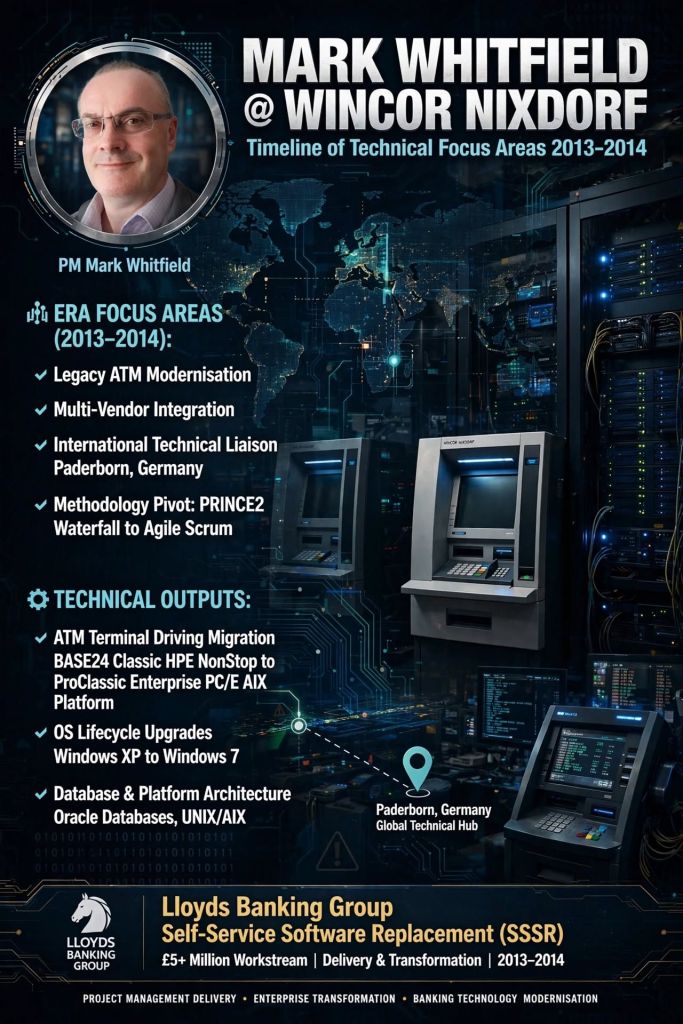
Mark Whitfield @ Wincor Nixdorf – Timeline of technical focus areas
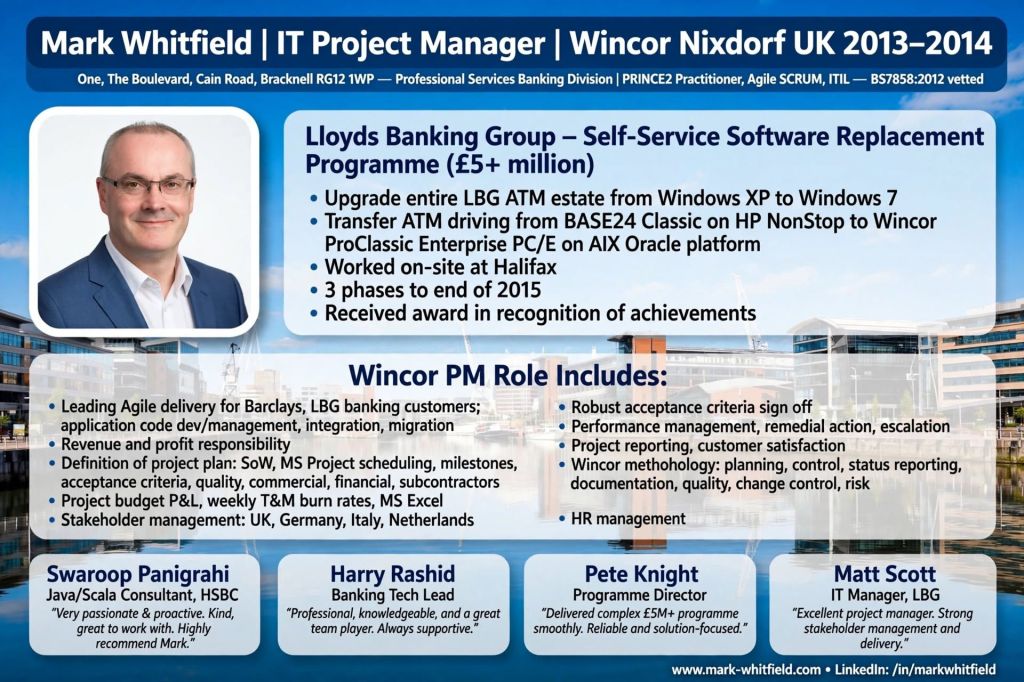
He spearheaded a £5+ million workstream on-site for Lloyds Banking Group (LBG) as part of their Self-Service Software Replacement (SSSR) programme.
The focus areas and technical outputs of his work during this era are detailed below.
🏛️ Era Focus Areas (2013–2014)
Legacy ATM Modernisation: Managing the transition of core banking infrastructure away from legacy terminal systems to prevent service outages and meet stricter post-2008 operational risk regulations.
Multi-Vendor Integration: Directing complex hardware and software integration streams to ensure Wincor Nixdorf solutions successfully paired with third-party banking frameworks.
International Technical Liaison: Acting as a qualified management link between the local UK delivery teams and Wincor Nixdorf’s central engineering base in Paderborn, Germany, for advanced subject matter expertise.
Methodology Pivot: Implementing project governance frameworks that bridged strict PRINCE2 Waterfall structures with Agile Scrum delivery models.
💻 Technical Outputs
ATM Terminal Driving Migration: Transferred critical automated teller machine (ATM) driving responsibilities away from legacy BASE24 Classic running on HPE NonStop mainframes over to Wincor’s ProClassic Enterprise (PC/E) product suite deployed on an AIX platform.
OS Lifecycle Upgrades: Successfully planned and executed the infrastructure upgrade of the Lloyds Banking Group ATM hardware estate from the end-of-life Windows XP operating system to Windows 7.
Database & Platform Architecture: Delivered backend systems alignment leveraging Oracle databases integrated across distributed UNIX/AIX environments.
Wincor Nixdorf was a premier global provider of IT solutions, hardware, software, and services tailored for retail banks and the retail industry.
Headquartered in Paderborn, Germany, the company historically commanded roughly 35% of the global automated teller machine (ATM) market and stood as a dominant force in electronic point-of-sale (EPOS) systems.
Its operations focused deeply on business process optimisation, automated cash handling, and retail self-checkout systems. In 2016, Wincor Nixdorf merged with its US rival Diebold, Inc., creating the modern consolidated market leader, Diebold Nixdorf.
Mark Whitfield | IT Project Manager | Wincor Nixdorf UK | 2013 thru 2014
Detailed Historical Timeline
The history of Wincor Nixdorf spans several distinct strategic eras, tracing its evolution from a post-war calculator workshop into a modern global fintech titan.
Era 1: The Founding & Decentralised Computing (1952–1989)
This era was defined by entrepreneur Heinz Nixdorf, who pioneered small-to-medium business computing and electronic banking terminals across Europe.
1952: Heinz Nixdorf establishes Labor für Impulstechnik in Paderborn, Germany. The small enterprise builds electronic calculators for businesses rebuilding in post-war Europe.
1964: The company shifts from acting as a third-party component supplier to marketing office calculators and billing systems under its own brand name. []
1968: Following corporate acquisitions, the company officially rebrands as Nixdorf Computer AG and develops some of the world’s earliest decentralized minicomputers.
1969: The firm enters the North American market by purchasing the electronics division of the US office equipment manufacturer Victor Comptometer.
1971: Secures its first landmark international banking contract, supplying 1,000 terminals to the Swedish banking industry.
1978: Global sales cross DEM 1 billion, and the workforce grows to over 10,000 employees globally.
1982: Expands its engineering breadth by forming a dedicated corporate telecommunications division.
1984: Launches its initial public offering (IPO), floating shares publicly on the Frankfurt Stock Exchange.
1986: Founder Heinz Nixdorf suddenly dies of a heart attack at a corporate event. The company struggles to pivot from hardware-locked minicomputers to emerging open personal computer architectures.
1989: Amid intensifying global hardware margins and strategic missed steps, corporate financial losses top DEM 1 billion.
Era 2: The Siemens Integration & Corporate Carve-Out (1990–1998)
During this stage, corporate giant Siemens rescued and absorbed the distressed business, later reorganizing its retail and banking assets into a specialized standalone vehicle.
1990: Siemens AG steps in to purchase the shares of Nixdorf Computer AG, officially merging it with its own Data Information Services division to create Siemens Nixdorf Informationssysteme (SNI) AG.
1992: SNI expands heavily across European IT markets, operating as a distinct, specialized computing arm under the Siemens umbrella.
1996: Becomes the largest IT company in Germany and the second largest across the European continent.
1998: Siemens restructures its computing strategy; it sells its personal computer division to Acer and spins off the highly profitable banking and retail segments into a new unit: Siemens Nixdorf Retail and Banking Systems GmbH.
Era 3: Private Equity Buyout & The Rise of Wincor Nixdorf (1999–2015)
This period marked the official birth of the independent “Wincor Nixdorf” brand, characterized by aggressive global expansion, software-driven solutions, and public market listing.
1999: Private equity firms Kohlberg Kravis Roberts (KKR) and Goldman Sachs Capital Partners complete a buyout of the Siemens unit. The company is formally renamed Wincor Nixdorf GmbH.
2000: Launches major end-to-end IT outsourcing and infrastructure managed services alongside its standard terminal hardware.
2004: On 19 May, Wincor Nixdorf successfully returns to the public markets, listing as Wincor Nixdorf AG on the Frankfurt Stock Exchange via a high-performing IPO.
2006: Longtime Chief Executive Officer Karl-Heinz Stiller resigns from the board, leaving a structurally sound company expanding deep into automated cash recycling and software.
2009–2014: Deploys multi-vendor banking software and automated checkout machines worldwide, expanding operations across roughly 100 countries.
2015: Reports global revenues of €1.8 billion, split roughly 65% in banking services and 35% in retail point-of-sale solutions. On 23 November, US rival Diebold announces a formal business combination agreement to acquire the company.
Era 4: The Diebold Nixdorf Consolidation (2016–Present)
This current era represents the unification of American and European ATM powerhouses to navigate shifting brick-and-mortar financial landscapes.
2016: Diebold Inc. officially completes its $1.8 billion voluntary public takeover of Wincor Nixdorf AG on 15 August. The consolidated global giant begins unified operations as Diebold Nixdorf on 16 August.
2017: The UK Competition and Markets Authority (CMA) formally clears the merger following a comprehensive antitrust review, requiring Diebold to divest its legacy UK customer ATM operation to avoid localized market monopoly.
2021: Capitalizing on self-checkout shifts accelerated by the pandemic, the combined entity launches its next-generation DN Series™ EASY self-service retail product line.
2023: Burdened by legacy debt structures, supply chain disruptions, and pandemic operational challenges, Diebold Nixdorf files for a prepackaged Chapter 11 bankruptcy protection in June. The restructuring swiftly sheds $2.1 billion in debt. By August, it successfully emerges from bankruptcy, resuming trading on the New York Stock Exchange (NYSE).
2024–2026: The restructured firm shifts its focus from low-margin hardware to high-margin managed services and cloud software, stabilizing its global operations with annual revenues reaching $3.75 billion.
Wincor Nixdorf’s journey spans from a mid-century German startup to its 2016 merger with Diebold, forming a global leader in banking and retail technology.
Mark Whitfield | IT Project Manager | Wincor Nixdorf UK | 2013 thru 2014