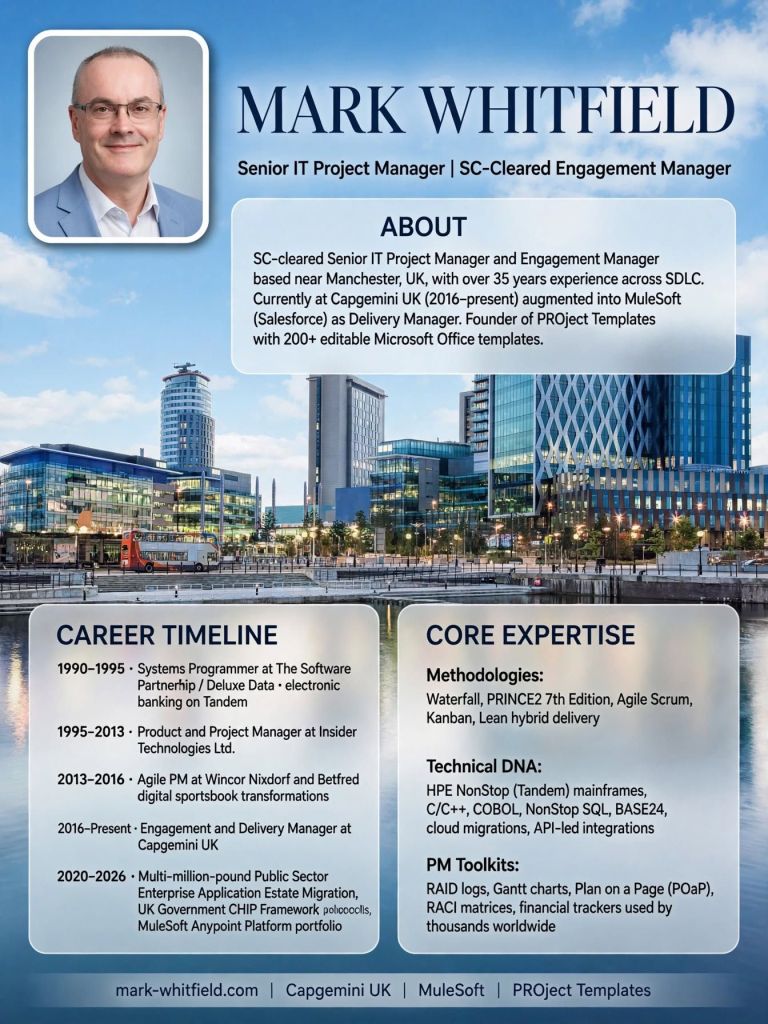
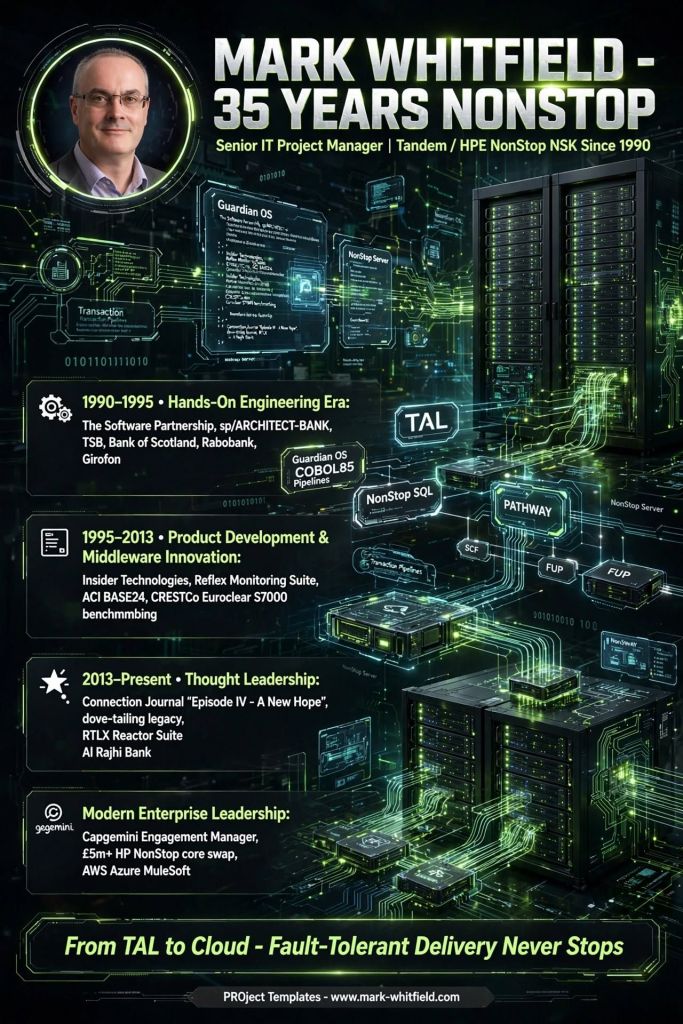
Mark Whitfield is an SC-cleared Senior IT Project Manager and Engagement Manager based in Wigan near Manchester, UK, with over 35 years of experience across the Software Development Lifecycle (SDLC). He is currently employed at Capgemini UK (2016–present) and formally augmented into MuleSoft (a Salesforce company) as a Delivery Manager.
Mark Whitfield | Senior IT Project Manager | Agile, PRINCE2 and Waterfall
He is also widely known as the founder and author of PROject Templates, a popular resource platform featuring over 200 tailored, editable Microsoft Office templates for project delivery.
Career Timeline & Milestones
1990–1995: Began his career as a systems programmer at The Software Partnership / Deluxe Data, developing electronic banking code for international banks on Tandem Computers.
1995–2013: Spent 18 years as a Product and Project Manager at Insider Technologies Ltd.
2013–2016: Handled Agile PM roles at Wincor Nixdorf and Betfred, managing digital sportsbook transformations.
2016–Present: Joined Capgemini UK as an Engagement and Delivery Manager.
Recent Deliveries (2020–2026): Spearheaded a multi-million-pound Public Sector Enterprise Application Estate Migration, managed the UK Government CHIP Framework under strict active Security Check (SC) protocols, and stepped into his active position at MuleSoft overseeing the Anypoint Platform portfolio.
Core Expertise & Delivery Frameworks
Methodologies: Expert across hybrid delivery models, blending rigid structure with flexibility using Waterfall, PRINCE2 7th Edition, Agile Scrum, Kanban, and Lean frameworks.
Technical DNA: Deep enterprise systems engineering background covering HPE NonStop (Tandem) mainframes, C/C++, COBOL, NonStop SQL, BASE24, cloud migrations, and API-led system integrations.
PM Toolkits: Created an extensive open repository containing RAID logs, Gantt charts, Plan on a Page (POaP) layouts, RACI matrices, and financial trackers used by thousands of digital project leaders worldwide.
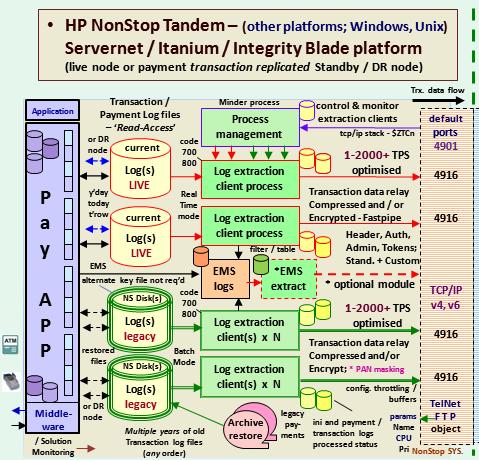
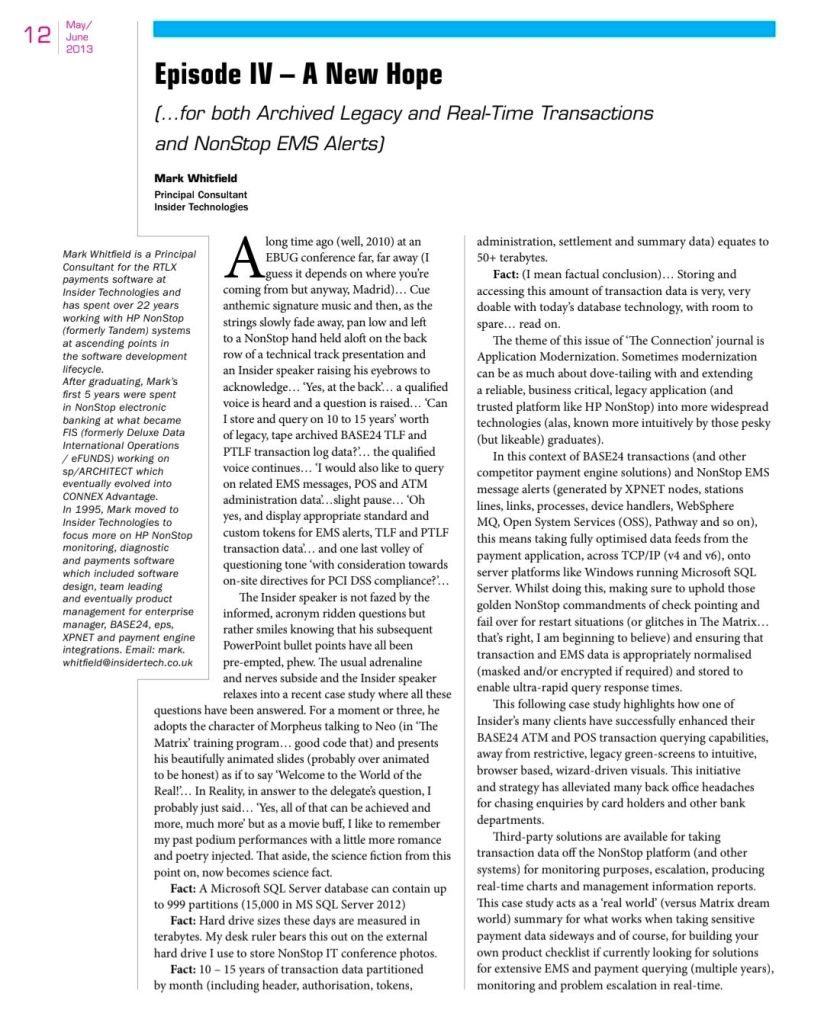
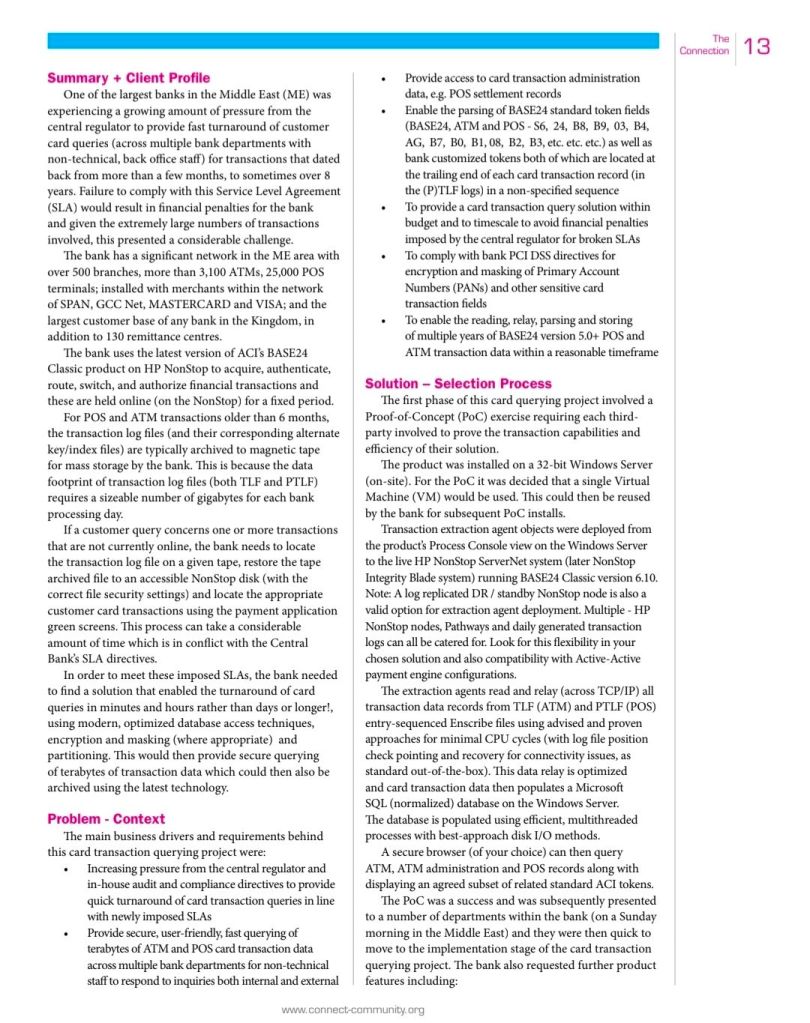
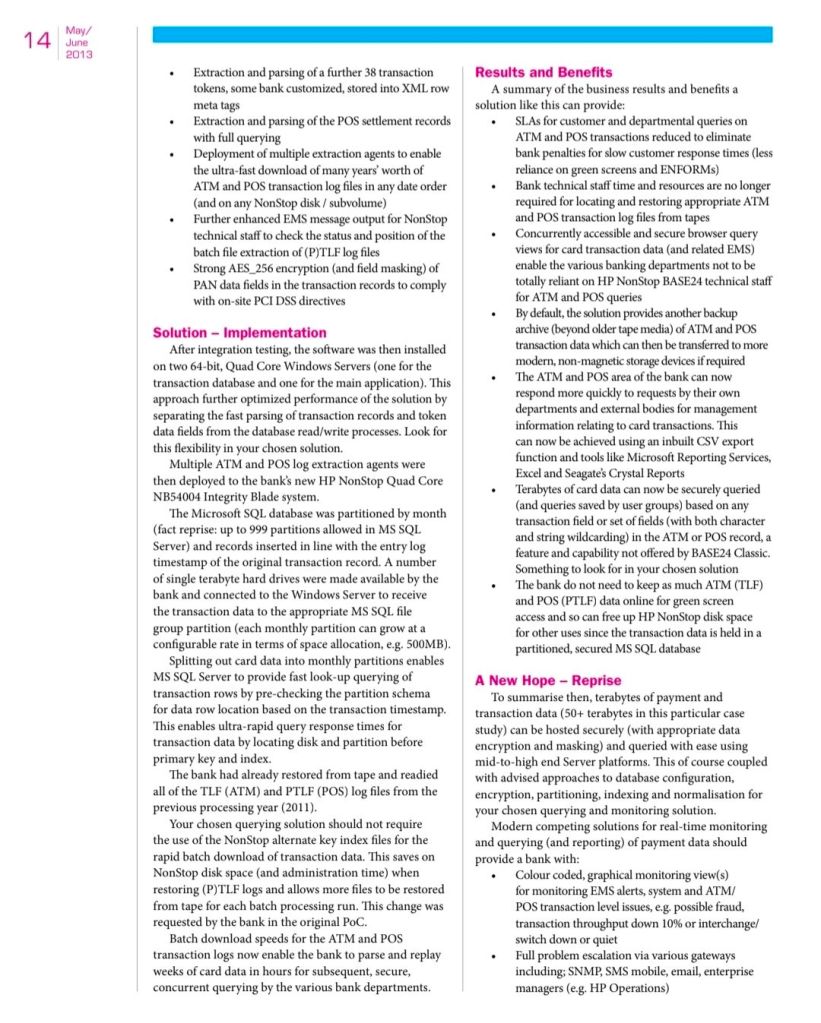
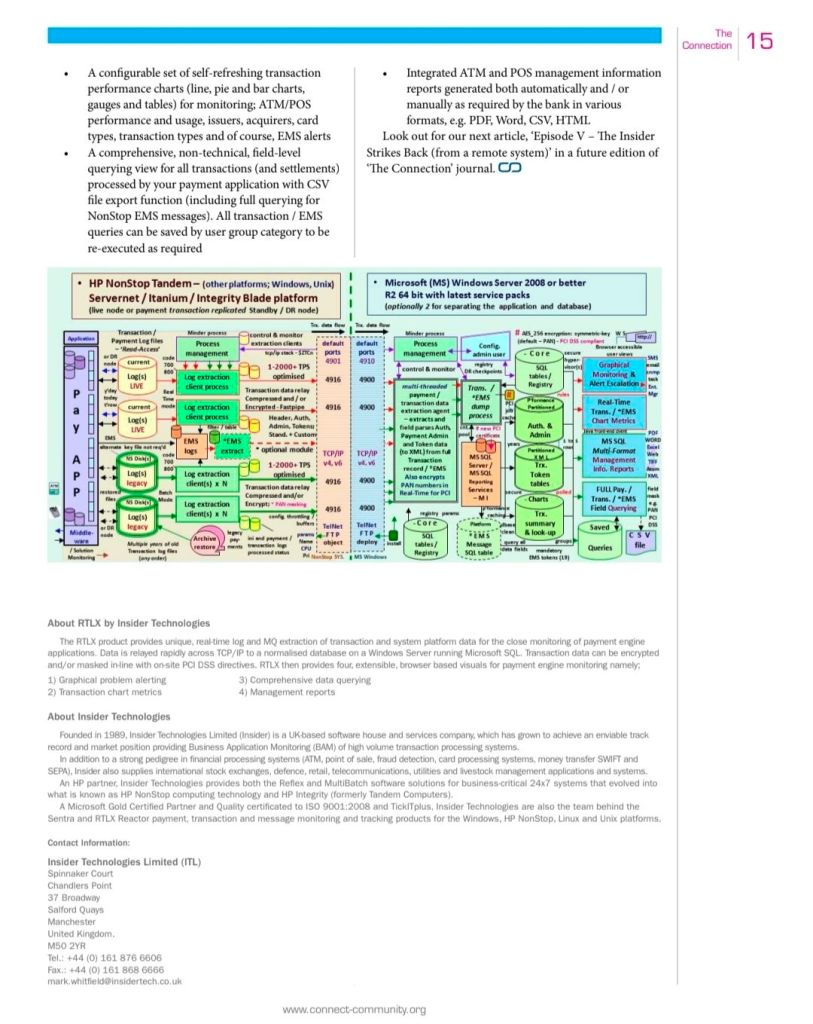
A HPE NonStop article I wrote in 2013 while I was working for Insider Technologies Limited in Salford Quays. I was working with a bank client in Saudi Arabia at the time who required a browser based solution for querying terabytes of transaction log data downloaded from a HPE NonStop mainframe. I themed the article on sci-fi movies. PDF version – page 12.
Episode IV – A New Hope (…for both Archived Legacy and Real-Time Transactions and NonStop EMS Alerts)
Mark Whitfield, Globally published HPE NonStop journal
A long time ago (well, 2010) at an EBUG conference far, far away (I guess it depends on where you’re coming from but anyway, Madrid)…
Mark Whitfield, Globally published HPE NonStop journal – ‘The Connection’, 2013
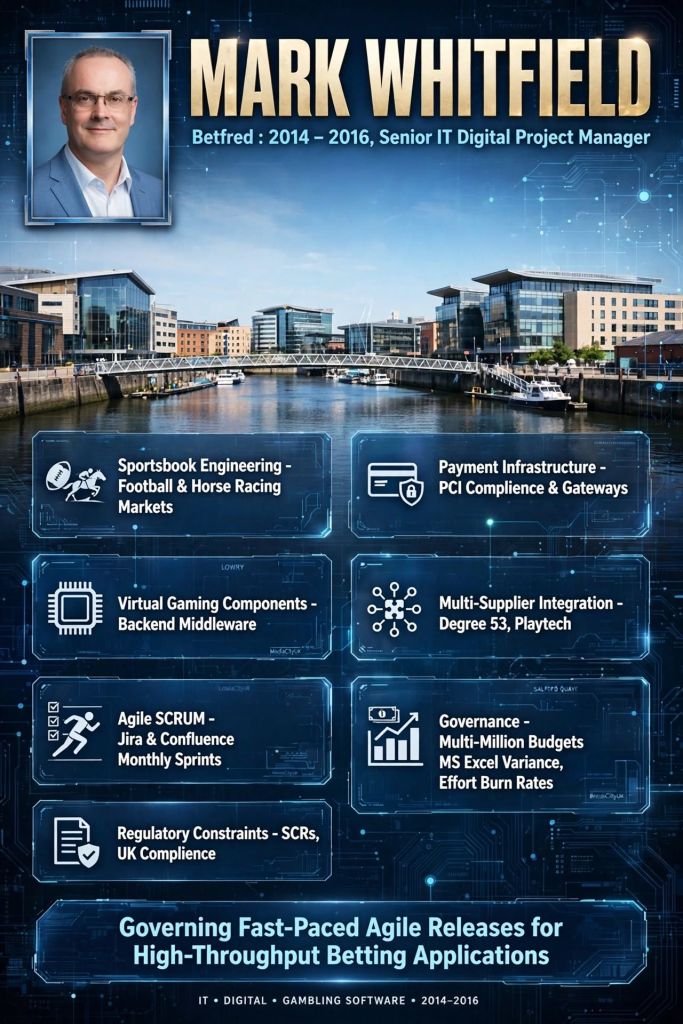
From December 2014 to January 2016, Mark Whitfield served as a Senior IT Digital Project Manager within the Online and Mobile Division at Betfred’s UK Head Office in Wigan, Lancashire. Operating in the highly competitive Gambling and Casinos industry, his role centered on governing fast-paced, end-to-end agile software releases for core, high-throughput web and mobile betting applications.
An in-depth breakdown of his technical scope, supplier ecosystem, regulatory landscape, and performance feedback illustrates his delivery footprint at Betfred.
Mark Whitfield | Betfred | Senior IT Digital Project Manager, 2014 thru 2016
Core Project Portfolios & Engineering Scope
Whitfield deployed the Agile SCRUM framework with rolling monthly sprint cycles to lead development across three foundational gaming pillars:
Sportsbook Engineering: Orchestrated core feature rollouts and update loops for high-volume football and horse racing markets.
Payment Infrastructure: Supervised the integration, expansion, and security of frontend payment methods and high-velocity transactional payment gateways.
Virtual Gaming Components: Managed the complex backend integration and middleware required to power online, computer-generated virtual casino products.
The technical environment demanded managing native software application stacks concurrently across three main consumer ecosystems: iOS, Android, and Windows Mobile.
Multi-Supplier Integration Ecosystem
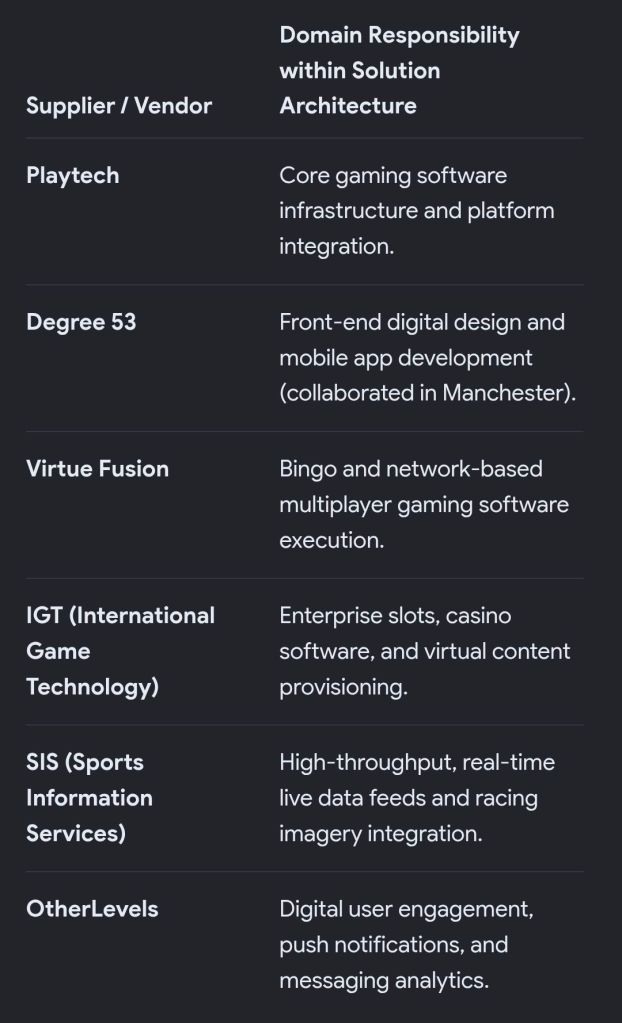
A massive portion of Whitfield’s role involved cross-functional supplier management. Because individual platform layers were built by separate third-party providers, he served as the central point of integration, managing UK- and EU-based delivery teams across several major industry suppliers:
Mark Whitfield’s role involved cross-functional supplier management
Project Governance & Financial Control
Whitfield handled multi-million rolling digital operational and R&D budgets. Rather than relying on automated corporate budgeting suites, his methodology focused heavily on granular variance tracking:
Effort Burn Rates: He took direct ownership of the weekly effort burn rates across distributed internal and external software teams, tracking exact resource consumption against forecasts via Custom MS Excel Variance Frameworks.
Delivery Infrastructure: Everyday Agile sprint workflows, backlog grooming, and cross-supplier alignment were facilitated directly through Jira and Confluence.
Regulatory Constraints & The Political Landscape
The delivery environment was heavily influenced by aggressive UK mobile entertainment deregulation and compliance updates. Whitfield was tasked with protecting Betfred’s operational licensing by responding to unexpected compliance mandates:
System Change Requests (SCRs): He structured rapid update loops to push compliance edits through production on minimal notice.
Directives Compliance: Industry auditors and compliance analysts commended his engineering oversight for maintaining strict adherence to mandatory industry directives, including rigorous PCI compliance protocols for financial processing streams.
Feedback & Professional Endorsements
Assessments from his tenure at Betfred and across his overarching tech career highlight a few recurring themes from peers, clients, and auditors:
Risk Mitigation under Pressure: Praised for his capability to handle complex “political landscapes” where changing regulatory goals frequently threatened project timelines. He successfully bridged the gap between strict compliance deadlines and flexible agile execution.
Supplier Synchronization: Commended by cross-functional teams for his ability to hold external software shops (like Degree 53 and Playtech) accountable to a unified release schedule.
Hybrid Delivery Prowess: Recognized for seamlessly blending strict financial reporting models (like PRINCE2 metrics) with fast-paced software loops (SCRUM sprints)—a structural approach he eventually popularized in the broader IT community through his Project Management Templates Gallery.
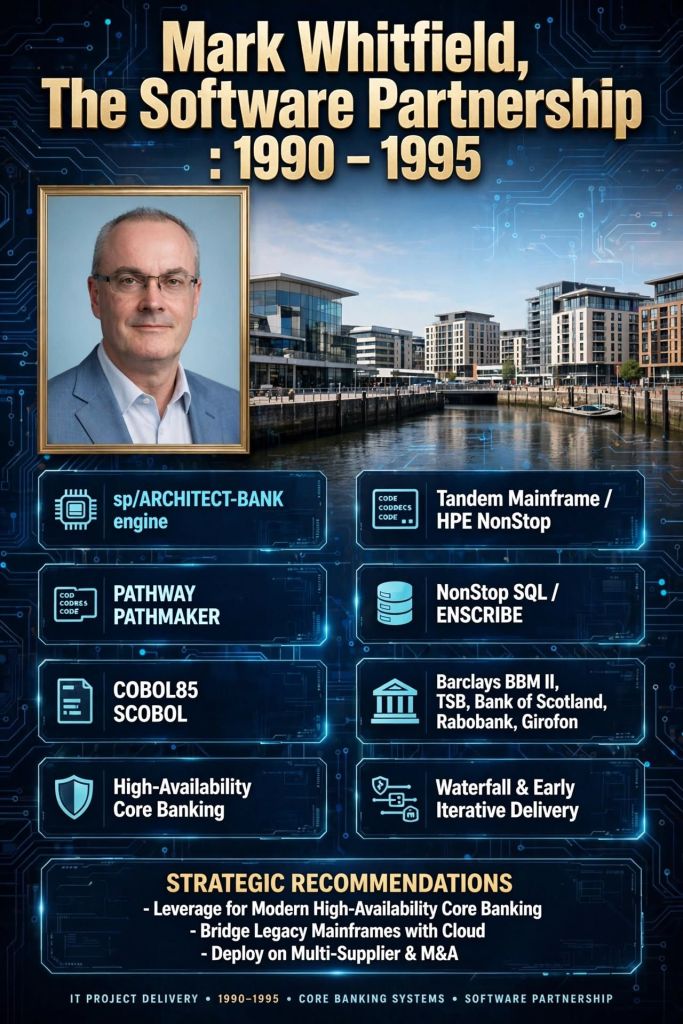
Between 1990 and 1995, Mark Whitfield operated as a Programmer and Lead Analyst at The Software Partnership (TSP) (headquartered at Norton House in Runcorn, Cheshire), a highly specialised software house that was acquired by Deluxe Data International in 1994.
Mark Whitfield – The Software Partnership, Runcorn, Cheshire
This foundational era of his career focused on the engineering, development, and delivery of cutting-edge, pre-internet corporate electronic desktop banking systems—a highly innovative concept at the time, enabling corporate clients to access account information, balance books, and perform inter-account transfers before the mainstream adoption of the World Wide Web.
🏢 Technical & Operational Industry Breakdown
1. Core Architecture & Product Focus
The technical epicenter of Whitfield’s work during this period was the sp/ARCHITECT-BANK engine. Operating as a developer and Lead Analyst, he built, refactored, and enhanced critical back-end modules for this high-availability desktop banking platform. The solution eventually evolved to lay the groundwork for what became the widely known CONNEX advantage solution.
2. The Tandem Mainframe Ecosystem
Because electronic banking demands zero downtime and maximum transaction integrity, the entire software infrastructure was built upon fault-tolerant Tandem Mainframe Computers (which later evolved into Compaq, then HP, and are now known as HPE NonStop systems). Whitfield’s day-to-day engineering focused heavily on:
High-Availability Environments: Utilizing PATHWAY and PATHMAKER runtime environments for transaction processing and load balancing.
Database & File Systems: Designing and querying databases using NonStop SQL and the native Tandem hierarchical file system ENSCRIBE.
System Programming: Writing highly efficient transaction-processing code primarily in COBOL85 and SCOBOL (Screen COBOL for terminal interactions), alongside diagnostic tools like INSPECT and the EMS (Event Management Service) subsystem.
Interactive Media: Integrating Periphonics interactive touch-tone voice response software to expand banking access via early automated telephone interfaces.
Based out of the Runcorn head office, Whitfield frequently performed on-site delivery, integration, and code customization directly at high-security client operations centres. Key financial institutions served during this 5-year tenure included:
Barclays Bank: Leading on-site delivery for the BBM II platform out of Barclays’ major operations centers in Knutsford and Poole.
Bank of Scotland: Developing bespoke desktop banking functionalities.
Rabobank (Netherlands): Extending the sp/ARCHITECT software framework to accommodate European international cross-border specifications.
Girofon (Denmark): Designing early telephone-based interactive banking capabilities.
4. Delivery Methodologies
Reflecting the software governance of the early 1990s, projects were heavily anchored in structured Waterfall lifecycles. However, working within a nimble software house like TSP also meant pioneering early iterative development practices to quickly build out custom components for various banks, blending rigid infrastructure with agile customer delivery models.
📊 Strategic Recommendations Based on This Era
Analysing this crucial early segment of Whitfield’s career yields specific recommendations for leveraging his technical foundations in contemporary, high-stakes enterprise projects:
Leverage for Modern High-Availability Core Banking: Because his technical foundations are rooted in fault-tolerant Tandem/HPE NonStop systems, he is uniquely qualified to manage risk, architecture upgrades, and modern digital transformations for core transaction engines that cannot afford even a single second of downtime.
Bridge Legacy Mainframes with Cloud Architectures: Having operated at the ground floor of pre-internet electronic banking, he should be deployed as a key translation layer or Engagement Manager when financial institutions attempt to decouple legacy COBOL/Tandem environments into modern microservices, cloud ecosystems (e.g., AWS, Azure), or API-led connectivity layers like MuleSoft.
Deploy on Multi-Supplier & M&A Environments: The transition of TSP through its acquisition by Deluxe Data in 1994 provides an early template of navigating organizational shift, platform re-branding, and cultural migration. This experience makes him an ideal lead for highly complex, multi-supplier governance structures within retail banking integrations.
Mark Whitfield is an SC-cleared Senior IT Project and Engagement Manager whose professional trajectory spans over three decades (1990–present).
His foundational career is deeply rooted in the architecture of fault-tolerant HPE NonStop (formerly Tandem Computers) NonStop Kernel (NSK) systems, progressing from deep low-level code engineering to high-stakes enterprise project delivery, payment engine monitoring, and digital transformations.
Mark Whitfield | HPE NonStop Tandem | Experience since 1990
Below is an in-depth analysis and comprehensive chronological summary of Mark Whitfield’s HPE NonStop and Tandem experience.
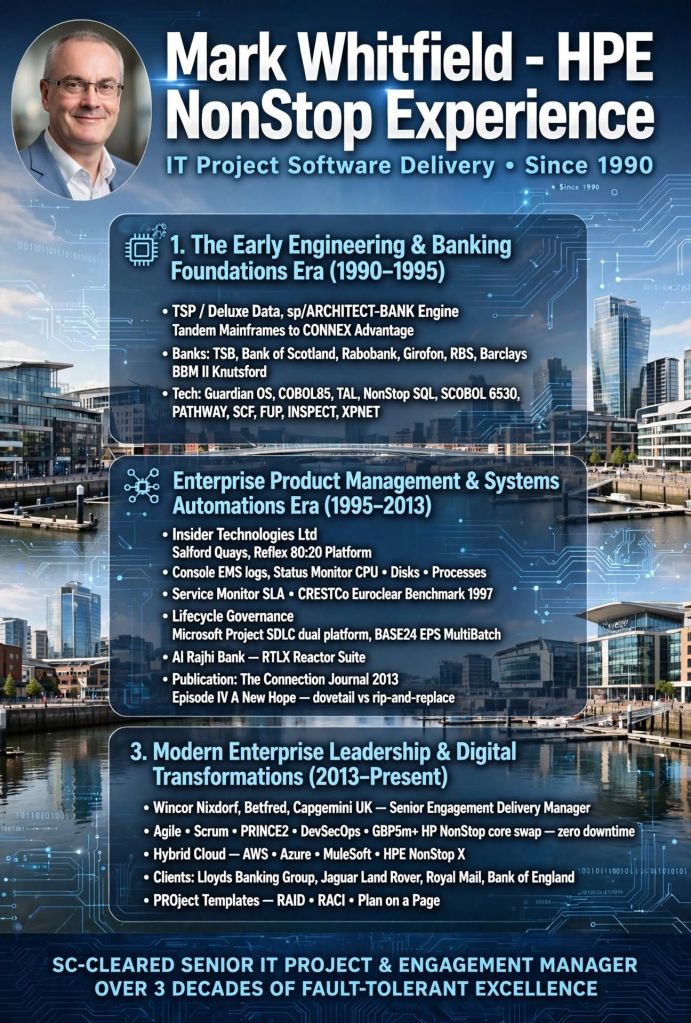
💼 1. The Early Engineering & Banking Foundations Era (1990–1995)
Company / Context: The Software Partnership (TSP), which was acquired by Deluxe Data International in 1994 (subsequently becoming part of eFunds/FIS).
Core Focus: Deep software engineering for electronic corporate desktop banking platforms prior to mainstream internet adoption.
Technical Scope & Deliverables
sp/ARCHITECT-BANK Engine: Whitfield operated as a Programmer and Lead Analyst, developing and enhancing core modules for this early innovative desktop banking system built specifically for Tandem Mainframes. This system eventually evolved into the globally utilized CONNEX Advantage platform.
Blue-Chip Bank Implementations: Wrote, optimized, and maintained mission-critical transaction code for major banking institutions including TSB, Bank of Scotland, Rabobank (Utrecht), Girofon (Denmark), and Royal Bank of Scotland (RBS).
Barclays On-Site Delivery: Handled direct, client-facing configuration and code delivery deployed on-site at the Barclays facility in Knutsford, Cheshire, working with the Barclays Business Master II (BBM II) system.
Tandem / NSK Subsystems & Toolset
Developed architectural code natively inside the fault-tolerant Tandem Guardian OS environment.
Programmed extensively using COBOL85, TAL (Tandem Application Language), NonStop SQL, and Screen COBOL (SCOBOL) for character-cell block-mode 6530 terminal environments.
Utilized vital platform management utilities including PATHWAY (middleware for online transaction processing), SCF (System Configuration Framework), FUP (File Utility Program), INSPECT (debugging tool), and XPNET (networking protocols).
🚀 2. Enterprise Product Management & Systems Automation Era (1995–2013)
Company / Context: Insider Technologies Limited (ITL), based in Salford Quays, Manchester.
Core Focus: Escalating from Senior Programmer to Lead Designer and ultimately IT Product / Project Manager managing the complete Software Development Lifecycle (SDLC) for critical infrastructure management platforms.
The Reflex Platform (Reflex 80:20): Co-developed high-availability diagnostic plugin modules to monitor platform health on HPE NonStop systems.
‘Console’ Module: Engineered for viewing and filtering real-time NonStop EMS (Event Management Service) logs.
‘Status Monitor’ Module: Designed to monitor system critical hardware and software layers (CPU, Disks, Processes, Files, WebSphere MQ, XPNET, and TCP/IP).
‘Service Monitor’ Module: Built complex, rule-based, multi-line analysis to evaluate combined system component health and report general service SLA metrics.
CRESTCo (Euroclear) Benchmark Consultant (1997): Handled an explicit placement at CRESTCo in London to write specialized volume-testing, throughput, and performance benchmarking software within their production-scale NonStop cluster.
Lifecycle Governance: Officially transitioned into full-cycle project management, tracking release schedules, multi-threaded sprints, and financial capital expenditure via Microsoft Project. Managed portfolios covering dual-platform applications (HPE NonStop backend systems intertwined with Microsoft Windows user-facing layers).
High-Value Integrations: Directed payment engine configurations, middleware components, and real-time electronic transaction interfaces for massive financial networks running BASE24, EPS, and MultiBatch environments.
Al Rajhi Bank (Saudi Arabia) Implementation: Successfully drove the execution and global deployment of the RTLX Reactor Suite at Al Rajhi Bank, bridging legacy fault-tolerant environments with modern analytical databases.
Global Thought Leadership (2013)
The Connection Journal Publication: Authored a major architectural white paper in The Connection, the world’s leading professional journal for HPE NonStop systems, entitled “Episode IV – A New Hope (…for both Archived Legacy and Real-Time Transactions and NonStop EMS Alerts)”.
Core Concept (Application Modernization): Provided a tactical logical data warehousing blueprint outlining how banks could “dovetail” rather than completely “rip-and-replace” multi-million pound NonStop structures by streaming real-time transaction log monitoring directly into modern, open Big Data systems.
🛡️ 3. Modern Enterprise Leadership & Digital Transformations (2013–Present)
Company / Context: Wincor Nixdorf (2013–2014), Betfred (2014–2016), and Capgemini UK (2016–Present) acting as Senior Engagement and Delivery Manager.
Core Focus: Unifying foundational high-availability Tandem mainframe knowledge with modern enterprise delivery frameworks (Agile, Scrum, PRINCE2, and DevSecOps).
Project & Program Achievements
Retail Banking Core Swap: Commanded a £5m+ HP NonStop core swap and log monitoring overhaul for premier retail banking giants, ensuring zero downtime migrations across system components.
Hybrid Cloud & API Bridges: Successfully spearheaded secure hybrid cloud infrastructure programs, connecting legacy on-premise hardware networks like HPE NonStop X frameworks directly into modern cloud fabrics (AWS, Azure, and MuleSoft API-led layers).
Cross-Sector Governance: Successfully applied high-availability service assurance across major blue-chip operations and critical state institutions including Lloyds Banking Group, Jaguar Land Rover (JLR), Royal Mail Group, and the Bank of England.
💡 Proactive Delivery Reference
Mark Whitfield continues to package his comprehensive knowledge across classical Waterfall, hybrid governance, and modern Agile deployments into PROject Templates, a curated repository featuring hundreds of customisable delivery tools (RAID logs, RACI matrixes, Plan on a Page maps, and financial tracking sheets) built to streamline delivery environments.
The professional performance and stakeholder feedback received by Senior IT Project Manager and Engagement Manager Mark Whitfield throughout his career (specifically documented across his tenure at Capgemini and various client engagements) is exceptionally positive.
Mark Whitfield | Client and Team | Project Feedback
His feedback has been categorized below into the primary areas of leadership, management, and technical delivery:
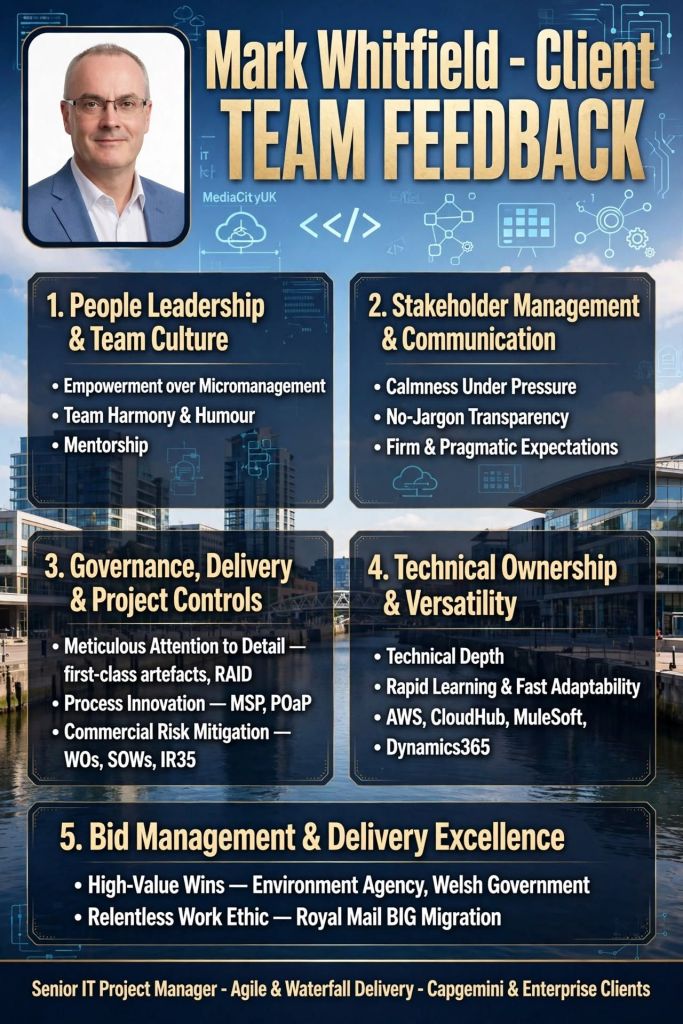
👥 People Leadership & Team Culture
Empowerment over Micromanagement: Multiple team members and consultants highlighted that Mark empowers individuals to take on responsibility, giving them the freedom to execute tasks without feeling pushy or micromanaged.
Team Harmony & Humour: Feedback from lead functional consultants explicitly credited Mark with building outstanding, cohesive remote team cultures. He balances high professionalism with a fantastic sense of humour and humility, making heavy workloads feel manageable and enjoyable.
Mentorship: Described by colleagues as a “tailored enabler” who caters to his team’s professional comfort to yield peak results, he has been thanked directly for creating learning opportunities in modern frameworks like the Power Platform and Azure cloud migration.
👔 Stakeholder Management & Communication
Calmness Under Pressure: Clients and Account Delivery Managers frequently commend Mark for his “voice of reason” demeanor. He maintains remarkable levels of calmness and rational thinking during complex project challenges, shifting timelines, and fluid client environments.
No-Jargon Transparency: He is highly respected for his “say it as it is” and “no-ego” client engagement style. He translates deeply complex technical aspects into clear, pragmatic delivery timelines, putting stakeholders at ease and building instant trust.
Firm & Pragmatic Expectations: While accommodating to customer needs, feedback indicates he is unafraid to push back firmly when faced with unreasonable client expectations or scope creep.
⚙️ Governance, Delivery & Project Controls
Meticulous Attention to Detail: Senior Program Managers have labeled Mark’s project artefacts, financial logs, and reporting structures as “first-class” and “exemplar”. He sticks rigorously to reporting cadences and ensures RAID (Risks, Issues, Assumptions, Dependencies) logs are meticulously maintained.
Process Innovation: Mark frequently goes beyond baseline requirements to improve delivery templates. For example, he spent considerable effort mapping complex “strawman” spreadsheets into robust Microsoft Project (MSP) plans and creating standard Plan on a Page (POaP) layouts utilized across wider programs.
Commercial Risk Mitigation: He works tightly with legal and account leadership to gain fast approvals on Work Orders (WOs) and Statements of Work (SOWs), effectively managing complex multi-million pound account financials and navigating corporate hurdles (such as IR35 legislation compliance).
💻 Technical Ownership & Versatility
Technical Depth: Uniquely for a project manager, technical architects have praised Mark for taking structural ownership of solutions. He acquires a deep enough technical understanding of complex architectures to “hold his own” on technical calls.
Rapid Learning & Fast Adaptability: Throughout his diverse contract assignments, Mark has consistently demonstrated an ability to quickly pick up new technologies (such as AWS, CloudHub, MuleSoft OBD, and Dynamics365) and unfamiliar client governance protocols with minimal to zero handover.
🏆 Bid Management & Delivery Excellence
High-Value Wins: Bid Directors have noted his exceptional proficiency in creating high-quality estimation models and plans under strict, stressful timelines, resulting in critical project extensions and massive programme wins (such as the Environment Agency estate migration and the Welsh Government Childcare bid).
Relentless Work Ethic: During high-impact cut-over periods (like the massive Royal Mail BIG Interface Migration), senior leadership highly commended Mark for his massive personal sacrifice, working long hours and overnights to deliver project milestones ahead of peak corporate change freezes.
Senior IT Project Manager Mark Whitfield possesses over 35 years of specialized expertise in the software development lifecycle, heavily rooted in Tandem / HPE NonStop fault-tolerant mainframe environments.
Mark Whitfield | Tandem HPE NonStop NSK | Career Experience since 1990
After graduating with distinction in Computing in 1990, his career evolved from writing low-level architectural code for electronic banking platforms into steering multi-million-pound high-availability enterprise migrations.
1. Hands-On Engineering Era (1990–1995)
Upon entering the tech industry in 1990, Whitfield was recruited as a programmer at The Software Partnership (acquired by Deluxe Data International in 1994) in Runcorn, Cheshire.
The Mission: Developing and maintaining the sp/ARCHITECT-BANK platform, a pioneering electronic desktop banking system deployed for Tier-1 institutions like TSB, Bank of Scotland, Rabobank, and Girofon (Denmark). This allowed corporate clients desktop access to their accounts—a cutting-edge milestone in the pre-internet era.
Core Technical Stack: Built deep core systems using TAL (Tandem Application Language), COBOL85, NonStop C/C++, and NonStop SQL. He mastered low-level Tandem system management utilities including PATHWAY, SCF, FUP, INSPECT, and XPNET.
2. Product Development & Middleware Innovation (1995–2013)
Whitfield transitioned to Insider Technologies Limited (ITL) at Salford Quays, Manchester, embarking on an 18-year tenure as a Senior Programmer and eventual Product/Project Manager.
The “Reflex” Monitoring Suite: He co-developed core platform health, automated diagnostic, and real-time transaction log extraction modules. This software provided critical SLA tracking for ATM and POS pipelines across massive networks, directly integrating with industry-standard ACI Worldwide BASE24 Classic and BASE24-eps architectures.
CRESTCo Benchmarking (1997): Deployed as a technical consultant on-site at CRESTCo (now Euroclear) in London, he authored custom stress-testing and performance benchmarking software to evaluate settlement performance on newly rolled-out S7000 HPE NonStop hardware.
3. Thought Leadership & Commentary (2013–Present)
As a Principal Consultant, Whitfield’s deep technical domain knowledge translated into published expert commentary on system modernization.
The Connection Journal Feature (2013): Whitfield authored a major feature in The Connection, the globally recognized journal for HPE NonStop systems. Entitled “Episode IV – A New Hope (…for both Archived Legacy and Real-Time Transactions and NonStop EMS Alerts)”, the paper served as a deep architectural breakdown.
Core Thesis: Whitfield advocated for “dove-tailing” rather than “ripping and replacing” legacy mainframe infrastructure. He demonstrated how to harness Big Data and modern analytics by bridging fault-tolerant Guardian environments with open-system frameworks using real-time transaction log monitoring—specifically outlining the successful implementation of the RTLX Reactor Suite at Al Rajhi Bank in Saudi Arabia.
4. Modern Enterprise Leadership
Since 2016, working as an Engagement and Delivery Manager for Capgemini, Whitfield has successfully merged his foundational high-availability knowledge with modern governance. His portfolio includes orchestrating a £5m+ HP NonStop core swap and log monitoring overhaul for retail banking giants alongside secure cloud transformations (AWS, Azure, and MuleSoft integrations).
To support the wider IT delivery community, he also curates a repository of professional resources via his site, PROject Templates.
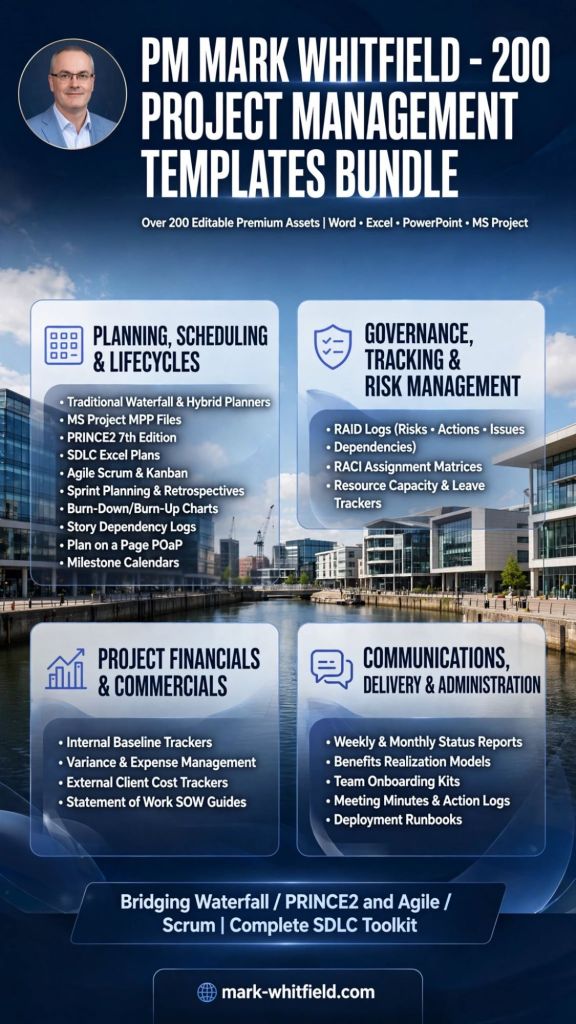
Mark Whitfield’s comprehensive Project Management Template Bundlecontains over 200 editable premium assets. These templates are designed to serve both traditional structured governance and modern frameworks, bridging the gap between Waterfall/PRINCE2 and Agile/Scrum execution.
Mark Whitfield | Free Upgrades | 200+ Project Management Templates
Available natively in Microsoft Word, Excel, PowerPoint, and MS Project (MPP) formats, they are built to support the entire software development lifecycle (SDLC) and general program delivery.
Below is an in-depth breakdown of the project management templates categorized by their primary operational focus, including links to relevant toolkits and deep-dives from the Mark Whitfield Project Management Portal:
📅 Planning, Scheduling & Lifecycles
These templates provide the core baseline for defining, pacing, and communicating project tasks across different methodologies.
Traditional Waterfall & Hybrid Planners
Microsoft Project Plan (MSP MPP) Files: Ready-made master schedules configured for structured delivery phases and software development lifecycles. Accessible via the MS Project Template Portal.
PRINCE2 7th Edition Schedules: Tailored governance templates adhering to the updated PRINCE2 framework principles.
Detailed SDLC Excel Project Plans: Complete alternative task trackers structured for teams operating without standard Microsoft Project desktop licenses. Available on the Excel and PowerPoint Plans Page.
Agile, Scrum & Kanban Execution
Sprint Planning & Retrospective Kits: Organized task blocks for managing daily stand-ups, backlog grooming, and sprint delivery cadences.
Agile Burn-Down & Burn-Up Charts: Dynamic visual tools to track team velocity and remaining sprint effort over active delivery blocks.
Story Dependency Logs: Dedicated cross-team alignment matrices specifically mapping blockers between product backlog items.
High-Level Stakeholder Communication
Plan on a Page (POaP) Viewports: Executive-level visual dashboards built natively in Excel and PowerPoint to summarize timelines for steering committees. Details can be reviewed on the Project Planning Examples Page.
Milestone Calendars: Simplified cloud-migration or deployment timeline graphics designed for quick C-suite alignment.
📊 Governance, Tracking & Risk Management
These documents enforce quality assurance, track real-time deviations, and maintain compliance throughout the project lifecycle.
RAID & Control Tracking
Comprehensive RAID Logs: Multi-tab Excel registers covering Risks, Actions, Issues, Opportunities, Lessons Learned, and Dependencies with built-in analytical charts. Complete operational toolsets are hosted on the PMO Toolkit Hub.
Basic RAID Frameworks: Lightweight, trimmed tracking variations engineered primarily for simpler project bids or rapid discovery blocks.
Resource and Accountability Management
RACI Assignment Matrices: Cross-functional grids to clearly assign and establish who is Responsible, Accountable, Consulted, and Informed across tasks.
Resource Capacity & Leave Trackers: Integrated team scheduling sheets managing calendar availability, annual leave allocations, and project burn rates.
💰 Project Financials & Commercials
A suite of detailed financial workbooks designed to align internal cost tracking against customer-facing baselines.
Cost & Baseline Engineering
Internal Baseline Trackers: Comprehensive “Company View” sheets detailing internal resourcing costs, forecast models, and gross margin goals. See structural breakdown details at the Template Folder Directory.
Variance & Expense Management: Formula-driven financial views tracking actual expenditures against forecasted baselines to flag overruns.
Vendor & Client Commercial Alignment
External Client Cost Trackers: Simplified, external-facing cost summary dashboards ready to share directly for regular client financial reviews.
Statement of Work (SOW) Guides: Document generation kits establishing delivery scope, contractual guidelines, and specific supplier rules.
📢 Communications, Delivery & Administration
Templates engineered to optimize day-to-day team functions, report project status, and handle operational management.
Status Reporting & Visibility
Weekly & Monthly Status Reports: Pre-built executive slide decks and text templates tailored to provide uniform delivery updates. These can be downloaded from the Professional Templates Page.
Benefits Realization Models: Analytical mapping systems designed to log, monitor, and formally verify the commercial value or ROI yielded by individual deliverables.
Onboarding & Daily Mechanics
Team Onboarding Kits: Structured resource folders containing organizational charts, contact lists, and system access paths for incoming team members.