Mark Whitfield, Biography overview

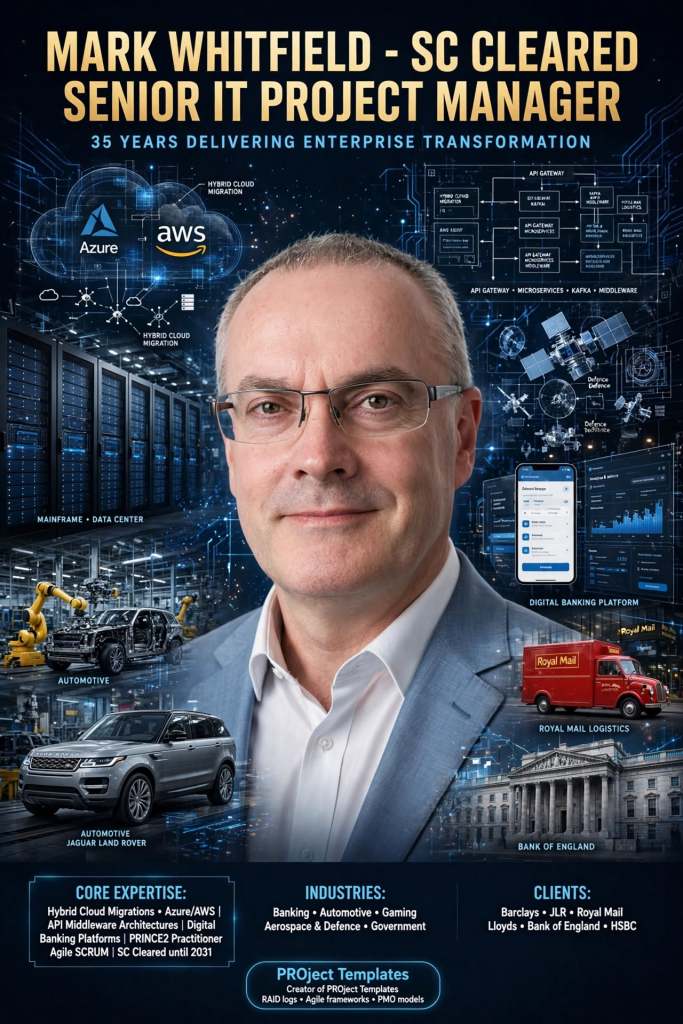
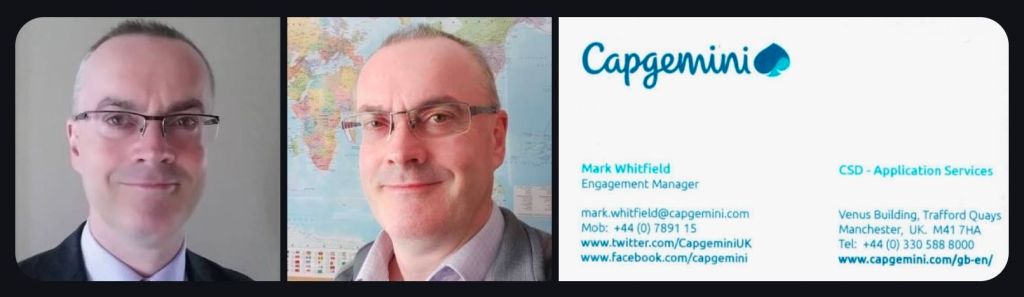
Mark Whitfield is a prominent UK-based, SC-cleared Senior IT Project Manager, Engagement Manager, and technology executive with over 35 years of experience spanning the entire Software Development Lifecycle (SDLC). He specialises in complex digital transformations, hybrid cloud migrations, and API-led system integrations.

Throughout his career, he has successfully delivered enterprise-scale solutions for massive blue-chip clients, including Barclays Bank, Jaguar Land Rover (JLR), Royal Mail Group (RMG), Lloyds Banking Group, and the Bank of England.

Executive Overview:

  • Core Expertise: Hybrid Cloud Migrations (Azure, AWS), API middleware architectures, and digital banking platforms.
  • Methodologies: Certified PRINCE2 Practitioner and Agile SCRUM delivery lead.
  • Security Clearance: Active UK Security Check (SC until 2031) clearance for public and defense-sector projects.
  • Industry Portfolio: Banking, Automotive, Gambling/Casinos, Aerospace & Defence, and Regional Government.

Professional Timeline & Milestones:

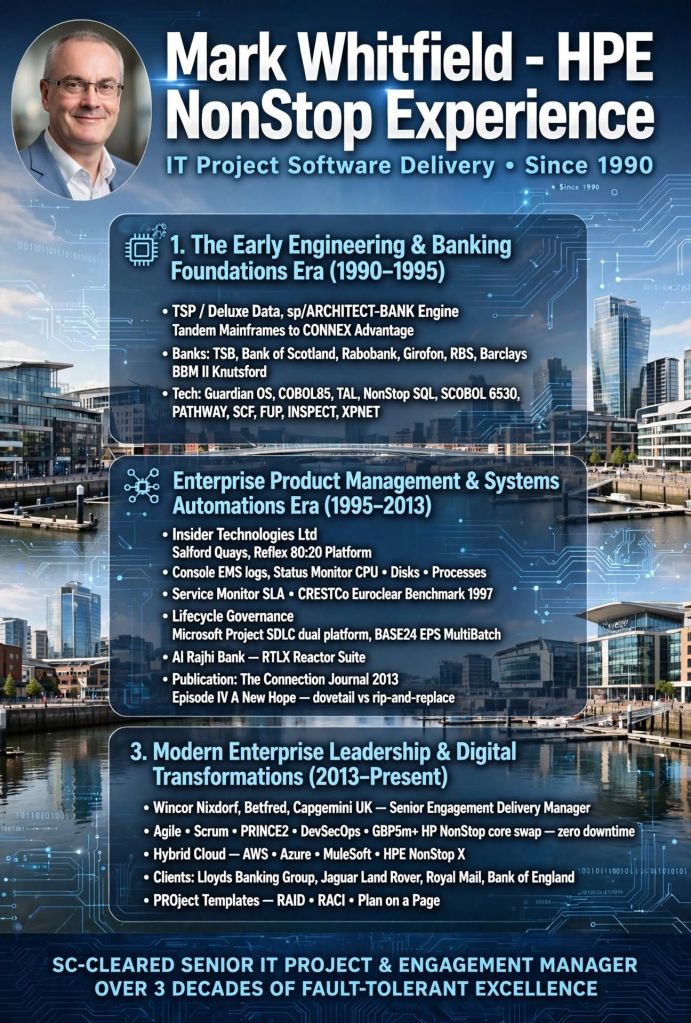
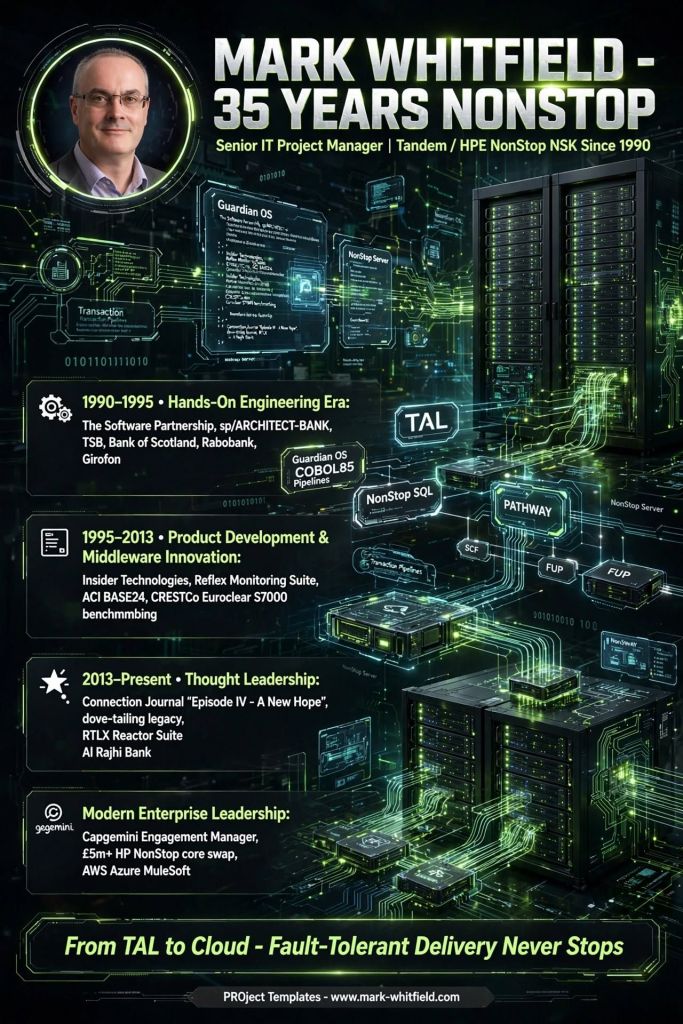
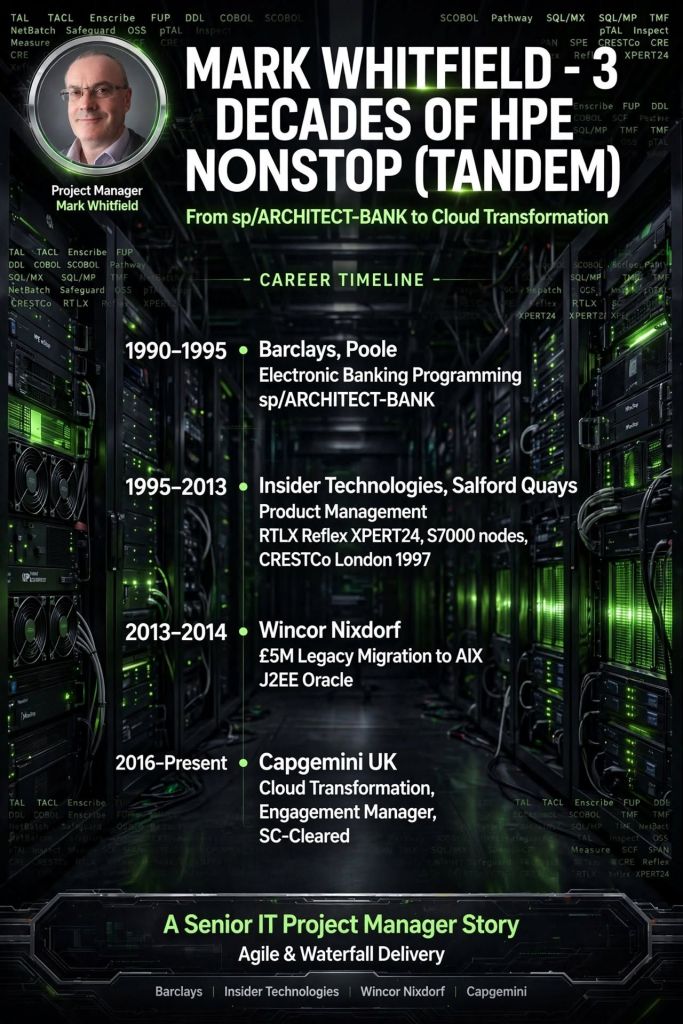
  • 1990–1995 (Early Engineering): Began his career immediately after graduating in Computing. He worked as a core programmer at The Software Partnership, building cutting-edge electronic banking software (sp/ARCHITECT-BANK) on legacy Tandem Mainframes (now HPE NonStop).
  • 1995–2013 (Insider Technologies Limited): Spent 18 years escalating from a Senior Programmer into a strategic project manager in Salford Quays, UK. He spearheaded high-volume mainframe transaction monitoring systems and ATM software delivery for major global banking institutions like HSBC and Al Rajhi Bank.
  • 2013–2016 (Retail & Gaming Delivery): Transitioned to Wincor Nixdorf as an Agile IT PM managing ATM software pipelines, followed by a Senior PM role at Betfred, delivering complex mobile sportsbook and online payment gateways.
  • 2016–Present (Enterprise Leadership): Joined Capgemini as a client-facing Engagement Project Manager. He later augmented into MuleSoft (a Salesforce company) as a Delivery Manager for the Anypoint Platform, directing massive cloud infrastructure overhauls.

Thought Leadership & Knowledge Sharing

Beyond active corporate execution, he is the creator of PROject Templates, an open professional repository where he publishes free upgrade enterprise project tracking models, RAID logs, and Agile planning frameworks used extensively by modern PMOs.

European BASE24 User Group (EBUG) Timeline from Inception

The European BASE24 User Group (EBUG) was established in the 1980s as an independent, community-led organization for users of the BASE24 payment processing system developed by Applied Communications, Inc. (now ACI Worldwide).

Originally a regional forum for IT professionals in Europe to discuss HPE NonStop (Tandem) transaction monitoring and network security, the group expanded globally over time.

European BASE24 User Group (EBUG) was a prominent, community-led organization
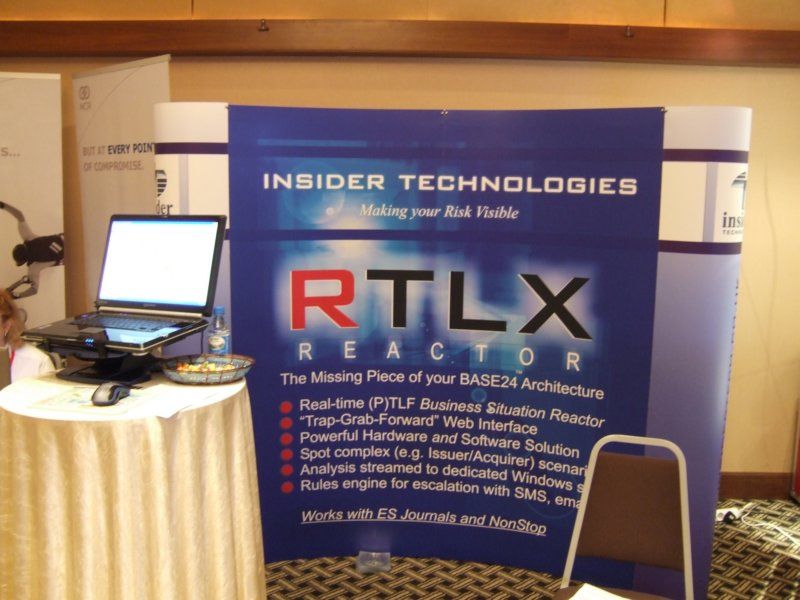
Insider Technologies regularly
attended EBUG, booth in 2007 –
RTLX now ETI-NET C-Deep

Following ACI’s withdrawal of direct corporate backing, EBUG evolved into “The Independent Group for All Payments System Users”—affectionately known as the Everybody Belongs User’s Group—welcoming users of multiple payment platforms like Postilion.

The detailed historical timeline of EBUG and the evolution of its core system, BASE24, outlines its development from a regional user collective to a global payments forum:

The Foundation Era (1975–1989)

  • 1975: ACI is founded in Omaha, Nebraska, initially developing software for fault-tolerant Tandem NonStop computers to connect ATMs to bank networks.
  • 1982: The BASE24 product family is officially launched globally, acting as “baseline” software for 24-hour financial operations.
  • 1980s: EBUG is established as a regional European community for BASE24 users to collaborate on ATM networking and transaction processing.
  • 1986: ACI expands BASE24’s reach, reporting 131 customers across 14 countries.

EBUG Prestige & BASE24 Transformation (1990–2009)

  • 1995: ACI goes public, trading on the Nasdaq stock exchange.
  • Early 2000s: EBUG annual conferences grow in prestige, featuring technical tracks on BASE24 transaction logging, Point-of-Sale (POS) networks, and network resilience.
  • 2007: EBUG hosts a high-profile international conference in Istanbul, Turkey.
  • 2008: EBUG hosts its annual meeting in Vienna, Austria, which is historically noted as a pivotal year where ACI began supporting immediate payments in Europe and discussed a strategic shift toward IBM platforms. ACI officially announces the future retirement of “BASE24 Classic”.
  • 2009: The conference is held in Prague, Czech Republic, maintaining strong community support for BASE24 on Tandem servers despite broader industry shifts.

Global Expansion, Rebranding & The Cloud Era (2010–Present)

  • 2012: ACI introduces BASE24-eps, their next-generation, platform-independent payments engine designed to replace the legacy BASE24 on HPE NonStop. EBUG’s technical focus shifts to real-time payments and log extraction.
  • 2013: With ACI ending direct involvement, the user group officially rebrands as the “Everybody Belongs User’s Group” at their conference in London, expanding attendance to professionals from Mexico, South Africa, and Australia.
  • 2015: ACI celebrates 40 years in payments. EBUG solidifies its status as a supplier-agnostic payments forum, opening sessions to non-BASE24 users.
  • 2020s: With BASE24 Classic retired, legacy users migrate to modern systems like BASE24-eps for cloud deployments and immediate payments.
  • Recent Years: ACI goes live as a pioneer in the Federal Reserve’s FedNow Service, building upon the decades-long transaction switching architecture first developed in the 1970s and 1980s.

European BASE24 User Group (EBUG) Timeline from Inception

Mark Whitfield HPE NonStop Tandem Experience over three decades

Mark Whitfield is a Senior IT Project Manager with over three decades of experience, heavily rooted in HPE NonStop (formerly Tandem).

His career has transitioned from hands-on NonStop development and product management into large enterprise cloud and digital transformation projects.

His NonStop specific projects and career trajectory can be broken down (at a high-level) by era, location, and focus as follows:

1990–1995: Early Programming

  • Location: Barclays, Poole, Dorset, UK
  • Focus: Electronic banking programming and development on Tandem Mainframe Computers.
  • Projects: Wrote, developed, and maintained software like sp/ARCHITECT-BANK and associated billing software (in Poole, 1993). This involved building early electronic banking systems for desktops long before internet banking was prevalent.
1993, Barclays, Poole, Dorset, UK

1995–2013: Senior Development & Product Management

  • Location: Insider Technologies, Salford Quays, Manchester, UK
  • Focus: NonStop product management, software design, and real-time event monitoring.
  • Projects: Product managed software lifecycles for four monitoring products (two NonStop based). This included creating health and diagnostic tools (RTLX, Reflex 80:20, Reflex ONE24, XPERT24) for mission-critical NonStop environments. He also deployed volume testing on early HP NonStop S7000 nodes for CRESTCo in London in 1997.
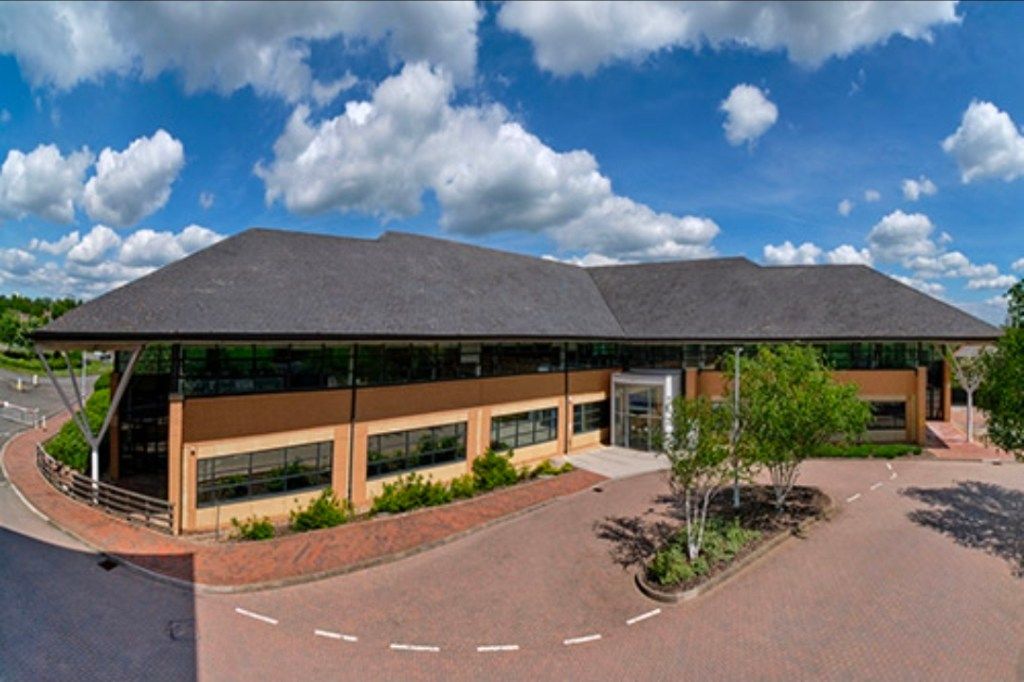
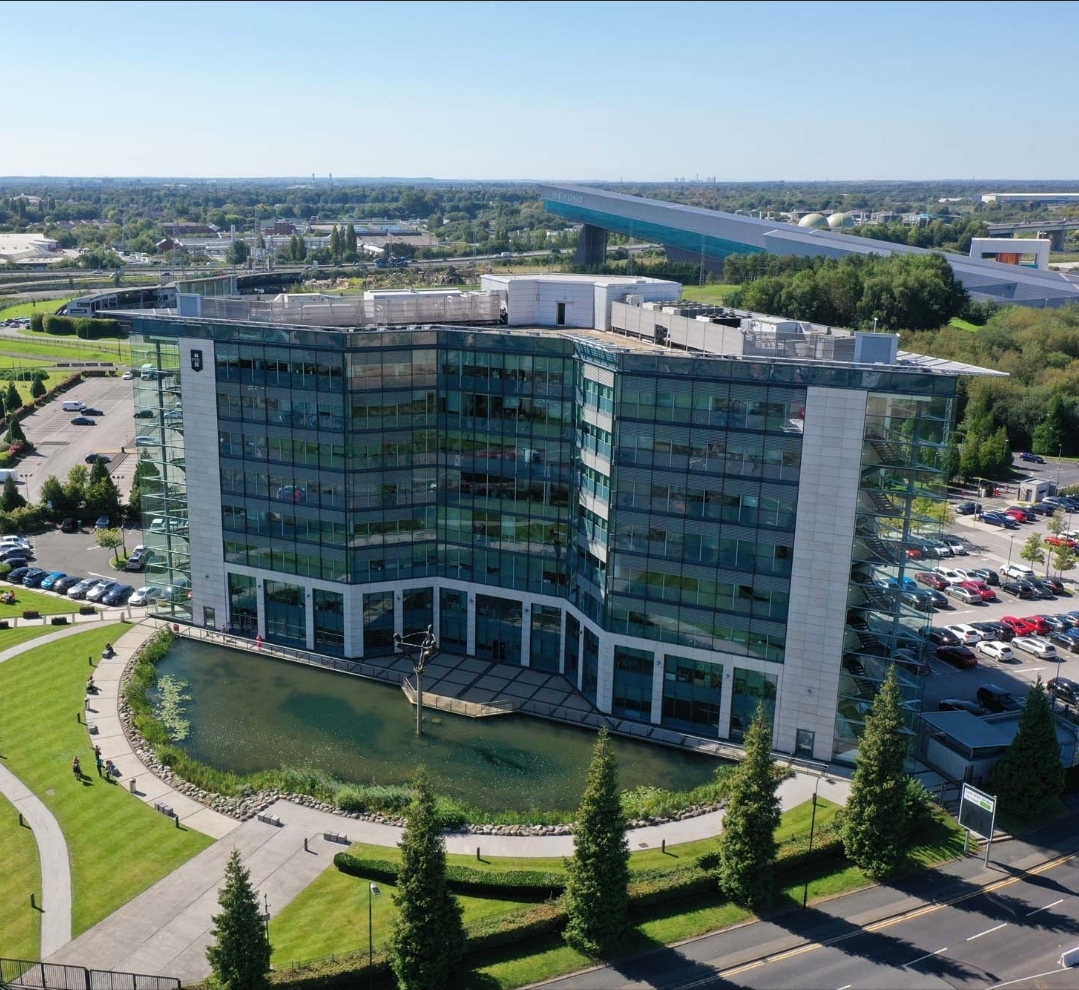
Spinnaker Court, Chandlers Point, Insider Technologies, Salford Quays, Manchester, UK
Insider Technologies, Salford Quays, Manchester, UK

2013–2014: Legacy Migration & Consulting

  • Location: Wincor Nixdorf & ATM/POS Financial Services, UK
  • Focus: Modernization and migration of legacy systems.
  • Projects: Managed a £5M+ replacement of legacy HP NonStop software systems at a large UK retail bank, migrating functionalities to AIX-based J2EE and Oracle architectures.
Diebold Nixdorf Ltd, Cain Rd, Binfield, Bracknell, RG12 1WP
Diebold Nixdorf Ltd, Cain Rd,
Binfield, Bracknell, RG12 1WP

2016–Present: Cloud Transformation & Digital Delivery

  • Location: Capgemini UK, Trafford Quays / UK-Wide
  • Focus: Delivery of enterprise-scale middleware, digital transformation, and cloud.
  • Projects: Acts as an Engagement Manager and SC-Cleared Project Manager. Focus includes Agile software delivery for Air Traffic organisations (e.g., iOS applications for military and public-facing airspace tracking) and rolling out middleware solutions.
Capgemini UK, Floor 7, Venus Building, Trafford Quays, Manchester. M41 7HA
Capgemini UK, Floor 7,
Venus Building, Trafford Quays
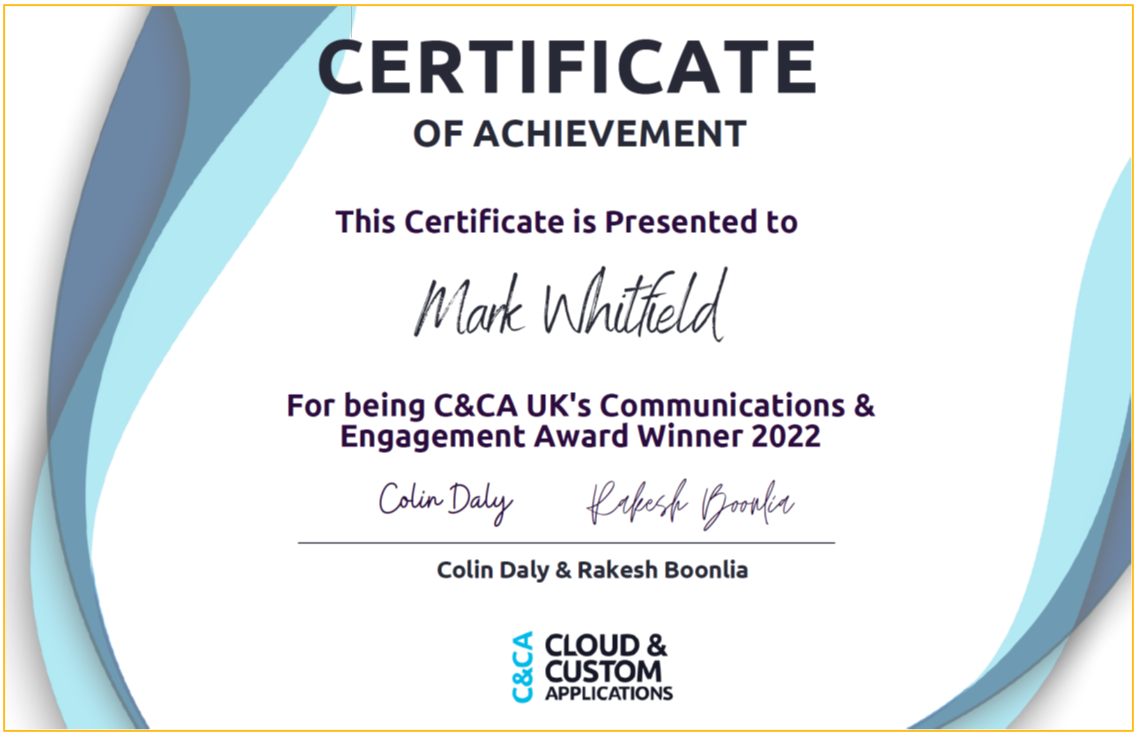
C&CA UK's Communications & Engagement Award Winner 2022 - Cloud & Custom Applications - Capgemini UK
C&CA UK’s Communications & Engagement Award Winner 2022 – Cloud & Custom Applications – Capgemini UK

For more career detail, click here.

HPE NonStop Tandem Architecture Walkthrough

The HPE NonStop architecture (originally engineered by Tandem Computers in 1976) is a specialized, 100% fault-tolerant computing platform designed to achieve continuous application availability and absolute data integrity. Unlike traditional mainframes or high-availability clusters that rely on rapid rebooting or switching resources upon a crash, NonStop prevents downtime entirely by masking failures through a hardware-software co-designed shared-nothing architecture.


1. Hardware Architecture: Massively Parallel & Shared-Nothing

At the physical tier, a NonStop system is built as a Loosely Coupled Multiprocessing (LCM) environment.

  • Independent Processor Modules: A single system consists of 2 to 16 independent CPUs (expandable via clustering up to 4,000+ CPUs). Each processor module contains its own dedicated Intel Xeon cores, memory, and I/O logic. Processors share no main memory, buses, or execution states. This isolation guarantees that a memory corruption or hardware crash in one CPU cannot physically propagate to another.
  • The Interconnect Fabric (ServerNet / RoCE): Because CPUs share nothing, they cooperate entirely by passing high-speed messages. Historically, this handled via a proprietary dual-bus named Dynabus, which evolved into ServerNet (the foundational grandfather of InfiniBand). Modern HPE NonStop X systems leverage RDMA over Converged Ethernet (RoCE) as the multi-gigabit interconnect fabric, providing dual-path, point-to-point messaging with sub-microsecond latency.
  • Dual-Ported, Redundant I/O Controllers: Every storage device, network interface, and controller card is physically dual-ported and cross-connected to two separate processor modules. If Processor A fails, Processor B seamlessly accesses the disk or network line using the alternate hardware path.
  • No-Spare, Active-Active Components: Every active element operates under a “no-spare” philosophy. Power supplies, cooling fans, and storage arrays are fully redundant and hot-swappable, ensuring the system can be repaired or upgraded while fully operational.

2. Operating System Architecture: NonStop OS (Guardian)

The foundational operating system is NonStop OS, which embeds the Guardian Kernel.

  • Distributed Copy Model: Every individual processor module loads and runs its own separate copy of the Guardian kernel. Rather than a monolithic OS orchestrating all chips, the system runs as a highly cooperative, message-driven distributed microkernel OS.
  • The Message System: The core of Guardian is its message router. Every operational request—whether writing a line to a database, opening a network socket, or checking a disk—is written as an inter-process message sent across the RoCE fabric. If a local resource is occupied, the message router redirects the request transparently across the fabric, making the entire cluster appear to applications as a single system image (SSI).
  • Continuous Heartbeats: All components and processors continually broadcast periodic “alive” heartbeat messages to one another. If a processor fails to respond to a heartbeat within a few milliseconds, the remaining CPUs immediately sever ties with it, declare it dead, and safely re-route pending workloads.

3. Software Fault Tolerance: Process Pairing

Hardware isolation is only half the battle. To tolerate software failures without dropping transactions, NonStop utilizes Process Pairs.

  • Primary and Backup Processes: When a critical application or system service starts, it creates two instances: a Primary Process executing on Processor 1, and a Hot-Standby Backup Process residing on Processor 2.
  • Real-Time Checkpointing: As the primary process performs work (e.g., executing a financial transaction step), it sends regular checkpoint messages to the backup process. These checkpoints copy vital state changes, register values, and memory updates.
  • Instant Takeover: If Processor 1 crashes, the Guardian OS instantly promotes the backup process to Primary. Because the backup contains the mirror state of the last transaction checkpoint, it picks up execution precisely where the failed process stopped. No state is lost, no connections drop, and the end-user experiences zero interruption.

4. Database & Storage Architecture: Enscribe, NonStop SQL, and TMF

Data integrity is paramount in NonStop’s design. It enforces strict ACID compliance at massive scale through layered data management software.

  • Enscribe & NonStop SQL/MX: NonStop supports Enscribe (a highly resilient structured file system) and NonStop SQL/MX (an ANSI-compliant relational database management system). Both are entirely decentralized, natively distributing table partitions across different physical disk drives managed by separate CPUs.
  • Mirrored Disks: Storage volumes are configured via volume-level mirroring (Disk 1 and Disk 2 track identical data blocks). Disk writes are executed in parallel across distinct I/O paths. If a drive fails or a sector corrupts, reads are immediately diverted to the mirror disc.
  • Transaction Monitoring Facility (TMF): TMF is the protected transaction manager. It acts as a distributed two-phase commit coordinator. If an application crashes mid-transaction, or an entire processing module loses power, TMF uses audit logs to back out incomplete transactions cleanly, guaranteeing that the database is never left in an inconsistent or corrupt state.

HPE NonStop Tandem Programming Languages and Development Timeline

The development of programming languages on the HPE NonStop platform (originally founded as Tandem Computers) is tightly bound to its architectural hardware transitions: from custom CISC stack machines to MIPS RISC, Intel Itanium, and eventually standard Intel x86-64 infrastructures.


Detailed List of NonStop Programming Languages

1. Core Proprietary & System Languages

  • TAL (Transaction Application Language): The foundational system programming language for Tandem. It is a block-structured, machine-dependent procedural language designed to compile directly into highly efficient machine instructions. It features ALGOL/Pascal-like syntax but implements C-like semantics, structural pointers, and weak data typing.
  • pTAL & epTAL: Specialized evolutions of TAL. Rather than rewriting legacy codebases from scratch during architecture shifts, pTAL was introduced to compile existing TAL code natively into MIPS RISC architectures. Later, epTAL was developed to target Intel Itanium microprocessors.
  • TACL (Tandem Advanced Command Language): A built-in command interpreter and interpreted scripting language. It functions like a Unix Bash shell but features highly complex macro capacities used to orchestrate system configurations, monitor processes, and automate failover procedures.

2. Enterprise & Enterprise Legacy Languages

  • COBOL85 (and older COBOL74): The undisputed workhorse of NonStop commercial workloads. HPE’s tailored implementation of the COBOL85 standard natively interfaces with the Guardian OS. It allows programmers to embed SQL/MP statements and program fault-tolerant Process Pairs through HPE NonStop Pathway (TS/MP).
  • SCOBOL (Screen COBOL): A specialized, high-level structural derivative of COBOL utilized exclusively to build blocks for character-cell terminal interfaces (such as the 6530 terminal environments) running within Pathway architectures.
  • NonStop SQL (SQL/MP and SQL/MX): While technically a database system, its embedded syntax acts as a declarative language integrated into C and COBOL. SQL/MP works with the legacy Guardian file system, while SQL/MX brings ANSI-compliant SQL closely bound with the Open System Services (OSS) environment.

3. Standard Mainstream Languages

  • C & C++: Heavily introduced during the RISC transition to allow software portability. Mainstream development on modern NonStop systems uses standard C/C++ cross-compilers. They run in either the native fault-tolerant Guardian personality or the standard POSIX-compliant Open System Services (OSS) environment.
  • Java: A first-class language layer deployed natively on NonStop. HPE optimizes the Java Virtual Machine (JVM) to scale across multi-CPU shared-nothing frameworks, allowing modern enterprise web apps to run with out-of-the-box system availability.

4. Modern Open-Source Options

  • Python, Go, & JavaScript (Node.js): Modern procedural and script utilities provided by HPE. These environments leverage the OSS POSIX platform layer, running modern DevOps orchestration, microservices, and hybrid-cloud pipelines alongside the native database engines.

Detailed Timeline Breakdown by Era and Year

The evolution of NonStop languages maps directly across distinct engineering ownership eras.

The Proprietary Foundation Era (Tandem Computers: 1974–1989)

  • 1976: Tandem ships the original Tandem/16 (NonStop I). TAL is the only available language on the platform. The entire Guardian Operating System is written completely in TAL.
  • 1981: The NonStop II hardware is introduced. Tandem expands language support to include COBOL74, FORTRAN, and BASIC to attract mainstream banking clients.
  • 1983: Tandem releases the Transaction Monitoring Facility (TMF) and Pathway application management software. SCOBOL is introduced alongside them to program secure terminal entry interfaces.
  • 1985: TACL is deployed, completely modernizing the command line shell ecosystem with scalable macros and structured operational control.
  • 1986: Tandem launches NonStop SQL, the first linearly scalable, fault-tolerant relational database engine. Embedded SQL syntax is integrated directly into TAL and COBOL compilers.
  • 1988: Compilers undergo a major update to natively support the newly established COBOL85 standard, which quickly replaces COBOL74 for all mission-critical banking transactions.

The Open Systems & Hardware Transition Era (Compaq: 1990–2001)

  • 1991: Hardware migrates from CISC stacks to MIPS RISC architectures with systems like the Cyclone/R. To protect client software assets, Tandem delivers the pTAL compiler to translate TAL source code into native RISC binaries.
  • 1995: Tandem introduces Open System Services (OSS), a POSIX-compliant UNIX subsystem running over the Guardian kernel. This brings full-scale, native native compliance for standard ANSI C and C++ programming.
  • 1997: Compaq acquires Tandem Computers. Engineering shifts heavily toward implementing Java on NonStop, targeting cross-platform, enterprise internet-banking codebases.
  • 2000: NonStop SQL/MX is released. It allows developers to use embedded SQL statements within standard C, C++, and emerging Java applications inside the OSS runtime environment.

The Corporate Alignment & Itanium Era (Hewlett-Packard: 2002–2014)

  • 2002: HP merges with Compaq. Java is designated as a first-class citizen on the platform, receiving deeper optimization to tie into native clusters seamlessly.
  • 2005: HP releases the Integrity “NonStop i” servers, moving processors away from MIPS onto Intel Itanium architectures. The epTAL compiler is rolled out alongside standard C/C++ updates to seamlessly compile older environments onto Itanium.
  • 2011: Open-source scripting engines, including early ports of modern Python, are introduced to the OSS environment, easing the system-management burden for engineers unfamiliar with legacy TACL.

The Modern Enterprise Era (Hewlett Packard Enterprise: 2015–2026)

  • 2015: HP splits, and the platform transitions to HPE. Standard Intel x86-64 hardware dominates with the NonStop X architecture. Compilers utilize an standard GCC/LLVM-based back end, allowing normal Linux/Unix C++ programs to build on NonStop with minimal alteration.
  • 2020: Sales of Itanium systems officially terminate. Legacy languages like TAL are deprecated for new software creation but are preserved to support older, foundational logic.
  • 2023–2024: HPE rolls out modern cloud-ready DevOps Starter Kits. Full, native support is added for modern languages such as Go, modern Python 3.x, and Node.js, allowing them to integrate into modern automated CI/CD build environments.

HPE NonStop Tandem Programming Languages and Development Timeline

HPE NonStop Tandem EMS Subsystem Overview and Chronological Timeline

In the HPE NonStop ecosystem, EMS (Event Management Service) is the core software subsystem responsible for collecting, formatting, filtering, logging, and routing system and application event messages. It provides fault-tolerant monitoring by gathering data from EMS collectors and selectively delivering alerts to consoles, log files, or automated management applications.

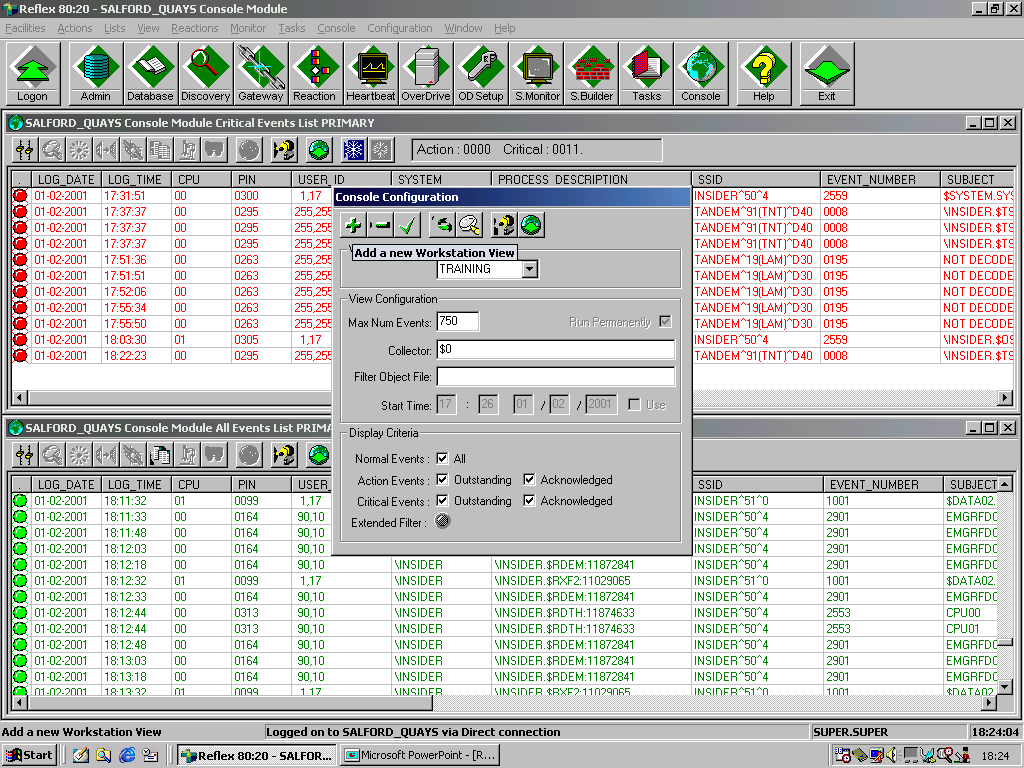
EMS events as viewed in Console, Reflex 80:20 event viewer (ITL)
EMS event detail as viewed in Console, Reflex 80:20 event viewer (ITL)
EMS event view configuration window in Console

The evolution and detailed historical timeline of NonStop EMS events and architecture is broken down by era below:

1. The Tandem Guardian Era (Late 1970s – 1980s)

Focus: Foundation of Fault-Tolerant Event Logging

  • 1976: Tandem releases the original Tandem/16 (NonStop I) system. Early event handling was primarily a rudimentary terminal console logging process.
  • 1978: System administrators struggled with message scaling as clusters and terminal networks expanded. Tandem began developing structured event tracking, paving the way for standardized subsystem messages.
  • 1980s: Introduction of early message formatting. Event messages 1 through 511 were reserved for unformatted, raw console events. The Event Management Service (EMS) was gradually formalized to centralize scattered terminal messages.

2. The D-Series & TMF Era (1990s)

Focus: Distributed Management & The Birth of Modern EMS

  • 1991: Tandem releases the Cyclone/R (CLX/R) and later the Himalaya K-series using MIPS processors.
  • 1993: The publication of the seminal EMS Reference Summaries standardized EMS APIs and SPI (System Programming Interface). Event IDs were structured into standardized subsystems (e.g., negative-numbered kernel messages).
  • 1995: The NonStop Kernel introduced Open System Services (OSS), natively integrating Unix-like event logs into the Guardian architecture.
  • 1997: Compaq acquires Tandem Computers. EMS underwent significant rewrites to interface with remote servers and client networks. The S-Series was launched utilizing ServerNet fabric, introducing advanced, distributed event collectors and distributors.

3. The Compaq Transition & HP Integration (2000s)

Focus: Web-Based Management and Automation

  • 2000 – 2003: Legacy ViewPoint tools were expanded. The emergence of GUI interfaces and DSM/PM (Distributed Systems Management/Performance Monitor) allowed operators to browse and filter EMS logs on alternate/primary event files.
  • 2003 – 2005: The transition to Web ViewPoint commenced, turning text-based EMS event logs into interactive, web-based graphical operations interfaces.
  • 2006 – 2009: With HP fully in charge after merging with Compaq, EMS event viewing was modernized through TSM (Tandem/HP Systems Management) and the Open System Management (OSM) Event Viewer.

4. The Modern HPE Era (2010s – 2026)

Focus: Cloud Integration, Virtualization, & Real-Time Analytics

  • 2015 – 2017: The platform is rebranded as HPE NonStop as the architecture migrates to x86 processors. EMS systems are upgraded to handle large datasets, feeding complex event processing (CEP) and SNMP trap frameworks for modern data centers.
  • 2018 – 2023: HPE integrates NonStop systems with HPE GreenLake. EMS event logging is modernized with API-driven integrations, allowing system events to be consumed by off-platform enterprise loggers, Splunk, and cloud-management consoles.
  • 2024 – 2026: EMS events operate in highly virtualized and hybrid cloud (x86 and Virtual NonStop) environments. Event management heavily relies on modern distributed systems where EMS distributors push logs seamlessly into centralized IT monitoring suites and continuous availability dashboards.

To look up specific system-generated event codes or statuses from any era, consult the legacy ⁠HP NonStop Operator Messages Manual or the broader ⁠HPE Nonstop Compute documentation portal.

HPE Nonstop Technology Architecture – specialized, 100% fault-tolerant infrastructure

The official HPE Nonstop Technology Architecture is a specialized, 100% fault-tolerant infrastructure built with a tightly integrated hardware and software stack designed to eliminate any single point of failure. Formal instruction and architectural frameworks have been modernized under the newly relaunched HPE Nonstop Compute Training Portfolio curriculum.

Originally developed by Tandem Computers in 1976, the platform eventually became part of Hewlett Packard Enterprise (HPE). Unlike standard servers that can crash due to a single component failure, NonStop uses a tightly integrated, “shared-nothing” architecture to ensure that if a hardware or software component fails, another instantly takes over with zero downtime or data loss.

Core Architectural Features

To understand how HPE NonStop works, you need to understand its unique design principles:

  • Shared-Nothing Architecture: Every processor has its own dedicated memory, I/O channels, and copy of the operating system. No single component is shared, eliminating any single point of failure.
  • Process Pairs: Applications run using a primary process and a backup process on a different processor. The primary process constantly copies its state to the backup. If the primary fails, the backup immediately takes over.
  • Massive Scalability: Systems can scale up seamlessly from small distributed environments to massive clusters containing up to 24,000 processor cores without interrupting running operations.
  • Hardware Platform: The modern software environment runs on industry-standard x86 architectures, available as physical server racks (like the HPE NonStop NS9 X5) or as virtualized instances in hybrid cloud environments.

Dual Operating Environments

HPE NonStop runs a specialized operating system called NonStop OS. Inside this OS, developers and administrators interact with two distinct environments:

  • Guardian Environment: The native, proprietary environment optimized for high-volume Online Transaction Processing (OLTP). It handles tasks sequentially through process-oriented manually-started jobs rather than traditional automated queues.
  • Open System Services (OSS): A UNIX-like, POSIX-compliant environment built on top of the NonStop kernel. This allows organizations to run standard open-source applications, tools, and scripts natively alongside Guardian.

Ecosystem and Use Cases

HPE NonStop is rarely used for standard office automation or basic web hosting. Instead, it serves as the backbone for global industries where an hour of downtime could cost millions of dollars:

  • Financial Transactions: Powers global stock exchanges, automated teller machines (ATMs), and retail point-of-sale credit card processing, eg. BASE24.
  • Travel and Logistics: Runs critical airline reservation systems and real-time cargo routing infrastructure.
  • Database Management: Features its own highly secure, distributed database engine called NonStop SQL, which guarantees absolute data integrity across all transactions.
  • Modern Development: Supports traditional languages like COBOL85 and ANSI C, alongside modern DevOps integrations like Git, Ansible, and Eclipse-based IDE environments.

If you plan to work directly with these systems, you can explore formal pathways like the Concepts and Facilities for HPE NonStop Systems course provided by HPE Education Services.


Core Architectural Layers (Diagram Blueprint)

An architectural blueprint of an HPE NonStop environment typically separates the layout into three core interdependent layers:

  • Hardware & Fabric Layer: Consists of independent, loosely-coupled Processor Nodes (handling up to 24,000 cores globally) connected via an ultra-fast InfiniBand or ServerNet system fabric backbone.
  • I/O & Subsystem Layer: Utilizes Cluster I/O Protocols (CLIMs), splitting tasks between Storage CLIMs (SCLIMs) and Network CLIMs (NCLIMs) to isolate external communication from main processing.
  • Operating System & DB Layer: Runs the NonStop OS, which simultaneously manages the traditional Guardian environment, Open System Services (OSS) for UNIX/Linux paradigms, and the NonStop SQL distributed database engine.

Recommended Architecture Training Curriculum

HPE organizes its technical blueprints into structured educational paths for engineers.

1. Foundational Blueprint Concepts

  • Course Code: U4147S (HPE Nonstop Compute System Fundamentals).
  • Focus: Delivers a top-down view of system goals, transaction processing, and fundamental architecture.
  • Key Modules: Explores Guardian vs OSS, Pathway application management, and basic database interaction.

2. System Operations & Administration

  • Course Code: H1SC3S (HPE Nonstop Compute System Administration I).
  • Focus: Maps physical and virtual components to real-world deployment.
  • Key Modules: Covers Processor Nodes, configuring SCLIMs/NCLIMs, and hands-on fault-scenario testing.

3. Low-Level OS Internals

  • Course Code: U8609S (HPE Integrity Nonstop Operating System Architecture).
  • Focus: Deep dive into runtime architecture, process control, and memory allocation.
  • Key Modules: Focuses on Inter-process Message Systems, synchronization mechanisms, and system debugging.

Training Delivery Options

Enrolling via HPE Education Services grants access to various professional development features:

  • HPE vLabs: Direct sandbox access to practice configuration and live fault injection inside virtual environments.
  • Digital Learner Credits: Flexible licensing options to assign corporate learning units across teams.
  • Modernized Tracks: Courses have been fully overhauled to support contemporary cloud paradigms and hybrid integration via HPE GreenLake frameworks.

My HPE NonStop (Tandem Computers) Certificates :

HPE NonStop (Tandem) Career Experience at Insider Technologies Limited, ITL
BASE24 eps monitoring

International Tandem User Group (ITUG) is dedicated to users of the Tandem NonStop computing platform (now HP Connect)

The International Tandem User Group (ITUG) is a non-profit association dedicated to users of the Tandem NonStop computing platform. Now part of the Connect Worldwide community, it facilitates education, networking, and technical exchange between users, vendors, and Hewlett Packard Enterprise (HPE). 

ITUG Overview

  • Purpose: To provide a platform for sharing technical knowledge, advocacy, and strategic information regarding Tandem (now HPE NonStop) systems.
  • Structure: ITUG operates as a global umbrella for various regional chapters, such as the British Isles Tandem User Group (BITUG) and the German Tandem User Group (GTUG).
  • Key ResourcesITUGLIB, an extensive download library containing open-source software, technical white papers, and legacy Guardian tools. 

Historical Timeline by Era

1. The Foundational Era (1974–1983)

  • 1974: Tandem Computers is incorporated in California by Jimmy Treybig and a core team of former HP 3000 engineers.
  • 1976: The first Tandem/16 (NonStop I) system ships to Citibank, establishing the fault-tolerant market.
  • 1980: Regional groups begin forming, such as GTUG in Germany, to support the rapidly growing user base.
  • 1981: Introduction of NonStop II, which adds 32-bit addressing capabilities. 

2. Growth and Expansion Era (1984–1996)

  • 1984BITUG is founded in the British Isles, eventually becoming the largest user group outside the USA.
  • 1986: Tandem launches NonStop SQL, the first fault-tolerant SQL database.
  • 1991: The platform migrates from proprietary stack-based processors to MIPS RISC architecture (TNS/R).
  • 1993: Release of the NonStop Himalaya K-series, further expanding scalability. 

3. Acquisition and Integration Era (1997–2008)

  • 1997: Compaq acquires Tandem Computers to bolster its enterprise server portfolio.
  • 2002: Hewlett-Packard (HP) acquires Compaq, bringing Tandem “back home” to the company that inspired its founders.
  • 2003: ITUG celebrates its 25th anniversary with participation from original Tandem executives.
  • 2005: ITUG officially merges with other HP user groups (Encompass and HP-Interex) to form Connect, though it often retains the “ITUG” branding for its NonStop-focused division. 

4. Modern Era (2009–Present)

  • 2014: The platform completes its transition to Intel x86 architecture, branded as Integrity NonStop X.
  • 2015: Hewlett-Packard splits; Tandem/NonStop becomes a core part of Hewlett Packard Enterprise (HPE).
  • Present: ITUG continues to operate under Connect Worldwide, hosting major annual events like the NonStop Technical Boot Camp (TBC). 

……….

HP Connect (often referred to as Connect Worldwide) is a leading global IT user community dedicated to professionals using Hewlett Packard Enterprise (HPE) and HP Inc. solutions. It serves as an independent hub for peer-to-peer networking, technical education, and advocacy, primarily supporting users of high-availability systems like NonStop, ProLiant, and HP-UX. 

Historical Timeline by Era

The community’s history is defined by the evolution and eventual merger of several legacy user groups representing the giants of the mid-20th-century computing world. 

1. The Legacy Foundations (1960s – 1990s)

Before the name “Connect” existed, three distinct user groups served the customers of the companies that would eventually form the modern HP/HPE ecosystem:

  • DECUS (1961): The Digital Equipment Computer Users’ Society was one of the oldest and largest user groups, supporting DEC systems.
  • Interex (1974): Founded as the HP 3000 International Users Group, it later expanded to support HP 9000 and HP-UX users.
  • ITUG (1970s): The International Tandem User Group supported the high-availability Tandem NonStop server community. 

2. The Consolidation Era (2000 – 2008)

Major corporate mergers necessitated the union of these independent communities:

  • 2002: HP acquired Compaq, which had already acquired DEC and Tandem.
  • 2004 – 2005: The DECUS community transitioned into Encompass, serving the Enterprise users of the merged entities.
  • 2008: Connect Worldwide was officially launched through the merger of Encompass and ITUG, creating a single, unified global community for HP enterprise users. 

3. The Unified “Connect” Era (2008 – 2015)

During this period, Connect Worldwide solidified its role as the primary independent voice for HP enterprise technology:

  • Global Advocacy: It represented over 50,000 members across 1,000+ member companies worldwide.
  • Technical Focus: The community focused heavily on HP’s “Converged Infrastructure” and mission-critical systems.
  • The “Boot Camp”: The NonStop TBC (Technical Boot Camp) became its flagship global event. 

4. The Modern Era & Digital Transformation (2015 – Present)

Following the historic 2015 split of Hewlett-Packard into HP Inc. and Hewlett Packard Enterprise (HPE), the community adapted to a dual-focus landscape: 

  • Specialised Sub-Communities: While “Connect” remains the umbrella for legacy enterprise users, newer platforms like the HP Support Community have risen to manage consumer and PC-specific technical needs.
  • HP Connect (Cloud Service): HP introduced a modern cloud-based tool also named HP Connect, which IT admins use to manage BIOS and security settings for corporate PC fleets via Microsoft Intune.
  • AI Integration: The latest era (2024+) focuses on the “HP AI Helix,” embedding AI management and security into the user experience.