

Overview of BASE24 and XPNET
BASE24 is an enterprise-grade electronic funds transfer (EFT) software suite developed by Applied Communications Inc. (now ACI Worldwide). It handles real-time transaction acquiring, authenticating, routing, switching, and authorization across ATMs, Point-of-Sale (POS) networks, and digital payment channels.
XPNET (Exchange Protocol Network) is the fundamental communications middleware layer designed explicitly for BASE24 on fault-tolerant systems. It acts as an abstraction layer managing interprocess communications (IPC), network protocols (e.g., Bisync, X.25, TCP/IP), line management, device messaging, and high-volume transaction routing. Together, they form the transactional backbone for a majority of the world’s top financial institutions.
I worked on BASE24 / BASE24-eps transaction tracking and XPNET monitoring at Insider Technologies Limited (ITL) in the early part of the millennium. See also HP NonStop Connection Journal article in 2013.
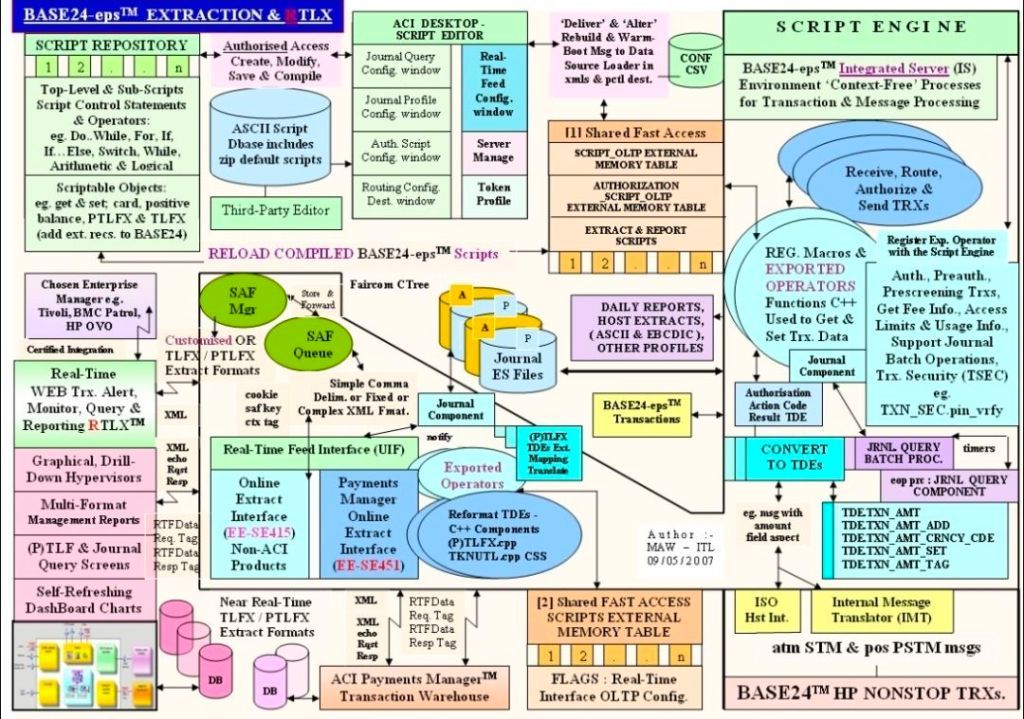
and ITLs RTLX (in 2007)
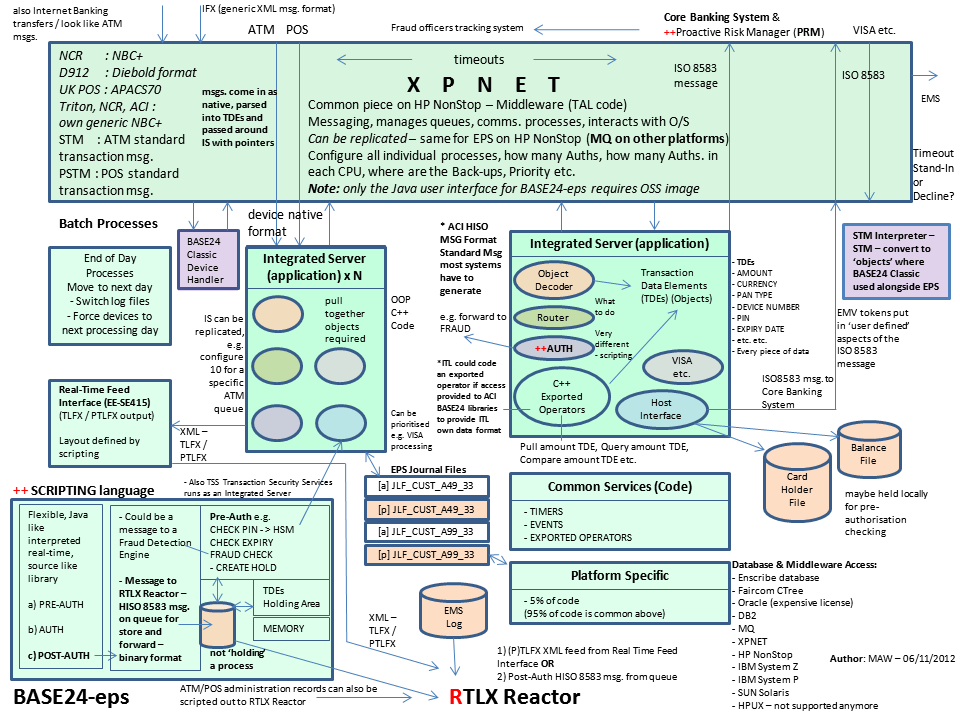
BASE24-eps & BASE24 XPNET transactions
Deep-Dive Architecture and Technology Stack
1. BASE24 Core Design
- Process Pair Architecture: Designed natively around Tandem’s process pairs. A Primary Process performs the active transaction switching while a Backup Process remains synchronized in a standby state. If the hardware or primary process fails, the backup takes over instantly with zero data loss or session drops.
- Functional Modules: Divided into specific transactional entities:
- ATM (Automated Teller Machine Device Handler): Direct control and state management of physical terminals using custom message streams (e.g., Diebold, NCR).
- POS (Point of Sale): Merchant terminal management and merchant accounting integration.
- Auth (Authorization Processor): Internal validation scripts against account records or stand-in limits.
2. XPNET Middleware Engine
- Line and Station Infrastructure: XPNET maps communication through abstract configurations. A Line represents a physical or logical network pipe, and a Station represents an endpoint (e.g., an interchange gateway or terminal node).
- Dynamic Load Buffering: Employs internal memory queue structures to absorb traffic spikes from international card networks (such as Visa and Mastercard) without spilling into disk storage.
- Protocol Multi-threading: It decouples low-level link dynamics (e.g., CRC checking, dropouts) from core business logic, converting legacy and modern network formats into standardized internal transaction tokens.
Application Development Timeline & Political Breakdown
The timeline below details how geopolitical, regulatory, and corporate ownership developments directly shaped versioning and core code changes in BASE24 and XPNET.
Era 1: The Tandem & Expansionist Era (1975–1992)
- Geopolitical & Industry Context: The rise of consumer credit card networks, personal checking accounts, and the physical expansion of banking via ATMs. Regional networks were fragmented, necessitating specialized software to cross-connect them.
- Corporate Dynamics: Applied Communications Inc. (ACI) operated as an independent software house in Omaha, Nebraska, forming a deep partnership with Tandem Computers before being acquired by US West (1988) and later Tandem directly (1991).
- Year-by-Year Code & Technical Milestones:
- 1975–1981: Initial exploration of high-availability banking systems on Tandem NonStop computers. Developers laid the groundwork using Tandem Screen COBOL and low-level communication drivers.
- 1982: BASE24 v1.0 officially launches. The original codebase was written in TAL (Tandem Application Language), a high-performance, structured system programming language designed specifically for NonStop systems.
- 1985: A primitive version of XPNET is spun out from early shared-memory messaging code to support multi-protocol lines (Bisync, Async) without forcing restarts of the core application.
- 1987: Introduction of early ISO 8583 message formatting engines within the core routing code. This allowed the software to natively interpret standard financial messaging frames across distinct interbank networks.
- 1991: Tandem acquires ACI. Code refactoring focused heavily on optimizing interactions with Tandem’s native file system (Enscribe) and expanding the XPNET process memory layout to take advantage of new Tandem CLX architecture performance.
Era 2: The TSA Corporate & Public Market Era (1993–2000)
- Geopolitical & Industry Context: Globalization of financial services, the consolidation of national card switches, and the commercial explosion of internet banking and POS devices.
- Corporate Dynamics: Tandem divested ACI to a private holding company, leading to the creation of Transaction Systems Architects (TSA) in late 1993. TSA went public on NASDAQ in 1995, pushing development velocity to meet Wall Street expectations.
- Year-by-Year Code & Technical Milestones:
- 1993–1994: Standardized compilation routines moved to Tandem’s pTAL (portable TAL) to bridge code execution compatibility between older CISC-based architectures and the newly emerging MIPS RISC processors.
- 1995–1996: BASE24 version 4.x introduces advanced multi-institution handling inside a single logical codebase, allowing multi-tenant processing for third-party credit card consolidators.
- 1997: Release of BASE24 v5.x, featuring significant expansions in XPNET (v2.x) to accommodate native TCP/IP sockets alongside aging X.25 line infrastructures.
- 1998–1999: Heavy investment into Y2K compliance remediation. Code changes involved updating binary-coded decimal (BCD) date configurations, expanding date-storage windows across Enscribe files, and deploying the BASE24 Year 2000 System Assessment frameworks globally.
Era 3: Enterprise Platform Shift & Consolidation (2001–2014)
- Geopolitical & Industry Context: Post-9/11 regulatory changes (e.g., USA PATRIOT Act), the implementation of modern security standards like Triple DES (TDES), and the birth of the PCI-DSS (Payment Card Industry Data Security Standard). Mainframes and alternative hardware processors (IBM, HP-UX) became fierce competitors to Tandem.
- Corporate Dynamics: TSA officially rebranded to ACI Worldwide, Inc. (ACIW) in 2007. A strategic decision was made to rewrite the platform to break vendor lock-in and provide cross-platform flexibility.
- Year-by-Year Code & Technical Milestones:
- 2001–2002: Standard cryptographic layers within BASE24 are systematically modified to enforce Triple DES compliance across automated teller machines.
- 2003: ACI introduces BASE24-eps (Enterprise Payments System). This marked a foundational architecture shift, moving away from TAL/pTAL entirely to an object-oriented paradigm written in C++ and designed to execute cross-platform (HPE NonStop, IBM z/OS, AIX, Linux).
- 2005–2006: BASE24-es/eps code integrates with enterprise middleware layers such as IBM WebSphere MQ, using CICS containers on z/OS to deliver modern service-oriented architecture (SOA) web services wrappers.
- 2008–2010: ACI shocks the banking industry by announcing the sunsetting of standard maintenance for classic Tandem NonStop BASE24 by late 2011. Millions of lines of legacy TAL code are effectively frozen, forcing major migrations toward BASE24-eps.
- 2011–2013: Code enhancements center around PA-DSS validation and securing encryption pathways to ensure tokenized processing. XPNET 3.x is deployed onto newer HP Integrity Itanium-based J-Series and H-Series blades.
Era 4: Modernization, Cloud-Native, and Open Systems (2015–Present)
- Geopolitical & Industry Context: The dominance of Real-Time Payments (RTP, FedNow, ISO 20022 formats), cloud computing mandates, and aggressive cost-reduction pushes away from high-maintenance legacy hardware configurations.
- Corporate Dynamics: ACI pivots sharply to open-ecosystem SaaS delivery, cloud partnerships (AWS, Microsoft Azure, Google Cloud), and co-development with IBM to optimize cross-platform throughput.
- Year-by-Year Code & Technical Milestones:
- 2015–2016: BASE24-eps code is successfully ported to Red Hat Enterprise Linux (RHEL) on standard x86 processors. This architectural pivot offered a reduction in total cost of ownership (TCO) compared to legacy hardware by providing massive processing scaling.
- 2018–2020: The introduction of standard ISO 20022 messaging libraries into the switching matrix to support instant transaction settlement schemes globally.
- 2021–2024: Legacy middleware systems are phased down. Modern releases feature direct REST API hooks, cloud-adaptor hooks, containerised microservices integration, and extended configuration capabilities via the ACI Desktop GUI.
- 2025–2026: ACI partners with IBM to launch native 64-bit deployment optimizations for BASE24-eps running on IBM Z mainframes (including z16/z17 configurations), incorporating hardware-driven AI fraud analysis models and full PCI-SSF (PCI 4.0) certification.
Overview of BASE24 and XPNET plus application timeline by era


