Preparing for an Agile Scrum interview requires a mix of theoretical knowledge, situational problem-solving, and a clear understanding of your specific role (Scrum Master, Product Owner, or Developer). Be ready to discuss the Scrum framework, roles, artifacts, ceremonies, and how you foster self-organization and continuous improvement.
Review these common Agile Scrum interview questions, categorized by topic:
1. Fundamentals & Frameworks
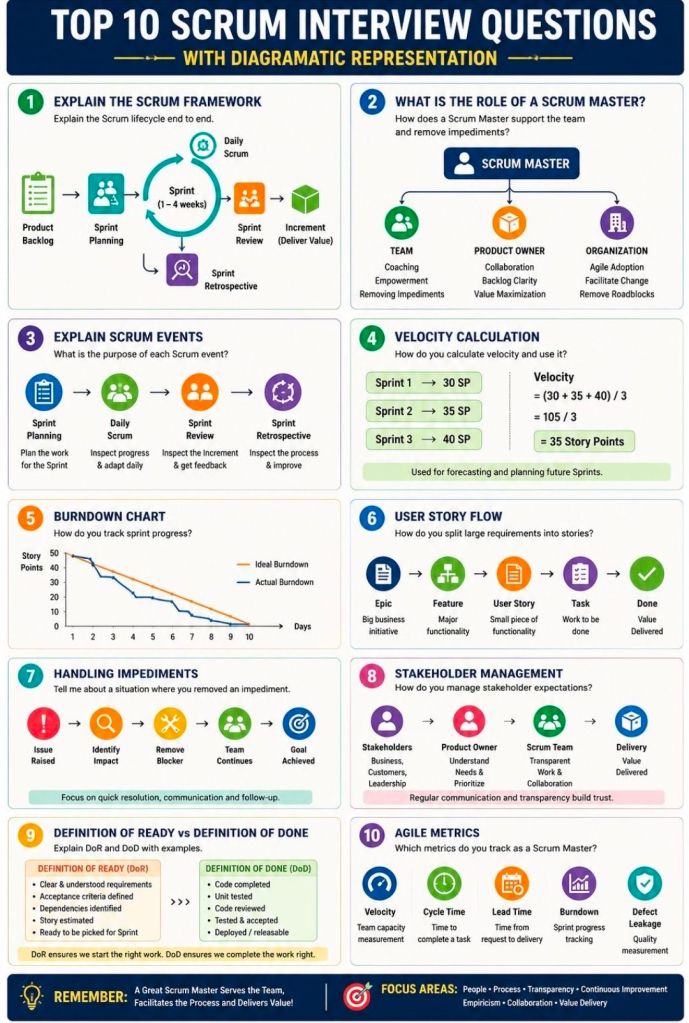
What is the difference between Agile and Scrum? Agile is an overarching project management philosophy focused on iterative development and flexibility. Scrum is a specific, lightweight framework within Agile that uses set roles, artifacts, and timeboxed “sprints” (usually 1-4 weeks).
What are the core roles on a Scrum Team? The three primary roles are the Product Owner (maximizes value, owns the backlog), the Scrum Master (servant-leader, removes impediments, ensures Scrum rules are followed), and the Developers (cross-functional team that delivers the increment).
What is a “Spike”? A spike is a timeboxed research or exploration task used to reduce uncertainty, figure out a technical approach, or better understand a requirement before development begins.
2. Scrum Ceremonies (Events)
What happens during a Sprint Planning meeting? The team collaborates to determine what work can be delivered in the upcoming sprint and creates a plan (the Sprint Backlog) for how to achieve this Product Goal.
Can you give a 2-3 minute overview of the Daily Scrum? It is a 15-minute timeboxed event for the Developers to inspect progress toward the Sprint Goal and adapt the upcoming work. It is not a status report to management; it is for the team to synchronize and plan the next 24 hours.
What is the purpose of a Sprint Retrospective? Held at the end of every sprint, the team inspects the past sprint regarding people, relationships, processes, and tools. The goal is to identify what went well and create a plan for implementing improvements.
What is the difference between a Sprint Review and a Retrospective? The Review inspects the software/product increment to adapt the Product Backlog. The Retrospective inspects the team’s process and working environment.
3. Artifacts & Estimation
What is the Definition of Done (DoD)? It is a shared, clear checklist of criteria that must be met for a product increment to be considered ready for release. It ensures consistency and quality across the team.
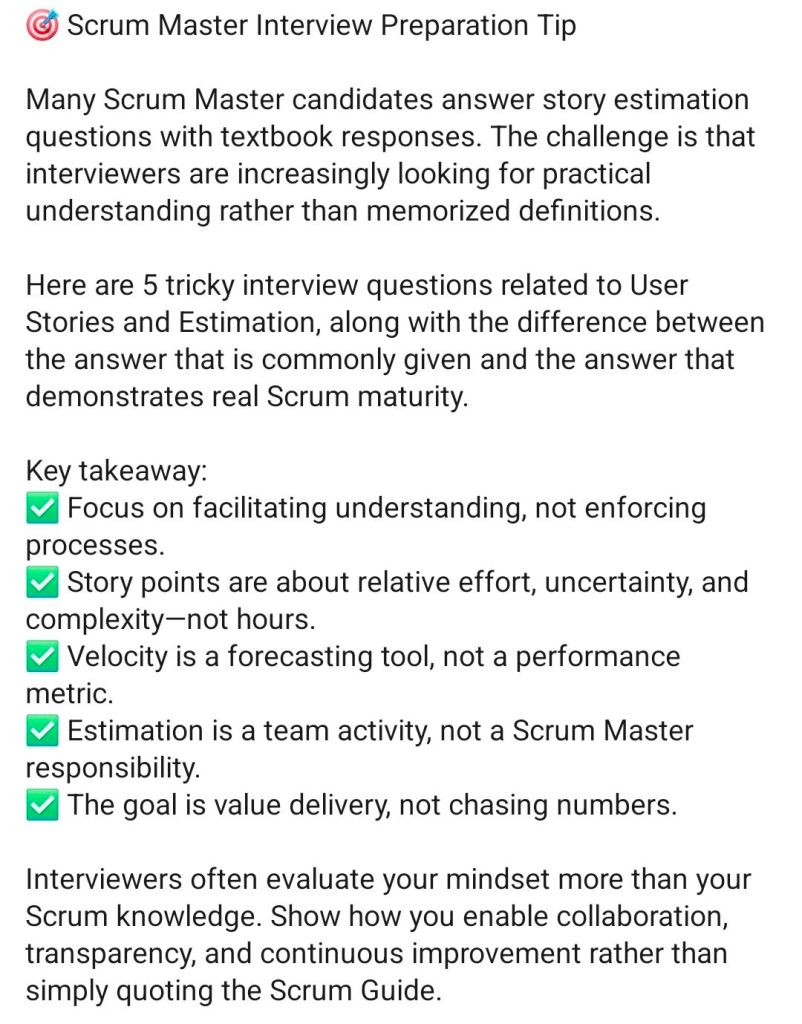
What is Velocity? Velocity measures the total amount of work (usually in Story Points) a Scrum Team can deliver during a single sprint. It is typically calculated as an average over the last 3-4 sprints and helps predict future delivery.
How do you handle scope creep? Emphasize that in Scrum, the sprint scope is locked once the sprint starts. If new work is urgent, it should go to the Product Backlog for future planning, or the team can negotiate with the Product Owner to remove an equally sized task from the current sprint to make room.
What do you do if a manager tries to dictate or assign tasks to the team? Coach the manager on Scrum principles (self-management) and act as a shield to protect the team from outside interference, allowing them to focus on the Sprint Goal.
How do you build trust with your team? Focus on empathy, transparency, consistency, and active listening. Build a safe space where the team can fail forward, experiment, and voice concerns without fear of retaliation.
How do you handle conflict within the team? Encourage the team to resolve conflicts themselves first, stepping in only if it affects the sprint goals. Facilitate open dialogue focusing on the issue (the process/problem), not the person.
Typical Agile Scrum Master interview questions evaluate your understanding of the Scrum Framework (the 3-5-3 structure), your ability to facilitate continuous improvement, and your soft skills in conflict resolution and servant leadership.
The questions generally fall into four core categories:
1. Scrum Fundamentals & Frameworks
These questions test your technical knowledge of Scrum and how it compares to other frameworks.
Explain Scrum vs. Agile: Agile is the overarching mindset and set of principles; Scrum is a specific, lightweight framework for implementing Agile.
The 3-5-3 structure: What are the three roles (Product Owner, Scrum Master, Developers), five events (Sprint, Sprint Planning, Daily Scrum, Sprint Review, Sprint Retrospective), and three artifacts (Product Backlog, Sprint Backlog, Increment)?
Scaling Agile: What experience do you have scaling Agile (e.g., SAFe, Scrum of Scrums, Nexus) if the organization is large?
2. Facilitation & Coaching
Interviewers want to see how you run events, coach Product Owners, and improve team delivery.
Daily Scrum: What is your approach to running the Daily Scrum, and how do you prevent it from becoming just a status update?
Retrospectives: What specific techniques or games do you use to keep retrospectives fresh and actionable?
Definition of Done (DoD): How do you help a team create and adhere to a clear Definition of Done?
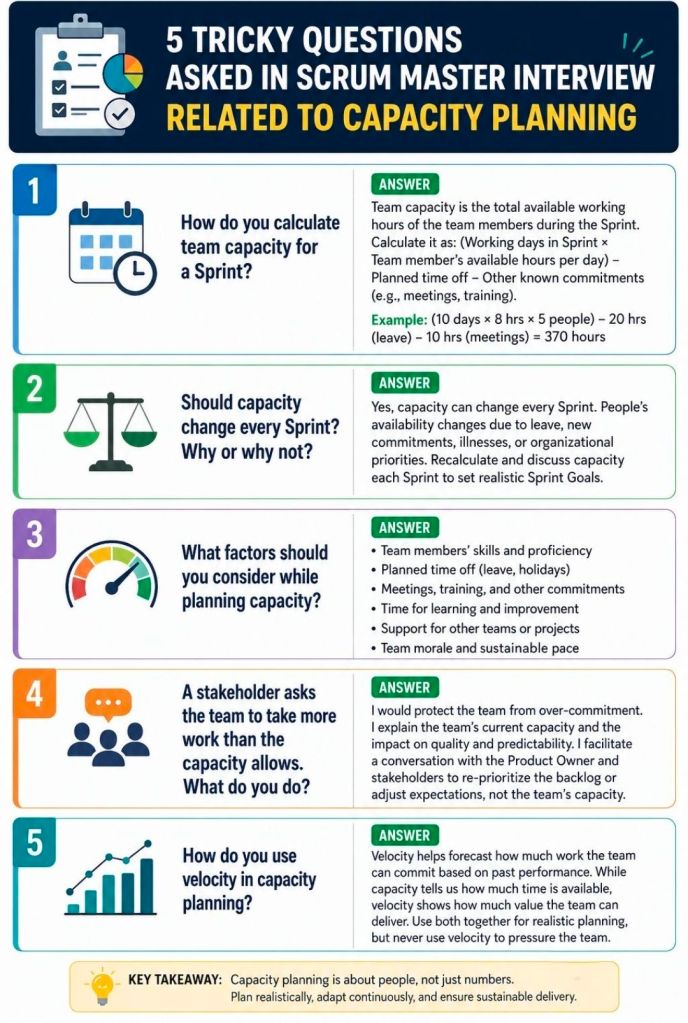
Metrics: How do you track a team’s effectiveness (e.g., velocity, sprint goal success, cycle time, burndown charts)?
3. Behavioral & Situational Scenarios
These “tell me about a time when…” questions assess your real-world experience.
Team Conflict: Can you describe a time when you had to resolve a conflict between team members or between a developer and the Product Owner?
Resistant Teams: What would you do if a team member or stakeholder doesn’t see the value in Scrum ceremonies and refuses to participate?
Management Intervention: How do you handle managers or executives who try to bypass the Scrum process or assign work directly to the developers?
Scope Creep: How do you handle sudden mid-sprint requirement changes or scope creep?
4. Self-Awareness & Servant Leadership
Hiring managers ask these to test your humility and growth mindset.
Your Greatest Failure: Can you share a time you failed as a Scrum Master, and what you learned from the experience?
Protecting the Team: How do you say “no” to leadership or protect the team from external noise while still serving the broader organization?
__________
More Agile Scrum Questions with Example Answers:
Mastering a Scrum Master interview involves demonstrating a deep understanding of servant leadership, the Agile mindset, and hands-on experience navigating team dynamics. Below are the most common interview questions, summarized with strategic, industry-recommended answers to help you stand out.
Core Scrum Framework & Mechanics
Question 1: Explain the 3-5-3 structure of Scrum.
What they’re looking for: A solid foundation in Scrum basics.
Recommended Answer: “Scrum is governed by a ‘3-5-3’ rule: 3 roles (Product Owner, Scrum Master, Developers), 5 events (Sprint, Sprint Planning, Daily Scrum, Sprint Review, Sprint Retrospective), and 3 artifacts (Product Backlog, Sprint Backlog, Increment).”
Question 2: What is the difference between a Product Backlog and a Sprint Backlog?
What they’re looking for: Understanding of backlog management and scope.
Recommended Answer: “The Product Backlog is a continuously evolving, prioritized list of everything needed for the product, owned by the Product Owner. The Sprint Backlog is a subset of the Product Backlog—it’s the specific forecast of items the team commits to delivering during the current sprint.”
Behavioral & Situational Questions
Question 3: How do you handle conflict within the Scrum team?
What they’re looking for: Your facilitation and conflict-resolution skills, avoiding direct intervention where the team can self-manage.
Recommended Answer: “I avoid playing the role of a micromanager. Instead, I facilitate open dialogue and encourage the team to address the conflict directly using the Scrum values of openness and respect. My goal is to guide them to find a mutually agreeable solution while fostering an environment of psychological safety.”
Question 4: What do you do if a team member refuses to adopt Scrum practices?
What they’re looking for: Change management skills and patience.
Recommended Answer: “I first try to understand the root cause of their resistance, as it usually stems from a lack of understanding or fear of change. I would have a private one-on-one conversation to address their concerns. I might pair them with an experienced Agile advocate or use team-building exercises to demonstrate the value of Scrum in a low-pressure way.”
Leadership & Stakeholder Management
Question 5: Tell me about a time you had to challenge leadership or management.
What they’re looking for: The courage to protect the team’s focus and uphold Scrum principles.
Recommended Answer: “I once had a stakeholder attempt to bypass the Product Owner and directly assign high-priority tasks to Developers mid-sprint. I respectfully but firmly challenged this by explaining how breaking the Sprint Goal jeopardizes the team’s focus and the project’s overall velocity. I then helped the stakeholder work with the Product Owner to place the new task in the Product Backlog for the next sprint planning.”
Question 6: How do you measure if your team is truly Agile?
What they’re looking for: Focus on delivering value over measuring arbitrary metrics like velocity.
Recommended Answer: “Velocity is for planning, not for measuring success. I look at outcome-based metrics, such as Sprint Goal success rates, customer satisfaction scores, time-to-market, and the quality of increments. The ultimate measure is whether we are continuously delivering iterative business value to our end users.”
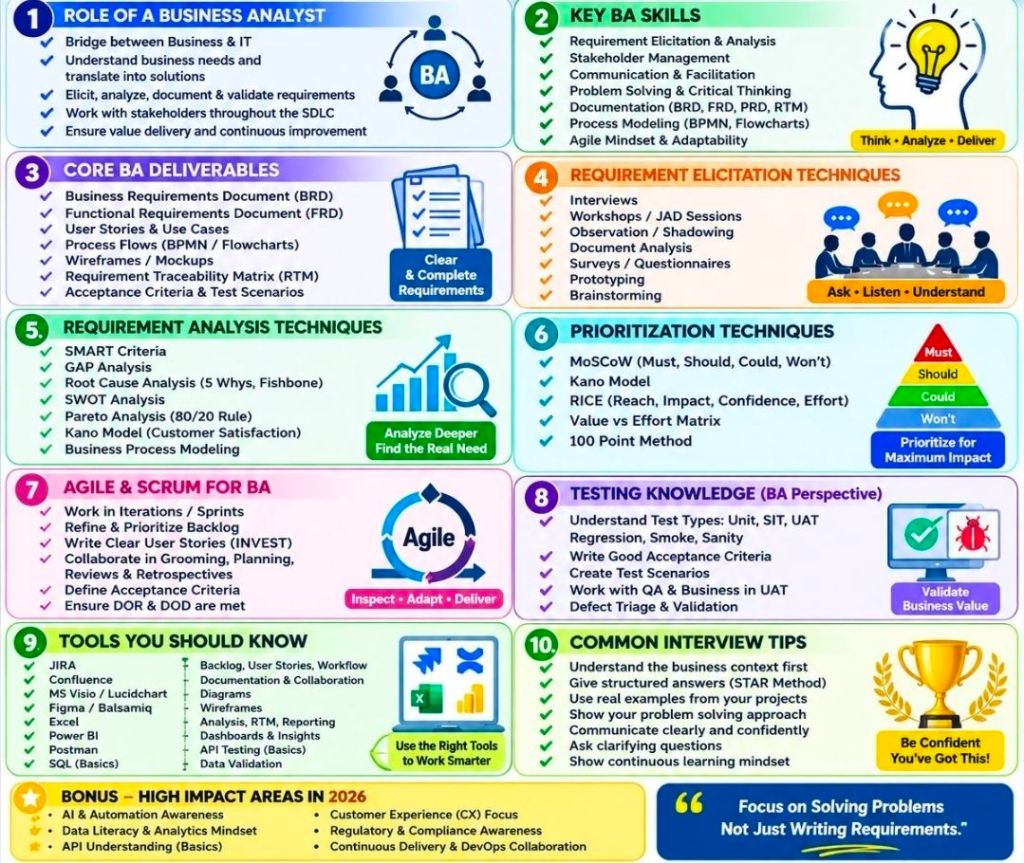
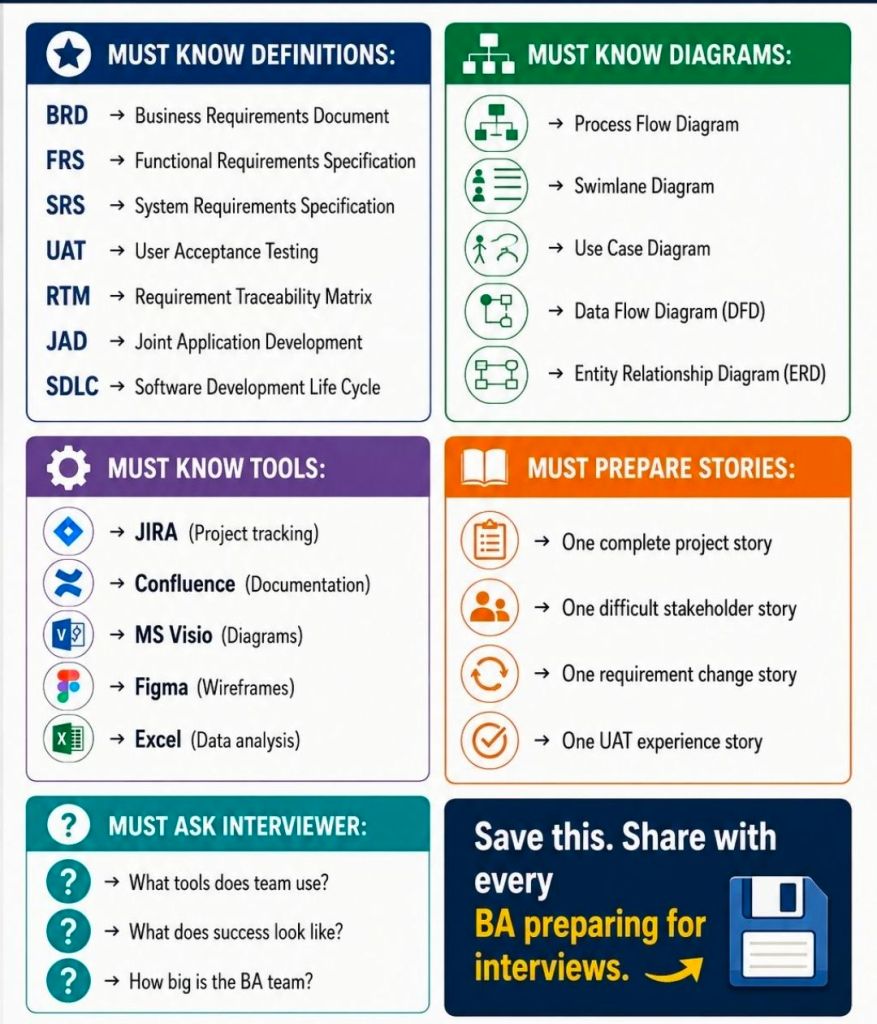
Business Analyst (BA) interview prep focuses on demonstrating how you translate business problems into technical/process solutions. Preparation revolves around three core pillars: competence (technical knowledge), communication (behavioral stories), and cultural fit.
1. Technical & Core Knowledge Prep
Familiarize yourself with the fundamental BA methodologies, documentation, and tools:
Methodologies: Understand the differences between Agile (Scrum, Kanban, sprints, user stories) and Waterfall (structured phase-gating).
Documentation: Review how to create a Business Requirements Document (BRD), Functional Requirements Document (FRD), and Software Requirements Specification (SRS).
Process Modeling: Refresh your knowledge on reading and creating Use Cases, User Stories, and UML diagrams (Activity diagrams, Flowcharts).
Requirements Gathering: Be ready to discuss techniques like interviews, workshops, prototyping, and document analysis.
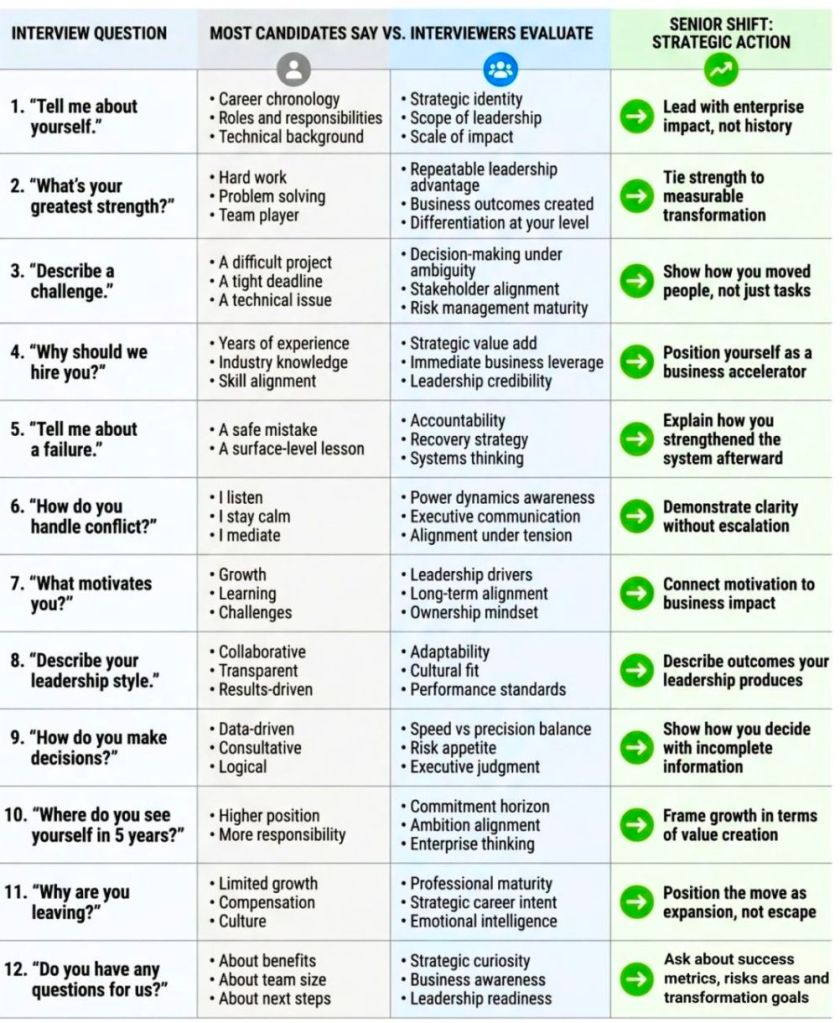
2. Behavioral & Scenario Prep (The STAR/STARS Method)
Expect situational questions that require you to tell a story about your past experience. Structure your answers using the STAR method (Situation, Task, Action, Result):
Conflict Resolution: How do you align stakeholders with opposing views or conflicting priorities?
Scope Creep: How do you manage a stakeholder requesting major changes midway through a project?
Ambiguity: Tell me about a time you had to work with limited data or changing requirements.
Failure/Mistakes: Describe a time you made an analytical error or missed a requirement and how you resolved it.
3. Interview Action Items Checklist
Work Samples: Bring a physical or digital portfolio containing redacted work samples (e.g., a process flow, user story backlog, or requirements document you’ve built).
The 30-60-90 Day Plan: Think about how you would approach the first few months on the job. (e.g., Day 1-30: Learn the business domain; Day 31-60: Map current processes; Day 61-90: Identify optimization opportunities.)
Reverse Questions: Prepare engaging questions to ask the interviewer, such as: “What does success look like in this role in the first 6 months?” or “Can you share more about how BAs collaborate with the technical team here?”