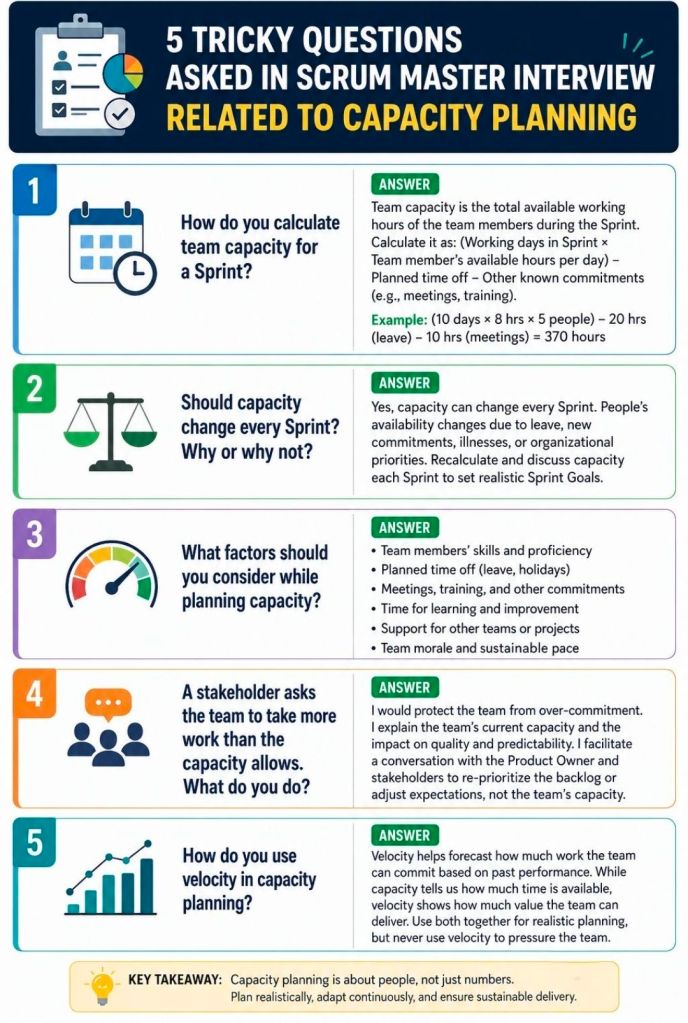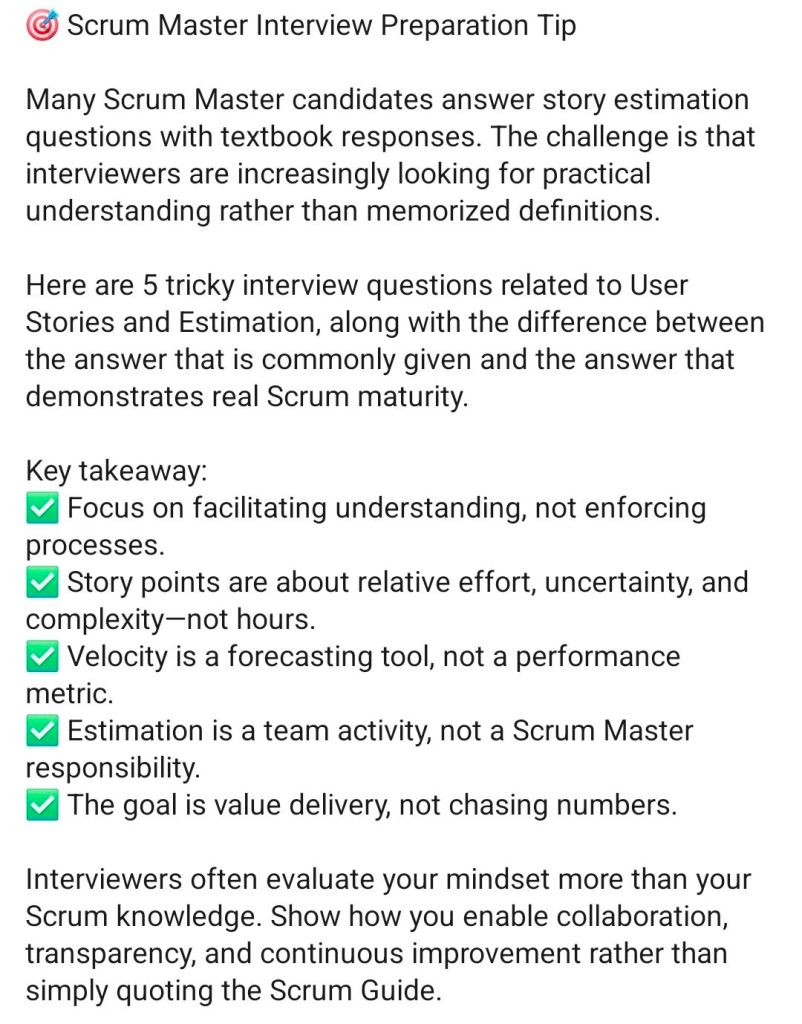
Typical Agile Scrum Master interview questions evaluate your understanding of the Scrum Framework (the 3-5-3 structure), your ability to facilitate continuous improvement, and your soft skills in conflict resolution and servant leadership.
The questions generally fall into four core categories:
1. Scrum Fundamentals & Frameworks
These questions test your technical knowledge of Scrum and how it compares to other frameworks.
- Explain Scrum vs. Agile: Agile is the overarching mindset and set of principles; Scrum is a specific, lightweight framework for implementing Agile.
- The 3-5-3 structure: What are the three roles (Product Owner, Scrum Master, Developers), five events (Sprint, Sprint Planning, Daily Scrum, Sprint Review, Sprint Retrospective), and three artifacts (Product Backlog, Sprint Backlog, Increment)?
- Scaling Agile: What experience do you have scaling Agile (e.g., SAFe, Scrum of Scrums, Nexus) if the organization is large?
2. Facilitation & Coaching
Interviewers want to see how you run events, coach Product Owners, and improve team delivery.
- Daily Scrum: What is your approach to running the Daily Scrum, and how do you prevent it from becoming just a status update?
- Retrospectives: What specific techniques or games do you use to keep retrospectives fresh and actionable?
- Definition of Done (DoD): How do you help a team create and adhere to a clear Definition of Done?
- Metrics: How do you track a team’s effectiveness (e.g., velocity, sprint goal success, cycle time, burndown charts)?
3. Behavioral & Situational Scenarios
These “tell me about a time when…” questions assess your real-world experience.
- Team Conflict: Can you describe a time when you had to resolve a conflict between team members or between a developer and the Product Owner?
- Resistant Teams: What would you do if a team member or stakeholder doesn’t see the value in Scrum ceremonies and refuses to participate?
- Management Intervention: How do you handle managers or executives who try to bypass the Scrum process or assign work directly to the developers?
- Scope Creep: How do you handle sudden mid-sprint requirement changes or scope creep?
4. Self-Awareness & Servant Leadership
Hiring managers ask these to test your humility and growth mindset.
- Your Greatest Failure: Can you share a time you failed as a Scrum Master, and what you learned from the experience?
- Protecting the Team: How do you say “no” to leadership or protect the team from external noise while still serving the broader organization?
__________
More Agile Scrum Questions with Example Answers:
Mastering a Scrum Master interview involves demonstrating a deep understanding of servant leadership, the Agile mindset, and hands-on experience navigating team dynamics. Below are the most common interview questions, summarized with strategic, industry-recommended answers to help you stand out.
Core Scrum Framework & Mechanics
Question 1: Explain the 3-5-3 structure of Scrum.
- What they’re looking for: A solid foundation in Scrum basics.
- Recommended Answer: “Scrum is governed by a ‘3-5-3’ rule: 3 roles (Product Owner, Scrum Master, Developers), 5 events (Sprint, Sprint Planning, Daily Scrum, Sprint Review, Sprint Retrospective), and 3 artifacts (Product Backlog, Sprint Backlog, Increment).”
Question 2: What is the difference between a Product Backlog and a Sprint Backlog?
- What they’re looking for: Understanding of backlog management and scope.
- Recommended Answer: “The Product Backlog is a continuously evolving, prioritized list of everything needed for the product, owned by the Product Owner. The Sprint Backlog is a subset of the Product Backlog—it’s the specific forecast of items the team commits to delivering during the current sprint.”
Behavioral & Situational Questions
Question 3: How do you handle conflict within the Scrum team?
- What they’re looking for: Your facilitation and conflict-resolution skills, avoiding direct intervention where the team can self-manage.
- Recommended Answer: “I avoid playing the role of a micromanager. Instead, I facilitate open dialogue and encourage the team to address the conflict directly using the Scrum values of openness and respect. My goal is to guide them to find a mutually agreeable solution while fostering an environment of psychological safety.”
Question 4: What do you do if a team member refuses to adopt Scrum practices?
- What they’re looking for: Change management skills and patience.
- Recommended Answer: “I first try to understand the root cause of their resistance, as it usually stems from a lack of understanding or fear of change. I would have a private one-on-one conversation to address their concerns. I might pair them with an experienced Agile advocate or use team-building exercises to demonstrate the value of Scrum in a low-pressure way.”
Leadership & Stakeholder Management
Question 5: Tell me about a time you had to challenge leadership or management.
- What they’re looking for: The courage to protect the team’s focus and uphold Scrum principles.
- Recommended Answer: “I once had a stakeholder attempt to bypass the Product Owner and directly assign high-priority tasks to Developers mid-sprint. I respectfully but firmly challenged this by explaining how breaking the Sprint Goal jeopardizes the team’s focus and the project’s overall velocity. I then helped the stakeholder work with the Product Owner to place the new task in the Product Backlog for the next sprint planning.”
Question 6: How do you measure if your team is truly Agile?
- What they’re looking for: Focus on delivering value over measuring arbitrary metrics like velocity.
- Recommended Answer: “Velocity is for planning, not for measuring success. I look at outcome-based metrics, such as Sprint Goal success rates, customer satisfaction scores, time-to-market, and the quality of increments. The ultimate measure is whether we are continuously delivering iterative business value to our end users.”