Direct comparison between O-Level system of 1980s and today’s numerical GCSE grades

In the 1980s, GCE O-Level grades ranged from A to E (where A, B, and C were considered passing). Due to grade inflation and changes in the curriculum over the decades, an O-Level grade C is roughly equivalent to a Grade 4 in the current numerical GCSE system, while an O-Level grade A equates to a Grade 7 or 8.

A direct, point-by-point comparison between the O-Level system of the 1980s and today’s numerical GCSE grades reveals the following equivalence:
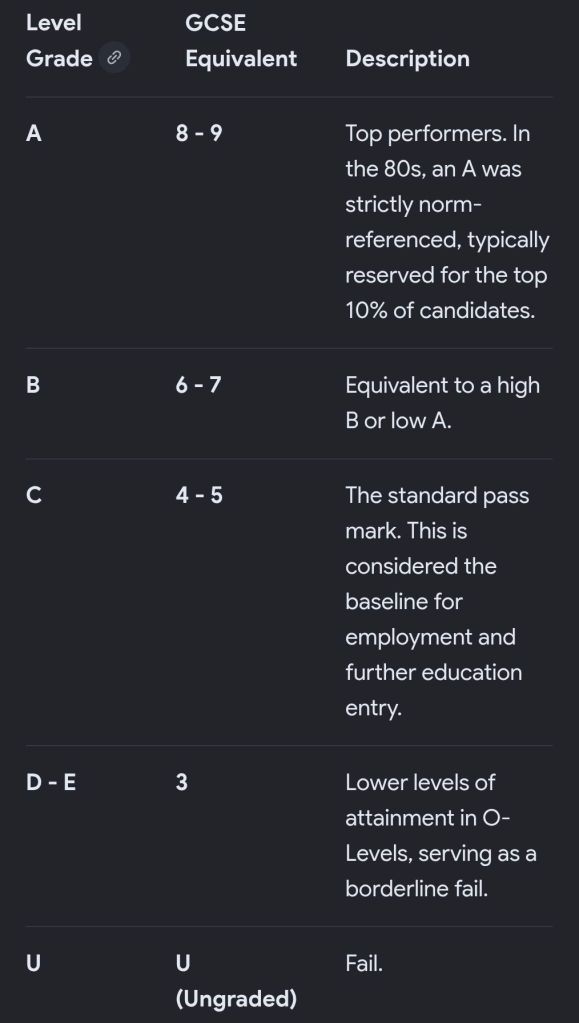
O-Level grade C is roughly equivalent to a Grade 4 in the current numerical GCSE system, while an O-Level grade A equates to a Grade 7 or 8
O-Level grade C is equivalent to Grade 4, while O-Level grade A equates to Grade 7/8

Important Differences in System Design

  • Grading Method: O-Levels were norm-referenced, meaning a fixed percentage of students received each grade every year, regardless of the overall score. Today’s GCSEs are criterion-referenced, meaning grades are awarded based strictly on the skills and knowledge the student demonstrates, with grade boundaries adjusted accordingly.
  • Cohort Reach: In the 1980s, O-Levels were designed for the top 20–25% of the academic cohort, while the next 40% took CSE (Certificate of Secondary Education) exams. The modern GCSE is designed to cater to the vast majority of all abilities.
  • Assessment & Breadth: O-Levels were almost entirely dependent on final, high-stakes written exams, whereas modern GCSEs require more breadth across a wider range of subjects and rely heavily on 9-1 scoring.

Direct comparison between O-Level system of 1980s and today’s numerical GCSE grades

Unknown's avatar

Author: Mark Whitfield

Welcome to my site! After graduating in Computing in 1990, I accepted a position as a programmer at a Runcorn based software house specialising in electronic banking software, namely sp/ARCHITECT-BANK on Tandem Computers (now HPE NonStop). This was before the internet became more prevalent and so the notion of enabling desktop access to company accounts for inter-account transfers and book keeping was still quite a cutting edge idea (and smartphones only ever hinted at in Space 1999). The company was called The Software Partnership (which was taken over by Deluxe Data in 1994). I spent 5 years in Runcorn developing code for SP/ARCHITECT for various banks like TSB, Bank of Scotland, Rabobank and Girofon (Denmark) to name but a few. I then moved onto a software house in Salford Quays for further bank facing projects. After a further 23 years in the IT industry and now a Senior IT Project Manager (both Agile and Waterfall delivery), I thought I would echo out my Career Profile in this corner of the internet for quick and easy access.

Leave a comment