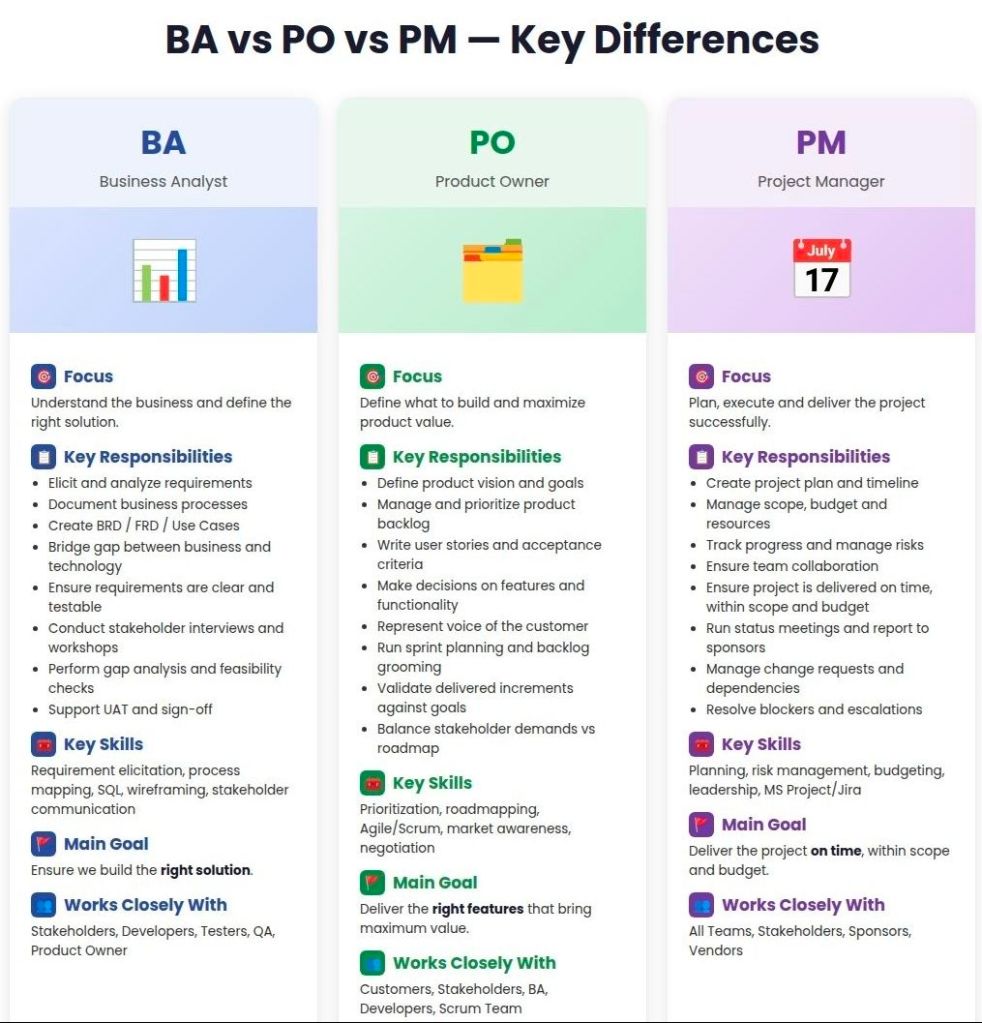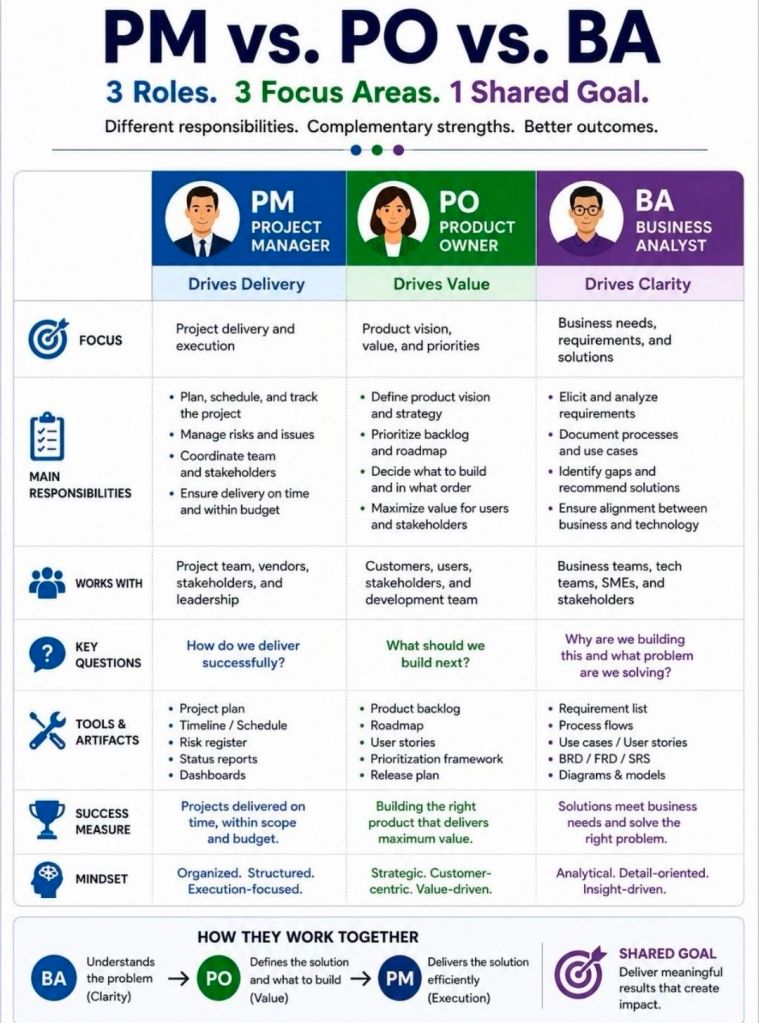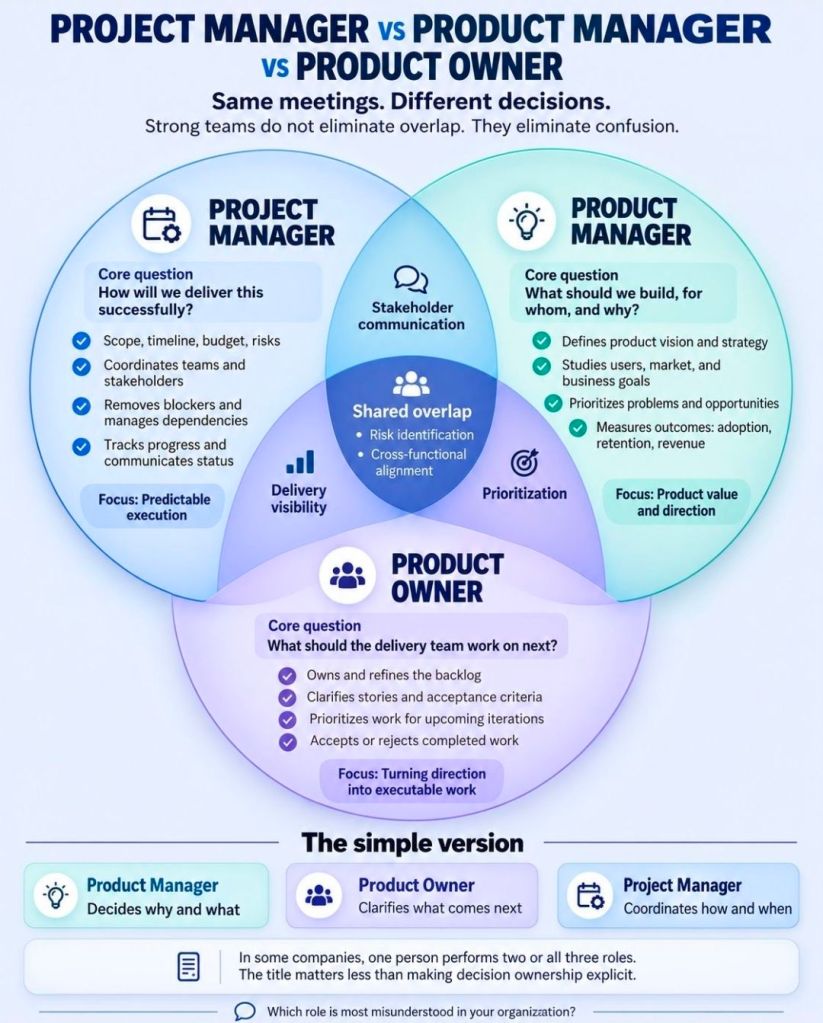
Business Analyst vs Product Owner vs Project Manager

Business Analyst vs Product Owner vs Project Manager

Why do we need a Project Manager if we are Agile?

Why do we need a Project Manager if we are Agile?
Why do we need a PM if we are Agile?

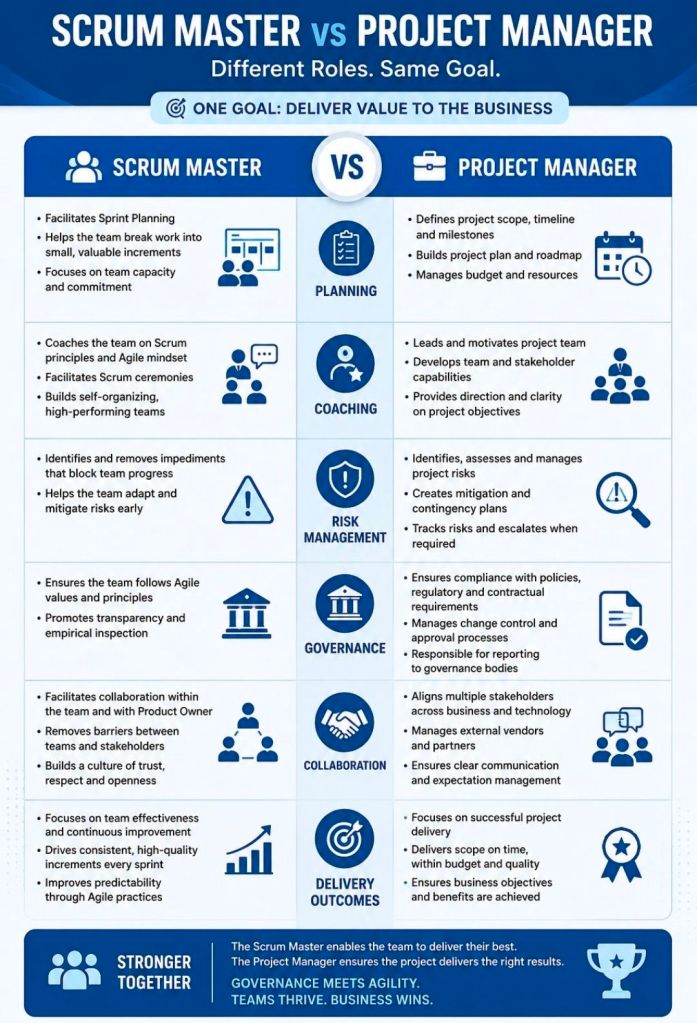
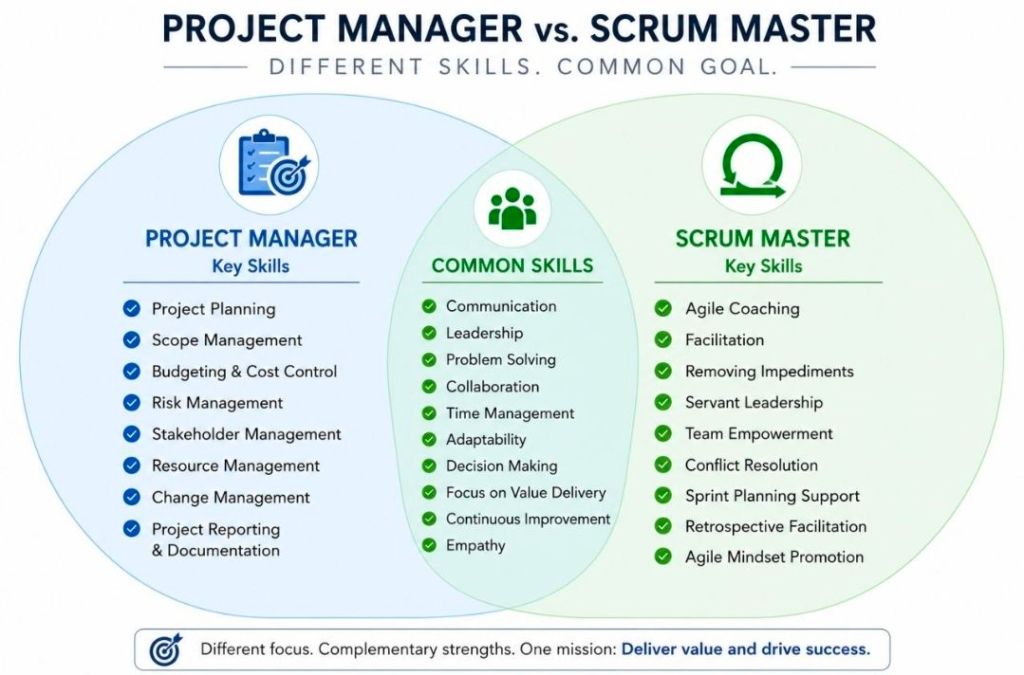
Scrum Master vs Project Manager

Scrum Master vs Project Manager

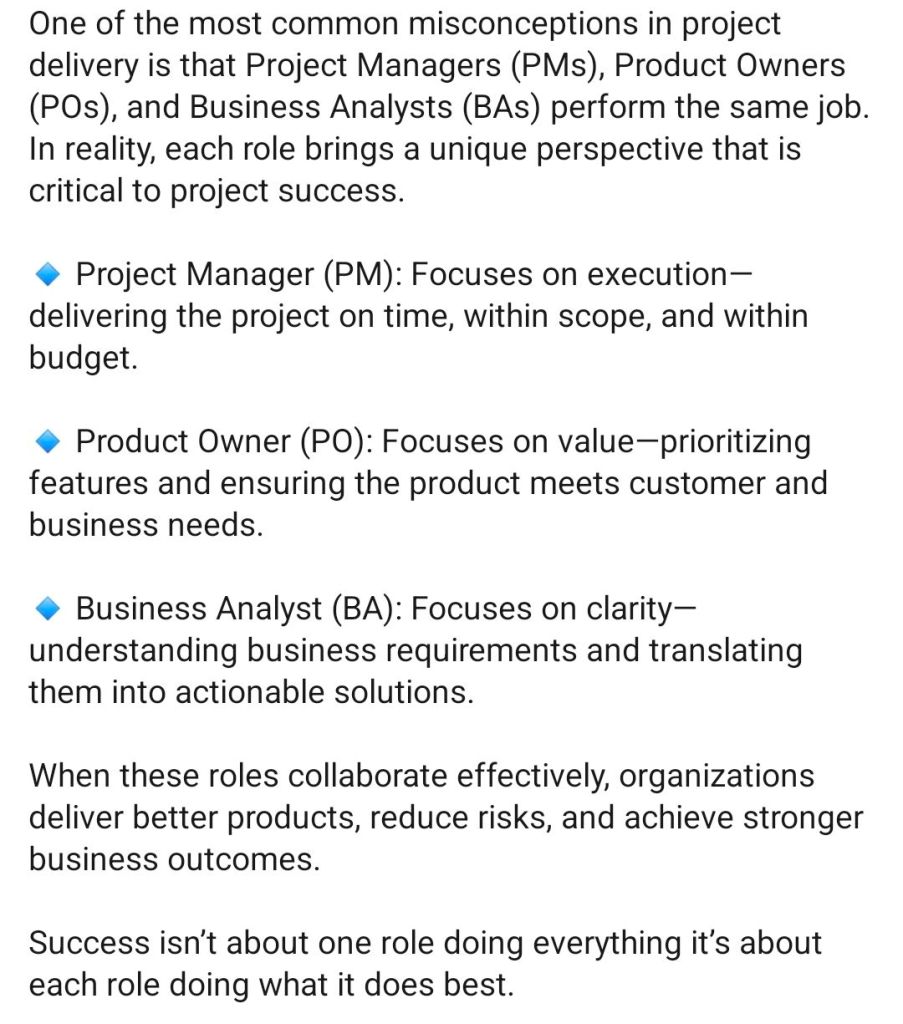
Project Manager vs Product Owner vs Business Analyst

Project Manager PM vs Product Owner PO vs Business Analyst BA
2. Project Manager vs Product Owner vs Business Analyst
Project Manager PM vs Product Owner PO
vs Business Analyst BA

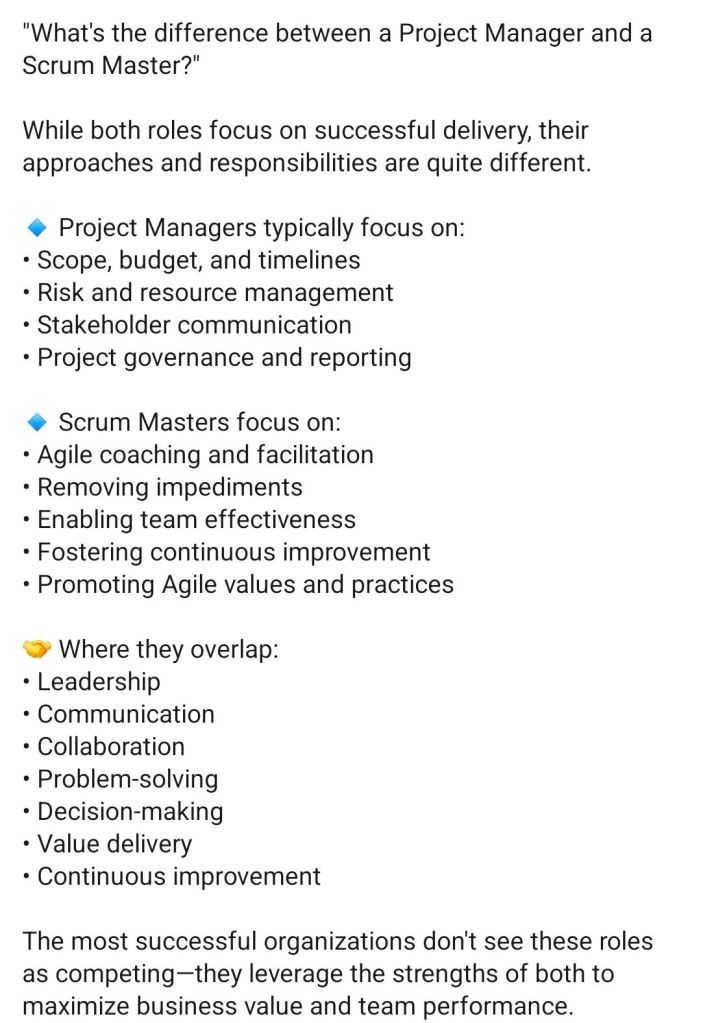
Project Manager vs. Scrum Master

Project Manager vs. Scrum Master

Agile Scrum Master versus Project Manager

The fundamental difference in project delivery ownership is that a Project Manager (PM) owns the overall project outcomes (Scope, Schedule, Budget, Risks), whereas a Scrum Master (SM) owns the delivery process, team effectiveness, and Agile practices.

Scrum Master vs Project Manager –
who owns delivery

A PM directs what needs to happen externally, while an SM coaches how the team works internally.

Agile Scrum Master versus Project Manager
Scrum Master vs Project Manager

Detailed Ownership Breakdown

1. Scope, Requirements, and Product Backlog

  • Project Manager: Directly manages the agreed-upon project scope. They review change requests, evaluate how scope changes impact the budget, and negotiate modifications with stakeholders. They are legally or contractually accountable for delivering the specified scope.
  • Scrum Master: Holds no direct ownership over the product content or scope. Instead, they coach the Product Owner on how to effectively manage the Product Backlog, draft clear user stories, and refine items for upcoming sprints.

2. Schedule, Milestones, and Timeline

  • Project Manager: Owns the macro-level timeline. They track critical path milestones, define task dependencies across multiple teams, and are accountable to executive management if a delivery deadline is missed.
  • Scrum Master: Owns the micro-level iteration cadence (sprints). They do not assign tasks or dictate schedules. Instead, they facilitate Sprint Planning, ensuring the team commits to a sustainable pace of predictable delivery.

3. Budget and Financial Accountability

  • Project Manager: Fully owns the project’s financial performance. They forecast costs, track actual spend against the budget, manage vendor contracts, and seek approval for capital expenditures.
  • Scrum Master: Has zero financial accountability or budget ownership. Their focus is entirely operational—maximizing value and efficiency through team performance rather than managing corporate balance sheets.

4. Issue Resolution and Risk Management

  • Project Manager: Focuses on long-term, macro-level risks (e.g., market shifts, organizational changes, vendor failures). They maintain formal risk registers and coordinate executive-level mitigation plans.
  • Scrum Master: Focuses on immediate, tactical impediments. They own the removal of daily “blockers”—such as technical hurdles, broken tools, or communication gaps—that slow down the development team.

5. Team Governance and Task Assignment

  • Project Manager: Operates with a directive or orchestrating leadership style. They often assign work packages, manage resource utilization, and hold individuals accountable for specific task deadlines.
  • Scrum Master: Operates as a servant-leader and coach. They have no direct authority over team members and do not assign tasks. They empower the team to self-manage, collaborate, and decide collectively how to accomplish the work.

Summary of Success Metrics

  • The Project Manager succeeds when the project is delivered on time, within budget, and according to specifications.
  • The Scrum Master succeeds when the team becomes highly self-managing, continuously improves, and predictably delivers increments of high value.

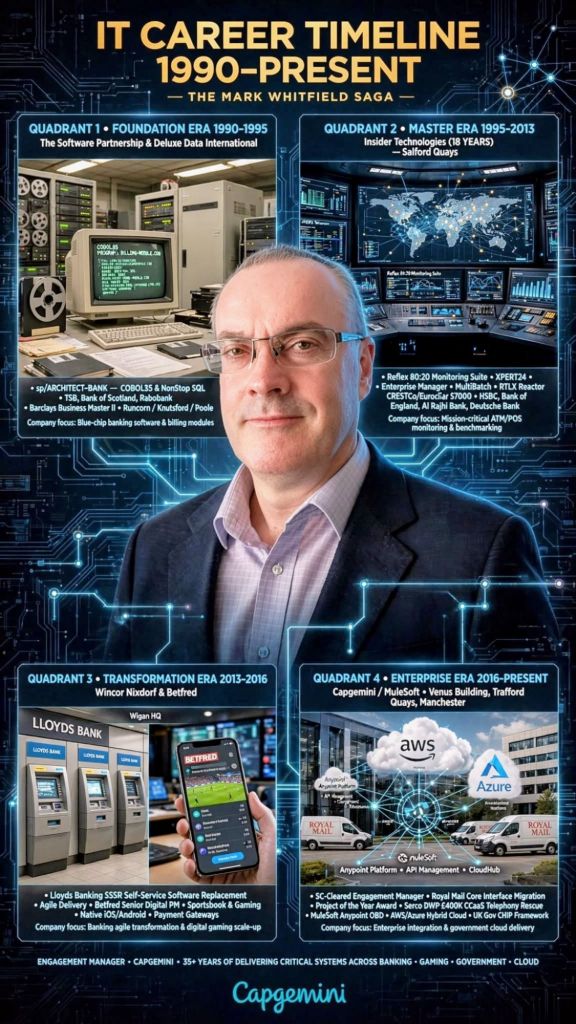
Mark Whitfield – Senior Project Manager – Projects Chronologically

Mark Whitfield is an SC-cleared Senior IT Project and Engagement Manager with over 30 years of experience. His career spans from early mainframe programming to leading multi-million-pound cloud migrations and digital transformations for major financial, utility, and government clients.

The chronological breakdown of his professional project portfolio, structured by his definitive career eras, is detailed below:

1. The Technical Era (1990–1995)

During this foundational era, Mark worked as a Programmer and Lead Analyst for The Software Partnership (acquired by Deluxe Data in 1994). He focused strictly on the development, optimization, and deployment of the sp/ARCHITECT-BANK electronic banking solution on Tandem Mainframe Computers.

  • Project: Barclays Business Master II (BBM II)
    • Year: 1990–1992
    • Client: Barclays (On-site at Knutsford, Cheshire)
    • Budget: Internal banking operational budget
    • Details: Handled the custom design and backend coding for a high-profile desktop electronic business banking application.
  • Project: Automated Touch-Tone Phone Banking Suite
    • Year: 1992–1993
    • Client: Girofon (Denmark)
    • Budget: Client-retained vendor contract
    • Details: Coded automated, menu-driven voice solutions operating on a Periphonics VRAM device to fetch live customer balances directly from mainframes.
  • Project: Early Digital Inter-Account Transfers
    • Year: 1993–1994
    • Client: TSB & Bank of Scotland
    • Budget: Internal product development
    • Details: Directed logic design and mainframe coding to support pioneering inter-account electronic funds transfers.
  • Project: International Banking Optimization
    • Year: 1994–1995
    • Client: Rabobank
    • Budget: Vendor-driven custom development framework
    • Details: Managed localized software optimization, custom patches, and deployment testing for global banking operations.

2. The Infrastructure & Monitoring Era (1995–2014)

Mark transitioned into a Product and Project Manager role at Insider Technologies Limited (and later a brief stint at Wincor Nixdorf). His focus shifted heavily toward platform diagnostics, high-availability transaction monitoring, and financial hardware software integrations.

  • Project: Reflex (Reflex 80:20) System Co-Development
    • Year: 1995–2004
    • Client: Multiple Tier-1 Investment Banks (including Euroclear/Crestco, Bank of England, and Deutsche Bank)
    • Budget: Part of a broader £3M Management Buyout (MBO) product portfolio
    • Details: Acted as Senior Programmer and Technical Lead to co-develop diagnostic monitoring modules for high-availability mainframes.
  • Project: ATM & Point-of-Sale (POS) Transaction Monitoring
    • Year: 2005–2013
    • Client: Barclays, HSBC, and Alliance & Leicester (now Santander)
    • Budget: Multi-year strategic technical vendor account
    • Details: Managed the integration of transaction tracking across ATM networks using ACI’s XPNET and HP NonStop architecture.
  • Project: Legacy ATM Software Modernisation
    • Year: 2013–2014
    • Client: Major UK Retail Bank (via Wincor Nixdorf Professional Services)
    • Budget: Corporate financial service transformation
    • Details: Served as Project Manager executing the swap-out of outdated, legacy ATM client systems for modernized software stacks.

3. The Digital and Cloud Era (2014–Present)

This era highlights Mark’s leadership of large-scale Agile and Waterfall digital delivery frameworks, moving from corporate gambling technology to complex, high-budget UK public sector programs.

  • Project: Mobile & Online Gaming Sportsbook Platforms
    • Year: 2014–2016
    • Client: Betfred Limited (Online & Mobile Division)
    • Budget: Multi-million phased agile commercial releases
    • Details: Led Agile Scrum development teams to upgrade payment gateways, implement fraud detection, and roll out football/horse racing mobile interfaces.
  • Project: National Air Space Real-Time Mobile Applications
    • Year: 2016
    • Client: NATS (UK-wide Air Traffic Organisation)
    • Budget: Corporate custom applications initiative
    • Details: Managed the secure Agile delivery of Apple iOS applications displaying live military and public airspace information.
  • Project: Core Systems Interface Data Centre Migration
    • Year: 2016 (May–October)
    • Client: Royal Mail Group (RMG) / Postal Services
    • Budget: £4.3 Million
    • Details: Led a massive cross-functional team of 90 Capgemini engineers to migrate over 1,100 platform data interfaces ahead of peak annual trading.
  • Project: Automated Call Centre CCaaS Telephony Implementation
    • Year: 2017 (May onwards)
    • Client: Local Regional Government
    • Budget: £400,000
    • Details: Deployed a programmatic dialler system linked with Microsoft Azure CRM to facilitate the “Support for Mortgage Interest” campaign.
  • Project: Automotive Online Car Sales and Digital Readiness
    • Year: 2017 (October)
    • Client: Jaguar Land Rover (JLR) / Aston Agile Delivery Centre
    • Budget: £1.1 Million (Split into a £670k Customer Sales Portal and a £430k Readiness project)
    • Details: Engagement Manager implementing a new-car ecommerce vehicle pipeline.

Project: Middleware & MuleSoft Anypoint Integrations

  • Year: 2018–2019
  • Client: UK Utility, Accounting, and Recruitment Industries (via MuleSoft augmentation)
  • Budget: Enterprise-wide technology vendor accounts
  • Details: Delivery Manager structuring API integration architectures across multi-million-pound client portfolios.

Project: Multi-App Cloud Migration Proof-of-Concept

  • Year: 2020 (Feb–May)
  • Client: UK Government
  • Budget: £375,000
  • Details: Directed a 3-month proof of concept migrating legacy Access, Oracle, and SQL databases to Microsoft Azure and Dynamics 365.

Project: Document Management Cloud Transformation

  • Year: 2021–2022
  • Client: UK Utility Industry (e.g., Welsh/Scottish Water)
  • Budget: £500,000+
  • Details: Managed the platform decommissioning and cloud modernization from legacy EQS document storage over to Azure Enablon.

Project: Enterprise Dynamics 365 Online Cloud Migration

  • Year: 2022 (November onwards)
  • Client: UK Government
  • Budget: £1 Million+ (Part of a larger £13.5M cloud program moving 130 apps)
  • Details: Orchestrated the launch and configuration of Azure Cloud frameworks migrating 12 historical Dynamics 2016 platforms to Dynamics 365 Online.

Project: Fish Export Service (FES) to CHIP Inspection Portal

  • Year: 2023–2024 (Nov–Feb)
  • Client: UK Government / Northern Ireland Trading Framework
  • Budget: £1 Million+
  • Details: Served as Technical Delivery Manager directing Agile Scrum teams to build cloud-hosted APIs supporting catch verification under the Windsor Framework.

Business Analyst vs Project Manager

Business Analyst vs Project Manager