The core electronic banking software product sp/ARCHITECT-BANK was originally developed by The Software Partnership (TSP), a highly specialized British software house co-founded by Nigel Walsh in Runcorn, Cheshire.
Engineered to deliver high-availability, fault-tolerant electronic and desktop home-banking services, it ran natively on Tandem NonStop mainframe computers (now HPE NonStop).
Over the decades, the product evolved through major corporate acquisitions, eventually being integrated into enterprise-level banking suites like CONNEX Advantage under eFunds and FIS.
The detailed timeline of the product, broken down by corporate era and year, is provided below by Mark Whitfield.
Click the previous link for more sp/ARCHITECT BANK project level detail between 1990 thru 1995.
Also, here is a LinkedIn group for the company Alumni.
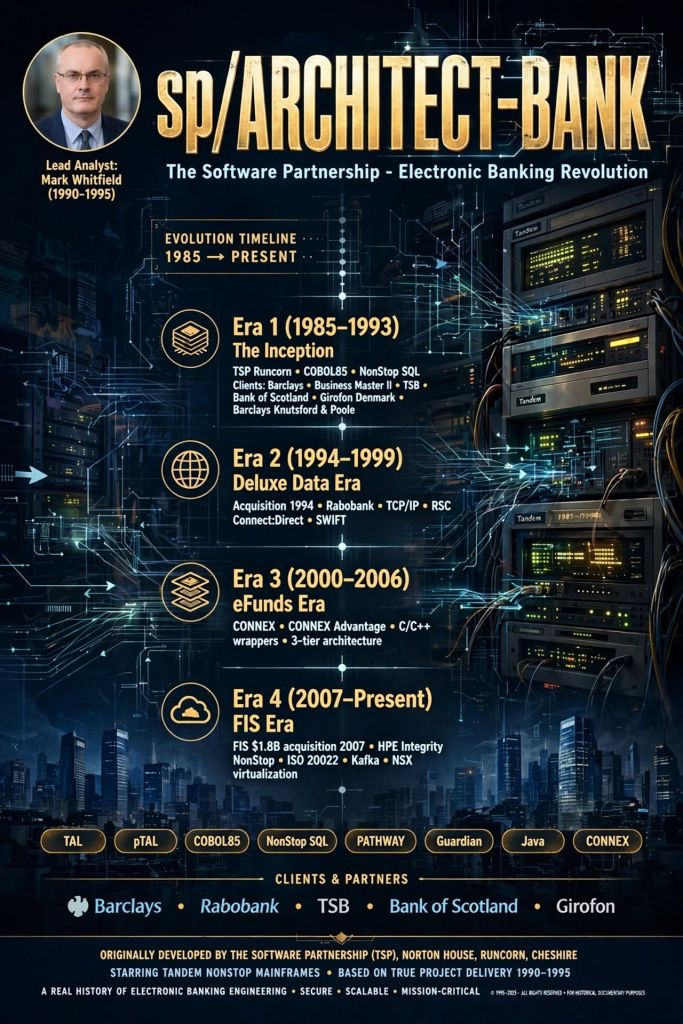
🌅 Era 1: The Inception and Independent Software House Era (Mid-1980s–1993)
During this foundational era, The Software Partnership engineered the core product from scratch to meet the emerging demand for “Direct Electronic Banking” before the commercial internet became prevalent.
- 1985: The Software Partnership (TSP) is co-founded by Nigel Walsh in Runcorn, Cheshire. Development begins on a standard product architecture designed specifically for the transaction processing monitor (PATHWAY) and operating system (Guardian) of Tandem Computers.
- 1988–1989: The company establishes sp/ARCHITECT (and its core module, sp/ARCHITECT-BANK) as a premier client-server base package for corporate and home-office electronic banking.
- 1990: The engineering team scales up to build standard product releases written in COBOL85 and utilizing NonStop SQL databases. They develop proprietary testing utilities like
sp/TESTBEDto simulate PC-to-mainframe interfaces. Mark Whitfield joins the company after graduating in Computing in late 1990. - 1991: Major deployment begins for the high-profile Barclays Business Master II (BBM II) desktop corporate banking application, with TSP placing teams (including Mark Whitfield) on-site at Barclays in Knutsford, Cheshire.

- 1992: A batch billing and invoicing suite of modules is engineered over 3-months and appended to the Barclays installation at Poole, Dorset. Mark Whitfield is assigned to this HPE NonStop (Tandem) billing/ invoicing development on the UK south coast. Simultaneously, TSP expands internationally into continental Europe.

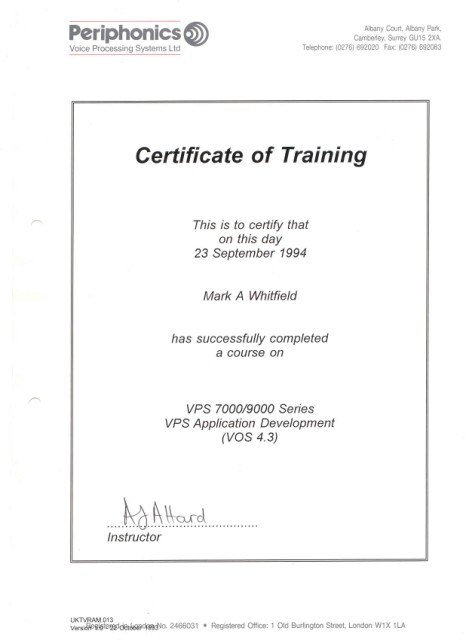
- 1993: TSP develops an automated, touch-tone voice menu system for Girofon (Denmark). The code interfaces phone lines through Periphonics Interactive Voice Response (IVR) hardware directly into the back-end Tandem banking system. Concurrently, the core application handles desktop money transfers and early logic checking for clearing giants TSB and Bank of Scotland. Mark Whitfield is also involved with supporting this IVR technology.
🤝 Era 2: The Deluxe Data International Era (1994–1999)
Recognizing the massive European banking client footprints of sp/ARCHITECT, US-based electronic funds transfer (EFT) specialist Deluxe Data acquired TSP to merge their direct banking and card processing capabilities.
- 1994: Deluxe Data Corporation acquires The Software Partnership. The Runcorn offices are reorganised as Deluxe Data International Operations.
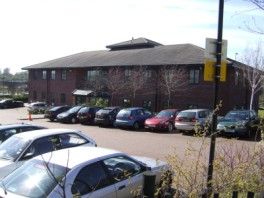
- 1995: The product undergoes heavy code optimization to satisfy customer acceptance loops for international clearers, notably deploying direct electronic banking solutions for major Dutch institutions like Rabobank. Mark Whitfield moves on from Deluxe Data (after 5 years) to Insider Technologies Limited in Salford Quays in late 1995. This to continue HPE NonStop programming work for both monitoring and diagnostic products like Reflex 80:20.
- 1996: Development transitions toward hybrid enterprise networking. The sp/ARCHITECT system is updated with custom TCP/IP software interfaces to allow newer mid-range UNIX servers (such as IBM RS/6000) to safely communicate with the core Tandem server environment.
- 1997: Deluxe Data expands the core platform’s messaging logic using Tandem’s Remote Server Call (RSC) facility. This enables early Windows NT operating systems to request live financial data from the sp/ARCHITECT host.
- 1998: An automated, multi-process file transfer protocol is integrated natively into the bank database, leveraging Connect:Direct transport layers to securely transfer corporate SWIFT financial data files.
🚀 Era 3: The eFunds & Corporate Consolidation Era (2000–2006)
Deluxe Data’s technologies spun off into a new corporate entity called eFunds Corporation, altering the delivery model of the legacy software.
- 2000: Deluxe Electronic Payment Systems officially merges with other divisions to form eFunds Corporation (EFD). The sp/ARCHITECT package becomes a core pillar of eFunds’ international banking portfolio.
- 2002–2004: To modernise the transaction handling backbone, components of the sp/ARCHITECT platform are refactored. The system’s underlying communication routing is systematically aligned with CONNEX, a dominant market-leading Electronic Funds Transfer (EFT) processing engine.
- 2005–2006: eFunds transitions the direct client-server software layers into highly secure corporate portals, providing the foundational logic for what would eventually be rebranded as the CONNEX Advantage banking solution.
🏢 Era 4: The FIS Integration and Legacy Modernisation Era (2007–Present)
The final stage of the product timeline represents its absorption into global banking infrastructure software, where its high-availability DNA remains active in institutional transaction environments.
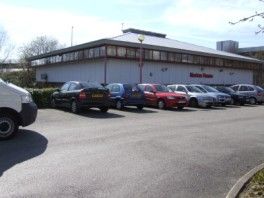
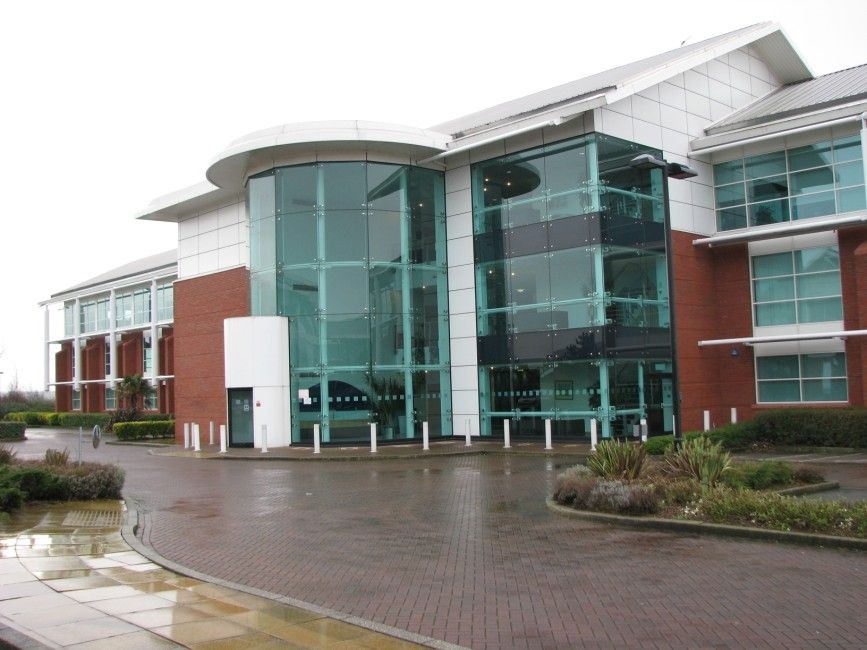
- 2007: Financial technology behemoth Fidelity National Information Services (FIS) acquires eFunds Corporation for approximately $1.8 billion. Following industry consolidation, the corporate remnants of the original TSP Runcorn operations are absorbed into Fidelity National Information Services (FIS) and relocated to Aegon House in Daresbury, Warrington.
- 2010: FIS fully absorbs the remaining codebase, utilizing its core Tandem architecture algorithms to fortify transaction processing stability.
- 2015–2020: The architectural concepts pioneered by sp/ARCHITECT-BANK continue to govern high-volume legacy systems. The logic stays preserved in COBOL85 code bases running on modern HPE Integrity NonStop (Intel Xeon-based) fault-tolerant environments.
- 2020s–Present: Modern banking infrastructures gradually migrate from the classic database frameworks toward microservice configurations and open-banking APIs. However, the core system layout remains a primary point of historical reference for designing high-throughput, 24/7/365 fault-tolerant banking systems.
sp/ARCHITECT-BANK originally developed by The Software Partnership (TSP), Runcorn, Cheshire
sp/ARCHITECT-BANK Code Evolution Timeline
The timeline below details how the code’s core design, language implementations, and application deployment strategies transformed by era and year.
1. The Monolithic & TAL Foundation Era (1980s – Early 1990s)
During this era, the application focus was strictly high-throughput, fault-tolerant electronic funds transfer (EFT) and point-of-sale (POS) switching systems natively built for Tandem Guardian environments.
- Late 1980s: The core design of sp/ARCHITECT is established using TAL (Tandem Application Language). Applications are deployed as single-system monoliths. Code optimization focuses heavily on low-level bit manipulation and message structuring to survive CPU or inter-process failures without losing in-flight transactions.
- 1991–1993: Structuring of modular execution libraries. Early iterations of the codebase segment transaction processing routes from core database logging routines. The introduction of Tandem’s newer NonStop SQL forces early integration layers to transition from standard unstructured unstructured file systems (Enscribe) to early relational tracking.
2. Distributed Client/Server & pTAL Migration Era (Mid 1990s – Early 2000s)
The architectural demands shifted from single-frame monoliths toward distributed banking systems, giving rise to “Distributed Monoliths” and client/server network structures.
- 1995–1996: Hardware evolutions transition from the older CISC-based Tandem systems to RISC architectures (MIPS processors). sp/ARCHITECT undergoes a massive compilation shift to pTAL (portable TAL) to preserve legacy code performance across new instruction sets.
- 1998–1999: Tandem’s acquisition by Compaq pushes the software suite to handle open standard protocols. The application code begins abstracting system calls to prepare for broader networking interfaces.
- 2001–2003: Deluxe Data / eFunds eras. The code sees the introduction of C/C++ wrappers around the legacy pTAL components. Systems are decoupled into a clear 3-Tier architecture: front-end terminal networks, back-end pTAL transactional engines, and standardized clearing houses.
3. Open Systems, Modern Middleware, & Java Integration Era (Mid 2000s – 2010s)
Following HP’s acquisition of Compaq and subsequent software realignments, the sp/ARCHITECT codebase was re-engineered to prevent vendor lock-in and adopt modern enterprise standards.
- 2005–2007: Java is introduced into the sp/ARCHITECT ecosystem. New application modules, specifically merchant portal interfaces and settlement reporting tools, are written entirely in Java and run via OSS (Open System Services) environments.
- 2010–2012: FIS acquisition era integration. Legacy pTAL code blocks are systematically refactored or heavily wrapped in C++ using object-oriented principles to ensure long-term maintenance. The transaction routing engine is altered to support early SOA (Service-Oriented Architecture) paradigms via web-services hooks.
- 2015–2018: Mainstream deployment of COB (Core Banking) standard formats within the application layer. The system moves away from old proprietary network messaging layouts to ISO 20022 compliance frameworks, utilizing dedicated conversion engines native to the sp/ARCHITECT stack.
4. Modern Cloud-Adjacent & Hybrid Infrastructure Era (2020s)
The current evolutionary footprint centers on maintaining the absolute sub-millisecond reliability of the core architecture while exposing capabilities to dynamic cloud endpoints.
- 2021–2023: Modernization of the application payload. High-performance micro-frontends handle real-time fraud monitoring and data streaming using asynchronous event-driven pipelines (e.g., Kafka event consumers interfacing directly with the NonStop core runtime environments).
- 2024–2026: Transition to containerized orchestration and cloud-adjacent infrastructure. The sp/ARCHITECT footprint utilizes x86-based virtualized NonStop systems (NSX), enabling legacy core modules (derived from the original TAL logic) to execute seamlessly on modern virtual environments alongside Linux-based multi-tenant applications.