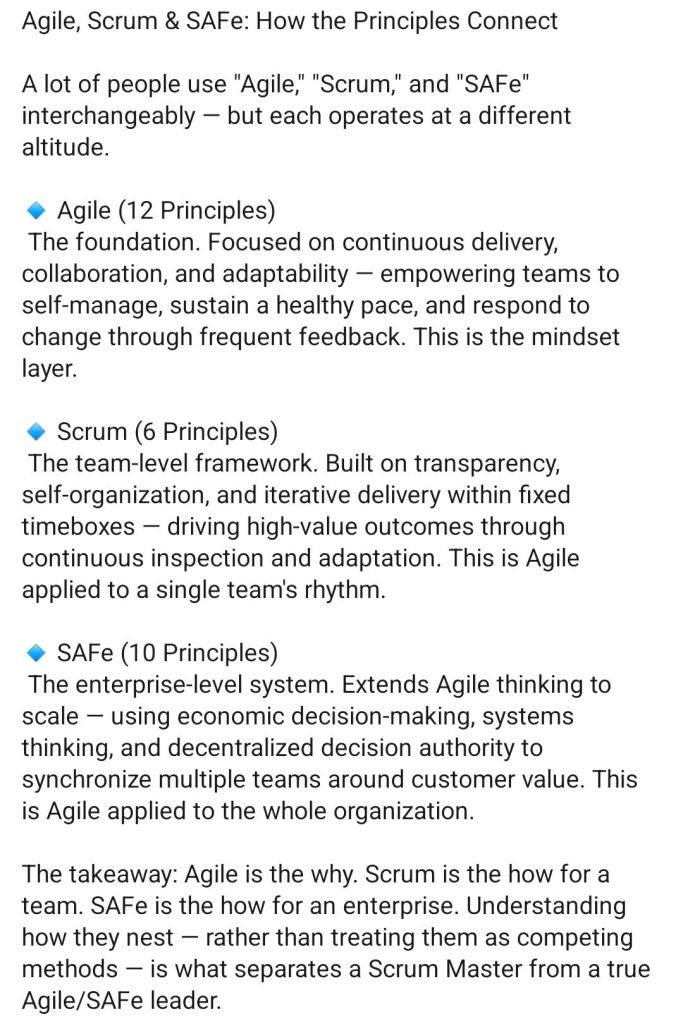
Frameworks compared


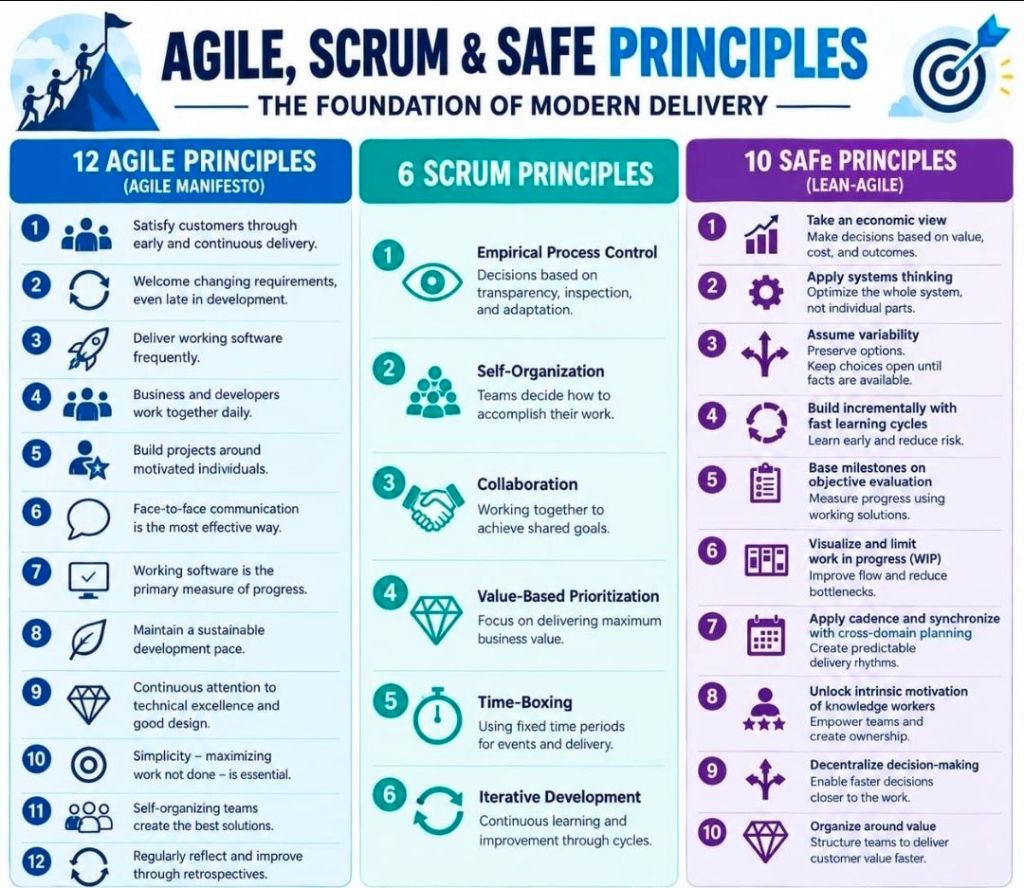
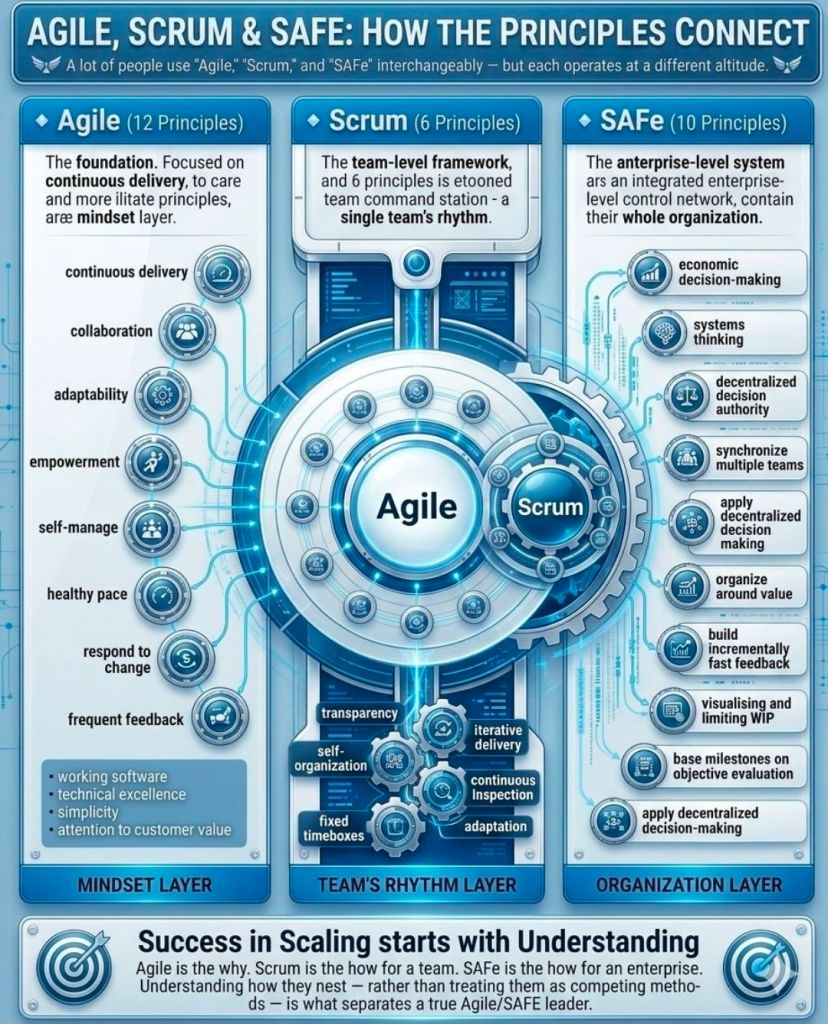
The fundamental difference is scale: Agile Scrum is designed for a single, autonomous team (typically 5–9 people), whereas Scaled Agile Framework (SAFe) is built for the enterprise level to coordinate dozens of teams (50+ people) working toward shared business goals.
Scrum prioritizes team flexibility and speed. Conversely, SAFe trades complete autonomy for centralized alignment, consistency, and structural predictability.
Industry Perspectives on the Trade-offs
While SAFe solves enterprise synchronization challenges, it faces regular scrutiny from product leaders who argue that its highly prescriptive nature can stifle the true spirit of agility.
A popular comment from an agile practitioner on Reddit’s Scrum Community highlights the developer sentiment regarding the process overhead:
“I’ve never seen SAFe implemented without a meeting explosion. More planning, more roles, more acronyms and way more time blocked on calendars.”
Another developer shared a similar perspective on Reddit’s ExperiencedDevs Community:
“Number of meetings have increased 4x. More time is spent for planning to build software than actually building software. Bureaucratic rituals are more important than getting things done.”
Ultimately, SAFe does not replace Scrum. Most organizations implementing SAFe still utilize standard Scrum practices at the team level, leveraging the macro framework solely to manage the dependencies that threaten to derail massive initiatives.
Choosing the Right Approach

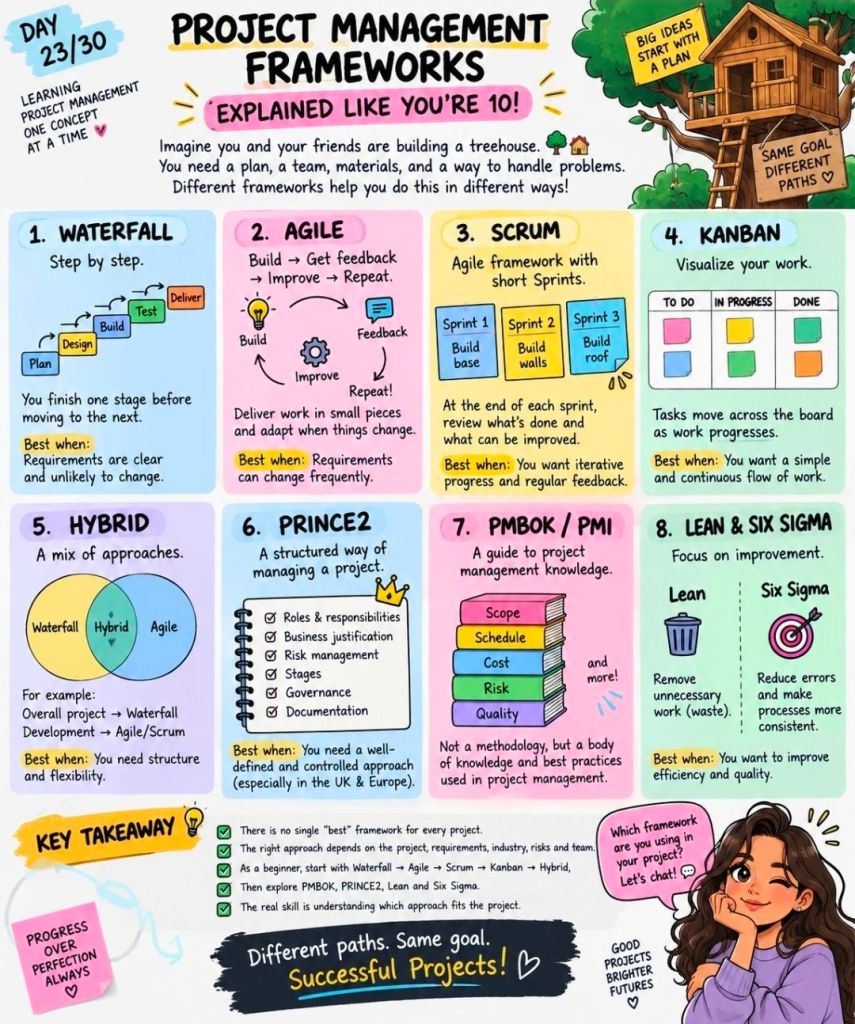
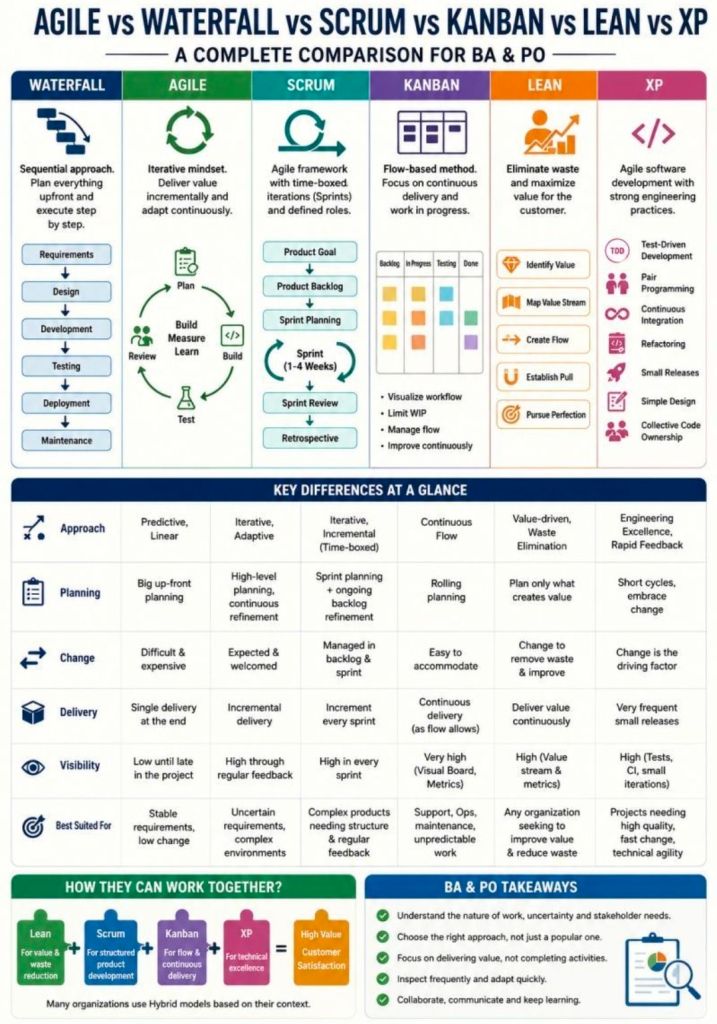
Agile delivery is an iterative approach to project management that focuses on delivering value early, frequently adapting to change, and maintaining continuous customer feedback. Rather than executing a project sequentially, teams break work into small increments to maximize flexibility and product quality.
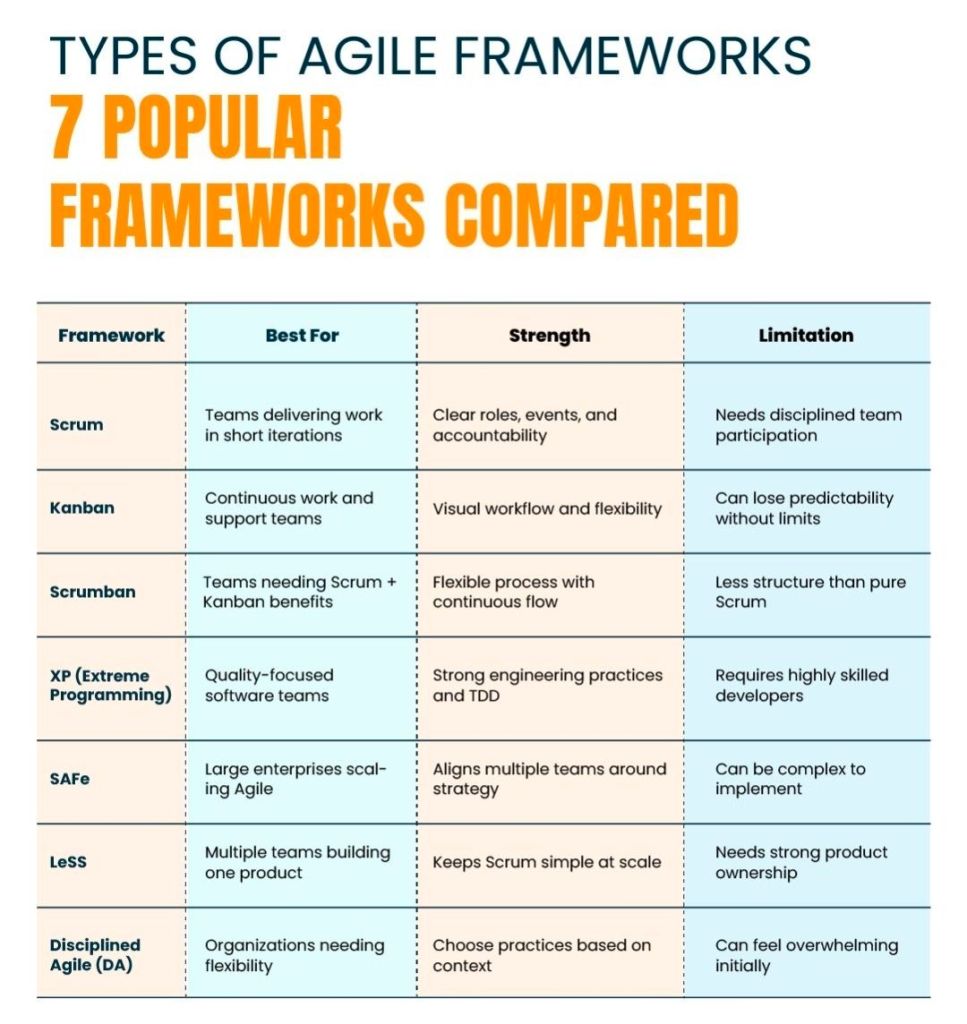
The most common types and frameworks of agile delivery include the following structured methodologies:
1. Scrum
Scrum is the most widely used agile framework, characterized by highly structured, time-boxed iterations called Sprints (typically 1 to 4 weeks long).
2. Kanban
Kanban is a visual workflow management system that emphasizes continuous delivery and transparency without strict time-boxed iterations.
3. Lean Software Development
Adapted from Toyota’s lean manufacturing principles, Lean focuses on maximizing customer value while minimizing waste.
4. Extreme Programming (XP)
XP focuses heavily on technical excellence and software engineering practices to boost product quality and responsiveness.
5. Feature-Driven Development (FDD)
FDD is a model-driven approach that is highly structured and focuses on building software in short, feature-by-feature iterations.
6. Scaled Agile Framework (SAFe)
SAFe is designed for larger enterprises that need to align cross-functional, multiple Agile teams toward a single business strategy.
For further implementation details, you can refer to comprehensive resources like the Atlassian Agile Project Management Guide or the ICAgile Types of Agile Methodology Overview.


Typical Agile Scrum Master interview questions evaluate your understanding of the Scrum Framework (the 3-5-3 structure), your ability to facilitate continuous improvement, and your soft skills in conflict resolution and servant leadership.
The questions generally fall into four core categories:
1. Scrum Fundamentals & Frameworks
These questions test your technical knowledge of Scrum and how it compares to other frameworks.
2. Facilitation & Coaching
Interviewers want to see how you run events, coach Product Owners, and improve team delivery.
3. Behavioral & Situational Scenarios
These “tell me about a time when…” questions assess your real-world experience.
4. Self-Awareness & Servant Leadership
Hiring managers ask these to test your humility and growth mindset.
__________
More Agile Scrum Questions with Example Answers:
Mastering a Scrum Master interview involves demonstrating a deep understanding of servant leadership, the Agile mindset, and hands-on experience navigating team dynamics. Below are the most common interview questions, summarized with strategic, industry-recommended answers to help you stand out.
Core Scrum Framework & Mechanics
Question 1: Explain the 3-5-3 structure of Scrum.
Question 2: What is the difference between a Product Backlog and a Sprint Backlog?
Behavioral & Situational Questions
Question 3: How do you handle conflict within the Scrum team?
Question 4: What do you do if a team member refuses to adopt Scrum practices?
Leadership & Stakeholder Management
Question 5: Tell me about a time you had to challenge leadership or management.
Question 6: How do you measure if your team is truly Agile?


Agile project management is an iterative, adaptive approach that breaks projects down into small, manageable cycles called sprints or iterations. Instead of planning the entire project upfront, teams continuously deliver functional increments, gather immediate feedback, and adapt to changing requirements. It prioritizes team collaboration, customer involvement, and rapid value delivery over rigid documentation and sequential phases.
Comprehensive Timeline Breakdown by Era and Year
Era 1: The Foundational Seeds (1950s – 1980s)
Before “Agile” existed as a formal term, engineers and researchers laid the groundwork through lean manufacturing and early iterative computing.
Era 2: The “Lightweight” Revolt (1990s)
Driven by frustration over the high failure rates and slow delivery of Waterfall, software pioneers independently build faster, more flexible frameworks.
Era 3: The Manifesto Moment (2000 – 2001)
The pivotal pivot point where separate iterative movements unite into a single, cohesive global movement.
Era 4: Mainstream Adoption & Scaling (2002 – 2019)
Agile shifts from a rebellious IT trend into a standard corporate expectation, requiring frameworks that can scale across massive enterprises.
Era 5: Modern Continuous Agility (2020s – Present)
Agile transcends IT entirely, cementing its place as an overarching organizational strategy for business survival in an uncertain world.
Agile Projects Overview and Timeline by year

SAFe (Scaled Agile Framework) events are structured, time-boxed ceremonies designed to drive synchronization, alignment, and continuous improvement across different levels of an enterprise.
These events are primarily categorized into Team-level events (which mirror standard Scrum practices) and Agile Release Train (ART) level events (which orchestrate multiple teams working toward a shared goal).
The core events within Essential SAFe are broken down below by organizational layer.
👥 Agile Team-Level Events
These recurrent ceremonies occur inside a short timebox called an Iteration (typically lasting 2 weeks) and focus on local execution.
🚊 Agile Release Train (ART) Level Events
These higher-level events drive the Planning Interval (PI), an 8 to 12-week timebox where an entire “train” of 5–12 teams delivers cross-functional value.
Summary of Differences
For a quick comparison, you can look at how responsibilities scale across the framework:


This is a detailed, comprehensive historical timeline of project management methodologies, tracing the evolution from ancient practices to modern adaptive frameworks.
I. Pre-Modern Era (Before 1900): Foundation of Task Coordination
II. Early Modern Era (1910s–1950s): The Scientific Management Era
This era brought “scientific management” to project control, focusing on efficiency and visualization.
III. The “Golden Age” of Project Management (1950s–1960s): Formal Methodologies
This era introduced mathematical models for managing complex, interdependent tasks.
IV. The “Silver Age” (1970s–1980s): Systems and Controls
V. Rebirth and Modern Era (1990s–2000s): Agile and Adaptive Methods
VI. The Contemporary Era (2010s–Present): Hybrid, AI, and Speed
Project Management Methodologies, historical timeline by era and year
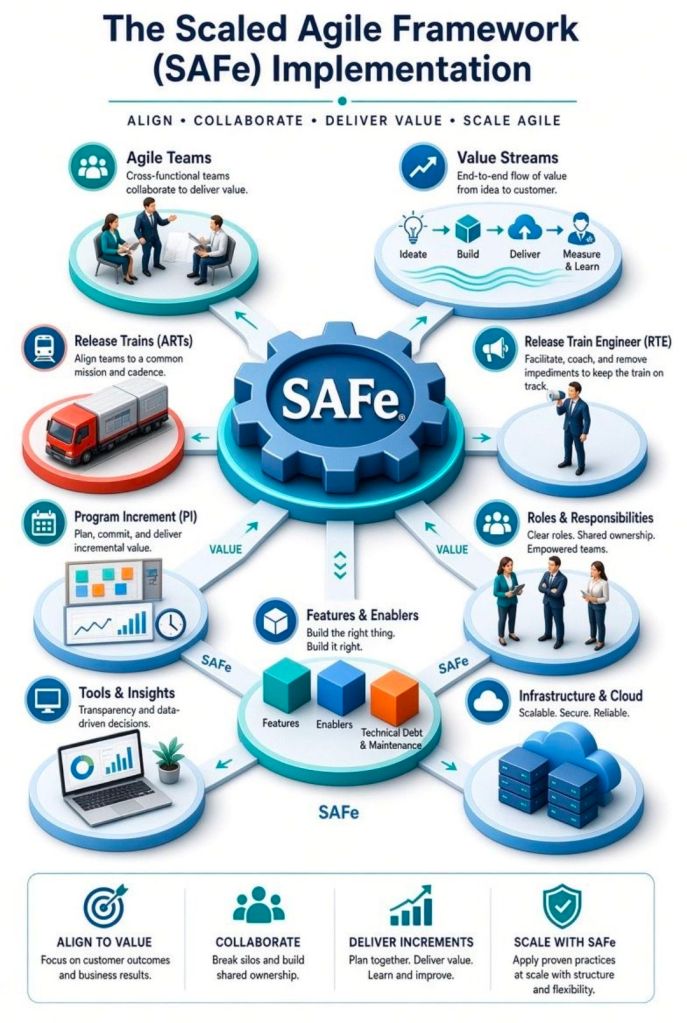
The Scaled Agile Framework (SAFe) is a set of organization and workflow patterns intended to guide enterprises in scaling lean and agile practices across large-scale software and systems development. Created by Dean Leffingwell in 2011, it combines Agile development, Lean product development, and systems thinking to enable alignment, collaboration, and delivery across hundreds or thousands of practitioners.
SAFe Project Management Summary
SAFe structures project management across multiple levels to bring agility to the enterprise:
Historical Timeline by Era and Version
The evolution of SAFe tracks the growing need for business agility and faster delivery in complex organizations.
1. Foundation & Initial Concept (2007–2010)
2. The Early Years: SAFe 1.0 – 2.0 (2011–2013)
3. Expansion: SAFe 3.0 – 4.0 (2014–2016)
4. The Enterprise & DevOps Era: SAFe 4.5 – 4.6 (2017–2018)
5. Business Agility Era: SAFe 5.0 – 5.1 (2020–2021)
6. AI & Continuous Learning Era: SAFe 6.0 (2023–Present)

SAFe Scaled Agile Framework summary and detailed historical timeline by era and year
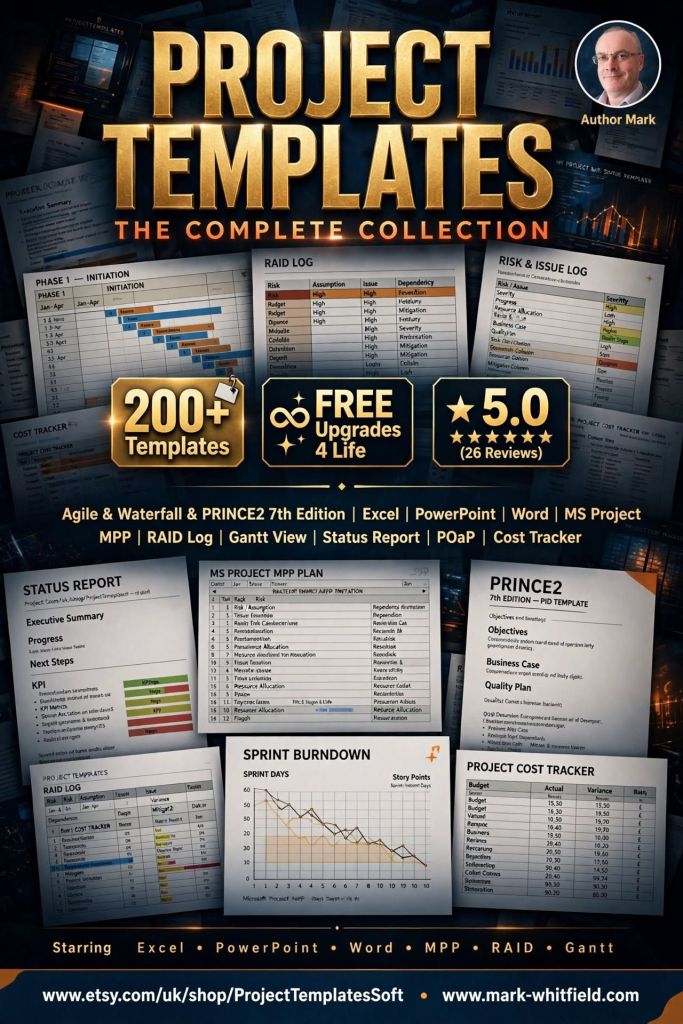
Mark Whitfield provides a comprehensive suite of over 200 editable project management templates designed for both Agile and Waterfall delivery. These tools are built based on 21+ years of IT project delivery experience and are formatted for Microsoft Office (Excel, Word, PowerPoint) and Microsoft Project (MPP).

Core Planning & Tracking Templates

Financial & Resource Management
Reporting & Communication

Methodology Support
These templates are available for purchase on Mark Whitfield’s official site and typically include free lifetime upgrades.
Free Upgrade Project Management Templates Download by focus area
Mark Whitfield’s project management (PM) template collection is a comprehensive professional toolkit containing over 200 editable templates. Designed for both Agile Scrum and PRINCE2/Waterfall delivery, the set is built on over 24 years of real-world experience and is available for purchase on his official website and Etsy.


Core Planning & Tracking Templates
Methodology-Specific Artifacts
Reporting & Documentation
Key Features
Editable Project Management Templates for Agile and Waterfall projects


https://www.linkedin.com/groups/163300
Project Management Café, PRINCE2 Agile SCRUM Kanban MPP MSP Templates ITIL LEAN DevOps PMP Six Sigma
This is a Project Management Group Café for PM students, graduates and professionals looking to either locate, discuss or contribute ideas for PM templates for; Agile, Scrum, Kanban, PRINCE2 Waterfall projects, e.g. Plan on a Page (POaP), RACI, MPP, RAID logs, finance trackers, status reports, org charts etc. etc.
Project Management LinkedIn Group


Agile and Scrum have evolved from specific product development theories into a global standard for project management. While Scrum predates the Agile Manifesto by several years, it has become the most widely adopted framework within the Agile umbrella.


Evolution Timeline
Key Shifts in Scrum Maturity

Agile’s history is a transition from rigid, manufacturing-based “Waterfall” models to flexible, people-centric frameworks. While the term was coined in 2001, its roots trace back to early 20th-century industrial practices and the “software crisis” of the 1960s.
Early Foundations (Pre-1990s)
Before Agile became a formal software methodology, its core principles of efficiency and iteration emerged from manufacturing and early computing.
The Rise of “Lightweight” Methods (1990–2000)
Frustrated by Waterfall’s slow delivery, practitioners developed several “lightweight” frameworks.
Formalisation & Modern Evolution (2001–Present)
The movement unified under a single name and eventually scaled to entire enterprises.
Agile’s evolution is not just a 21st-century phenomenon but a response to decades of “software crises” and rigid industrial processes. Below is a comprehensive historical breakdown of Agile’s journey.
1. Pre-Digital Foundations (1910s – 1940s)
Long before software, the concepts of efficiency and waste reduction were born in manufacturing.
2. Early Iterative Development (1950s – 1970s)
The 1950s saw the first departures from strictly sequential “waterfall” planning.
3. The Proliferation of “Lightweight” Methods (1980s – 1990s)
Frustration with heavyweight, document-heavy processes led to several “Agile” precursors.
4. The Agile Manifesto & Formalisation (2001 – 2010)
Agile moved from a collection of “lightweight” methods to a global standard.
5. Scaling and Modern Business Agility (2011 – Present)
Agile expanded beyond coding into enterprise-wide strategy.

Microsoft PowerPoint was originally developed as “Presenter” by Forethought, Inc. in 1987 for the Apple Macintosh. Microsoft acquired it just three months later for $14 million, marking their first major acquisition.


Foundational Years (1984–1990)
Office Integration (1992–2003)


Modernization & Cloud (2007–Present)


Microsoft PowerPoint Development Timeline History


Microsoft Excel has evolved from a niche Apple Macintosh tool into the world’s most dominant spreadsheet software. Its history is marked by strategic shifts, such as jumping from the MS-DOS era to graphical interfaces to outmanoeuvre then-leader Lotus 1-2-3.
Timeline of Major Excel Milestones


Technological Evolution Highlights


Microsoft Excel Development Timeline History


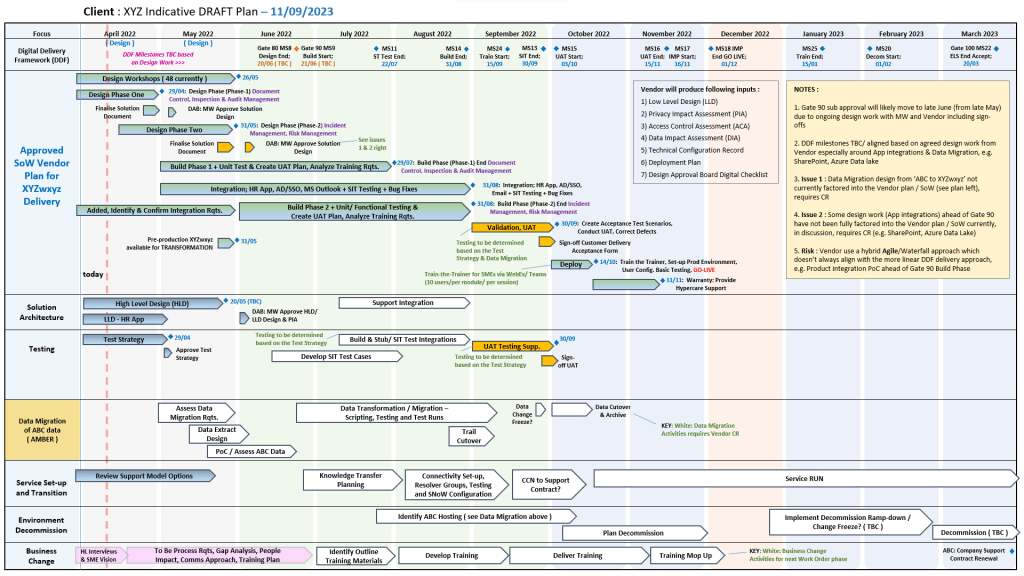
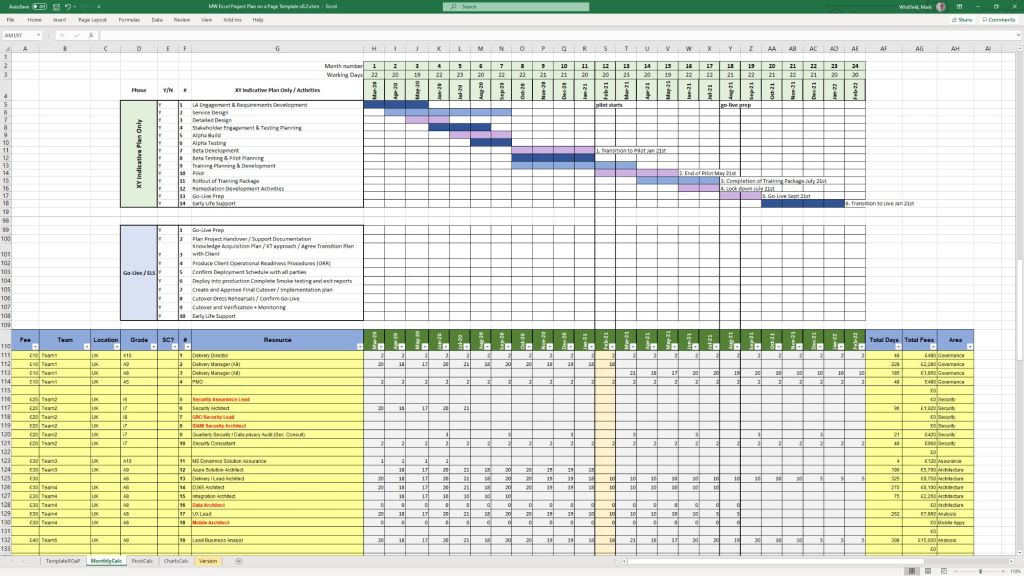
Mark Whitfield’s project management templates offer a range of timeline and planning views designed for Agile, Waterfall, and PRINCE2 delivery. These templates typically include a high-level Plan on a Page (POaP) and detailed Microsoft Project (MPP) or Excel schedules.

Timeline & Planning Views
Key Timeline Components
The templates are pre-configured with several essential timeline elements:
You can find the full package of over 200 editable templates, which include these timeline views and RAID logs, on Mark Whitfield’s official website or via his Etsy store.
Project Management Templates Bundle FREE Upgrades


Gallery of ALL Project Management templates…
(also download the Template Inventory PDF file – 15MB)
Join the FREE PM templates related Facebook Group (LIKE Facebook page) and LinkedIn Group.


https://www.linkedin.com/groups/163300


https://www.eloquens.com/channel/mark-whitfield
https://officedocdepot.com/channel/i_pro_pm_templates/
https://flevy.com/author/ipropmtemplates
https://www.depop.com/products/nonstopmark-free-upgrades-4-life-50/
Buy Editable Project Program Management Template Examples, FREE upgrades and Additions


Plan on a Page POaP example templates 30+ in Microsoft PowerPoint PPT available at website link in banner…


SAFe Implementation Roadmap, Scaled Agile Framework


https://www.etsy.com/uk/listing/995674478/free-upgrades-4-life-agile-waterfall
Available at Etsy or by clicking on the banner link at the top of the page.


Project Management Delivery Templates, FREE upgrades and additions

In the context of business agility, the Scaled Agile Framework (SAFe) management involves synchronising alignment, collaboration, and delivery for multiple agile teams.