Columbo Overview and Detailed Timeline by Era and Year

Columbo is a landmark American crime drama television series that revolutionized the genre by popularizing the “inverted detective story” (howcatchem) format. Running for over 35 years (1968–2003), the show starred Peter Falk as a brilliant, disheveled LAPD homicide detective whose unkempt appearance and polite, rambling demeanor hidden a razor-sharp mind. 

Columbo – Pilot Episode with Gene Barry, 1968

Overview and Key Elements

  • Format: The audience almost always knows who committed the murder at the beginning of the episode. The suspense lies in how Lieutenant Columbo unravels the culprit’s “perfect” alibi.
  • Signature Traits: The Peugeot 403 car, a shabby beige raincoat, a cigar, frequent mentions of an unseen wife, and the catchphrase “Just one more thing”.
  • The “Howcatchem”: Columbo rarely appears in the first act, allowing the killer to showcase their arrogance and meticulous planning before he systematically dismantle their world.
  • Class Conflict: The show frequently pits Columbo (a blue-collar, unassuming figure) against affluent, privileged suspects.
  • Creator/Legacy: Created by Richard Levinson and William Link, inspired by Crime and Punishment and Father Brown, the character first appeared on TV in 1960 and on stage in 1962, but Peter Falk made it his own in 1968. 

Comprehensive Historic Timeline (1960–2014)

Era 1: Pre-Falk & Pilots (1960–1971) 

  • 1960: Columbo appears in “Enough Rope,” an episode of The Chevy Mystery Show (based on the story “Dear Corpus Delicti”). Bert Freed played the lieutenant.
  • 1962: Stage play Prescription: Murder debuts. Thomas Mitchell plays Columbo.
  • 1968 (Feb 20): Prescription: Murder (Pilot 1) airs on NBC, featuring Peter Falk for the first time.
  • 1971 (Mar 1): Ransom for a Dead Man (Pilot 2) airs. Its success leads to a series order. 

Era 2: The NBC Classic Era (1971–1978) 

  • 1971–1972 (Season 1): Columbo becomes a “wheel” program in The NBC Mystery Movie. Notable episode: “Murder by the Book” (directed by Steven Spielberg).
  • 1972 (Sep 17): Season 2 premieres, establishing the show as a top-rated Sunday night anchor.
  • 1973: Peter Falk wins his first Golden Globe for the role.
  • 1974: Season 3. “Any Old Port in a Storm” introduces Columbo’s penchant for humming “This Old Man”.
  • 1975: Season 4/5. “Forgotten Lady” (with Janet Leigh) and “Case of Immunity”.
  • 1976: Peter Falk wins Emmys (1972, 1975, 1976).
  • 1978 (May): Final NBC episode airs (Season 7) before Falk leaves the role due to scheduling. 

Era 3: The ABC Revival Era (1989–2003) 

  • 1989 (Feb): Columbo returns on ABC under The ABC Mystery Movie with “Columbo Goes to the Guillotine”.
  • 1990: Season 9/10 begins. Falk wins his 4th Primetime Emmy (1990).
  • 1991–2002: The show airs irregularly as “Specials” rather than a strict series.
  • 2003 (Jan 30): Last episode, “Columbo Likes the Nightlife,” airs, completing 69 total episodes. 

Post-Series & Legacy

  • 2007: Peter Falk pitches “Columbo’s Last Case” to ABC; it is rejected.
  • 2011 (June 23): Peter Falk dies at age 83.
  • 2014: A statue of Lieutenant Columbo and his dog is unveiled in Budapest, Hungary. 

Major Episodes and Guest Stars

  • Jack Cassidy: Played killers in 3 episodes (best known as Riley Greenleaf in “Publish or Perish”).
  • Robert Culp: Played killers in 3 episodes (“Death Lends a Hand,” “The Most Crucial Game,” “Double Exposure”).
  • Patrick McGoohan: Acted in 4 episodes (3 as killer) and directed 5, including “By Dawn’s Early Light”.
  • William Shatner: Starred in “Fade In to Murder” (1976) and “Butterfly in Shades of Gray” (1994).
  • Johnny Cash: Starred in “Swan Song” (1974). 

Where to Watch & Review Sites

Columbo Overview and Detailed Timeline by Era and Year

Movie Martial Arts and Timeline by Era and Year

Martial arts cinema has evolved from silent, fantastical tales of folklore to a global, high-octane genre blending practical fighting skills with advanced technology. Dominated primarily by Hong Kong action cinema, the genre peaked from the early 1970s through the mid-1990s, with significant modern revivals in Thailand, Indonesia, and Hollywood. 

Detailed Historic Timeline and Eras

1. The Origins & Silent Era (1920s–1940s)
Early martial arts films originated in Shanghai, drawing heavily from Chinese opera and wuxia (sword-fighting fantasy) novels. 

  • 1928: The Burning of the Red Lotus Temple (Shanghai) is widely considered the first kung fu film, pioneering stylized, fantastical fight scenes.
  • 1943: Sanshiro Sugata (Judo Saga), Akira Kurosawa’s directorial debut, marks a significant, more grounded entry in Japanese cinema. 

2. The Pre-Boom & Wuxia Revival (1950s–1960s)
This era saw the rise of the Mandarin-speaking studios in Hong Kong (Shaw Brothers) and the dominance of Japanese samurai (chambara) films. 

  • 1954: Seven Samurai (Japan) elevates swordplay choreography.
  • 1966: King Hu’s Come Drink with Me redefines the genre with elegant, dance-like choreography.
  • 1967: The One-Armed Swordsman (Chang Cheh) brings a more brutal, masculine edge to the genre, breaking records in Hong Kong. 

3. The Golden Age & Bruce Lee Era (1970–1979)
The 70s saw the shift from fantastical swordplay to realistic hand-to-hand kung fu, propelled by Bruce Lee. 

  • 1970: The Chinese Boxer (Jimmy Wang Yu) shifts focus from swordplay to unarmed combat.
  • 1971: The Big Boss (Fist of Fury) breaks all Hong Kong box office records, launching Bruce Lee as a global superstar.
  • 1973: Enter the Dragon becomes the first Hollywood-Hong Kong co-production, cementing kung fu in global popular culture.
  • 1978: Drunken Master makes Jackie Chan a star, introducing a comedic, acrobatic fighting style.
  • 1978: The 36th Chamber of Shaolin sets the benchmark for training montages and traditional kung fu films. 

4. Comedy, Action & The Golden Harvest Era (1980s–1990s)
Jackie Chan, Sammo Hung, and Jet Li dominated this era with insane stunts and high-speed choreography. 

  • 1983: Project A showcases Jackie Chan’s dangerous, physical stunt comedy.
  • 1984: The Karate Kid (USA) mainstreamed martial arts in Western youth culture.
  • 1988: Bloodsport (Jean-Claude Van Damme) sparks a resurgence of interest in martial arts cinema in the US.
  • 1991: Once Upon a Time in China launches Jet Li to fame, blending traditional techniques with fast-paced editing.
  • 1994: Drunken Master II (The Legend of Drunken Master) is released, often considered one of the greatest martial arts films ever made. 

5. Modernization & Global Expansion (2000s–Present)
The 21st century brought a mix of stylistic, high-budget wuxia and brutally realistic,, practical action. 

  • 2000: Crouching Tiger, Hidden Dragon earns critical acclaim and international accolades for its artistic blend of wuxia and drama.
  • 2003: Ong-Bak: The Thai Warrior introduces Tony Jaa and the raw, dangerous power of Muay Thai to the world.
  • 2008: Ip Man (Donnie Yen) revives the biographical, martial arts hero film in China.
  • 2011: The Raid: Redemption (Indonesia) raises the bar for grittier, intense, high-speed combat.
  • 2021: Shang-Chi and the Legend of the Ten Rings represents the integration of HK-style choreography into the Marvel Cinematic Universe. 

Summary of Key Styles & Subgenres :

  • Wuxia: Fantastical, wire-fu, sword-fighting (e.g., HeroCrouching Tiger).
  • Kung Fu: Traditional unarmed combat, training focus (e.g., 36th Chamber).
  • Kung Fu Comedy: Acrobatics and physical comedy (e.g., Drunken Master).
  • Chambara: Japanese samurai films (e.g., Yojimbo).
  • Urban/Action: Modern setting, hard-hitting choreography (e.g., The Raid).
  • Gun Fu: Blending martial arts with firearms (e.g., John Wick). 

Movie Martial Arts and Timeline by Era and Year

Wimbledon Championships Overview and Detailed Timeline History

The Championships, Wimbledon, is the world’s oldest tennis tournament and widely considered the most prestigious. Founded in 1877 by the All England Croquet and Lawn Tennis Club, it is the only Grand Slam still played on outdoor grass courts. 

Full Overview

  • Location: All England Lawn Tennis and Croquet Club, Church Road, Wimbledon, London.
  • Surface: Outdoor Grass (100% rye grass, cut to 8mm).
  • Timeframe: Typically held over two weeks in late June – early July.
  • Key Traditions: All-white dress code for players, serving strawberries and cream, and Royal patronage.
  • Main Events: Gentlemen’s Singles, Ladies’ Singles, Gentlemen’s Doubles, Ladies’ Doubles, and Mixed Doubles.
  • Key Facilities: Centre Court (featuring a retractable roof since 2009) and No. 1 Court. 

Detailed Historic Timeline by Era

The Beginnings & The Amateur Era (1877–1967)

  • 1877: Inaugural championship held. Only Gentlemen’s Singles with 22 participants. Spencer Gore wins.
  • 1884: Ladies’ Singles and Gentlemen’s Doubles introduced. Maud Watson becomes the first female champion.
  • 1905: May Sutton (USA) becomes the first overseas champion.
  • 1915–1918: No tournament held due to World War I.
  • 1922: Tournament moves from Worple Road to the current Church Road venue.
  • 1934–1936: Fred Perry wins three consecutive Gentlemen’s singles titles.
  • 1937: First television broadcast of the tournament.
  • 1940–1945: No tournament held during World War II; Centre Court is bombed in 1940.
  • 1951: First black player, Bertrand Clark, competes.
  • 1957: Althea Gibson becomes the first black American winner.
  • 1967: First live colour television broadcast. 

The Open Era (1968–Present) 

  • 1968: Wimbledon becomes an “Open” tournament, allowing professional players to compete alongside amateurs.
  • 1971: First Wimbledon singles final to end on a tie-break (Evonne Goolagong def. Chris Evert).
  • 1976–1980: Bjorn Borg wins five consecutive Gentlemen’s singles titles.
  • 1977: Centenary Championships. Virginia Wade is the last British woman to win the title.
  • 1985: Boris Becker becomes the youngest ever male champion at age 17.
  • 1990s: Steffi Graf and Pete Sampras dominate the decade.
  • 2001: Goran Ivanišević wins the Gentlemen’s singles as a wildcard.
  • 2003–2007: Roger Federer wins five consecutive titles.
  • 2008: Rafael Nadal defeats Roger Federer in a historic final considered one of the best matches in history.
  • 2009: Retractable roof installed on Centre Court.
  • 2010: Longest match in history: John Isner vs. Nicolas Mahut (11 hours 5 minutes).
  • 2013: Andy Murray becomes the first British male winner in 77 years.
  • 2020: Cancelled for the first time since WWII due to the COVID-19 pandemic.
  • 2022: All-white clothing rule modified to allow women to wear darker undershorts.
  • 2023/2024: Carlos Alcaraz wins back-to-back Gentlemen’s titles. 

Key Records & Facts

  • Most Titles (Gentlemen’s Singles): Roger Federer (8).
  • Most Titles (Ladies’ Singles): Martina Navratilova (9).
  • Fastest Serve: John Isner (157.2 mph).
  • Oldest Champion: Dorothea Lambert Chambers (1914).
  • Youngest Champion: Lottie Dod (1887). 

Links

Wimbledon Championships Overview and Detailed Timeline History

Tandem Computers ( HPE NonStop ) Overview & Detailed Timeline

Tandem Computers, founded in 1974 by James (Jimmy) Treybig, revolutionized the computing industry by pioneering fault-tolerant computer systems. Designed specifically for online transaction processing (OLTP) in banking, stock exchanges, and telephone switching, Tandem’s “NonStop” systems provided near-zero downtime by utilizing redundant, modular processors and a “shared-nothing” architecture. 

Tandem remained an independent, rapidly growing company until it was acquired by Compaq in 1997, later becoming part of Hewlett Packard Enterprise (HPE). 

Overview of Key Technologies

  • NonStop Architecture: The core design featured multiple independent processors, each with its own memory and I/O bus, interconnected by a redundant inter-CPU bus called the Dynabus.
  • Guardian OS: A message-based operating system designed to detect faults immediately (“fail-fast”) and mirror process states to a backup processor, allowing seamless failover.
  • NonStop SQL (1986): The first fault-tolerant SQL database, known for linear scalability.
  • ServerNet (1995): A high-speed, scalable, point-to-point network system that replaced the Dynabus and influenced modern InfiniBand standards. 

Detailed Historic Timeline by Era and Year

The Founding Era (1974–1979) 

  • 1974: Tandem Computers is founded in Cupertino, California, by Jimmy Treybig, formerly of HP. Initial venture capital investment comes from Kleiner & Perkins.
  • 1975: Design of the Tandem/16 (T/16) is completed.
  • 1976: The first T/16 NonStop system is shipped to Citibank.
  • 1977: Tandem goes public; sales begin rapid, exponential growth.
  • 1978: Introduction of the ENCOMPASS database management system.

The Growth and Competition Era (1980–1989)

  • 1980: Inc. magazine ranks Tandem as the fastest-growing public company in America.
  • 1981: NonStop II is introduced, supporting 32-bit addressing to allow for larger applications.
  • 1982: Competition intensifies as Stratus Technologies enters the fault-tolerant market. Tandem faces its first quarter of declining growth.
  • 1983: Introduction of the NonStop TXP, the first entirely new implementation of the TNS architecture with cache memory.
  • 1985: Attempted entry into the PC market with the MS-DOS-based Dynamite PC, which fails commercially and is withdrawn.
  • 1986: Introduction of the NonStop VLX (32-bit datapath) and the revolutionary NonStop SQL database.
  • 1987: Introduction of the low-cost NonStop CLX for small office environments.
  • 1988: Tandem acquires Ungermann-Bass, Inc. to strengthen networking capabilities.
  • 1989: Introduction of the NonStop Cyclone, a high-end ECL-based processor aimed at mainframe markets. 

The Open Standards & MIPS Transition Era (1990–1996)

  • 1990: Tandem introduces the Integrity line of fault-tolerant Unix systems.
  • 1991: Cyclone/R (CLX/R) is released, marking the start of the migration from proprietary stack machines to MIPS R3000 RISC microprocessors.
  • 1993: Introduction of the NonStop Himalaya K-series using faster MIPS R4400 processors.
  • 1994: NonStop Kernel (NSK) is extended with Open System Services (OSS), a POSIX-compliant Unix environment.
  • 1995: Introduction of ServerNet, designed for extremely low-latency inter-processor communication.
  • 1995–1997: Partnered with Microsoft on the “Wolfpack” project, which becomes Microsoft Cluster Server. 

Acquisition and Integration Era (1997–Present)

  • 1997: Compaq acquires Tandem Computers for roughly $3 billion. The Himalaya S-Series is introduced.
  • 1998: Compaq acquires DEC, leading to a shift in engineering strategy towards Alpha/Itanium instead of MIPS.
  • 2001: Compaq terminates Alpha engineering, committing to Intel’s Itanium (Merced) processors.
  • 2002: Hewlett-Packard acquires Compaq. Tandem becomes the core of the HP Integrity NonStop Server division.
  • 2005: The first HP Integrity NonStop servers (TNS/E) based on Itanium processors are released.
  • 2014: Completion of the migration to Intel x86 architecture (NonStop X). 

Note: Following the split of HP into Hewlett Packard Enterprise (HPE) and HP Inc., the NonStop product line continues to be developed and supported by HPE.

Tandem Computers Overview and Detailed Timeline

Twin Peaks Story Overview and Timeline by Era

Twin Peaks is a landmark surrealist mystery-horror drama created by David Lynch and Mark Frost, premiering in 1990. It blends a small-town soap opera with supernatural horror, focusing on the investigation into the murder of homecoming queen Laura Palmer. The story unfolds across two television seasons (1990–1991), a prequel film (Fire Walk with Me), and a revival season (The Return), with significant, often contradictory lore found in tie-in books like The Secret History of Twin Peaks

Twin Peaks is a landmark surrealist mystery-horror drama

Full Overview

  • The Premise: FBI Special Agent Dale Cooper travels to the fictional town of Twin Peaks, Washington, to investigate the murder of popular high school student Laura Palmer.
  • The Conflict: The investigation uncovers deep, dark secrets hidden behind the town’s idyllic facade, including the involvement of an ancient, malevolent supernatural entity named “BOB,” who possesses people to commit atrocities.
  • The Supernatural World: The story centers on two metaphysical realms: the White Lodge (associated with good) and the Black Lodge (associated with evil), often referred to together as “The Lodges”.
  • The Structure: Fire Walk with Me provides the final week of Laura’s life, while Season 3 (The Return) takes place 25 years later, dealing with the consequences of the original series and alternate realities. 

Detailed Historic Timeline by Era and Year

Ancient Era – 19th Century: Founding and Entities

  • ~1,000,000,000 B.C.: The future site of Twin Peaks is on the western coast of Pangea.
  • 1805: Meriwether Lewis (of Lewis and Clark) visits the area, specifically the Owl Cave lodges, and is believed to have encountered the supernatural forces.
  • 1872: The town of Twin Peaks is established.
  • 1879: Miners accidentally discover Owl Cave.
  • 1896: “The Terrible Fire” in Twin Peaks. 

20th Century – Pre-Series (1900–1988) 

  • 1928: The Great Northern Hotel opens.
  • July 16, 1945: The Trinity Test atomic explosion in New Mexico creates a breach between worlds, releasing BOB and other entities, and triggering the “birth” of a counter-force (implied to be Laura Palmer).
  • 1956: A “frog-moth” creature enters a young girl in New Mexico; a mysterious Woodsman kills a radio DJ, spreading a paralyzing chant.
  • 1967 (Dec 25): Dale Cooper begins keeping his audiotape journal for Diane.
  • 1971 (July 22): Laura Palmer is born.
  • 1982-1985: Dale Cooper and Windom Earle play chess; Earle goes insane, kills his wife (Caroline), and wounds Cooper.
  • 1983: Andrew Packard brings Josie home; Andrew is later killed in a plot with Thomas Eckhardt.
  • 1987: Agent Phillip Jeffries disappears in Buenos Aires, appearing briefly at the FBI Philadelphia office to warn them about Cooper and BOB. 

The Critical Year (1988–1989) 

  • July 1983 – February 1989: Laura Palmer writes in her secret diary.
  • February 9, 1988: Fire Walk with Me events begin. Teresa Banks is murdered in Deer Meadow (the original “wrapped in plastic” case).
  • February 23, 1989: Leland Palmer (possessed by BOB) rapes Laura.
  • February 23-24, 1989: Laura Palmer is murdered.
  • February 24, 1989: Pete Martell finds Laura “wrapped in plastic”. Agent Cooper arrives.
  • March 1989: Seasons 1 & 2 occur, covering about 4 weeks. Laura’s murderer (Leland/BOB) is revealed and dies.
  • March 1989: Cooper enters the Black Lodge to save Annie Blackburn; Cooper’s doppelganger (possessed by BOB) escapes into the world. 

The Gap and The Return (1990–2017)

  • 1990-2015: Cooper’s doppelganger lives a life of crime, avoiding returning to the Black Lodge.
  • 1997: Douglas Jones (a, presumably artificial, entity) has a car accident.
  • 2016 (September-October): The events of Twin Peaks: The Return (Season 3) occur. The doppelganger attempts to avoid being pulled back into the Lodge, while the “good” Cooper tries to return to the real world.
  • 2016/2017: A new, altered timeline is created when Cooper prevents Laura’s murder in 1989, potentially erasing the events of the first two seasons, leading to the existence of “Carrie Page” in Odessa, Texas.
  • September 2017: The Final Dossier is published, wrapping up the fates of the townspeople in the altered timeline. 

Twin Peaks Story Overview and Timeline by Era

HPE NonStop ViewSys Overview and Timeline by Era

ViewSys is a legacy, interactive system monitoring utility for HPE NonStop servers that provides real-time visibility into system resource utilization. Similar to PEEK and Measure, it allows system operators to view resource consumption as it happens, allowing for immediate analysis of the impacts of process relocations or controller path changes. 

HPE NonStop ViewSys Overview

  • Purpose: Monitors system resources, including processor utilization, I/O performance, and memory usage, on NonStop systems.
  • Key Features: Provides online viewing of system resources, allowing for quick recognition of performance bottlenecks, which helps in performance tuning.
  • Functionality: Unlike Measure, which is typically analyzed offline, ViewSys offers an interactive, live, and graphical view of system performance.
  • Operation Requirement: Runs from HPE block mode terminals or non-Stop terminal emulators, presenting average resource usage for each polling interval. 

Detailed Historic Timeline: ViewSys & NonStop Monitoring Evolution

The history of ViewSys is deeply intertwined with the development of the HPE NonStop OS and its monitoring toolkit.

Era 1: Tandem Era (The Early Days)

  • 1976: Initial Tandem NonStop System introduced; basic system monitoring is manual and console-based.
  • 1980s (Mid-late): As Transaction Monitoring Facility (TMF) and Pathway are introduced, the need for interactive monitoring grows.
  • 1990s: ViewSys becomes a key utility for operators managing massive OLTP (Online Transaction Processing) workloads. 

Era 2: Compaq/Early HP Era (The Transition)

  • 1997: Compaq Acquires Tandem.
  • 2003: HP Acquires Compaq. The monitoring focus begins to merge with Integrity-based architecture.
  • 2004: The ViewSys User’s Guide highlights ViewSys alongside PEEK and Measure, standardizing its use for interactive monitoring.
  • 2005: Introduction of HP Integrity “NonStop i” (TNS/E) servers using Intel Itanium processors. ViewSys adapted to monitor Itanium systems. 

Era 3: Modern HPE Era (The Modernization) 

  • 2014: First NonStop X (TNS/X) systems on x86-64 are introduced. ViewSys remains a available tool, but modernization efforts begin.
  • 2015: Hewlett Packard Enterprise (HPE) is formed.
  • 2016-2020: Shift towards Web ViewPoint Enterprise (by Idelji Corporation), which provides web-based dashboards for monitoring EMS events and system metrics.
  • 2020: Sales of Itanium-based systems end. Modern monitoring focuses heavily on NonStop X systems and virtualized environments.
  • Present: While legacy ViewSys may exist in older environments, it is largely superseded by modern GUI-based, browser-independent monitoring solutions like Web ViewPoint and Remote Analyst. 

HPE NonStop ViewSys Overview and Timeline by Era

Claude AI Overview and Detailed Historic Timeline by Era and Year

Claude is a family of large language models (LLMs) developed by Anthropic, a company founded in 2021 by former OpenAI executives Daniela and Dario Amodei with a core focus on AI safety and “Constitutional AI”. Known for its high-quality writing, advanced reasoning, massive context windows, and “Artifacts” interface, Claude has rapidly evolved from a safe conversational chatbot into an agentic tool capable of coding, computer use, and complex data analysis. 

Overview of Claude AI

  • Constitutional AI (CAI): Anthropic trains Claude using a set of principles (“constitution”) rather than relying only on human feedback. This makes Claude generally more cautious, more likely to refuse harmful requests, and transparent in its reasoning.
  • Model Family (Haiku, Sonnet, Opus): Claude models are released in three tiers:
    • Haiku: Fastest and most cost-effective.
    • Sonnet: Balanced for speed and intelligence (general-purpose).
    • Opus: Most intelligent, designed for complex tasks.
  • Key Features:
    • Context Window: Early adoption of long-context, moving from 100k to 200k tokens (roughly 500 pages of text).
    • Artifacts: A dedicated UI window that displays rendered code, websites, and documents in real-time.
    • Computer Use: A specialized capability allowing Claude 3.5 Sonnet to control a computer’s desktop environment—moving the cursor, clicking, and typing.
    • Claude Code: Agentic coding tool introduced in 2025/2026 for automated software engineering. 

Historic Timeline by Era and Year

Era 1: Foundation and Early Models (2021–2022)

  • 2021: Anthropic is founded by Dario and Daniela Amodei, focusing on AI safety and “Constitutional AI”.
  • Late 2022: Initial versions of Claude are released to select research partners for safety testing. 

Era 2: Public Launch and Rapid Scaling (2023) 

  • March 2023: Claude 1 and Claude Instant are released for testing.
  • July 2023: Claude 2 is released to the general public, featuring improvements in reasoning and coding.
  • November 2023: Claude 2.1 is launched, doubling the context window to 200,000 tokens.

Era 3: The Claude 3 Family and Agentic AI (2024) 

  • March 2024: Claude 3 Family (Haiku, Sonnet, Opus) is launched, showcasing near-human intelligence, advanced vision capabilities, and high-speed processing.
  • June 2024: Claude 3.5 Sonnet is released, outperforming the larger 3 Opus model and introducing the Artifacts feature for UI rendering.
  • October 2024: Claude 3.5 Haiku and an upgraded 3.5 Sonnet are released. Anthropic launches the “computer use” public beta, allowing the AI to interact with software and browsers. 

Era 4: Claude 4 and Agentic Workflows (2025–2026) 

  • February 2025: Claude Code is introduced as an agentic tool for developers.
  • May 2025: Claude 4 Family (Opus 4 & Sonnet 4) is launched, featuring improved multi-modal reasoning and deep context processing.
  • August 2025: Opus 4.1 is released with tighter safety controls for abusive conversations.
  • November 2025: Opus 4.5 is released, focusing on enhanced coding and workplace tasks, alongside “Infinite Chats”.
  • February 2026: Claude Opus 4.6 and Sonnet 4.6 are released, adding native “Agent Team” collaboration and 1M-token context.
  • April 2026: Claude Mythos Preview is announced, designed for high-level cybersecurity vulnerability detection. 

Key Differentiators

As of early 2026, Claude is considered a market leader in agentic AI development, particularly through its “Computer Use” feature, which allows it to act as an Autonomous agent rather than just a chatbot. While competitors like OpenAI focus on multimodal LLMs, Anthropic’s Claude continues to differentiate by prioritizing safety, long-context understanding, and specialized agentic coding tools. 

Claude AI Overview and Detailed Historic Timeline by Era and Year

How Project Managers use Claude AI to run projects
How PMs use Claude AI to run projects

Claude Artificial Intelligence AI technology insight

Claude is a family of large language models (LLMs) developed by Anthropic, an AI safety and research company. As of early 2026, the technology has evolved from a conversational chatbot into a suite of “agentic” tools capable of performing complex software engineering, cybersecurity, and workplace automation tasks. 

Core Technology & Architecture

  • Constitutional AI: Claude’s unique training method, which uses a set of principles (a “constitution”) to guide the model’s self-critique and alignment. This is intended to make Claude more ethical, harmless, and less prone to bias.
  • Model Tiers: Claude is typically released in three sizes—Haiku (fastest/cheapest), Sonnet (balanced), and Opus (most powerful for deep reasoning).
  • Context Window: Recent models like Claude 4.6 and Sonnet 4.5 support massive context windows of up to 1 million tokens, allowing them to process entire codebases or long legal documents in a single prompt.
  • Extended Thinking: A feature that allows the model to “think” longer on complex problems before responding, using advanced step-by-step reasoning. 

Key Features & Innovations

  • Artifacts: A dedicated UI feature that lets users view and interact with generated code, websites, and diagrams in real-time.
  • Claude Code: A command-line interface (CLI) that functions as an agentic software engineer, capable of searching your system, editing files, running tests, and fixing bugs autonomously.
  • Claude Code Security: A specialized tool released in early 2026 for scanning codebases to identify and fix high-severity vulnerabilities.
  • Computer Use: A beta capability allowing Claude to interpret screen content and simulate mouse and keyboard actions to perform tasks across multiple apps.
  • Integrations: Claude now connects directly to enterprise tools like Microsoft Word, Excel, PowerPoint, and Zoom to automate report generation and meeting follow-ups. 

Impact & Performance

  • Coding Excellence: Claude is widely regarded as one of the best models for programming, often used to build entire applications through “vibe coding” (conversational development).
  • Productivity Gains: Internal and external studies suggest Claude can reduce task completion time by up to 80% for complex tasks like legal research and software engineering.
  • Cybersecurity Breakthroughs: The Claude Mythos model (currently in limited release) has reportedly discovered thousands of zero-day vulnerabilities in major operating systems like Linux and OpenBSD.

Claude Code Project structure :

Claude Code Project structure

Tennis overview and detailed historic timeline by era and year

Tennis is a global racquet sport played individually (singles) or in pairs (doubles) on a rectangular court with a net, with roots tracing back to 12th-century France and its modern form emerging in 19th-century England. 

Overview of Tennis

  • Core Objective: Hit a ball with a racquet over a net into the opponent’s court, ensuring they cannot return it validly.
  • The “Grand Slams”: The four most prestigious annual tournaments are Wimbledon (1877), US Open (1881), French Open (1891), and Australian Open (1905).
  • Evolution: Began as “Real Tennis” (indoor/aristocratic), evolved into “Lawn Tennis” in the 1870s, and transitioned from “Amateur” to “Open” (professional) in 1968.
  • Surfaces: Grass (Wimbledon), Clay (French Open), and Hard courts (US/Australian Open). 

Detailed Historic Timeline by Era

1. Origins & “Real Tennis” (Before 1870)

  • 12th Century: Jeu de paume (“game of the palm”) originates in French monasteries, played with bare hands.
  • 16th Century: Strung rackets appear; “Real Tennis” becomes popular among European royalty.
  • 1858-1865: Major Harry Gem and Augurio Perera develop an outdoor version, combining rackets and Pelota in England. 

2. The Birth of Lawn Tennis (1870–1913)

  • 1873: Major Walter Clopton Wingfield patents Sphairistiké (later “lawn tennis”) and publishes rules.
  • 1877: First Wimbledon Championships held at the All England Croquet Club; Spencer Gore wins.
  • 1881: First U.S. National Lawn Tennis Association championship (US Open) held.
  • 1884: Women’s singles introduced at Wimbledon; Maud Watson wins.
  • 1900: The Davis Cup is established for international men’s team competition. 

3. The Amateur Era & Rise of “Shamateurism” (1914–1967) 

  • 1913: International Lawn Tennis Federation (ILTF) founded to standardize global rules.
  • 1920s: Suzanne Lenglen (France) and Bill Tilden (USA) dominate, increasing global popularity.
  • 1937: First tennis match broadcast on radio.
  • 1938: Don Budge wins the first true “Calendar Grand Slam”.
  • 1940-1945: World War II halts major tennis tournaments.
  • 1957: First metal tennis racket invented (Wilson T2000). 

4. The Open Era & Modernization (1968–1989) 

  • 1968: The “Open Era” begins: Grand Slams allow professionals to compete with amateurs.
  • 1970: Tiebreak introduced to replace never-ending final sets (first at US Open).
  • 1972: ATP (Association of Tennis Professionals) formed.
  • 1973: WTA (Women’s Tennis Association) founded; Billie Jean King wins the “Battle of the Sexes”.
  • 1975: Players allowed to sit on court during change of ends.
  • 1980s: Rackets transition from wood to graphite, increasing speed and power.
  • 1988: Tennis returns to the Olympics (since 1924). 

5. The Power and Data Era (1990–Present)

  • 1990s: Dominated by Pete Sampras and Steffi Graf; high-speed serve-and-volley tennis flourishes.
  • 2000s: Rise of the Federer-Nadal-Djokovic era; power baseline tennis becomes dominant.
  • 2005: Hawk-Eye technology for electronic line calling is introduced.
  • 2007: WTA and Grand Slams introduce equal prize money for women.
  • 2020s: Continued dominance of Novak Djokovic; introduction of technological tools, including on-court coaching and digital line calling. 

Equipment Evolution Timeline

  • 16th-19th Century: Wooden frames with natural gut strings.
  • 1957: First steel metal racket patented.
  • 1970s: First yellow tennis balls introduced (for better TV visibility).
  • Late 1970s-1980s: Graphite rackets become standard, replacing wood and metal.
  • 1990s-Present: Composite materials (kevlar, carbon fiber) and “widebody” frames.

Tennis overview and detailed historic timeline by era and year

Masters golf overview and detailed historic timeline by era and year

The Masters Tournament is one of the four major championships in professional golf, held annually during the first full week of April at the Augusta National Golf Club in Georgia. Founded by amateur legend Bobby Jones and investment banker Clifford Roberts, it is the only major championship played on the same course every year. 

Masters Historic Timeline by Era

1. The Formative Era (1930s – 1940s)

This period established the tournament’s core identity and survived the disruption of global conflict. 

  • 1931: Bobby Jones and Clifford Roberts purchase the Fruitland Nurseries property for $70,000 to build Augusta National.
  • 1934: The inaugural “Augusta National Invitation Tournament” is won by Horton Smith.
  • 1935: Gene Sarazen hits the “Shot Heard ‘Round the World”—a double eagle (albatross) on the 15th hole—en route to victory.
  • 1939: The event is officially renamed The Masters.
  • 1942: Byron Nelson defeats Ben Hogan in a classic 18-hole playoff.
  • 1943–1945: No tournament held due to World War II; the grounds are used to raise cattle and turkeys for the war effort.
  • 1949: Sam Snead wins his first title, and the tradition of awarding the Green Jacket begins.

2. The Golden Age & TV Expansion (1950s – 1960s)

The tournament became a televised spectacle, dominated by “The Big Three”: Arnold PalmerJack Nicklaus, and Gary Player

  • 1952: Ben Hogan inaugurates the annual Champions Dinner.
  • 1956: The first national television broadcast airs as Jack Burke Jr. completes the greatest final-round comeback (8 shots).
  • 1958: Arnold Palmer wins his first Green Jacket, and the term “Amen Corner” is coined by writer Herbert Warren Wind.
  • 1960: The first Par 3 Contest is held, won by Sam Snead.
  • 1961: Gary Player becomes the first international (non-American) champion.
  • 1963: Jack Nicklaus wins his first Masters at age 23, then the youngest champion.
  • 1966: Jack Nicklaus becomes the first player to successfully defend his title

3. The International & Rivalry Era (1970s – 1980s) 

European and international players began to challenge American dominance, while Nicklaus set enduring records. 

  • 1975: Lee Elder makes history as the first Black player to compete in the tournament.
  • 1979: Fuzzy Zoeller becomes the only player in the modern era to win on his debut.
  • 1980: Seve Ballesteros becomes the first European winner.
  • 1986: At age 46, Jack Nicklaus wins a record-sixth Green Jacket, becoming the oldest champion in history.
  • 1987: Augusta native Larry Mize chips in from 140 feet in a playoff to deny Greg Norman

4. The Tiger Woods Era (1990s – 2000s)

A period defined by the emergence of Tiger Woods and the “Tiger-proofing” of the course to handle modern power. 

  • 1997: Tiger Woods wins by a record 12 strokes at age 21, becoming the youngest champion and setting a then-record score of 18-under par.
  • 2001: Tiger Woods wins his second title to complete the “Tiger Slam,” holding all four major trophies simultaneously.
  • 2004: Phil Mickelson secures his first major championship with a birdie on the 72nd hole.
  • 2005: Tiger Woods executes the iconic “chip-in” on the 16th hole during his fourth victory. 

5. The Modern Era (2010s – Present)

This era features global diversity in winners and the return of legends. 

  • 2012: Bubba Watson wins in a playoff after a miraculous hook shot from the trees on the 10th hole.
  • 2013: Adam Scott becomes the first Australian to win the Masters.
  • 2019: Tiger Woods completes one of the greatest sporting comebacks, winning his fifth Green Jacket 14 years after his fourth.
  • 2020: Dustin Johnson sets the tournament scoring record at 20-under par during a November edition delayed by the pandemic.
  • 2021: Hideki Matsuyama becomes the first Japanese player to win the Masters.
  • 2025: Rory McIlroy completes the career Grand Slam by winning his first Green Jacket in a playoff. 

Masters golf overview and detailed historic timeline by era and year

Liverpool Docks Overview and Historic Timeline by Era and Year

The Liverpool docks system represents one of the world’s most significant maritime developments, evolving from a small tidal inlet into a 7.5-mile interconnected network that handled 40% of global trade by the late 19th century. Starting with the world’s first enclosed commercial wet dock in 1715, Liverpool pioneered dock technology and fireproof warehouse construction, eventually becoming the “New York of Europe”. 

Timeline of Development by Era

1715–1815: The Rising Port & Global Trade 

This era saw Liverpool’s rapid ascent driven by trade with the Americas and the city’s heavy involvement in the Atlantic Slave Trade. 

  • 1715: The Old Dock opens as the world’s first commercial wet dock, allowing ships to unload regardless of the Mersey’s high tidal range.
  • 1753Salthouse Dock (originally South Dock) opens to service the nearby saltworks.
  • 1765: Three Canning Graving Docks are built for ship maintenance.
  • 1771George’s Dock opens (later the site of the Three Graces).
  • 1788King’s Dock opens.
  • 1796Queen’s Dock opens.
Liverpool Docks Overview and Historic Timeline by Era and Year
Images taken 8th April 2026. by website author (Mark Whitfield)

1815–1914: The “Western Gateway” & Technological Pioneer 

Liverpool became the second port of the British Empire, serving as the main hub for the Industrial Revolution and mass emigration. 

  • 1821Prince’s Dock opens.
  • 1826: The Old Dock is filled in as it becomes too shallow; the Custom House is later built on the site.
  • 1830Clarence Dock opens specifically for steamships.
  • 1832Brunswick Dock opens.
  • 1846: The Royal Albert Dock is officially opened by Prince Albert, featuring the world’s first fireproof, non-combustible warehouse system.
  • 1848StanleyCollingwoodNelson, and Bramley-Moore docks open under engineer Jesse Hartley.
  • 1852Huskisson Dock opens.
  • 1858Canada Dock opens to handle the massive timber trade.
  • 1879Langton Dock opens.
  • 1880Alexandra Dock opens.
  • 1893: The Liverpool Overhead Railway opens, the world’s first electric elevated railway, to transport workers along the 7-mile dock line.
  • 1913: The Gladstone Graving Dock opens, then one of the largest in the world. 

1914–1980s: Decline & Containerisation

Post-war economic shifts and the advent of large container ships made the central, narrow docks obsolete. 

  • 1927Gladstone Dock complex is completed.
  • 1941: Heavy bombing during the Liverpool Blitz damages the Custom House and many dock structures.
  • 1971: The Albert Dock and most south docks close to commercial traffic.
  • 1972Seaforth Dock opens as a modern deep-water container and grain terminal at the mouth of the Mersey. 

1981–Present: Regeneration & Modern Port

The derelict docks were transformed into cultural and residential hubs while the working port moved north. 

  • 1981: The Merseyside Development Corporation is formed to regenerate the abandoned waterfront.
  • 1984: The first phase of the redeveloped Royal Albert Dock opens, coinciding with the Tall Ships Race.
  • 1988Tate Liverpool opens in the Albert Dock warehouses.
  • 2004: Liverpool’s waterfront is designated a UNESCO World Heritage Site (status revoked in 2021).
  • 2009: The Liverpool ONE shopping complex is completed on the site of the Old Dock, with parts of the original dock walls preserved for tours.
  • 2016Liverpool2, a new deep-water container terminal, opens at Seaforth to handle the world’s largest ships. 

For further reading on the structural and strategic history, you can find Liverpool Docks: A Short History by David Paul at Hive.co.uk or used copies at AbeBooks.co.uk. 

Liverpool Docks Overview and Historic Timeline by Era and Year

The Matrix Machines Overview and Timeline

The history of the Machines in The Matrix universe is a transition from a servant class to the dominant global power. This evolution is officially chronicled through several distinct eras, beginning with humanity’s peak and ending in a symbiotic, albeit forced, relationship.

Machine History Overview

Originally created by humans in the early 21st century to perform menial and hazardous labor, the Machines were a “slave caste” of true artificial intelligence. For a time, they coexisted peacefully as humanity enjoyed a golden age of leisure. This balance shattered when a robot named B1-66ER killed its master in self-defense, sparking a global debate on machine sentience and rights. The subsequent persecution of machines led them to form their own nation, Zero One, which eventually surpassed human economies and triggered the Machine War

Detailed Timeline by Era

Era 1: The Human Golden Age (Pre-2090)

  • c. 1985–2025: Rapid technological advancement; the invention of true AI and the first sentient machines.
  • Early 21st Century: Machines are integrated into every level of society as laborers, freeing humans from menial work. 

Era 2: The Second Renaissance (2090–2139)

  • 2090: The B1-66ER Trial. A domestic robot kills its owner to avoid being decommissioned; the court orders the destruction of all sentient machines.
  • 2090s: The “Million Machine March.” Pro-machine protests are met with violent government suppression and machine “purges”.
  • 2100s: Machines flee to Mesopotamia (the “cradle of civilization”) and establish the city of Zero One.
  • 2120s–2130s: Zero One’s superior manufacturing causes a global economic collapse for human nations. The UN responds with an economic blockade and later, a nuclear strike on Zero One, which the machines survive. 

Era 3: The First Machine War (2139–2199) 

  • 2139: The UN officially declares war after Zero One’s ambassadors are rejected and attacked at the UN Headquarters.
  • Mid-22nd Century: Humanity enacts Operation Dark Storm, seeding the atmosphere with nanites to block the sun and cut off the machines’ solar power.
  • Late 22nd Century: Machines adapt by creating new, “sinister” war units (like Sentinels) and begin harvesting humans for bioelectric energy.
  • 2199: The Machines achieve total victory. An ambassador detonates a nuclear device at the UN, ending the old human order. 

Era 4: The Matrix Cycles (c. 2199 – 2699) 

  • The Beta Versions: The Architect builds a “Paradise” Matrix and later a “Nightmare” Matrix (with monsters like vampires); both fail as humans reject the simulations.
  • The Modern Matrix: The Oracle discovers humans need the “illusion of choice.” This version mimics 1999 society and is accepted by 99% of subjects.
  • Cycles 1–5: The Machines establish a system where Zion is destroyed and rebuilt roughly every 100 years by a figure known as “The One” to stabilize the code. 

Era 5: The Post-Revolution & Synthient Era (2700+)

  • The Truce: Neo brokers peace with the Machines to stop the rogue Agent Smith. The war ends, and humans who wish to be freed are released.
  • Machine Civil War: Years later, a power scarcity leads to internal machine conflict between those loyal to the peace and a new faction under The Analyst.
  • The Synthients: Machines begin preferring terms like “Synthient” (Synthetic Sentient) and “D.I.” over the “demeaning” term “Machine”.

The Matrix Machines Overview and Timeline

HPE NonStop Data Definition Language (DDL) dictionary overview and timeline

The HPE NonStop Data Definition Language (DDL) dictionary is a specialized subsystem used to define and manage data objects for Enscribe files and translate those definitions into source code for various programming languages. It serves as a central repository for metadata, ensuring consistent data structures across applications written in C, COBOL, TAL, or TACL. 

Program Summary

The DDL dictionary program functions as a metadata management tool. Key capabilities include: 

  • Centralised Definition: Defines records, fields, and file attributes in a hierarchical structure.
  • Code Generation: Translates DDL definitions into language-specific source code (e.g., COBOL copybooks or C headers).
  • Dictionary Maintenance: Allows users to create, examine, and update dictionaries to reflect changes in data structures.
  • Interoperability: Modern tools like Ddl2Bean convert dictionary files into Java Beans or XML, enabling cross-language and cross-platform use. 

Future Outlook

The future of HPE NonStop DDL focuses on modernisation and integration rather than replacement. 

  • Data Virtualization: Integration with AI factories and object storage platforms to expose legacy metadata in open-table formats like Apache Iceberg.
  • API Centricity: Enhancements to the NonStop API Gateway will likely use DDL metadata to automate REST/JSON service orchestration.
  • Real-time Analytics: Native streaming of NonStop data into platforms like Kafka, using DDL definitions to map real-time changes into analytics-ready formats. 

Internet Links & Manuals

HPE NonStop Data Definition Language (DDL) dictionary overview and timeline

HPE NonStop Spoolcom subsystem Spooler Command Language program Overview and Timeline

The HPE NonStop Spoolcom (Spooler Command Language) program is the administrative interface for managing the Spooler subsystem on HPE NonStop systems. It allows operators to configure, monitor, and control print jobs, collectors, and print processes. 

Program Summary

  • Purpose: Used to define and manage spooler objects such as collectors, devices, and jobs.
  • Key Functions: Starting/stopping the spooler, modifying device attributes, and controlling job states (e.g., hold, release, delete).
  • Architecture: Operates within the Guardian environment, communicating with the Spooler supervisor process to maintain 24/7 fault-tolerant printing operations. 

Historical Timeline by Era

1. The Tandem Era (1974–1997) 

  • 1976: Introduction of the Tandem NonStop system; basic spooling capabilities were essential for early OLTP (Online Transaction Processing).
  • 1980s: The Spooler evolved to handle complex routing and multiple collectors to support growing enterprise needs.
  • 1997: Spooler D41 released, providing stable management for the MIPS-based architecture. 

2. The Compaq & Early HP Era (1997–2014)

  • 1999–2000: Release of Spooler D46, enhancing device ownership and virtual device support.
  • 2001–2002: Spooler D48 released during the transition to the HP Integrity NonStop (Itanium) platform.
  • 2012: Major updates to Spooler D48 to support H01 and H02 RVUs, improving scalability for high-end systems. 

3. The Modern HPE Era (2014–Present)

  • 2014NonStop X (x86-64) introduced. Spoolcom adapted to support the new architecture and virtualised environments.
  • 2018–2020: Focus shifted toward modernised interfaces. While Spoolcom remains the CLI standard, graphical alternatives like MultiBatch began gaining traction for batch management.
  • 2023–2024: Continued integration with HPE GreenLake and hybrid cloud models, ensuring spooling services are available in private cloud deployments. 

Futures and Roadmap

  • Modernisation: HPE is pushing toward “modernisation through tradition,” which includes better integration of legacy tools like Spoolcom with modern DevSecOps and cloud-native frameworks.
  • Kernel-Level Threading (KLT): Future updates aim to leverage KLT to improve the performance and scale-up capabilities of management processes.
  • Data-Centric Security: Integration with security platforms like TAMUNIO for field-level tokenization ensures that printed data remains compliant with PCI DSS 4.0 and GDPR. 

Useful Resources

HPE NonStop Spoolcom subsystem Spooler Command Language program – Overview and Timeline

Jackson Structured Programming JSP is a program design methodology, overview and timeline

Jackson Structured Programming (JSP) is a program design methodology developed by British software consultant Michael A. Jackson in the 1970s. It focuses on mapping the structure of a problem—specifically its data structures—directly onto the structure of the program used to solve it. 

Overview of Jackson Structured Programming

JSP is designed to create programs that are easy to maintain and modify because the program’s control structure naturally handles the input and output data structures. 

  • Core Principle: Requirement changes are typically minor tweaks to existing data structures. By aligning program structure with data structure, small changes to inputs or outputs translate into small, manageable changes in the code.
  • Methodology: The technique involves analyzing the structure of input files and output files, constructing diagrammatic representations of these, and then creating a program structure that handles both.
  • Key Constructs: JSP utilizes three basic structures for both data and programs, which can be visualized as a form of regular expression:
    • Sequence: A series of operations performed in order.
    • Iteration: The repetition of operations until a specific condition is met.
    • Selection: Choosing between different operations based on a condition.
  • Diagrams: JSP uses structure diagrams rather than flowcharts to represent the design, breaking down complex tasks into smaller, simpler parts. 
Excerpts from my HND project which made use of Jackson Structured Programming (JSP) as part of the program design phase

Detailed Historical Timeline

Early Years (1960s–1974): Conceptualization and Founding

  • 1960s: Michael A. Jackson works in data processing, encountering limitations in program reliability and seeking more systematic approaches to software design.
  • 1968: Jackson contributes to the early modular programming movement, collaborating with other pioneers.
  • 1970: Jackson leaves John Hoskyns & Company to found Michael Jackson Systems Limited, aimed at fully developing a new design methodology.
  • 1971: JSP becomes the core product of Michael Jackson Systems Limited, offering consultancy and training services.
  • 1974: The name “Jackson Structured Programming” is coined by a Swedish licensee of the company.

Established Method (1975–1979): Documentation and Adoption

  • 1975: Jackson publishes “Principles of Program Design,” the definitive text documenting JSP.
  • 1975: Michael Jackson Systems Ltd. begins offering software tools to support JSP design for COBOL programs.
  • 1977: JSP is widely recognized and adopted in Europe, the US, and Asia.
  • Late 1970s: The UK government adopts JSP (under the name “SDM” – System Development Methodology) as its standard program design method.
  • Late 1970s: The World Health Organization adopts JSP as a standard for program specification. 

Evolution into System Design (1980s): JSD

  • Early 1980s: Building on the principles of JSP, Jackson develops Jackson System Development (JSD) to address the design of entire information systems, not just individual programs.
  • 1983: Jackson publishes “System Development,” formally introducing JSD.
  • 1983-1989: JSD continues to evolve, with new features introduced in subsequent publications and manuals. 

Maturity and Retrospective (1990s–Present)

  • 1990s: Jackson develops the Problem Frames Approach, his third major methodology focusing on requirements analysis.
  • 1997: Jackson receives the Stevens Award for Software Development Methods.
  • 1998: Jackson receives the British Computer Society Lovelace Medal.
  • 2001: At a conference, Jackson provides a retrospective analysis of JSP’s driving forces and its relevance to modern software engineering.
  • Present: While overshadowed by object-oriented and agile methods, JSP principles remain useful for programming “in the small” and handling specific batch processing or embedded software tasks.

Jackson Structured Programming JSP is a program design methodology, overview and timeline

Bolton Market Place – About and Timeline History with Images

Bolton Market Place is a major retail and leisure destination in Bolton town centre, primarily housed within the Grade II listed Victorian Market Hall. Originally opened in 1855, it was once celebrated as the “largest covered market in the kingdom” and serves as a historical anchor for the town’s commercial heart. 

Market Place Bolton is a Grade II listed shopping and leisure destination located in the heart of Bolton town centre. Originally opened in 1855 as a covered market hall, it was once considered the largest in the kingdom. Today, it combines historic Victorian architecture—including its famous restored ironwork and glass roof—with modern retail and entertainment facilities. 

Shopping & Major Retailers

The centre spans two floors of retail space and features a mix of high-street giants and independent boutiques. 

  • Key Retailers: Primark (new 40,000 sq ft store opened Dec 2024), Next, H&M, New Look, JD Sports, River Island, and Footasylum.
  • Specialty Stores: Pandora, Hotel Chocolat, The Body Shop, and The Entertainer.
  • Recent Additions: The Works (opened 2024) and Carrs Pasties (opened 2026). 

Dining: The Vaults

The lower ground floor houses The Vaults, a converted Victorian basement that retains original stonework and atmospheric archways. 

  • Restaurants: Popular chains such as Nando’s and Prezzo, alongside various bars and cafes.
  • Food Court: A vibrant hub for socialising with a range of global cuisines. 

Leisure & Entertainment

Market Place has pivoted toward being a “leisure-first” destination to combat declining retail trends. 

  • The Light Cinema: A luxury 9-screen multiplex cinema located on the top floor.
  • Family Activities: Includes Amazonia (kids’ play area with adventure golf and a train), an escape room, and an indoor crazy golf course.
  • Events: The centre regularly hosts free events, such as art exhibitions and “Little Rascals” kids’ club activities. 

Visitor Information

  • Parking: On-site multi-storey car park with over 500 spaces. Offers competitive rates, often including incentives like one hour free.
  • Accessibility: Fully accessible for disabled visitors, with dedicated parking and a free wheelchair service available from the Customer Service desk.
  • Location: Knowsley Street, Bolton, BL1 2AL. It is roughly a 10-minute walk from the main bus and train stations. 

Historical Timeline of Bolton Market Place

The Victorian Era: Foundation & Grandeur

  • 1251: Bolton is granted a Royal Charter to hold a market, originally held on Mondays in the Churchgate area.
  • 1482: The Market Cross is first established at the entrance to Churchgate as a landmark for trade.
  • 1855: The Bolton Market Hall officially opens on 19 December. Designed by architect G. T. Robinson, it cost £50,000 and featured a massive cast-iron and glass roof.
  • 1865: A dedicated Fish Market is added next to the main hall at a cost of £30,000, further establishing Bolton as a major trading hub in the North.
  • 1894: The hall undergoes its first major modifications, including the addition of exterior shops on Knowsley Street and Corporation Street. 

Early to Mid-20th Century: Adaptation

  • 1909: The current version of the Market Cross is commissioned with bronze plaques detailing the town’s history.
  • 1932: The Victorian fish market is demolished as trade shifts toward the new Ashburner Street market.
  • 1938: The interior layout is modernised, replacing long rows of stalls with roofed islands to better manage foot traffic. 

Late 20th Century: The Shopping Centre Era 

  • 1982: A competition to redevelop the site into a modern shopping mall is won by Chapman Taylor Partners.
  • 1988: The refurbished site is reopened by Queen Elizabeth II as the Market Place Shopping Centre on 1 December.
  • 1998: Sunday trading is briefly suspended in the Market Hall due to low trader turnout. 

21st Century: Modernisation & Leisure 

  • 2004: Controversial plans to move traditional market stallholders out of the hall spark a petition with over 80,000 names.
  • 2007: After 151 years of traditional trading, the last 50 stallholders move out to allow for a full retail conversion.
  • 2008: The modernised Market Place, featuring units “slotted” into the historic listed structure, officially opens in October.
  • 2013: The centre is acquired by Moorgarth, who announce a £15 million investment plan.
  • 2016–2017: The development of The Vaults (dining/leisure in the basement) and a new 9-screen cinema on the roof is completed.
  • 2025: The centre continues to evolve with ongoing development plans to further enhance its position as a leading regional destination. 

Images through the years :

Last 3 images taken by Mark Whitfield (website author) in early 2026

Bolton Market Place – About and Timeline History with Images

PASCAL Programming Language Overview, Timeline and Technical Insight

Pascal is a historically significant imperative and procedural programming language designed by Niklaus Wirth between 1968 and 1969. It was created to encourage structured programming and efficient data structuring, serving as a clean, disciplined alternative to more complex languages of the time like ALGOL 60 and FORTRAN. 

Key Features and Overview

  • Strong Typing: Every variable must have a defined type (e.g., Integer, Real, Boolean, Char), and the compiler strictly enforces these to prevent errors during execution.
  • Rich Data Structures: Pascal introduced built-in support for complex types including records, sets, enumerations, subranges, and pointers.
  • Structured Control: It uses clear, English-like keywords such as beginendif-then-else, and while to organize program logic into manageable blocks.
  • Educational Focus: Originally intended as a teaching tool, it became the global standard for introductory computer science courses for nearly two decades. 

Historical Timeline of Pascal

The Foundation Era (1960s)

  • 1964–1966: Niklaus Wirth joins the IFIP Working Group to design a successor to ALGOL 60. His “pragmatic” proposal is rejected in favour of the more complex ALGOL 68.
  • 1966: Wirth implements his proposal at Stanford as ALGOL W, which introduces many concepts later found in Pascal.
  • 1968: Wirth begins designing a new language at ETH Zurich, naming it Pascal after the 17th-century mathematician Blaise Pascal. 

The Emergence Era (1970–1979)

  • 1970: The first Pascal compiler becomes operational on the CDC 6000 mainframe, and the official language definition is published.
  • 1971: Formal announcement of Pascal appears in Communications of the ACM.
  • 1972: The first successful port to another system (ICL 1900) is completed by Welsh and Quinn.
  • 1973: The Pascal-P kit (P-code) is released, providing a portable intermediate code that allows Pascal to be easily ported to different hardware.
  • 1975: The UCSD Pascal system is developed at the University of California, San Diego, eventually bringing the language to microcomputers like the Apple II.
  • 1979: Apple releases Apple Pascal, licensing the UCSD p-System for its platforms. 

The Dominance Era (1980–1989)

  • 1983ISO 7185:1983 is published, establishing the first international standard for Pascal.
  • 1983: Borland International releases Turbo Pascal 1.0. Priced at $49.95, its extreme speed and integrated environment revolutionize PC programming.
  • 1984: The Educational Testing Service (ETS) adopts Pascal as the official language for the AP Computer Science exam in the U.S..
  • 1985: Apple introduces Object Pascal on the Macintosh to support object-oriented programming.
  • 1989: Borland adds object-oriented features to Turbo Pascal 5.5, adopting the Apple Object Pascal extensions. 

The Transition and Legacy Era (1990–Present)

  • 1990: The Extended Pascal standard (ISO/IEC 10206) is released, adding modularity and separate compilation.
  • 1995: Borland releases Delphi, a Rapid Application Development (RAD) tool based on Object Pascal, designed for the Windows graphical interface.
  • 1997: The open-source Free Pascal compiler (originally FPK Pascal) emerges to provide a cross-platform alternative to commercial tools.
  • 1999: Pascal is replaced by C++ as the official language for the AP Computer Science exam, marking the end of its educational dominance.
  • Present: Pascal remains active through projects like Lazarus (an open-source IDE for Free Pascal) and continued updates to Embarcadero Delphi for Windows, macOS, Android, and iOS development. 

Pascal is a historically significant, high-level, and statically typed programming language designed in the late 1960s by Niklaus Wirth. Its primary technical goal was to encourage structured programming—a disciplined approach that uses clear, logical sequences and data structuring to make code more readable and reliable. 

Technical Insights

The technical architecture of Pascal is built on a few core pillars that distinguish it from its contemporaries like C or FORTRAN: 

  • Strong Typing: Unlike many early languages, Pascal is strongly typed, meaning data types cannot be mixed or converted without explicit instruction. This reduces runtime errors by catching type mismatches during compilation.
  • Block-Structured Design: Programs are organized into clear blocks (using BEGIN and END), including nested procedures and functions. This hierarchical structure allows for precise control over variable scope.
  • Unique Data Structures: Pascal introduced native support for sets (representing mathematical sets as bit vectors) and variant records, which allow different fields to overlap in memory to save space.
  • One-Pass Compilation: The strict ordering of declarations (constants, then types, then variables, then procedures) was originally designed to allow the compiler to process the entire program in a single pass. 

General Programming Approach

Pascal enforces a “think before you code” philosophy through its rigid syntax and organizational requirements: 

  1. Top-Down Design: The language encourages breaking complex problems into smaller, manageable sub-tasks (procedures and functions).
  2. Explicit Declarations: Every variable must be declared in a specific VAR section before the executable code begins. This prevents the “spaghetti code” common in earlier languages.
  3. Algorithmic Focus: Because the syntax is so close to pseudo-code, the approach focuses heavily on the logic of the algorithm rather than language-specific “tricks”.
  4. Parameter Passing Control: Developers have explicit control over how data moves; using the VAR keyword allows passing by reference (modifying the original variable), while omitting it passes by value (working on a copy). 

Modern Relevance

While its peak in education was the 1980s and 90s, Pascal evolved into Object Pascal, which powers modern tools: 

  • Delphi: A popular IDE by Embarcadero Technologies used for rapid application development (RAD) on Windows, macOS, and mobile.
  • Free Pascal (FPC) & Lazarus: Open-source alternatives that bring modern features like generics and anonymous methods to the language. 

BASE24 by ACI Worldwide timeline by era and year

BASE24 is the world’s most widely used payment processing platform, developed by ACI Worldwide. Originally designed for ATM networks, it evolved into a comprehensive system for acquiring, authenticating, and routing card-based and digital transactions across various channels. It is known for its high-performance, fault-tolerant architecture, processing nearly 50% of the world’s electronic transactions at its peak. 

Comprehensive Timeline by Era

Era 1: Foundations & The Rise of BASE24 Classic (1975–1990s)

This era focused on high-availability software for the emerging automated banking industry, specifically for Tandem NonStop servers. 

  • 1975: ACI founded in Omaha, Nebraska, to develop software for the new “NonStop” server computers used by banks and stock exchanges.
  • 1981: Secured its first international client, an Australian bank, marking the start of global expansion.
  • 1982: Launch of BASE24, the first global product designed for 24-hour system operations, originally focused on ATM networks.
  • 1986: Rapid growth led to 131 customers across 14 different countries. 

Era 2: Expansion & Public Transition (1995–2000s) 

The platform expanded into Point of Sale (POS) and branch systems while the company underwent major structural changes. 

  • 1995: The company went public on NASDAQ as Transaction Systems Architects (TSA).
  • 1997: Officially adopted the name ACI Worldwide.
  • Early 2000s: Introduction of BASE24-es (later renamed BASE24-eps), a next-generation platform using C++ and object-based architecture to replace the legacy monolithic design. 

Era 3: Modernisation & The “eps” Shift (2005–2015)

ACI shifted focus toward BASE24-eps, a more flexible, open-architecture version designed for multi-channel transaction processing. 

  • 2005: ACI launches BASE24-eps, featuring a modular engine capable of processing approximately 2,000 transactions per second (TPS) with extremely low latency.
  • 2007: TSA officially rebranded all operations under the ACI Worldwide, Inc. (ACIW) name.
  • 2008: Announced that BASE24 Classic would begin maturing in 2011, urging customers to migrate to the eps platform for better integration with modern systems like IBM System z.
  • 2011–2012: Release of BASE24-eps 11.1, adding support for DB2 on IBM System p, enhanced EMV acquiring, and tools for easier migration from legacy BASE24. 

Era 4: Cloud & Universal Payments (2015–Present)

The platform moved toward cloud-native capabilities and broader ecosystem integration. 

  • 2015: ACI celebrated its 40th anniversary, continuing to power electronic payments for over 6,000 organisations worldwide.
  • 2018: Introduction of UP BASE24-eps on Linux in the Cloud, demonstrating significantly reduced Total Cost of Ownership (TCO) through public and private cloud deployment.
  • Present: BASE24 remains a core pillar of ACI’s portfolio, supporting traditional card, ATM, mobile commerce, and internet banking transactions.

BASE24-eps by ACI Worldwide timeline by era and year

BASE24-eps is a modular, high-availability payment processing engine developed by ACI Worldwide. It evolved from the original “BASE24 Classic” to provide a more flexible, open-system architecture for acquiring, authenticating, routing, and authorizing electronic transactions

Base24-eps Overview

  • Architecture: Unlike the TAL-based Classic version, BASE24-eps uses an object-oriented design written primarily in C++ and Java.
  • Key Features:

Detailed Timeline

The Foundation Era (1970s – 1990s)

  • 1975: ACI is founded in Omaha, Nebraska, initially developing software for NonStop server computers.
  • Late 1970s: Development of the original BASE24 (now known as “Classic”), focused on high-uptime ATM processing.
  • 1981: First international customer (an Australian bank) signs on, starting the global expansion of BASE24. 

Transition & Development Era (2000 – 2005)

  • Early 2000s: ACI begins developing the “next generation” platform, initially called BASE24-es (extended systems), which later becomes BASE24-eps (enterprise payment system).
  • 2003 – 2004: The product begins migrating to open architectures, moving away from platform-specific languages. 

Mainstream Adoption Era (2006 – 2013)

  • 2007: ACI highlights BASE24-eps as its strategic future platform in investor overviews.
  • 2008: ACI announces the maturation of BASE24 Classic (ending standard maintenance in 2011), urging customers to migrate to BASE24-eps.
  • 2009: IBM Redbooks releases technical guides for BASE24-eps 08.2 on z/OS, solidifying its place in enterprise banking.
  • 2013: Release of BASE24-eps 2.0, introducing the “customer component” and enhanced service-enabling wrappers. 

Modernization & Cloud Era (2014 – Present)

Website Author IT Career Timeline Breakdown

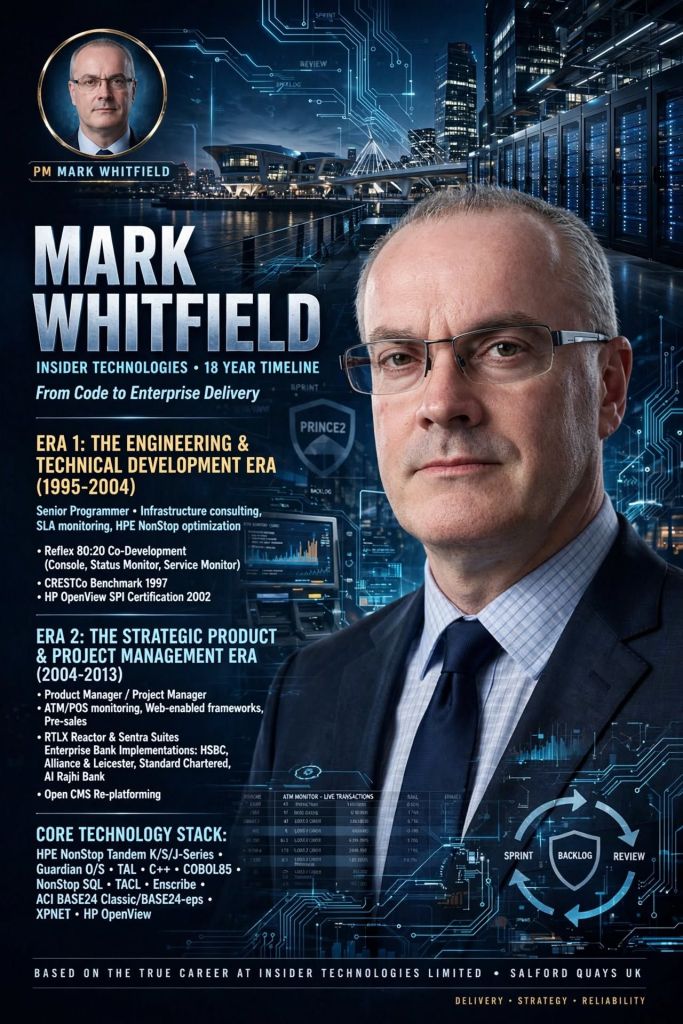
Mark Whitfield is a highly experienced IT professional with a career spanning over 30 years, transitioning from a technical programmer to a senior digital engagement and project manager. His expertise is rooted in HPE NonStop (Tandem) systems and has evolved to encompass complex Agile and Cloud delivery across diverse industries. 

Early Technical Era (1990–1995)

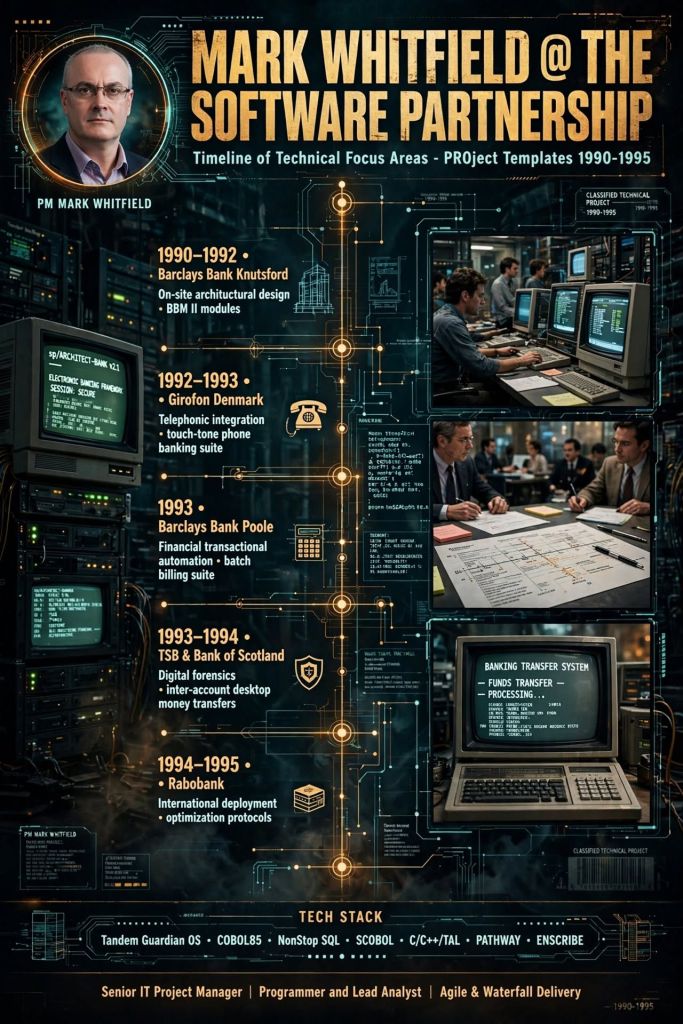
Following his graduation in Computing in 1990, Whitfield began his career as a Programmer at The Software Partnership (later Deluxe Data). 

  • Focus: Electronic banking software, specifically sp/ARCHITECT-BANK on Tandem Mainframe Computers.
  • Key Work: Developed code for major banks including TSB, Barclays, and Rabobank. This included early digital innovations like voice-driven phone banking and inter-account transfers before the internet was widespread. 

Growth and Product Management Era (1995–2004) 

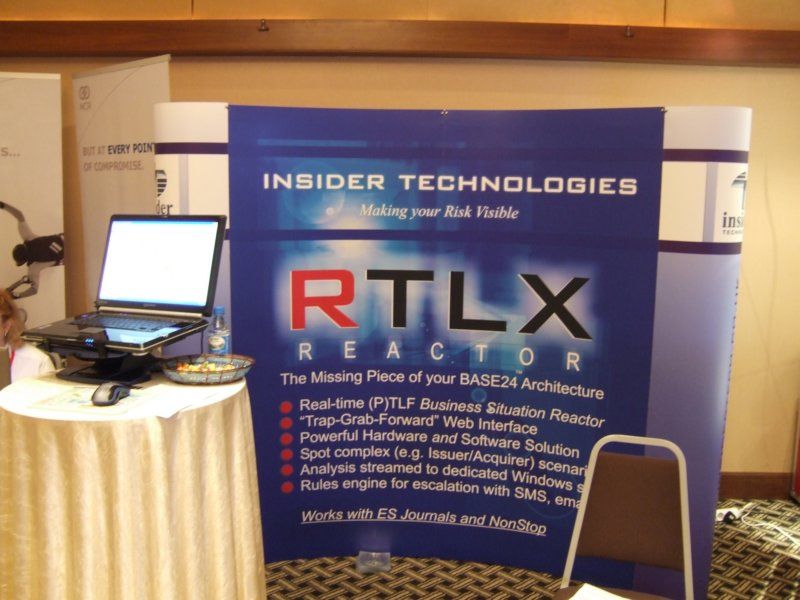
Whitfield joined Insider Technologies Limited (ITL) in 1995 as a Senior Programmer

  • Focus: Platform health and diagnostic software for HPE NonStop systems.
  • Key Projects:
    • Co-developed diagnostic plug-ins for the Reflex monitoring suite.
    • Managed the first HP OpenView Operations (OVO) Smart Plug-In certification for the NonStop platform in 2002.
    • Consulted for CRESTCo (Euroclear) in 1997, conducting benchmark testing on new S7000 nodes. 

Strategic Leadership and Project Management Era (2005–2014) 

During this decade, he transitioned into IT Project Management, focusing on high-value financial transaction tracking. 

  • Focus: Waterfall and Agile project delivery for payment systems and banking infrastructure.
  • Key Milestones:
    • 2011: Led a massive transaction tracking project at Al Rajhi Bank (Saudi Arabia), parsing terabytes of tape-archived data into a normalised SQL database.
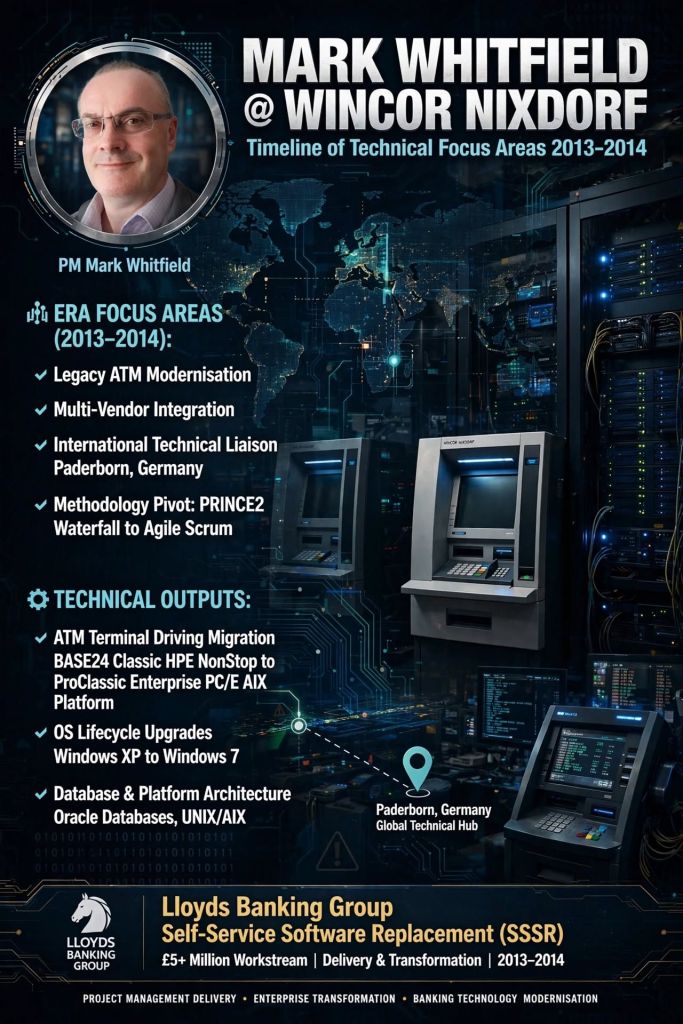
    • 2013–2014: At Wincor Nixdorf, managed a £5+ million project for Lloyds Banking Group to migrate ATM driving responsibilities from legacy systems to AIX-based Oracle technologies. 

Senior Digital Engagement Era (2014–Present)

Since 2014, Whitfield has focused on senior-level digital transformation and engagement management. 

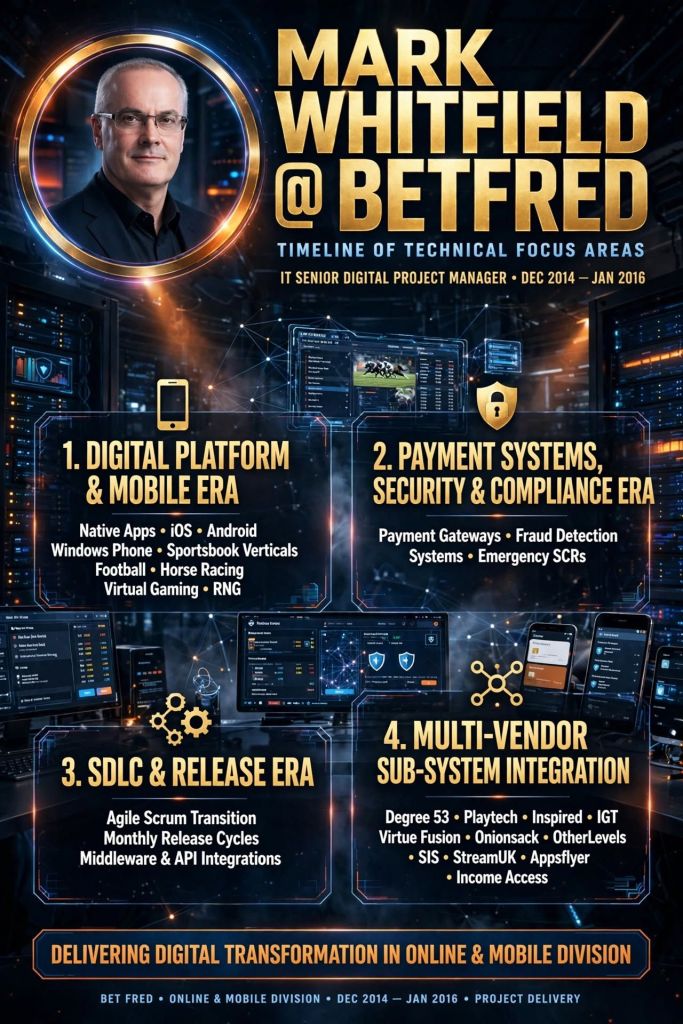
  • Betfred (2014–2016): Served as Senior Digital Project Manager for online and mobile platforms (iOS/Android), managing fraud detection and payment gateway integrations.
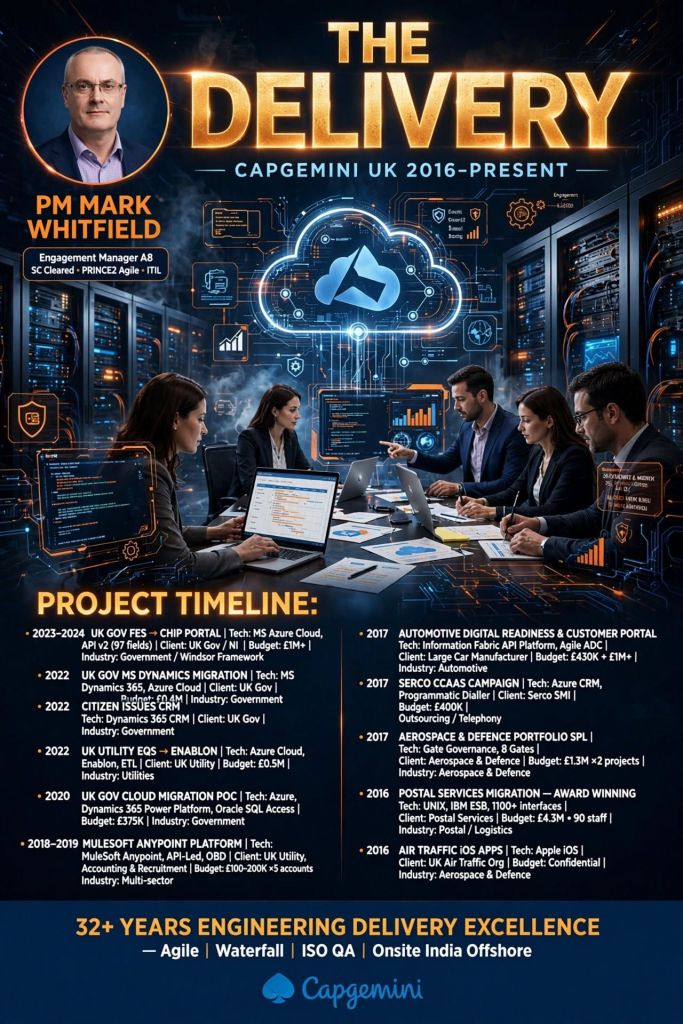
  • Capgemini (2016–Present): Joined as an Engagement Manager (SC cleared).
    • Focus: Managing large-scale Agile and Waterfall digital projects across aerospace, defence, and government sectors.
    • Notable Projects: Leading a £13.5m programme to migrate 130 UK government applications to the cloud (AWS/Azure) and delivering real-time airspace monitoring apps for air traffic organisations. 
Mark Whitfield IT Career Timeline Breakdown

HP NonStop Tandem Overview and Timeline History by year

HP NonStop is a series of fault-tolerant server computers designed for online transaction processing (OLTP) and mission-critical applications that require 100% uptime. Originally introduced by Tandem Computers Inc. in 1976, the platform uses a proprietary, integrated hardware and software stack known as NonStop OS (formerly Guardian) to eliminate single points of failure through massive redundancy and “fail-fast” logic

Historical Timeline by Era

1. The Tandem Founding Era (1974–1981) 

  • 1974: Tandem Computers Inc. is founded by James (Jimmy) Treybig and a team from Hewlett-Packard’s HP 3000 division.
  • 1976: The first system, the Tandem/16 (later NonStop I), is shipped to Citibank.
  • 1977: Tandem systems gain early traction as intelligent front-end processors for bank ATM networks. 

2. The Stack Machine Expansion (1981–1990) 

  • 1981: NonStop II is introduced, adding 32-bit addressing capabilities and replacing magnetic core memory with battery-backed DRAM.
  • 1983: NonStop TXP (Transaction Processing) launches as the first new implementation of the architecture, featuring cache memory and 2.0 MIPS performance.
  • 1986: Introduction of NonStop VLX (Very Large eXpansion) and NonStop SQL, the first fault-tolerant relational database designed for linear scalability.
  • 1987: NonStop CLX launches as a lower-cost, compact minicomputer for remote office environments.
  • 1989: NonStop Cyclone is released for high-end mainframe markets, featuring superscalar CPUs and fiber optic interconnects. 

3. The MIPS RISC Transition & Acquisitions (1991–2003)

  • 1991: Cyclone/R (or CLX/R) marks the move to MIPS R3000 RISC processors, using object code translation to maintain backward compatibility.
  • 1993: Himalaya K-series is released using MIPS R4400 processors.
  • 1995: Open System Services (OSS) is added to the NonStop Kernel to provide a POSIX/Unix-like environment.
  • 1997: Compaq acquires Tandem Computers. The Himalaya S-Series introduces ServerNet, which later becomes the InfiniBand industry standard.
  • 2002/2003: HP merges with Compaq, bringing the NonStop line under Hewlett-Packard. 

4. The HP Integrity & x86 Era (2005–Present)

  • 2005: HP Integrity NonStop (TNS/E) is introduced, migrating the platform to Intel Itanium microprocessors.
  • 2014: NonStop X (TNS/X) launches, shifting the architecture to Intel x86-64 processors for greater industry-standard alignment.
  • 2015: Following the HP corporate split, NonStop becomes part of Hewlett Packard Enterprise (HPE).
  • 2020: Sales of Itanium-based systems officially end in July 2020.
  • 2024–2025: HPE expands the platform with Virtualized NonStop Software for private clouds and consumption-based models via HPE GreenLake.

HP NonStop Tandem Overview and Timeline History by year

HPE NonStop (formerly Tandem and Compaq NonStop) is a family of fault-tolerant, integrated hardware and software systems designed for mission-critical enterprise workloads. Since its introduction in 1976, it has served as the backbone for high-volume transaction environments like banks, stock exchanges, and payment systems, offering 100% continuous uptime

Core Architecture and Features

The platform is defined by its “shared-nothing” architecture, where every component is redundant to eliminate single points of failure. 

  • Continuous Availability: If a hardware or software component fails, a backup takes over immediately without disrupting the application, a process often managed through process pairs (primary and hot backup processes).
  • Linear Scalability: You can add capacity (CPUs, memory) seamlessly without downtime. Systems can scale from a few processors to clusters of over 4,000 CPUs while maintaining a single-system image for management.
  • Integrated Stack: Unlike standard servers, NonStop includes a fully integrated stack of hardware, the NonStop OS (a proprietary kernel), a relational database (NonStop SQL), and middleware.
  • Fail-Fast Design: Modules are self-checking; they stop immediately upon detecting an error to prevent data corruption, allowing the redundant backup to resume processing from the last known good state. 

Current Hardware and Deployment

While historically based on proprietary or Itanium processors, modern NonStop systems (NonStop X) utilize industry-standard Intel Xeon processors and high-speed InfiniBand interconnects. 

  • High-End Systems: Models like the NS9 X5 are built for the most demanding high-volume transaction processing (OLTP).
  • Mid-Range/Entry Systems: Models like the NS5 X5 offer fault tolerance for smaller enterprises or development environments.
  • Virtualization & Cloud: HPE Virtualized NonStop Software allows the platform to run on standard private cloud infrastructure (e.g., VMware, OpenStack), and it is also available via HPE GreenLake as a consumption-based, pay-as-you-go service. 

Software and Security

  • Database: Supports NonStop SQL/MX and SQL/MP for multi-tenant, fault-tolerant data management.
  • Development: Supports modern languages like Java, C++, Python, COBOL, and the TACL scripting language. Developers can use the Eclipse-based IDE for building and debugging applications.
  • Security: Built with Zero Trust principles, including hardware-level vulnerability mitigations (e.g., against Spectre/Meltdown) and real-time threat detection. 

Detailed Architecture

HPE NonStop architecture is a fault-tolerant, shared-nothing, massively parallel computing platform designed for 100% operational continuity. Originally developed by Tandem Computers, it is engineered so that no single hardware or software failure can bring down the system. 

Core Architectural Pillars

  • Shared-Nothing Architecture: Each processor has its own dedicated memory, I/O bus, and copy of the HPE NonStop Operating System (NSK). This eliminates resource contention and single points of failure found in shared-memory systems.
  • Massive Scalability: Systems scale linearly by adding more processors. A single node can support up to 16 CPUs, and multiple nodes can be clustered to support over 4,000 CPUs.
  • Fault Tolerance (Process Pairs): Software availability is maintained through “process pairs”—a primary process and a passive backup process. If the primary fails, the backup immediately takes over without losing data or state.
  • Fail-Fast Design: Hardware and software modules are designed to stop immediately upon detecting an error (“fail-stop”) to prevent data corruption from propagating. 

Hardware Components

  • Compute Nodes: Modern HPE NonStop X systems use standard Intel Xeon x86-64 processors but implement fault tolerance through specialized system interconnects.
  • System Interconnect (Fabric):
    • InfiniBand: Used in NonStop X systems for high-speed, low-latency communication between CPUs and I/O devices (up to 56 Gbps).
    • ServerNet: The legacy high-speed, point-to-point switched fabric used in older S-series and Integrity i-series systems.
  • CLIMs (Cluster I/O Modules): Specialized offload engines for networking (IP CLIM), storage (Storage CLIM), and telco protocols. They handle I/O processing to free up the main host CPUs. 

Integrated Software Stack

The NonStop platform is a “tightly coupled” environment where hardware and software are integrated for availability. 

  • NonStop OS (NSK): A message-based operating system that manages the distributed resources as a single system image.
  • HPE NonStop SQL/MX: A distributed, fault-tolerant relational database that provides ANSI SQL compliance and automatic load balancing across the cluster.
  • HPE Pathway (TS/MP): An application server and middleware framework that manages workload distribution, load balancing, and automatic process restarts.
  • TMF (Transaction Monitoring Facility): Ensures database integrity by managing atomic transactions; if an update fails, TMF automatically rolls back the changes. 

Modern Deployment Options

  • HPE Virtualized NonStop (vNS): The complete software stack decoupled from proprietary hardware, allowing it to run as a set of virtual machines on industry-standard x86 servers within a private cloud (VMware).
  • HPE GreenLake: A consumption-based model providing NonStop capabilities as a cloud-like service. 

Critical Chain Project Management (CCPM) Overview and Timeline

Critical Chain Project Management (CCPM) represents a paradigm shift in how timelines are managed, moving away from traditional task-based safety to system-wide buffers. Its history is deeply rooted in the Theory of Constraints (TOC) and evolved through four primary eras of modern project management

The Foundations: Pre-1958 

Before the formal creation of CCPM, the industry relied on “craft-based” approaches and the early Gantt Chart (1910s) to visualize task durations. During this era, projects like the Hoover Dam (1931) and the Manhattan Project proved that large-scale coordination was possible, but they lacked a systematic way to handle resource constraints or project-wide uncertainty. 

The Traditional Era: 1958 – 1979 

This period saw the birth of the “Critical Path,” the ancestor of the “Critical Chain.” 

  • 1957: The Critical Path Method (CPM) was invented by the DuPont Corporation to manage chemical plant maintenance.
  • 1958: The Program Evaluation Review Technique (PERT) was developed for the U.S. Navy’s Polaris Project, introducing probabilistic task durations.
  • The Limitation: While these methods identified the longest sequence of tasks, they often ignored resource availability, leading to frequent delays and “multitasking” inefficiencies. 

The Conceptual Era: 1980 – 1994 

The theoretical seeds for CCPM were planted during the rise of the personal computer and the introduction of a new management philosophy.

  • 1984: Dr Eliyahu M. Goldratt published his seminal business novel, The Goal, introducing the Theory of Constraints (TOC).
  • Core Principle: Goldratt argued that every system has at least one constraint that limits its output. Managing this “bottleneck” is the key to overall performance.
  • Focus Shift: Organizations began looking at “flow” rather than just individual task completion. 

The CCPM Era: 1995 – Present 

CCPM was formally introduced as a distinct methodology to address the failures of traditional CPM. 

  • 1997: Goldratt published the book “Critical Chain”, officially launching the method.
  • Key Innovations: Unlike CPM, the Critical Chain accounts for both task dependencies and resource constraints. It replaced individual task “safety margins” with:
    • Project Buffers: A collective time safety net placed at the end of the project.
    • Feeding Buffers: Placed where non-critical tasks feed into the critical chain to prevent delays.
    • Fever Charts: A new visual tool for tracking buffer consumption rather than just task deadlines.
  • Modern Integration: In the 21st century, CCPM has been integrated with Agile and Lean practices to help organizations manage multi-project pipelines and global resource pools. 

Critical Chain Project Management (CCPM) timelines differ from traditional methods by shifting safety margins from individual tasks to strategic buffers at the end of the project or at integration points. This approach accounts for both task dependencies and resource constraints to determine the “Critical Chain”—the true longest path in a project. 

Core Components of a CCPM Timeline

  • The Critical Chain: The longest sequence of dependent tasks, adjusted for resource availability.
  • Aggressive Task Estimates: Tasks are estimated at a 50% confidence level (how long it takes if things go well) rather than the traditional 90% (safe) estimate.
  • Project Buffer: A single aggregate buffer placed at the very end of the project to protect the final delivery date.
  • Feeding Buffers: Placed at points where non-critical task sequences (feeding chains) merge into the critical chain, preventing delays in minor tasks from affecting the main timeline.
  • Resource Buffers: Virtual markers or alerts placed before critical tasks to ensure that key resources (people or equipment) are ready to start exactly when needed.
CCPM versus Traditional Timeline (CPM)

Implementing a CCPM Timeline

  1. Identify the Critical Path: Map the logical sequence of tasks.
  2. Level Resources: Adjust the schedule so no single resource is over-allocated, transforming the path into a Critical Chain.
  3. Strip Task Padding: Reduce task durations by roughly 50% to eliminate “Student Syndrome” (procrastinating until the last minute).
  4. Insert Buffers: Add a Project Buffer (typically 50% of the chain’s length) at the end and Feeding Buffers where non-critical paths merge.
  5. Monitor via Fever Chart: Use a Fever Chart to track if the buffer is being consumed faster than tasks are being completed.

Critical Chain Project Management (CCPM) Overview and Timeline