European BASE24 User Group (EBUG) was a prominent, community-led organization

The European BASE24 User Group (EBUG) was a prominent, community-led organization dedicated to the ACI BASE24 payment processing system. It provided a vendor-neutral forum for IT professionals, banks, and processors to collaborate, share knowledge, and discuss technical tracks like HPE NonStop monitoring and payment security.

Conference Timeline

  • 1980s — Establishment: EBUG is formed as a regional community for European financial institutions utilizing the growing BASE24 platform.
  • Early 2000s — Technical Growth: EBUG annual conferences become prominent technical forums featuring specialized tracks focused on Tandem/HP NonStop hardware and payment system security.
  • 2007 — Istanbul Conference: Features heavily attended technical sessions and workshops addressing growing transaction volumes and early EMV (chip card) migrations.
European BASE24 User Group (EBUG) was a prominent, community-led organization
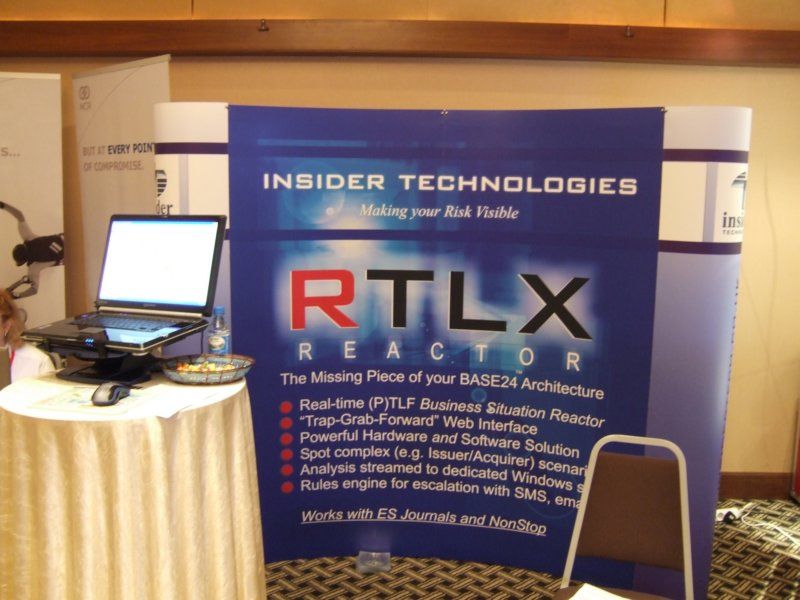
Insider Technologies regularly attended EBUG, booth in 2007
  • 2008 — Vienna Conference: Notable for introducing ACI’s strategic shift to support IBM platforms alongside traditional HPE NonStop environments.
European BASE24 User Group (EBUG) was a prominent, community-led organization
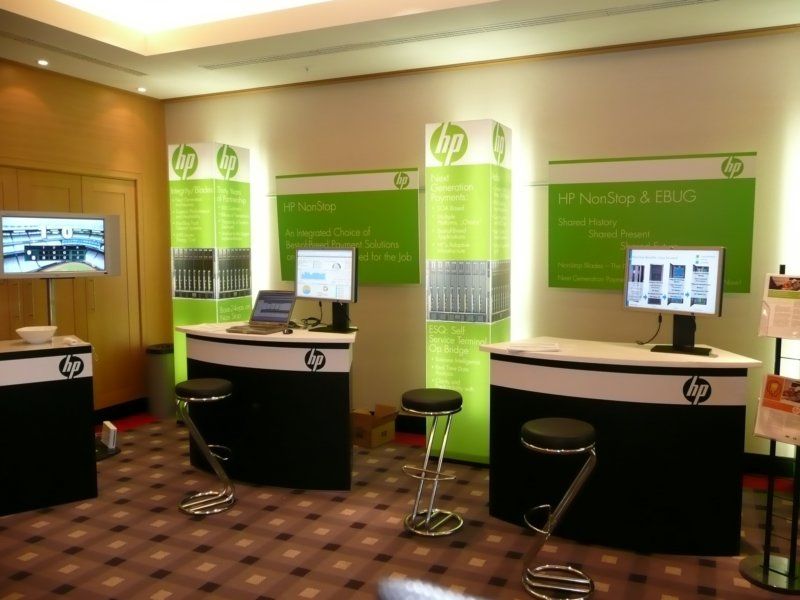
HP booth at Vienna EBUG, 2008
  • 2009 — Prague Conference: Continues strong advocacy and technical troubleshooting for BASE24 on NonStop despite broader industry platform shifts.
European BASE24 User Group (EBUG) was a prominent, community-led organization
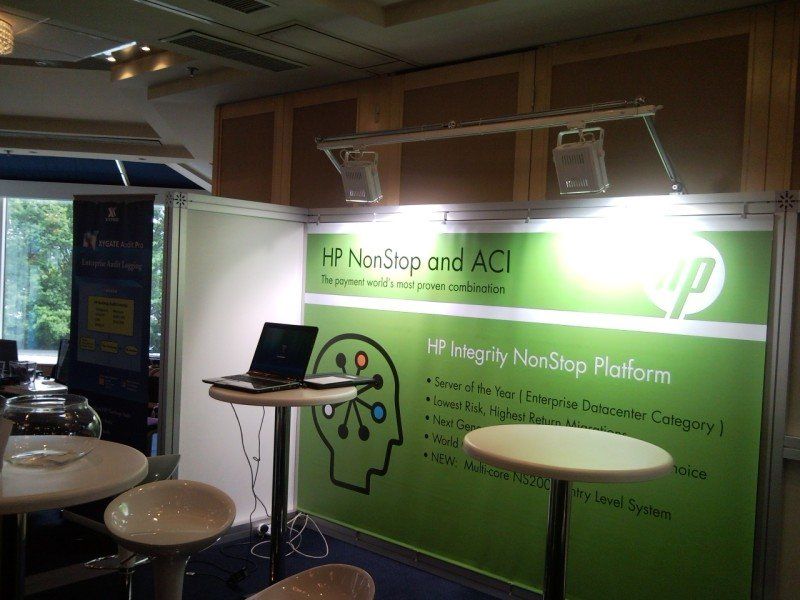
HP Booth at Prague conference, 2009
  • 2012 — London TFG: A technical focus group is held in London at Trinity House, bringing together engineers and ACI product managers to debug and refine system architecture.
  • Late 2010s to Present — The “Everybody Belongs” Era: As ACI broadened its product portfolio, the user group expands its scope to include other payment technologies like Postilion. The conference formally rebrands as an independent entity, later transitioning into The Payments Knowledge Forum, to serve all payment systems users inclusively.

European BASE24 User Group (EBUG) was a prominent, community-led organization

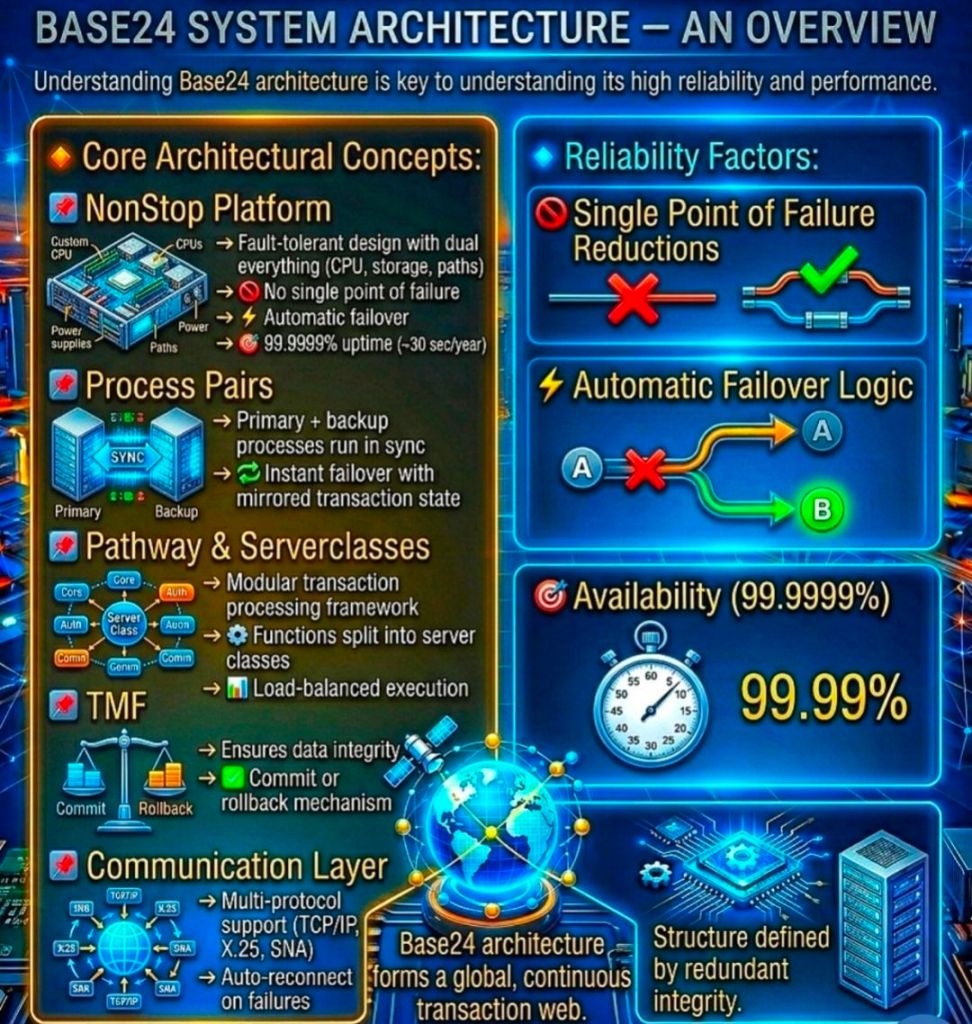
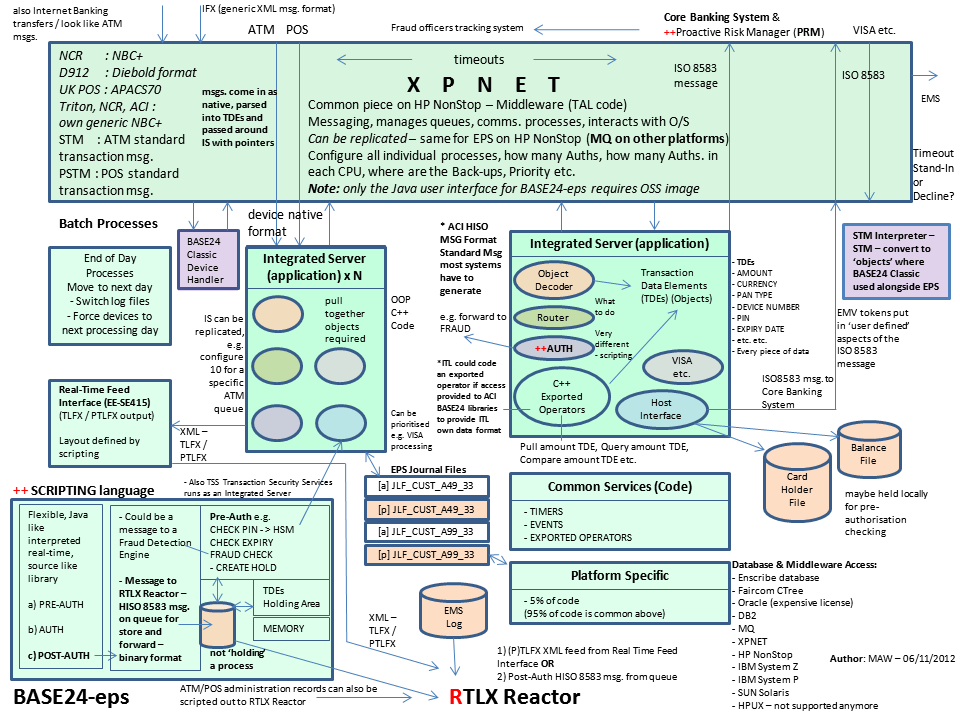
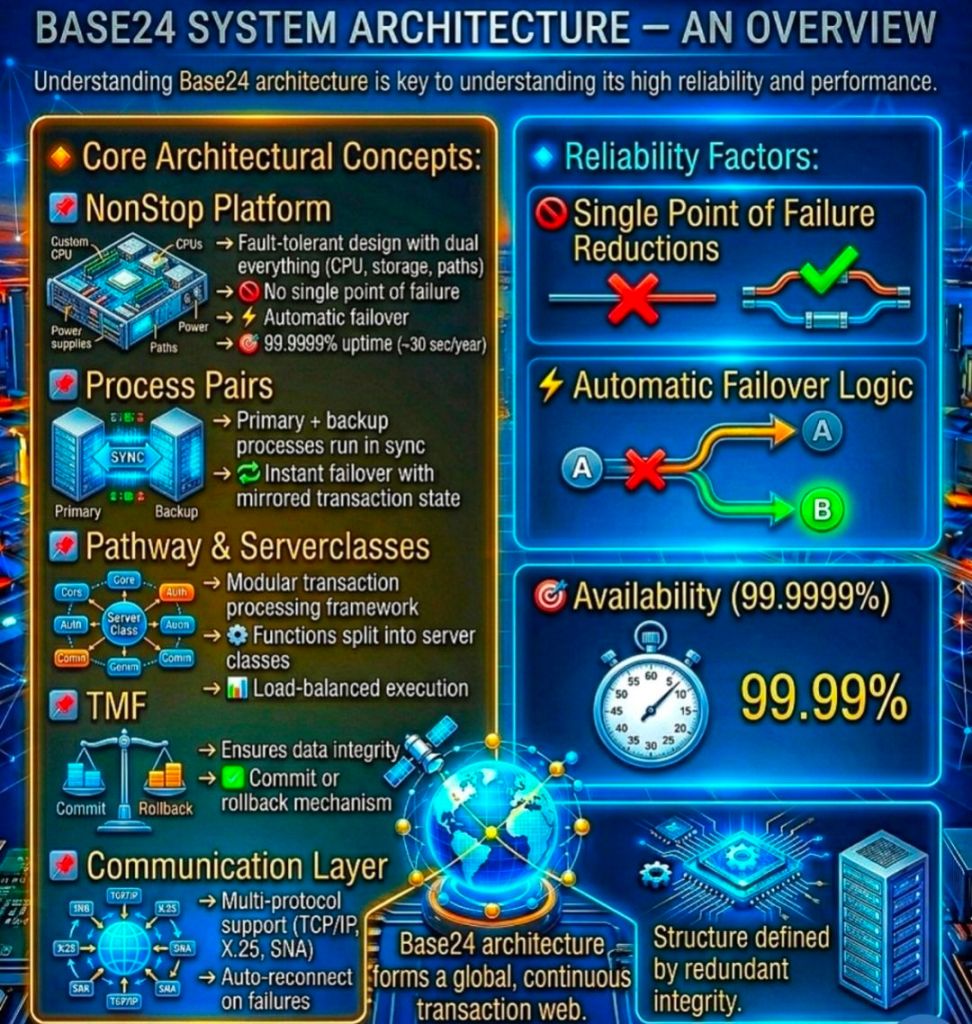
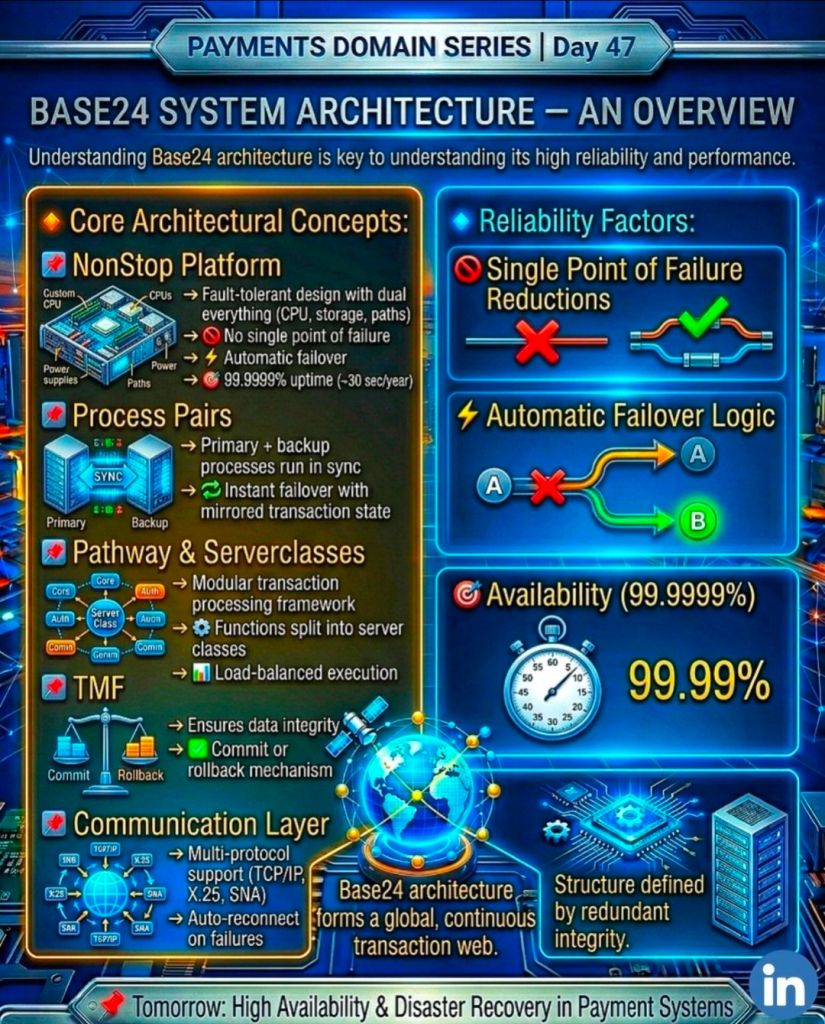
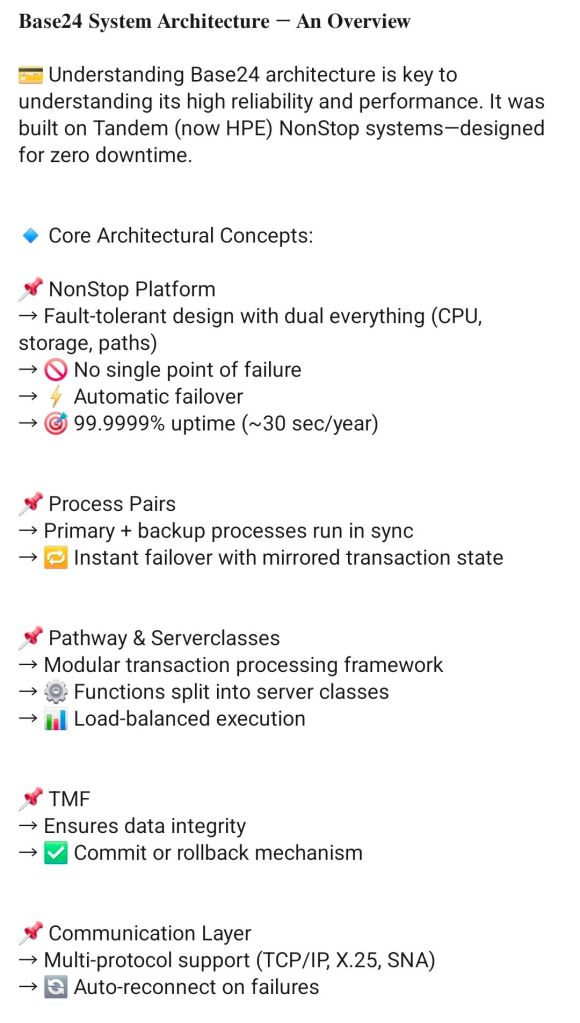
BASE24 and BASE24-eps architecture overview

The BASE24 electronic payment system developed by ACI Worldwide exists in two primary architectural generations:

BASE24 Classic (historically deployed on HPE NonStop / Tandem fault-tolerant hardware) and

BASE24-eps (Enterprise Payments System, built using an object-oriented C++ framework deployable across open systems, z/OS, and cloud infrastructure).

Despite structural differences, both share a highly optimized, component-based transaction routing engine.

BASE24 and BASE24-eps architecture overview
BASE24 architecture overview

Core Structural Component Layers

The component architecture maps the complete end-to-end lifecycle of a financial message (such as ISO 8583) through five distinct functional sub-systems:

1. Network & Message Routing Component (XPNET)

  • Purpose: Coordinates all message traffic across internal processes and physical network nodes.
  • Function: Operates as a specialized middleware network manager that decouples low-level communication links from upper transaction routing layers.
  • Configuration: Relies on a Logical Network Configuration File (LCONF) to define active execution nodes, hardware lines, and physical stations.

2. Perimeter Access Layer (Device Handlers)

  • Purpose: Translates device-specific message protocol formats into the system’s unified internal format.
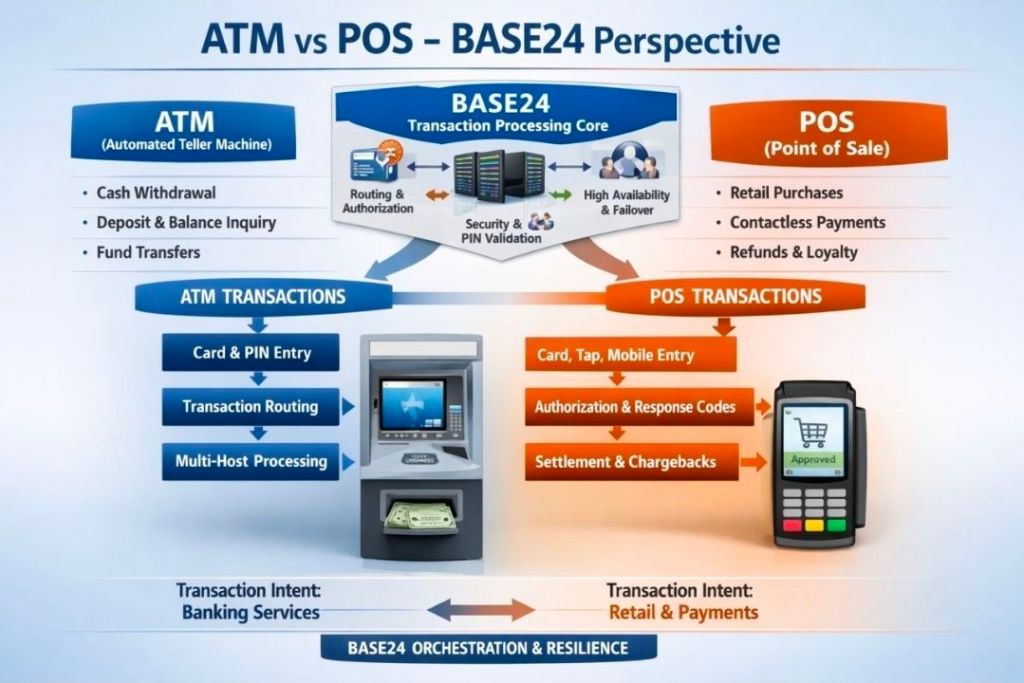
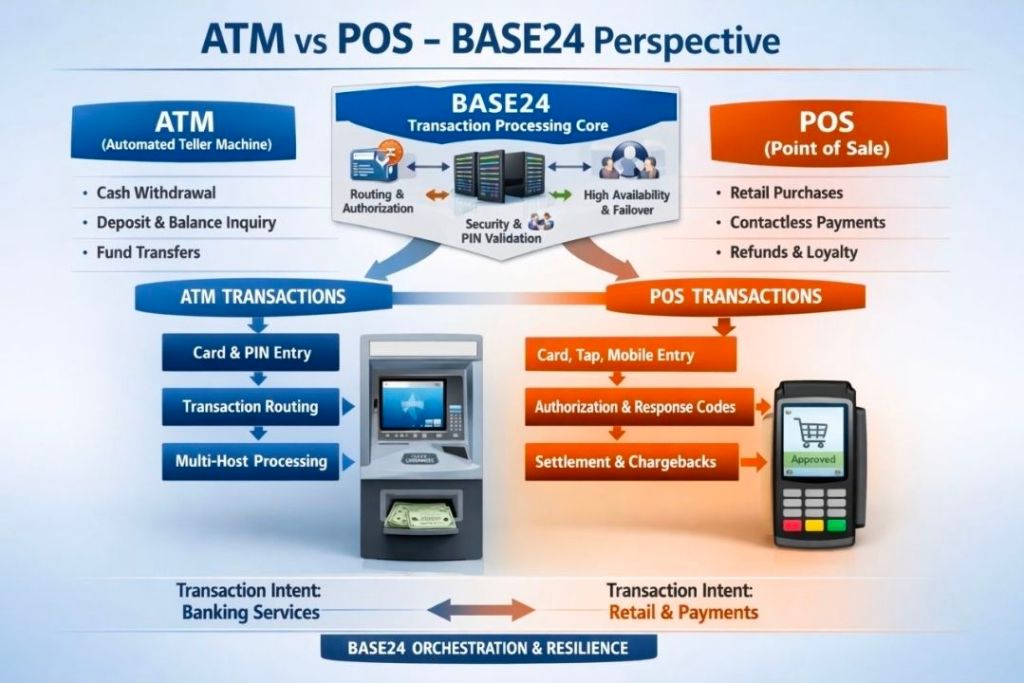
  • ATM Device Handlers (ATMDH): Manage direct connectivity to automated teller machines, unpack specific vendor dialects (such as Diebold or NCR states), and track terminal hardware statuses.
  • POS Device Handlers (POSDH): Interface with point-of-sale acquirer terminals and merchants.
  • Security Operations: Triggers immediate payload encryption/decryption and Hardware Security Module (HSM) PIN-block translation directly within this ingestion ring.

3. Core Transaction Logic (Authorization System)

  • Purpose: Determines whether a payment request should be accepted, rejected, or modified.
  • Full On-Us Authorization: Inspects internal databases for matching account records, positive balances, and velocity thresholds to issue real-time decisions.
  • Parametric/Negative Checks: Validates card status against offline negative files, usage restrictions, or custom risk parameters.
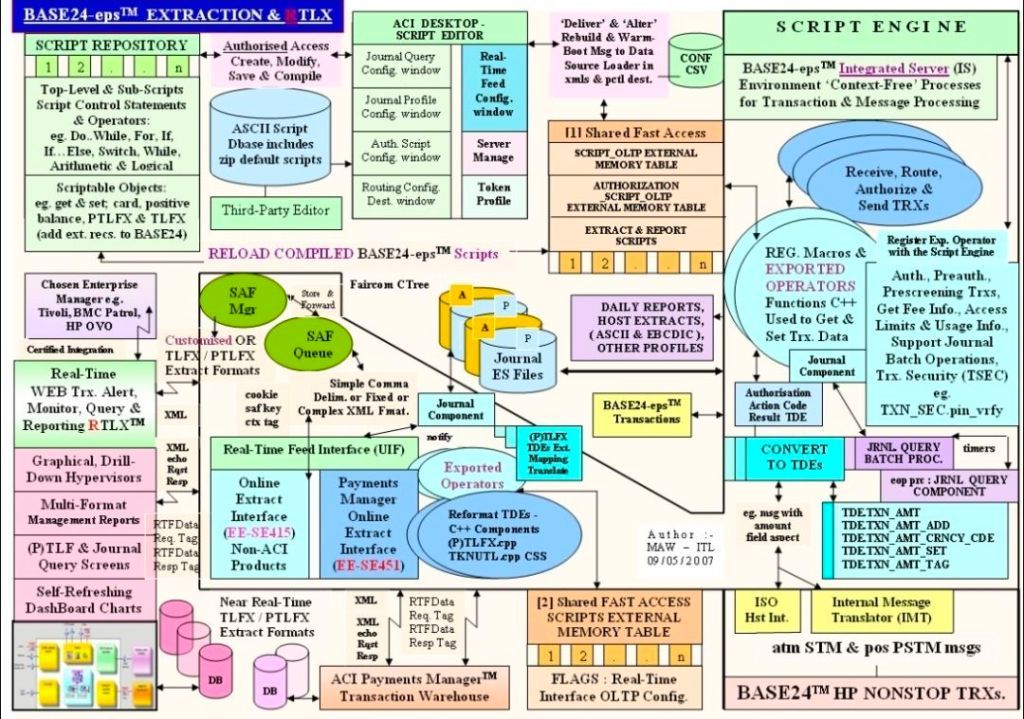
  • Scripting Engine: Modern BASE24-eps variants execute localized transaction routing scripts via customized operators without forcing a compile rewrite of the core engine core.

4. Boundary Channels (Interchange & Host Interfaces)

  • Interchange Interfaces (ICH): Package and transform the transaction payload into international network profiles (e.g., Visa, Mastercard, regional switches). It handles strict message mapping and regional network check requirements.
  • Host Interfaces (HIF): Create synchronous links back to an institution’s underlying Core Banking system to apply ledger adjustments, check balances, or execute real-time holds.

5. Offline & Administrative Subsystems

  • Extract Component: Gathers active transaction logs and streams filtered payloads out to analytical reporting databases.
  • Refresh Component: Updates terminal operational data, key packages, and card exclusion lists from parent systems down to active execution nodes.
  • Settlement Initiator: Groups, cleanses, and batches net-clearing totals to finalize payment entries into regional clearinghouses.

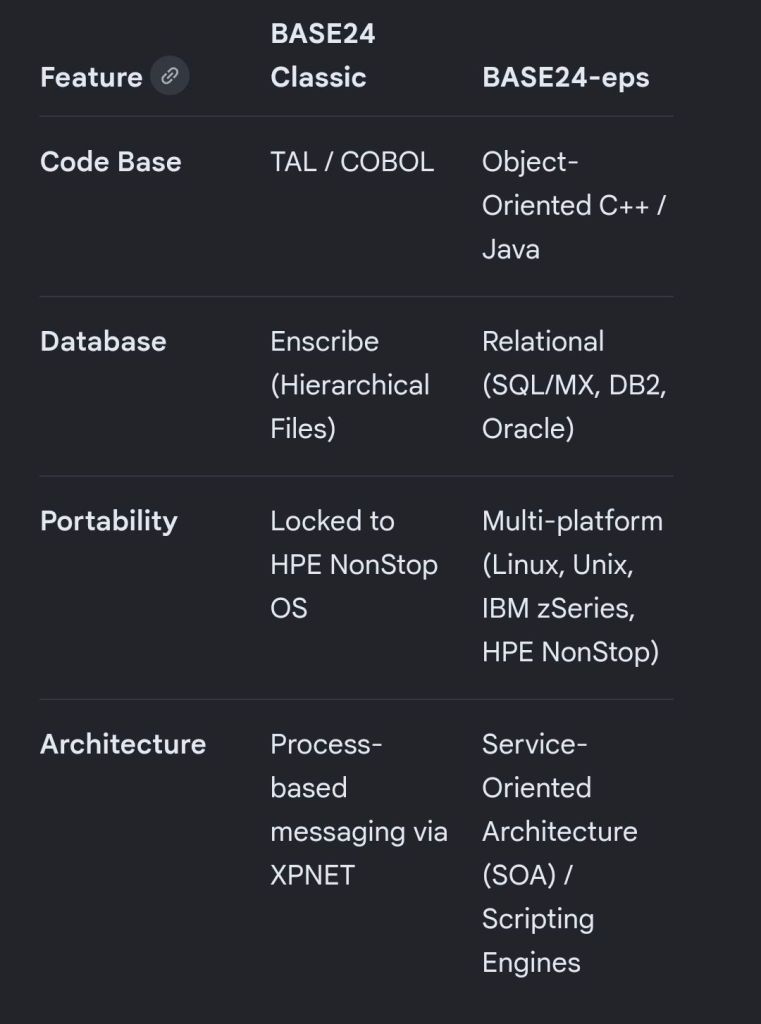
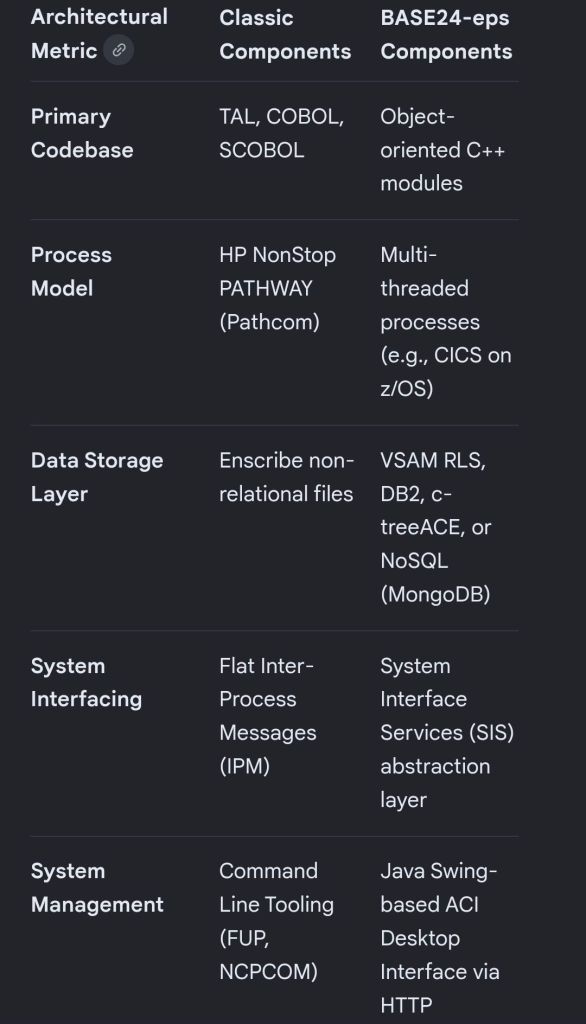
Architectural Divergence: Classic vs. EPS

The structural design varies significantly depending on the generation of the software deployment:

BASE24 and BASE24-eps architecture overview

End-to-End Component Transaction Flow

  1. An ATM transaction arrives at the network interface layer managed by XPNET.
  2. The message is routed to the Device Handler, which strips hardware packaging and requests translation from the HSM.
  3. The clean internal message passes to the Authorization Engine.
  4. If it is a “Not-On-Us” card, the engine identifies the destination BIN and transfers routing control to the Interchange Interface.
  5. The Interchange Interface maps the payload to the external scheme standard (such as Visa) and transmits it to the external network.
  6. The outbound network response is unwrapped by the Interchange component and tracked through the core engine to log final response codes.
  7. The transaction safely records inside the active log file, allowing the Extract / Settlement components to pick it up later during batch processing.

BASE24 and BASE24-eps architecture overview

BASE24 and BASE24-eps architecture overview

BASE24 Overview and Historical Timeline

BASE24 is a foundational electronic payments software suite developed by ACI Worldwide, first launched in 1982 to provide “always-on” (24/7/365) transaction processing, primarily on HP NonStop servers.

It is used by large financial institutions to acquire, authenticate, route, switch, and authorize card- and non-card-based financial transactions across multiple channels, including ATMs, point-of-sale (POS) terminals, and mobile/internet banking. 

The product has evolved from “Base24 Classic” into BASE24-eps (formerly BASE24-es), a modern, object-oriented, platform-independent payments engine designed to support high-volume, real-time transaction processing in hybrid or cloud-based environments. 

Comprehensive Historical Timeline of BASE24 

  • The Foundation Era (1975–1981): ACI (Applied Communications, Inc.) was founded in Omaha, Nebraska, in 1975, initially developing software for fault-tolerant Tandem NonStop computers. The focus was on connecting the first wave of ATMs to bank systems.
  • The Launch and Global Expansion (1982–1990):
    • 1982: BASE24 product family is officially launched, serving as the “baseline” software for 24-hour operations.
    • 1986: By 1986, ACI has 131 customers in 14 countries, expanding globally.
    • 1987: ACI receives the U.S. President’s “E” Award for Excellence in Export.
  • Public Company and Modernization (1995–2000):
    • 1995: ACI becomes a public company.
    • 1997: Adopts the name ACI Worldwide.
    • 1996–2000: Initial expansion of support to platforms beyond Tandem, including IBM mainframes and UNIX, to support rising internet commerce.
  • The Transition to Open Systems: BASE24-eps (2001–2010):
    • Early 2000s: Introduction of BASE24-es (later renamed BASE24-eps), a Next-Gen, C++ based engine.
    • 2003: BASE24-eps is live on HP NonStop, IBM zSeries, and IBM pSeries/Sun Solaris.
    • 2006: ACI announces a version of BASE24-es to support UK Faster Payments.
    • 2008–2010: ACI moves toward a unified strategy, with BASE24-eps becoming the mainstream offering while Classic matured.
  • Modernization and Cloud Era (2011–Present):
    • 2011: BASE24-eps wins the Most Innovative Financial Product Award.
    • 2015: ACI celebrates 40 years of operation and introduces advanced fraud detection (Proactive Risk Manager) integrated with BASE24-eps.
    • 2023: ACI goes live as an early adopter of the Federal Reserve’s FedNow Service, using modernized BASE24-eps technology.
    • 2024–2025: BASE24-eps becomes fully PCI-SSF compliant (PCI 4.0), running on Red Hat Enterprise Linux and supporting hybrid cloud deployments. 

Key Features of BASE24-eps

  • Fault Tolerance: Designed for high availability with near-zero downtime.
  • Multi-Channel Support: Manages ATM (NCR, Diebold Nixdorf), POS, and Mobile/Web traffic in a single engine.
  • Scripting Engine: Uses JavaScript-like scripts to allow customers to define authorization logic without modifying the core system.
  • Universal Connectivity: Supports 40+ global and regional network interfaces (Visa, Mastercard, etc.).
  • Platform Independence: Runs on HPE NonStop, IBM z/OS (CICS), and Linux/x86_64.
  • Real-time Fraud Prevention: Integrated with ACI Proactive Risk Manager. 

BASE24 Classic vs. BASE24-eps

  • Classic: Monolithic, Tandem-dependent, older technology.
  • eps: Object-oriented (C++), open systems architecture, 30% faster processing, supports cloud-native approaches. 

BASE24 Overview and Historical Timeline

BASE24 by ACI Worldwide timeline by era and year

BASE24 is the world’s most widely used payment processing platform, developed by ACI Worldwide. Originally designed for ATM networks, it evolved into a comprehensive system for acquiring, authenticating, and routing card-based and digital transactions across various channels. It is known for its high-performance, fault-tolerant architecture, processing nearly 50% of the world’s electronic transactions at its peak. 

Comprehensive Timeline by Era

Era 1: Foundations & The Rise of BASE24 Classic (1975–1990s)

This era focused on high-availability software for the emerging automated banking industry, specifically for Tandem NonStop servers. 

  • 1975: ACI founded in Omaha, Nebraska, to develop software for the new “NonStop” server computers used by banks and stock exchanges.
  • 1981: Secured its first international client, an Australian bank, marking the start of global expansion.
  • 1982: Launch of BASE24, the first global product designed for 24-hour system operations, originally focused on ATM networks.
  • 1986: Rapid growth led to 131 customers across 14 different countries. 

Era 2: Expansion & Public Transition (1995–2000s) 

The platform expanded into Point of Sale (POS) and branch systems while the company underwent major structural changes. 

  • 1995: The company went public on NASDAQ as Transaction Systems Architects (TSA).
  • 1997: Officially adopted the name ACI Worldwide.
  • Early 2000s: Introduction of BASE24-es (later renamed BASE24-eps), a next-generation platform using C++ and object-based architecture to replace the legacy monolithic design. 

Era 3: Modernisation & The “eps” Shift (2005–2015)

ACI shifted focus toward BASE24-eps, a more flexible, open-architecture version designed for multi-channel transaction processing. 

  • 2005: ACI launches BASE24-eps, featuring a modular engine capable of processing approximately 2,000 transactions per second (TPS) with extremely low latency.
  • 2007: TSA officially rebranded all operations under the ACI Worldwide, Inc. (ACIW) name.
  • 2008: Announced that BASE24 Classic would begin maturing in 2011, urging customers to migrate to the eps platform for better integration with modern systems like IBM System z.
  • 2011–2012: Release of BASE24-eps 11.1, adding support for DB2 on IBM System p, enhanced EMV acquiring, and tools for easier migration from legacy BASE24. 

Era 4: Cloud & Universal Payments (2015–Present)

The platform moved toward cloud-native capabilities and broader ecosystem integration. 

  • 2015: ACI celebrated its 40th anniversary, continuing to power electronic payments for over 6,000 organisations worldwide.
  • 2018: Introduction of UP BASE24-eps on Linux in the Cloud, demonstrating significantly reduced Total Cost of Ownership (TCO) through public and private cloud deployment.
  • Present: BASE24 remains a core pillar of ACI’s portfolio, supporting traditional card, ATM, mobile commerce, and internet banking transactions.

BASE24-eps by ACI Worldwide timeline by era and year

BASE24-eps is a modular, high-availability payment processing engine developed by ACI Worldwide. It evolved from the original “BASE24 Classic” to provide a more flexible, open-system architecture for acquiring, authenticating, routing, and authorizing electronic transactions

Base24-eps Overview

  • Architecture: Unlike the TAL-based Classic version, BASE24-eps uses an object-oriented design written primarily in C++ and Java.
  • Key Features:

Detailed Timeline

The Foundation Era (1970s – 1990s)

  • 1975: ACI is founded in Omaha, Nebraska, initially developing software for NonStop server computers.
  • Late 1970s: Development of the original BASE24 (now known as “Classic”), focused on high-uptime ATM processing.
  • 1981: First international customer (an Australian bank) signs on, starting the global expansion of BASE24. 

Transition & Development Era (2000 – 2005)

  • Early 2000s: ACI begins developing the “next generation” platform, initially called BASE24-es (extended systems), which later becomes BASE24-eps (enterprise payment system).
  • 2003 – 2004: The product begins migrating to open architectures, moving away from platform-specific languages. 

Mainstream Adoption Era (2006 – 2013)

  • 2007: ACI highlights BASE24-eps as its strategic future platform in investor overviews.
  • 2008: ACI announces the maturation of BASE24 Classic (ending standard maintenance in 2011), urging customers to migrate to BASE24-eps.
  • 2009: IBM Redbooks releases technical guides for BASE24-eps 08.2 on z/OS, solidifying its place in enterprise banking.
  • 2013: Release of BASE24-eps 2.0, introducing the “customer component” and enhanced service-enabling wrappers. 

Modernization & Cloud Era (2014 – Present)

BASE24 and core Networking Component XPNET timeline

The technical timeline for BASE24 and its core networking component, XPNET, reflects the evolution of high-availability payment switching on HP NonStop (Tandem) systems.

Technical Evolution Timeline

  • 1980s: The Foundation
    • BASE24 Release: Originally developed by Applied Communications Inc. (now ACI Worldwide), BASE24 was built for the Tandem Guardian operating system.
    • XPNET Introduction: Developed as the Message-Oriented Middleware (MOM) to handle all transaction routing and communications. It introduced a multi-node architecture allowing different “satellite” processes (ATM, POS, Host) to communicate.
  • 1990s: Scale and Maturity
    • Classic Era: BASE24 “Classic” became the industry standard for ATM and POS switching.
    • XPNET 3.x: Enhanced to support larger networks and more complex auditing through NCPCOM.
    • Language & DB: The system relied on TAL (Tandem Application Language), COBOL, and the Enscribe database.
  • 2000s: The Shift to BASE24-eps
    • 2003–2005: ACI introduced BASE24-eps (Electronic Payment Systems). This was a re-architecture using C++ and Java to provide platform independence.
    • XPNET 4.1: Released to support the transition, adding features like Common Transport Subsystem (CTS) for better Pathway integration and support for external processes.
    • z/OS Support: By 2009, BASE24-eps was fully ported to IBM z/OS using CICS and VSAM.
  • 2010s – Present: Modernisation & Cloud
    • 2014–2017: Continued updates to BASE24 Classic R6.0, maintaining its relevance for legacy users.
    • Cloud Enablement: Recent versions of BASE24-eps focus on REST API integration via tools like LightWave, allowing legacy XPNET paths to be exposed as web services.
    • Active/Active Environments: Modern implementations focus on “continuous availability” using GoldenGate for data replication between sites. 

Key Technical Components

  • NMM (Network Management Module): The core process of XPNET that manages the configuration of lines, stations, and links.
  • LCONF: The Logical Network Configuration File used by XPNET to define how messages route between processes.
  • Auditing: XPNET provides the primary transaction auditing mechanism, which is still utilized by both Classic and eps versions.

BASE24 and core Networking Component XPNET

Base24-eps and UPF integration

Base24-eps and UPF integration

Integration between BASE24-eps and the Universal Payments Framework (UPF) is a core part of ACI Worldwide’s strategy to bridge legacy payment systems with modern, real-time payment capabilities. The UP Framework acts as a bridge, allowing financial institutions to orchestrate diverse payment types and channels while protecting their existing investment in BASE24-eps infrastructure. 

Key Aspects of the Integration

  • Investment Protection: The UP Framework allows existing BASE24 customers to continue using their current systems for some functions while incrementally adding new payment types and volumes through the UP Framework. This approach eliminates the need for a complete “rip and replace” of legacy systems.
  • Modernization and Flexibility: The integration with UPF allows banks to rapidly introduce new payment methods, adhere to new network schemes (like real-time payments), and integrate with new partners through configuration rather than custom coding.
  • Unified Retail Payments: UP Retail Payments is ACI’s comprehensive solution that combines the strengths of BASE24-eps (a market-leading retail payment platform) and the UP Framework (which orchestrates all aspects of payments processing) into a single, end-to-end platform.
  • Data Protection & Compliance: The UPF is used in conjunction with data security solutions (like Comforte’s SecurDPS) to tokenize sensitive cardholder data before it is passed to BASE24-eps applications or stored in logs, helping institutions meet PCI DSS compliance requirements.
  • Role-Based Expertise: The integration is an area of specialized technical expertise in the payment industry, with job roles focusing on the implementation, customization, configuration, and support of both BASE24-eps and UPF modules. 

In essence, the UPF provides a flexible, open architecture that extends the life and capabilities of BASE24-eps, enabling financial institutions to manage traditional and emerging payment demands within a unified ecosystem. 

What is BASE24-eps?

BASE24-eps is a comprehensive solution for acquiring, authenticating, routing, switching, and authorizing card- and non-card-based financial transactions through various channels.

BASE24-eps is designed to:

  • Increase the profitability of payment processing by enabling a set of common transaction services to support multiple channels and different types of transactions
  • Offer organizations greater flexibility with built-in support for all major card types, devices, national and regional switches, international payment schemes and host systems
  • Create a comprehensive view of customers and ensure consistent, high-quality customer service across different points of contact
  • Reduce organizations’ total cost of ownership through complete platform independence
  • Give organizations the options to deploy on premise, in their own private or public cloud, or in a secure, cloud-based environment managed by ACI

https://www.aciworldwide.com/solutions/base24-eps

In 2013, delivered a large transaction tracking project at a retail bank in Riyadh

Retail Banking (off-shore) – in 2013, delivered a large transaction tracking project at a retail bank in Riyadh (Saudi Arabia). This involved the BASE24 Classic payment solution and the relay and optimised parsing of multiple Terabytes of tape archived POS & ATM transaction logs to a new monitoring and reporting system. Project managed the work and delivery both in Salford Quays, Manchester and locally at the bank in Riyadh.

mark whitfield wordpress_connection_HP_NonStop_to_Windows_Combined

( now C-Deep [Transaction Monitoring] https://etinet.com/products/c-deep-transaction-monitoring/ )