Legacy Enterprise Management Systems, EMS

Legacy enterprise managers (often spanning IT Service Management, Network Node Management, and Event Correlation) defined enterprise IT in the 1980s, 1990s, and 2000s. The following are major, pioneering platforms, their primary functions, and their eventual modern replacements:

Legacy IT Operations Management (ITOM)

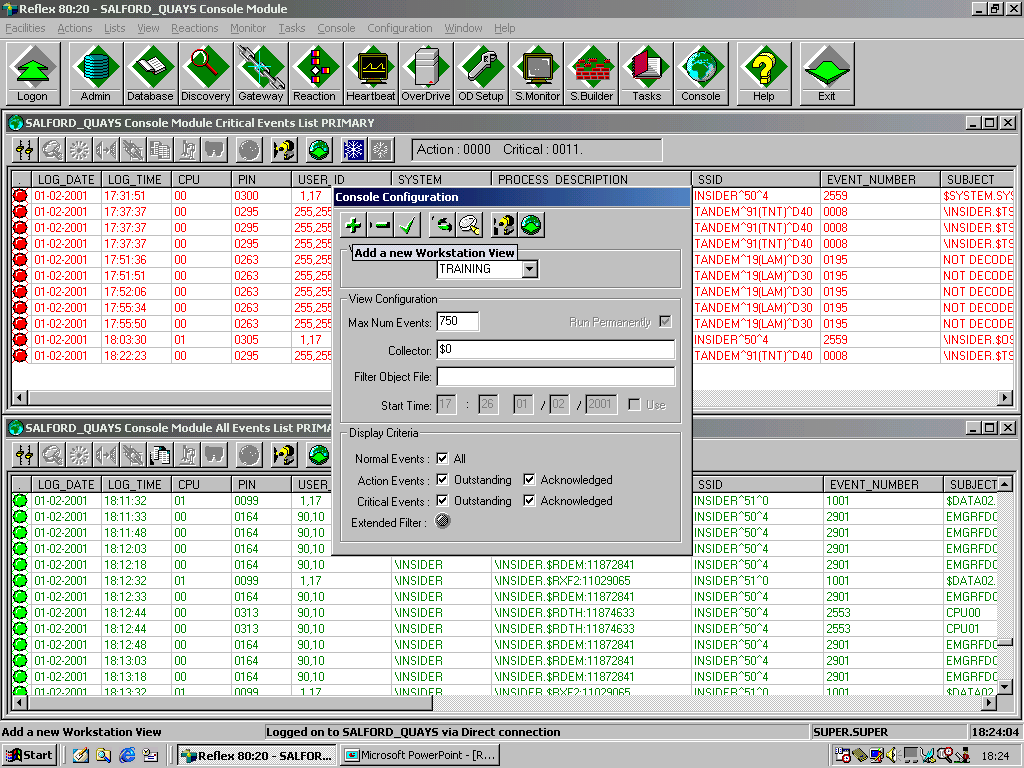
  • HP OpenView: A flagship suite that included Network Node Manager (NNM) for topology mapping and Operations Manager (formerly OVO) for centralized event and alert monitoring across Unix, Windows, and mainframes. I overlooked the integration of the HP NonStop product Reflex 80:20 with HP OpenView.
    • Modern equivalent: Evolved into Micro Focus Operations Bridge, later absorbed by OpenText.
  • IBM Tivoli: A massive suite born from the acquisition of Candle and Tivoli Systems. The core components included Tivoli Enterprise Console (TEC) for event correlation and Tivoli Netcool/OMNIbus for real-time network and service monitoring. I overlooked the integration of the HP NonStop product Reflex 80:20 with IBM Tivoli.
    • Modern equivalent: Evolved into IBM Cloud Pak for Watson AIOps.
  • BMC Patrol: One of the premier tools for deep system, application, and database monitoring (often known for its KM – Knowledge Module – architecture).
    • Modern equivalent: BMC TrueSight Operations Management and BMC Helix.
  • CA Unicenter: A comprehensive, all-in-one mainframe and distributed systems management tool for job scheduling, asset management, and event monitoring.
    • Modern equivalent: Rebranded under Broadcom, largely integrated into their enterprise software division.
  • Sun Microsystems SunNet Manager / Solstice Enterprise Manager: Early pioneers in Unix-based network management and remote system administration.
    • Modern equivalent: Discontinued; mostly absorbed by Oracle Enterprise Manager.

Enterprise Event Correlation & Command Centers

  • Command/Post (Boole & Babbage): One of the earliest automated event correlation engines designed for mainframes, which later expanded into distributed environments. Acquired by BMC.
  • Micromuse Netcool: Famous for its ultra-fast, rules-based Omnibus, capable of ingesting vast amounts of SNMP traps and Syslog messages across telecommunications and large enterprise networks. Acquired by IBM.

Network and Performance Managers

  • HP OpenView Performance/SysView: Tools specifically built for historical performance charting, OS native monitoring, and deep metric extraction.
  • Novell NMS (NetWare Management System): The standard for managing legacy Novell NetWare servers and IPX/SPX network topologies.

Most of these tools were displaced by modern APM (Application Performance Monitoring) and AIOps (Artificial Intelligence for IT Operations) platforms that feature cloud-native architectures, distributed tracing, and out-of-the-box integrations. Common replacements include:

  • Datadog
  • Dynatrace
  • Splunk / Splunk IT Service Intelligence
  • LogicMonitor
  • ScienceLogic

HP OpenView Operations

HP OpenView Operations Enterprise Manager integration with Reflex 80:20
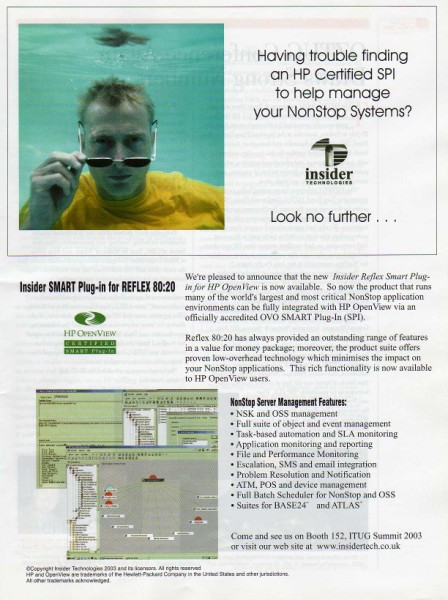
First HP NonStop 2-way Smart Plug-In (SPI) for HP OVO HP OpenView Operations
First HP NonStop 2-way Smart Plug-In
(SPI) for HP OVO

Requested to research and produce a design for integrating the ITL NSK based Reflex 80:20 product with the hp OpenView Operations (hp OVO) enterprise manager. This initially involved a trip to Lisbon to attend the hp OpenView Universe event that represents the technical showcase for this enterprise level product. I then put together a number of design documents and managed a development team tasked with engineering an hp OpenView Smart Plug-in (SPI) to interact with Reflex 80:20 on the hp NonStop platform. This hp SPI approach represents the latest technology for integrating third-party products and provides an unparalleled approach for enabling remote platform control and management under hp OVO.

Once the Reflex SPI development was complete, I overlooked acceptance testing at the hp labs at Fort Collins, Colorado and was instrumental in attaining HP certification for the Reflex 80:20 product. As part of the certification process, I produced a comprehensive Reflex SPI user guide along with supporting marketing literature. More information.
HPE NonStop EMSDIST, Event Management Service EMS Distributor Timeline by Era

HPE NonStop EMSDIST (Event Management Service Distributor) is a critical component within the HPE NonStop operating system responsible for distributing and managing event messages (logs) generated by the system, subsystems, or applications. It is part of the Event Management Service (EMS), which is essential for fault-tolerant monitoring. 

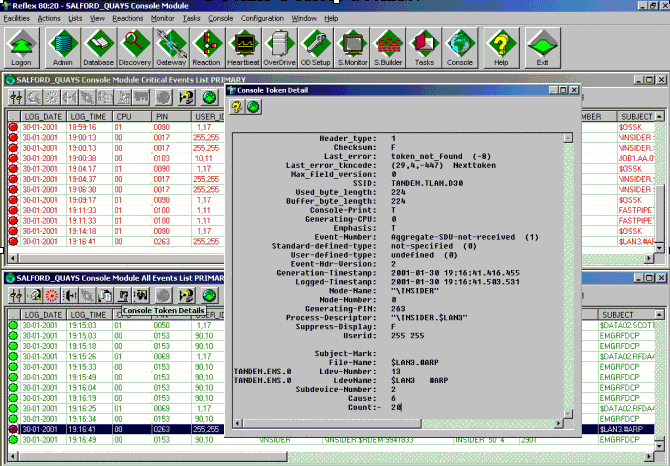
EMS events (via EMSDIST) seen in the Reflex 80:20 application ( now Sentinel (Nonstop Monitoring) by ETI-NET)

EMSDist Overview

  • Purpose: EMSDIST reads events from an EMS collector process ($0, $ZLOG, etc.) or a collector logfile, filters them based on user criteria, and sends them to a user-specified destination (such as a terminal, printer, or another file).
  • Key Functionality: It enables both real-time monitoring and historical analysis of events.
  • Event Handling: It handles EMS messages, including those generated by the EMS subsystem itself (messages 513-999) and those from EMS distributors (messages > 1000).
  • Integration: Often used in conjunction with TACL (Tandem Advanced Command Language) for automated event management scripts. 

Detailed Historic Timeline and Evolution

EMSDIST has evolved alongside Tandem / Compaq / HPE NonStop systems, transitioning from basic console management to complex distributed management systems. 

1. The Tandem Guardian Era (Late 1970s – 1980s)

  • Context: The emergence of Tandem NonStop systems focused on continuous availability.
  • EMS Origins: Initial event handling was largely via console messages. As systems grew, the need to manage logs across multiple processors led to early Event Management Service components.
  • Role of EMSDist: Early distributors primarily moved messages from local collectors to a central console or tape log.

2. The D-Series & TMF Era (1990s)

  • Context: Introduction of sophisticated transaction monitoring and distributed databases.
  • 1996: A significant EMS Reference Summary was released (PN 114754), formalizing the structure of EMS collectors and distributors.
  • Capabilities: EMSDIST became capable of filtering high-volume events, separating critical errors from warning messages (513-1019).
  • Evolution: Began integrating with the Distributed Systems Management (DSM) suite for better network-wide event visibility. 

3. The Compaq & Integrity (J-Series/H-Series) Era (2000s – 2010s)

  • Context: Shift from MIPS-based processors to Intel Itanium (Integrity) servers.
  • 2003-2005: Integration with Windows-based management systems (DSM/NOW) and improvements to the Multi Event Viewer (MEV).
  • 2014: HP Integrity NonStop Operations Guides emphasized using EMSDIST alongside modern tools like OSM (Open System Management) Event Viewer, especially for H-Series and J-Series systems.
  • Key Capability: Improved handling of large logs, with better time-based querying (TIME and STOP options) for auditing and troubleshooting. 

4. The HPE NonStop X & Modern Era (2015 – Present)

  • Context: Adoption of x86 architecture and cloud-ready systems (L-Series).
  • 2015: HPE takes over the portfolio, accelerating integration with HPE InfoSight for AI-driven log analysis.
  • Modernization: While EMSDIST remains, modern environments heavily leverage NS Software Essentials and third-party tools for advanced analytics.
  • Continued Importance: EMSDIST remains essential for analyzing historical logs via the LOGFILE option, especially when dealing with cold-standby or restored logs from tape/disk. 

Key Functional Milestones

  • Message Categorization: Formalization of messages 513-999 (collectors) and >1000 (distributors) for structured analysis.
  • Filtering Efficiency: Implementation of complex FILTER parameters allowed operators to filter events by process, user, or time.
  • Logfile Access: The ability for EMSDIST to process archived or older LOGFILE entries independently of the live $0 collector.
  • Template Support: Ability to use specific =_EMS_TEMPLATES for customizable output formatting. 

HPE NonStop EMSDIST, Event Management Service Distributor Timeline by year