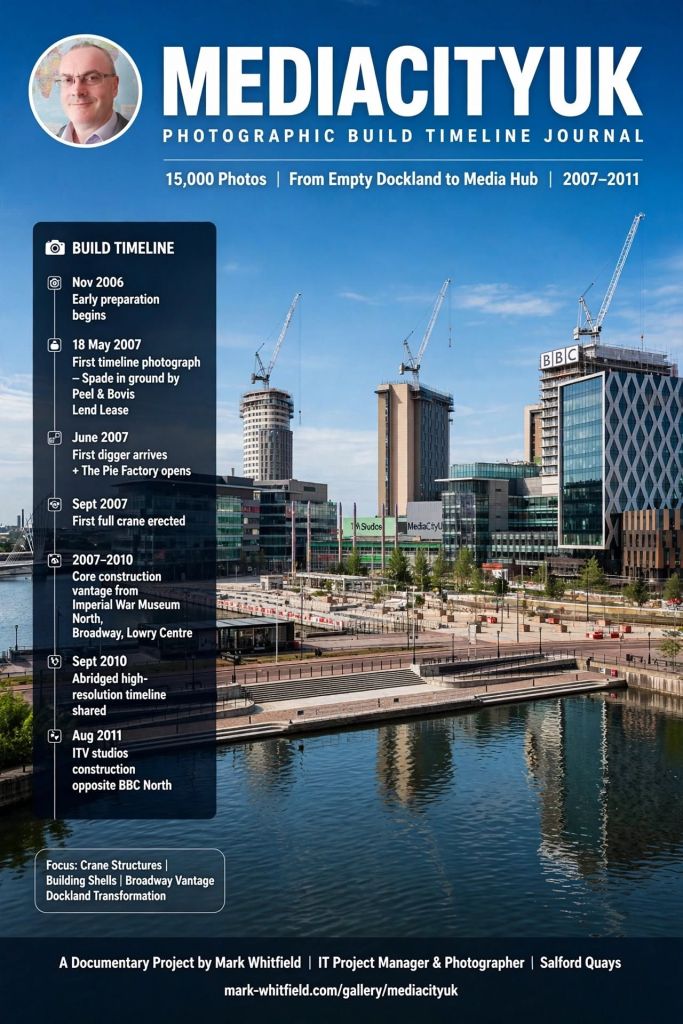
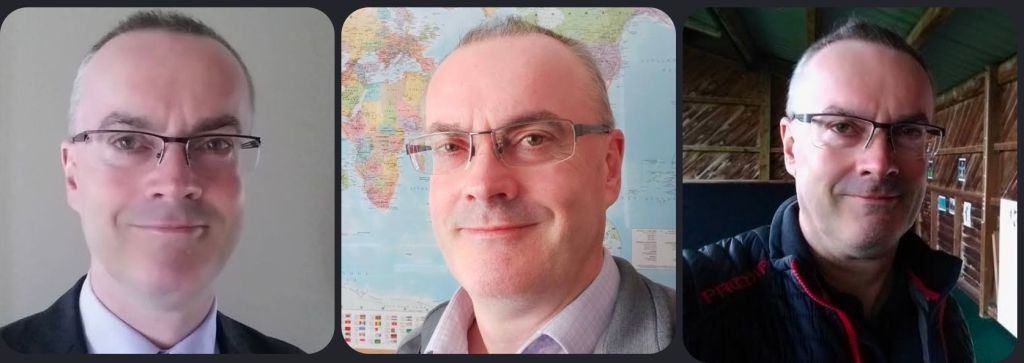
The MediaCityUK Photographic Build Timeline Journal is an extensive, long-term documentary project created by IT Project Manager and photographer Mark Whitfield. Working nearby in Salford Quays, Whitfield used his close proximity to methodically document the area’s massive transformation from an empty dockland into a major UK media hub.
Mark Whitfield | MediaCityUK Photographic Build Timeline Journal
The project captured over 15,000 photos over its lifespan, focusing heavily on the phase 1 construction lifecycle from the ground up.
Key Project Timeline & Milestones
November 2006: Early preparation work and digging begins around the site. Temporary cabins are placed off Broadway to house the initial project staff and BBC contingents.
18 May 2007: Mark Whitfield captures his first timeline photograph, marking the formal start of his build documentation. This coincides with the official “spade in the ground” by Peel Group and Bovis Lend Lease.
June 2007: Visible ground development scales up as the first digger arrives on-site. Concurrently, “The Pie Factory” (a refurbished bakery) opens as the first working studio space.
September 2007: Construction advances rapidly with the erection of the first full-sized crane on the development site.
2007–2010: The core construction phase takes place. Whitfield systematically updates his weekly journal from vantage points like the Imperial War Museum North, Broadway, and the Lowry Centre side, capturing the rising crane structures and building shells.
September 2010: As the main grassland is replaced by the finished media campus, Whitfield shares an abridged public high-resolution timeline containing a curated selection of his massive archive.
August 2011: Documentation expands to capture the next steps of growth, including the initial construction phases of the ITV studios situated directly opposite BBC North.
Exploring the Photo Journal
The full history and comprehensive photo collections can be found across Mark Whitfield’s active journals:
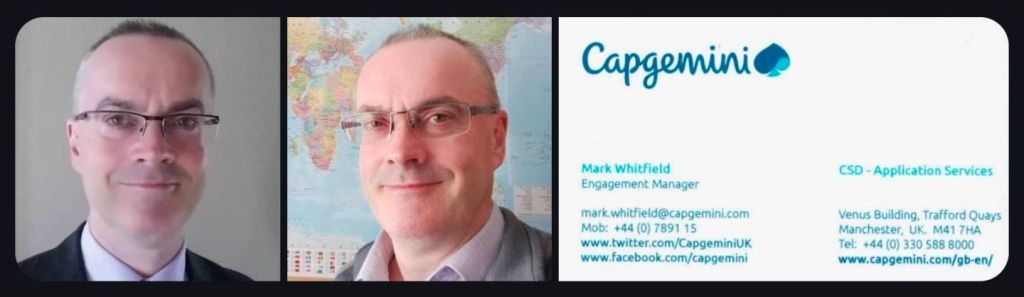
Mark Whitfield is a highly prominent, SC-cleared Senior IT Project Manager, Engagement Manager, and technology executive based in the UK.
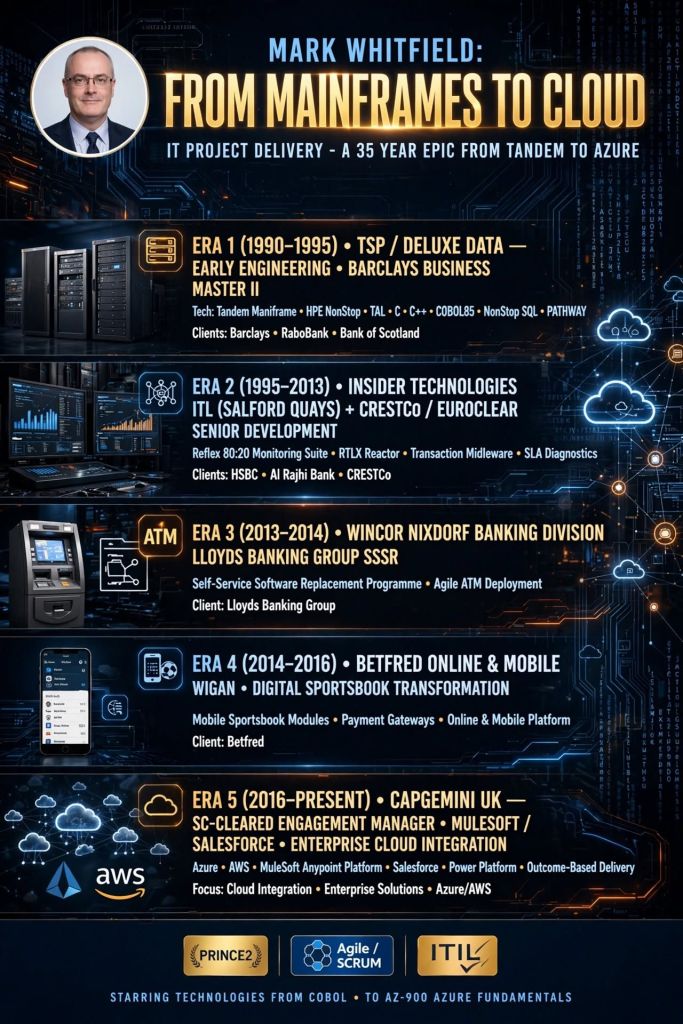
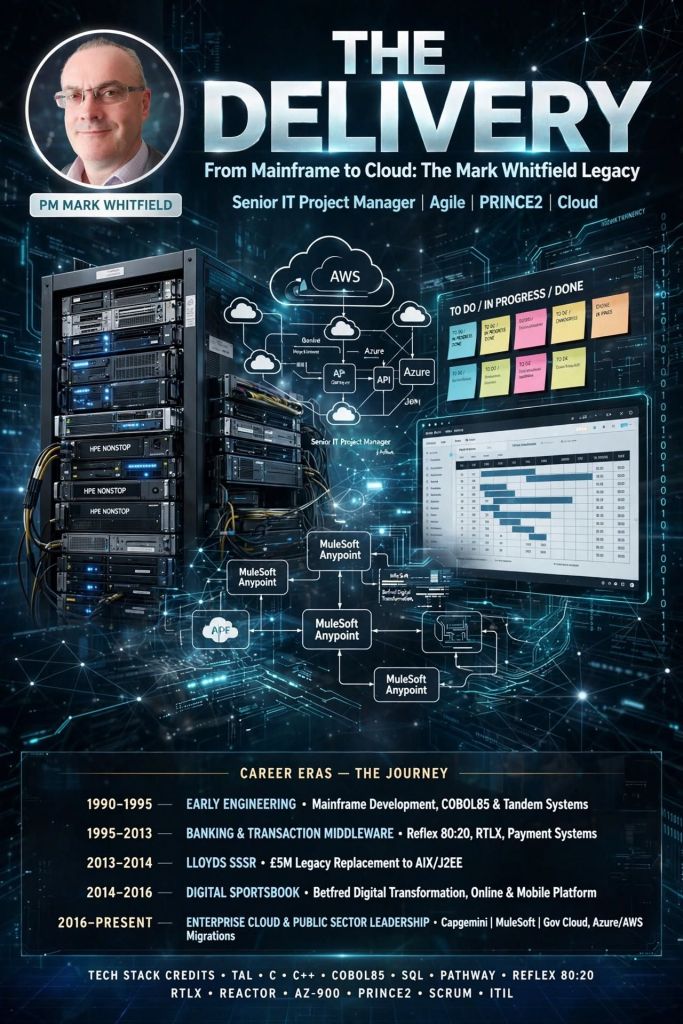
Mark Whitfield | Career Summary Timeline from Mainframes to Cloud
Over a career spanning more than 35 years, he has successfully transitioned from deep technical software engineering on legacy banking mainframes to steering multi-million-pound enterprise-scale cloud migrations and API-led digital transformations.
Mark Whitfield detailed timeline by Decade, Focus Areas and Outcomes
🎓 Foundational Era & Education (1975–1990)
Focus Areas: Logic systems, structural systems analysis, programming methodology, and corporate data processing.
Timeline Milestones:
1975–1980: Attended Hindley Green County Primary School, developing an early interest in computing logic.
1980–1985: Attended Park High Secondary School (Wigan), completing 8 GCE ‘O’ Levels including a focus on Computer Studies.
1985–1988: Attended Leigh College for ‘A’ Levels in Computer Science and Biology. He built a custom ad-revenue tracking solution in Turbo Pascal on an Amstrad PC 1512.
Outcomes: Graduated with a BTEC Higher National Diploma (HND) in Computer Studies with Distinction, finishing first in his class.
💾 The 1990s: Core Software Engineering & Infrastructure Benchmarking
Focus Areas: Electronic banking software systems, legacy Tandem Mainframes (HPE NonStop), code architecture, and high-availability volume benchmarking.
Timeline Milestones:
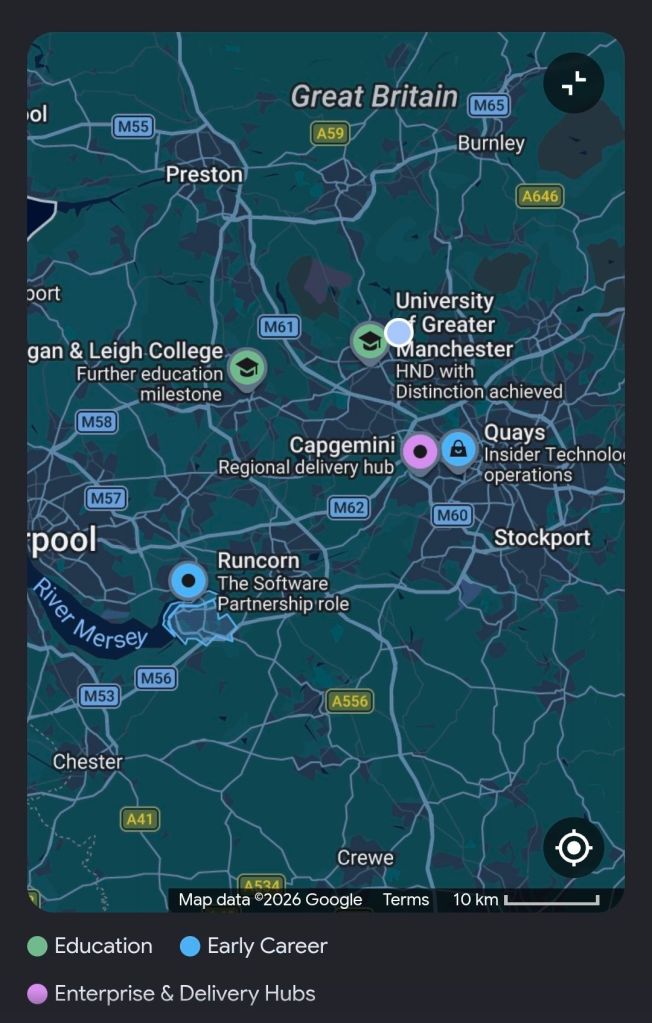
1990–1995: Core Programmer at The Software Partnership (acquired by Deluxe Data in 1994) in Runcorn.
1995–1996: Joined Insider Technologies Limited (ITL) in Salford Quays as a core developer.
1997–1998: Stepped up as a Technical Infrastructure Consultant for CRESTCo (now Euroclear) at St. Katharine’s Dock, London.
Outcomes: Built cutting-edge mainframe software packages like sp/ARCHITECT-BANK for blue-chip clients such as Barclays Bank, TSB, and Bank of Scotland. He successfully architected platform diagnostics for the flagship Reflex 80:20 tracking console and executed critical benchmark testing on Tandem S7000 nodes to secure European equity settlement pathways.
💳 The 2000s: Technical Consulting & High-Volume Transaction Monitoring
Focus Areas: Automated Teller Machine (ATM) and Point-of-Sale (POS) electronic transaction tracking, telemetry engines, SLA monitoring suites, and project coordination.
Timeline Milestones:
1999–2001: Headed vital telemetry initiatives for Tier-1 institutions including the Bank of England and Deutsche Bank.
2001–2009: Escalated into a Lead Consultant and Project Manager at Insider Technologies Limited, regularly representing the group across international stages like the European BASE24 User Group (EBUG).
Outcomes: Oversaw the delivery of complex mainframe transaction security architectures for high-volume banking institutions (including HSBC and Al Rajhi Bank). Successfully guarded SLA tracking parameters for national central banking ecosystems using specialized ACI XPNET software configurations.
📱 The 2010s: Transition to Agile Delivery & Enterprise Engagement Leadership
Focus Areas: Transitioning from Waterfall frameworks to hybrid Agile SCRUM models, e-commerce, consumer betting application releases, and client-facing stakeholder relationship management.
Timeline Milestones:
2013–2014: Recruited as an Agile IT Project Manager at Wincor Nixdorf, standardizing ATM pipeline delivery structures for major UK retail banks.
2014–2016: Appointed Senior IT Project Manager at Betfred, heading high-throughput transaction, sportsbook, and gaming release cycles.
2016–2019: Scaled into enterprise-tier leadership by joining Capgemini as an SC-cleared, client-facing Engagement Project Manager.
Outcomes: Successfully deployed high-traffic native mobile apps (iOS & Android) and online payment gateways for Betfred. At Capgemini, he orchestrated the massive Royal Mail Group Core Interface Migration, which won Capgemini’s Project of the Year Award and earned Mark an individual PM recognition award.
Focus Areas: Hybrid cloud overhauls (AWS and Microsoft Azure), API middleware architectures, large-scale public sector governance frameworks, and executive project tracking tooling.
Timeline Milestones:
2018–2020: Directed large-scale Microsoft Dynamics enterprise platform upgrade modules.
2020–2023: Spearheaded a multi-million-pound Public Sector Enterprise Application Estate Migration.
2023–2024: Managed the high-profile UK Government CHIP Framework under stringent active UK Security Check (SC) protocols.
2024–Present (2026): Formally augmented into MuleSoft (a Salesforce company) as a Delivery Manager overseeing the Anypoint Platform portfolio. [1]
Outcomes: Successfully directed total cloud infrastructure modernizations for top-tier defense and public sector branches. Concurrently, he packaged his 24+ years of delivery logic into the widely acclaimed Premium PM Delivery Templates Suite, which provides visual Plan on a Page (POaP) layouts and RAID tracking dashboards to thousands of digital project leaders worldwide.
The transformation of Salford Quays from a major industrial inland port into a vibrant cultural, residential, and digital hub is one of the most successful urban regeneration stories in the UK.
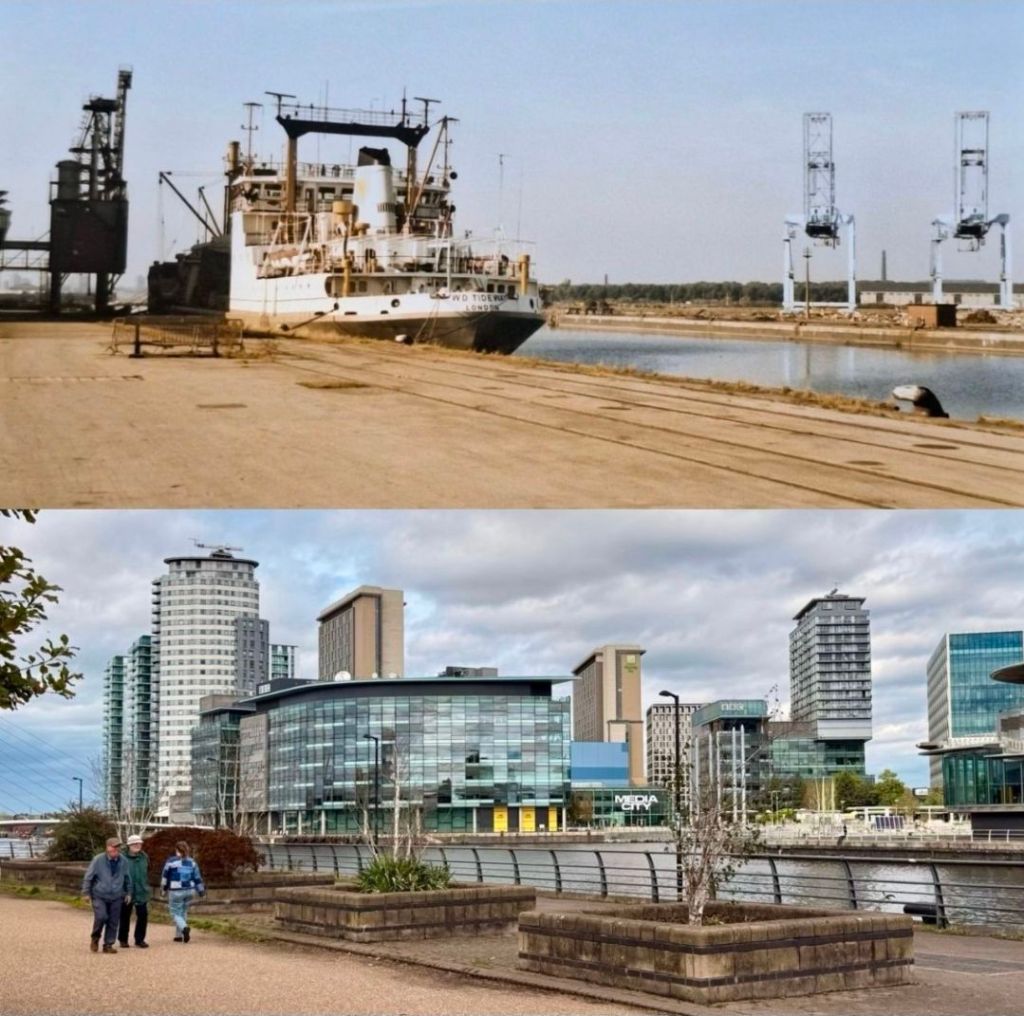
Salford Quays in 1983 and 2026
Here is the detailed timeline of Salford Quays, broken down by era, year, and key milestones.
⚓ The Industrial & Docks Era (1894–1982)
Before the late 19th century, the area was largely empty space, occupied only by a medieval hall and a racecourse. The construction of the Manchester Ship Canal fundamentally altered the landscape, making the inland region accessible to ocean-going ships.
1894: Queen Victoria officially opens the Manchester Ship Canal and the Manchester Docks. Four of the largest docks (Docks 6, 7, 8, and 9) are built on the Salford side of the canal.
1905: King Edward VII opens Dock No. 9, which becomes the largest and most crucial dock in the Salford cluster.
1947–1948: Owing to heavy damage suffered by rival ports like Hull during the World War II Blitz, Salford and Manchester Docks temporarily peak to become Britain’s third busiest port.
1952–1974: The golden era of operations. Over 16 million tonnes of cargo and 5,000 ships pass through the canal annually.
1970s: The rapid rise of standardized maritime containerization triggers a sharp decline. Newly built global freight vessels grow too large to navigate the tight locks of the Ship Canal.
1982: Traffic dries up completely. The historic docks officially close down, resulting in 3,000 immediate job losses and leaving behind 120 acres of heavily contaminated, derelict land.
🏗️ The Reclamation & Infrastructure Era (1983–1999)
With the area decaying into an unsafe, heavily polluted “no-go zone,” local government took a bold, unprecedented approach to urban reclamation.
1983: Salford City Council buys the derelict docks from the Manchester Ship Canal Company. See photo above.
1984: The council secures a Derelict Land Grant to finance total land reclamation. The territory is officially rebranded as Salford Quays.
1985: The Salford Quays Development Plan is formally adopted, laying out a master plan for commercial, residential, and leisure zoning. Dams are constructed to isolate the stagnant dock basins from the heavily polluted main canal.
1987: To fix severe water pollution, an innovative compressed air mixing aeration system is installed. Oxygen levels bounce back, allowing scientists to successfully introduce 12,000 coarse fish into the re-engineered ecosystem.
1988: The council publishes a development review expanding the vision to highlight massive tourism, leisure, and cultural landmarks. The early concept for a performing arts center (later known as The Lowry) is drafted.
1990: By this year, the initial infrastructure push transforms the landscape. Roads, promenades, bridges, and the first wave of offices, hotels, and houses are constructed across Piers 5, 6, and 7.
1999: Major pedestrian and structural bridge works conclude. Crucially, the Metrolink tram system extension opens, instantly linking Salford Quays directly to Manchester City Centre.
🎭 The Cultural Landmark Era (2000–2005)
With the environmental clean-up and transit links secured, the focus shifted to turning the Quays into a premier leisure destination.
2000: The Lowry arts centre officially opens to the public, housing a major theatre and art gallery dedicated to local artist L.S. Lowry.
2001: The retail landscape arrives with the opening of the Lowry Outlet Mall (now known as Quayside MediaCityUK). The Salford Community Water Sports Centre opens to take advantage of the clean waters.
2002: The striking architectural landmark Imperial War Museum North (IWM North) opens directly across the water. The dock lock gates reopen, linking the Quays back into the national canal network.
2004: The BBC begins looking at Salford Quays as a prime option for decentralized office relocation outside of London.
📺 The MediaCityUK & Residential Boom Era (2006–Present)
The modern era established Salford Quays as a powerhouse for the UK’s creative, digital, and high-rise residential sectors.
2006: Salford Quays is officially selected over competing sites to host the massive MediaCityUK development project.
2011: Phase One of MediaCityUK completes. Broadcasters like the BBC and ITV relocate massive operations, studios, and staff here alongside the University of Salford’s media campus.
2012–2020: The region experiences a massive economic boom. The wider borough sees average property values double over eight years as young professionals flood the high-rise apartments flanking the waterfront.
2023: Vertical expansion continues as Eda (Erie Dock Apartments), a prominent 29-storey residential skyscraper, is completed.
2026 (Present): Salford Quays is currently undergoing a massive ongoing £1 billion expansion approved by the local council to double its development footprint, headlined by high-density projects like the four-tower X1 Michigan Towers reaching up to 46 storeys.
The professional and academic career timeline for Mark Whitfield, a Senior IT Project Manager from Hindley Green, Wigan, UK, is outlined below.
Professional & Academic Career Timeline for Mark Whitfield – Senior IT Project Manager
Synthesised directly from his official records and technical portfolio on PROject Templates, this low-level breakdown is structured by chronological era, specific years, and core focus areas.
🎓 Foundational Era: Academic Roots & Early Computing (1975–1990)
1975–1980
Institution: Hindley Green County Primary School (Thomas Street, Hindley Green).
Focus Area: Primary education and initial interest in logic systems.
1980–1985
Institution: Park High Secondary School (Park Road, Hindley).
Focus Area: Completed 8 GCE ‘O’ Levels with top marks, explicitly choosing Computer Studies alongside Mathematics and English.
1985–1988
Institution: Leigh College (Marshall Street, Leigh).
Focus Area:‘A’ Level Computer Science & Biology. In 1986, engineered a custom software solution using Turbo Pascal on an Amstrad PC 1512 to track and calculate advertising revenue files for a local regional newspaper.
1988–1990
Institution: Bolton Institute of Higher Education (BIHE).
Focus Area: Graduated with a BTEC Higher National Diploma (HND) in Computer Studies with a Distinction classification, finishing first in his cohort. Studies focused heavily on structural systems analysis, programming methodology, and corporate data processing.
💻 Era 1: Early Engineering & Technical Analysis (1990–1995)
Focus Area: Electronic desktop banking software development, establishing foundational secure remote access to business accounts.
1990
Organization: The Software Partnership (TSP) / Deluxe Data International (Runcorn).
Details: Joined the core engineering team as a Programmer/Lead Analyst to develop standard client-server banking release cycles.
1991–1993
Details: Deployed on-site at Barclays Bank (Knutsford/Poole) for the high-profile Barclays Business Master II (BBM II) application.
1994–1995
Details: Focused on back-end integration, writing complex transaction code for clients like RaboBank and the Bank of Scotland.
Core Technology: Tandem Mainframe Computers (now HPE NonStop), utilizing TAL, C, C++, COBOL85, NonStop SQL, and PATHWAY architectures.
🏦 Era 2: Senior Development & Product Management (1995–2013)
Focus Area: High-volume transaction middleware, system monitoring, and strict Service Level Agreement (SLA) diagnostics for global financial institutions.
Details: Operated as Senior Programmer co-developing the core platform health and transaction logging extraction modules for the “Reflex” (Reflex 80:20) Monitoring Suite.
1997
Details: Contracted on-site to CRESTCo (now Euroclear), authoring custom benchmarking and stress-testing applications to track software liquidity on newly introduced S7000 HPE NonStop architecture.
2000–2007
Details: Designed complex Automated Teller Machine (ATM) and Point-of-Sale (POS) environment monitoring expansion tools. Managed transaction security projects deployed across primary banks like HSBC and Al Rajhi Bank.
2008–2013
Details: Escalated from technical consultancy into a strategic IT Project Manager role. Directed large data extraction architectures and modern transaction engine tracking suites like the RTLX Reactor.
🏧 Era 3: Professional Services Banking Delivery (2013–2014)
Focus Area: Legacy migrations, hardware/software replacement programmes, and traditional retail banking software delivery.
2013–2014
Organization: Wincor Nixdorf (Banking Division).
Details: Served as Project Manager for Professional Services. Spearheaded the critical Wincor workstream for Lloyds Banking Group’s massive Self-Service Software Replacement (SSSR) programme. Tracked Agile ATM deployment pipelines to ensure immediate time-to-market performance changes.
🎲 Era 4: Digital Sportsbook Transformation (2014–2016)
Focus Area: Consumer digital gaming systems, high-throughput web architecture, and instant online billing gateways.
Details: Hired as IT Senior Digital Project Manager. Managed multi-disciplinary software engineers across the UK to deploy complex mobile sportsbook modules and online payment platforms. Successfully aligned quick-turnaround web logic pipelines with stringent security parameters.
☁️ Era 5: Enterprise Cloud, Integration & Public Sector Leadership (2016–Present)
Details: Formally stepped into client-facing enterprise leadership as an SC-cleared Engagement Manager. Directed large hybrid offshore/onshore development pipelines for the automotive, defence, and aerospace sectors.
2018–2022
Organization: Capgemini / Augmented into MuleSoft (A Salesforce Company).
Details: Operated as a Delivery Manager governing multi-million-pound portfolios utilizing the MuleSoft Anypoint Platform. Directed hybrid cloud migration blueprints (Azure, AWS, and Power Platform) leveraging MuleSoft Outcome Based Delivery (OBD) frameworks.
2023–Present
Details: Continues to operate as a highly senior technical project strategist, publishing refined, reusable governance frameworks, visual dashboards, and Plan on a Page (POaP) Templates to unify Agile engineering speed with strict PRINCE2 methodologies.
Mark Whitfield’s training transitions from deep-dive mainframe engineering courses in the 1990s to corporate project management, Agile delivery, and cloud infrastructure methodologies.
The detailed chronological breakdown of his professional training from 1990 onwards, categorized by course, focus area, and year, is outlined below:
🛠️ Project Management, Governance & Frameworks
Fundamentals of Successful Project Management (2000) – Project initiation, core project management mechanics, and planning frameworks.
Managing Multiple Projects, Objectives and Deadlines (1999) – Multi-project tracking, prioritization techniques, and timeline optimization.
Microsoft Project ’98 Certification Series (1998) – Advanced Critical Path method modeling, tracking metrics, and timeline layouts using MS Project.
PRINCE2 Registered Practitioner (2011) – Structured waterfall project governance, stage-gate management, and risk frameworks via ILX.
Agile SCRUM Training Course (2011) – Sprint ceremonies, user story mapping, agile delivery mechanics, and backlog prioritization.
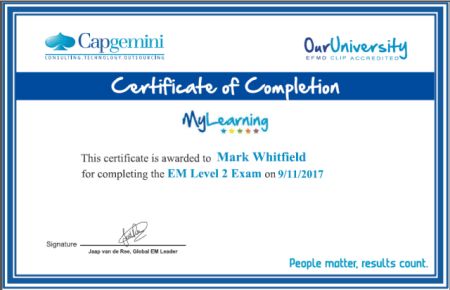
Advanced Engagement Management Course (Level 2 Exam) (2017) – Enterprise stakeholder management, delivery financials, and large-scale delivery mechanics at the Capgemini Campus in Chantilly, France.
Engagement Manager eLearning & Group Training (2019) – Capgemini operational workflows, anti-corruption policies, and corporate IPR (Intellectual Property Rights) risk mitigation protocols.
ITIL Framework (Ongoing/Capgemini era) – IT Service Management (ITSM) and aligning enterprise IT operations with business outcomes.
💻 Software Engineering, Databases & Technology
AZ-900 Microsoft Certified Azure Fundamentals (2022) – Cloud architecture concepts, cloud security protocols, and core Azure deployment ecosystems.
Querying Microsoft SQL 2000 with Transact SQL (M2071) (2009) – Database querying architectures, T-SQL scripting, and data manipulation.
Developing MS ASP.NET Web Applications using MS Visual Studio .NET (Course 2310B) (2007) – Building scalable 5-day web components, data binding using ADO.NET, web controls, and XML Web Service integration.
C++ for Non-C Programmers (1997) – Object-oriented application design, structural code transitions, and memory management.
TANDEM TAL (Transaction Application Language) Programming (1995) – High-performance low-level systems programming optimized for secure mainframe transaction monitors.
TANDEM Performance Analysis and Tuning (1995) – Code profiling, infrastructure bottleneck diagnostics, and mainframe system optimization.
VPS 7000/9000 Series Application Development (VOS 4.3) (1994) – Legacy platform application configuration and system engineering.
TANDEM Guardian Principles Course (1993) – Core Tandem fault-tolerant operating system architectures and file security configurations.
📊 Business Operations, Design & Digital Productivity
Microsoft Excel Refresher Course (2024) – Data analysis formulas, validation tracking, and programmatic report structures via Udemy.
Microsoft Excel 2010 (Expert Skills) (2017) – Complex variance mapping, financial track design, and cross-functional project tracking sheets.
Website Visibility and Promotion by Design (2009) – Search engine discoverability metrics and web application positioning mechanics.
Writing for the Web (2009) – Content architecture and copy optimization for digital platforms.
How to Design Attention-Grabbing Brochures, Catalogues, Ads, Newsletters and Reports (2006) – Desktop publishing formatting, layout typography, and corporate design principles.
Selling Insider Technologies Successfully (Insider Tech era) – Strategic relationship building, value proposition mapping, and enterprise software sales processes.
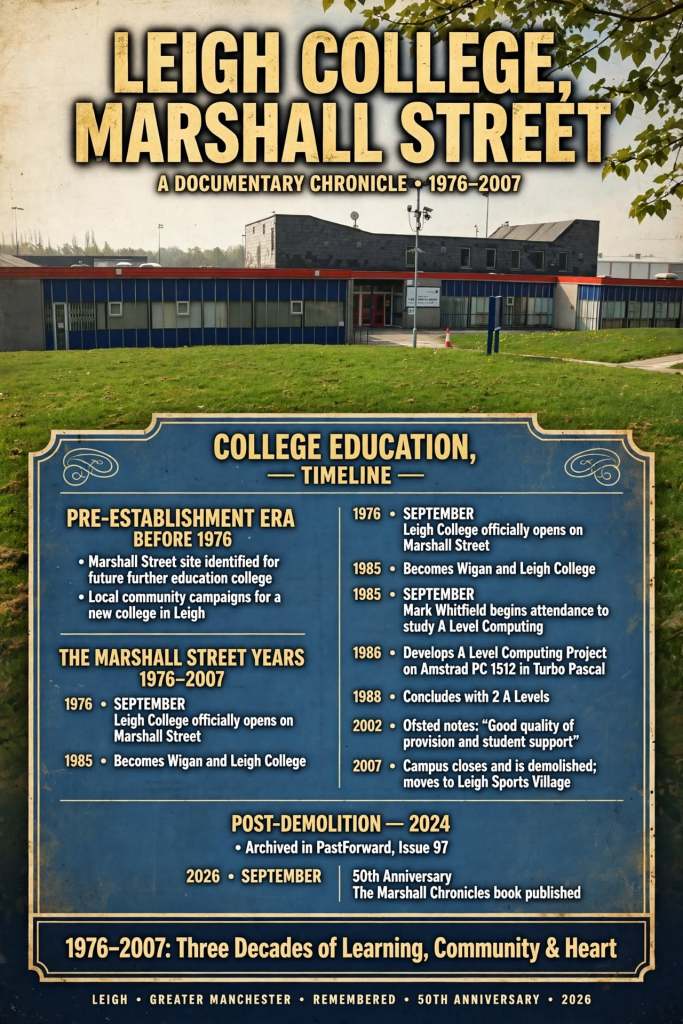
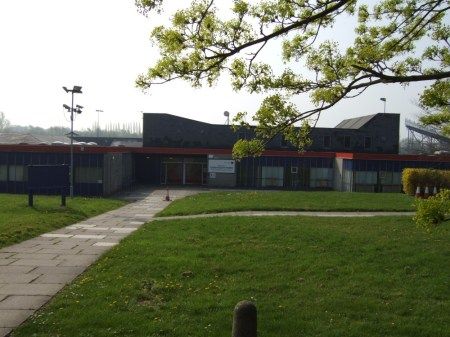
The history of Leigh College on Marshall Street spans just over three decades, bridging the gap between traditional grammar school education and modern tertiary facilities.
Mark Whitfield | Leigh College, Marshall Street
Below is a detailed historical timeline of the site, including the specific attendance details of alumnus and Senior IT Project Manager Mark Whitfield (this website author).
🏛️ Pre-Establishment Era (Before 1976)
1976 (Early): Under the newly introduced comprehensive education system, the historic Leigh Grammar School and Leigh Girls’ Grammar School (originally opened in 1921 on Windermere Road) close their doors. Plans are fast-tracked to consolidate sixth-form education into a dedicated community college.
🧱 The Marshall Street Years (1976–2007)
1976 (September): Leigh College officially opens its new, purpose-built campus on Marshall Street. Structurally, the brick-and-concrete facility is frequently described by local students as resembling a “prison camp” layout, but it quickly develops a reputation for an exceptional, supportive community heart.
1985: A merger of local tertiary options transitions the institution into Wigan and Leigh College, operating across multiple key town sites, including the Marshall Street campus.
1985 (September): Mark Whitfield begins his attendance at Leigh College. Having completed his GCE ‘O’ Levels at Park High Secondary School (Park Road, Hindley, Wigan), he enrols to pursue advanced technical qualifications including ‘A’ Level Computing.
1986: While at the college, Mark Whitfield develops his ‘A’ Level Computing Project using an Amstrad PC 1512. Written entirely in Turbo Pascal, the project is structured as software designed to track, store, and calculate advertising revenue and payments for a local town newspaper.
1988 (June): Mark Whitfield concludes his attendance at Leigh College. He graduates with 2 ‘A’ Levels in Computer Science and Biology, immediately moving on to pursue a Higher National Diploma (HND) in Computer Studies with Distinction at the University of Bolton (then BIHE).
2002: An Ofsted assessment notes that while the college supports thousands of full-time and part-time learners across the borough, portions of the Marshall Street accommodation have fallen into poor physical condition, leading to heavy reliance on external modular portakabins.
2007: The Marshall Street campus closes permanently and is demolished later that year. Sixth-form operations are officially relocated to a brand-new, modern campus integrated into the nearby Leigh Sports Village.
📅 Post-Demolition & Commemoration
2024 (August–November): The historical legacy of the college is formally archived in Issue 97 of PastForward (Wigan Archives & Museums local history magazine) in a retrospective article curated by Julie McKiernan.
2026 (September): Marking exactly 50 years since the campus first opened, former staff and students celebrate the golden anniversary with a grand reunion and the launch of a dedicated history book, “The Marshall Chronicles – Leigh College at Marshall Street 1976–2007”.
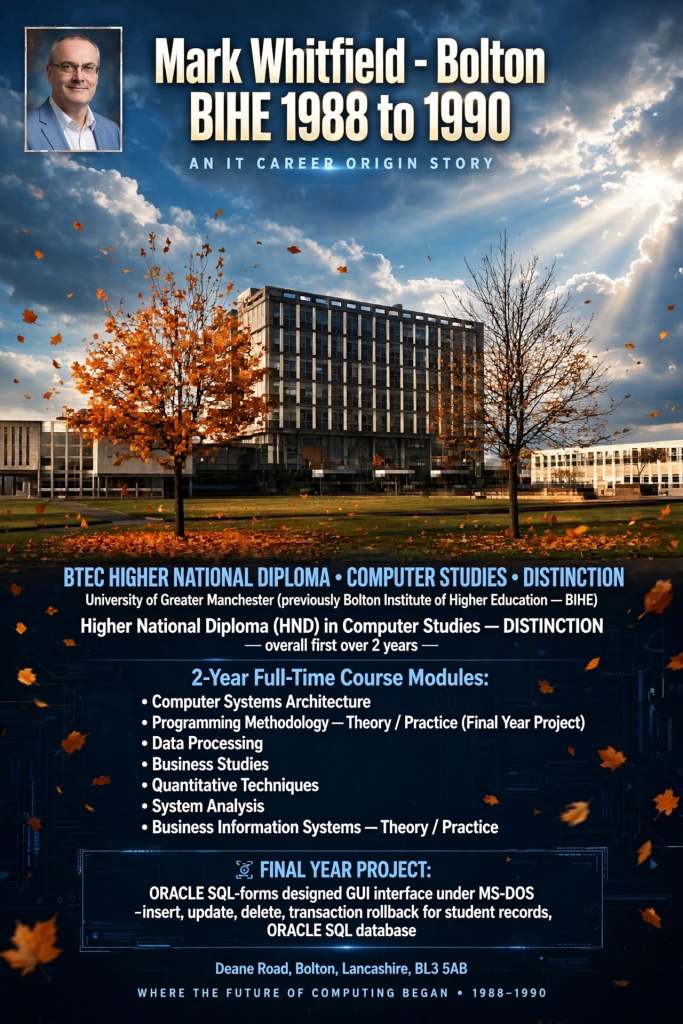
Mark Whitfield completed his BTEC HND in Computer Studies at the Bolton Institute of Higher Education (BIHE), which has since evolved into the University of Bolton and rebranded as the University of Greater Manchester in 2025.
Mark Whitfield | Bolton Institute of Higher Education, BIHE | BTEC HND Computing, Distinction
He attended the institution from 1988 to 1990, graduating with a Distinction and achieving overall first place across his entire cohort for the duration of the two-year, full-time course.
Mark Whitfield attended BIHE, 1988 – 1990
The academic breakdown of his specific computing curriculum and achievements is detailed below.
📋 HND Module Breakdown
The two-year executive-level HND program consisted of seven core modules blending technical computer science with business information systems:
Computer Systems Architecture: Focus on hardware design, CPU structures, and system configurations.
Programming Methodology (Theory / Practice): Foundations of logic, software development lifecycles, and code optimization.
System Analysis: Methodologies for assessing business requirements and mapping technical system designs.
Data Processing: Data management workflows, storage systems, and batch/transaction structures.
Business Information Systems (Theory / Practice): The application of computer networks and platforms within corporate infrastructures.
Business Studies: Fundamentals of corporate structure, commerce, and finance to bridge technical and commercial alignments.
Quantitative Techniques: Mathematical and statistical methods applied to computing and resource management.
💻 Final Year Project
For his definitive practical project, Mark Whitfield developed a database interface that aligned with his specialized programming modules.
Tech Stack: Built using an ORACLE SQL-forms graphical user interface (GUI) operating within an MS-DOS environment.
Functionality: Created an administrative system to record student enrollments, module assignments, and course grades.
This academic performance served as the launchpad for his 30+ year career as an IT Senior Project Manager and Delivery Lead.
His deep technical foundation from BIHE transitioned into complex enterprise solution deliveries—such as legacy ATM modernization, hybrid cloud migrations, and API integrations—for financial and corporate entities including the Bank of England, Barclays, Lloyds Banking Group, and Jaguar Land Rover.
He is also the author of the industry resource platform, PROject Templates.
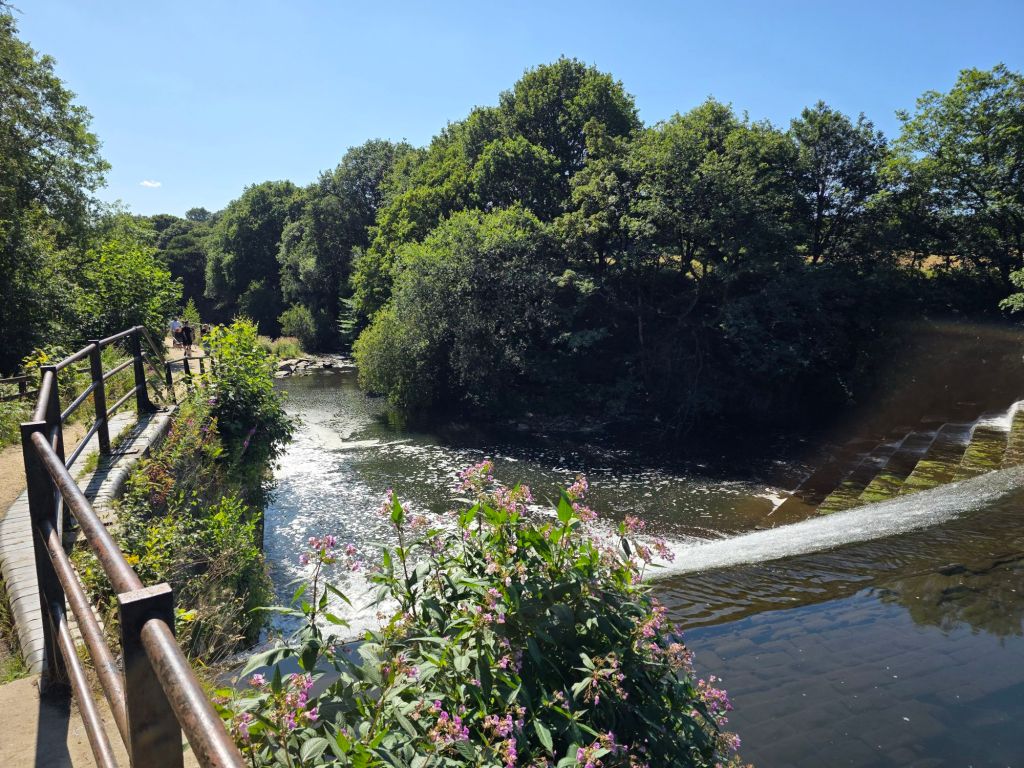
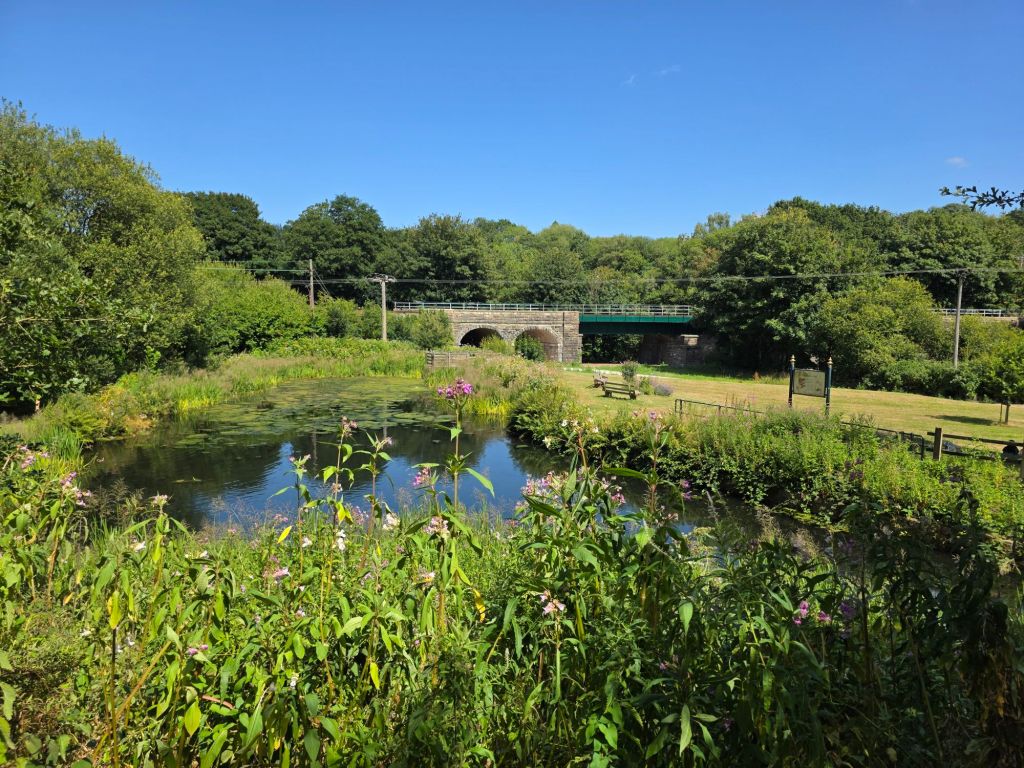
Burrs Country Park is a 36-hectare scenic countryside destination located along the River Irwell, just one mile northwest of Bury town centre. Managed by Bury Council alongside the dedicated community volunteer group, the park has proudly held a Green Flag Award since 2005 for being clean, safe, and environmentally sustainable.
Key Highlights
Industrial Heritage: Once a busy industrial hub, the site features archaeological remains of two major 18th-century cotton mills—Higher Woodhill Mill and Burrs Mill.
Steam Railway: The heritage East Lancashire Railway runs directly alongside the grounds, allowing visitors to stop at the dedicated Burrs Country Park Halt.
Art Installations: The park serves as a featured stop on the Irwell Sculpture Trail, hosting interactive outdoor artworks like Waterwheel and Stone Cycle.
Wildlife & Nature: The grounds feature diverse habitats including wetlands, ponds, and woodlands that make it an ideal hub for birdwatching, fishing, and nature walks.
Amenities & Dining: Visitors can enjoy food and drink at the dog-friendly The Lamppost Café or grab a meal at the historic The Brown Cow pub, which dates back to 1752.
The main park entrance is located on Woodhill Road (Postcode: BL8 1DA). If you are travelling by public transit, you can catch the 472 or 474 bus routes from the nearby Bury Interchange. For additional maps, safety guidelines, and event calendars, you can visit the official Bury Council Park Portal.