Agile Scrum Team Estimation Techniques

Agile Scrum Team Estimation Techniques

Agile estimation techniques use relative sizing rather than exact time tracking to gauge the effort, complexity, and risk of completing tasks. These collaborative methods help Scrum teams maintain predictable delivery and realistic workloads without relying on rigid, top-down predictions.

Common Agile estimation techniques include:

1. Planning Poker

  • How it works: Team members use a deck of cards with values from the modified Fibonacci sequence (0, 1, 2, 3, 5, 8, 13, 21, etc.). The Product Owner presents a user story, the team discusses it, and each member privately selects a card representing their effort estimate.
  • When to use it: Ideal for detailed sprint planning and backlog refinement, especially when you need to encourage team collaboration and reach a consensus.

2. T-Shirt Sizing

  • How it works: Tasks are assigned sizes (XS, S, M, L, XL) based on high-level complexity rather than precise points.
  • When to use it: Excellent for rapid, broad-brush estimation during initial release planning or when mapping out large Epics that aren’t yet refined into granular user stories.

3. Affinity Estimation

  • How it works: The team collaboratively groups user stories on a wall or digital board into columns representing different sizes. Every team member can move a story if they disagree with its current size, creating a consensus through comparative grouping.
  • When to use it: Best suited for large product backlogs where many items need to be sized quickly in a single session.

4. Dot Voting

  • How it works: Team members receive a limited number of physical or digital “dots” to place on user stories they believe carry the highest complexity or effort, prioritizing stories based on the concentration of votes.
  • When to use it: Helpful for quick prioritization and establishing a baseline for relative difficulty among a large list of tasks.

5. The Bucket System

  • How it works: Similar to Affinity Estimation, various “buckets” (numbered with Fibonacci sequences) are laid out. Stories are placed in the buckets, which helps the team rapidly categorize relative effort.
  • When to use it: Great for medium-to-large backlogs requiring faster execution than traditional Planning Poker without sacrificing sizing accuracy.

To dive deeper into implementing these practices for your team, check out Atlassian’s Guide to Agile Estimation or explore Monday.com’s Agile Estimation Strategies.

RACI, RAID and ROAM – Essential Project Management & Agile Tools

RACI, RAID and ROAM - Essential Project Management & Agile Tools
RACI, RAID and ROAM – Essential Project Management & Agile Tools

Agile Scrum Velocity and Capacity

Agile Scrum Velocity and Capacity
Agile Scrum Velocity and Capacity 2

Mark Whitfield, High-Level Project Management Summary

You can review or download the targeted, one-page CV for Mark Whitfield (Senior Project Manager specializing in HPE NonStop systems) via the Mark Whitfield CV PDF link.

Mark Whitfield, High-Level Project Management Summary

The high-level, scannable overview of his professional profile is outlined below:

Executive Profile

  • Role: IT Senior Project Manager / Delivery Lead
  • Background: 30+ years of experience delivering highly complex technology, business transformation, and infrastructure projects.
  • Core Skills: Cloud migration (hybrid), legacy ATM software modernisation, Point of Sale (POS) implementations, and software development lifecycles (SDLC).
  • Methodologies: Agile, Waterfall, PRINCE2 Practitioner, and ITIL certified.

Core Expertise & Competencies

  • HP NonStop & Legacy Integration: Deep technical roots in Tandem Computers/HP NonStop development, TAL programming, and high-volume transaction environments.
  • Global Delivery: Managed large-scale IT and system monitoring rollouts across the UK and international markets (e.g., Saudi Arabia).
  • Stakeholder Management: Experienced in bridging the gap between highly technical development teams and high-level business stakeholders.

For direct access to his official templates, articles, and full professional journey, you can visit the PROject Templates Website.

Microsoft Power Platform Summary, Technical Evolution by Year & Career Involvement

Microsoft Power Platform is an enterprise-grade, low-code platform that allows organizations to build applications, automate workflows, analyze data, and create AI-powered virtual agents. It natively connects to Microsoft 365, Azure, and Dynamics 365, serving as a core pillar of modern digital transformation.

Microsoft Power Platform Summary and Technical Evolution by Year
Microsoft Power Platform Overview

Core Pillars

  • Power Apps: A low-code development environment for building custom, cross-platform business applications (Canvas or Model-driven) without writing traditional code.
  • Power Automate: An automation service enabling the creation of workflows, API-based integrations, and Robotic Process Automation (RPA) for legacy systems.
  • Power BI: A business analytics service that provides interactive visualizations and business intelligence capabilities with an interface simple enough for end users to create their own reports and dashboards.
  • Power Pages: A secure, enterprise-grade low-code software-as-a-service (SaaS) platform for designing, configuring, and publishing external-facing websites.
  • Microsoft Copilot: AI-assisted generative capabilities natively built across the platform, allowing users to build apps, write flows, or generate reports using natural language.

Foundational Technologies

  • Dataverse: A secure, cloud-based data storage and management layer featuring a standardized common data model, allowing disparate Microsoft tools to seamlessly share information.
  • Connectors: Over 1,000 pre-built wrappers that facilitate communication between the Power Platform and external services (like Salesforce, SQL databases, or REST APIs).
  • Power Fx: A low-code, strongly-typed functional programming language based on Excel formulas that serves as the logic layer across the platform.

Technical Evolution by Year

The Power Platform did not launch overnight; it evolved through the gradual introduction of several standalone tools before Microsoft formally unified them under one umbrella.

2013–2015: The Origins of Data Analysis & Logic

  • 2013: Power BI is initially released as an add-in for Microsoft Excel, allowing users to build pivot tables and light analytics.
  • 2015: Power BI transitions into a standalone cloud service. Concurrently, Power Apps enters public preview, introducing the low-code app paradigm.

2016–2017: Workflow Automation

  • 2016: Microsoft Flow (the predecessor to Power Automate) is launched to handle cloud-based workflow automation.
  • 2017: Common Data Service (now Dataverse) is introduced to provide a standardized, secure data layer.

2018–2019: The “Power Platform” Unification

  • 2018: Microsoft officially unifies Power BI, Power Apps, and Microsoft Flow under the official name “Microsoft Power Platform”, introducing the formal concept of a connected, low-code business ecosystem.
  • 2019: The Common Data Service gets deeper integration across Dynamics 365 and Microsoft 365, accelerating citizen development across large enterprises.

2020: AI and Robotic Process Automation (RPA)

  • 2020: Microsoft launches AI Builder, allowing users to integrate pre-trained AI models (like form processing and object detection) directly into their apps and workflows.
  • 2020: Softomotive is acquired, bringing RPA (desktop flows) into Power Automate.

2021–2022: New Additions and Expanded Web Presence

  • 2021: The Common Data Service is officially rebranded as Microsoft Dataverse.
  • 2021: Power Fx is introduced as the standard, open-source low-code language.
  • 2022: Power Apps Portals is rebranded and expanded into Power Pages, creating a dedicated, robust tool for building external-facing websites.

2023–2024: The Generative AI Wave

  • 2023: Microsoft embeds generative AI across the suite through Copilot. Users begin building data tables, applications, and automation flows entirely through conversational prompts.
  • 2024: Power Platform deepens its integration with Microsoft Fabric and brings further enterprise-grade management, data governance, and AI agent orchestration features directly into Dataverse.

2025–2026: Agentic Computing and Modern Controls

  • 2025: Power Platform evolves beyond standard applications and automations into “agentic computing.” Makers can build autonomous, AI-driven data agents directly within Dataverse using the Python SDK.
  • 2026: Power Apps rolls out massive updates to its interface, deploying responsive layouts and modern controls as default settings. Advanced lifecycle management and process-mining features cement the platform’s role in modern fusion development.

My Recent MS Power Platform Involvement :

UK Gov : Cloud Migration (Hybrid) – In 2020, working as a Senior Project Manager on a client sponsored Agile proof-of-concept (POC) project to move 3 Client elected Apps (with MS Access, Oracle and SQL 2008 DBs), to the Cloud (Microsoft Azure and Dynamics365 Power Platform). The migration to the cloud was based on 3 primary app patterns namely; re-host, re-platform and re-factor. This project spanned approximately 3 months and started in early February 2020 with a budget of £375k.

The project was a pre-cursor and effort indicator for the larger piece of migration work to move 130 client estate apps to the cloud. This is a very complex app estate with many touch points and different technology stacks.

As the Capgemini Senior PM, responsible for the project planning, control, organisation, stakeholder communication, aligning with current GDPR directives and status reporting against delivery of Capgemini services to the client. As the PM, also the first escalation point for the project team and the client.

C&CA UK's Communications & Engagement Award Winner 2022 - Cloud & Custom Applications - Capgemini UK
December 2022 – C&CA UK’s Communications & Engagement Award Winner – Cloud & Custom Applications – Capgemini UK

Business Analyst Documentation, Types, Uses and Impact

Business Analyst Documentation, Types, Uses and Impact

Agile Scrum Velocity & Burn Down Chart Summary

Agile Scrum Velocity & Burn Down Chart Summary

Scrum velocity and burndown charts are essential agile metrics used to measure team capacity and track progress. Velocity measures the average story points completed over past sprints to forecast future capacity. Burndown charts visually represent the remaining work daily, highlighting if the team is on track to meet sprint goals.

Scrum Velocity

  • Definition: The amount of work (usually in story points or hours) a team completes in a single sprint.
  • Purpose: Helps forecast team capacity for future sprints and promotes sustainable pace.
  • Calculation: Sum of story points for all “Done” items at the end of a sprint.
  • Best Practice: Average velocity over 3–5 sprints provides a more accurate, stable forecast.

Burndown Chart

  • Definition: A graph showing the amount of work remaining versus time (days) in a sprint.
  • Components:
    • Ideal Work Line: A straight line showing the projected pace to complete work.
    • Actual Work Line: A line plotting daily completed work against the ideal line.
  • Purpose: Provides daily visibility into progress and detects risks early (e.g., if the line is above the ideal, the team is behind).
  • Types: Sprint Burndown (short term) vs. Release/Product Burndown (long term).

Key Differences

  • Velocity is a planning metric looking at historical performance.
  • Burndown is a monitoring tool looking at current progress.

Common Pitfalls

  • Velocity: Treating velocity as a productivity metric (it is a capacity planning metric) or comparing it between teams.
  • Burndown: Using “manual updates” rather than automated tools, leading to inaccurate data.
  • Both: Neglecting to refine user stories, which makes velocity unpredictable and burndowns inaccurate.

Mark Whitfield IT, Technical & Project Management Training Overview

Mark Whitfield, a Manchester-based Senior IT Project Manager, has completed extensive professional training throughout his career, focusing on project management methodologies, delivery software, and technical tools.

Core Project Management Methodologies :

  • PRINCE2 Practitioner: Certified as a registered PRINCE2 Practitioner in May 2011 via the ILX Group (Gold e-Learning).
  • Agile SCRUM Training: Attended in-house training with RADTAC in May 2011.
  • Advanced Engagement Management (Level 2): Completed at Capgemini in November 2017.
  • Project Management Fundamentals: Completed “Fundamentals of Successful Project Management” in February 2000 through Skillpath in Manchester.
  • Managing Multiple Projects: Attended “Managing Multiple Projects, Objectives and Deadlines” in October 1999/1998 via Skillpath.

Software & Cloud Platforms :

  • AZ-900 Microsoft Azure Fundamentals: Certified in February 2022.
  • Microsoft Project: Completed the Microsoft Project ’98 Certification Series in May 2000 through the IIL UK Education Centre in Reading.
  • Microsoft Excel Expert Skills: Upgraded skills via a 2017 Expert course and a July 2024 Udemy refresher.

Technical & Programming Courses :

  • Tandem / HP NonStop: Completed Tandem Guardian Principles (1993), Tandem Performance Analysis (1995), and Tandem TAL Programming (1995).
  • C / C++ Programming: Attended “C++ for Non-C Programmers” with Comtec Computer Training in March 1997.
  • Database Querying: Completed “Querying Microsoft SQL 2000 with Transact SQL” via QA Training in March 2009.
  • Web Applications: Attended “Developing MS ASP Web Applications using MS Visual Studio .NET” in January 2007.

Marketing & Communication Training :

  • Writing for the Web: Completed in May 2009 with gbdirect (iTrain Education in London).
  • Brochure & Document Design: Attended a SkillPath Seminar on designing marketing brochures and reports in April 2006.

10 Principles of Scaled Agile Framework (SAFe)

10 Principles of Scaled Agile Framework (SAFe)

Agile: It’s Not a Race

Agile: It’s Not a Race

Mark Whitfield is a Senior IT Project Manager based in Manchester

Mark Whitfield is a highly experienced Senior IT Project Manager based in Manchester, UK, with over 31 years of experience in the IT industry specializing in both Agile and Waterfall methodologies. He holds SC clearance (valid until 2031) and has a strong technical background in banking and digital project delivery, including experience as a developer in software development lifecycles (SDLC).

Mark Whitfield is a highly experienced Senior IT Project Manager based in Manchester

Professional Biography

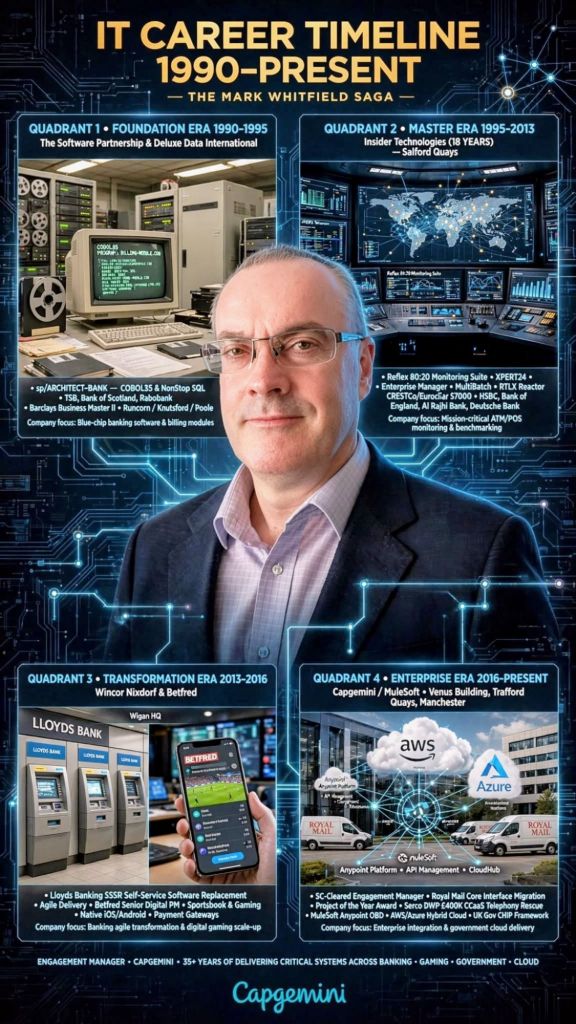
After graduating in Computing in 1990, Mark began his career as a programmer specializing in Electronic Banking software on Tandem Mainframe Computers (HPE NonStop). He spent five years coding in COBOL85 and NonStop SQL for banking clients before transitioning into project management.

Mark has operated as a Senior IT Project Manager for over two decades, delivering complex projects for major blue-chip clients, including Jaguar Landrover, Heathrow, Royal Mail Group, and various financial institutions. He currently provides project management templates based on his extensive experience via his website, PROject Templates.

Example POaP Plan On a Page templates by Mark Whitfield

Key Skills & Expertise

  • Methodologies: Agile SCRUM, Waterfall, PRINCE2 Practitioner.
  • Technologies: HP NonStop (BASE24, TAL, C, C++, SQL), Java, .NET, Mobile (iOS, Android, Windows).
  • Areas: ATM software delivery, Gambling/Casinos, Public Sector/LRG, Payment Systems, Digital Transformation.
  • Clearance: SC Cleared until 2031.
Capgemini Engagement Manager, 2016 thru 2025

Professional Career & Projects

Capgemini UK (Jan 2016 – Present)

  • Role: Client-facing SC Cleared Engagement Manager.
  • Projects: Delivered Waterfall and Agile digital projects for automotive, local regional government (LRG), postal services, and aerospace & defence sectors.
C&CA UK’s Communications & Engagement Award Winner 2022

Betfred (Late 2014 – Jan 2016)

  • Role: Senior IT Project Manager.
  • Projects: Managed mobile and online gambling/casino projects, including payment gateways, sportsbook, and virtual gaming using Agile SCRUM.

Wincor Nixdorf (Sept 2013 – Late 2014)

  • Role: Agile IT PM, Professional Services – Banking Division.
  • Projects: Managed ATM software delivery (Wincor Nixdorf work stream >£5M) for Lloyds Banking Group/Halifax.

Insider Technologies Limited (Aug 1995 – Sept 2013)

  • Role: Project Manager – Strategic Technical Initiatives.
  • Projects: Technical pre-sales, product management, and installation for HPE NonStop banking products (Reflex 80:20, RTLX).
HP NonStop TAL Programming Course
1995, HP NonStop TAL Programming Course

The Software Partnership / Deluxe Data (1990 – 1995)

  • Role: Programmer.
  • Projects: Developed code for sp/ARCHITECT-BANK on Tandem Computers for banks like TSB, Bank of Scotland, and Rabobank.

Professional Training & Certification

Registered PRINCE2 Practitioner (May 2011, ILX)
1990, BTEC HND in Computer Studies from Bolton Institute of Higher Education, BIHE

PowerPoint Plan On a Page (POaP) templates

Mark Whitfield provides a variety of Plan On a Page (POaP) templates designed to simplify complex project schedules into a single, high-level visual. These templates are typically available through his official website as part of a larger project management toolkit that includes over 200 editable documents.

PowerPoint Plan On a Page (POaP) templates

Mark Whitfield’s POaP Template Formats

Whitfield’s templates are available across multiple platforms to suit different project needs:

PowerPoint POaP Templates

Includes over 35+ slide examples showing different ways to visualise a Software Development Life Cycle (SDLC) plan. These are ideal for client presentations where high-level detail is needed.

Excel POaP & Tracker Templates

Features Gantt views, resource costing grids, and Agile Sprint views. Some Excel versions allow you to align the POaP with resource availability and overall phase costs, useful for project bids.

MS Project (MPP) Templates

Detailed PRINCE2 and Waterfall templates that can be condensed into a “timeline” view to serve as a POaP. These are annotated for tasks like Agile Scrum ceremonies or specific PRINCE2 7th Edition stages.

Key Features of the POaP Templates

  • Adaptability: Templates are designed to be tailored for Waterfall (PRINCE2) or Agile (Scrum/Sprints) methodologies.
  • Integrated Tracking: Often bundled with RAID logs (Risk, Action, Issue, Dependency) and RACI trackers to provide a complete overview beyond just the schedule.
  • Visual Dashboards: Many versions include self-populating charts and summary dashboards for at-a-glance status reporting.
  • Availability: Templates can be purchased individually or as a bulk pack on Mark Whitfield’s Website or through platforms like Etsy and Eloquens.

PowerPoint Plan On a Page (POaP) templates

Understanding Agile Scrum, A Framework for Delivering Value, Iteratively

Understanding Agile Scrum, A Framework for Delivering Value, Iteratively

Agile Scrum Metrics that Drive Team Improvement

Agile Scrum Metrics that Drive Team Improvement

Right Project Management Approach, Adaptability over Rigid Approach

Right Project Management Approach, Adaptability over Rigid Approach

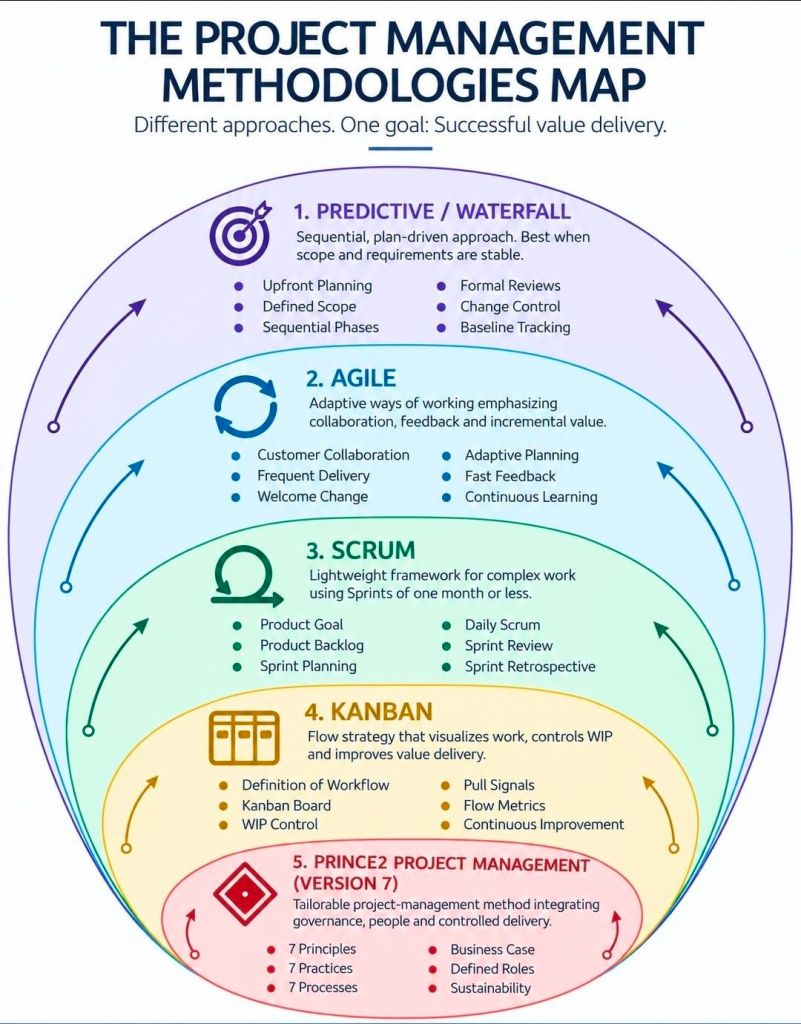
PRINCE2 Agile Outline

PRINCE2 Agile combines the structured governance of PRINCE2 with the flexibility of agile methods (like Scrum and Kanban) to manage projects effectively. It focuses on maintaining control, transparency, and high-quality delivery while empowering teams, making it ideal for fast-paced environments.

Key Aspects of PRINCE2 Agile:

  • Structure + Flexibility: It provides the framework to guide projects, while allowing the use of agile techniques to build the product.
  • Key Focus Areas:
    • The Agilometer: Assesses the level of risk and agility in a project.
    • Requirements: Prioritized to ensure the most valuable features are delivered first.
    • Rich Communication: Emphasizes face-to-face interaction and team rooms.
    • Frequent Releases: Ensures regular delivery and feedback loops.
  • Tailored Governance: Allows projects to remain aligned with organizational goals while keeping the flexibility needed for innovation.
  • Compatibility: Works well with various agile methods including Scrum, Kanban, and Lean Startup.

Main Benefits:

  • Increased Flexibility: Enables faster adaptation to changes and new information.
  • Improved Quality: Focuses on delivering high-quality products that meet client needs.
  • Enhanced Control: Provides necessary governance for project success.

When to Use:

  • Projects requiring both structure and high responsiveness.
  • Teams using Agile techniques who need to satisfy governing bodies.
  • Situations demanding regular, iterative delivery of results.

For more in-depth knowledge, consider exploring the PRINCE2 Agile Wiki and Good e-Learning articles.

Comparing Agile Work Units; Epic, User Story & Task

Comparing Agile Work Units; Epic, User Story & Task

Agile User Story Creation for Scrum Masters; clarity, value and readiness

Agile User Story Creation for Scrum Masters; clarity, value and readiness

Waterfall vs Agile Methodology, Pros & Cons

Waterfall vs Agile Methodology, Pros & Cons
Agile vs Waterfall
Agile vs Waterfall

Mark Whitfield IT Project Manager, Brief Summary

Mark Whitfield is a highly experienced, SC-cleared Senior Project Manager and IT professional with over 31 years of experience in both public and private sectors, specializing in software development, cloud migration, and IT systems delivery.

He is currently associated with Capgemini (since 2016) and runs a project management resource website, PROject Templates.

Joined Capgemini in 2016 having worked at ascending points in software development lifecycle projects for over 31 years

Key Qualifications & Experience:

  • Roles: Senior Project Manager, Engagement Project Manager, Delivery Manager, and former programmer.
  • Methodologies: PRINCE2 Practitioner, skilled in both Waterfall and Agile (SCRUM) approaches.
  • Sector Experience: Extensive experience in finance and banking, including ATM software swap-outs, cloud migration (Azure, AWS, Power Platform), and POS monitoring systems.
  • Background: Graduated in Computing in 1990; worked as a developer (COBOL, SQL, Tandem / HPE NonStop) before transitioning to project management.
PRINCE2 Practitioner, skilled in both Waterfall and Agile (SCRUM) approaches

Professional Highlights:

  • Delivered major projects for clients such as Barclays, Bank of England, HSBC, Royal Mail Group, UK & Welsh Government, Heathrow, and Jaguar Land Rover.
  • Led complex IT infrastructure projects and business transformations.
  • Maintains mark-whitfield.com, offering over 200 project management templates, trackers (RAID, budget, benefit, cost etc.), and many plans for Agile / Waterfall projects including 30+ Plan On a Page (POaP) and MS Project MPP examples (click on Blog above for a summary).
  • Provides specialized templates for PRINCE2 7th edition and MS Project (MPP).
December 2022 – C&CA UK’s Communications & Engagement Award Winner – Cloud & Custom Applications – Capgemini UK
November 2017 – Advanced Engagement Management Course – Level 2 Exam
June 1990 – Higher National Diploma in Computer Studies (DISTINCTION – overall top) – BIHE
June 1990 – Higher National Diploma in Computer Studies, Distinction

Read more…