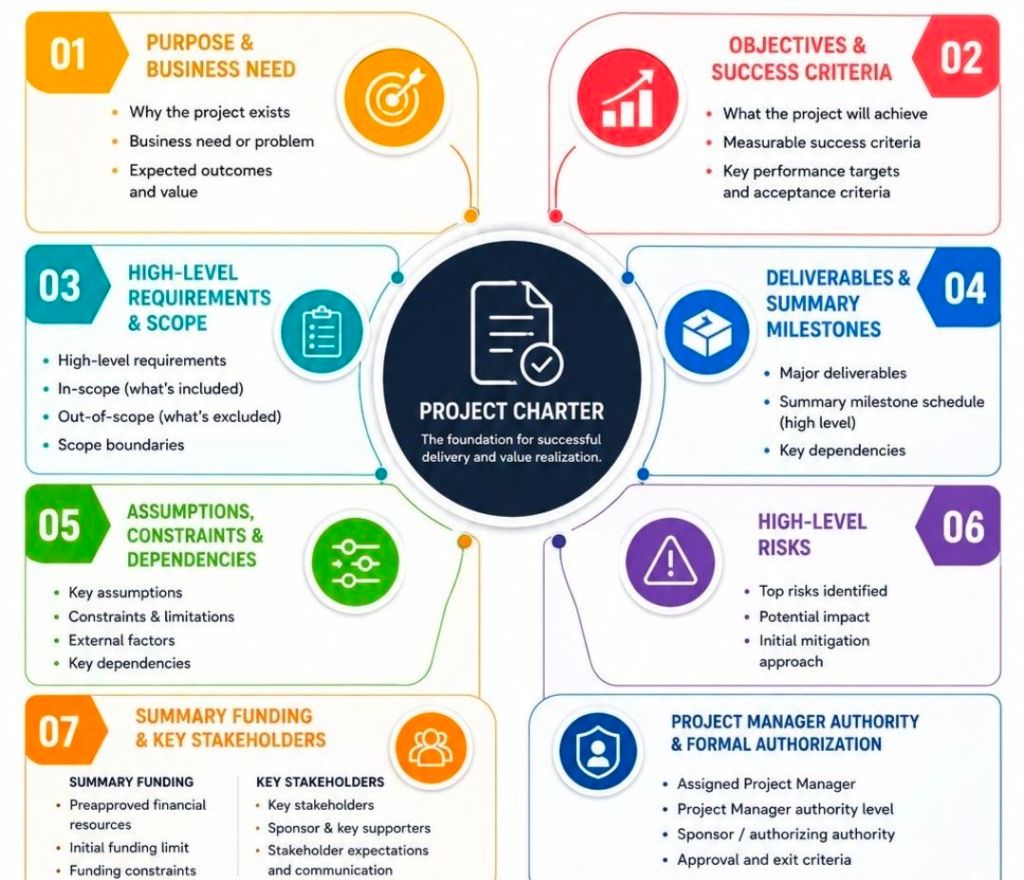
A project charter summary acts as a formal, high-level blueprint that officially authorizes a project, aligns stakeholders, and empowers the project manager. Because it is pitched to executive leaders, it condenses detailed planning into a concise one- to two-page summary containing crucial governance and directional information.
1. General Project Information
Project Name: The official title reflecting the project’s purpose.
Key Roles: Identification of the Project Sponsor, Project Manager, and core team members.
Stakeholders: A list of key internal and external parties impacted.
2. Core Project Context
Business Case: The strategic rationale explaining why the project exists.
Problem Statement: A short description of the core issue being resolved.
Project Scope: Explicitly defines what is included and excluded from the work.
Key Deliverables: The tangible outputs or products to be produced.
Success Criteria: The baseline metrics used to evaluate final delivery.
4. Constraints & Logistics
Milestone Timeline: A high-level schedule detailing major phases and target deadlines.
Budget Estimate: A preliminary breakdown of funding and financial resources.
Risks & Assumptions: Anticipated roadblocks and presumed truths impacting planning.
5. Governance
Authority Level: Explicit statement of what resources the project manager can allocate.
Sign-off / Approvals: Signature blocks for executive sponsors to grant project liftoff.
The Purpose of a Project Charter
Formal Authorization: It acts as the “official green light” to start the project and use company funds.
Establish Authority: It delegates decision-making power and resources to the project manager, which helps manage and push back on stakeholder interference.
Prevent Scope Creep: By setting boundaries in writing, it gives teams a touchstone to review against whenever new, unapproved tasks are requested mid-project.
Stakeholder Alignment: It ensures that every party—from executive leadership to the hands-on team—shares the same understanding of what “done” looks like.
Project Charter vs. Project Plan
It is common to confuse the charter with the project plan, but they serve vastly different purposes at different stages of the project lifecycle:
Project Charter: Created before planning. It is a high-level summary that answers the “what” and “why” to secure project authorization.
Project Plan: Created after the charter is approved. It is a detailed blueprint that answers the “how”, including task-by-task execution, granular schedules, resource allocations, and communication cadences.
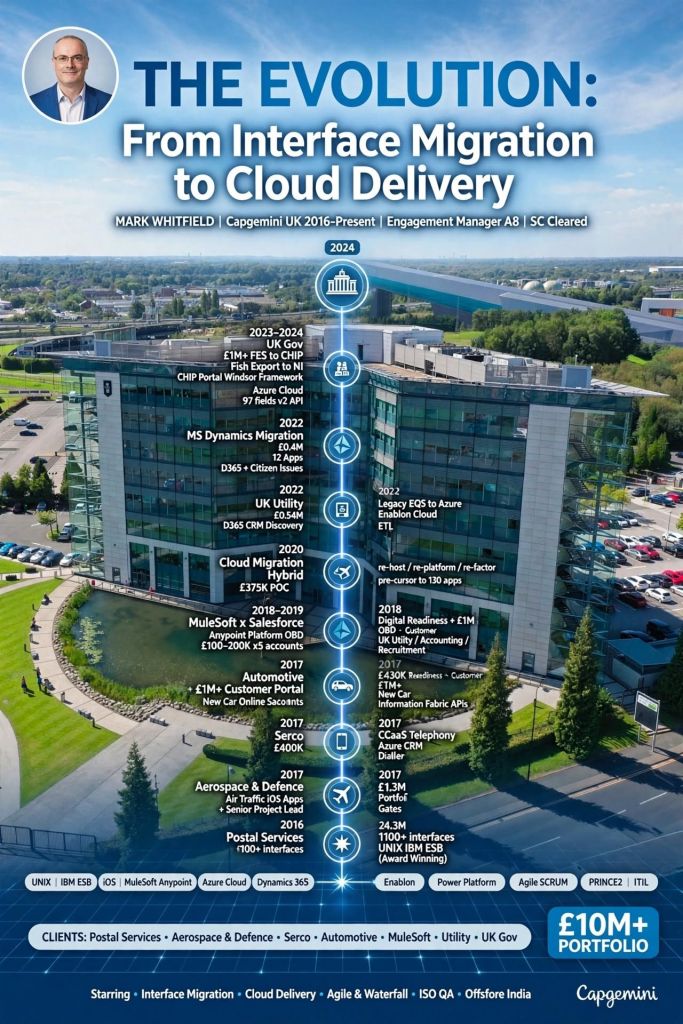
Joining in January 2016, he has orchestrated enterprise-scale cloud migrations, middleware application refactoring, and API-led integration architectures across public sector and tier-one corporate clients.
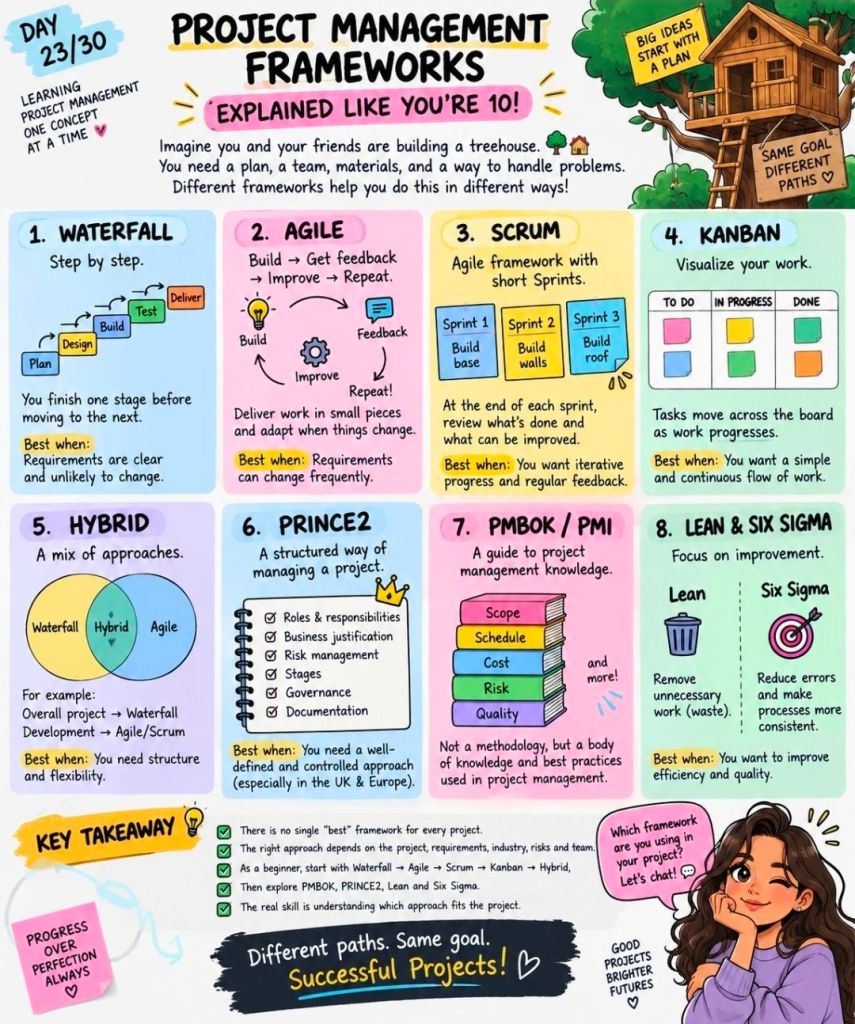
Methodologies: Agile Scrum ceremonies, Waterfall frameworks, and hybrid delivery patterns
Core Competencies: Hybrid cloud migrations, API lifecycle architectures, cross-data centre integration, multi-supplier governance, and financial forecasting
Key Clients Served: UK Government, MuleSoft / Salesforce, Jaguar Land Rover, Royal Mail Group, NATS, and Welsh Water
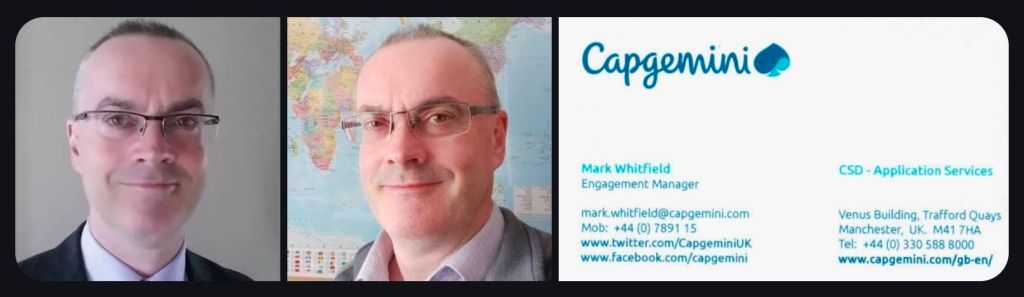
Mark Whitfield | Capgemini Projects Managed from 2016 thru 2025, Summary
Detailed Capgemini Projects Timeline Breakdown by Year:
2016 – 2017: Aerospace & Defence Integration & Postal Infrastructure
Aerospace & Defence Mobile Apps: Managed an Agile Scrum delivery stream for a UK-wide Air Traffic organisation (NATS). He supervised the development of dual-layered Apple iOS applications rendering real-time airspace positioning data, separating sensitive internal military maps from public views.
Salesforce Portal Deployment: Led the enterprise integration and deployment of a Salesforce-driven Single Customer View (SCV) portal platform for defence stakeholders.
Postal Services Migration (May 2016 – Oct 2016): Appointed as PM for an award-winning £4.3 million Data Centre Migration project for a major postal client (Royal Mail Group). He directed 90 Capgemini engineers to shift 1,100+ critical interfaces—migrating file transmissions written in UNIX shell scripts and upgrading 150 interfaces processing through IBM ESB to safe software versions right before peak seasonal trading lockouts.
2017 – 2018: Automotive Supply Chain Middleware
Jaguar Land Rover iFAB Project: Directed the complex 12-month iFAB Middleware Project architecture development scheme. This cross-functional framework connected globally dispersed manufacturing supply components.
Supplier Governance: Coordinated on-site daily standups alongside integration engineering leads to accurately synchronize multiple software suppliers handling distinct tiers of middleware, messaging queues, and front-end architectures.
2018 – 2019: Enterprise API Platform Delivery (MuleSoft)
MuleSoft HQ Augmentation (October 2018 – June 2019): Embedded directly into MuleSoft’s London headquarters (Salesforce Tower) as a Senior Delivery Manager.
MuleSoft’s London office is located within the Salesforce Tower at 110 Bishopsgate.
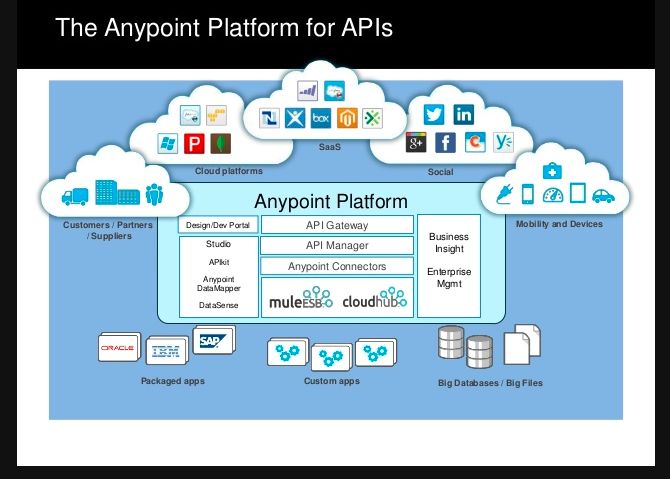
Anypoint Platform Deployments: Guided multinational corporate clients through API-led connectivity lifecycles. This encompassed configuring Anypoint Code Builder structures, validating hyper-automation runtime layers, and ensuring architectural compliance against regulatory framework rules.
Anypoint Platform is the leading enterprise platform for building APIs, integrations & application networks
2019 – 2021: Large-Scale Public Sector Cloud Migration
UK Government Hybrid Cloud Transformation: Commanded a massive modernization program migrating a highly complex estate of legacy code.
130 Applications Transformed: Acted as the primary client escalation point to refactor, re-host, and re-platform 130 public-sector software applications into hybrid cloud environments. His responsibilities included aligning the massive multi-stack migration with strict GDPR protection directives and managing offshore project delivery targets.
2022: Utility Infrastructure & Cloud Upgrades
Water Utility EQS Cloud Shift: Dual-managed a £0.5 million technical contract moving an legacy document management environment (EQS) onto Microsoft Azure cloud structures via Enablon for Welsh Water and Scottish Water.
MS Dynamics 365 Evolution: Supervised a £0.4 million discovery and blueprint phase to move 12 legacy Microsoft Dynamics 2016 instances operating on outdated shared 8.2 infrastructure onto the unified Microsoft Dynamics 365 Online ecosystem. This involved authoring precise Statements of Work (SoW), custom exit strategies, and foundational Microsoft Project (MPP) tracking models.
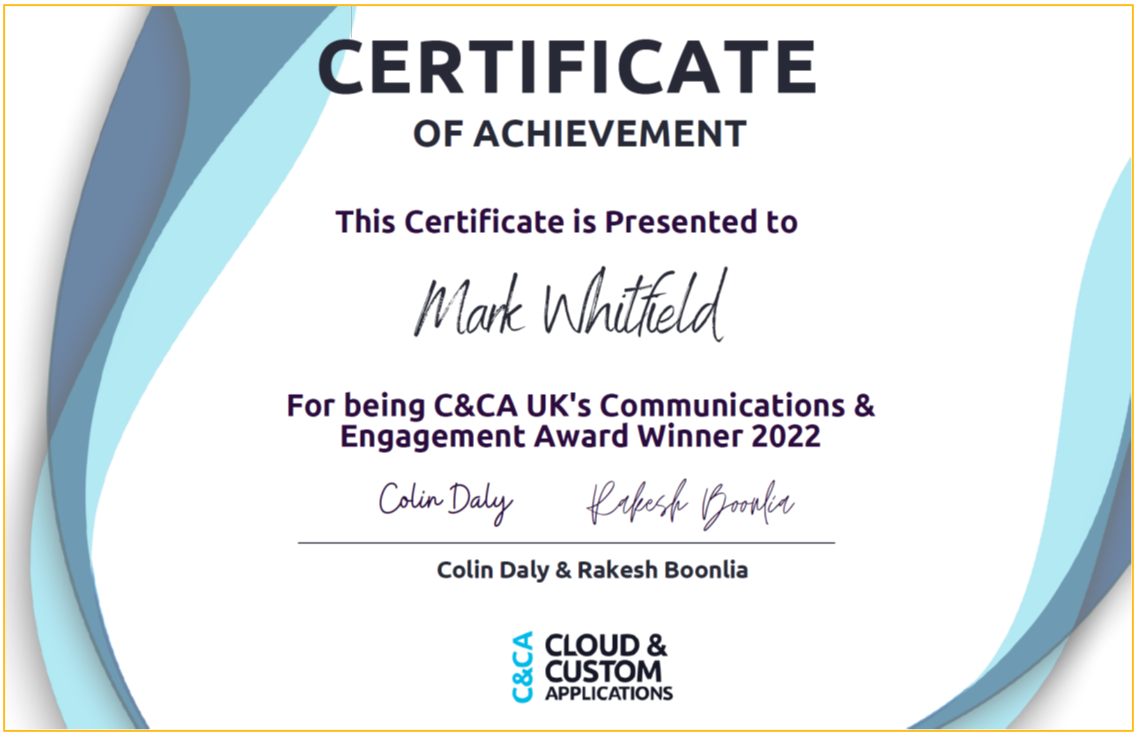
Accolades: Won the prestigious Capgemini C&CA UK Communications & Engagement Award in December 2022 for outstanding delivery inside the Cloud & Custom Applications business unit.
C&CA UK’s Communications & Engagement Award Winner 2022 – Cloud & Custom Applications – Capgemini UK
Mark Whitfield is a Greater Manchester-based Senior IT Project and Engagement Manager.
With over 30 years in the IT and software development industry, he has continuously upskilled in project delivery, Agile methodologies, cloud platforms, and cyber security.
Phase 1: Foundational Education
1985 – 1988: Leigh College, UK
Focus: Computer Science and Biology (‘A’ Levels)
1988 – 1990: University of Greater Manchester (formerly Bolton Institute of Higher Education, BIHE)
Focus: Higher National Diploma (HND) in Computer Studies (Graduated with Distinction; First overall in the year)
Key Modules: System Analysis, Programming Methodology, Database Architecture, and Business Information Systems
Phase 2: Project Management & Professional Training
2000 – 2006: Industry Integration & Early Methodologies
Focus: Service-Oriented Architecture (SOA), Agile, Sales, and early project management
Courses/Certifications: Sales and Marketing (In-house Outsource, 2001), Web Services and SOA (Insider Technologies, 2005), PRINCE2 Foundation (2006), Designing Good Marketing Literature (SkillPath Seminars, 2006)
2009: Digital & Communications
Focus: Digital marketing and content
Courses: Writing for the Web, and Website Promotion and Visibility by Design (iTrain Education)
2011: Structured Frameworks
Focus: Formal project frameworks and delivery methodologies
Courses/Certifications: PRINCE2 Foundation & Practitioner (ILX Group), Agile Scrum (RADTAC)
2012: Operational Management
Focus: Service management best practices
Courses/Certifications: ITIL Foundation
Phase 3: Advanced Engagement & Enterprise Training
2017 – 2019: Capgemini Engagement & Compliance
Focus: High-level engagement management and corporate governance
Courses/Certifications: Advanced Engagement Management Certification (Level 2), Group Anti-Corruption, and Intellectual Property Rights (IPR) Training
2022: Cloud Modernization
Focus: Enterprise cloud computing fundamentals
Courses/Certifications: AZ-900 Microsoft Certified Azure Fundamentals
You can review or download the targeted, one-page CV for Mark Whitfield (Senior Project Manager specializing in HPE NonStop systems) via the Mark Whitfield CV PDF link.
Mark Whitfield, High-Level Project Management Summary
The high-level, scannable overview of his professional profile is outlined below:
Executive Profile
Role: IT Senior Project Manager / Delivery Lead
Background:30+ years of experience delivering highly complex technology, business transformation, and infrastructure projects.
Core Skills: Cloud migration (hybrid), legacy ATM software modernisation, Point of Sale (POS) implementations, and software development lifecycles (SDLC).
Methodologies: Agile, Waterfall, PRINCE2 Practitioner, and ITIL certified.
Core Expertise & Competencies
HP NonStop & Legacy Integration: Deep technical roots in Tandem Computers/ HPE NonStop development, TAL programming, and high-volume transaction environments.
Global Delivery: Managed large-scale IT and system monitoring rollouts across the UK and international markets (e.g., Saudi Arabia).
Stakeholder Management: Experienced in bridging the gap between highly technical development teams and high-level business stakeholders.
For direct access to his official templates, articles, and full professional journey, you can visit the PROject Templates Website.
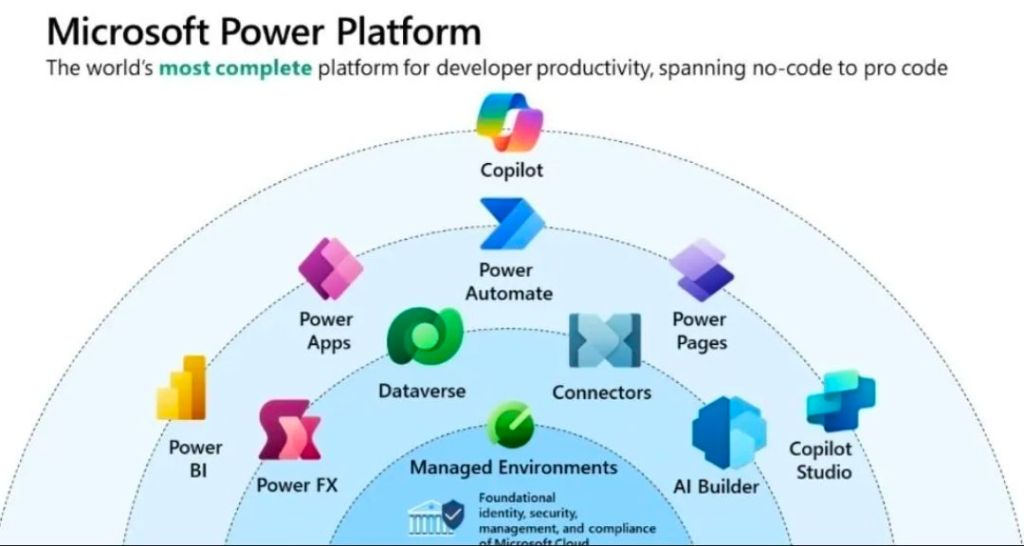
Microsoft Power Platform is an enterprise-grade, low-code platform that allows organizations to build applications, automate workflows, analyze data, and create AI-powered virtual agents. It natively connects to Microsoft 365, Azure, and Dynamics 365, serving as a core pillar of modern digital transformation.
Microsoft Power Platform Overview
Core Pillars
Power Apps: A low-code development environment for building custom, cross-platform business applications (Canvas or Model-driven) without writing traditional code.
Power Automate: An automation service enabling the creation of workflows, API-based integrations, and Robotic Process Automation (RPA) for legacy systems.
Power BI: A business analytics service that provides interactive visualizations and business intelligence capabilities with an interface simple enough for end users to create their own reports and dashboards.
Power Pages: A secure, enterprise-grade low-code software-as-a-service (SaaS) platform for designing, configuring, and publishing external-facing websites.
Microsoft Copilot: AI-assisted generative capabilities natively built across the platform, allowing users to build apps, write flows, or generate reports using natural language.
Foundational Technologies
Dataverse: A secure, cloud-based data storage and management layer featuring a standardized common data model, allowing disparate Microsoft tools to seamlessly share information.
Connectors: Over 1,000 pre-built wrappers that facilitate communication between the Power Platform and external services (like Salesforce, SQL databases, or REST APIs).
Power Fx: A low-code, strongly-typed functional programming language based on Excel formulas that serves as the logic layer across the platform.
Technical Evolution by Year
The Power Platform did not launch overnight; it evolved through the gradual introduction of several standalone tools before Microsoft formally unified them under one umbrella.
2013–2015: The Origins of Data Analysis & Logic
2013: Power BI is initially released as an add-in for Microsoft Excel, allowing users to build pivot tables and light analytics.
2015: Power BI transitions into a standalone cloud service. Concurrently, Power Apps enters public preview, introducing the low-code app paradigm.
2016–2017: Workflow Automation
2016: Microsoft Flow (the predecessor to Power Automate) is launched to handle cloud-based workflow automation.
2017: Common Data Service (now Dataverse) is introduced to provide a standardized, secure data layer.
2018–2019: The “Power Platform” Unification
2018: Microsoft officially unifies Power BI, Power Apps, and Microsoft Flow under the official name “Microsoft Power Platform”, introducing the formal concept of a connected, low-code business ecosystem.
2019: The Common Data Service gets deeper integration across Dynamics 365 and Microsoft 365, accelerating citizen development across large enterprises.
2020: AI and Robotic Process Automation (RPA)
2020: Microsoft launches AI Builder, allowing users to integrate pre-trained AI models (like form processing and object detection) directly into their apps and workflows.
2020: Softomotive is acquired, bringing RPA (desktop flows) into Power Automate.
2021–2022: New Additions and Expanded Web Presence
2021: The Common Data Service is officially rebranded as Microsoft Dataverse.
2021: Power Fx is introduced as the standard, open-source low-code language.
2022: Power Apps Portals is rebranded and expanded into Power Pages, creating a dedicated, robust tool for building external-facing websites.
2023–2024: The Generative AI Wave
2023: Microsoft embeds generative AI across the suite through Copilot. Users begin building data tables, applications, and automation flows entirely through conversational prompts.
2024: Power Platform deepens its integration with Microsoft Fabric and brings further enterprise-grade management, data governance, and AI agent orchestration features directly into Dataverse.
2025–2026: Agentic Computing and Modern Controls
2025: Power Platform evolves beyond standard applications and automations into “agentic computing.” Makers can build autonomous, AI-driven data agents directly within Dataverse using the Python SDK.
2026: Power Apps rolls out massive updates to its interface, deploying responsive layouts and modern controls as default settings. Advanced lifecycle management and process-mining features cement the platform’s role in modern fusion development.
My Recent MS Power Platform Involvement :
UK Gov : Cloud Migration (Hybrid) – In 2020, working as a Senior Project Manager on a client sponsored Agile proof-of-concept (POC) project to move 3 Client elected Apps (with MS Access, Oracle and SQL 2008 DBs), to the Cloud (Microsoft Azure and Dynamics365 Power Platform). The migration to the cloud was based on 3 primary app patterns namely; re-host, re-platform and re-factor. This project spanned approximately 3 months and started in early February 2020 with a budget of £375k.
The project was a pre-cursor and effort indicator for the larger piece of migration work to move 130 client estate apps to the cloud. This is a very complex app estate with many touch points and different technology stacks.
As the Capgemini Senior PM, responsible for the project planning, control, organisation, stakeholder communication, aligning with current GDPR directives and status reporting against delivery of Capgemini services to the client. As the PM, also the first escalation point for the project team and the client.
December 2022 – C&CA UK’s Communications & Engagement Award Winner – Cloud & Custom Applications – Capgemini UK
Mark Whitfield, a Manchester-based Senior IT Project Manager, has completed extensive professional training throughout his career, focusing on project management methodologies, delivery software, and technical tools.
Core Project Management Methodologies :
PRINCE2 Practitioner: Certified as a registered PRINCE2 Practitioner in May 2011 via the ILX Group (Gold e-Learning).
Agile SCRUM Training: Attended in-house training with RADTAC in May 2011.
Advanced Engagement Management (Level 2): Completed at Capgemini in November 2017.
Project Management Fundamentals: Completed “Fundamentals of Successful Project Management” in February 2000 through Skillpath in Manchester.
Managing Multiple Projects: Attended “Managing Multiple Projects, Objectives and Deadlines” in October 1999/1998 via Skillpath.
Software & Cloud Platforms :
AZ-900 Microsoft Azure Fundamentals: Certified in February 2022.
Microsoft Project: Completed the Microsoft Project ’98 Certification Series in May 2000 through the IIL UK Education Centre in Reading.
Microsoft Excel Expert Skills: Upgraded skills via a 2017 Expert course and a July 2024 Udemy refresher.
Technical & Programming Courses :
Tandem / HP NonStop: Completed Tandem Guardian Principles (1993), Tandem Performance Analysis (1995), and Tandem TAL Programming (1995).
C / C++ Programming: Attended “C++ for Non-C Programmers” with Comtec Computer Training in March 1997.
Database Querying: Completed “Querying Microsoft SQL 2000 with Transact SQL” via QA Training in March 2009.
Web Applications: Attended “Developing MS ASP Web Applications using MS Visual Studio .NET” in January 2007.
Marketing & Communication Training :
Writing for the Web: Completed in May 2009 with gbdirect (iTrain Education in London).
Brochure & Document Design: Attended a SkillPath Seminar on designing marketing brochures and reports in April 2006.