

In Europe, “free” higher education almost always refers to zero tuition fees at public universities, though you will still need to pay for living expenses (rent, food, books). No European country requires student loans; rather, loans are an optional choice to fund living costs.
Use the regional breakdown below to see which countries offer zero tuition and which generally require you to pay.
Countries with Free (or Almost Free) Tuition
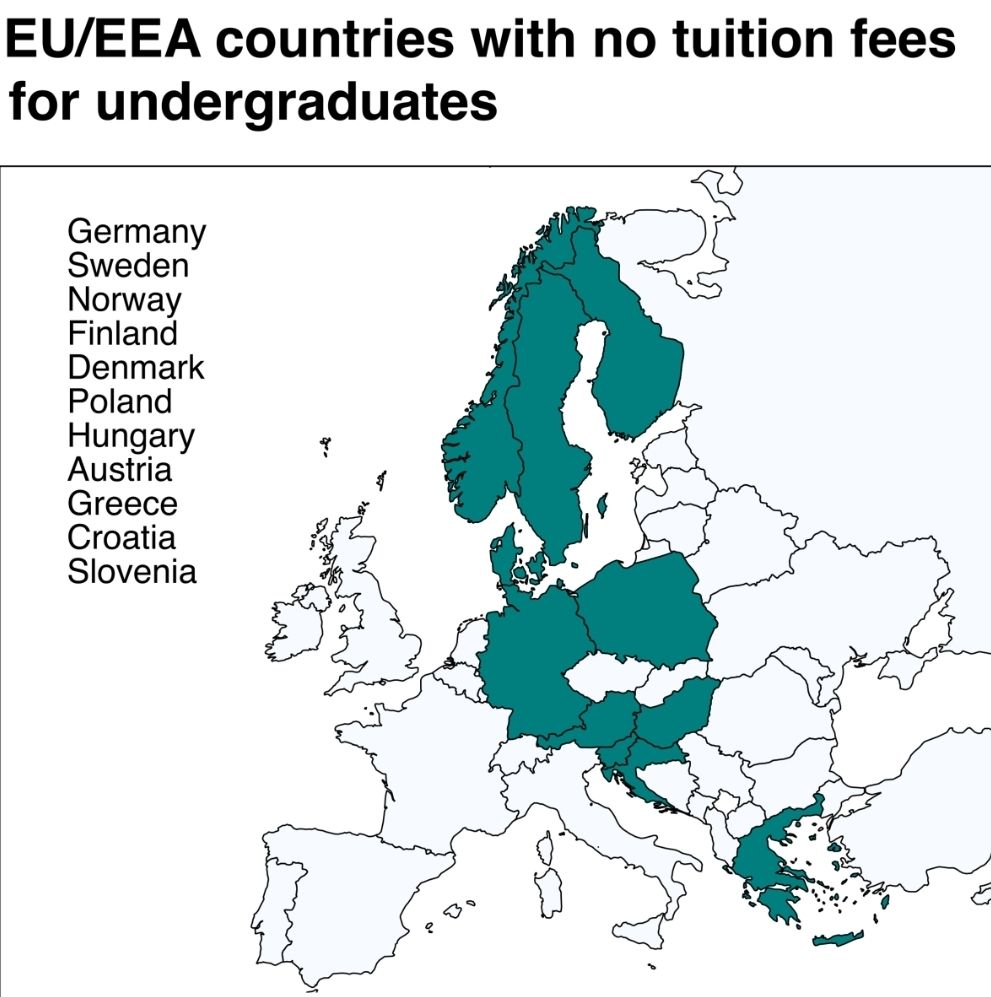
These countries charge no tuition fees (or very minimal administrative fees) for eligible students:
- Germany: Public universities are completely tuition-free for both domestic and international students, including those from outside the EU. You only pay a small semester fee (approx. €150-€350).
- Norway: Free of charge for all students, regardless of nationality.
- Austria: Free for EU/EEA students. For non-EU students, the fee is generally a very low €727 per semester.
- France: Public university tuition is heavily subsidized and extremely low (approx. €170 to €2,700 per year, depending on the degree).
- Iceland: Free tuition at public universities, though a registration fee of roughly €400-€600 is required.
- Czech Republic: Public universities are free if you study a program taught in the Czech language. English programs require tuition.
- Greece: Free tuition for EU/EEA nationals; non-EU students pay very low fees (around €1,500/year).
- Poland: Tuition is free for Polish citizens and EU/EEA students.
Countries with Free Tuition for EU/EEA Students Only
These countries offer free degrees if you are a European citizen, but charge international (non-EU/EEA) students:
- Denmark: Free for EU/EEA students; international students pay up to €16,000 per year.
- Sweden: Free for EU/EEA students; international students pay full tuition.
- Finland: Free for EU/EEA students. Non-EU students pay tuition for English-taught programs.
- Slovenia: Free for full-time undergraduate students from the EU.
Countries That Generally Require Tuition (and Potential Loans)
In these countries, you will pay tuition fees ranging from a few hundred to several thousand Euros per year, making student loans or personal savings more necessary:
- United Kingdom: In England and Wales, tuition fees can cost up to £9,250 a year for domestic students, and higher for international students. Students heavily utilize the government’s Student Loans Company to cover both fees and maintenance.
- The Netherlands: Yearly tuition fees for EU students are around €2,500, with higher fees for international students. Dutch citizens and eligible EU students can take out loans through DUO.
- Italy & Spain: Both charge moderate tuition fees for public universities based on family income or the specific region, making it much more affordable than the UK but rarely entirely free without scholarships.


