PRINCE2 (PRojects IN Controlled Environments) Overview and Evolution Timeline

PRINCE2 (PRojects IN Controlled Environments) is a structured, process-driven project management method used internationally to deliver projects within time, cost, and quality constraints. Originally developed for IT projects, it has evolved into a generic, flexible, and scalable framework applicable to any type of project, now owned by PeopleCert.

Detailed Overview of PRINCE2 (2026 Framework)

As of 2026, the current framework is PRINCE2 7th Edition, launched in late 2023. It is characterized by its focus on people, digital tools, and sustainability, while retaining its core focus on governance.

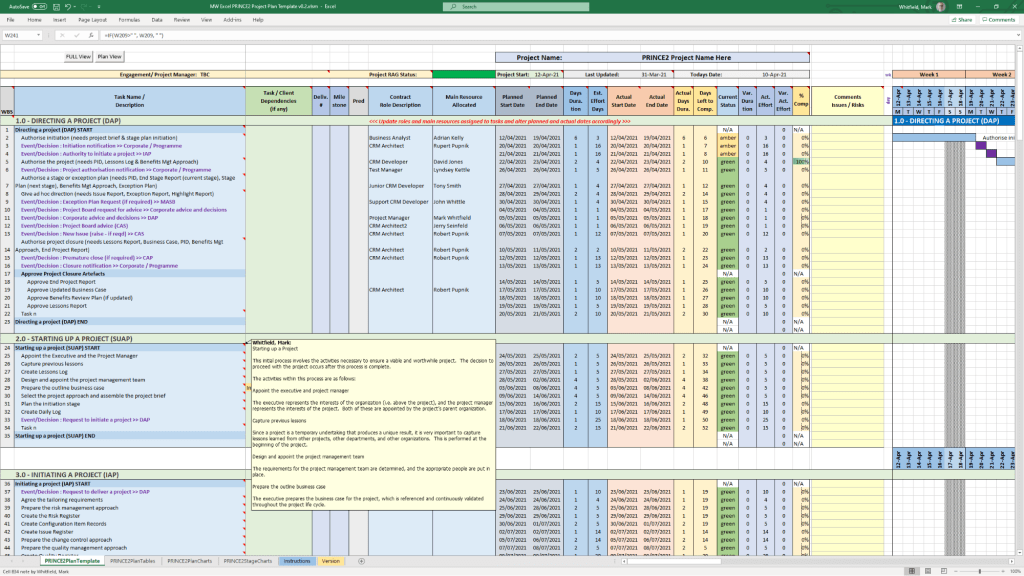
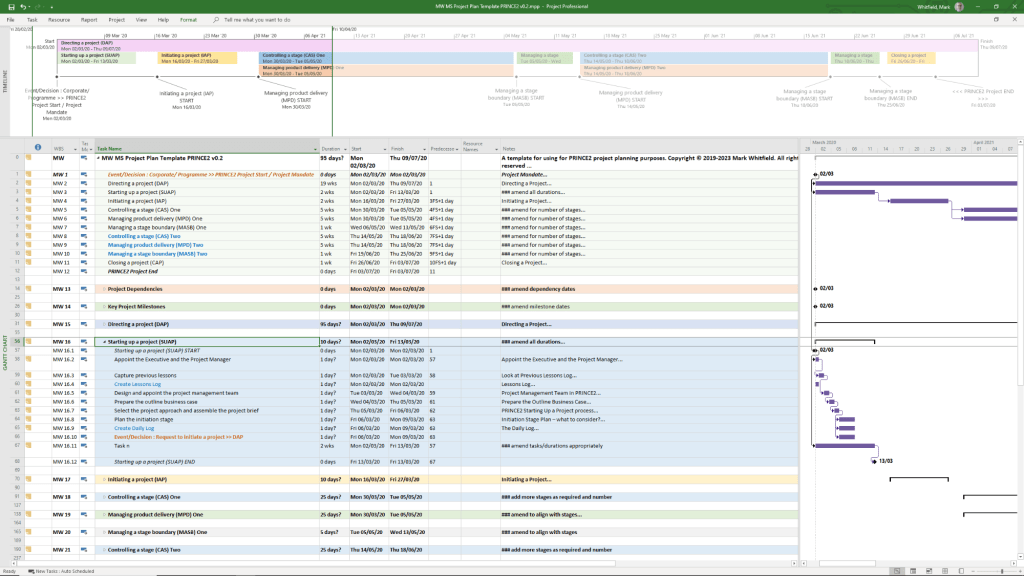
MS Project MPP template example

1. The Seven Principles (Why PRINCE2 is used)

  • Continued Business Justification: A project must have a valid business case.
  • Learn from Experience: Lessons are documented and used.
  • Defined Roles and Responsibilities: Clear organizational structure.
  • Manage by Stages: Projects are broken into manageable chunks.
  • Manage by Exception: Empowerment given to managers to act within tolerances.
  • Focus on Products: Focus on deliverables rather than activities.
  • Tailor to Suit the Project: Adapted to suit the project’s size, environment, and complexity.

2. The Seven Themes (What must be managed)

  • Business Case
  • Organization
  • Quality
  • Plans
  • Risk
  • Change
  • Progress

3. The Seven Processes (How to manage)

  • Starting up a Project
  • Directing a Project
  • Initiating a Project
  • Controlling a Stage
  • Managing Product Delivery
  • Managing a Stage Boundary
  • Closing a Project

4. Certification Levels

  • Foundation: Confirms basic knowledge of the methodology.
  • Practitioner: Tests the ability to apply and tailor the method to scenarios.

Detailed Timeline Evolution by Era and Year

PRINCE2 has evolved from a niche IT methodology to a global standard through three major revisions.

Era 1: The Foundations (1975–1989)

  • 1975: Simpact Systems Ltd. creates the PROMPT (Project, Resource, Organization, Management, and Planning Technique) methodology.
  • Early 1980s: UK Central Computer and Telecommunications Agency (CCTA) licenses PROMPT.
  • 1989: CCTA enhances PROMPT II, renaming it PRINCE (PROMPT in the CCTA Environment), mandated for UK IT projects.

Era 2: Launch and Public Adoption (1990–2005)

  • 1990: PRINCE is released into the public domain.
  • 1996: PRINCE2 is released by CCTA, designed for a broader range of projects (non-IT).
  • 2000: Ownership transfers to the UK Office of Government Commerce (OGC).
  • 2002/2005: Major revisions to the manual structure, strengthening the “product-based planning” approach.

Era 3: Modernization & Privatization (2009–2021)

  • 2009: Major “Refresh” released, introducing the seven principles, themes, and processes. Focuses on simplicity and customizability.
  • 2013: Ownership transfers to AXELOS Ltd, a joint venture between the UK Government and Capita.
  • 2017: PRINCE2 2017 Update (6th Edition) is released, focusing on enhanced flexibility and tailoring guidance.
  • 2018: Launch of PRINCE2 Agile.
  • 2021: PeopleCert acquires AXELOS, taking full ownership of the methodology.

Era 4: The 7th Edition (2023–Present/2026)

  • September 2023: Launch of PRINCE2 7th Edition.
  • 2024: PRINCE2 is branded as “PRINCE2 Project Management”.
  • 2026 (Current): Focus on hybrid delivery, digital transformation, and sustainability within the 7th edition framework.
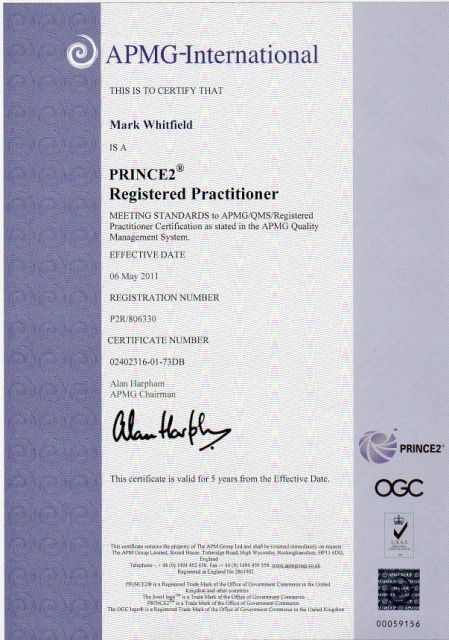
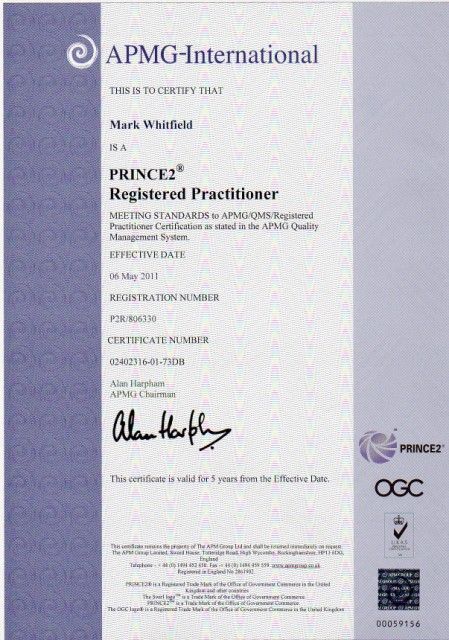
Mark Whitfield, May 2011 – Registered PRINCE2 Practitioner with ILX
May 2011 – Registered PRINCE2 Practitioner with ILX, Mark Whitfield
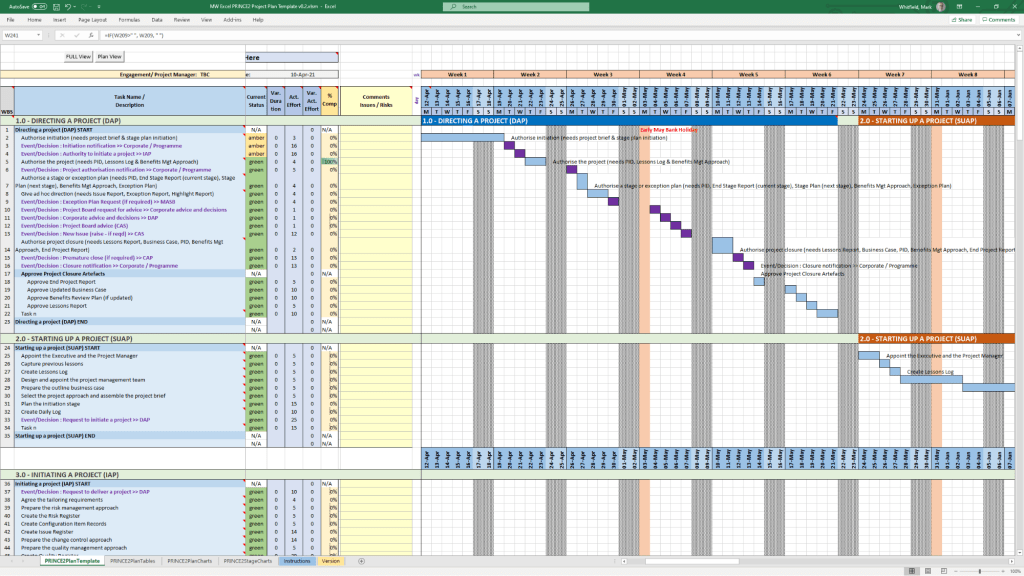
Prince2, Plan On a Page POaP, MS Excel Template

Agile Scrum Overview and Evolution Timeline

Agile Scrum is a widely adopted, iterative, and incremental framework designed to manage complex product development and software projects.

It breaks down large, daunting projects into small, manageable units called sprints—fixed-length iterations typically lasting 1–4 weeks—to deliver functional components faster and adapt to changing requirements.

Detailed Summary of the Scrum Framework

Scrum relies on three pillars—transparency, inspection, and adaptation—and is defined by specific roles, events, and artifacts.

1. The Scrum Team (Roles)

  • Product Owner (PO): Maximizes the value of the product by managing the Product Backlog. They define “what” is built.
  • Scrum Master: A servant-leader who helps the team follow Scrum theory and removes impediments.
  • Developers: The cross-functional team members responsible for creating the increment each sprint.

2. Scrum Events (Ceremonies)

  • Sprint Planning: Defines the Sprint Goal and the work to be done during the sprint.
  • Daily Scrum: A 15-minute daily meeting for developers to synchronize activities and plan the next 24 hours.
  • Sprint Review: Held at the end of the sprint to showcase the increment to stakeholders and gather feedback.
  • Sprint Retrospective: The team reflects on the process and identifies improvements for the next sprint.

3. Scrum Artifacts

  • Product Backlog: An ordered list of everything required in the product.
  • Sprint Backlog: The set of Product Backlog items selected for the sprint, plus the plan for delivering them.
  • Increment: The usable, working product increment produced at the end of a sprint.

Evolution of Scrum Over the Years

Scrum was developed in the early 1990s as a response to the failures of the linear “waterfall” approach.

  • 1986 (Concept Origins): Takeuchi and Nonaka publish “The New New Product Development Game,” comparing traditional relay-race product development to a rugby “scrum” team.
  • 1993 (First Implementation): Jeff Sutherland, John Scumniotales, and Jeff McKenna implement the first Scrum team at Easel Corporation.
  • 1995 (Public Introduction): Ken Schwaber and Jeff Sutherland formalize Scrum and present “The Scrum Development Process” at the OOPSLA ’95 conference.
  • 2001 (Agile Manifesto): Sutherland and Schwaber become signatories of the Agile Manifesto, cementing Scrum as a major Agile methodology.
  • 2010 (The Scrum Guide): The first official Scrum Guide is released to standardize the framework worldwide.
  • 2011–2017 (Refinements): The guide is updated to clarify roles and events, including strengthening the role of the Scrum Master and introducing self-organizing teams.
  • 2020 (The Modern Scrum Guide): A major update makes the guide less prescriptive, focusing on a single Scrum Team (removing “development team” and “scrum team” split), introducing the Product Goal for long-term focus, and focusing on one team working towards one product.

Key Resources and Links

Agile Scrum Overview and Evolution Timeline

Artificial Intelligence (AI) Overview and Detailed Timeline Evolution

Artificial Intelligence (AI) is the branch of computer science dedicated to creating systems capable of performing tasks that typically require human intelligence, such as reasoning, learning, problem-solving, and perception. As of 2026, AI has transitioned from experimental research to widespread deployment as foundational infrastructure, with focus shifting from mere generative models to agentic, autonomous systems capable of executing complex, multi-step workflows.

Detailed Overview of AI in 2026

  • Core Capabilities: Modern AI combines large language models (LLMs), multimodal understanding (text, image, audio), and autonomous agents that can plan, remember, and act independently.
  • Agentic AI: A significant shift is the proliferation of AI agents that act as “digital coworkers” rather than just tools, handling tasks within business environments.
  • Democratization & Open Source: The open-source movement has accelerated, placing powerful AI capabilities in the hands of many, reducing dependence on single providers.
  • Regulation and Ethics: Following frameworks like the EU AI Act, 2026 is marked by the implementation of laws focusing on safety, transparency, and accountability, including AI watermarking to curb misinformation.
  • Major Trends: Key trends include standardized AI performance benchmarks (e.g., Machine Intelligence Quotient), interoperability between different AI agents, and integration of AI into physical robotics.

Historic Timeline and Evolution of AI (1950–2026)

I. The Foundations (1950–1956)

II. Early Enthusiasm and First Winter (1960s–1970s)

  • 1966: Joseph Weizenbaum develops ELIZA, the first chatbot capable of simulating conversation.
  • 1970s: AI progress slows due to limited computer power, leading to reduced funding—known as the first “AI Winter”.

III. Expert Systems and Second Winter (1980s–1990s)

  • 1980: Expert systems (e.g., XCON) emerge, bringing AI back into commercial use.
  • 1986: Geoffrey Hinton and others popularize backpropagation, enabling neural network training.
  • 1997: IBM’s Deep Blue defeats world chess champion Garry Kasparov, showcasing the power of strategic AI.

IV. The Rise of Big Data and Deep Learning (2000s–2010s)

  • 2006: Geoffrey Hinton publishes work reigniting interest in neural networks through “deep learning”.
  • 2011: IBM Watson wins Jeopardy!, showcasing advances in natural language processing.
  • 2012: AlexNet wins the ImageNet competition, proving the efficiency of Convolutional Neural Networks (CNNs).
  • 2014: Ian Goodfellow invents Generative Adversarial Networks (GANs), enabling AI to create realistic images.
  • 2016: DeepMind’s AlphaGo defeats Lee Sedol, mastering the complex game of Go.
  • 2017: Google researchers introduce Transformers, the architecture underpinning modern LLMs.

V. Generative AI and Agentic Era (2020s–2026)

  • 2020: OpenAI releases GPT-3, demonstrating unprecedented language generation capabilities.
  • 2022: The public release of ChatGPT marks the mainstream breakthrough of Generative AI.
  • 2024: OpenAI releases o1 (formerly Strawberry), focusing on advanced reasoning.
  • 2025–2026: AI becomes “Agentic,” shifting from chatbots that create content to autonomous agents that plan, execute, and interact across software systems.

Key References for Further Reading

Artificial Intelligence (AI) Overview and Detailed Timeline Evolution

Project Management evolution timeline by era

The history of project management has evolved from ancient manual coordination to highly sophisticated, digital-first methodologies

Pre-20th Century: The Era of Ancient Marvels

During this era, project management was characterized by massive labour forces and basic resource coordination without standardized scheduling tools. 

  • 2570 BC: Completion of the Great Pyramid of Giza. Documentation shows managers were assigned to each of the four faces to oversee progress.
  • 208 BC: Construction of the Great Wall of China. Labour was systematically organized into groups of soldiers, civilians, and criminals.
  • 1850s: Construction of the Pacific Railroad. This is often cited as one of the first large-scale industrial project management undertakings in the U.S.. 

1900–1950: The Birth of Modern Project Management 

This era introduced scientific management principles and the first visual scheduling tools. 

  • 1911Frederick Taylor publishes The Principles of Scientific Management, focusing on efficiency and unskilled labour training.
  • 1917Henry Gantt develops the Gantt Chart, a radical tool for visualising schedules that remains a global standard today.
  • 1931–1936: Construction of the Hoover Dam. This project was a major early adopter of Gantt’s scheduling techniques.
  • 1942–1945The Manhattan Project. This complex R&D effort pioneered the use of large-scale task coordination and resource management. 

1950–1980: The Era of Management Science 

Driven by the Cold War and space race, this period saw the creation of mathematical scheduling techniques. 

  • 1956: AACE International is formed, focusing on cost engineering.
  • 1957–1958: Development of Critical Path Method (CPM) by DuPont and Program Evaluation and Review Technique (PERT) by the U.S. Navy.
  • 1962–1975: Introduction of Work Breakdown Structure (WBS) by the DoD, founding of IPMA and PMI, and development of PROMPT (later PRINCE). 

1980–2000: The Computing Revolution 

Personal computers allowed project management software to proliferate into the private sector. Key milestones included the early Scrum framework and the initial PMBOK Guide release. 

  • 1989–1997: Widespread adoption of Earned Value Management (EVM), release of PRINCE2, and development of Critical Chain Project Management (CCPM)

2000–Present: The Agile and Digital Era 

Modern project management emphasizes flexibility, speed, and digital tools. 

  • 2001: The Agile Manifesto is published.
  • 2012–2021: Release of ISO 21500, major updates to PRINCE2 and PMBOK to integrate Agile, and the shift to performance-based standards in PMBOK 7th Ed.

Project Management evolution timeline by era

Project management has evolved from ancient engineering feats to a highly structured, data-driven discipline. Below is a comprehensive timeline of its historical development and the evolution of its core methodologies. 

Ancient & Early Eras

  • 2570 BC: The Great Pyramid of Giza – Completed with record-keeping and oversight for each of the four faces, demonstrating early forms of planning and control.
  • 208 BC: The Great Wall of China – Built with a massive labour force organised into specific groups: soldiers, ordinary people, and criminals.
  • 1917: Gantt Chart – Developed by Henry Gantt, this scheduling diagram became a radical innovation for tracking project tasks chronologically. 

The Mid-20th Century: Formalization

  • 1956: AACE International Formed – Early practitioners of cost engineering and scheduling founded what is now the leading society for project control specialists.
  • 1957: Critical Path Method (CPM) – Invented by DuPont to address chemical plant maintenance; it saved the company $1 million in its first year.
  • 1958: PERT (Program Evaluation Review Technique) – Developed for the U.S. Navy’s Polaris project to analyse the minimum time needed for task completion.
  • 1962: Work Breakdown Structure (WBS) – Mandated by the U.S. Department of Defense as a hierarchical tree structure for project deliverables.
  • 1965: IPMA Founded – The world’s first project management association was started in Vienna as a global forum for networking.
  • 1969: Project Management Institute (PMI) Launched – Founded to advance the profession, PMI has since become the primary publisher of global standards. 

Late 20th Century: Methodology Proliferation 

  • 1975: PROMPTII & “The Mythical Man-Month” – Guidelines were created for computer projects, while Fred Brooks’s Brooks’s law observed that adding manpower to late software projects makes them later.
  • 1984: Theory of Constraints (TOC) – Introduced by Dr. Eliyahu M. Goldratt, focusing on identifying system bottlenecks.
  • 1986: Scrum – First named as a project management style for software development in a Harvard Business Review paper.
  • 1987: PMBOK Guide First Published – PMI published the first “A Guide to the Project Management Body of Knowledge” as a white paper to standardise practices.
  • 1989: PRINCE & Earned Value Management – The PRINCE method was developed for UK government IT projects; meanwhile, Earned Value Management (EVM) became an essential part of procurement.
  • 1996: PRINCE2 – A more generic revision of PRINCE was published, applicable to any project type.
  • 1997: Critical Chain Project Management (CCPM) – Invented to keep resources levelly loaded and flexible. 

21st Century: Agile & Global Standards

  • 2001: The Agile Manifesto – Written by 17 developers in Utah, codifying the principles of lightweight, iterative software development.
  • 2006: Total Cost Management Framework – Released by AACE International as the first integrated process for portfolio and project management.
  • 2012: ISO 21500:2012 – The International Organisation for Standardisation released its global guidance on project management.
  • 2017: PMBOK 6th Edition & PRINCE2 Update – Updates reflected the integration of Agile practices into traditional project settings.
  • 2021: PMBOK 7th Edition – Shifted toward a principle-based approach to help practitioners be more proactive and innovative.

Agile Scrum Evolution Timeline Overview

Agile and Scrum have evolved from specific product development theories into a global standard for project management. While Scrum predates the Agile Manifesto by several years, it has become the most widely adopted framework within the Agile umbrella. 

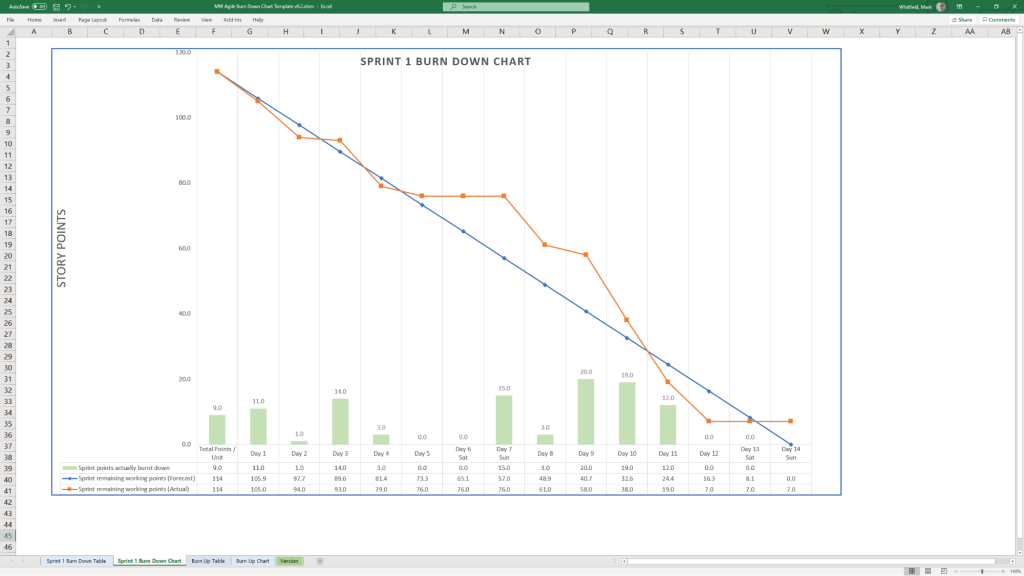
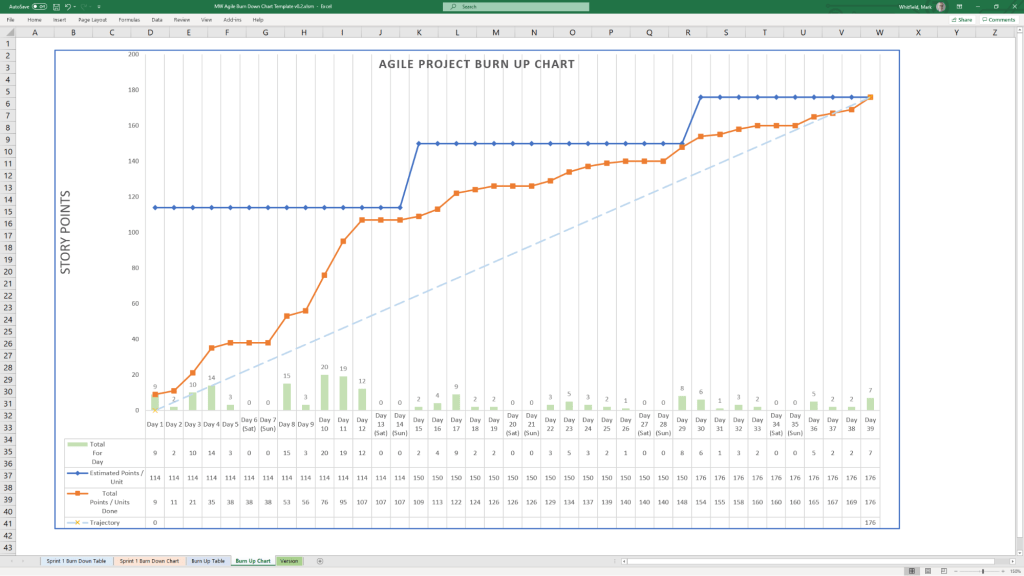
Agile Scrum Burn down and Burn up charts – can be downloaded from website banner

Evolution Timeline

  • 1986: The Inspiration. Hirotaka Takeuchi and Ikujiro Nonaka publish “The New New Product Development Game” in Harvard Business Review, introducing the “rugby” approach to product development.
  • 1993: The First Scrum. Jeff Sutherland and his team at Easel Corporation implement the first official Scrum.
  • 1995: Public Presentation. Ken Schwaber and Jeff Sutherland formally present Scrum at the OOPSLA ’95 conference, introducing the concept of Sprints.
  • 2001: The Agile Manifesto. 17 software developers meet in Utah to sign the Manifesto for Agile Software Development, codifying the 4 values and 12 principles that define Agile.
  • 2002: Scrum Alliance Founded. The Scrum Alliance is established by Ken Schwaber, Mike Cohn, and Esther Derby to provide training and certifications like the Certified ScrumMaster (CSM).
  • 2009: Founding of Scrum.org. Ken Schwaber founds Scrum.org to provide a more consistent approach to Scrum training and assessments.
  • 2010: The First Scrum Guide. Sutherland and Schwaber publish the first Official Scrum Guide, providing a definitive, minimal definition of the framework.
  • 2011–2017: Iterative Refinements. Updates to the Scrum Guide clarify the Daily Scrum purpose (2013) and emphasize Scrum Values (2016).
  • 2020: The “Simplified” Guide. The latest 2020 Scrum Guide is released, focusing on making the framework less prescriptive and more applicable to non-software industries by removing technical jargon. 

Key Shifts in Scrum Maturity

  • Prescriptive to Descriptive: Early Scrum was highly prescriptive about meetings and roles; modern Scrum focuses on Empiricism (Transparency, Inspection, Adaptation).
  • Team Autonomy: The 2013 update pivoted from “selecting tasks” to focusing on the Sprint Goal, empowering teams to decide how to achieve the objective.
  • Scaling Frameworks: As organizations grew, frameworks like SAFe (2011) and LeSS (2013) emerged to apply Scrum across hundreds of teams.
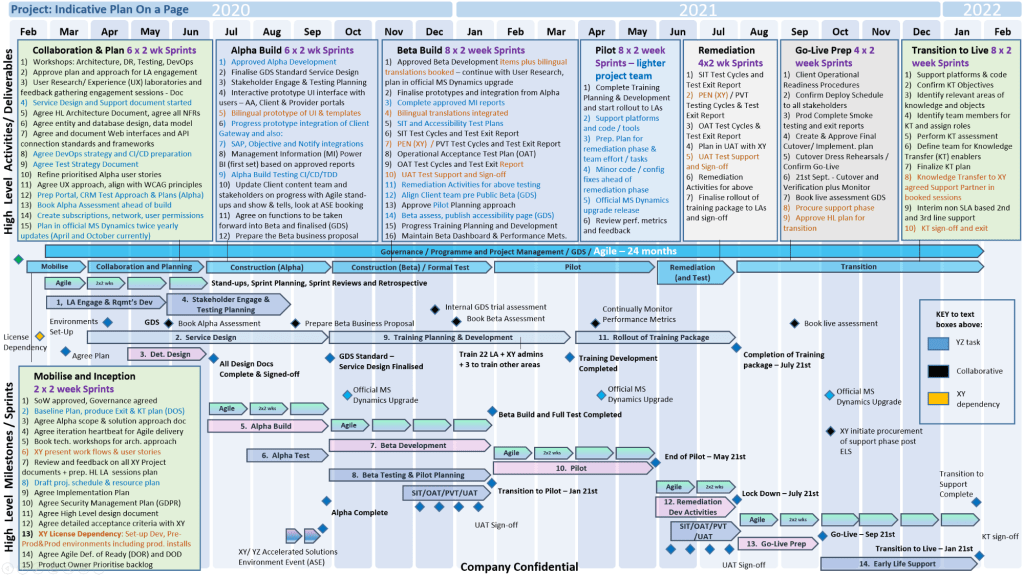
Plan On a Page POaP for an Agile Scrum project, available for download above

Capgemini’s evolution from a small French startup to a global IT leader

Capgemini’s evolution from a small French startup to a global IT leader is marked by strategic mergers and a shift toward high-growth technologies like AI. 

Corporate History Timeline

  • 1967: Serge Kampf founded Sogeti in Grenoble, France, focusing on enterprise management and data processing.
  • 1973–1975: Through hostile takeovers and mergers with CAP and Gemini Computer Systems, the group became CAP Gemini Sogeti.
  • 1985–1988: The company was listed on the Paris Stock Exchange (1985) and entered the CAC 40 index (1988).
  • 1996: The name was simplified to Cap Gemini, and a new logo was launched.
  • 2000: Acquired Ernst & Young Consulting for $11 billion, expanding its global reach, especially in North America.
  • 2004: The brand officially became Capgemini to reflect a unified global identity.
  • 2015: Acquired iGate for $4 billion, making North America its largest market.
  • 2019–2021: Acquired Altran (2019), later rebranded as Capgemini Engineering (2021), to dominate the engineering and R&D services sector.
  • 2024–2025: The strategic focus shifted to AI. In July 2025, Capgemini announced a €3.3 billion deal to acquire WNS Global Services to bolster its agentic AI and intelligent operations. 

Recruitment & Career Timelines

The hiring process typically follows this path:

  • Hiring Process: Usually takes a few weeks, involving application screening, multiple interview rounds (technical and HR), and background verification.
  • Graduate/Mass Hiring: Often conducted via the Superset platform, where status updates like “offered” appear roughly a week after interviews.
  • Graduate Programme: The Accelerate Programme (UK) spans approximately 21 months, starting with a 3-month business overview followed by 18 months in a specific pathway academy.
My own Capgemini career path 2016 – 2025
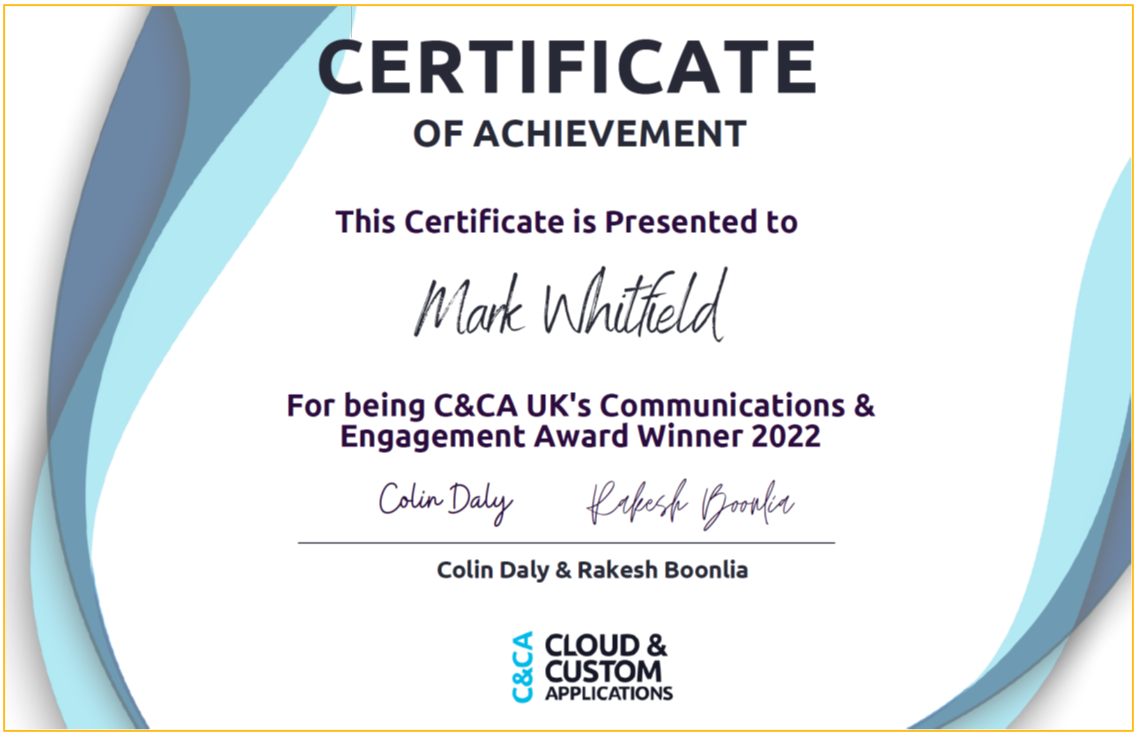
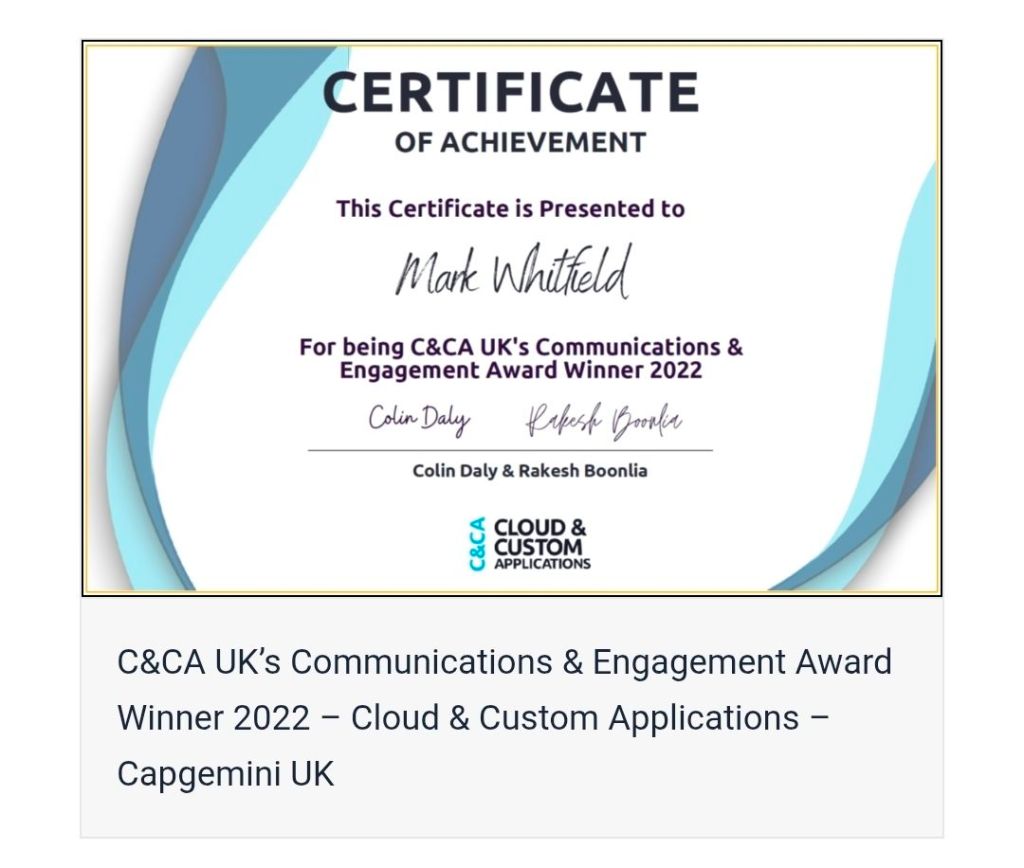
C&CA UK’s Communications & Engagement Award Winner 2022 – Cloud & Custom Applications – Capgemini UK
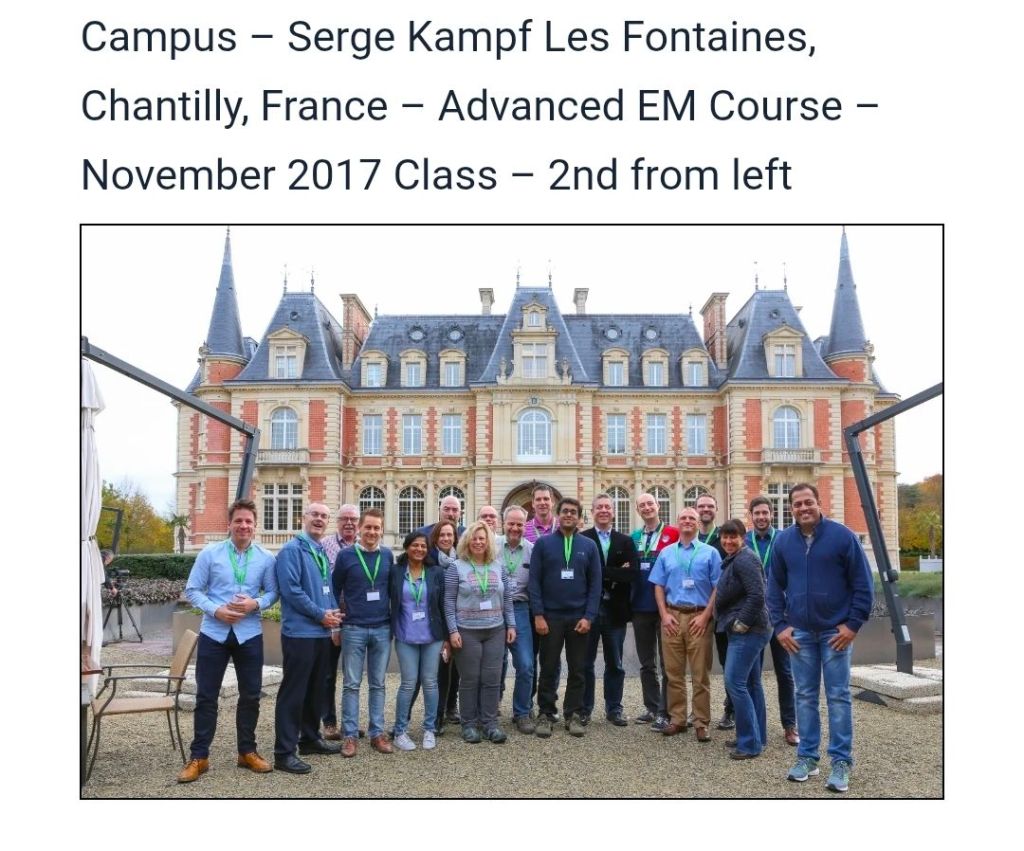
Campus – Serge Kampf Les Fontaines, Chantilly, France – Advanced EM Course – November 2017 Class – 2nd from left
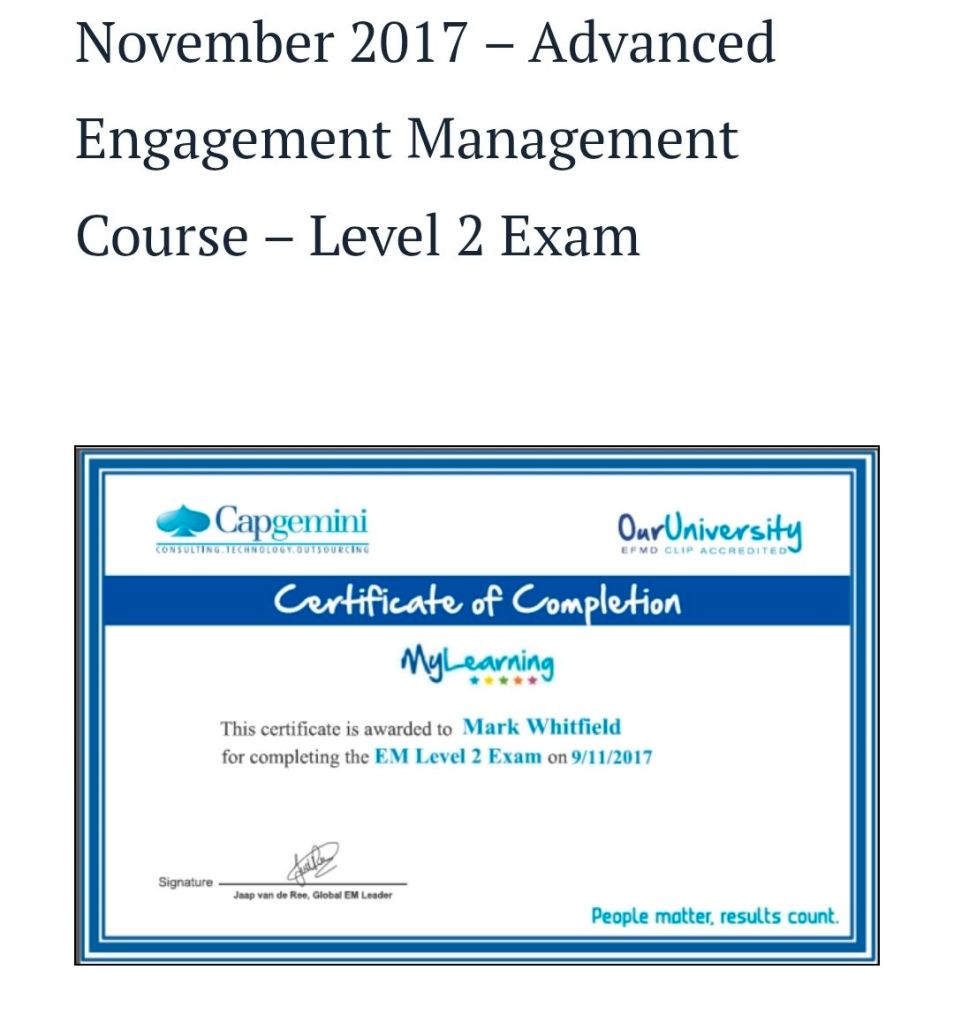
November 2017 – Advanced Engagement Management Course – Level 2 Exam

Capgemini’s evolution from a small French startup to a global IT leader

Timeline History of Agile Scrum Evolution, Development

Timeline History of Agile Scrum Evolution, Development

PMBOK Evolution Timeline – 1996 to 2025

PMBOK Evolution Timeline – 1996 to 2025