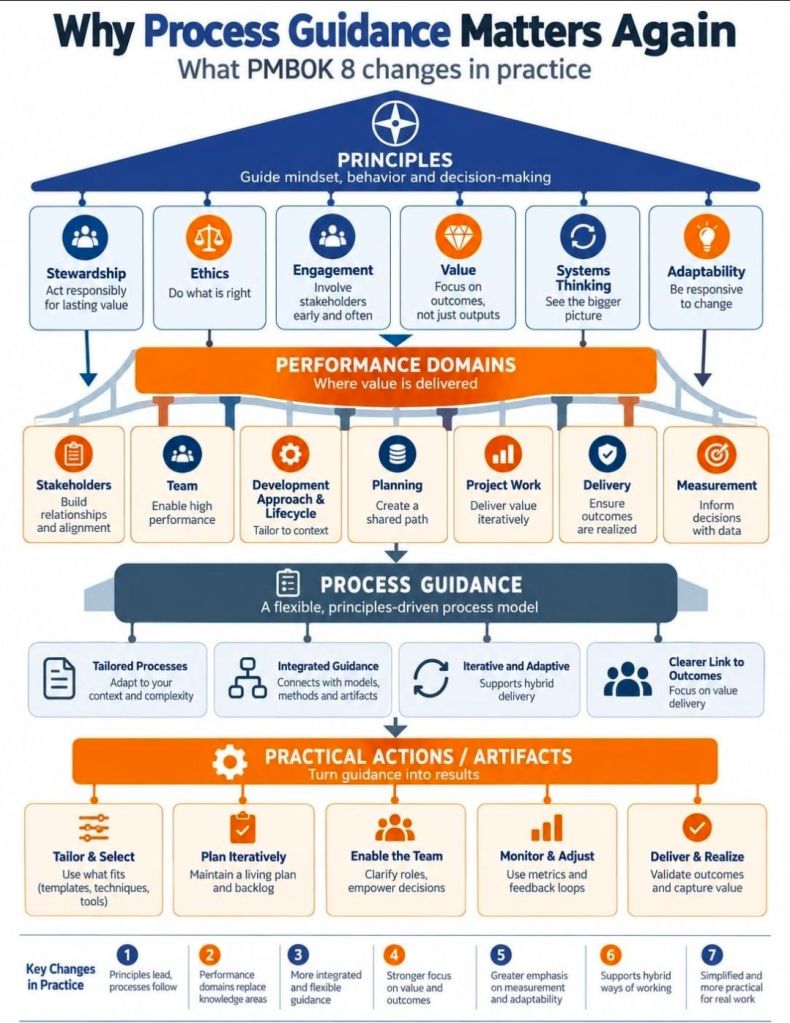
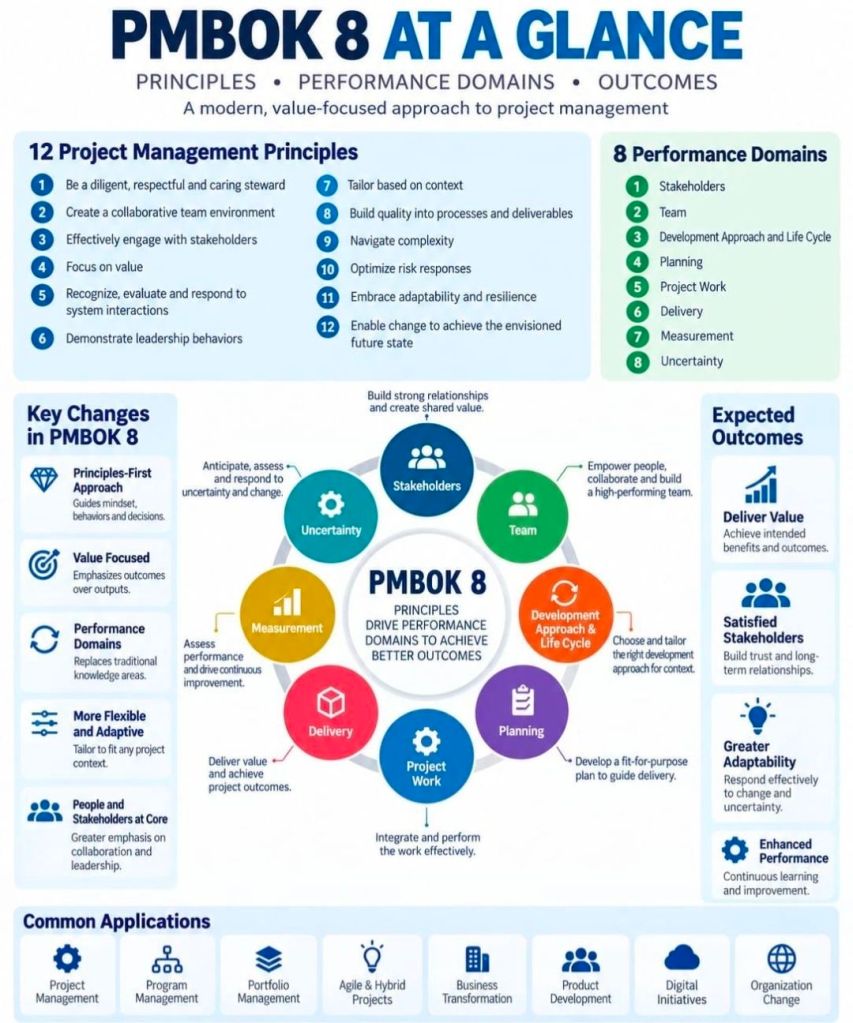
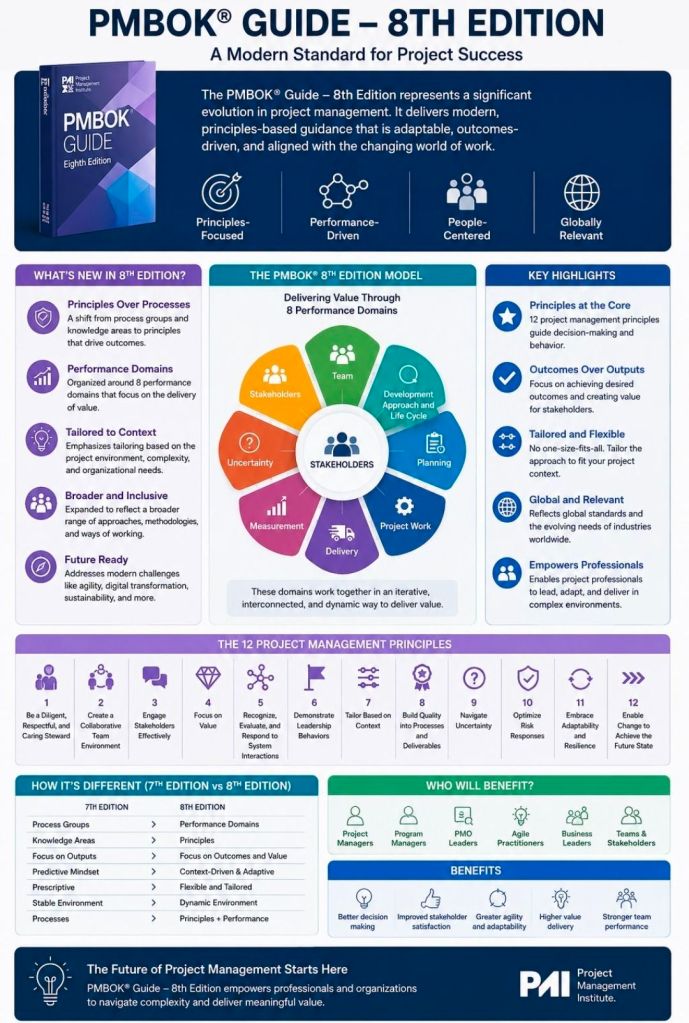
The PMBOK Guide 8th Edition is an integrated, value-driven framework that bridges the high-level principles of the 7th edition with the practical, process-oriented structure of older editions. It reintroduces 40 non-prescriptive processes alongside six core principles and seven performance domains.
📚 The Structure: Two Books in One
Similar to its predecessors, the printed volume of the 8th Edition includes two integrated publications:
The Standard for Project Management: An official ANSI standard that focuses on strategic alignment, value delivery systems, and global applicability.
A Guide to the Project Management Body of Knowledge (PMBOK Guide): The practical handbook containing the processes, tools, techniques, and tailoring considerations.
🟢 The 6 Core Principles
The 8th Edition streamlines the 12 principles from the 7th edition into six actionable pillars designed to guide professional behavior and mindset:
Adopt a Holistic View: Think in terms of systems and understand how a project integrates with organizational strategy.
Focus on Value: Direct efforts toward long-term outcomes and net-positive benefits rather than just output production.
Build Accountable Leadership: Cultivate a culture of transparency, clear responsibilities, and high-performance teamwork.
Embed Quality: Ensure quality processes and continuous improvement are woven into every phase of the work.
Integrate Sustainability: Consider the long-term environmental, social, and economic impacts of project delivery.
Build Empowered Teams: Foster environments where team members are supported, trusted, and empowered to solve problems.
🔵 The 7 Performance Domains
These represent key areas of practice, serving as the technical “what” of your project:
Governance: Setting the rules, decision frameworks, and oversight mechanisms.
Scope: Defining boundaries, deliverables, and requirements.
Schedule: Managing timeframes, milestones, and critical paths.
Finance: Budgeting, forecasting, and cost management.
Stakeholders: Managing expectations, engagement, and communications.
Resources: Allocating people, equipment, and physical/material assets.
Risks: Identifying, analyzing, and mitigating uncertainties.
🟠 The 40 Evolved Processes & Focus Areas
A highly praised update in the 8th edition is the return of process guidance. To offer structured “how-to” guidance without becoming rigid, the processes are grouped into five Focus Areas (replacing the traditional Process Groups):
Initiating
Planning
Executing
Monitoring & Controlling
Closing
Across these five focus areas, there are 40 non-prescriptive processes that detail the typical inputs, tools, techniques, and outputs (ITTOs). The guide includes explicit tailoring advice on how to adapt these processes for predictive, hybrid, and agile environments.
💡 Key Modern Additions
Reflecting over 48,000 global practitioner data points, the 8th Edition expands coverage into modern project environments:
Artificial Intelligence (AI): Guidance on using AI and data analytics in project management.
Project Management Offices (PMOs): Expanded focus on PMO structures and strategic value alignment.
If you are planning to take the PMP exam, make sure to check the official PMI PMP Certification Overview for the most up-to-date Exam Content Outline (ECO). The exam relies heavily on the ECO, and the 8th Edition guide serves as foundational reference material.
The Project Management Institute (PMI), founded in 1969, is the world’s leading professional association for the project management profession. Headquartered in the United States, it serves millions of professionals across 208 locations through over 300 local chapters, developing industry standards and globally recognised certifications.
Complete Overview
Mission: To maximize project success to elevate the world by creating products, services, and experiences that power the profession.
Vision: A world where every project lives up to its full potential for positive impact.
Core Functions:
Standards: Publishing the PMBOK Guide, a globally recognised standard for project management.
Certifications: Offering credentials such as the PMP (Project Management Professional) and CAPM.
Community: Managing a network of over 600,000 members and 10,000 volunteers globally.
Detailed Historical Timeline
Era 1: Foundations & The Scheduling Era (1960s – 1979)
During this period, project management emerged as a distinct discipline in the aerospace, construction, and defence industries.
1968: E.A. “Ned” Engman sends a letter of invitation to form an organization dedicated to project management.
1969: PMI is founded in Atlanta, Georgia, by James Snyder, Eric Jenett, Gordon Davis, E.A. Engman, and Susan Gallagher.
1969: First Seminars & Symposium, “Advanced Project Management Concepts,” held in Atlanta with 83 attendees.
1971: First PMI chapter established in Houston, Texas.
1975: PMI releases its first set of official organizational goals.
1977: Concept for PMI Seminars and Symposiums further developed by Susan Gallagher.
Era 2: Standardization & Professionalization (1980 – 1999)
This era focused on uncertainty reduction and the formalization of global standards.
1984: PMP Certification launched; co-founder Eric Jenett is the first to be certified.
1987: First publication of A Guide to the Project Management Body of Knowledge (PMBOK Guide) as a white paper.
1996: First formal edition of the PMBOK Guide published.
1998: PMBOK recognized as an ANSI Standard.
Era 3: Global Outreach & Diversification (2000 – 2018)
PMI expanded its global footprint and adapted to new methodologies.