Project Management Methodologies, historical timeline by era and year

This is a detailed, comprehensive historical timeline of project management methodologies, tracing the evolution from ancient practices to modern adaptive frameworks.

I. Pre-Modern Era (Before 1900): Foundation of Task Coordination

  • 2570 BC (Great Pyramid of Giza): Completion of the pyramids, demonstrating early project organization with managers for each of the four faces, planning, and logistics.
  • 208 BC (Great Wall of China): Construction of the Great Wall, involving massive workforce organization divided into soldiers, citizens, and criminals.
  • 1850s (Transcontinental Railroad): US railroad projects requiring large-scale resource and schedule management.
  • 1896 (Harmonogram): Karol Adamiecki developed the harmonogram, a predecessor to the Gantt chart (published in 1931). 

II. Early Modern Era (1910s–1950s): The Scientific Management Era 

This era brought “scientific management” to project control, focusing on efficiency and visualization. 

  • 1910s (Gantt Chart): Henry Gantt developed the Gantt chart, a visual tool for scheduling tasks over time.
  • 1911 (Scientific Management): Frederick Taylor published The Principles of Scientific Management, focusing on efficiency and time-saving.
  • 1931–1936 (Hoover Dam): One of the first large-scale applications of Gantt charts for complex scheduling.
  • 1942–1945 (Manhattan Project): Development of the atomic bomb, creating a need for rapid, complex planning and large-scale team coordination. 

III. The “Golden Age” of Project Management (1950s–1960s): Formal Methodologies 

This era introduced mathematical models for managing complex, interdependent tasks. 

  • 1956 (AACE Formed): The American Association of Cost Engineers (now AACE International) was formed, specializing in cost control and scheduling.
  • 1957 (Critical Path Method – CPM): Developed by Dupont Corporation to manage chemical plant maintenance shutdowns.
  • 1958 (Program Evaluation and Review Technique – PERT): Created by the US Navy Special Projects Office for the Polaris missile submarine project to manage task time and risk.
  • 1962 (Work Breakdown Structure – WBS): The US Department of Defense mandated the use of WBS for large, complex projects.
  • 1965 (IPMA Founded): The International Project Management Association (IPMA) was launched, the world’s first project management association.
  • 1969 (PMI Founded): The Project Management Institute (PMI) was launched to promote the profession, later developing the PMP certification. 

IV. The “Silver Age” (1970s–1980s): Systems and Controls 

  • 1970s (Waterfall Introduction): While used informally earlier, the Waterfall methodology was formalized for software development in the 1970s, emphasizing sequential phases.
  • 1975 (PROMPTII): Simpact Systems Ltd created PROMPTII, a methodology to handle cost overruns in computer projects, which later formed the basis of PRINCE.
  • 1975 (Mythical Man-Month): Fred Brooks published his seminal work on software engineering project management.
  • 1978 (Toyota Production System): Lean production and Kanban techniques, used in manufacturing, began to influence project workflow.
  • 1984 (Theory of Constraints – TOC): Dr. Eliyahu Goldratt published The Goal, introducing the Theory of Constraints for managing constraints (bottlenecks).
  • 1986 (Scrum): Takeuchi and Nonaka defined Scrum as a project management style for fast-paced development.
  • 1987 (PMBOK Guide): The Project Management Institute published the first Project Management Body of Knowledge (PMBOK) white paper.
  • 1989 (PRINCE): The UK government launched PRojects IN Controlled Environments (PRINCE), the standard for information systems projects. 

V. Rebirth and Modern Era (1990s–2000s): Agile and Adaptive Methods 

  • 1994 (CHAOS Report): The Standish Group published the first report documenting high IT project failure rates.
  • 1995 (Scrum Formalization): Jeff Sutherland and Ken Schwaber formally defined the Scrum framework.
  • 1996 (PRINCE2): PRINCE was updated to PRINCE2 to become a generic, more flexible methodology applicable to all project types.
  • 1997 (Critical Chain Project Management – CCPM): Eliyahu Goldratt invented CCPM, based on the Theory of Constraints.
  • 1998 (PMBOK Standard): The American National Standards Institute (ANSI) recognized PMBOK as a standard.
  • 2001 (Agile Manifesto): 17 software developers met to publish the Manifesto for Agile Software Development, prioritizing collaboration and adaptability over rigid plans.
  • 2007 (Kanban for Software): David Anderson adopted Kanban for software development, focusing on visualizing work and limiting work-in-progress. 

VI. The Contemporary Era (2010s–Present): Hybrid, AI, and Speed 

  • 2012 (ISO 21500): The International Organization for Standardization published ISO 21500:2012, “Guidance on Project Management”.
  • 2017 (PMBOK 6th Ed & PRINCE2 Update): PMI introduced Agile/adaptive practices into PMBOK, while AXELOS released a more flexible PRINCE2.
  • 2018 (PRINCE2 Agile): PRINCE2 Agile was launched to combine the governance of PRINCE2 with the flexibility of Agile.
  • 2021 (PMBOK 7th Ed): A major shift in PMI standards, moving from process-based to principle-based, focusing on project outcomes.
  • 2020s–Present (AI/Hybrid): Rise of AI-driven project management, automated reporting, and hybrid methodologies combining Waterfall stability with Agile speed. 

Project Management Methodologies, historical timeline by era and year

PRINCE2 Management Products Templates Overview and Historical Timeline
PRINCE2 management products are the 26 standard documents (templates) used to manage a project throughout its lifecycle. They are categorised into Baselines (plans and definitions), Records (registers and logs), and Reports (periodic updates). 

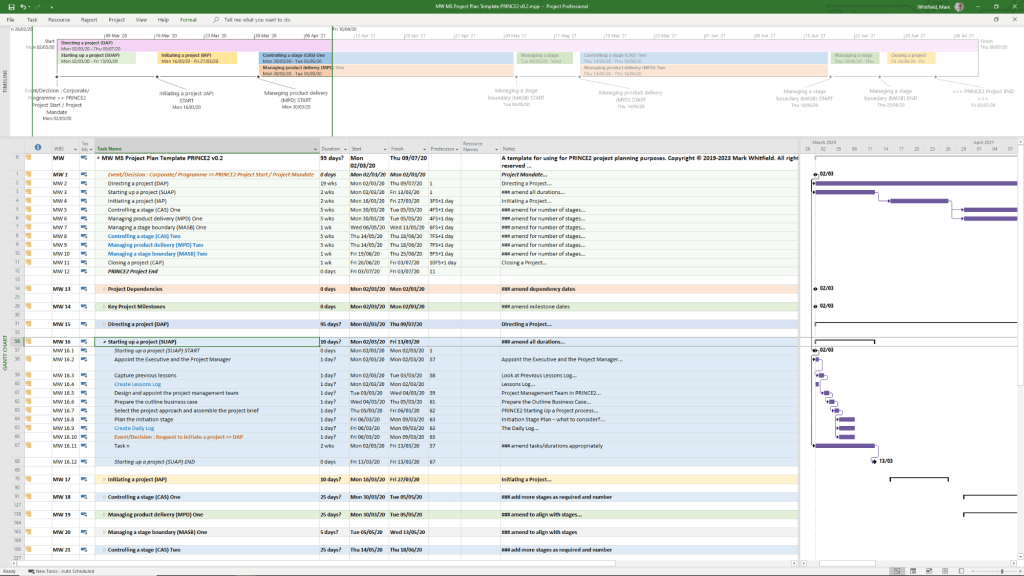
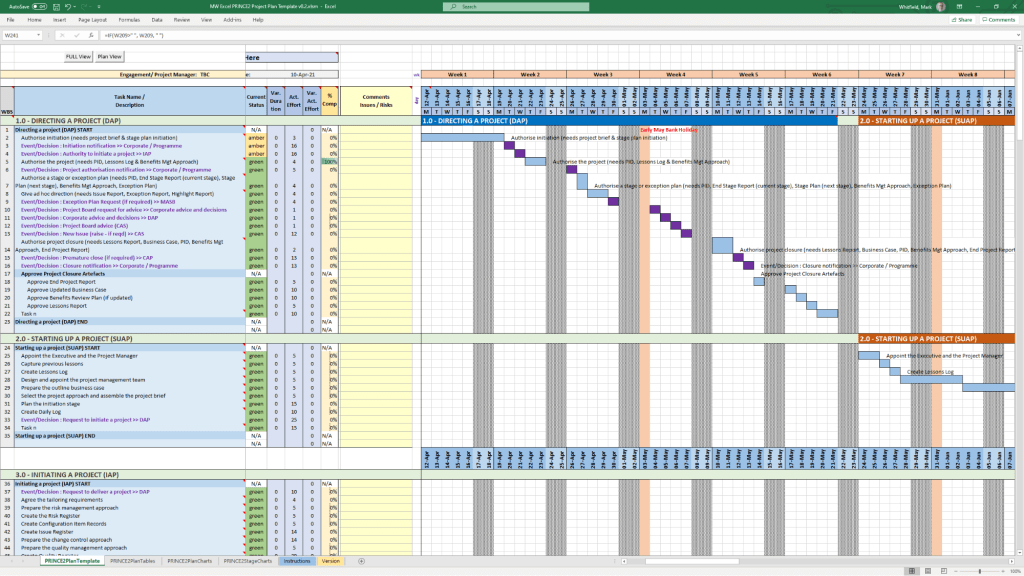
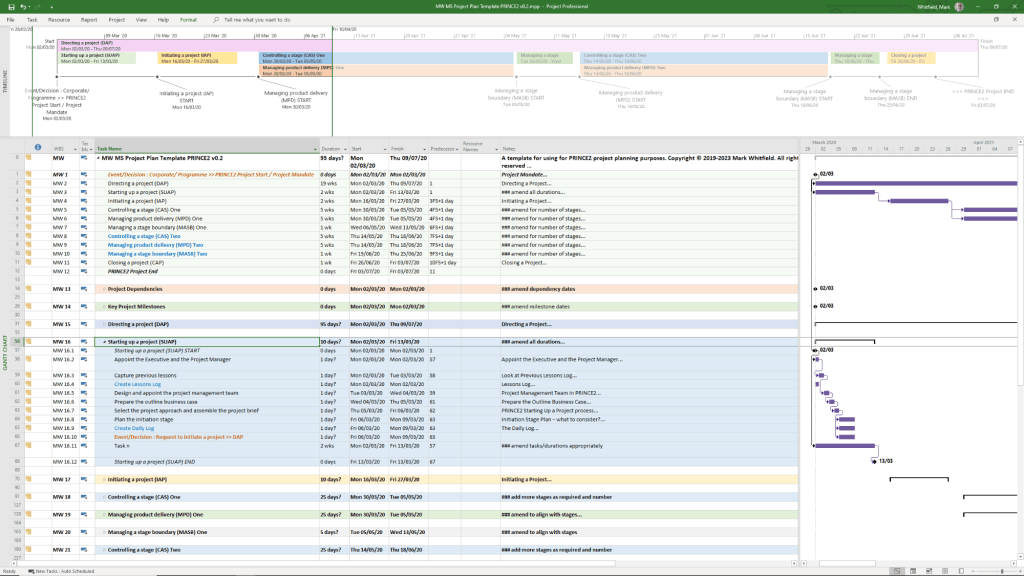
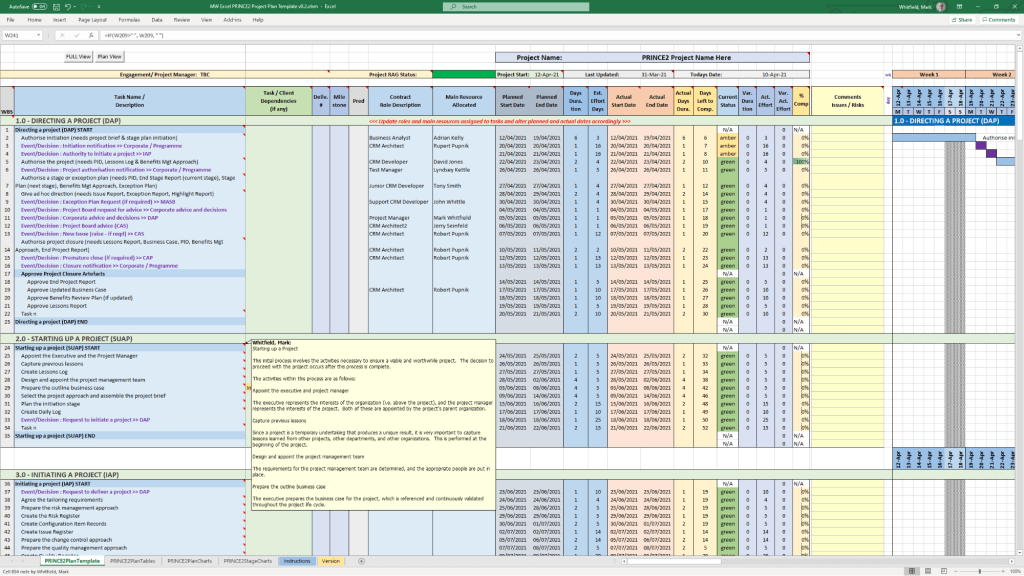
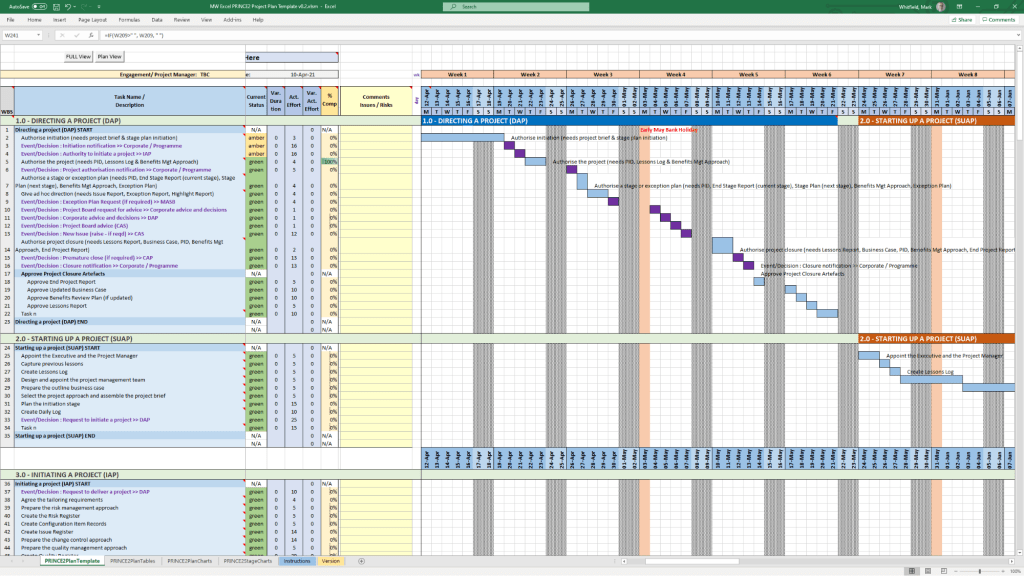
PRINCE2 Microsoft Project & Excel templates

Management Products Overview

The core templates provided in the methodology ensure consistent project control. Official templates are often available through accredited providers, this website or the official AXELOS website. 

  • Baselines: Used to define the project foundation (e.g., Business Case, Project Initiation Document, Plan).
  • Records: Dynamic logs to track day-to-day data (e.g., Risk Register, Issue Register, Lessons Log).
  • Reports: Snapshots of progress or specific events (e.g., Highlight Report, Checkpoint Report, Exception Report). 

Historical Timeline of Templates & Methodology

The evolution of these products reflects a shift from rigid, IT-specific documents to flexible, industry-agnostic templates. 

The Pre-PRINCE Era (1975 – 1988) 

  • 1975PROMPT II (Project Resource Organisation Management and Planning Techniques) was developed by Simpact Systems Ltd.
  • Key Focus: Introduced the concept of project phases (Initiation, Specification, Design) but was strictly for IT. 

The PRINCE Era (1989 – 1995) 

  • 1989PRINCE (PROMPT II in the CCTA Environment) launched by the UK Government’s CCTA.
  • Key Focus: Added Critical Path Analysis and formal management roles, but remained IT-heavy and rigid. 

The PRINCE2 Emergence (1996 – 2008)

  • 1996PRINCE2 (1st Edition) was released as a generic framework.
  • Key Change: IT-specific jargon was removed to make templates applicable to any industry.
  • 2002/2005: Minor updates (3rd and 4th Editions) focused on minor refinements based on user feedback. 

The Revision Era (2009 – 2022)

  • 2009PRINCE2:2009 Refresh (5th Edition) introduced the seven core principles.
  • Key Change: Templates were simplified and made more customisable to reduce “prowess-driven” bureaucracy.
  • 2017PRINCE2 6th Edition (formerly the 2017 Update) launched.
  • Key Change: Emphasis on Tailoring and scalability for different project sizes. 

The Modern Era (2023 – Present)

  • 2023PRINCE2 7th Edition was released.
  • Key Change: Added a “People” element and introduced three new management approaches: SustainabilityCommercial, and Digital & Data

Template Kits & Resources

For those seeking pre-formatted digital versions:

  • PRINCE2 7th Edition Template Bundle: Comprehensive sets including MS Project MPP, Excel Gantt charts, and Word artifacts are available at Etsy and eBay.
  • Specialised Packs: Focused collections like the PRINCE2 Control & Monitoring Pack can be found at WorkFlo Design.
  • Individual Documents: Individual templates like the Project Initiation Document (PID) are often sold separately for specific project needs. 
  • PRINCE2 Templates can be purchased directly from this website including a Microsoft Project Plan in MPP format and also a Microsoft Excel Project Plan in XLS format, see below and website link.

PRINCE2 Management Products Templates Overview and Historical Timeline
PRINCE2 Microsoft Project MPP file template
PRINCE2 Microsoft Excel XLS template 1
PRINCE2 Microsoft Excel XLS template 2

Roger Federer Overview and Historical Timeline by Era and Year
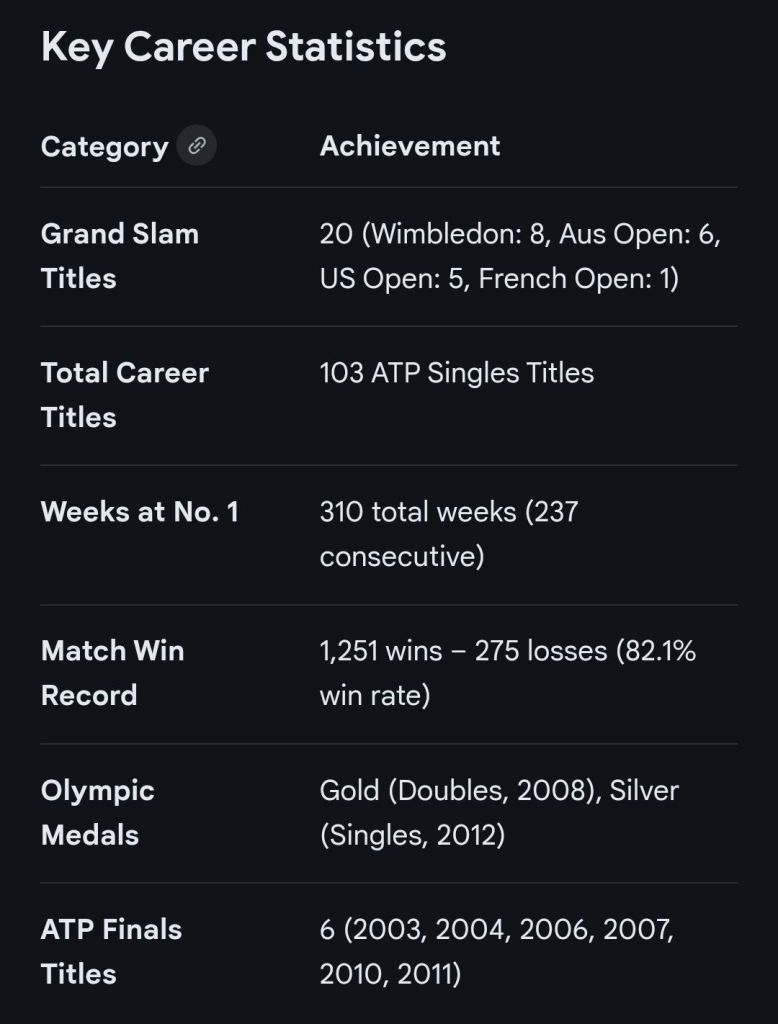
Roger Federer is a Swiss former professional tennis player who is widely regarded as one of the greatest athletes in history. His 24-year career (1998–2022) is defined by a “deadly combination of power and grace,” characterized by an effortless one-handed backhand and fluid movement. He won 20 Grand Slam singles titles, including a record eight at Wimbledon, and held the world No. 1 ranking for 310 weeks, including a record 237 consecutive weeks

Historical Career Timeline

Era 1: Junior Years and Professional Transition (1992–2002) 

Before his global dominance, Federer was a temperamental junior who transformed into a top-ten professional. 

  • 1992–1993: Served as a ballboy at the Swiss Indoors in his hometown of Basel.
  • 1995: Accepted into the Swiss Tennis national development programme at age 14.
  • 1998: Won the Wimbledon junior singles and doubles titles; finished the year as the world’s No. 1 junior. Made his ATP debut at the Swiss Open Gstaad.
  • 1999: Became the youngest player (18 years, 4 months) to end the year in the top 100.
  • 2000: Reached the bronze-medal match at the Sydney Olympics (finished 4th) and met his future wife, Mirka Vavrinec.
  • 2001: Gained international fame by defeating defending champion Pete Sampras at Wimbledon to reach his first major quarter-final. Won his first ATP title in Milan.
  • 2002: Ended the year ranked No. 6 globally; qualified for his first year-end Masters Cup (ATP Finals). 

Era 2: Unrivalled Dominance (2003–2007) 

Federer established a “Golden Era,” reaching all four Grand Slam finals in a single year three times during this period (2006, 2007, 2009). 

  • 2003: Won his first Grand Slam title at Wimbledon, defeating Mark Philippoussis.
  • 2004: Won three Grand Slams (Australian Open, Wimbledon, US Open) and became world No. 1 for the first time on 2 February, a position he would not relinquish for 237 weeks.
  • 2005: Defended his Wimbledon and US Open titles.
  • 2006: Arguably his greatest season, winning three majors and reaching the final of the fourth (French Open); finished with a 92–5 match record.
  • 2007: Reached all four Grand Slam finals again, winning three. Defeated Novak Djokovic in the US Open final to claim his 12th major.

Era 3: Rivalries and Record-Breaking (2008–2012) 

As rivals Rafael Nadal and Novak Djokovic emerged, Federer achieved his most significant career milestones. 

  • 2008: Battled mononucleosis but won a fifth consecutive US Open. Won Olympic Gold in doubles with Stan Wawrinka.
  • 2009: Completed the Career Grand Slam by winning the French Open and broke Pete Sampras’s record of 14 majors by winning his 15th at Wimbledon.
  • 2010: Won his fourth Australian Open.
  • 2011: The first year since 2002 he did not win a major title, despite ending Djokovic’s 43-match win streak at the French Open.
  • 2012: Won a record-equalling 7th Wimbledon title, returned to world No. 1, and won Olympic Silver in singles at the London Games. 

Era 4: Injury Struggles and Late Renaissance (2013–2019) 

After several years of injury and titles eluding him, Federer staged a historic comeback. 

  • 2013–2016: Plagued by back and knee injuries. Underwent knee surgery in 2016 and missed the second half of that season, dropping out of the top 10 for the first time in 14 years.
  • 2017: Returned from a 6-month layoff to win the Australian Open (defeating Nadal) and a record 8th Wimbledon title without dropping a set.
  • 2018: Won his 20th and final Grand Slam title at the Australian Open and became the oldest world No. 1 in history at age 36.
  • 2019: Won his 100th career title (Dubai) and reached his 12th Wimbledon final, losing an epic 5-set match to Djokovic despite holding championship points. 

Era 5: Retirement (2020–2022) 

  • 2020–2021: Limited by multiple knee surgeries. Played his final Grand Slam match at Wimbledon 2021, reaching the quarter-finals.
  • 2022: Announced his retirement in September. Played his final match—a doubles pairing with Rafael Nadal—at the Laver Cup in London.

Roger Federer Overview and Historical Timeline by Era and Year
Roger Federer career statistics

with hyperlinks

Roger Federer‘s professional career spanned 24 years, from his ATP debut in 1998 to his emotional retirement at the Laver Cup on 23 September 2022. He concluded his career with 103 singles titles and 20 Grand Slam championships, including a record eight Wimbledon titles. 

Career Timeline (1998–2022)

  • 1998: Professional Debut
    • Federer made his ATP debut at the Swiss Open Gstaad.
    • Won the Wimbledon junior singles and doubles titles.
  • 2001: Breakthrough Victory
    • Defeated defending champion Pete Sampras at Wimbledon, ending Sampras’s 31-match win streak and reaching his first major quarter-final.
  • 2003: First Grand Slam Title
  • 2004: Ascending to World No. 1
    • Won the Australian Open, Wimbledon, and US Open.
    • Became World No. 1 for the first time on 2 February, beginning a record-breaking streak of 237 consecutive weeks at the top.
  • 2006: The “Career-Best” Season
    • Reached the final of all four Grand Slams, winning three of them (Australian Open, Wimbledon, US Open) and finishing the year with 12 titles and a 92–5 record.
  • 2008: Olympic Gold
  • 2009: Career Grand Slam
    • Won the French Open to complete his Career Grand Slam and equaled Pete Sampras’s then-record of 14 major titles.
    • Secured his 15th major title at Wimbledon shortly after.
  • 2012: Olympic Silver & No. 1 Return
    • Won an eighth Wimbledon title and reclaimed the World No. 1 ranking.
    • Earned an Olympic silver medal in singles at the London Games.
  • 2014: Davis Cup Triumph
    • Led Switzerland to its first-ever Davis Cup title, defeating France in the final.
  • 2017: The Renaissance
    • After a six-month injury hiatus, won the Australian Open and a record eighth Wimbledon title.
  • 2018: 20th Grand Slam & Oldest No. 1
  • 2022: Retirement
    • Announced his retirement on 15 September.
    • Played his final competitive match in doubles alongside Rafael Nadal at the Laver Cup in London.

HP NonStop MultiBatch Overview and Historical Timeline
HP NonStop MultiBatch is a “mainframe-class” workload automation and batch scheduling manager developed by Insider Technologies (distributed by ETI-NET). It is designed specifically for the HPE NonStop (formerly Tandem) platform to automate, manage, and secure complex batch processing across both Guardian and OSS environments. 

Product Overview

While the native NonStop scheduler is NetBatch, MultiBatch is positioned as a modern, high-performance alternative that provides deeper integration with the NonStop architecture. 

  • Workload Automation: Manages thousands of concurrent jobs with sophisticated calendaring and dependency tracking.
  • Architecture: Built to leverage NonStop’s fault tolerance and linear scalability, allowing batch schedules to execute across multiple networked nodes.
  • Interfaces: Modernized from command-line tools to a suite of role-based Graphical User Interfaces (GUIs) for operations and management.
  • Security: Includes a secure, audited environment with full support for NonStop-specific security attributes like High-PIN and CPU selection. 

Historical Timeline by Era

The evolution of MultiBatch is closely tied to the history of the Tandem/NonStop platform, which spans over 50 years of ownership changes and architectural shifts. 

1. The Tandem Era (1974 – 1997)

  • 1974: Tandem Computers founded by James Treybig to build the first fault-tolerant commercial systems.
  • Late 1980s – Early 1990sMultiBatch originated during this period (reportedly in the early 1990s) to address the needs of large financial institutions requiring complex batch schedules beyond the capabilities of the original NetBatch.
  • 1991: Release of the Cyclone/R and the start of the migration from proprietary stack machines to MIPS RISC processors. 

2. The Compaq & Early HP Era (1997 – 2014)

  • 1997: Compaq acquires Tandem.
  • 2002: Hewlett-Packard (HP) merges with Compaq. The NonStop platform begins its migration from MIPS to Intel Itanium (branded as Integrity NonStop).
  • Mid-2000s: MultiBatch matures as a mission-critical tool for global banks and stock exchanges. Development focuses on MultiBatch 7 and 8, enhancing GUI capabilities and adding support for Open System Services (OSS). 

3. The Modern HPE Era (2014 – Present)

  • 2014NonStop X is introduced, moving the architecture from Itanium to Intel x86-64.
  • 2015: Hewlett-Packard splits into HP Inc. and Hewlett Packard Enterprise (HPE).
  • 2018 – 2020MultiBatch 9.5 is released with an enhanced GUI. It increasingly becomes the primary alternative as HPE shifts focus away from active sales of the legacy NetBatch product.
  • 2023 – 2024: Release of MultiBatch 10, introducing “Define Classes,” support for up to 2,500 jobs, and improved OSS process handling. This era focuses on “modernisation through tradition,” aligning with HPE’s push for virtualized NonStop and hybrid cloud deployments. 

MediaCityUK Photo Journal and Historical Timeline, Salford Quays

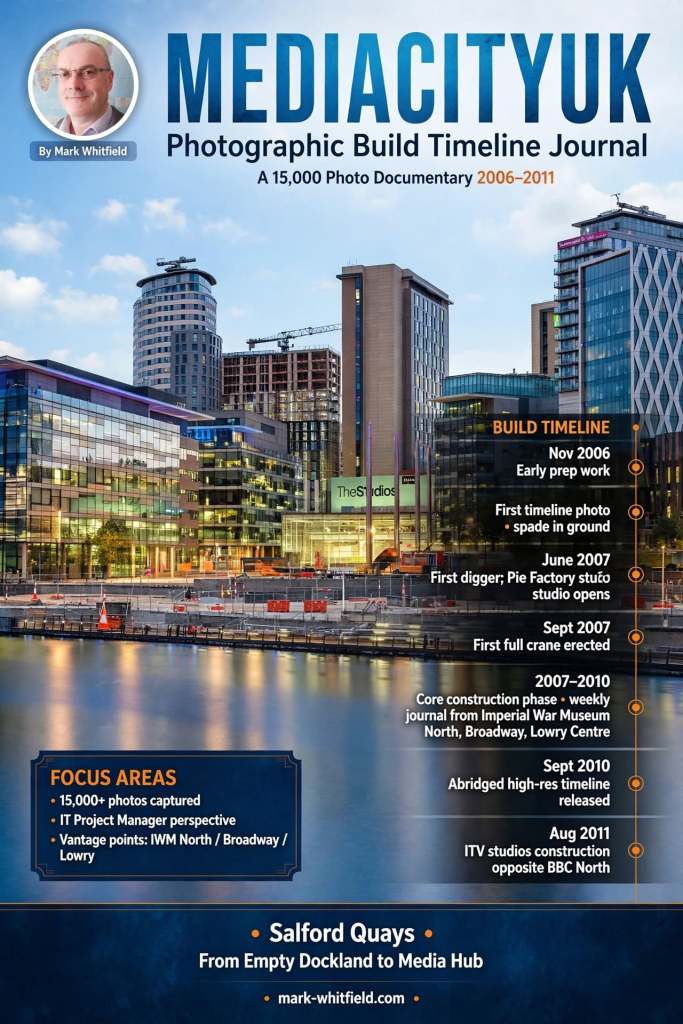
Mark Whitfield is a photographer who has documented the development of MediaCityUK in Salford Quays through an extensive “Photographic Build Timeline Journal”. His collection includes over 15,000 images that capture the site’s transformation from a derelict dockland into a global media hub. 

MediaCityUK Photo Timeline

Mark Whitfield: Photography Overview

  • Project Focus: Whitfield began documenting the rise of MediaCityUK in May 2007, specifically focusing on the construction of the BBC’s new northern home.
  • Visual Documentation: His work is described as a unique photo timeline that charts the incredible structural changes at the site over several years.
  • Background: Beyond his photography, Whitfield has a background in IT project management and has worked in Salford Quays for over 15 years.
  • Galleries: Much of his work is hosted on his personal website, mark-whitfield.com, and he has shared specific milestones on platforms like Flickr and Instagram
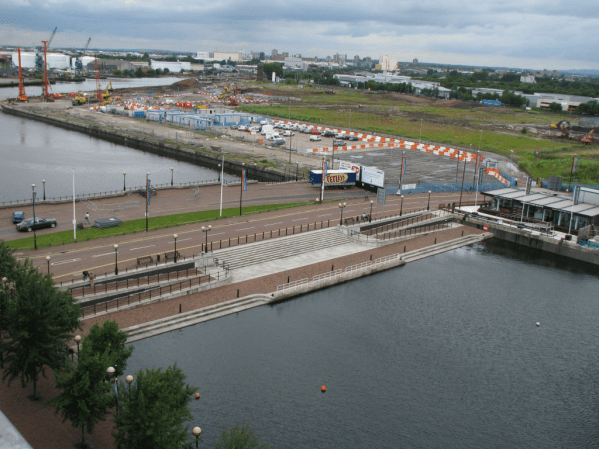
MediaCityUK site in 2007

Historical Timeline of MediaCityUK

The following timeline integrates key development milestones with Whitfield’s photographic journey:

  • 2004–2006: Pre-Construction Phase
    • The BBC signals its intention to move jobs to Manchester (2004).
    • Salford Quays is officially chosen as the site for the new development (June 2006).
  • 2007: Construction Begins
    • May 18, 2007: Mark Whitfield captures his first timeline photo, marking the start of the build.
    • The first “spade in the ground” occurs as Peel Group and Bovis Lend Lease begin work.
    • The Pie Factory, a refurbished bakery, opens as the first working studio complex.
  • 2008–2009: Structural Growth
    • Whitfield continues extensive documentation; photos from April 2008 and February 2009 capture the rising concrete frames of the main buildings.
    • The high-rise 2,116-space multi-storey car park is completed (August 2009).
  • 2010: Infrastructure Milestones
    • The MediaCityUK Metrolink station opens (September 20), connecting the site to the wider Manchester tram network.
    • First trial show is recorded in Studio HQ2 (November), featuring a simulated power failure and evacuation.
    • Initial infrastructure is completed by December.
  • 2011: Operational Launch
    • January 2011: Dock10 studios become operational.
    • February 2011: The first program, Don’t Scare the Hare, is filmed at MediaCityUK.
    • May 2011: BBC staff begin moving into three dedicated buildings: Bridge House, Dock House, and Quay House.
    • October 2011: The University of Salford opens its new media academy at the site.
  • 2012–2014: Full Integration
    • April 2012: The Queen and Duke of Edinburgh officially open MediaCityUK.
    • March 2013: ITV completes its move to the site.
    • January 2014: Coronation Street records its first episode at the new production facility on Trafford Wharf.
  • 2015–2021: Expansion & Sustainability
    • 2016: Completion of “Tomorrow,” the final building in Phase One.
    • 2020: The Pie Factory closes and is demolished to make way for Phase Two.
    • 2021: MediaCityUK buildings become the first in the UK to achieve net-zero carbon status. 
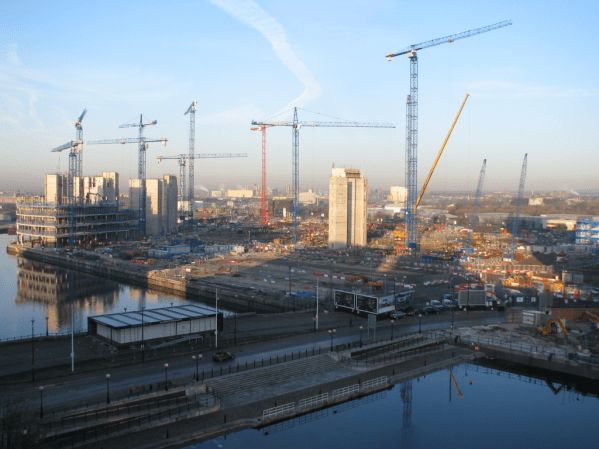
MediaCityUK building beginning to take shape in late 2008

HND Higher National Diploma Overview and Historical Timeline by Year
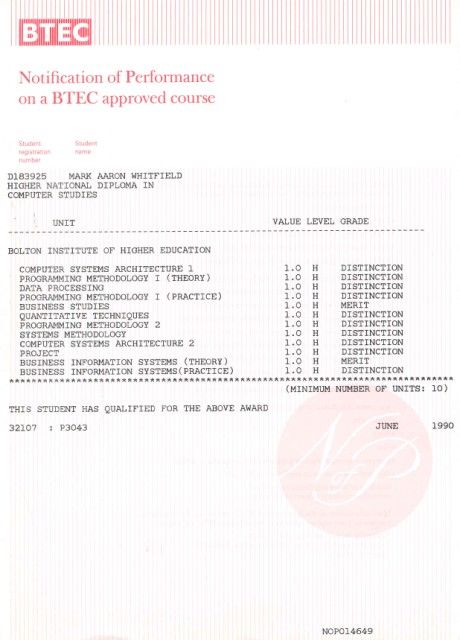
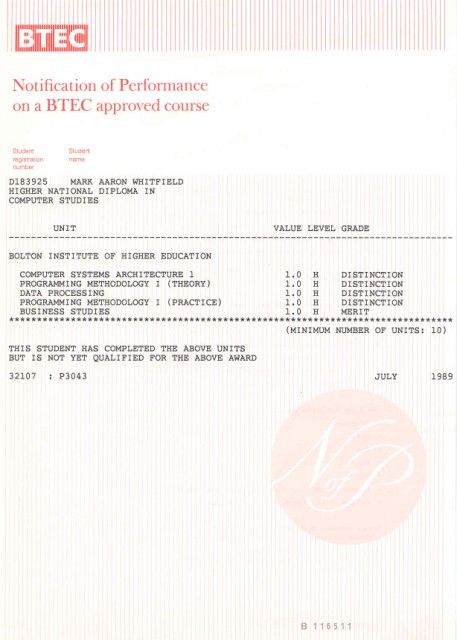
Higher National Diploma (HND) is a Level 5 vocational qualification in the UK, equivalent to the first two years of a university bachelor’s degree. Designed to provide industry-specific practical skills, it typically takes two years of full-time study or three to four years part-time. 

Higher National Diploma HND in Computer Studies (3)

Historical Timeline of the HND

The HND has evolved from a niche engineering credential into a globally recognised vocational standard. 

The Early Era: Origins and Industrial Focus (1920s–1950s)

  • 1920: The Higher National Diploma was first introduced in England and Wales alongside the Ordinary National Diploma (OND) and Higher National Certificate (HNC).
  • 1921–1923: Initial subject frameworks were established, starting with Mechanical Engineering (1921) and Electrical Engineering (1923).
  • 1930s: The qualification expanded into Building (1929) and Commerce (1939) to support a growing industrial economy.
  • Post-WWII: The 1944 Butler Act reorganised secondary education, but HNDs remained the primary route for advanced technical training in colleges. 

The Expansion Era: Growth and New Governance (1960s–1970s)

  • 1960s: HNDs gained prominence in polytechnics, addressing critical skills gaps through a practical approach to higher education.
  • 1968–1969: Awards for HNDs saw a massive 665% increase compared to a decade prior, beginning to rival university “ordinary degrees” in popularity.
  • 1972–1974: Under Margaret Thatcher (then Education Secretary), the Haselgrave Report recommendations led to moving qualifications from the City and Guilds to two new bodies: the Business Education Council (BEC) and the Technician Education Council (TEC)

The BTEC and Modernisation Era (1980s–2000s)

  • 1983: BEC and TEC merged to form the Business and Technician Education Council (BTEC), which became the primary awarding body for HNDs.
  • 1990s: BTEC merged with the University of London Examinations Board to form Edexcel (now part of Pearson).
  • 1980s–90s: The curriculum diversified rapidly into modern sectors such as computing, business, catering, and performing arts.
  • 2000s: Global expansion accelerated; for instance, the HND was formally introduced in Cameroon in 2002
Higher National Diploma HND in Computer Studies (1)

The Contemporary Era: Frameworks and Global Standard (2010s–Present)

  • 2013–2014: Despite a decline in public sector colleges due to the rise of Foundation Degrees, HND student numbers at private providers grew from 13,000 to 30,000 in just one year.
  • 2018: Major global curriculum updates were implemented to integrate digital literacy, sustainability, and entrepreneurship into traditional vocational subjects.
  • 2020s: Current HNDs are positioned at Level 5 on the Regulated Qualifications Framework (RQF) and are delivered in over 60 countries. 

Key Characteristics of the HND

  • Academic Standing: Equivalent to Level 5 (Year 2 of a Degree).
  • Progression: Over 95% of UK universities allow HND graduates to “top up” to a full bachelor’s degree, often entering directly into the final year.
  • Assessment: Focuses on practical projects, case studies, and work placements rather than just theoretical exams. 

HND Higher National Diploma Overview and Historical Timeline by Year
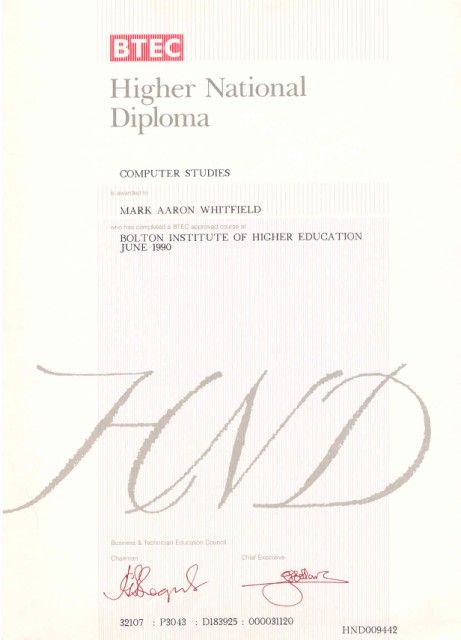
Higher National Diploma HND in Computer Studies (2)

Golf Overview and Historical Timeline by Era and Year
Modern golf originated in 15th-century Scotland, where it was played on coastal linksland with wooden clubs and leather balls. While earlier stick-and-ball games like the Roman paganica and Dutch colf likely influenced its development, Scotland is credited with formalising the game into the sport known today. 

Comprehensive Overview of Golf Eras

  • Ancient Origins (Pre-1400s): Various cultures played stick-and-ball games, including the Roman paganica (1st century) and the Chinese chuiwan (960–1279 AD).
  • Early Scottish Era (1400–1743): Golf took shape in Scotland. It was famously banned by King James II in 1457 to prioritise archery practice. The ban was later lifted by King James IV in 1502, who became an avid player himself.
  • The Enlightenment & Formalisation (1744–1850): The first official golf clubs were formed, and the first “13 Rules of Golf” were written by the Honourable Company of Edinburgh Golfers in 1744.
  • The Victorian Boom & Expansion (1851–1900): The Industrial Revolution and the birth of railways allowed golf to spread globally. The first Open Championship was held in 1860, and the United States Golf Association (USGA) was founded in 1894.
  • The Modern Professional Era (1901–Present): Professional organisations like the PGA of America (founded 1916) and the PGA Tour (spun off in 1968) formalised the competitive circuit. The late 20th century saw the rise of global icons like Jack Nicklaus and Tiger Woods. 

Detailed Historical Timeline

Origins & Royal Influence

  • 1457: King James II of Scotland bans golf (“ye golf”) via a parliamentary decree because it distracted soldiers from archery.
  • 1502: King James IV lifts the ban after signing the Treaty of Perpetual Peace with England; he commissions the first custom set of clubs.
  • 1552: First recorded evidence of golf played at St Andrews.
  • 1567: Mary, Queen of Scots, is recorded playing golf; she is credited with coining the term “caddy” (from the French cadets).
  • 1618: The “feathery” ball (leather stuffed with boiled goose feathers) is invented, replacing primitive wooden balls.
  • 1659: First reference to golf in America—a ban on playing in the streets of Albany, New York. 

Era of Clubs & Rules

  • 1744: The Gentlemen Golfers of Leith (later the Honourable Company of Edinburgh Golfers) form the first official club and establish the first 13 rules.
  • 1754: The Society of St Andrews Golfers is founded; it later becomes the Royal and Ancient Golf Club (R&A).
  • 1764: St Andrews reduces its course from 22 holes to 18 holes, establishing the global standard.
  • 1766: Royal Blackheath is formed near London, the first golf club outside Scotland.
  • 1810: First recorded women’s golf competition is held at Musselburgh Links, Scotland.
  • 1848: Invention of the “guttie” ball (made from gutta-percha), which was cheaper and more durable than the feathery. 

The Championship Era

  • 1860: The inaugural Open Championship is held at Prestwick Golf ClubWillie Park Sr. is the first champion.
  • 1888: The St Andrew’s Golf Club of Yonkers is formed, marking the permanent arrival of golf in the U.S..
  • 1894: The USGA is founded to standardise rules in the United States.
  • 1895: The first U.S. Open and U.S. Amateur championships are held.
  • 1900: The Haskell ball (rubber core) is introduced, significantly increasing driving distances. 

Modern Professional Era

  • 1916: The Professional Golfers’ Association (PGA) of America is established.
  • 1927: The first Ryder Cup takes place in Worcester, Massachusetts.
  • 1930: Bobby Jones wins the first and only Original Grand Slam.
  • 1934: The first Masters Tournament (then the Augusta National Invitation Tournament) is held.
  • 1947: The U.S. Open becomes the first golf tournament televised live.
  • 1968: The PGA Tour officially forms as a separate entity from the PGA of America.
  • 1971: Astronaut Alan Shepard hits a golf ball on the Moon during the Apollo 14 mission.
  • 1996: Tiger Woods turns professional, sparking a global boom in the sport’s popularity.
  • 2023: The PGA Tour and Saudi-backed LIV Golf announce a framework agreement to merge and reunite professional golf. 

Golf Overview and Historical Timeline by Era and Year

Llandudno Pier Overview and Historical Timeline by Era

Llandudno Pier, often called the “Queen of Welsh Piers”, is the longest pier in Wales at 2,295 feet (700 metres). It is a Grade II* listed structure renowned for its Victorian and Edwardian elegance, featuring ornate ironwork and classic kiosks. 

Llandudno Pier, often called the “Queen of Welsh Piers”, is the longest pier in Wales

Historical Timeline by Era

Early Origins (The Pre-Pier Era)

  • 1858: A short wooden pier (242 ft) was built by the St George’s Harbour and Railway Company to export limestone.
  • 1859: This original structure was severely damaged by the “Royal Charter Storm”.
  • 1860–1875: Though repaired, the wooden pier was too short for steamships except at high tide. 

Victorian Era: Construction and Growth

  • 1875: The Llandudno Pier Company was formed to build a new, modern structure.
  • 1876: Construction began in June/July. The first pile was driven on 16 September 1876.
  • 1877: The pier officially opened on 1 August, initially measuring 1,234 feet.
  • 1878: Construction was fully completed; the first steamboat (Prince Arthur) landed in May.
  • 1884: A landward extension was added, bringing the pier to its current length of 2,295 feet.
  • 1886: The Pier Pavilion opened on 16 September as a 2,000-seat theatre and concert hall.
  • 1887: Renowned conductor Jules Rivière took charge of the pier’s orchestra, which eventually grew to symphony proportions.
  • 1891: A new landing stage was added to accommodate increased steamship traffic. 

Edwardian and Mid-20th Century

  • 1905: A pier-head pavilion was constructed.
  • 1910: Extensive improvements were made, including widening most of the pier.
  • 1938: Major alterations were carried out on the landing stage.
  • 1968: The pier was purchased by the Trust House Forte Group.
  • 1969: The landing stage was totally rebuilt in concrete and steel to handle large Isle of Man steamers. 

Modern Era: Challenges and Restoration

  • 1983: The pier became part of the First Leisure Corporation.
  • 1984: The Pier Pavilion theatre closed.
  • 1994: A major fire destroyed the Pier Pavilion on 13 February, leaving only the iron supports.
  • 1998: Purchased by Leisure Parks Ltd (Trevor Hemmings) along with several other UK piers.
  • 2005: Voted “Pier of the Year” by the National Piers Society.
  • 2015: Purchased by local entrepreneur Adam Williams (Tir Prince Leisure Group) for £4.5 million.
  • 2021: Adam Williams purchased the derelict Pavilion site to protect the pier’s future.
  • 2025: Voted “Pier of the Year” for the second time following major restoration efforts. 

Llandudno Pier Overview and Historical Timeline by Era

Golf Historical Timeline Overview

The history of golf is broadly categorised into five distinct eras that track its evolution from a forbidden Scottish pastime to a multi-billion dollar global industry. 

1. The Foundation Years (Pre-1400s – 1899)

This era established the basic rules, the 18-hole standard, and the first major championships. 

  • 1457: King James II of Scotland bans golf and football because they distract young men from archery and military training.
  • 1502: King James IV lifts the ban and becomes a golfer himself, leading to the sport’s popularity among royalty.
  • 1744: The first official golf club, the Honourable Company of Edinburgh Golfers, is formed and establishes the first 13 rules of golf.
  • 1764: The Old Course at St Andrews reduces its round from 22 holes to 18 holes, setting the global standard for course length.
  • 1848: The “Guttie” ball (made of gutta-percha) is introduced, making the game more affordable and durable than the original feather-filled leather balls.
  • 1860: The first Open Championship (British Open) is held at Prestwick, won by Willie Park Snr.
  • 1894: The United States Golf Association (USGA) is founded to govern the sport in America.
  • 1895: The first U.S. Open and U.S. Women’s Amateur championships are held. 

2. The Golden Era (1900 – 1945)

This period saw the rise of legendary players, the formalisation of the professional tour, and the transition to steel equipment. 

  • 1916: The PGA of America is founded, and the PGA Championship is inaugurated.
  • 1920s: Steel shafts are patented and eventually legalised by the USGA (1924) and R&A (1929), replacing hickory.
  • 1927: The first Ryder Cup match is played between teams from the United States and Great Britain.
  • 1930Bobby Jones achieves the “Grand Slam” by winning the U.S. Open, U.S. Amateur, British Open, and British Amateur in a single year.
  • 1934: The first Masters Tournament is held at Augusta National, founded by Bobby Jones.
  • 1945Byron Nelson sets a record by winning 11 consecutive tournaments (18 total in the year).

3. The Television Boom (1946 – 1980s)

Broadcast sports turned golf into a global phenomenon, fueled by the rivalry between Jack Nicklaus and Arnold Palmer

  • 1950: The LPGA Tour is officially formed.
  • 1968: The PGA Tour is formally established as a separate entity from the PGA of America.
  • 1971: Astronaut Alan Shepard hits a golf ball on the moon during the Apollo 14 mission.
  • 1970s: Graphite shafts and metal-headed woods (drivers) begin to replace traditional wooden clubs. 

4. The Tiger Era (1990s – 2010) 

The arrival of Tiger Woods sparked a massive surge in popularity, prize money, and athletic training. 

  • 1991: Callaway introduces the Big Bertha driver, popularising oversized metalwood heads.
  • 1997Tiger Woods wins the Masters at age 21 by 12 strokes, becoming the youngest champion and sparking a global “Tiger Boom”.
  • 2009Tiger Woods becomes the first athlete to surpass $1 billion in career earnings. 

5. The Modern Game (2011 – Present)

This era is defined by extreme data analysis (Launch Monitors), advanced technology, and shifting tours. 

  • 2016: Golf returns to the Olympic Games after a 112-year absence.
  • 2022: The launch of LIV Golf introduces a significant competitive landscape shift in professional golf.
  • 2026: A planned “golf ball rollback” is scheduled to manage the increasing distances professional players are hitting the ball.

Golf Historical Timeline Overview