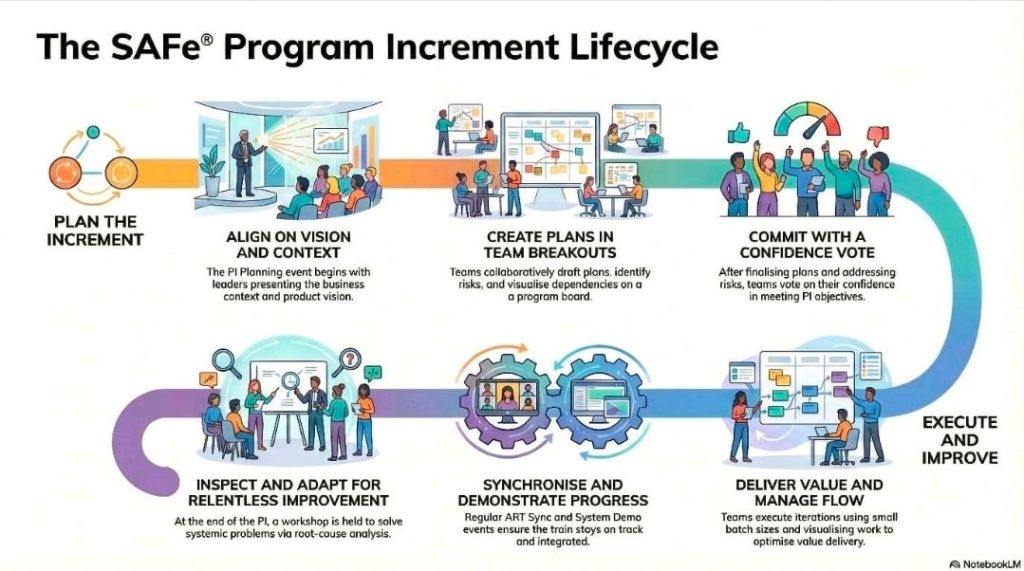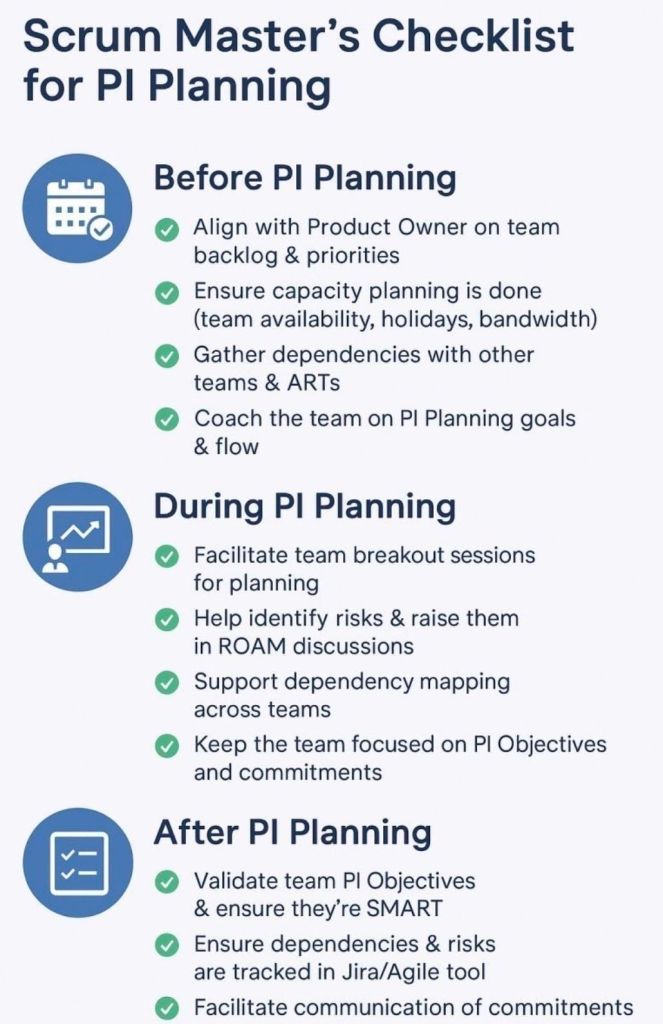
An Agile Scrum Master’s checklist for a Program Increment (PI)ensures your team is aligned, dependencies are resolved, and a realistic delivery plan is established for the upcoming 8–12 weeks of work. As a facilitator and coach, you support the team across three core phases: Pre-PI Planning, During PI Planning Events, and Post-PI Execution.
Here is a comprehensive checklist structured across the lifecycle of a Program Increment.
📅 Phase 1: Pre-PI Planning Readiness
- Establish Sprint Cadence: Define exact start/end dates for every sprint within the upcoming PI.
- Calculate Team Capacity: Factor in vacations, public holidays, corporate events, and historic team velocity.
- Refine the Backlog: Collaborate with the Product Owner to ensure top features meet the Definition of Ready (DoR).
- Encourage Feature Decomposition: Guide developers to begin breaking down high-priority features into draft user stories.
- Prepare Digital Tooling: Set up virtual whiteboards like Miro or MURAL, and structure project boards in systems like Jira.
- Align Engineering Standards: Review architectural patterns with system architects to prevent technical blockers.
🛠️ Phase 2: During the PI Planning Event
- Day 1 Breakout Management: Facilitate your team’s breakdown of features into actionable, estimated sprint user stories.
- Map Dependencies: Identify files, data, or logic needed from external teams and link them on the program board.
- Draft PI Objectives: Help the team write clear, outcome-oriented, and SMART goals based on their planned work.
- Surface Program Risks: Collaboratively categorize all technical or resource hurdles using the ROAM framework (Resolved, Owned, Accepted, Mitigated).
- Day 2 Plan Finalization: Ensure uncommitted objectives are preserved for high-risk items requiring external prerequisites.
- Conduct Confidence Votes: Run an anonymous digital vote to gauge psychological safety and realistic alignment before final team commitment.
🚀 Phase 3: Post-PI & Execution Tracking
- Sync the Agile Tooling: Move sticky notes and analog mappings directly into active Jira epics or tracking backlogs.
- Establish Sprint Tracking: Distribute automated calendar sequences for recurring Daily Scrums, Sprint Plannings, and Sprint Reviews.
- Monitor Cross-Team Risks: Attend standard Scrum of Scrums (SoS) meetings to report on blockers and coordinate incoming dependency tracks.
- Protect the WIP Limits: Enforce explicitly defined work-in-progress (WIP) boundaries to prevent team burnout over mid-increment changes.
- Inspect and Adapt (I&A): Facilitate the final evaluation comparing actual value delivered against initial PI targets to feed process enhancements back into the train.