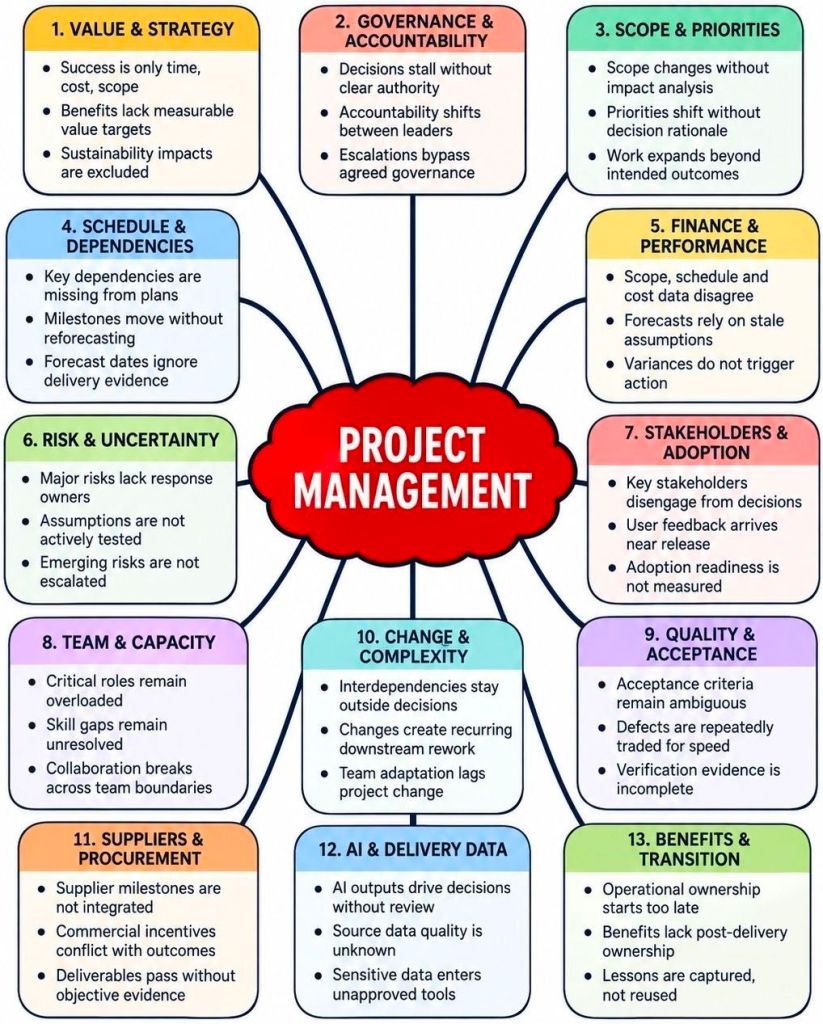
Key red flags in project management serve as early warning signs that a project is veering off course, helping teams intervene before minor issues escalate into total project failure.
Experienced project managers look past superficial status updates to spot subtle breakdowns in communication, planning, and execution.
The most common project management red flags are grouped by their operational area below:
📋 Scope and Strategy
Continuous Scope Creep: Requirements keep expanding without corresponding adjustments to the project budget, timeline, or resource allocation.
Misalignment with Strategy: The project outputs focus entirely on immediate tactical tasks but no longer deliver the overarching strategic value or outcomes the business actually needs.
Superficial Project Plan: Key details, task dependencies, or success metrics are absent, making it difficult for team members to know what steps to take next.
⏱️ Timeline and Tracking
Slipping Timelines with Vague Excuses: Milestones are consistently missed or delayed, accompanied by repetitive, hollow reassurances that the team will “catch up later”.
Always-Green Status Reports: The project status dashboard shows a perfect “Green” light week after week, yet actual deliverables are lagging or shifting behind the scenes.
Lack of a Baseline Schedule: Work is actively progressing in the field or in development, but the team still hasn’t officially approved or aligned on a baseline schedule to measure progress against.
👥 Team and Resources
Key Person Risk: Critical technical or institutional knowledge is held entirely by one individual, making the entire project fragile if they leave or step away.
Resource Misallocation: Shared resources or team members are over-allocated across multiple projects, leading to immediate bottlenecks and unmanaged dependencies.
PM-as-Glue Syndrome: The project is only moving forward because the project manager is manually holding everything together through sheer willpower, rather than relying on an established system.
💬 Communication and Culture
Sudden Drop in Engagement: Stakeholders stop replying to messages promptly, meeting attendance drops off significantly, or team collaboration noticeably slows down.
Decision Paralysis: Leadership or key decision-makers repeatedly delay approvals or shift their minds, leaving the execution team completely stalled.
False Alignment: Team members nod their heads and agree in meetings but silently push back or reverse decisions once the session is over.
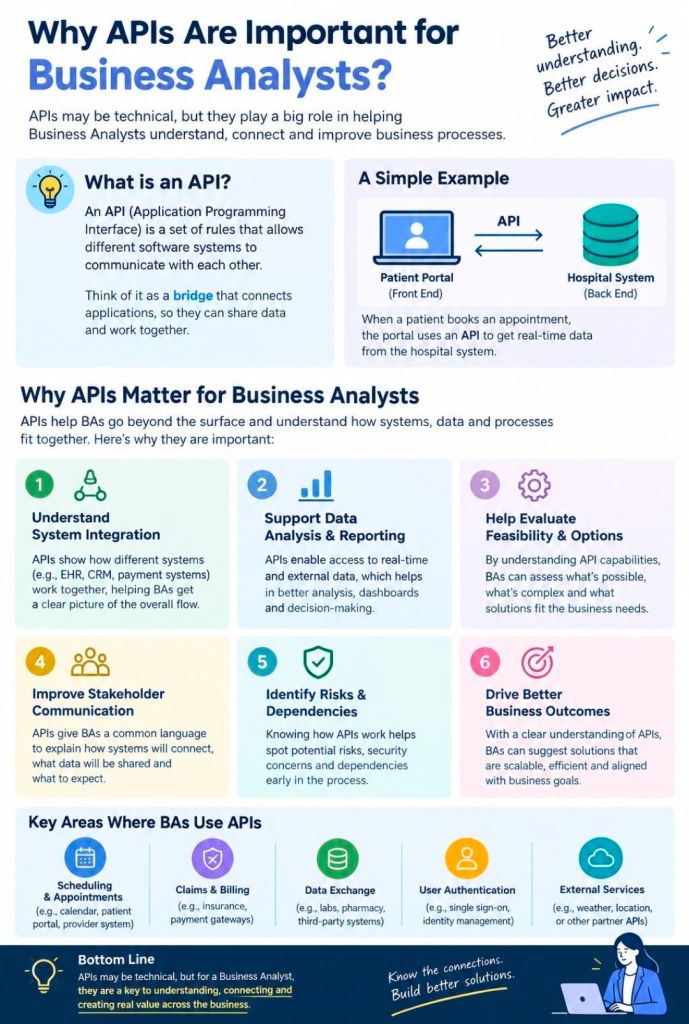
An Application Programming Interface (API) is a set of rules, definitions, and protocols that allows different software applications to communicate and exchange data with one another.
Essentially, an API acts as a software intermediary or “digital contract”: if one application submits a request in a specific format, the other system promises to return a predictable response or perform a specific action.
Instead of building every single feature from scratch, software engineers use APIs to seamlessly integrate tools, databases, and services built by other creators.
How an API Works (The Restaurant Analogy)
The easiest way to understand an API is to think of a restaurant:
The Client (You): You sit at the table looking at the menu, wanting to order food.
The Server (The Kitchen): The kitchen has the ingredients and the capability to cook your food, but you cannot talk directly to the chef.
The API (The Waiter): The waiter takes your specific order (the Request), delivers it to the kitchen, and returns to your table with your food (the Response).
Real-World Examples
Most modern digital experiences rely completely on APIs working behind the scenes:
Weather Apps: A phone app doesn’t track global weather itself. It sends an API request to an official organization like AWS Weather Systems or Weather.com, which safely delivers the live forecast data back to your screen.
Travel Booking: Websites like Expedia use APIs provided by individual airlines to instantly gather, compare, and display live flight prices and times in one place.
Ride-Hailing: Apps like Uber use the Google Maps API to handle location routing and mapping, rather than spending millions building their own global maps system.
Core Benefits
Efficiency: Developers save months of time by plugging into pre-built features instead of reinventing the wheel.
Security: APIs hide internal server details. They only share tiny packets of necessary data, keeping the main database protected from outside users.
Automation: They let data flow cleanly between applications without requiring manual file exports or human intervention.