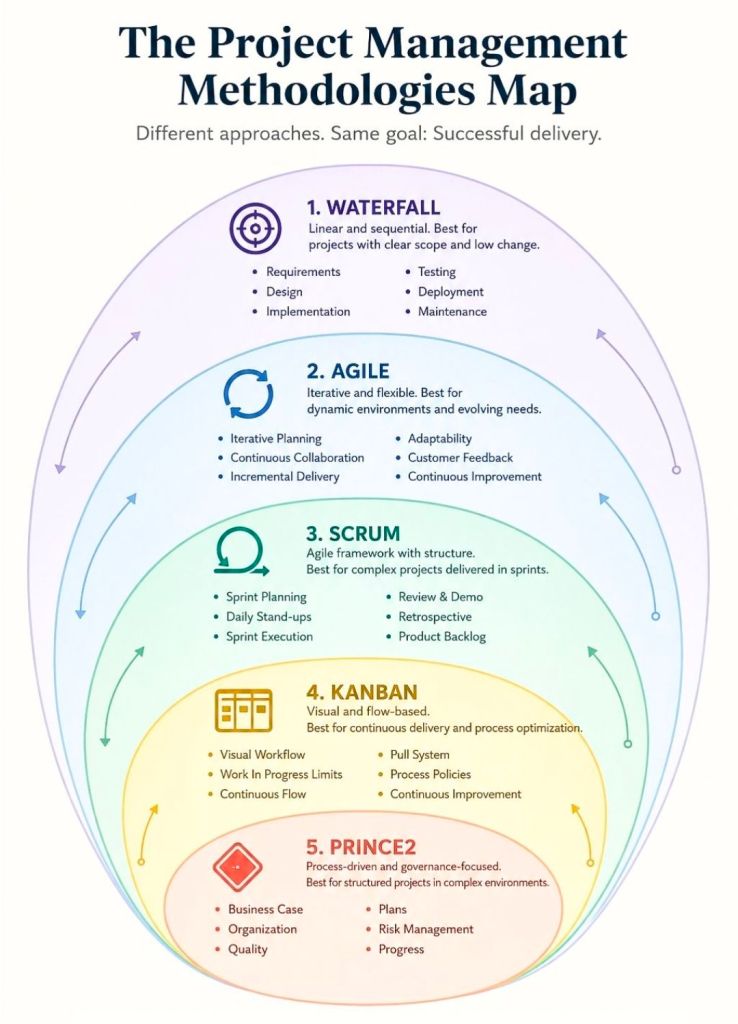
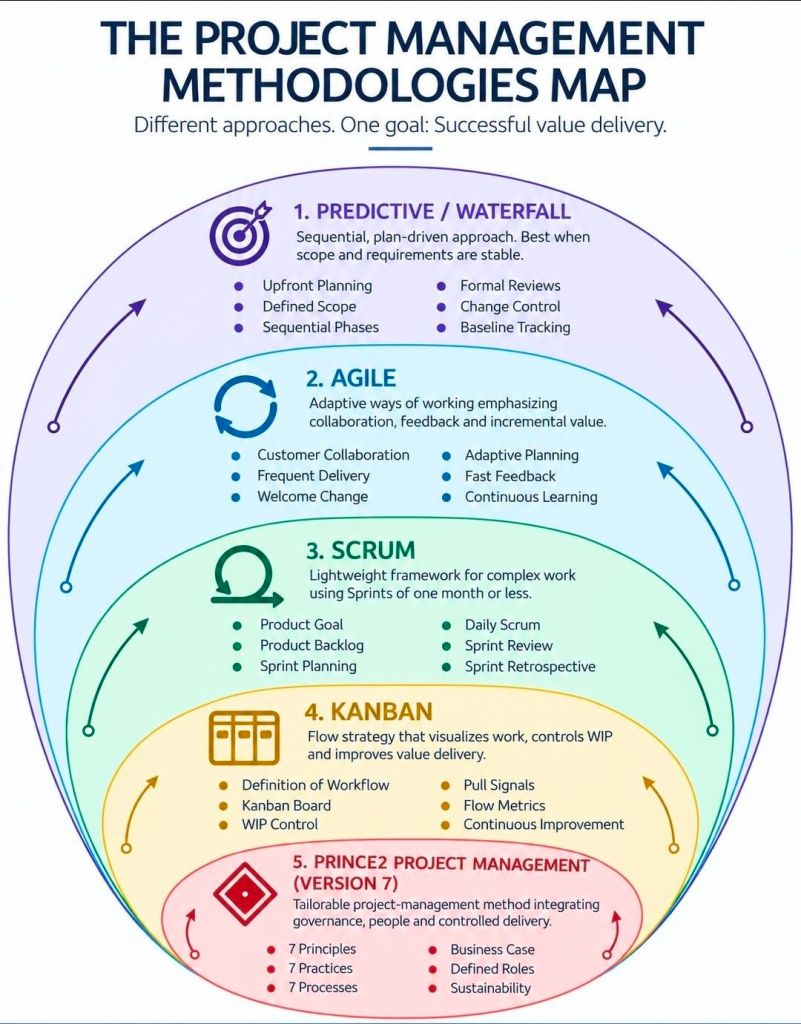
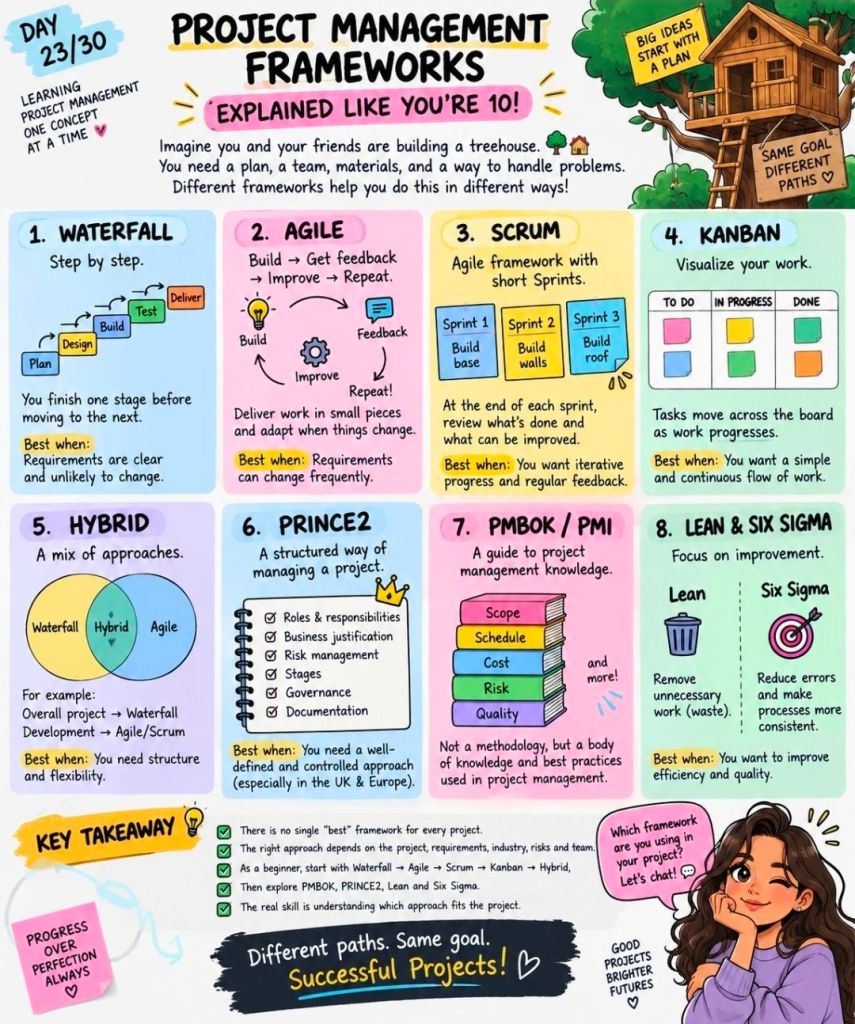
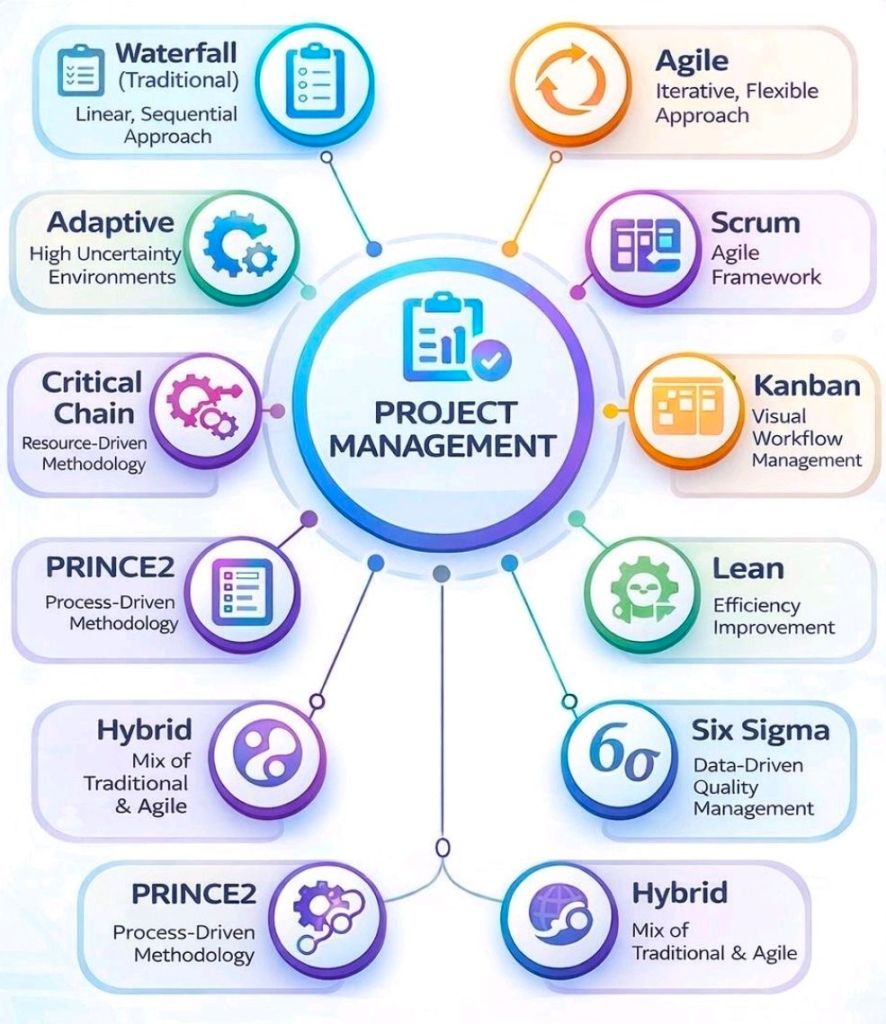
Project Management Methodologies Summarised

Project Management Methodologies Summarised

Project Management Methodologies, historical timeline by era and year

This is a detailed, comprehensive historical timeline of project management methodologies, tracing the evolution from ancient practices to modern adaptive frameworks.

I. Pre-Modern Era (Before 1900): Foundation of Task Coordination

  • 2570 BC (Great Pyramid of Giza): Completion of the pyramids, demonstrating early project organization with managers for each of the four faces, planning, and logistics.
  • 208 BC (Great Wall of China): Construction of the Great Wall, involving massive workforce organization divided into soldiers, citizens, and criminals.
  • 1850s (Transcontinental Railroad): US railroad projects requiring large-scale resource and schedule management.
  • 1896 (Harmonogram): Karol Adamiecki developed the harmonogram, a predecessor to the Gantt chart (published in 1931). 

II. Early Modern Era (1910s–1950s): The Scientific Management Era 

This era brought “scientific management” to project control, focusing on efficiency and visualization. 

  • 1910s (Gantt Chart): Henry Gantt developed the Gantt chart, a visual tool for scheduling tasks over time.
  • 1911 (Scientific Management): Frederick Taylor published The Principles of Scientific Management, focusing on efficiency and time-saving.
  • 1931–1936 (Hoover Dam): One of the first large-scale applications of Gantt charts for complex scheduling.
  • 1942–1945 (Manhattan Project): Development of the atomic bomb, creating a need for rapid, complex planning and large-scale team coordination. 

III. The “Golden Age” of Project Management (1950s–1960s): Formal Methodologies 

This era introduced mathematical models for managing complex, interdependent tasks. 

  • 1956 (AACE Formed): The American Association of Cost Engineers (now AACE International) was formed, specializing in cost control and scheduling.
  • 1957 (Critical Path Method – CPM): Developed by Dupont Corporation to manage chemical plant maintenance shutdowns.
  • 1958 (Program Evaluation and Review Technique – PERT): Created by the US Navy Special Projects Office for the Polaris missile submarine project to manage task time and risk.
  • 1962 (Work Breakdown Structure – WBS): The US Department of Defense mandated the use of WBS for large, complex projects.
  • 1965 (IPMA Founded): The International Project Management Association (IPMA) was launched, the world’s first project management association.
  • 1969 (PMI Founded): The Project Management Institute (PMI) was launched to promote the profession, later developing the PMP certification. 

IV. The “Silver Age” (1970s–1980s): Systems and Controls 

  • 1970s (Waterfall Introduction): While used informally earlier, the Waterfall methodology was formalized for software development in the 1970s, emphasizing sequential phases.
  • 1975 (PROMPTII): Simpact Systems Ltd created PROMPTII, a methodology to handle cost overruns in computer projects, which later formed the basis of PRINCE.
  • 1975 (Mythical Man-Month): Fred Brooks published his seminal work on software engineering project management.
  • 1978 (Toyota Production System): Lean production and Kanban techniques, used in manufacturing, began to influence project workflow.
  • 1984 (Theory of Constraints – TOC): Dr. Eliyahu Goldratt published The Goal, introducing the Theory of Constraints for managing constraints (bottlenecks).
  • 1986 (Scrum): Takeuchi and Nonaka defined Scrum as a project management style for fast-paced development.
  • 1987 (PMBOK Guide): The Project Management Institute published the first Project Management Body of Knowledge (PMBOK) white paper.
  • 1989 (PRINCE): The UK government launched PRojects IN Controlled Environments (PRINCE), the standard for information systems projects. 

V. Rebirth and Modern Era (1990s–2000s): Agile and Adaptive Methods 

  • 1994 (CHAOS Report): The Standish Group published the first report documenting high IT project failure rates.
  • 1995 (Scrum Formalization): Jeff Sutherland and Ken Schwaber formally defined the Scrum framework.
  • 1996 (PRINCE2): PRINCE was updated to PRINCE2 to become a generic, more flexible methodology applicable to all project types.
  • 1997 (Critical Chain Project Management – CCPM): Eliyahu Goldratt invented CCPM, based on the Theory of Constraints.
  • 1998 (PMBOK Standard): The American National Standards Institute (ANSI) recognized PMBOK as a standard.
  • 2001 (Agile Manifesto): 17 software developers met to publish the Manifesto for Agile Software Development, prioritizing collaboration and adaptability over rigid plans.
  • 2007 (Kanban for Software): David Anderson adopted Kanban for software development, focusing on visualizing work and limiting work-in-progress. 

VI. The Contemporary Era (2010s–Present): Hybrid, AI, and Speed 

  • 2012 (ISO 21500): The International Organization for Standardization published ISO 21500:2012, “Guidance on Project Management”.
  • 2017 (PMBOK 6th Ed & PRINCE2 Update): PMI introduced Agile/adaptive practices into PMBOK, while AXELOS released a more flexible PRINCE2.
  • 2018 (PRINCE2 Agile): PRINCE2 Agile was launched to combine the governance of PRINCE2 with the flexibility of Agile.
  • 2021 (PMBOK 7th Ed): A major shift in PMI standards, moving from process-based to principle-based, focusing on project outcomes.
  • 2020s–Present (AI/Hybrid): Rise of AI-driven project management, automated reporting, and hybrid methodologies combining Waterfall stability with Agile speed. 

Project Management Methodologies, historical timeline by era and year

AI Projects and Methodologies for Managing AI Projects

Artificial intelligence (AI) is transforming project management through two distinct but related paths: the use of AI-powered tools to manage general projects and the specialized methodologies required to manage AI development itself

1. Methodologies for Managing AI Projects

Traditional software development methods (like Waterfall) often fail for AI because these projects are experimental and non-linear. Specialized frameworks have emerged to handle the “data-first” nature of AI: 

  • CPMAI (Cognitive Project Management for AI): A leading methodology that combines Agile principles with data-centric phases: Business Understanding, Data Understanding, Data Preparation, Model Development, Model Evaluation, and Model Operationalization.
  • Agile-AI Hybrid: Adapts standard Agile by using “short-boxed” iterations for model training and allowing for a “flexible scope” because model performance is unpredictable until tested.
  • Data Driven Scrum: A variation of Scrum that prioritizes work based on data availability and experimental results rather than just feature backlogs.
  • MLOps (Machine Learning Operations): An operational framework focused on the continuous integration, deployment, and monitoring of models to prevent “model drift” after a project officially “ends”. 

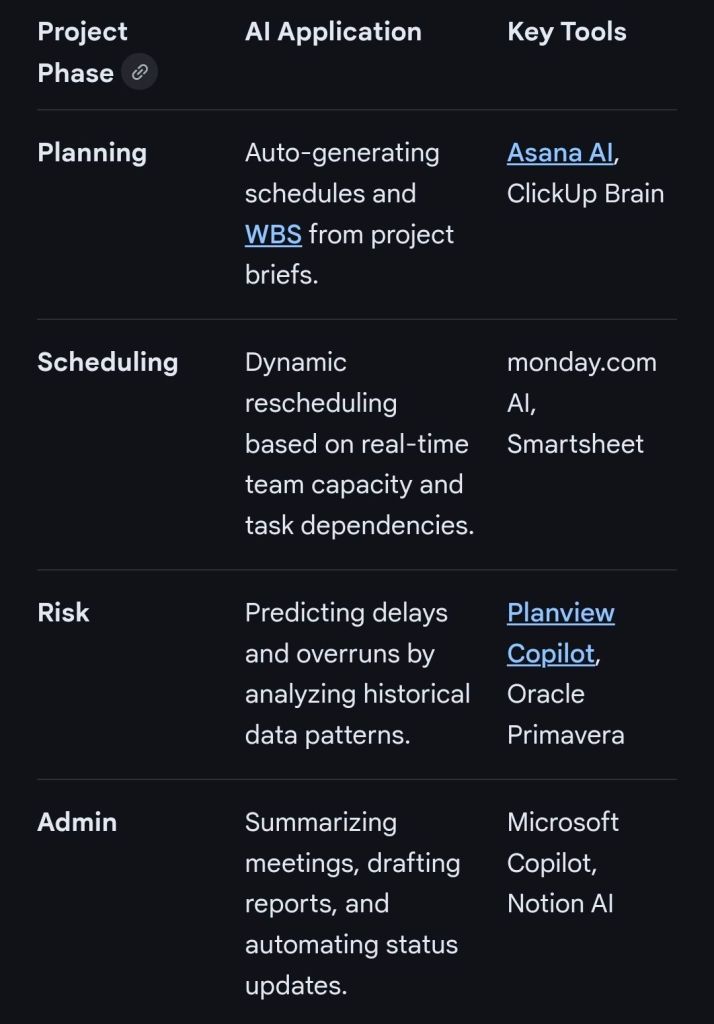
2. AI-Augmented Project Management (The “AI Copilot”)

For non-AI projects, AI acts as an intelligent assistant to automate administrative tasks and provide predictive insights. 

3. Implementation Strategy

Experts recommend a phased approach to integrating AI into management workflows: 

  1. Assess Inefficiencies: Identify repetitive tasks (e.g., status reporting) that can be automated first.
  2. Data Governance: Ensure project data is clean and centralized; AI is only as good as the data it consumes (“Garbage In, Garbage Out”).
  3. Human-in-the-Loop: Use AI for data-heavy lifting, but retain human judgment for high-stakes leadership, ethics, and stakeholder empathy.

AI Projects and Methodologies for Managing AI Projects

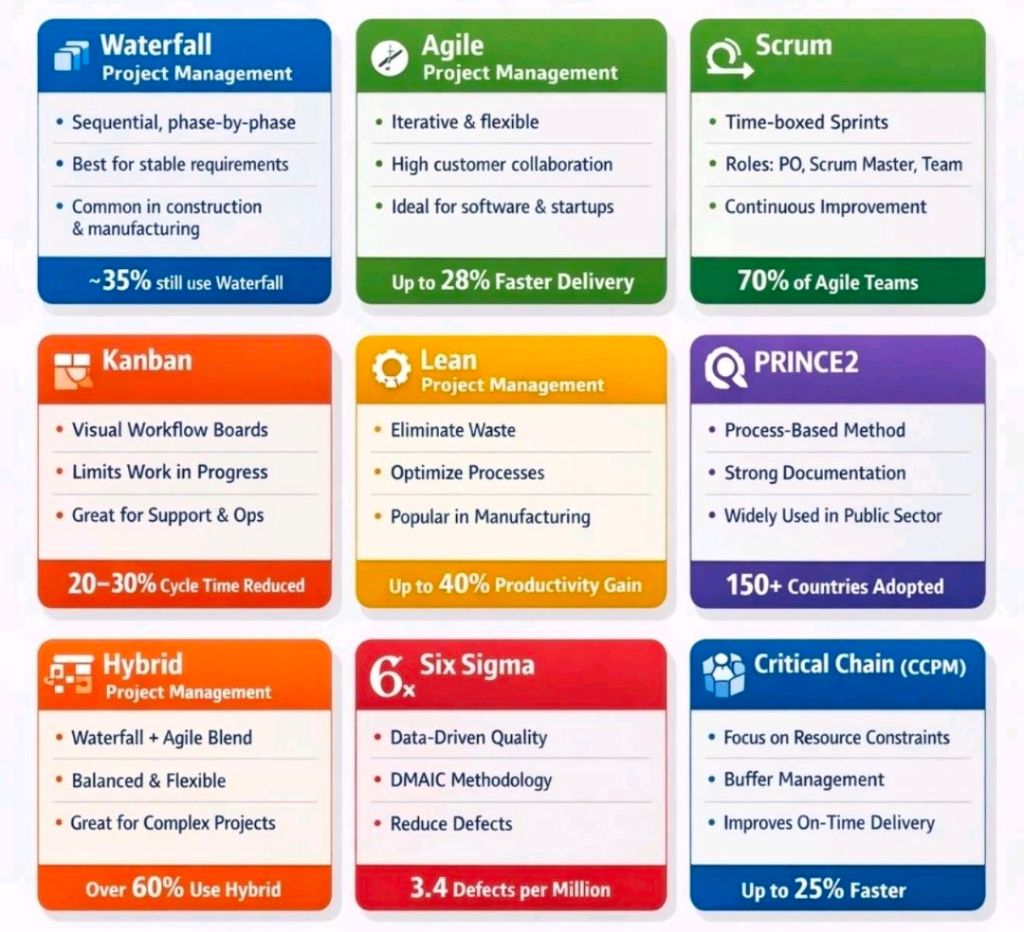
Project Management Types Summarised, Overview

Project Management Types Summarised, Overview

Project Management Methodologies – Waterfall, Agile, Scrum, Kanban, XP and Lean

Project Management Methodologies – Waterfall, Agile, Scrum, Kanban, XP and Lean

Project Management Methodologies

Project Management Methodologies

Types of Project Management Methodologies, Frameworks

Types of Project Management Methodologies, Frameworks

Methodologies in Project Management Delivery

Methodologies in Project Management Delivery

Guide to Agile Methodologies

Guide to Agile Methodologies

Project Management Group on LinkedIn

https://www.linkedin.com/groups/163300

Project Management Group on LinkedIn

Summary of PM Approaches