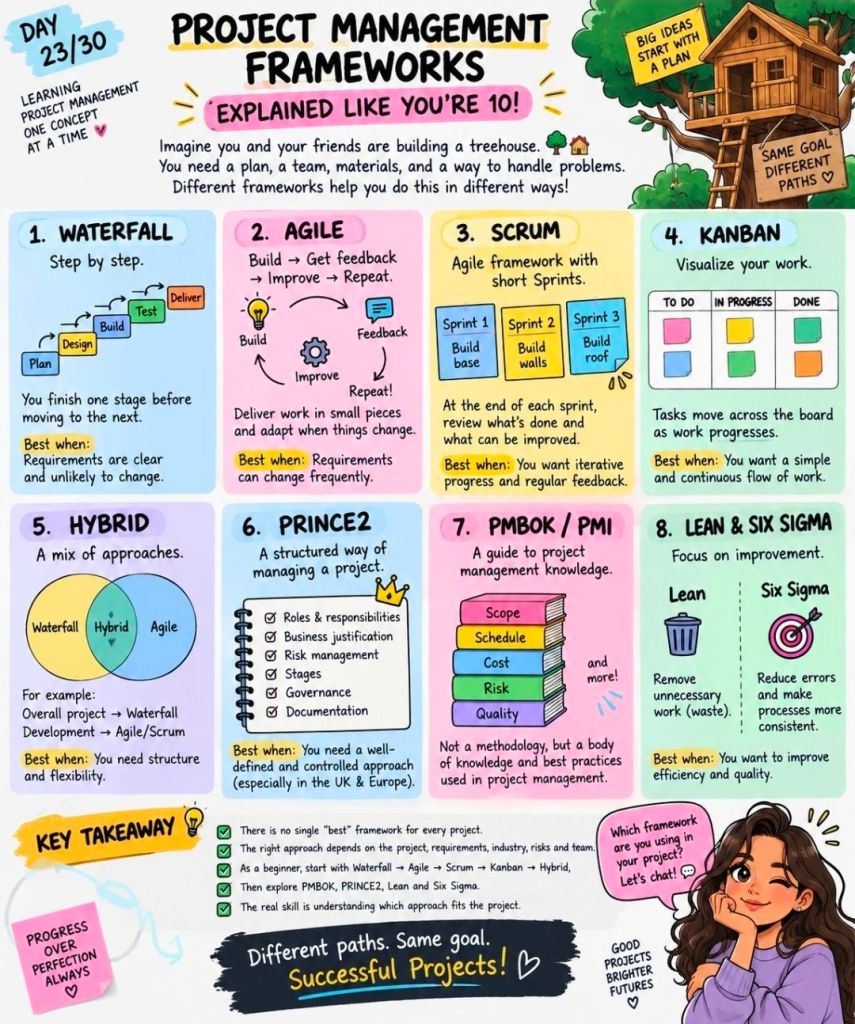
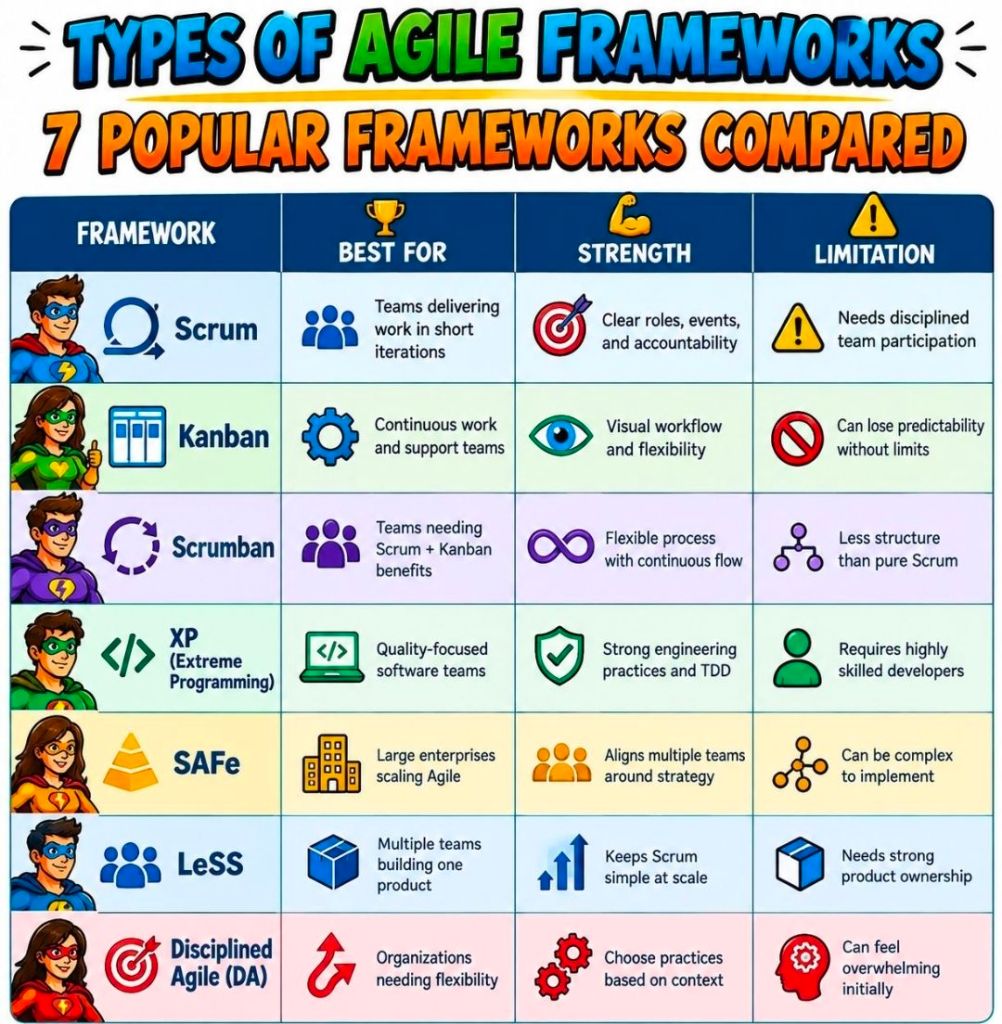
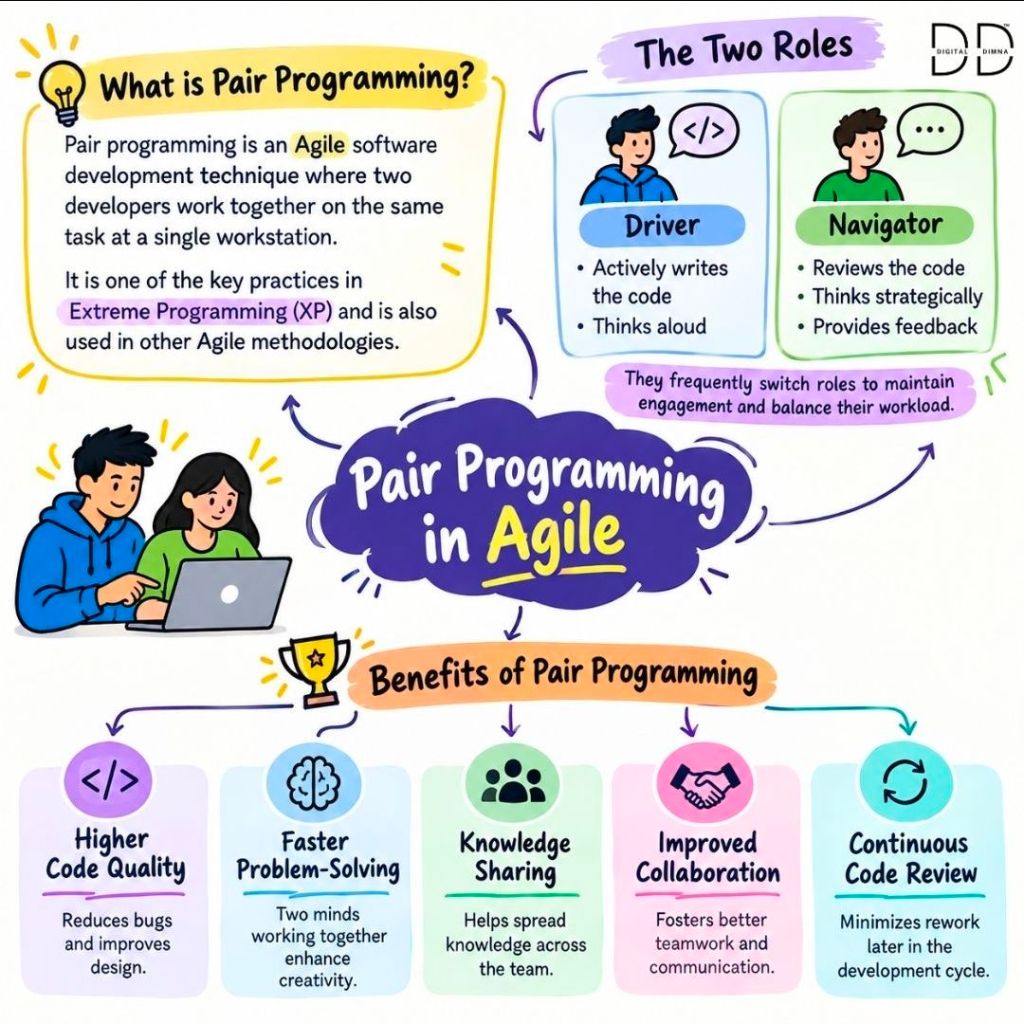
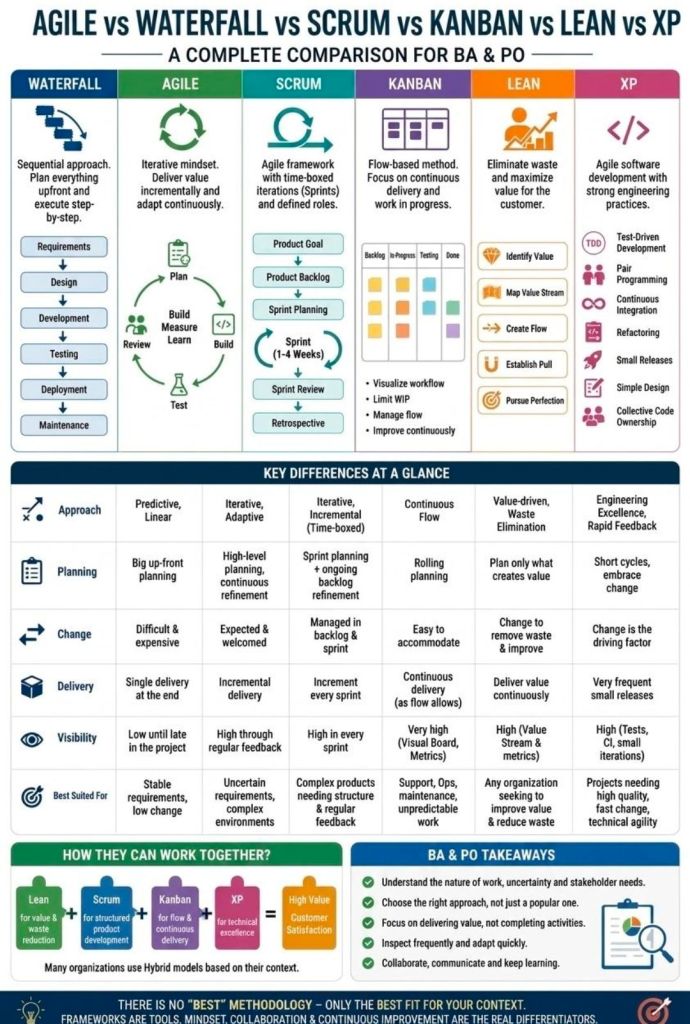
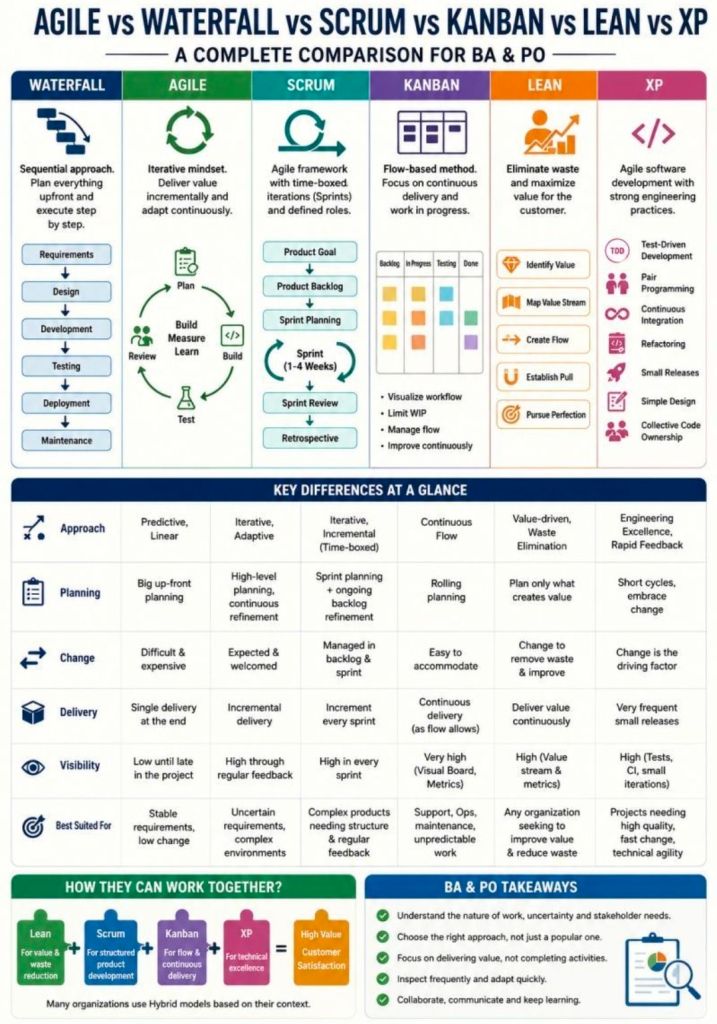
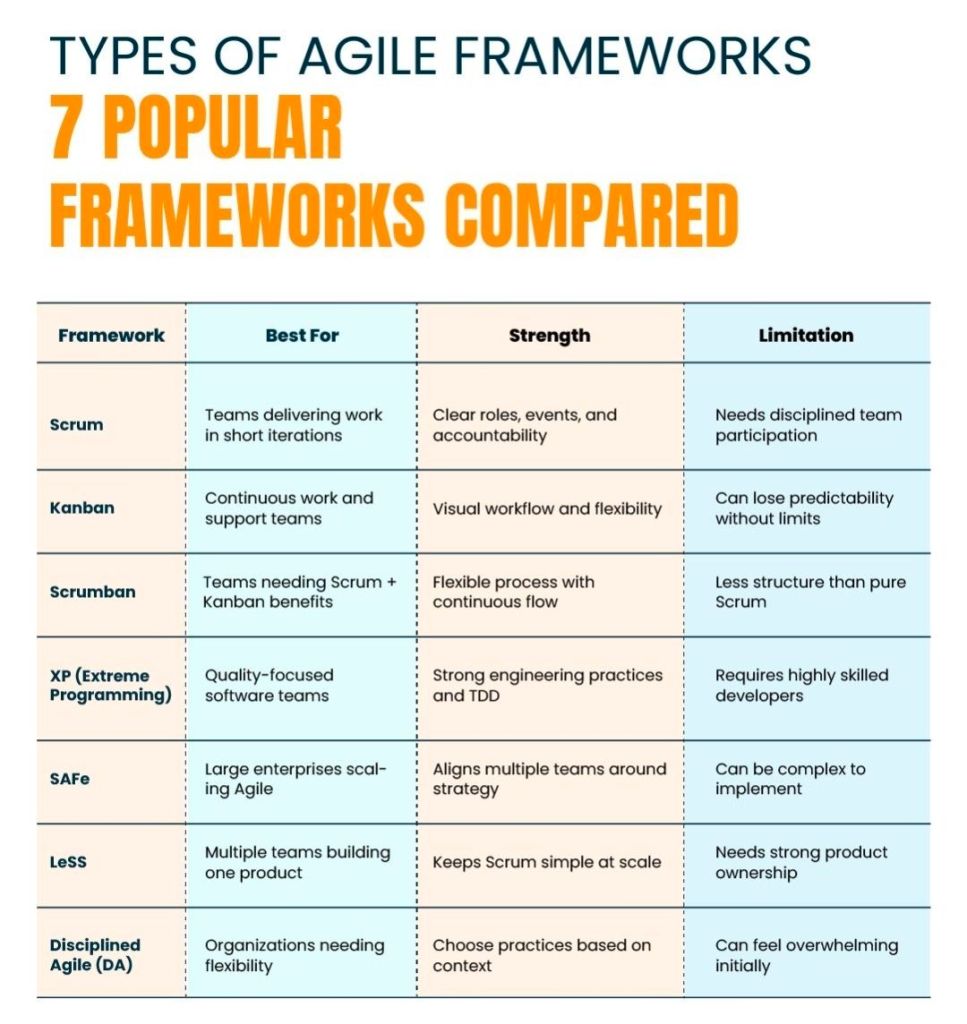
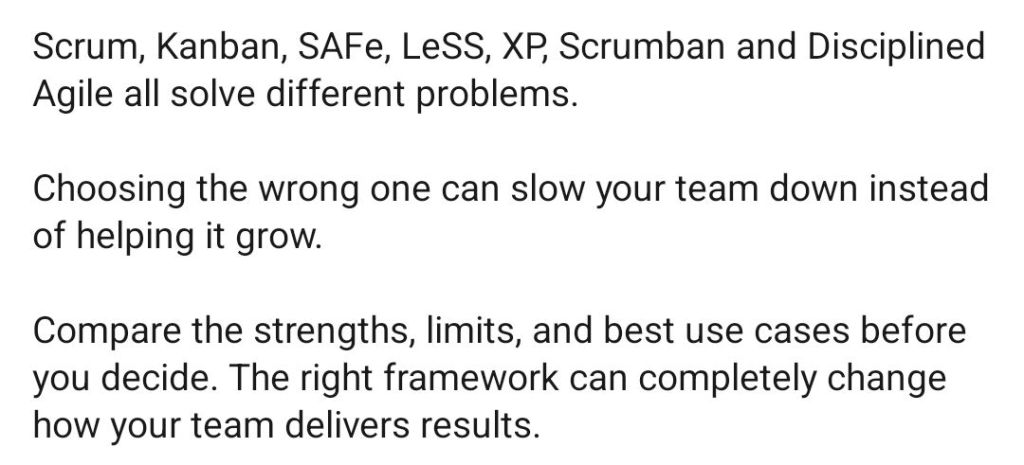
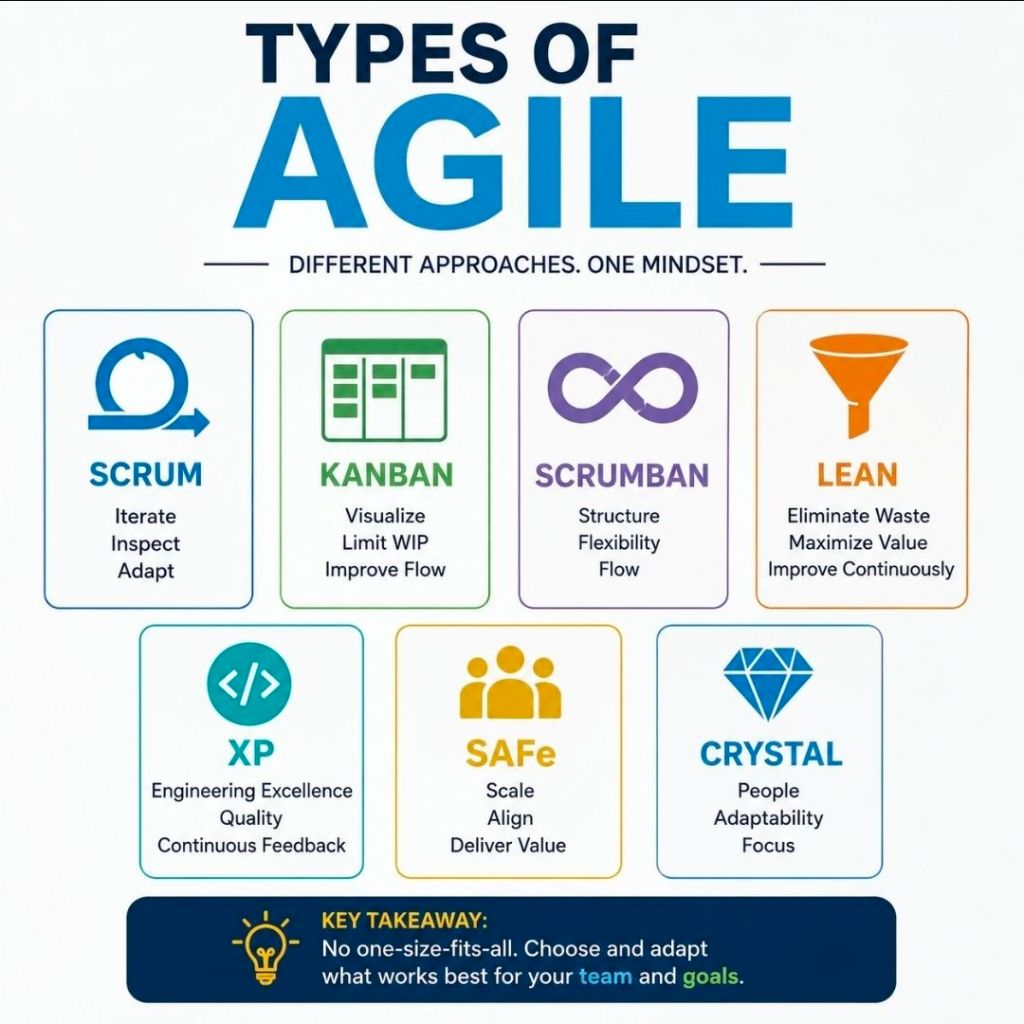
Frameworks compared


Agile delivery is an iterative approach to project management that focuses on delivering value early, frequently adapting to change, and maintaining continuous customer feedback. Rather than executing a project sequentially, teams break work into small increments to maximize flexibility and product quality.
The most common types and frameworks of agile delivery include the following structured methodologies:
1. Scrum
Scrum is the most widely used agile framework, characterized by highly structured, time-boxed iterations called Sprints (typically 1 to 4 weeks long).
2. Kanban
Kanban is a visual workflow management system that emphasizes continuous delivery and transparency without strict time-boxed iterations.
3. Lean Software Development
Adapted from Toyota’s lean manufacturing principles, Lean focuses on maximizing customer value while minimizing waste.
4. Extreme Programming (XP)
XP focuses heavily on technical excellence and software engineering practices to boost product quality and responsiveness.
5. Feature-Driven Development (FDD)
FDD is a model-driven approach that is highly structured and focuses on building software in short, feature-by-feature iterations.
6. Scaled Agile Framework (SAFe)
SAFe is designed for larger enterprises that need to align cross-functional, multiple Agile teams toward a single business strategy.
For further implementation details, you can refer to comprehensive resources like the Atlassian Agile Project Management Guide or the ICAgile Types of Agile Methodology Overview.
Agile project management is an iterative, adaptive approach that breaks projects down into small, manageable cycles called sprints or iterations. Instead of planning the entire project upfront, teams continuously deliver functional increments, gather immediate feedback, and adapt to changing requirements. It prioritizes team collaboration, customer involvement, and rapid value delivery over rigid documentation and sequential phases.
Comprehensive Timeline Breakdown by Era and Year
Era 1: The Foundational Seeds (1950s – 1980s)
Before “Agile” existed as a formal term, engineers and researchers laid the groundwork through lean manufacturing and early iterative computing.
Era 2: The “Lightweight” Revolt (1990s)
Driven by frustration over the high failure rates and slow delivery of Waterfall, software pioneers independently build faster, more flexible frameworks.
Era 3: The Manifesto Moment (2000 – 2001)
The pivotal pivot point where separate iterative movements unite into a single, cohesive global movement.
Era 4: Mainstream Adoption & Scaling (2002 – 2019)
Agile shifts from a rebellious IT trend into a standard corporate expectation, requiring frameworks that can scale across massive enterprises.
Era 5: Modern Continuous Agility (2020s – Present)
Agile transcends IT entirely, cementing its place as an overarching organizational strategy for business survival in an uncertain world.
Agile Projects Overview and Timeline by year


This is a detailed, comprehensive historical timeline of project management methodologies, tracing the evolution from ancient practices to modern adaptive frameworks.
I. Pre-Modern Era (Before 1900): Foundation of Task Coordination
II. Early Modern Era (1910s–1950s): The Scientific Management Era
This era brought “scientific management” to project control, focusing on efficiency and visualization.
III. The “Golden Age” of Project Management (1950s–1960s): Formal Methodologies
This era introduced mathematical models for managing complex, interdependent tasks.
IV. The “Silver Age” (1970s–1980s): Systems and Controls
V. Rebirth and Modern Era (1990s–2000s): Agile and Adaptive Methods
VI. The Contemporary Era (2010s–Present): Hybrid, AI, and Speed
Project Management Methodologies, historical timeline by era and year
Extreme Programming (XP) is a prominent, disciplined Agile software development framework designed to improve software quality and responsiveness to changing customer requirements. Developed by Kent Beck in the mid-1990s, it focuses on taking beneficial engineering practices—such as pair programming, testing, and continuous integration—to “extreme” levels.
Project Management Summary: Core XP Components
XP differs from other Agile methods by focusing intensely on technical engineering practices alongside project management techniques.
Detailed Historical Timeline of XP
Era 1: Origins and The Chrysler C3 Project (1993–1996)
Era 2: Formalization and “Embracing Change” (1997–2000)
Era 3: Rise of Agile and Expansion (2001–2005)
Era 4: Integration with DevOps and Continuous Delivery (2006–Present)
Extreme Programming XP project management summary and detailed historical timeline by era and year
Mark Whitfield provides a comprehensive suite of over 200 editable project management templates designed for both Agile and Waterfall delivery. These tools are built based on 21+ years of IT project delivery experience and are formatted for Microsoft Office (Excel, Word, PowerPoint) and Microsoft Project (MPP).

Core Planning & Tracking Templates

Financial & Resource Management
Reporting & Communication

Methodology Support
These templates are available for purchase on Mark Whitfield’s official site and typically include free lifetime upgrades.
Free Upgrade Project Management Templates Download by focus area
Mark Whitfield’s project management (PM) template collection is a comprehensive professional toolkit containing over 200 editable templates. Designed for both Agile Scrum and PRINCE2/Waterfall delivery, the set is built on over 24 years of real-world experience and is available for purchase on his official website and Etsy.


Core Planning & Tracking Templates
Methodology-Specific Artifacts
Reporting & Documentation
Key Features
Editable Project Management Templates for Agile and Waterfall projects


https://www.linkedin.com/groups/163300
Project Management Café, PRINCE2 Agile SCRUM Kanban MPP MSP Templates ITIL LEAN DevOps PMP Six Sigma
This is a Project Management Group Café for PM students, graduates and professionals looking to either locate, discuss or contribute ideas for PM templates for; Agile, Scrum, Kanban, PRINCE2 Waterfall projects, e.g. Plan on a Page (POaP), RACI, MPP, RAID logs, finance trackers, status reports, org charts etc. etc.
Project Management LinkedIn Group


Agile and Scrum have evolved from specific product development theories into a global standard for project management. While Scrum predates the Agile Manifesto by several years, it has become the most widely adopted framework within the Agile umbrella.


Evolution Timeline
Key Shifts in Scrum Maturity

Agile’s history is a transition from rigid, manufacturing-based “Waterfall” models to flexible, people-centric frameworks. While the term was coined in 2001, its roots trace back to early 20th-century industrial practices and the “software crisis” of the 1960s.
Early Foundations (Pre-1990s)
Before Agile became a formal software methodology, its core principles of efficiency and iteration emerged from manufacturing and early computing.
The Rise of “Lightweight” Methods (1990–2000)
Frustrated by Waterfall’s slow delivery, practitioners developed several “lightweight” frameworks.
Formalisation & Modern Evolution (2001–Present)
The movement unified under a single name and eventually scaled to entire enterprises.
Agile’s evolution is not just a 21st-century phenomenon but a response to decades of “software crises” and rigid industrial processes. Below is a comprehensive historical breakdown of Agile’s journey.
1. Pre-Digital Foundations (1910s – 1940s)
Long before software, the concepts of efficiency and waste reduction were born in manufacturing.
2. Early Iterative Development (1950s – 1970s)
The 1950s saw the first departures from strictly sequential “waterfall” planning.
3. The Proliferation of “Lightweight” Methods (1980s – 1990s)
Frustration with heavyweight, document-heavy processes led to several “Agile” precursors.
4. The Agile Manifesto & Formalisation (2001 – 2010)
Agile moved from a collection of “lightweight” methods to a global standard.
5. Scaling and Modern Business Agility (2011 – Present)
Agile expanded beyond coding into enterprise-wide strategy.

Microsoft PowerPoint was originally developed as “Presenter” by Forethought, Inc. in 1987 for the Apple Macintosh. Microsoft acquired it just three months later for $14 million, marking their first major acquisition.


Foundational Years (1984–1990)
Office Integration (1992–2003)


Modernization & Cloud (2007–Present)


Microsoft PowerPoint Development Timeline History


Microsoft Excel has evolved from a niche Apple Macintosh tool into the world’s most dominant spreadsheet software. Its history is marked by strategic shifts, such as jumping from the MS-DOS era to graphical interfaces to outmanoeuvre then-leader Lotus 1-2-3.
Timeline of Major Excel Milestones


Technological Evolution Highlights


Microsoft Excel Development Timeline History


Mark Whitfield’s project management templates offer a range of timeline and planning views designed for Agile, Waterfall, and PRINCE2 delivery. These templates typically include a high-level Plan on a Page (POaP) and detailed Microsoft Project (MPP) or Excel schedules.

Timeline & Planning Views
Key Timeline Components
The templates are pre-configured with several essential timeline elements:
You can find the full package of over 200 editable templates, which include these timeline views and RAID logs, on Mark Whitfield’s official website or via his Etsy store.
Project Management Templates Bundle FREE Upgrades


Gallery of ALL Project Management templates…
(also download the Template Inventory PDF file – 15MB)
Join the FREE PM templates related Facebook Group (LIKE Facebook page) and LinkedIn Group.


https://www.linkedin.com/groups/163300


https://www.eloquens.com/channel/mark-whitfield
https://officedocdepot.com/channel/i_pro_pm_templates/
https://flevy.com/author/ipropmtemplates
https://www.depop.com/products/nonstopmark-free-upgrades-4-life-50/
Buy Editable Project Program Management Template Examples, FREE upgrades and Additions


Plan on a Page POaP example templates 30+ in Microsoft PowerPoint PPT available at website link in banner…


https://www.etsy.com/uk/listing/995674478/free-upgrades-4-life-agile-waterfall
Available at Etsy or by clicking on the banner link at the top of the page.


Project Management Delivery Templates, FREE upgrades and additions