

Mark Whitfield, a UK-based, SC-cleared Senior IT Project Manager and Engagement Manager, has leveraged a diverse mix of Waterfall, PRINCE2, and Agile Scrum methodologies to drive complex client-facing software development lifecycles (SDLC) since graduating in 1990.
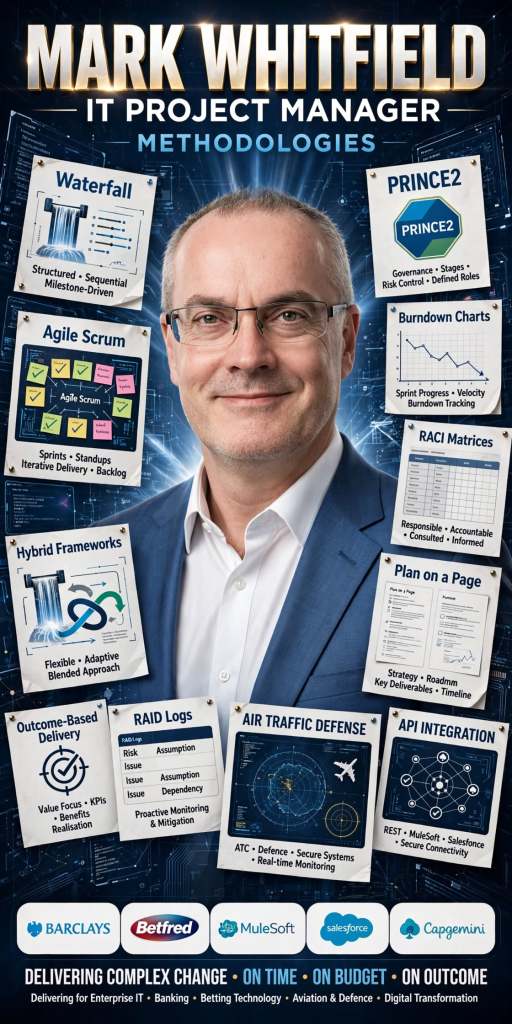
Over his three-decade career—which spans corporate transformations at Capgemini and technical delivery management at MuleSoft (a Salesforce company)—his project delivery framework transitioned from early rigid structures to highly flexible hybrid and agile delivery models.
📋 Overview of Delivery Methodologies Used
Whitfield’s career delivery history is divided into two primary methodology eras:
1. Predictive & Structured Waterfall Frameworks (1990–Mid-2000s)
- Early Iterative & Sequential Waterfall: In his early career (1990–1995) at The Software Partnership/Deluxe Data, Whitfield operated under strict sequential SDLC models to design and code core mainframe structures like the Barclays Business Master II project.
- PRINCE2 Structure: Transitioning into management roles at Insider Technologies (1995–2013), he utilized formal PRINCE2 methodologies to establish control, manage multi-phase budgets, and deploy ATM/POS transaction-monitoring systems across Europe and the Middle East.
2. Adaptive & Agile Delivery Frameworks (Mid-2000s–Present)
- Agile Scrum: Formally certified in Agile Scrum, Whitfield actively uses full Scrum ceremonies (Sprints, Standups, Demos, Retrospectives) to manage both onshore and offshore development teams. He successfully implemented this at Betfred for mobile/online gambling architectures and within air traffic defense initiatives.
- Hybrid Frameworks: Adept at transitioning teams smoothly from chaotic Waterfall workstreams into structured Agile workflows, often combining predictive higher-level metrics with agile engineering tracks.
- Outcome-Based Delivery (OBD): Utilised heavily during his tenure at MuleSoft to manage API-led connectivity frameworks, microservices integration, and enterprise client enablement with C4E. A MuleSoft Center for Enablement (C4E) is a cross-functional team that empowers an organization to build and share software assets, like APIs, faster. It replaces traditional gatekeeping IT teams with a self-service model. It speeds up projects, creates standard rules, and encourages teams to reuse existing code.
🛠️ Practical Application Toolsets
Rather than relying on purely theoretical practices, Whitfield operates with a customized Project Management Toolkit consisting of over 200 tailored artifacts engineered to enforce project governance. Key tracking items include:
- RAID Logs: Comprehensive tracking mechanism used across all customer portfolios to log Risks, Actions, Issues, and Dependencies.
- Plan on a Page (POaP): High-level visual timelines used for managing complex stakeholder expectations and milestone dependencies.
- Burndown & Burnup Charts: Deployed within Jira/Azure DevOps to track sprint velocity and delivery trajectories for tier-one global brands.
- RACI Matrices: Used to formally map team roles (Responsible, Accountable, Consulted, Informed) across multi-million-pound initiatives.

