Agile Projects Overview and Timeline by year

Agile project management is an iterative, adaptive approach that breaks projects down into small, manageable cycles called sprints or iterations. Instead of planning the entire project upfront, teams continuously deliver functional increments, gather immediate feedback, and adapt to changing requirements. It prioritizes team collaboration, customer involvement, and rapid value delivery over rigid documentation and sequential phases.


Comprehensive Timeline Breakdown by Era and Year

Era 1: The Foundational Seeds (1950s – 1980s)

Before “Agile” existed as a formal term, engineers and researchers laid the groundwork through lean manufacturing and early iterative computing.

  • 1957: IBM begins utilizing incremental development concepts under Gerald M. Weinberg.
  • 1958: Software for Project Mercury (NASA’s first human spaceflight program) is developed using rapid half-day iterations.
  • 1970: Dr Winston Royce publishes a paper describing the Waterfall methodology. Paradoxically, he presents it as high-risk, yet it becomes the dominant, rigid corporate framework for decades.
  • 1980: Toyota refines “Just-In-Time” logistics and visual management system concepts, which later directly inspire Kanban and Lean software practices.
  • 1986: Authors Hirotaka Takeuchi and Ikujiro Nonaka publish “The New New Product Development Game” in the Harvard Business Review. They introduce a holistic, “rugby-style” team approach, coining the term “Scrum”.
  • 1988: Dr Barry Boehm introduces the Spiral Model, formalizing risk-driven, iterative lifecycle planning.

Era 2: The “Lightweight” Revolt (1990s)

Driven by frustration over the high failure rates and slow delivery of Waterfall, software pioneers independently build faster, more flexible frameworks.

  • 1991: James Martin formalizes Rapid Application Development (RAD), highlighting timeboxing, prototyping, and active customer involvement.
  • 1993: Jeff Sutherland, John Scumniotales, and Jeff McKenna deploy the very first operational Scrum process at Easel Corporation.
  • 1994: The Dynamic Systems Development Method (DSDM) is launched in the UK, providing one of the earliest structured frameworks for iterative project delivery.
  • 1995: Ken Schwaber and Jeff Sutherland co-present the formal Scrum Framework to the public at the OOPSLA conference.
  • 1996: Kent Beck introduces Extreme Programming (XP), introducing core engineering mechanics like pair programming and test-driven development (TDD).
  • 1997: Jeff De Luca and Peter Coad design Feature-Driven Development (FDD) to focus strictly on client-valued functional results.

Era 3: The Manifesto Moment (2000 – 2001)

The pivotal pivot point where separate iterative movements unite into a single, cohesive global movement.

  • 2000: Pre-meeting alignment occurs. Martin Fowler publishes his definitive article on Continuous Integration (CI), and Extreme Programming teams begin adopting Scrum’s three-question daily standup format.
  • February 2001: The Agile Manifesto is Born. Seventeen software development pioneers meet at a ski resort in Snowbird, Utah. They discover common ground, author the Manifesto for Agile Software Development, and establish the 4 Core Values and 12 Principles.
  • Late 2001: The Agile Alliance non-profit is established to safeguard, evolve, and distribute Agile education globally.

Era 4: Mainstream Adoption & Scaling (2002 – 2019)

Agile shifts from a rebellious IT trend into a standard corporate expectation, requiring frameworks that can scale across massive enterprises.

  • 2002: Ken Schwaber co-founds the Scrum Alliance to offer standardized certifications (like Certified ScrumMaster), dramatically accelerating global adoption.
  • 2003: Mary and Tom Poppendieck publish Lean Software Development, cleanly mapping Toyota’s manufacturing efficiencies directly onto digital projects.
  • 2009: The Software Craftsmanship Manifesto is created to ensure technical excellence and code quality are not forgotten during rapid business sprints.
  • 2011: Dean Leffingwell releases the Scaled Agile Framework (SAFe), allowing massive corporate enterprises to align hundreds of agile teams across entire portfolios.
  • 2015: Global project management authorities officially pivot; AXELOS releases PRINCE2 Agile, and the Project Management Institute (PMI) introduces Agile certifications into its core curriculum.

Era 5: Modern Continuous Agility (2020s – Present)

Agile transcends IT entirely, cementing its place as an overarching organizational strategy for business survival in an uncertain world.

  • 2020: The Scrum Guide receives its most significant structural update, streamlining language, eliminating prescriptive micro-management, and focusing intensely on a single, unified team working toward a singular “Product Goal”.
  • 2021–2023: Business Agility explodes. Non-technical departments—including HR, Marketing, Legal, and Finance—broadly restructure their workflows into iterative agile backlogs to manage volatile hybrid work environments.
  • 2024–Present: AI-Driven Agility becomes standard practice. Project management tools use generative AI to automatically draft user stories, estimate team velocity, and dynamically rewrite project sprint backlogs based on real-time market shifts.

Agile Projects Overview and Timeline by year
HPE NonStop Inspect debugger Overview and timeline by year

HPE NonStop Inspect is the primary symbolic, source-level debugger for applications running on the HPE NonStop (formerly Tandem) operating system. It allows developers to interactively control program execution, examine and change data variables, and debug complex multi-process applications in both the Guardian and Open System Services (OSS) environments. 

Program Summary

The Inspect debugger family facilitates high-availability software development through several specialized versions: 

  • Inspect (Legacy): A command-line tool for TNS, TNS/R, and TNS/E systems.
  • Native Inspect (eInspect/xInspect): Adapted from GDB for Itanium and x86 architectures; it provides a command-line interface with scripting capabilities.
  • Visual Inspect: A Windows-hosted GUI debugger that provides “point-and-click” efficiency for setting breakpoints and displaying variables.
  • NSDEE (Eclipse): Modern debugging integrated into the Eclipse-based development environment, supporting NonStop Application, Attach Process, and Snapshot debug configurations. 

Historic Timeline by Era

The evolution of the NonStop debugger mirrors the platform’s hardware transitions over five decades.

The Tandem Era (1974 – 1997) 

  • 1974: Tandem Computers is founded; the platform begins with T/16 (NonStop I).
  • 1980s: Inspect is introduced as the standard interactive debugger for the TNS (Tandem Network Strategy) CISC architecture.
  • Early 1990s: Migration to MIPS-based TNS/R systems; Inspect is updated to support RISC instruction sets and optimized compilers. 

The Compaq & Early HP Era (1997 – 2014)

  • 1997: Compaq acquires Tandem.
  • 2002: HP acquires Compaq; migration to TNS/E (Intel Itanium) architecture begins.
  • 2005 – 2010: Visual Inspect becomes a staple for developers seeking a GUI experience on Windows.
  • 2013: Release of the Inspect H01 Manual, documenting full support for TNS/R and TNS/E concurrent debugging. 

The Modern HPE Era (2014 – Present)

  • 2014: Introduction of NonStop X (x86-64 architecture). Native Inspect (xInspect) is launched, based on GDB, to support the move away from Itanium.
  • 2015: HPE is formed; focus shifts to the NonStop Development Environment for Eclipse (NSDEE).
  • 2020 – 2024: Enhancements in NSDEE include improved OSS process handling and support for large-scale application debugging.
  • 2025: HPE celebrates 50 years of NonStop; updates to the OS introduce greater development and debugging flexibility for named processes on NS5 X5 and NS9 X5 platforms

Future Outlook

HPE’s roadmap for NonStop focuses on modernisation through tradition, ensuring that legacy tools like Inspect remain compatible while transitioning to cloud-native and virtualized environments. 

  • Virtualized NonStop (vNS): Debugging tools are being adapted to work seamlessly within enterprise private clouds and HPE GreenLake consumption models.
  • AI Integration: Future enhancements likely include AI-driven diagnostics and automation within the debugger infrastructure to manage the complexity of modern REST/JSON API gateways and Kafka messaging buses.

HPE NonStop Inspect debugger Overview and timeline by year

PRINCE2 (PRojects IN Controlled Environments) Overview and Timeline by Year

PRINCE2 (PRojects IN Controlled Environments) is a structured, process-based project management methodology focusing on organization, control, and business justification. Originating from UK government IT standards in the 1970s, it has evolved into a globally recognized, tailorable standard used in over 150 countries for projects across various industries. 

PRINCE2 Project Management Summary

  • Core Philosophy: Continued Business Justification (projects must make sense financially), Manage by Exception (delegating authority within limits), and Product-Based Planning.
  • Seven Principles: Projects must have continued business justification, learn from experience, define roles and responsibilities, manage by stages, manage by exception, focus on products, and tailor to suit the project.
  • Seven Processes: Starting a Project, Directing a Project, Initiating a Project, Controlling a Stage, Managing Product Delivery, Managing a Stage Boundary, and Closing a Project.
  • Key Themes: Business Case, Organization, Quality, Plans, Risk, Change, and Progress.
  • Main Benefits: Provides a common language, clear accountability, defined roles, and tailored, consistent documentation. 

Detailed Historical Timeline (1975–2023+)

Era 1: The PROMPT Origins (1975–1988) 

  • 1975: Simpact Systems Ltd develops PROMPT (Project Resource Organisation Management and Planning Techniques) in response to IT projects running over time and budget. PROMPT II introduces a phased approach (Initiation, Specification, Design, Development, Installation, Operation). 

Era 2: The PRINCE Birth (1989–1995)

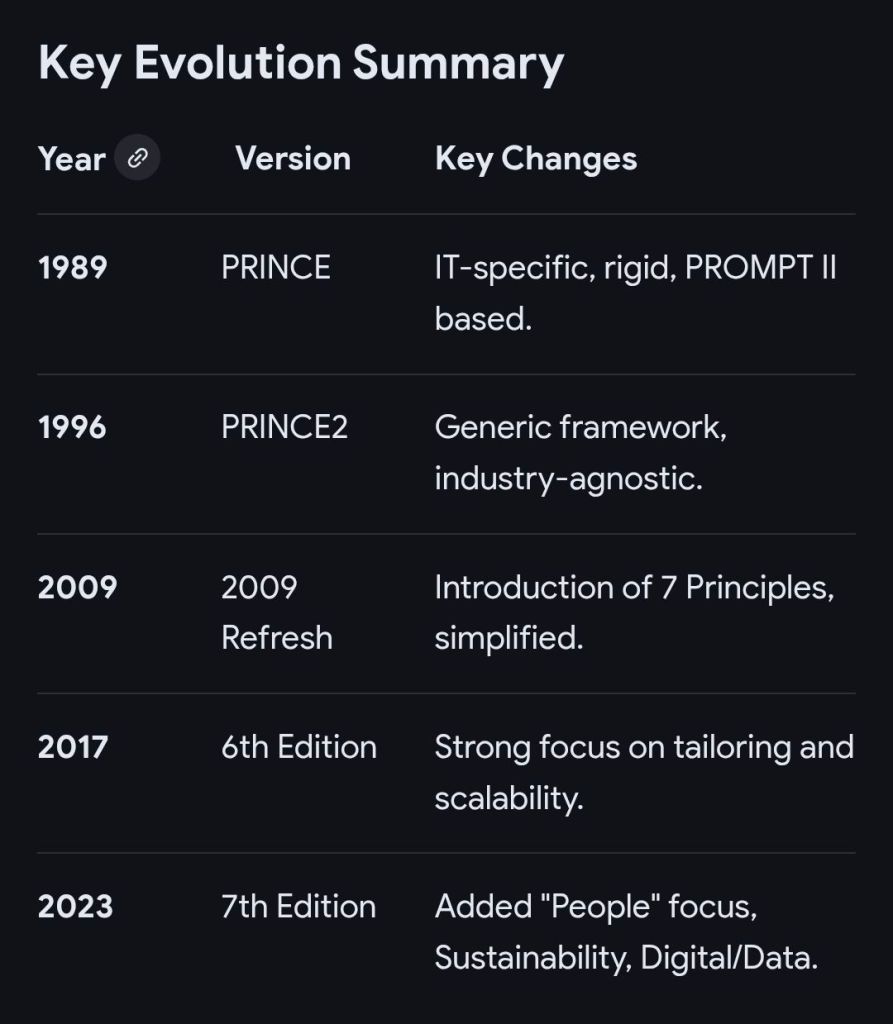
  • April 1989: The UK Central Computer and Telecommunications Agency (CCTA) adopts PROMPT II as the standard for IT projects, renaming it PRINCE (initially “PROMPT II IN the CCTA Environment”).
  • 1990: PRINCE is released into the public domain and widely adopted by the private sector for non-IT projects, although it is perceived as too rigid for small projects. 

Era 3: The Birth of PRINCE2 (1996–2008) 

  • 1996: PRINCE2 is published by the CCTA. It is rewritten for broader use (not just IT), removing jargon to become a generic project management framework.
  • 1998: PRINCE2 begins undergoing revisions based on user feedback.
  • 2000: The Office of Government Commerce (OGC) becomes the owner of PRINCE2.
  • 2002: The international user community begins consultative updates to the method. 

Era 4: The Modern Revision Era (2009–2022) 

  • 2009: PRINCE2: 2009 Refresh is released by the OGC. This major revision simplifies the method, makes it more customizable, and introduces the seven core principles.
  • 2013: Ownership transfers from the UK Cabinet Office to AXELOS Ltd, a joint venture between the UK Government and Capita.
  • 2017: PRINCE2 2017 Update is published, focusing on increased flexibility, scalability, and better tailoring guidance.
  • 2018: PRINCE2 Agile is launched, bringing a governance layer to agile delivery methods like Scrum and Kanban.
  • 2020: PRINCE2 2017 is renamed “PRINCE2 6th Edition”.
  • 2021: PeopleCert becomes the sole owner of AXELOS and PRINCE2. 

Era 5: The Current Era (2023–Present) 

  • September 2023: PRINCE2 7th Edition is released. The update introduces a “People” element, focusing on change management and team leadership, along with new guidance on Sustainability, Commercial, and Digital & Data management. 
PRINCE2 Key Evolution Summary
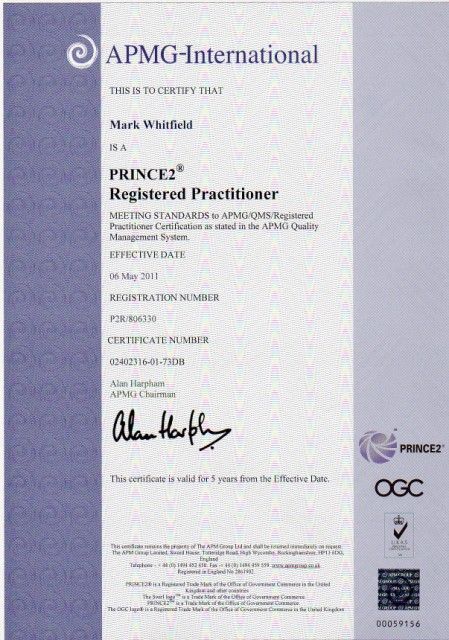
May 2011 – Registered PRINCE2 Practitioner with ILX, Mark Whitfield

PRINCE2 (PRojects IN Controlled Environments) Overview and Timeline by Year

RTLX by Insider Technologies, Overview and Timeline by Year

Insider Technologies RTLX (now C-Deep (Transaction Monitoring) https://etinet.com/products/c-deep-transaction-monitoring/ ) is a real-time monitoring and tracking solution designed to provide end-to-end visibility for high-volume electronic payments and transactional processes. It specifically ensures that every stage of a payment—from the initial card “tap” at a point-of-sale (POS) terminal to the final movement of funds from an account—is monitored to maintain operational continuity. 

RTLX Overview

  • Function: Real-time transaction and payment monitoring.
  • Platforms: Runs on HP NonStop, Windows, Linux, and Unix.
  • Core Value: Simplifies “Big Data” for IT operations by alerting teams to potential failures before they impact consumers (e.g., preventing ATM or online banking outages).
  • Key Use Case: Used by major financial institutions like the Bank of England and Royal Bank of Scotland for settlement and transaction security. 

RTLX Historical Timeline

The development of RTLX is closely tied to Insider Technologies’ growth as a specialist in mission-critical HP NonStop environments. 

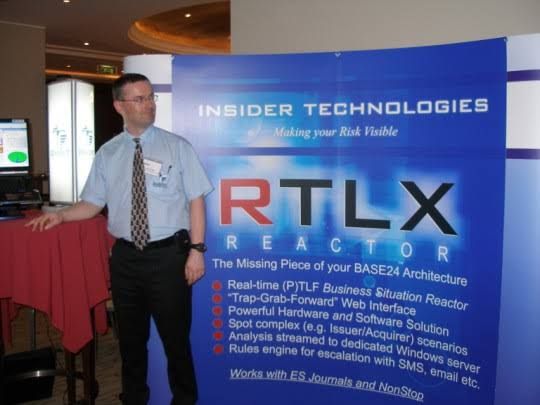
EBUG Conference, Mark Whitfield – Product Manager

The Foundational Era (1989–2000)

  • 1989Insider Technologies Limited is founded in Manchester, UK, by IT industry veterans.
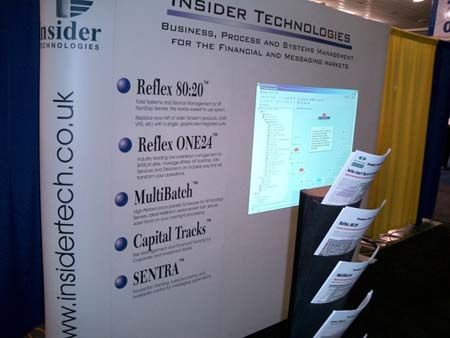
  • 1990s: The company establishes its “DNA” in the HP NonStop (Tandem) platform, developing core products like MultiBatch and Reflex.
  • 1995: Insider begins a period of rapid growth, providing technical support for critical UK financial infrastructure, including Euroclear (formerly CRESTCo), which settles 88% of UK equities. 

The Expansion Era (2001–2014)

  • 2002: Launch of the state-of-the-art Systems Training Platform, featuring 4x patented cloning technology for hyper-realistic simulations.
  • 2004–2013: Development of the Reflex suite (Reflex 80:20 and Reflex ONE24) and the introduction of Sentra and RTLX Reactor monitoring products.
  • 2014: Insider expands its product initiatives to include diagnostic and trending solutions for real-time electronic payments, solidifying the role of RTLX in global banking. 

The Acquisition & Integration Era (2015–Present)

  • 2015ETI-NET acquires Insider Technologies on 1 July, integrating its monitoring expertise with ETI-NET’s mainframe storage and backup solutions.
  • 2019: Insider celebrates its 30th year of operations, highlighting RTLX’s role in monitoring modern POS and “tap” payment systems.
  • 2023–Present: Insider becomes part of the PartnerOne group, a global family of mission-critical software companies, further scaling its threat detection and real-time monitoring capabilities. 

RTLX by Insider Technologies, Overview and Timeline by Year

Critical Path Method CPM Overview and Timeline by year

The Critical Path Method (CPM) is a mathematical algorithm used for scheduling a set of project activities. It identifies the longest sequence of dependent tasks required to complete a project, which in turn determines the shortest possible duration to finish it. 

Timeline of the Critical Path Method

The evolution of CPM is categorised into four primary eras, moving from manual mathematical foundations to modern AI-driven automation. 

1. Pre-Formalisation Era (1940s – Early 1950s) 

  • 1940–1943: DuPont develops precursor techniques for scheduling that are applied to the Manhattan Project.
  • Early 1950s: Growing complexity in industrial plants leads to “scheduling crises,” where traditional Gantt charts are no longer sufficient for managing thousands of interdependent tasks. 

2. The Development & Mainframe Era (1956 – 1969)

  • 1956: Morgan R. Walker of DuPont and James E. Kelley Jr. of Remington Rand begin collaborative research to improve plant maintenance scheduling.
  • 1957–1958: The duo formalises the Critical Path Method (CPM).
  • 1958: The U.S. Navy and Booz Allen Hamilton develop the Program Evaluation and Review Technique (PERT) for the Polaris missile program; it is from this project that the term “critical path” is actually coined.
  • 1959: The first computer-based CPM is implemented on a UNIVAC mainframe, allowing DuPont to reduce plant maintenance downtime from 125 to 78 hours.
  • 1966: CPM is used for the first time in a massive skyscraper project for the construction of the World Trade Center Twin Towers in New York City. 

3. The PC Revolution & Methodology Expansion (1970s – 1999) 

  • 1970s: Dedicated project management software companies like Oracle (then Software Development Laboratories) begin to emerge.
  • 1984: Eliyahu M. Goldratt introduces the Theory of Constraints (TOC), which later influences the development of the Critical Chain.
  • 1980s: The advent of the Personal Computer (PC) makes CPM accessible to smaller companies, moving it away from expensive, bulky mainframes.
  • 1997: Eliyahu M. Goldratt introduces Critical Chain Project Management (CCPM), a more sophisticated evolution of CPM that accounts for resource constraints and buffers. 

4. Modern Era: Digital Integration & AI (2000 – Present) 

  • 2000s–2010s: CPM becomes a standard feature in cloud-based tools like AsanaWrike, and Microsoft Project, allowing for real-time schedule updates.
  • 2020: The COVID-19 pandemic accelerates the adoption of virtual project management tools, where CPM is used to manage remote, globally distributed teams.
  • 2025–Present: Artificial Intelligence is increasingly used to predict risks and automatically calculate “crashing” scenarios (reducing task duration to shorten the overall project) based on historical data.
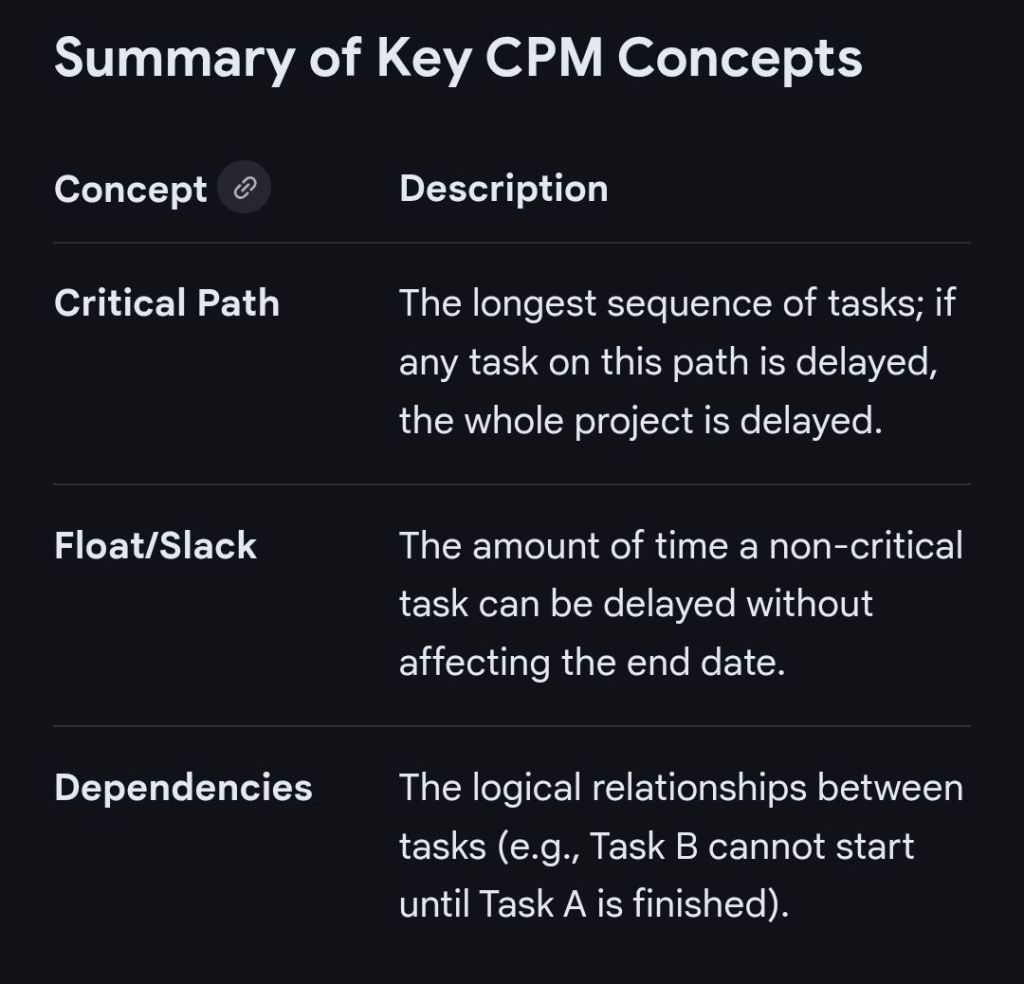
Summary of Key CPM Concepts

Critical Path Method CPM Overview and Timeline by year