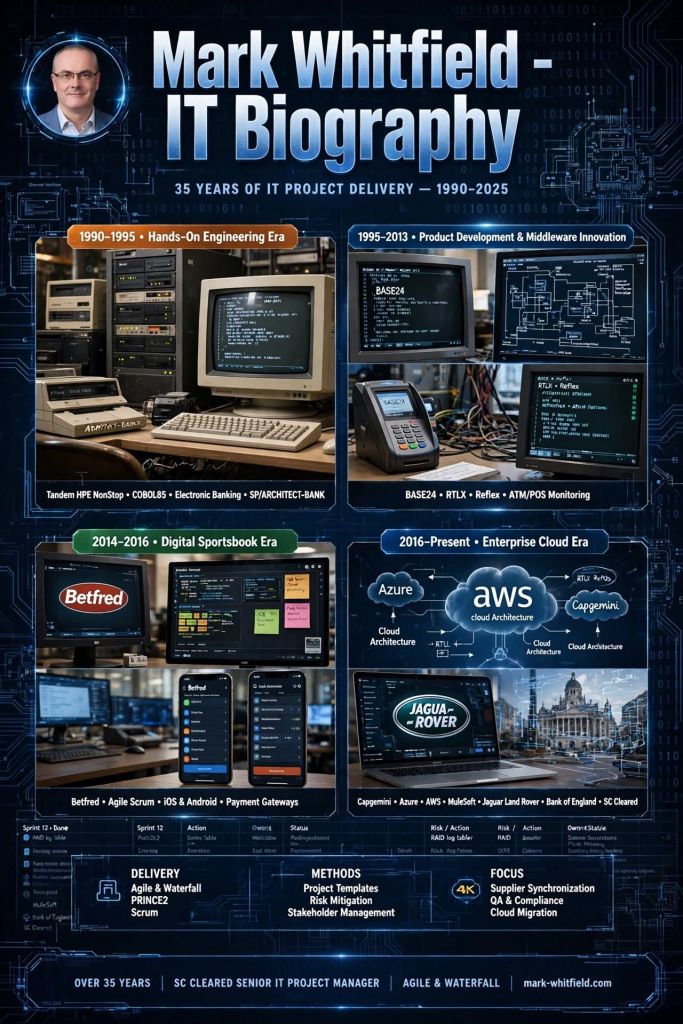
Mark Whitfield is a UK-based, SC-cleared Senior IT Project Manager, Engagement Manager (Capgemini), and technology executive with over 35 years of hands-on and leadership experience across the Software Development Lifecycle (SDLC).
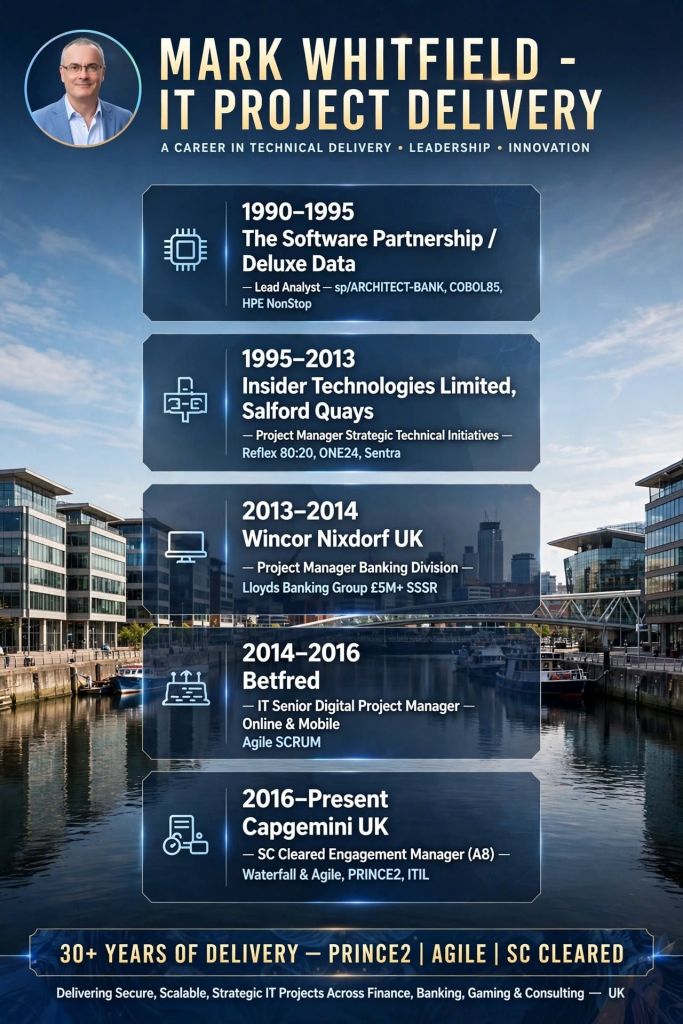
Mark Whitfield, High-Level Career Summary from 1990 thru 2026
Specialising in complex digital transformation, hybrid cloud migrations, and API-led system integrations, Mark graduated with an HND (Distinction) in Computing in 1990 and has delivered major enterprise solutions for clients such as Barclays Bank, Jaguar Land Rover (JLR), Royal Mail Group (RMG), Lloyds Banking Group, and the Bank of England. He is also the author of the PROject Templates resource platform, which provides project management toolkits.
Mark Whitfield | Career Summary Timeline from Mainframes to Cloud
The following comprehensive biography and career timeline breakdown details his professional trajectory by era.
Phase 1: Early Programming & Lead Analysis Era
Era Focus: Electronic banking software development, establishing foundational desktop access to company accounts.
Deluxe Data International, Wingate House, Northway, Runcorn
Main Focus Items: Core software design, coding, and back-end integration for electronic desktop banking.
Project Outputs: Software design, coding, and back-end integration for electronic desktop banking. Developed batch billing suite modules (NonStop SQL embedded COBOL85) to attach to the BBM II application, in Poole, Dorset (1993).
Milestones: Transitioned banking from purely paper-based to electronic systems. Made early remote banking a reality.
Methodology: Early iterative development & structured Waterfall lifecycles.
Highlights: Helped in the design and development of the Barclays Business Master II application while on-site in Knutsford, and later successfully developed and deployed a batch-billing suite for the bank in Poole, Dorset (1993).
Political Landscape: Early post-deregulation European banking markets. The Single European Act drove a need for cross-border electronic financial transparency and transaction systems.
Technology Landscape: Desktop PCs were novel; banking was driven by mainframe computing, specifically Tandem NonStop systems (now HPE NonStop).
Phase 2: Technical Consultancy & Product Management Era
Era Focus: Transitioning to product management, system and transaction monitoring, and SLA monitoring for critical-path financial hardware/ software.
Insider Technologies Limited, Salford Quays, Greater Manchester (UK)
Locations: Salford Quays, UK (head office); London, UK; International client sites
Clients included: Global Payments, Standard Chartered, Girofon, Rabobank, CRESTCo (Euroclear), Alrajhi Bank, LloydsTSB, HSBC, Santander, Bank of Ireland, Bank of Valletta (Malta) and both Commercial and Piraeus Bank (Greece)
Budget: Internal operational budgets and R&D capital expenditure
Main Focus Items: Infrastructure consulting, volume testing, system management & monitoring, and Service Level Agreement (SLA) monitoring for critical path payment applications. Attending related conferences, EBUG, ITUG, BITUG, SATUG
Project Outputs: Developed platform health and diagnostic modules for the Reflex monitoring product. Successfully delivered BASE24 ATM/ POS/ transaction Cross-border monitoring.
Milestones: Achieved the first HP OpenView Operations Enterprise Manager 2-way Smart Plug-In (SPI) certification for HPE NonStop in 2002.
Highlights:Consultant for CRESTCo in 1997, producing volume testing/benchmark software to test Stock Settlement applications on the newly introduced S7000 HPE NonStop systems.
Political Landscape: The late 1990s and 2000s saw the creation of the Eurozone, demanding high-capacity regional clearing and settlement networks that required robust transaction monitoring.
Technology Landscape: Market expansion of ATM and Point-of-Sale (POS) devices; ACI BASE24 Classic payments; move toward centralized, multi-platform GUI monitoring.
Also: Designer and author of a new company website using an Open Content Management framework identified as part of a Research phase. Authored a major technical summary published globally in the recognized HPE NonStop industry journal, The Connection, defining payment software lifecycles.
Phase 3: Professional Services Banking Delivery
Era Focus: IT Project Management and delivery of legacy migrations to primary UK high-street banks.
Project Outputs: Managed the Wincor Nixdorf workstream for Lloyds Banking Group’s Self-Service Software Replacement (SSSR) programme. Modernising legacy ATM software and directing hardware/ software transitions. Implementing ProClassic/Enterprise and PC/E SmartClient (Win 7) to replace the existing ProCash/NDC (Win XP) Stacks on a variety of multivendor devices.
Milestones: Transferred ATM driving responsibility away from BASE24 Classic on HPE NonStop to Wincor’s PC/E product on the AIX platform. Managed international rollout and off-shore resources.
IT Training: Agile, ITIL methodologies.
Methodology: Wincor project management methodology, with regard to planning, control, status reporting, documentation, quality, change control, risk analysis and management.
Highlights: Successfully upgraded LBG ATM hardware estate from Windows XP to Windows 7.
Political Landscape: Post-2008 financial crisis regulations brought stricter compliance and operational risk rules, accelerating the modernisation of core legacy banking systems to prevent service outages.
Technology Landscape: Transition from proprietary mainframe terminal driving to AIX, Oracle, and Windows-based banking environments.
Technology Areas: Multi-vendor hardware & software integration for ATMs.
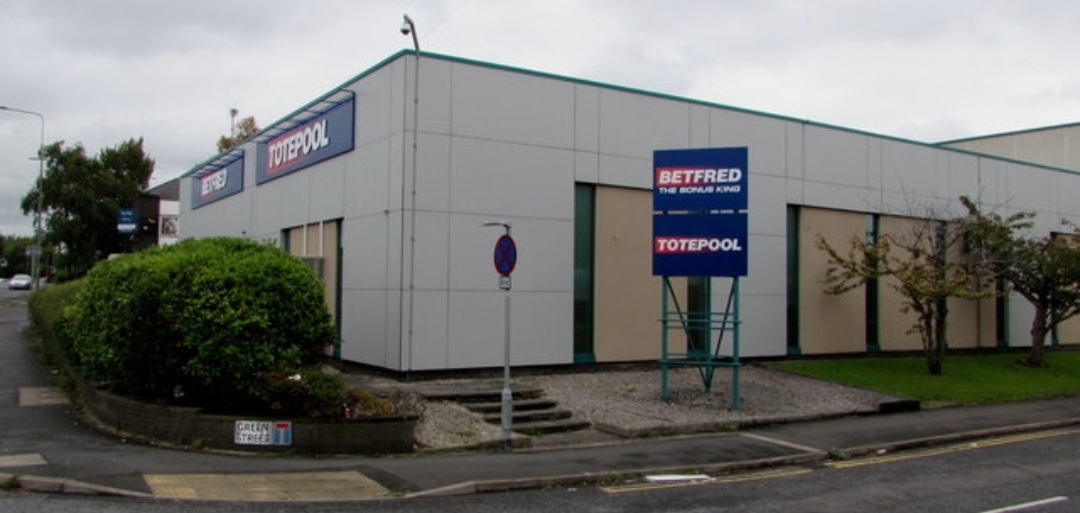
Supplier Management: for external software suppliers like Degree53, Playtech, Onionsack, Intelligent Payments (Myriad), Inspired, iovation, StreamUK, Finsoft, Ineda, OtherLevels, Appsflyer, Income Access, Activewin, Virgo, Virtue Fusion, In Game Media, Satellite Information Services (SIS) and IGT
Budget: Managed multiple project budgets for Betfred apps, tracking via weekly effort burn rates
Programming Methodologies: Agile SCRUM in conjunction with Degree53
IT Products: iOS, Android, and Windows native apps, Football/ Horse Racing Sportsbook platforms
Main Focus Items: Taking new sports and virtual gaming components live, integrating payment gateways, managing app release cycles, and handling regulatory compliance.
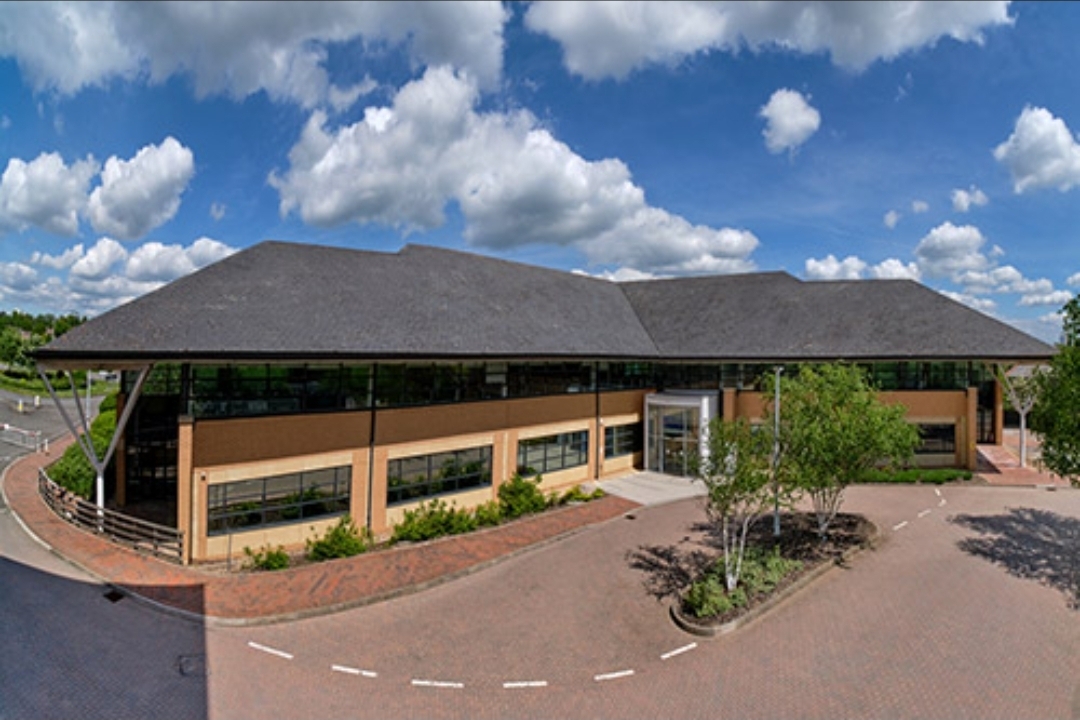
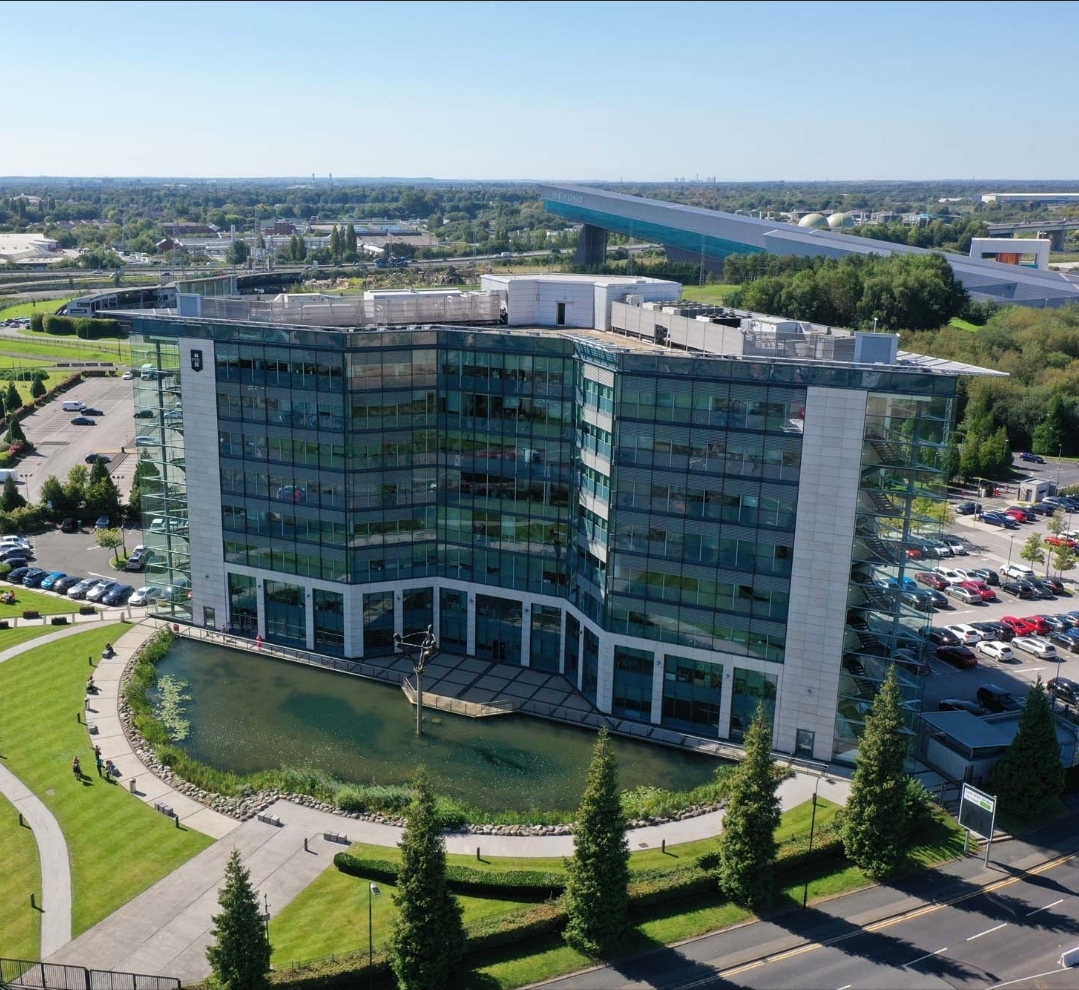
Locations: Manchester (local office above), London, Birmingham, UK
Clients included: Jaguar Land Rover (JLR), Heathrow Airport, Royal Mail Group (RMG), National Air Traffic Services (NATS), UK Export Finance (UKEF), Welsh Water
Budget: Managed multi-million pound digital transformation and cloud refactoring contracts
Highlights: Maintained full SC Clearance. Authored and managed comprehensive Project Governance Plans (PGPs) to realize project targets, streamline margins, and successfully navigate complex off-shore delivery models.
Political Landscape: The government focus on “Digital by Default” for public services, coupled with significant public and corporate drives for green IT and cloud adoption to optimize operating costs.
Mark Whitfield is a UK-based, SC-cleared Senior IT Project Manager and Engagement Manager whose career spans over three decades of evolution within the software development lifecycle (SDLC) and project delivery areas.
Mark Whitfield | SC-cleared Senior IT Project Manager and Engagement Manager
Graduating with a Distinction level Higher National Diploma (HND) in Computing from the University of Bolton (formerly the Bolton Institute of Higher Education, BIHE), his professional journey documents a foundational shift from hands-on mainframe engineering to managing enterprise-scale cloud migrations and API-led integration ecosystems.
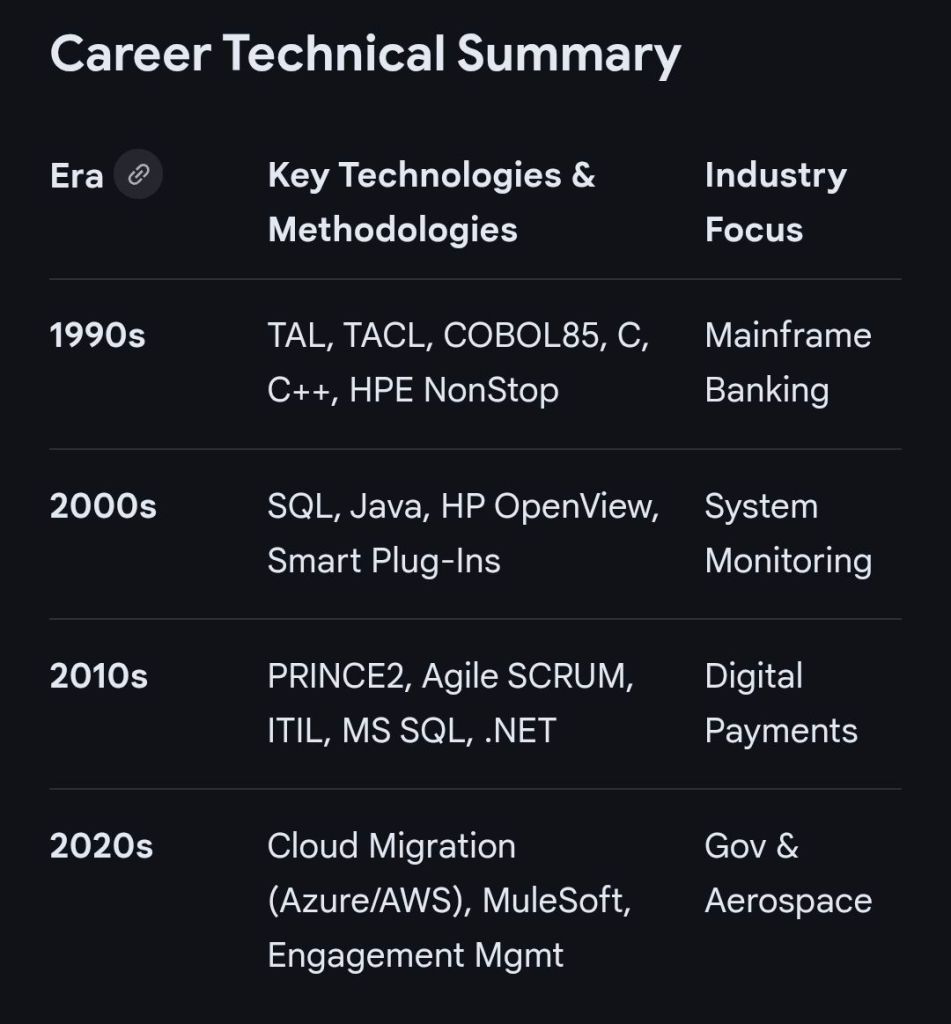
His professional transformation reflects broader shifts across four technological eras and political-economic landscapes:
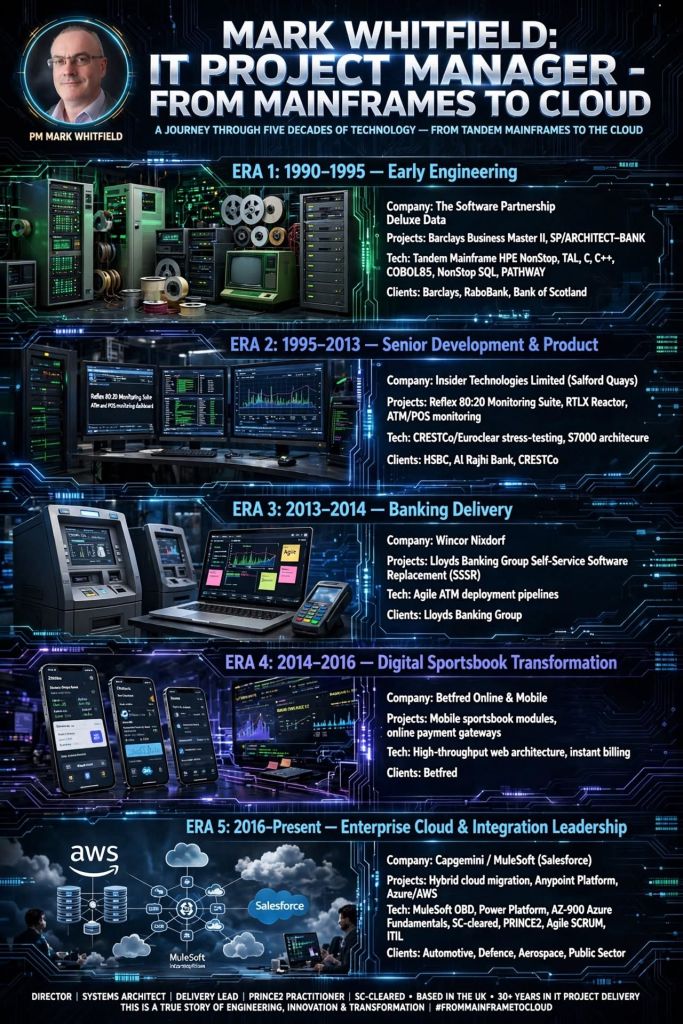
1. Mainframe & Early Electronic Banking (1990–1995)
Technology Era: Dominated by localized infrastructure, Tandem Mainframe Computers (now HPE NonStop), COBOL, C, C++, TAL, PATHWAY, and Jackson Structured Programming (JSP).
Political & Economic Landscape: The aftermath of Thatcherite deregulation (the 1986 “Big Bang”) triggered intense competition in retail banking. Financial institutions aggressively adopted bespoke desktop and telephone banking applications to acquire market share.
Role & Projects: Working as a Programmer and Lead Analyst for The Software Partnership (acquired by Deluxe Data International in 1994), Whitfield engineered core software architectures like sp/ARCHITECT-BANK. He spent significant time on-site at Knutsford and Poole (Dorset) delivering the Barclays Business Master II (BBM II) platform, pushing desktop corporate banking into reality before the commercial internet matured.
2. Infrastructure Middleware & System Monitoring (1995–2013)
Technology Era: Shift toward web-enabled browser monitoring, middleware solutions, client-server architectures, and automated system diagnostics.
Political & Economic Landscape: The rise of New Labour, globalisation, and cross-border European integration. Financial sectors faced stricter service levels and skyrocketing volumes due to the growing ubiquity of ATMs, Point-of-Sale (POS) systems, and cross-border settlement demands.
Role & Projects: Joining Insider Technologies Limited (ITL) at Salford Quays (Manchester), Whitfield ascended from a Senior Programmer to an IT Project Manager overseeing strategic technical initiatives.
He co-developed system diagnostic modules for the Reflex platform.
He famously secured the first HP OpenView Operations Enterprise Manager 2-way Smart Plug-In (SPI) certification for HPE NonStop platforms.
Managing structured Waterfall frameworks, he led high-volume automated transaction deployments (notably BASE24 Classic and EPS) via the browser-enabled RTLX (Real-Time Log eXtraction) Reactor for heavyweights like HSBC, Alliance & Leicester, and Standard Chartered.
Technology Era: The definitive mass pivot from rigid Waterfall, PRINCE2 models toward Agile Scrum frameworks, mobile applications (iOS, Android), and multi-vendor hybrid software integration.
Political & Economic Landscape: Post-2008 financial crash regulatory overhauls paired with UK coalition government-driven austerity. High-street legacy architectures required rapid rationalization, while private entertainment industries (like consumer gambling) exploded due to mobile deregulation.
Role & Projects:
Wincor Nixdorf (2013–2014): Served as an award winning Agile IT PM modernizing legacy ATM networks and deploying multi-vendor software integrations (PC/E Enterprise, Oracle, Windows 7) for Lloyds Banking Group.
Betfred (2014–2016): Pivoted to the gambling sector as a Senior IT Project Manager. He spearheaded multiple complex Agile release cycles to take mobile sportsbook components, virtual gaming, and secure fraud-detection payment gateways live.
4. Enterprise Cloud, Security, & API Integration (2016–Present)
Technology Era: Modern hybrid cloud platforms (Azure, AWS), SaaS, MuleSoft Anypoint Platform, API-led connectivity, and microservices.
Political & Economic Landscape: The post-Brexit geopolitical landscape coupled with heightened national security frameworks. Public and private sectors faced mounting mandates for secure, interoperable architectures, requiring professionals to carry strict government Security Clearance (SC) credentials to manage critical infrastructure.
Centiun is a UK-based Microsoft AI Cloud Partner and IT consultancy specializing in digital transformation, cloud migration, and AI integration for public and private sector organizations.
Centiun is a UK-based Microsoft AI Cloud Partner and IT consultancy
They help businesses modernize operations, leverage low/no-code platforms, and transition legacy infrastructure to secure cloud environments.
Core Services
Cloud & App Modernization: Migrating on-premise, legacy applications to secure cloud environments to reduce costs and enhance agility.
Microsoft AI & Business Applications: Implementing solutions across the Microsoft stack, including Copilot, Power Platform, and Dynamics 365, to improve process efficiency and data-driven decision-making.
Managed Services & Governance: Providing SLA-compliant technical governance, threat monitoring, and support to ensure business continuity.
Training & Enablement: Upskilling staff to confidently use Microsoft tools and low-code solutions.
Target Industries
Centiun tailors their technology solutions to several specialized sectors, offering domain expertise in:
Healthcare and Non-profits
Public Bodies and Central Government
Financial Services and Manufacturing
Energy and Utilities
Why They Stand Out
Microsoft Expertise: Their seasoned experts hold numerous Microsoft certifications and boast a combined 20+ years of experience in Microsoft Business Applications.
Tailored Approach: They focus on personal service rather than one-size-fits-all solutions, aiming to help clients scale and modernize while minimizing operational disruption.
Security & Trust: The firm operates with strict data security measures, holding accreditations like Cyber Essentials and registration with the Information Commissioner’s Office (ICO).
Explore their complete list of solutions and case studies directly on the Centiun Official Website.
Mark Whitfield is a highly experienced IT professional with a career spanning over 30 years, transitioning from a technical programmer to a senior digital engagement and project manager. His expertise is rooted in HPE NonStop (Tandem) systems and has evolved to encompass complex Agile and Cloud delivery across diverse industries.
Early Technical Era (1990–1995)
Following his graduation in Computing in 1990, Whitfield began his career as a Programmer at The Software Partnership (later Deluxe Data).
Focus: Electronic banking software, specifically sp/ARCHITECT-BANK on Tandem Mainframe Computers.
Key Work: Developed code for major banks including TSB, Barclays, and Rabobank. This included early digital innovations like voice-driven phone banking and inter-account transfers before the internet was widespread.
Growth and Product Management Era (1995–2004)
Whitfield joined Insider Technologies Limited (ITL) in 1995 as a Senior Programmer.
Focus: Platform health and diagnostic software for HPE NonStop systems.
Key Projects:
Co-developed diagnostic plug-ins for the Reflex monitoring suite.
Managed the first HP OpenView Operations (OVO) Smart Plug-In certification for the NonStop platform in 2002.
Consulted for CRESTCo (Euroclear) in 1997, conducting benchmark testing on new S7000 nodes.
Strategic Leadership and Project Management Era (2005–2014)
During this decade, he transitioned into IT Project Management, focusing on high-value financial transaction tracking.
Focus: Waterfall and Agile project delivery for payment systems and banking infrastructure.
Key Milestones:
2011: Led a massive transaction tracking project at Al Rajhi Bank (Saudi Arabia), parsing terabytes of tape-archived data into a normalised SQL database.
2013–2014: At Wincor Nixdorf, managed a £5+ million project for Lloyds Banking Group to migrate ATM driving responsibilities from legacy systems to AIX-based Oracle technologies.
Senior Digital Engagement Era (2014–Present)
Since 2014, Whitfield has focused on senior-level digital transformation and engagement management.
Betfred (2014–2016): Served as Senior Digital Project Manager for online and mobile platforms (iOS/Android), managing fraud detection and payment gateway integrations.
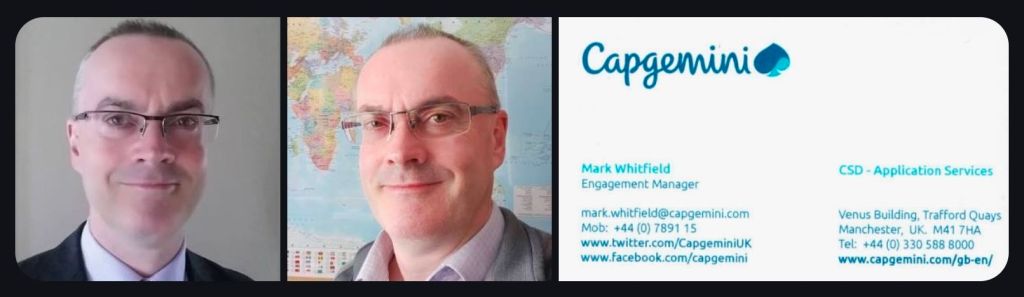
Capgemini (2016–Present): Joined as an Engagement Manager (SC cleared).
Focus: Managing large-scale Agile and Waterfall digital projects across aerospace, defence, and government sectors.
Notable Projects: Leading a £13.5m programme to migrate 130 UK government applications to the cloud (AWS/Azure) and delivering real-time airspace monitoring apps for air traffic organisations.
This resume summarizes the career of Mark Whitfield, a Senior IT Project Manager with over 30 years of experience specializing in digital and software development lifecycles, cloud migrations, and HP NonStop systems.
Core Focus: Senior Project Management for Digital/ Software Development Lifecycles (SDLC).
Expertise: Transitioning from a technical background in programming (pre-2000) to senior leadership in large-scale projects for global blue-chip companies.
Key Skills & Competencies
Methodologies: PRINCE2 Practitioner, Agile (Scrum/ Kanban), Waterfall, ITIL, ISO QA.
Project Controls: MS Project, Budget & Burn Tracking, GDPR compliance, Supplier & Stakeholder Management, Statement of Work (SoW).
Technical Proficiencies:
Platforms: HP NonStop (Tandem), Cloud Migration (Hybrid).
Languages (Historical): C/C++, Java, COBOL85, TAL, TACL, SCOBOL, SQL, MS SQL.
Utilities: PATHWAY, SCF, FUP, INSPECT, XPNET.
Professional Experience
Senior IT Project Manager (Various Projects):
Managed large-scale solutions for clients including Jaguar Land Rover (JLR), Heathrow, Royal Mail Group (RMG), NATS, and Euroclear.
Extensive work within the financial sector for Bank of England, Barclays, HSBC, Santander, Standard Chartered, Deutsche Bank, and Global Payments.
Government and public sector projects for Defra, UKEF, Welsh Water, and Scottish Water.
Early Career (Programmer / Technical Lead):
1990 – 1995: Programmer at The Software Partnership (later Deluxe Data) in Runcorn, specializing in electronic banking software (sp/ARCHITECT-BANK) on Tandem Mainframe Computers.
Education & Certifications
Degree: Higher National Diploma (HND) in Computing (Distinction, Graduated 1990).
The history of cloud computing evolved from 1950s time-sharing concepts to today’s AI-integrated hyperscale ecosystems. While John McCarthy and J.C.R. Licklider envisioned computing as a global utility in the 1960s, the modern era truly began with the 1999 launch of Salesforce and the 2006 debut of Amazon Web Services (AWS).
Foundational Era (1950s – 1980s)
1955: John McCarthy introduces the theory of sharing computing time among a group of users.
1961: McCarthy proposes that computing will one day be sold as a public utility, similar to water or electricity.
1967: IBM develops the first operating system that allows multiple users to timeshare a single resource.
1969: ARPANET (Advanced Research Projects Agency Network) is launched, serving as the precursor to the modern internet.
1972: IBM releases the first version of its Virtual Machine (VM) operating system.
1977: The cloud symbol is first used in original ARPANET diagrams to represent networks of computing equipment.
The Rise of the Modern Cloud (1990s – 2009)
1996: The term “cloud computing” appears in an internal Compaq business plan.
1997: Professor Ramnath Chellappa defines cloud computing as a “computing paradigm where the boundaries of computing will be determined by economic rationale”.
1999: Salesforce.com launches, becoming the first company to offer business applications over the internet, pioneering SaaS.
2002: Amazon Web Services (AWS) launches as a suite of web-accessible tools for developers.
2006: AWS releases Elastic Compute Cloud (EC2) and Simple Storage Service (S3), marking the birth of modern IaaS.
2007: Netflix begins its transition to a video-streaming service using cloud infrastructure.
2008: Google releases Google App Engine, a platform for developing and hosting web applications in its data centres.
2009: Google Apps (now G Suite) launches, bringing browser-based enterprise applications to the mainstream.
Expansion & Specialisation (2010 – 2019)
2010: Microsoft officially releases Azure.
2010: NASA and Rackspace initiate OpenStack, an open-source project for cloud software.
2011: Apple launches iCloud, popularising consumer cloud storage.