Senior Project Manager (PM) Mark Whitfield’s 2013 article published in The Connection Journal (a globally recognized publication for HPE NonStop / Tandem systems) focused extensively on Application Modernization and Logical Data Warehousing.
Writing as a Principal Consultant for Insider Technologies, Whitfield provided a detailed blueprint for how banks and financial institutions could harness Big Data by bridging legacy, fault-tolerant mainframe environments with modern, open-system analytics frameworks.
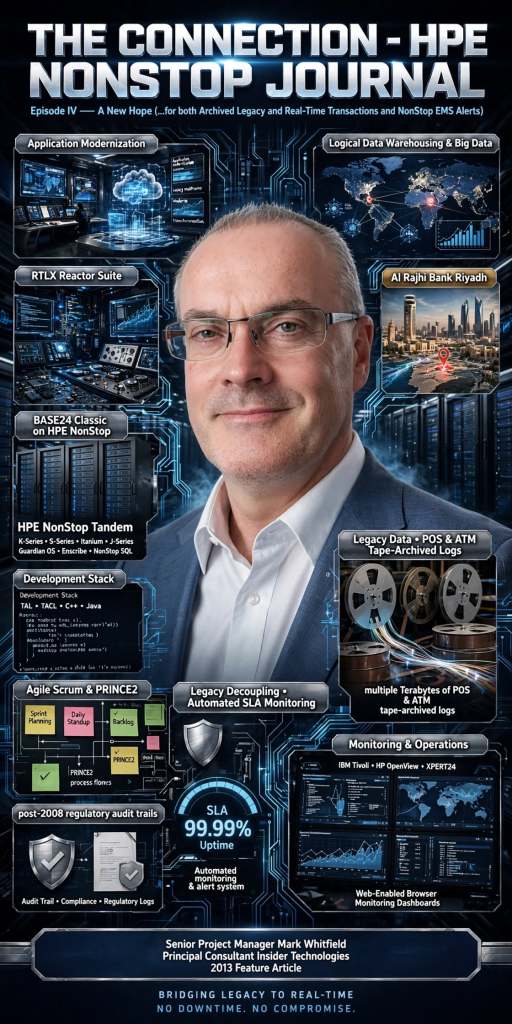
The piece serves as a technical commentary on the successful implementation of the Real-Time Log Extraction (RTLX) Reactor Suite for Al Rajhi Bank in Riyadh, Saudi Arabia.
The technical architecture and strategic insights from his feature, entitled “Episode IV – A New Hope (…for both Archived Legacy and Real-Time Transactions and NonStop EMS Alerts)”, are detailed below.
📋 Executive Project Summary
- The Core Objective: Designing and deploying a transaction querying solution capable of processing and optimising multiple Terabytes of tape-archived POS and ATM transaction logs.
- The Technology: Integrating BASE24 Classic payment solutions hosted on mission-critical HPE NonStop (Tandem) mainframes with automated real-time transaction extraction protocols.
- The Outcome: Consolidation of disparate legacy logs into unified, web-enabled browser monitoring dashboards, effectively shielding high-volume consumer touchpoints from systemic transaction gaps.
🏗️ Strategic Commentary: Technical & Operational Shift
The article highlights a broader methodology transition led by Whitfield at Insider Technologies Limited before he exited the company later in 2013. The project illustrated two major shifts in the IT management sector:
- Framework Hybridisation: Moving complete software development lifecycles (SDLC) away from rigid Waterfall planning by heavily introducing early Agile Scrum and PRINCE2 practitioner frameworks to traditional banking environments.
- Legacy Decoupling: Parsing heavy backend mainframe operations into client-server browser monitoring frameworks, democratising real-time system health data for corporate stakeholders.
🏛️ The Political Landscape
The deployment and publication of this case reference coincided with a unique intersection of global and localized “political” pressures:
- Stricter Regulatory Mandates: Operating in the post-2008 financial crisis landscape meant that global financial institutions faced unprecedented compliance audits. The explosion of point-of-sale card transactions driven by emerging digital economies forced regulatory bodies to demand absolute, bulletproof audit trails to minimize systemic operational risk.
- Geopolitical & Cultural Adaptability: The project required navigating cross-border operational landscapes. This included managing on-site requirements gathering, commercial bidding, and system implementation within a strict Middle Eastern financial architecture (e.g., executing critical system shifts during Sunday-to-Thursday regional corporate schedules).
- Modernisation Inertia: Internally, the corporate landscape was heavily resistant to altering legacy mainframe infrastructure. The political success of the project relied on bridging the divide between old-school hardware stability and modern web tracking demands—a precursor to the massive enterprise cloud and API migration transformations Whitfield later managed at firms like Wincor Nixdorf and Capgemini.
🏗️ Technical Commentary
Core Technological Infrastructure
The technology insight details an ecosystem designed for high-volume, mission-critical electronic banking and payment infrastructures. The core environment relies on bridging the following components:
- The Mainframe Foundation: HPE NonStop (including Tandem K-Series, S-Series, and Itanium J-Series architectures) running the Guardian Operating System.
- Payment & Communication Middleware: Integration with industry staples like ACI Worldwide’s BASE24 Classic, BASE24-eps, and the XPNET communications framework.
- Primary System Languages: Native implementations using NonStop C, C++, Java, TAL (Tandem Application Language), and TACL scripting.
- Data Structures: High-performance Enscribe hierarchical file systems paired with NonStop SQL databases.
The Technical Insight: “Dovetailing” vs. Rip-and-Replace
Whitfield’s primary thesis argued that application modernization does not require the risky and expensive process of ripping out core mainframe infrastructure. Instead, it should focus on “dove-tailing”. This technique extends the life of business-critical transaction processors by cleanly feeding their outputs into modern, open-system analytical architectures.
Key Technical Pillars
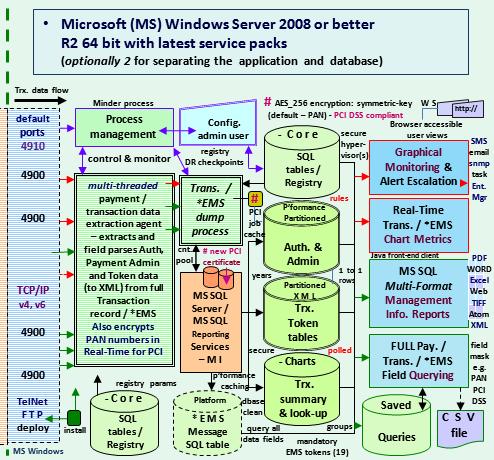
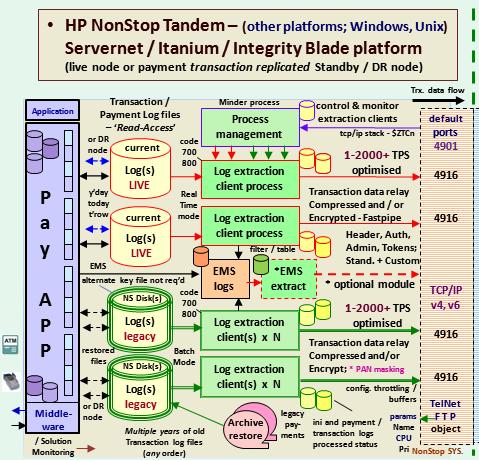
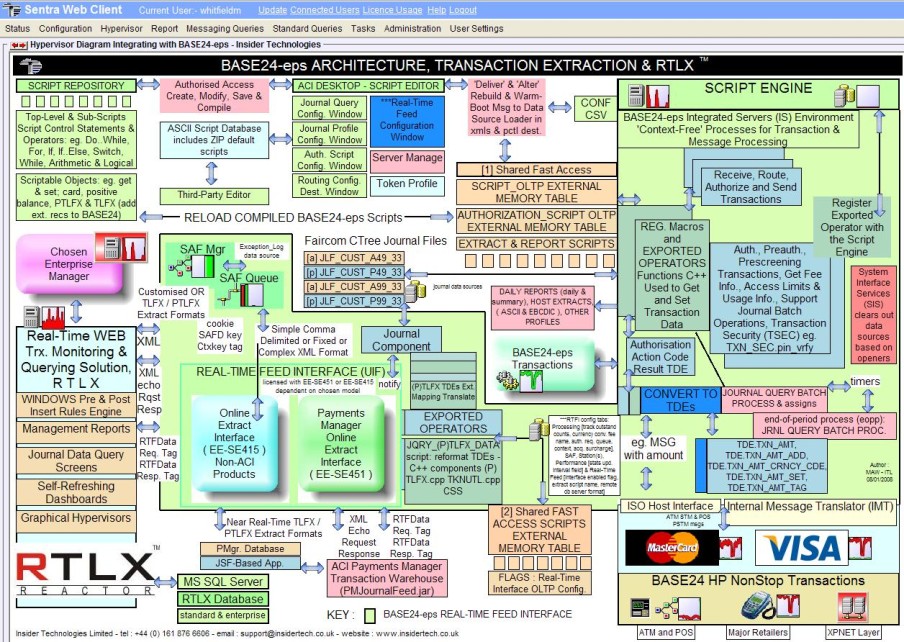
- The RTLX Reactor Engine: The insight highlighted the use of modern monitoring software (like the RTLX Payments Suite) to act as a real-time event pipeline. It breaks traditional operational silos by capturing raw payment transaction logs and system alerts on the fly.
- Cross-Platform Pipeline Federation: The architecture successfully mapped proprietary, low-level mainframe telemetry into open-system corporate risk portals. This allowed legacy system logs to natively stream into mainstream enterprise managers such as IBM Tivoli, XPERT24, and HP OpenView Operations (HP OVO).
- Logical Data Warehousing: Instead of forcing massive, continuous physical data migrations that bottleneck mainframe compute cycles, the paper advocated for logical warehousing. This mechanism allows multi-year historical archives (such as long-term Event Management Service alerts) to be queried alongside real-time transaction pipelines without degrading active banking processing speeds.
- Automated SLA Monitoring and Escalation: The integration established immediate, real-time end-to-end visibility over cross-border ATM, POS, and SWIFT channels. This framework allowed financial institutions to programmatically enforce and track Service Level Agreements (SLAs), escalating transactional friction points the second they materialised.
Results and Benefits
The Regulatory and Business Driver
The timing of this technical insight aligned directly with the post-2008 banking crisis landscape. Global financial bodies (such as Standard Chartered and Global Payments) were facing heavy regulatory pressure to prove absolute operational resilience.
Whitfield’s architectural approach provided the necessary compliance evidence by transforming raw, text-heavy mainframe strings into transparent, real-time data visualisations on executive ITIL corporate dashboards.
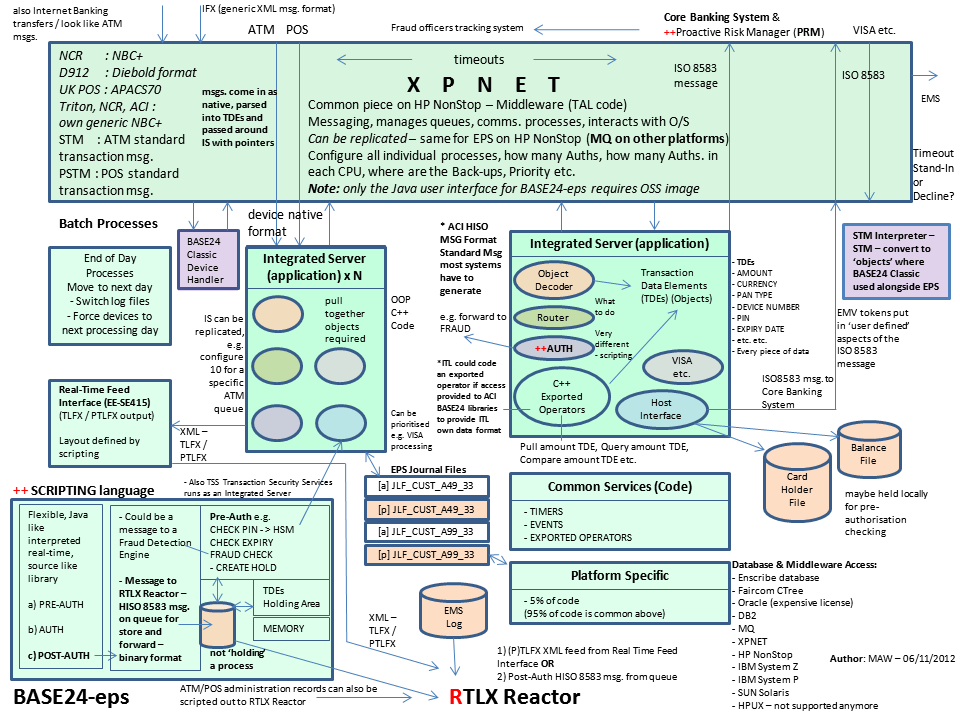
Above and below, RTLX Reactor (in 2012) for tracking BASE24-eps & BASE24 Classic XPNET transactions
Read article at: “Episode IV – A New Hope (…for both Archived Legacy and Real-Time Transactions and NonStop EMS Alerts)“
Note:
The Insider RTLX product at ETI-NET is now called C-Deep for Transaction Monitoring;
The Insider Reflex product at ETI-NET is now called Sentinel for NonStop Monitoring;
C-Deep for Transaction Monitoring & Sentinel for HPE NonStop Monitoring.