

Mark Whitfield’s IT project management and software engineering career in the 1990s was defined by deep technical engineering on fault-tolerant HPE NonStop systems (formerly Tandem Computers), foundational electronic banking applications, and a transition toward enterprise system governance.
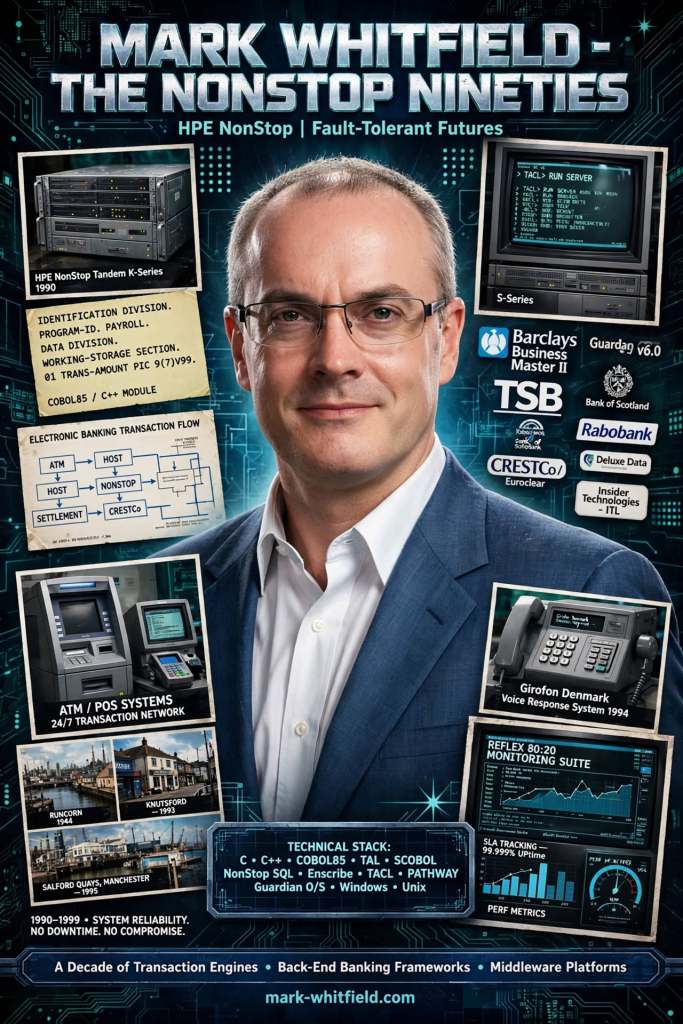
After graduating with distinction in Computer Studies in 1990, he spent the decade building transaction engines, back-end banking frameworks, and middleware platforms for major blue-chip clients.
A detailed chronological breakdown of his 1990s career shows a clear progression from core application development to critical infrastructure management:
🏦 The Software Partnership / Deluxe Data Era (1990–1995)
During this foundational era, Whitfield operated as a Programmer and Lead Analyst at a software house based in Runcorn, Cheshire (which was acquired by Deluxe Data International in 1994). His work focused on cutting-edge, pre-internet corporate electronic banking systems:
- sp/ARCHITECT-BANK Platform: He designed, developed, and coded back-end software modules for this foundational framework. His work allowed corporate clients to execute secure desktop-to-mainframe electronic account transfers and bookkeeping.
- Barclays Business Master II (BBM II): He was deployed on-site at the Barclays facility in Knutsford, Cheshire, leading the architectural design and core mainframe coding for their premier high-profile business banking platform.
- Girofon (Denmark) Integration: He engineered a specialized voice-response interactive suite. This system integrated touch-tone phone hardware with back-end Tandem COBOL85 and NonStop SQL databases, allowing customers to query live balances securely.
- Tier-1 Financial Client Tailoring: He managed software builds and system configurations for high-street banking architectures, including TSB, Bank of Scotland, and Rabobank.
💻 Insider Technologies Limited (ITL) Era (1995–1999)
In 1995, Whitfield moved to a software development studio in Salford Quays, Manchester, embarking on an 18-year tenure with ITL. During the late nineties, he operated as a Senior Programmer:
- The “Reflex” Monitoring Suite: He co-developed core platform health, automated diagnostic, and transaction log extraction modules for Reflex (also known as Reflex 80:20). This software provided critical real-time Service Level Agreement (SLA) tracking for high-availability payment pipelines.
- CRESTCo Infrastructure Benchmark (1997): He was contracted on-site to CRESTCo (now Euroclear). There, he wrote custom benchmarking and stress-testing software to evaluate stock settlement software performance on newly rolled-out S7000 HPE NonStop systems.
- Middleware & Protocol Bridging: He authored middleware frameworks to handle volume transaction tracking across automated teller machine (ATM) and point-of-sale (POS) systems.
🛠️ Technical Stack & Methodology Portfolio (The Nineties)
Whitfield’s 1990s technical landscape focused heavily on heavy-duty, high-availability financial systems:
- Operating Systems & Architectures: HPE NonStop (Tandem K-Series and S-Series), Guardian O/S, Windows, and Unix.
- Languages & Toolsets: C, C++, COBOL85, TAL (Tandem Application Language), SCOBOL, NonStop SQL, Enscribe, TACL, and Tandem PATHWAY systems.
- Methodology: Transitioned from strict Waterfall lifecycles to early iterative development patterns, paving the way for his eventual 2000s transition into formalized PRINCE2 and Agile Scrum project management.

