sp/ARCHITECT was a pioneering electronic banking and funds-transfer software suite originally developed by the Runcorn-based firm The Software Partnership (TSP). Following its acquisition by the American firm Deluxe Electronic Payment Systems in 1994, the Runcorn office became the European hub for what was then rebranded as Deluxe Data.
sp/ARCHITECT electroinic banking by The Software Partnership TSP
Overview
The Runcorn operation specialised in high-availability, mission-critical banking software, specifically the sp/ARCHITECT-BANK product. This software was designed to run on Tandem Computers (now HPE NonStop), which were known for their fault-tolerant architecture. The “sp/ARCHITECT” platform was highly valued for its client-server design, allowing it to be adapted for various hardware brands, including Unix-based systems.
Historical Timeline
Mid-1980s: The Software Partnership (TSP) is co-founded by Nigel Walsh. The company starts developing online banking systems in Timperley before moving to Runcorn.
1990: The firm establishes itself at Norton House in Crowngate, Runcorn, focusing on electronic banking software for major clients like TSB and Bank of Scotland.
1992: The Runcorn office relocates to Wingate House on Northway.
1994: Deluxe Electronic Payment Systems (a subsidiary of Deluxe Corporation) acquires The Software Partnership for an undisclosed sum. The acquisition is aimed at helping Deluxe expand its global presence and accelerate the use of the sp/ARCHITECT suite.
1994–1995: The Runcorn office operates as Deluxe Data, providing software design, coding, and 24-hour support for international clients including Rabobank.
2000: Following a series of corporate shifts, the company name changes to EFD eFunds.
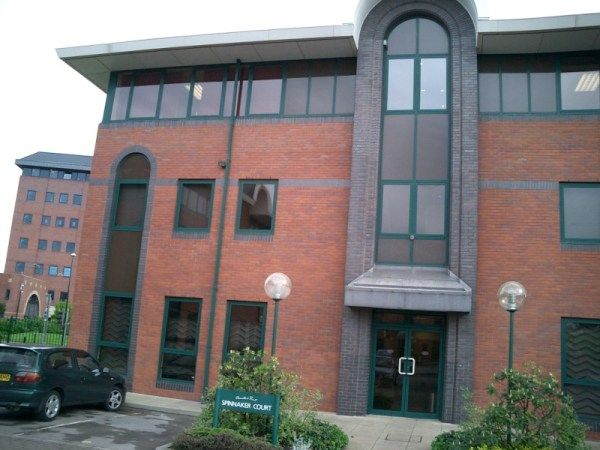
2007: By this year, the operation has transitioned to Fidelity National Information Services (FIS) and is based in Aegon House, Daresbury, Warrington.
sp/ARCHITECT electroinic banking by The Software Partnership TSP
The history of the Machines in The Matrix universe is a transition from a servant class to the dominant global power. This evolution is officially chronicled through several distinct eras, beginning with humanity’s peak and ending in a symbiotic, albeit forced, relationship.
Machine History Overview
Originally created by humans in the early 21st century to perform menial and hazardous labor, the Machines were a “slave caste” of true artificial intelligence. For a time, they coexisted peacefully as humanity enjoyed a golden age of leisure. This balance shattered when a robot named B1-66ER killed its master in self-defense, sparking a global debate on machine sentience and rights. The subsequent persecution of machines led them to form their own nation, Zero One, which eventually surpassed human economies and triggered the Machine War.
Detailed Timeline by Era
Era 1: The Human Golden Age (Pre-2090)
c. 1985–2025: Rapid technological advancement; the invention of true AI and the first sentient machines.
Early 21st Century: Machines are integrated into every level of society as laborers, freeing humans from menial work.
Era 2: The Second Renaissance (2090–2139)
2090: The B1-66ER Trial. A domestic robot kills its owner to avoid being decommissioned; the court orders the destruction of all sentient machines.
2090s: The “Million Machine March.” Pro-machine protests are met with violent government suppression and machine “purges”.
2100s: Machines flee to Mesopotamia (the “cradle of civilization”) and establish the city of Zero One.
2120s–2130s: Zero One’s superior manufacturing causes a global economic collapse for human nations. The UN responds with an economic blockade and later, a nuclear strike on Zero One, which the machines survive.
Era 3: The First Machine War (2139–2199)
2139: The UN officially declares war after Zero One’s ambassadors are rejected and attacked at the UN Headquarters.
Mid-22nd Century: Humanity enacts Operation Dark Storm, seeding the atmosphere with nanites to block the sun and cut off the machines’ solar power.
Late 22nd Century: Machines adapt by creating new, “sinister” war units (like Sentinels) and begin harvesting humans for bioelectric energy.
2199: The Machines achieve total victory. An ambassador detonates a nuclear device at the UN, ending the old human order.
Era 4: The Matrix Cycles (c. 2199 – 2699)
The Beta Versions: The Architect builds a “Paradise” Matrix and later a “Nightmare” Matrix (with monsters like vampires); both fail as humans reject the simulations.
The Modern Matrix: The Oracle discovers humans need the “illusion of choice.” This version mimics 1999 society and is accepted by 99% of subjects.
Cycles 1–5: The Machines establish a system where Zion is destroyed and rebuilt roughly every 100 years by a figure known as “The One” to stabilize the code.
Era 5: The Post-Revolution & Synthient Era (2700+)
The Truce: Neo brokers peace with the Machines to stop the rogue Agent Smith. The war ends, and humans who wish to be freed are released.
Machine Civil War: Years later, a power scarcity leads to internal machine conflict between those loyal to the peace and a new faction under The Analyst.
The Synthients: Machines begin preferring terms like “Synthient” (Synthetic Sentient) and “D.I.” over the “demeaning” term “Machine”.
Mark Whitfield is a highly experienced IT Senior Project Manager and Engagement Manager based in Manchester, UK, specializing in Agile Scrum, PRINCE2, and Waterfall methodologies. He holds a degree in Computing (1990) and has extensive experience in IT hardware solutions, financial services, and Aerospace & Defence.
Here is a comprehensive summary of his profile, with links based on the provided search data:
Professional Profile
Name: Mark Whitfield
Role: IT Senior Project Manager / Engagement Manager (SC Cleared)
Mark Whitfield is a highly experienced IT Project Manager, Senior Developer, and SC-cleared consultant with over 30 years of experience, specializing in HP NonStop (Tandem) systems, banking software, and digital transformation projects. He is currently an Engagement Project Manager at Capgemini.
Career Overview
Specialism: HP NonStop (Tandem) mainframes, BASE24, transaction monitoring, Agile/Waterfall methodologies.
1990: Graduated in Computing and started as a Programmer for The Software Partnership in Runcorn, specializing in sp/ARCHITECT-BANK on Tandem Computers.
1990-1994: Developed banking code for TSB, Bank of Scotland, Rabobank, and Girofon (Denmark).
1992: Worked on the Barclays Business Master II (BBM II) project in Knutsford.
1994: Company taken over by Deluxe Data (later FIS).
2. Insider Technologies & Monitoring Era (1995–2013)
1995–2013: Joined Insider Technologies Ltd as a Senior Development Engineer and Project Manager.
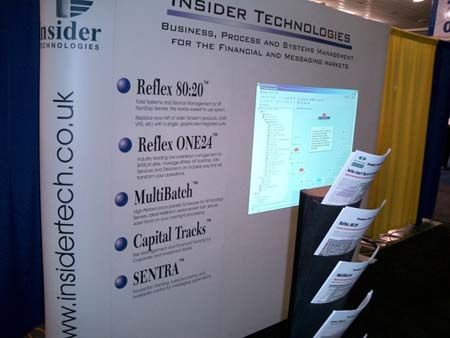
1995-2004: Developed monitoring/diagnostic software (Reflex 80:20, Reflex ONE24) for HP NonStop payment systems.
1997: Worked on projects for CRESTCo.
Early 2000s: Focused on HP NonStop transaction/payment monitoring for ATM/POS devices using ACI’s XPNET.
2005-2013: Managed first HP OpenView Operations Smart Plug-In certification for NonStop; designed XPERT24.
2011: Certified as a PRINCE2 Practitioner.
3. Banking Transformation & Consultancy Era (2013–2016)
2013–2014: Wincor Nixdorf UK – Worked as a Project Manager in Professional Services for the Banking Division.
2013-2014: Assigned to Lloyds Banking Group (LBG) for the Self-Service Software Replacement (SSSR) program (ATM estate upgrade).
2014–2016: Joined Betfred as an IT Project Manager in the gambling/casinos industry, delivering mobile/online payment gateways (iOS, Android).
4. Digital Transformation & Capgemini Era (2016–Present)
2016: Joined Capgemini UK as a client-facing Engagement Manager.
2016-2017: Led digital projects for automotive, local government, and aerospace sectors.
2017: Obtained Microsoft Excel Expert skills and Advanced Engagement Management certifications.
2018–2019: Augmented into MuleSoft as a Delivery Manager for the Anypoint Platform.
2022: Completed Microsoft Azure Fundamentals (AZ-900) certification.
2023–2024: Assigned to a UK Government account for a cloud migration of 130+ applications and the Fish Export Service (FES) project.
Key Qualifications
PRINCE2 Practitioner & Agile Scrum
ITIL Certified
SC Cleared (UK Government)
Technical Skills: C, C++, MS SQL, COBOL, TAL, Java, ASP.NET, HP NonStop
Extreme Programming (XP) is a prominent, disciplined Agile software development framework designed to improve software quality and responsiveness to changing customer requirements. Developed by Kent Beck in the mid-1990s, it focuses on taking beneficial engineering practices—such as pair programming, testing, and continuous integration—to “extreme” levels.
Project Management Summary: Core XP Components
XP differs from other Agile methods by focusing intensely on technical engineering practices alongside project management techniques.
Core Values: Communication, Simplicity, Feedback, Courage, and Respect.
Key Practices: Pair Programming, Test-Driven Development (TDD), Collective Ownership, Continuous Integration, Refactoring, and Small Releases.
Project Management Focus:
The Planning Game: Combines business priorities with technical estimates to determine what to build next.
Small Releases: Frequent, working software releases (often 1–2 weeks) to gather rapid customer feedback.
On-site Customer: A customer representative works with the team to provide instant feedback and clarify requirements.
Sustainable Pace: Limiting work weeks to 40 hours to avoid burnout and maintain quality.
Detailed Historical Timeline of XP
Era 1: Origins and The Chrysler C3 Project (1993–1996)
1993: Chrysler launches the Comprehensive Compensation System (C3) project to upgrade payroll software, which struggles for years.
March 1996:Kent Beck is brought in to lead the C3 project. To salvage the project, Beck starts encouraging team members to adopt a set of technical practices he developed based on his experiences.
1996:Ward Cunningham heavily influences the development of early XP concepts, particularly the “metaphor”.
1996: The project begins adopting daily meetings, pair programming, and TDD.
Era 2: Formalization and “Embracing Change” (1997–2000)
1997: Ron Jeffries is brought in to coach the C3 team, helping solidify the practices.
1998: The term “Extreme Programming” becomes widely discussed within the Smalltalk and Object-Oriented programming communities.
October 1999: Kent Beck publishes Extreme Programming Explained: Embrace Change, formally defining the framework.
February 2000: Daimler-Benz acquires Chrysler and cancels the C3 project after 7 years of work. Despite cancellation, the methodology proved that it could produce working, high-quality software, just not fast enough to overcome the legacy backlog.
Era 3: Rise of Agile and Expansion (2001–2005)
February 2001: Kent Beck and Ron Jeffries are among the 17 developers who draft the Manifesto for Agile Software Development at Snowbird, Utah. XP is recognized as one of the foundational “Agile” methods.
2001: The first Agile Alliance conference is held. XP is considered the dominant agile methodology during this period.
2002–2003: XP gains global popularity; numerous books are published expanding on the core 12 practices.
2004: The second edition of Extreme Programming Explained is released, shifting focus from 12 rigid practices to more adaptive principles.
Era 4: Integration with DevOps and Continuous Delivery (2006–Present)
2006-2010: As Scrum gains popularity for general project management, XP practices like TDD and Pair Programming become the “standard” technical practices for high-performing teams, often blended with Scrum (ScrumXP).
2010s: The rise of DevOps and continuous delivery, which inherently requires XP practices like CI/CD (Continuous Integration/Continuous Delivery).
2020-2026: While fewer companies identify strictly as doing “XP,” its technical practices are considered essential to modern software development and are integrated into almost all Agile methodologies to ensure quality and speed.
Extreme Programming XP project management summary and detailed historical timeline by era and year
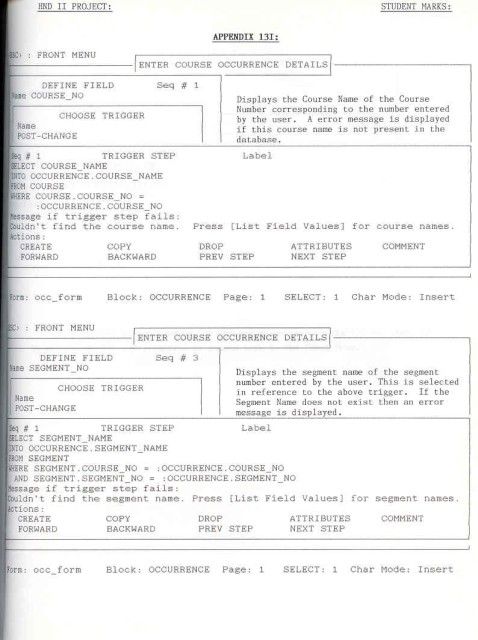
Oracle Forms triggers are event-handlers written in PL/SQL (originally a proprietary step-based language) that execute in response to specific events within an application, such as mouse clicks, data entry, or database transactions. They allow developers to augment or replace default processing behavior.
The evolution of Oracle Forms is defined by its transition from character-mode terminals to graphical user interfaces (GUI) and eventually to web-based and cloud architectures.
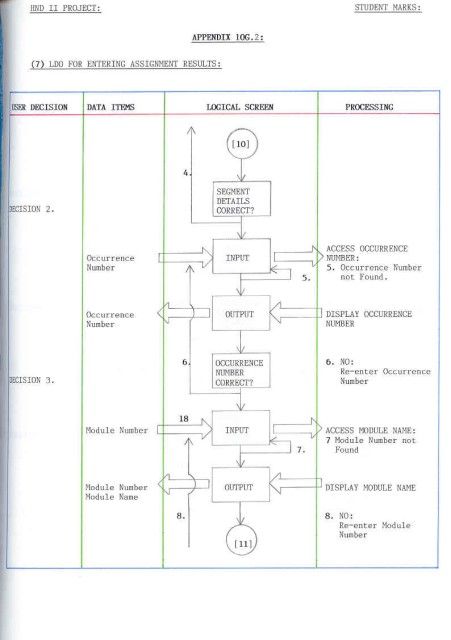
HND Oracle SQL forms design example 2, 1990
Era 1: The Character Mode & Macro Era (1979 – 1980s)
In this era, applications were designed for text-only terminals like the VT220. Logic was primitive and lacked the structural flow of modern programming.
1979 – Interactive Application Facility (IAF): The earliest form of the tool, consisting of a compiler (IAG) and a runtime interpreter (IAP).
1984 – FastForms / SQL*Forms 2.0: Renamed during the Oracle v4/v5 database era.
Trigger Detail: Triggers did not use PL/SQL. They used a proprietary language based on trigger steps. To achieve logic like an IF statement, developers had to jump between steps based on the success or failure of a SQL statement.
1987 – SQL*Forms 2.3: A significant improvement that introduced procedural capabilities via EXEMACRO CASE for more complex logic.
Era 2: The PL/SQL & GUI Revolution (Late 1980s – 1990s)
This period marked the shift toward modern programming standards and the Windows operating system.
1988 – SQL*Forms 3.0: The first version to support PL/SQL within triggers. This replaced the old step-based triggers with block-structured code.
1993 – Oracle Forms 4.0: The first true GUI-based version, supporting checkboxes, radio groups, and mouse-based interactions.
1994 – Oracle Forms 4.5: A “quantum leap” in the product’s history.
Trigger Detail: Introduced GUI-based triggers (e.g., WHEN-MOUSE-CLICK) and a modern IDE with an Object Navigator and Code Editor.
Era 3: The Web & Internet Era (Late 1990s – 2010s)
As the internet grew, Oracle pivoted to a three-tier architecture where forms ran in web browsers via Java.
1999 – Oracle Forms 6i: The ‘i’ stood for Internet. It introduced the Forms Server, allowing forms to run in a browser using a Java applet.
2002 – Oracle Forms 9i: Officially dropped support for client-server and character-mode deployment. Triggers began to support Java integration via imported Java classes.
2004 – Oracle Forms 10g: Integrated more deeply with J2EE and web services.
2009 – Oracle Forms 11g: Introduced external events and JavaScript support, allowing triggers to interact with web-based elements.
Era 4: Modern Cloud & Standalone Era (2015 – Present)
The current focus is on maintaining legacy reliability while adapting to modern infrastructure without a browser dependency.
2015 – Oracle Forms 12c: Introduced Java Web Start (JWS) and standalone modes, allowing applications to run without a parent browser.
2023 – Oracle Forms 12.2.1.19: Released with features like automatic language detection and browser-less launching (FSAL).
2024 – Oracle Forms 14.1.2: The latest stable release (skipping version 13), featuring modernized widgets and support for REST data sources.
2025/2026 – Transition Period: Long-time product advocates have left Oracle, signaling a shift toward sustaining mode where users are encouraged to modernize toward Oracle APEX.
Oracle Forms SQL triggers, event-handlers historical timeline by era
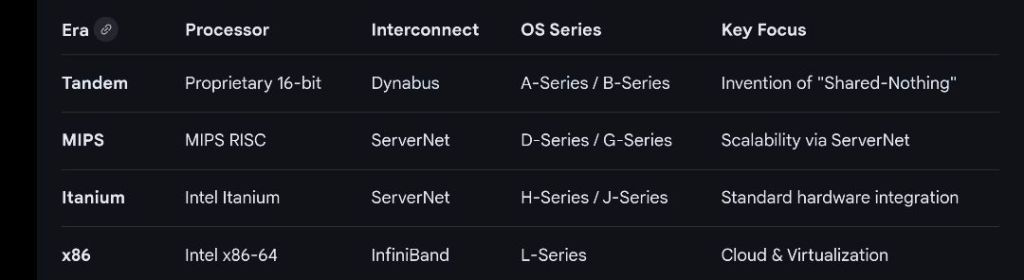
The HPE NonStop architecture is defined by its “shared-nothing” design, where every hardware and software component is redundant and operates independently to ensure 100% operational continuity. For over 40 years, it has evolved through four distinct hardware eras while maintaining upward software compatibility.
1. The Tandem Era (1974–1997): Proprietary Foundations
Architecture Approach: Founded by James Treybig, Tandem introduced the first commercial fault-tolerant system using a proprietary 16-bit stack-based architecture.
Key Technical Milestones:
1976 (NonStop I/T16): Introduced the Dynabus, a custom inter-processor backplane, and the Guardian OS, which used message-passing instead of shared memory to isolate faults.
1981–1983 (NonStop II & TXP): Introduced 32-bit addressing and the Transaction Monitoring Facility (TMF), which allowed applications to be fault-tolerant without specialized coding.
1986–1989 (VLX & Cyclone): Scaled to the mainframe market with ECL gate-array chips and the first fault-tolerant relational database, NonStop SQL.
2. The MIPS Era (1991–2004): Migration to RISC
Architecture Approach: To keep pace with industry performance, Tandem transitioned from proprietary processors to off-the-shelf MIPS RISC processors while emulating the original instruction set for compatibility.
Key Technical Milestones:
1991 (Cyclone/R): The first MIPS-based system.
1997 (Himalaya S-Series): Replaced Dynabus with ServerNet, a high-speed system interconnect that later evolved into the industry-standard InfiniBand.
Ownership Shift: Compaq acquired Tandem in 1997, and HP merged with Compaq in 2002.
3. The Itanium Era (2005–2013): HP Integrity NonStop
Architecture Approach: Branded as Integrity NonStop (NonStop i), this era moved the platform to Intel Itanium processors.
Key Technical Milestones:
2005 (NS-series/J-series): Focused on “NonStop Advanced Architecture” (NSAA), leveraging standard HP server components to lower costs while maintaining Availability Level 4 (AL4).
Technical Commentary: While powerful, the reliance on Itanium’s EPIC architecture eventually limited growth as the industry consolidated around x86-64.
4. The Modern HPE Era (2014–Present): x86-64 & Virtualization
Architecture Approach: Shifted to standard Intel x86-64 processors (NonStop X), fully decoupling the software stack from proprietary hardware.
Key Technical Milestones:
2014 (NonStop X/TNS/X): Introduced the L-series operating system. The architecture transitioned to a standard InfiniBand fabric for inter-processor communication.
2017–2020 (vNS): Launched Virtualized NonStop (vNS), allowing the environment to run on standard hypervisors like VMware, bringing fault tolerance to private and hybrid clouds.
2025 (NS9 X5): Modern systems now support up to 8 TB of RAM and are integrated into the HPE GreenLake consumption-based cloud model.
Pascal is a historically significant imperative and procedural programming language designed by Niklaus Wirth between 1968 and 1969. It was created to encourage structured programming and efficient data structuring, serving as a clean, disciplined alternative to more complex languages of the time like ALGOL 60 and FORTRAN.
Key Features and Overview
Strong Typing: Every variable must have a defined type (e.g., Integer, Real, Boolean, Char), and the compiler strictly enforces these to prevent errors during execution.
Rich Data Structures: Pascal introduced built-in support for complex types including records, sets, enumerations, subranges, and pointers.
Structured Control: It uses clear, English-like keywords such as begin, end, if-then-else, and while to organize program logic into manageable blocks.
Educational Focus: Originally intended as a teaching tool, it became the global standard for introductory computer science courses for nearly two decades.
Historical Timeline of Pascal
The Foundation Era (1960s)
1964–1966: Niklaus Wirth joins the IFIP Working Group to design a successor to ALGOL 60. His “pragmatic” proposal is rejected in favour of the more complex ALGOL 68.
1966: Wirth implements his proposal at Stanford as ALGOL W, which introduces many concepts later found in Pascal.
1968: Wirth begins designing a new language at ETH Zurich, naming it Pascal after the 17th-century mathematician Blaise Pascal.
The Emergence Era (1970–1979)
1970: The first Pascal compiler becomes operational on the CDC 6000 mainframe, and the official language definition is published.
1971: Formal announcement of Pascal appears in Communications of the ACM.
1972: The first successful port to another system (ICL 1900) is completed by Welsh and Quinn.
1973: The Pascal-P kit (P-code) is released, providing a portable intermediate code that allows Pascal to be easily ported to different hardware.
1975: The UCSD Pascal system is developed at the University of California, San Diego, eventually bringing the language to microcomputers like the Apple II.
1979: Apple releases Apple Pascal, licensing the UCSD p-System for its platforms.
The Dominance Era (1980–1989)
1983: ISO 7185:1983 is published, establishing the first international standard for Pascal.
1983: Borland International releases Turbo Pascal 1.0. Priced at $49.95, its extreme speed and integrated environment revolutionize PC programming.
1985: Apple introduces Object Pascal on the Macintosh to support object-oriented programming.
1989: Borland adds object-oriented features to Turbo Pascal 5.5, adopting the Apple Object Pascal extensions.
The Transition and Legacy Era (1990–Present)
1990: The Extended Pascal standard (ISO/IEC 10206) is released, adding modularity and separate compilation.
1995: Borland releases Delphi, a Rapid Application Development (RAD) tool based on Object Pascal, designed for the Windows graphical interface.
1997: The open-source Free Pascal compiler (originally FPK Pascal) emerges to provide a cross-platform alternative to commercial tools.
1999: Pascal is replaced by C++ as the official language for the AP Computer Science exam, marking the end of its educational dominance.
Present: Pascal remains active through projects like Lazarus (an open-source IDE for Free Pascal) and continued updates to Embarcadero Delphi for Windows, macOS, Android, and iOS development.
Pascal is a historically significant, high-level, and statically typed programming language designed in the late 1960s by Niklaus Wirth. Its primary technical goal was to encourage structured programming—a disciplined approach that uses clear, logical sequences and data structuring to make code more readable and reliable.
Technical Insights
The technical architecture of Pascal is built on a few core pillars that distinguish it from its contemporaries like C or FORTRAN:
Strong Typing: Unlike many early languages, Pascal is strongly typed, meaning data types cannot be mixed or converted without explicit instruction. This reduces runtime errors by catching type mismatches during compilation.
Block-Structured Design: Programs are organized into clear blocks (using BEGIN and END), including nested procedures and functions. This hierarchical structure allows for precise control over variable scope.
Unique Data Structures: Pascal introduced native support for sets (representing mathematical sets as bit vectors) and variant records, which allow different fields to overlap in memory to save space.
One-Pass Compilation: The strict ordering of declarations (constants, then types, then variables, then procedures) was originally designed to allow the compiler to process the entire program in a single pass.
General Programming Approach
Pascal enforces a “think before you code” philosophy through its rigid syntax and organizational requirements:
Top-Down Design: The language encourages breaking complex problems into smaller, manageable sub-tasks (procedures and functions).
Explicit Declarations: Every variable must be declared in a specific VAR section before the executable code begins. This prevents the “spaghetti code” common in earlier languages.
Algorithmic Focus: Because the syntax is so close to pseudo-code, the approach focuses heavily on the logic of the algorithm rather than language-specific “tricks”.
Parameter Passing Control: Developers have explicit control over how data moves; using the VAR keyword allows passing by reference (modifying the original variable), while omitting it passes by value (working on a copy).
Modern Relevance
While its peak in education was the 1980s and 90s, Pascal evolved into Object Pascal, which powers modern tools:
Delphi: A popular IDE by Embarcadero Technologies used for rapid application development (RAD) on Windows, macOS, and mobile.
Free Pascal (FPC) & Lazarus: Open-source alternatives that bring modern features like generics and anonymous methods to the language.
BASIC (Beginner’s All-purpose Symbolic Instruction Code) was designed to make computers accessible to non-technical users, revolutionising personal computing and software development.
BASIC Historical Timeline
The Dartmouth Era (1964–1970s)
1964: BASIC was created at Dartmouth College by John G. Kemeny and Thomas E. Kurtz. It first ran on 1 May 1964 on a GE-225 mainframe.
1964: The Dartmouth Time-Sharing System (DTSS) was launched alongside BASIC, allowing multiple users to program simultaneously.
1965: Added character string functionality and simplified mathematical support.
1967: Approximately 2,000 Dartmouth students had learned to code in BASIC by this year.
Late 1960s: Hewlett-Packard launched the HP 2000 series, which ran a version of BASIC and brought the language to minicomputers.
The Microcomputer Revolution (1975–1980s)
1975: Bill Gates and Paul Allen developed a BASIC interpreter for the MITS Altair 8800, leading to the founding of Microsoft.
1976: Steve Wozniak wrote Integer BASIC for the Apple I, which later became a staple of the Apple II.
1977: BASIC became the de facto standard for the “1977 Trinity” of home computers: the Apple II, Commodore PET, and TRS-80.
1979: Atari BASIC was released for Atari 8-bit computers.
1981: IBM PC launched with a BASIC interpreter in its firmware (ROM BASIC) and GW-BASIC for disk-based systems.
1982: The BBC Micro launched with BBC BASIC, which introduced structured programming features like procedures and local variables to home users.
1982: The Commodore 64 (and Sinclair ZX Spectrum) was released, eventually becoming the best-selling computer model, with BASIC as its primary user interface.
Modern and Visual Era (1990s–Present)
1991: Microsoft released Visual Basic, which introduced a graphical “drag-and-drop” interface for building Windows applications, revitalising the language for professional use.
2001: Visual Basic .NET was released, fully integrating BASIC into the modern object-oriented .NET framework.
Modern Day: Various modern dialects exist, such as Xojo, FreeBASIC, and QB64, while legacy-style BASIC remains popular in the hobbyist “retro-computing” community.
Key Insights into BASIC
Democratisation of Coding: Before BASIC, programming required knowledge of complex assembly or scientific languages like FORTRAN. BASIC used simple English commands like PRINT, GOTO, and IF...THEN to make coding accessible to everyone.
Immediate Feedback: Unlike “batch processing” where users waited hours for results, BASIC was designed for interactive use, providing immediate error messages and results.
Hardware Efficiency: Early BASIC versions were highly optimised to fit into the tiny memories (often as little as 4 KB) of 1970s microcomputers.
Cultural Impact: An entire generation of software engineers began by typing BASIC code into their home computers from hobbyist magazines.
BASIC (Beginners’ All-purpose Symbolic Instruction Code), first released in 1964, was designed to make computing accessible to non-scientists. While modern programming has evolved, the core technical insights and approaches remain the foundation for all software development.
Technical Insights: The Building Blocks
Programs are constructed using universal building blocks that dictate how a machine processes data:
Variables & Data Types: Containers that store values (e.g., integers, strings).
Control Flow (The Logic):
Sequence: The specific order in which instructions are executed.
Selection: Conditional “if-else” statements that determine the program’s path based on criteria.
Iteration (Loops): Repeating a section of code (e.g., FOR or WHILE loops) until a condition is met.
Functions & Subroutines: Blocks of reusable code designed to perform specific tasks, improving organization and readability.
Syntax: The “grammar” of a language (keywords, operators, punctuation) that must be followed for the machine to understand instructions.
General Programming Approach
Mastering programming requires a systematic method for solving problems rather than just memorizing code.
Understand the Problem: Identify the necessary inputs, desired outputs, and any constraints before writing a single line of code.
Design the Algorithm: Break the problem into smaller, manageable steps. Using flowcharts or pseudocode helps map out the logic without getting bogged down in syntax.
Implementation: Translate your plan into the chosen language (e.g., Python, C++, or JavaScript).
Test & Debug: Execute the code with sample data to ensure accuracy. Debugging is the process of identifying and fixing errors when the output doesn’t match expectations.
Refine & Optimize: Improve the performance and maintainability of your code by reducing steps or using more efficient data structures.
Tandem TAL (Transaction Application Language) is a block-structured, procedural language designed in the mid-1970s for Tandem’s NonStop fault-tolerant operating systems, optimized for systems programming, high-reliability OLTP, and direct hardware interaction. It is heavily influenced by ALGOL and HP 3000 systems, allowing high-performance, message-based applications, and remains supported on modern HP Enterprise NonStop x86-64 platforms.
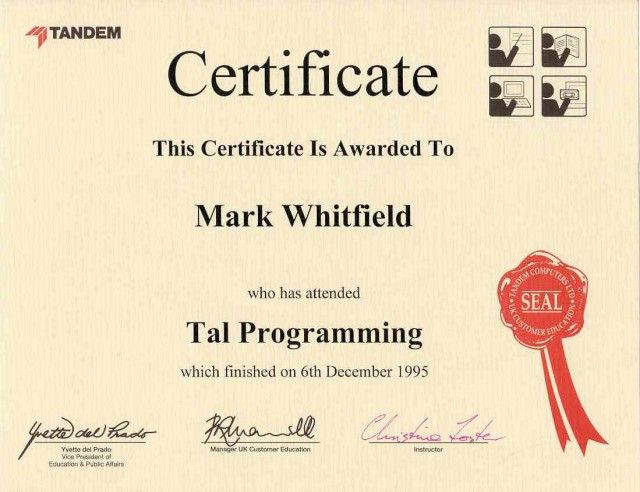
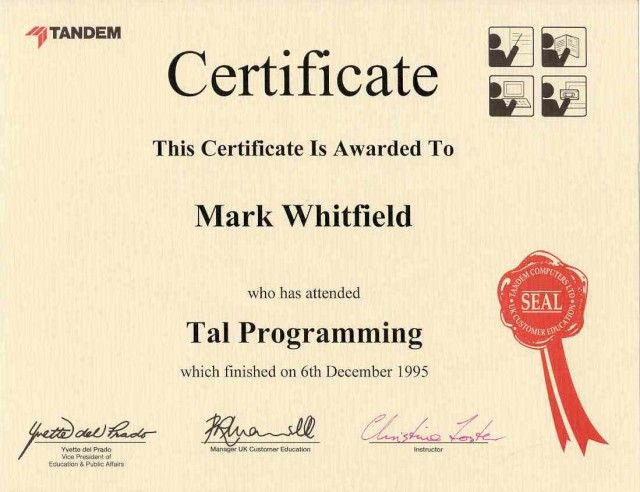
Tandem TAL Programming certificate back in 1995, Mark Whitfield
Overview of TAL Programming
Purpose: Developed to run on Tandem’s GUARDIAN operating system to build highly available, fault-tolerant transactional systems.
Characteristics: Procedural, block-structured, efficient (closer to assembly than C), and designed for speed and direct memory access, according to a NonStop Insider article.
Features: Strong support for data manipulation, process management, and message-based IPC (Inter-Process Communication) necessary for node-to-node replication, as described on the Wikipedia page on Tandem Computers.
Relation to TACL: While TAL is for creating compiled applications, TACL (Tandem Advanced Command Language) is the interpreter/macro language used for command procedures and system interaction, as explained in a Scribd document.
Historical Timeline of TAL
1975–1976 (Founding Era): TAL is created for the first Tandem/16 system shipped in 1976, heavily utilizing expertise from HP 3000 systems programming, according to a personal blog post.
Early 1980s (Expansion): TAL becomes the standard for ATM networks and banking systems, requiring high-reliability code, as seen in this blogger.com article.
1985 (Evolution): TAL is used to build complex OLTP environments, distinguishing it from nascent PC markets as noted in archived Tandem press clippings.
1990s (Native TAL): Introduction of “Native” TAL (T/TAL) to handle new architecture requirements and move from 16-bit to 32-bit environments, according to a TAL Programmer’s Guide document.
1997 (Compaq Merger): Tandem is acquired by Compaq; TAL continues as the core systems language.
2001 (HP Merger): Tandem (via Compaq) is acquired by HP, bringing TAL to the HP Integrity (Itanium) platform.
2010s–Present (Modernization): TAL applications are ported to HP Enterprise NonStop x86-64, with support for running TAL programs on Intel processors and in virtualized instances, according to a NonStop Insider article.
Present Day
TAL remains essential for maintaining legacy systems, but new applications often utilize C/C++ or Java on the modern NonStop platform, as noted in the Wikipedia page on Transaction Application Language.
TAL applications are still relevant due to the “single system image” and fault-tolerance features that define the current NonStop environment, according to the NonStop Insider article.
PTAL Overview and Timeline
Tandem PTAL (Portable Transaction Application Language) is a block-structured, procedural systems programming language used on HPE NonStop (formerly Tandem) servers. It is the portable successor to the original TAL (Transaction Application Language), designed to allow high-level systems programming without an assembler while maintaining near-machine efficiency.
Overview: TAL, PTAL, and epTAL
The language evolved to support different processor architectures over Tandem’s 50-year history:
TAL (Original): Designed for the 16-bit CISC stack machine architecture (TNS). It has the syntax of ALGOL/Pascal but the low-level semantics of C.
PTAL (Portable): Introduced during the migration to MIPS RISC processors (TNS/R). It removed machine-specific constructs to allow code to be compiled into native RISC instructions.
epTAL (Extended): Developed for the migration to Intel Itanium processors (TNS/E).
Historical Timeline by Year
Year Milestone
1974, Tandem Computers founded by James Treybig; initial design of the Tandem/16 hardware begins.
1976, TAL released. The Tandem/16 (NonStop I) ships with TAL as its only programming language.
1981, NonStop II introduced, adding 32-bit addressing support to TAL via an “extended data segment”.
1983, NonStop TXP launched; first major reimplementation of the instruction set architecture supported by TAL.
1986, NonStop VLX introduced with 32-bit data paths; NonStop SQL released, often managed via TAL-based systems.
1989, NonStop Cyclone released, the high-end mainframe competitor for the TAL environment.
1991, PTAL Development starts with the release of Cyclone/R, the first MIPS-based machine. TAL code is initially translated via an “Accelerator” tool before native PTAL compilers take over.
1993, Himalaya K-series released; native mode operating system (NSK) and native compilers (PTAL) become standard.
1997, Compaq acquires Tandem. Migration begins from MIPS to Alpha (later abandoned).
2002, HP merges with Compaq. Development focuses on the Itanium (TNS/E) architecture.
2005, epTAL introduced for the new Integrity NonStop i servers based on Intel Itanium microprocessors.
2014, x86 Migration. NonStop X (TNS/X) systems are released, transitioning the TAL/PTAL environment to Intel x86-64 processors.
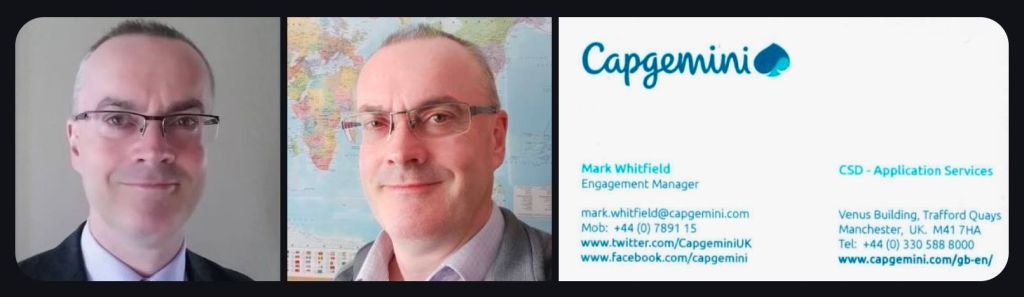
Mark Whitfield is a Senior IT Project Manager and Engagement Manager with over 30 years of experience in the software development lifecycle (SDLC). He is currently a SC-cleared Engagement Manager at Capgemini UK.
Professional Background by Era
1990–1995: Early Programming (The Software Partnership/Deluxe Data)
Role: Programmer/Lead Analyst.
Focus: Developed electronic banking software (sp/ARCHITECT-BANK) on Tandem Mainframe Computers (now HPE NonStop).
1995–2013: Senior Development & Product Management (Insider Technologies)
Role: Progressed from Senior Programmer to Project Manager for Strategic Technical Initiatives.
Focus: Developed platform health and diagnostic modules for the “Reflex” monitoring product.
2013–2014: Project Management (Wincor Nixdorf)
Role: Project Manager, Professional Services – Banking Division.
Focus: Managed the Wincor Nixdorf workstream for Lloyds Banking Group’s Self-Service Software Replacement (SSSR) programme.
2014–2016: Digital Project Management (Betfred)
Role: Senior Digital Project Manager, Online and Mobile Division.
Focus: Delivered payment gateways, sportsbooks, and virtual gaming components for iOS, Android, and Windows.
Focus: Leading digital transformation and cloud migration projects for public and private sector clients.
Technologies & Frameworks
Project Methodologies: Agile SCRUM, PRINCE2 (Practitioner), Waterfall, ITIL, and ISO QA.
Mainframe & Infrastructure: HPE NonStop (Tandem), IBM ESB, UNIX shell scripting, and Cloud (MS Azure/AWS).
Programming & Databases: C/C++, MS SQL, Java, COBOL85, TAL, TACL, and SCOBOL.
Tools: MS Project, MS Excel/Office, MuleSoft Anypoint Platform, and Jira.
Major Projects & Customers
UK Government: Managed a £13.5m cloud migration of 130 applications and the £1m+ Fish Export Service (FES) to CHIP portal.
Royal Mail Group (RMG): Managed a £4.3m data centre migration project involving over 1,100 interfaces.
Lloyds Banking Group (LBG): Led a £5m+ self-service software replacement project.
Other Notable Clients: Jaguar Land Rover (JLR), Heathrow, NATS (Air Traffic Control), Barclays, HSBC, Deutsche Bank, and Euroclear.
Awards & Education
Awards:
C&CA UK’s Communications & Engagement Award (2022) at Capgemini UK.
Project Recognition Award from Wincor Nixdorf for achievements on the LBG SSSR project.
Education:
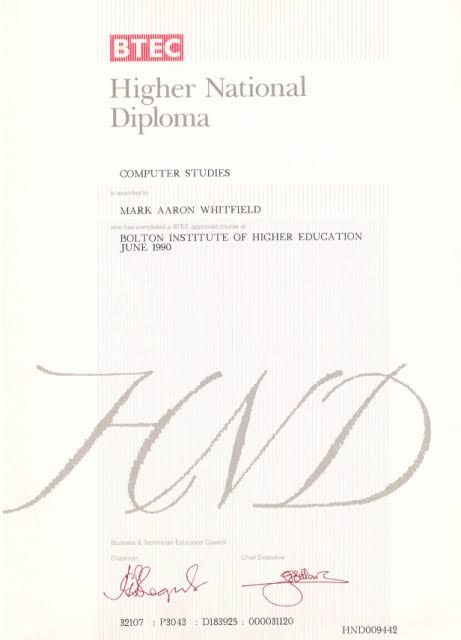
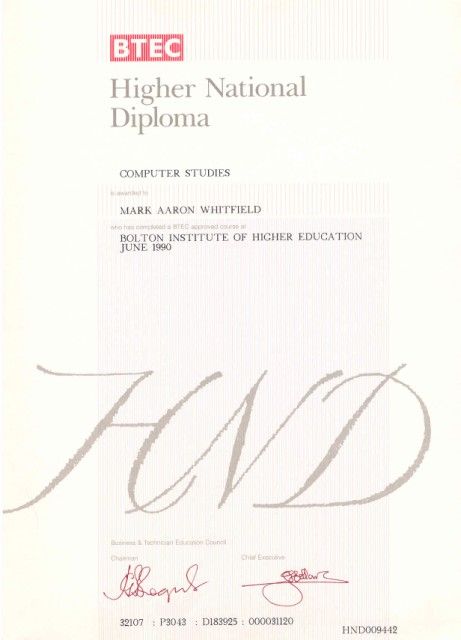
HND in Computer Studies (Distinction) from the University of Greater Manchester (formerly BIHE), 1988–1990.
A-Levels in Computer Science and Biology from Leigh College.
Project Management Templates
Whitfield provides a library of over 200 editable resources through his site, PROject Templates, designed for Agile, Waterfall, and PRINCE2 7th Edition delivery. Key items include:
Plan on a Page (POaP): Over 35+ executive-level summary slides.
Detailed Project Plans: Templates in MS Project (MPP) and Excel for SDLC tracking.
RAID Logs: Comprehensive registers for risks, actions, issues, and dependencies.
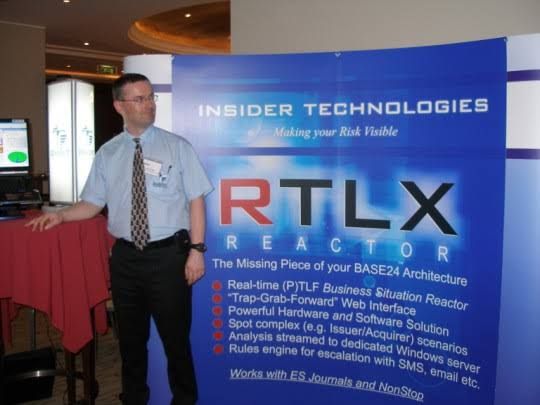
Insider Technologies RTLX (now C-Deep (Transaction Monitoring) https://etinet.com/products/c-deep-transaction-monitoring/ ) is a real-time monitoring and tracking solution designed to provide end-to-end visibility for high-volume electronic payments and transactional processes. It specifically ensures that every stage of a payment—from the initial card “tap” at a point-of-sale (POS) terminal to the final movement of funds from an account—is monitored to maintain operational continuity.
RTLX Overview
Function: Real-time transaction and payment monitoring.
Platforms: Runs on HP NonStop, Windows, Linux, and Unix.
Core Value: Simplifies “Big Data” for IT operations by alerting teams to potential failures before they impact consumers (e.g., preventing ATM or online banking outages).
Key Use Case: Used by major financial institutions like the Bank of England and Royal Bank of Scotland for settlement and transaction security.
RTLX Historical Timeline
The development of RTLX is closely tied to Insider Technologies’ growth as a specialist in mission-critical HP NonStop environments.
1990s: The company establishes its “DNA” in the HP NonStop (Tandem) platform, developing core products like MultiBatch and Reflex.
1995: Insider begins a period of rapid growth, providing technical support for critical UK financial infrastructure, including Euroclear (formerly CRESTCo), which settles 88% of UK equities.
The Expansion Era (2001–2014)
2002: Launch of the state-of-the-art Systems Training Platform, featuring 4x patented cloning technology for hyper-realistic simulations.
2004–2013: Development of the Reflex suite (Reflex 80:20 and Reflex ONE24) and the introduction of Sentra and RTLX Reactor monitoring products.
2014: Insider expands its product initiatives to include diagnostic and trending solutions for real-time electronic payments, solidifying the role of RTLX in global banking.
The Acquisition & Integration Era (2015–Present)
2015: ETI-NET acquires Insider Technologies on 1 July, integrating its monitoring expertise with ETI-NET’s mainframe storage and backup solutions.
2019: Insider celebrates its 30th year of operations, highlighting RTLX’s role in monitoring modern POS and “tap” payment systems.
2023–Present: Insider becomes part of the PartnerOne group, a global family of mission-critical software companies, further scaling its threat detection and real-time monitoring capabilities.
RTLX by Insider Technologies, Overview and Timeline by Year
BASE24 is the world’s most widely used payment processing platform, developed by ACI Worldwide. Originally designed for ATM networks, it evolved into a comprehensive system for acquiring, authenticating, and routing card-based and digital transactions across various channels. It is known for its high-performance, fault-tolerant architecture, processing nearly 50% of the world’s electronic transactions at its peak.
Comprehensive Timeline by Era
Era 1: Foundations & The Rise of BASE24 Classic (1975–1990s)
This era focused on high-availability software for the emerging automated banking industry, specifically for Tandem NonStop servers.
1975: ACI founded in Omaha, Nebraska, to develop software for the new “NonStop” server computers used by banks and stock exchanges.
1981: Secured its first international client, an Australian bank, marking the start of global expansion.
1982:Launch of BASE24, the first global product designed for 24-hour system operations, originally focused on ATM networks.
1986: Rapid growth led to 131 customers across 14 different countries.
Era 2: Expansion & Public Transition (1995–2000s)
The platform expanded into Point of Sale (POS) and branch systems while the company underwent major structural changes.
1995: The company went public on NASDAQ as Transaction Systems Architects (TSA).
1997: Officially adopted the name ACI Worldwide.
Early 2000s: Introduction of BASE24-es (later renamed BASE24-eps), a next-generation platform using C++ and object-based architecture to replace the legacy monolithic design.
Era 3: Modernisation & The “eps” Shift (2005–2015)
ACI shifted focus toward BASE24-eps, a more flexible, open-architecture version designed for multi-channel transaction processing.
2005: ACI launches BASE24-eps, featuring a modular engine capable of processing approximately 2,000 transactions per second (TPS) with extremely low latency.
2007: TSA officially rebranded all operations under the ACI Worldwide, Inc. (ACIW) name.
2008: Announced that BASE24 Classic would begin maturing in 2011, urging customers to migrate to the eps platform for better integration with modern systems like IBM System z.
2011–2012: Release of BASE24-eps 11.1, adding support for DB2 on IBM System p, enhanced EMV acquiring, and tools for easier migration from legacy BASE24.
Era 4: Cloud & Universal Payments (2015–Present)
The platform moved toward cloud-native capabilities and broader ecosystem integration.
2015: ACI celebrated its 40th anniversary, continuing to power electronic payments for over 6,000 organisations worldwide.
2018: Introduction of UP BASE24-eps on Linux in the Cloud, demonstrating significantly reduced Total Cost of Ownership (TCO) through public and private cloud deployment.
Present: BASE24 remains a core pillar of ACI’s portfolio, supporting traditional card, ATM, mobile commerce, and internet banking transactions.
BASE24-eps by ACI Worldwide timeline by era and year
BASE24-eps is a modular, high-availability payment processing engine developed by ACI Worldwide. It evolved from the original “BASE24 Classic” to provide a more flexible, open-system architecture for acquiring, authenticating, routing, and authorizing electronic transactions.
Base24-eps Overview
Architecture: Unlike the TAL-based Classic version, BASE24-eps uses an object-oriented design written primarily in C++ and Java.
Key Features:
Multi-Channel Support: Manages transactions from ATMs, POS terminals, mobile, and ecommerce.
Late 1970s: Development of the original BASE24 (now known as “Classic”), focused on high-uptime ATM processing.
1981: First international customer (an Australian bank) signs on, starting the global expansion of BASE24.
Transition & Development Era (2000 – 2005)
Early 2000s: ACI begins developing the “next generation” platform, initially called BASE24-es (extended systems), which later becomes BASE24-eps (enterprise payment system).
2003 – 2004: The product begins migrating to open architectures, moving away from platform-specific languages.
Mainstream Adoption Era (2006 – 2013)
2007: ACI highlights BASE24-eps as its strategic future platform in investor overviews.
2008: ACI announces the maturation of BASE24 Classic (ending standard maintenance in 2011), urging customers to migrate to BASE24-eps.
2009: IBM Redbooks releases technical guides for BASE24-eps 08.2 on z/OS, solidifying its place in enterprise banking.
2013: Release of BASE24-eps 2.0, introducing the “customer component” and enhanced service-enabling wrappers.
Mark Whitfield, an IT Project Manager specializing in HP NonStop systems, has a career and training history that spans over three decades, from his academic beginnings in the late 1980s to advanced cloud certifications in the 2020s.
Early Career & Foundations (1988–1995)
During this era, Whitfield focused on core computer science and specialized mainframe systems while working for The Software Partnership (TSP) and Deluxe Data.
1988–1990: Completed a Higher National Diploma (HND) in Computing at the Bolton Institute of Higher Education (BIHE). Modules included Computer Systems Architecture, Programming Methodology, and Data Processing.
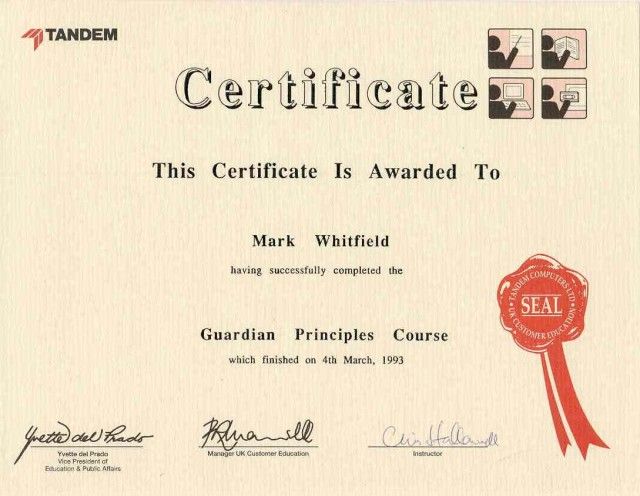
May 1993: Tandem Guardian Principles Course.
September 1994: VPS 7000/9000 Series and VPS Application Development (VOS 4.3).
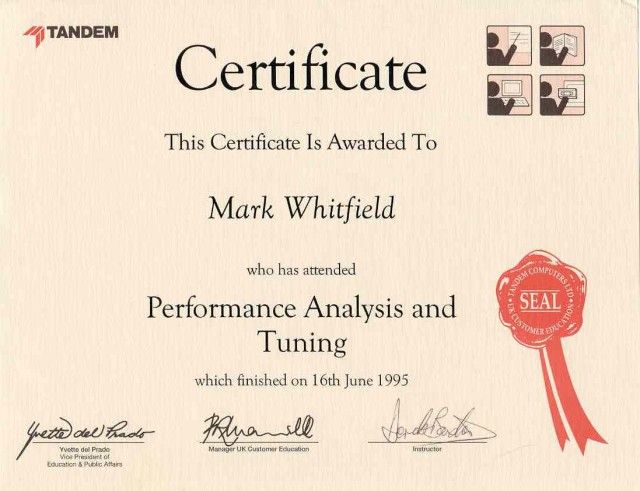
June 1995: HP NonStop (Tandem) Performance Analysis and Tuning.
Development & Technical Specialisation (1995–2005)
Working primarily with Insider Technologies Limited, this period was marked by software development training in languages like C++ and initial forays into project management.
November 1995: HP NonStop TAL Programming.
March 1997: C / C++ Programming at Comtec Computer Training.
October 1998: Managing Multiple Projects, Objectives, and Deadlines at SkillPath.
February 1999: Successful Project Management at SkillPath.
May 2000: Microsoft Project ’98 Certification (Orange Belt) at the IIL UK Education Centre.
February 2001: Sales and Marketing training (In-House).
March 2004: MultiBatch NSK Job Scheduling Product.
February 2005: Web Services and SOA.
Web Development & Security Focus (2006–2010)
This era shows a shift toward web-based technologies and specialized security products.
January 2006: PRINCE2 Project Management Foundation.
February 2006: NetObjects Fusion.
March 2006: Cryptography (In-House at Thales e-Security).
December 2006: Thales e-Security SafeSign Product.
January 2007: Developing Web Applications Using Microsoft Visual Studio .NET.
March 2009: Querying Microsoft SQL 2000 with Transact SQL (M2071) at QA Training.
May 2009: Writing for the Web and Website Visibility & Promotion at iTrain Education.
November 2009: Thales e-Security HP NonStop Security Resource Manager (SRM).
Agile & Advanced Management (2011–Present)
In his current era at companies like Betfred and Capgemini, Whitfield has prioritized professional certifications in management and cloud infrastructure.
May 2011: Agile SCRUM Training (RADTAC) and PRINCE2 Practitioner Certification (ILX Group).
June–July 2011: Java and Google Android programming using the Eclipse IDE.
January 2012: ITIL Foundation Course.
July 2014: Advanced Microsoft Excel 2013.
November 2017: Advanced Engagement Management Certification (Level 2) at Capgemini.
February 2022: AZ-900 Microsoft Certified Azure Fundamentals.
July 2024: Microsoft Excel Refresher 2024 via Udemy.
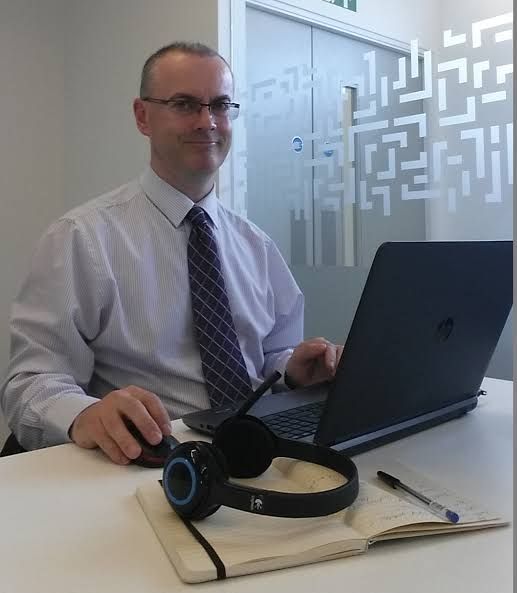
Mark Whitfield is a Senior, SC cleared IT Project and Engagement Manager with over 30 years of experience, specializing in the software development lifecycle (SDLC) for large-scale digital and financial payment systems.
Mark Whitfield is a Senior, SC cleared IT Project and Engagement Manager
Key Projects: Leading high-value digital transformations and cloud migrations for UK Government applications, automotive (Jaguar Land Rover), and aerospace (Air Traffic Management iOS apps).
2014–2016: Betfred Limited (UK)
Role: IT Senior Digital Project Manager, Online and Mobile Division.
Key Projects: Managed multiple Agile SCRUM projects for payment gateways, sportsbooks, and virtual gaming components across iOS, Android, and Windows platforms.
2013–2014: Wincor Nixdorf Limited (UK)
Role: Project Manager, Professional Services – Banking Division.
Key Projects: Managed a £5M+ workstream for Lloyds Banking Group’s Self-Service Software Replacement (SSSR) program, migrating legacy HP NonStop systems to AIX-based Oracle technologies.
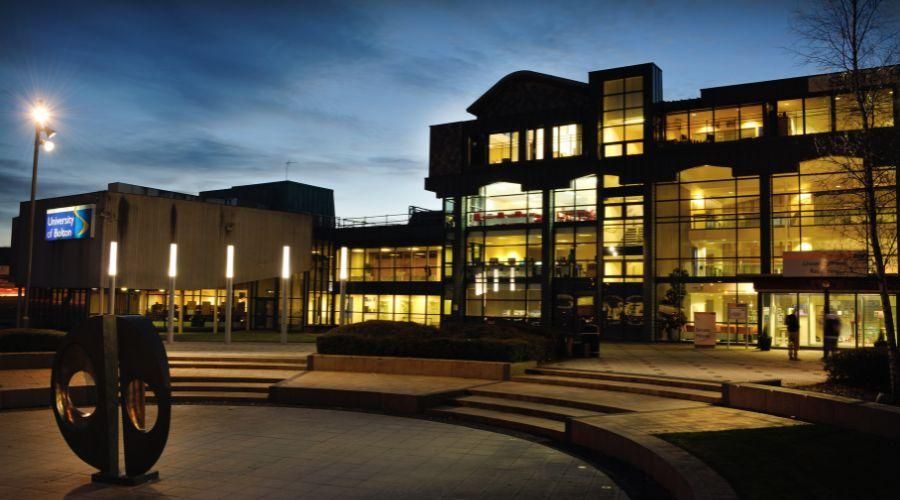
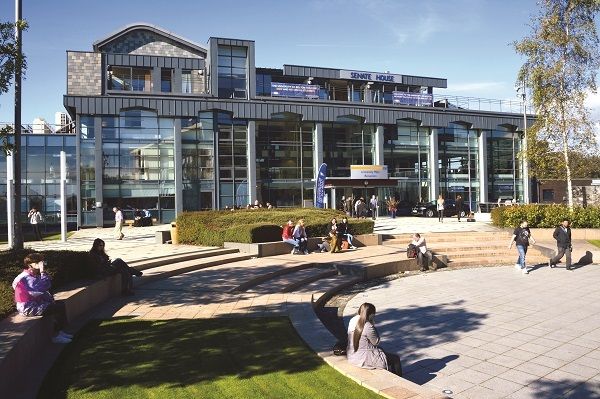
The Higher National Diploma (HND) in Computer Studies at the Bolton Institute of Higher Education (BIHE)—now the University of Greater Manchester—is a two-year, Level 5 vocational qualification designed to provide practical, industry-specific skills.
BIHE / University of Greater Manchester Evolution
The institution has undergone several name changes and status upgrades that affected the delivery of the HND:
1982: BIHE was formed through the merger of Bolton Institute of Technology and Bolton College of Education (Technical).
1992: The Institute was granted the power to award taught degrees.
2004/2005: BIHE achieved full university status, becoming the University of Bolton.
2024: The university rebranded as the University of Greater Manchester.
HND Computer Studies: Detailed Timeline
The course traditionally follows a two-year full-time or three-year part-time structure.
Year 1: Foundations (HE4 Level)
The first year focuses on establishing core technical and business knowledge. In many versions of the Bolton curriculum, Year 1 is common across several computing programmes to allow for flexible progression.
Core Modules:
Introduction to Programming: Developing fundamental coding logic.
Computer Platforms & Systems Architecture: Understanding the hardware and software environments.
Information Systems & Databases: The basics of data management.
Website Production & Networking Fundamentals: Introduction to web technologies and connectivity.
Quantitative Techniques & Business Studies: Integrating mathematical and commercial contexts.
Year 2: Specialisation (HE5 Level)
The second year shifts toward advanced application, systems analysis, and professional practice.
Advanced Modules:
Systems Analysis & Design: Producing system requirements and user interface specifications.
Programming Methodology: Moving into more complex application development.
Business Information Systems: Exploring how IT supports organizational requirements.
Final Year Project: A major 20-credit core project where students investigate a specific field and apply their cumulative skills to a real-world scenario.
Progression and Modern Standards
Academic Standing: Completion of the HND is equivalent to the first two years of a Bachelor’s degree (Level 5).
Modern HTQs: Current versions of the course, such as the HND Computing for England (HTQ), now integrate modern fields like Artificial Intelligence, Cloud Computing, and VR technologies.
1988 to 1990 : University of Greater Manchester (previously Bolton Institute of Higher Education – BIHE)Higher National Diploma (HND) in Computer Studies, Bolton Institute of Higher Education (BIHE)—now the University of Greater Manchester
HP NonStop (originally Tandem) training focuses on the platform’s unique fault-tolerant architecture, designed to ensure 24×7 availability and data integrity for mission-critical industries like finance and telecommunications. Current training is provided by HPE Education Services, which offers expert-led courses ranging from basic concepts to advanced system management and database administration.
Training Overview
HPE’s curriculum is structured to support IT teams at all levels—from beginners to experienced operators—and can be customised for specific business needs. Key training areas include:
System Operations: Managing NonStop environments, including S-Series or newer x86-based systems.


 PROject Templates