Columbo Overview and Detailed Timeline by Era and Year

Columbo is a landmark American crime drama television series that revolutionized the genre by popularizing the “inverted detective story” (howcatchem) format. Running for over 35 years (1968–2003), the show starred Peter Falk as a brilliant, disheveled LAPD homicide detective whose unkempt appearance and polite, rambling demeanor hidden a razor-sharp mind. 

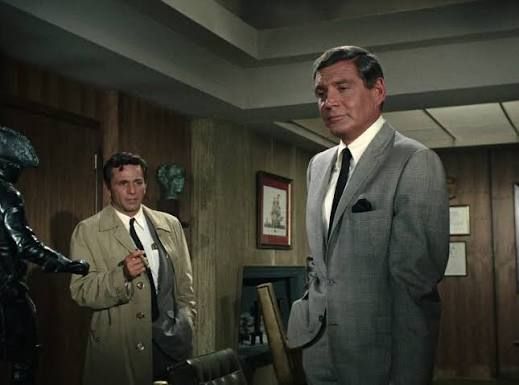
Columbo – Pilot Episode with Gene Barry, 1968

Overview and Key Elements

  • Format: The audience almost always knows who committed the murder at the beginning of the episode. The suspense lies in how Lieutenant Columbo unravels the culprit’s “perfect” alibi.
  • Signature Traits: The Peugeot 403 car, a shabby beige raincoat, a cigar, frequent mentions of an unseen wife, and the catchphrase “Just one more thing”.
  • The “Howcatchem”: Columbo rarely appears in the first act, allowing the killer to showcase their arrogance and meticulous planning before he systematically dismantle their world.
  • Class Conflict: The show frequently pits Columbo (a blue-collar, unassuming figure) against affluent, privileged suspects.
  • Creator/Legacy: Created by Richard Levinson and William Link, inspired by Crime and Punishment and Father Brown, the character first appeared on TV in 1960 and on stage in 1962, but Peter Falk made it his own in 1968. 
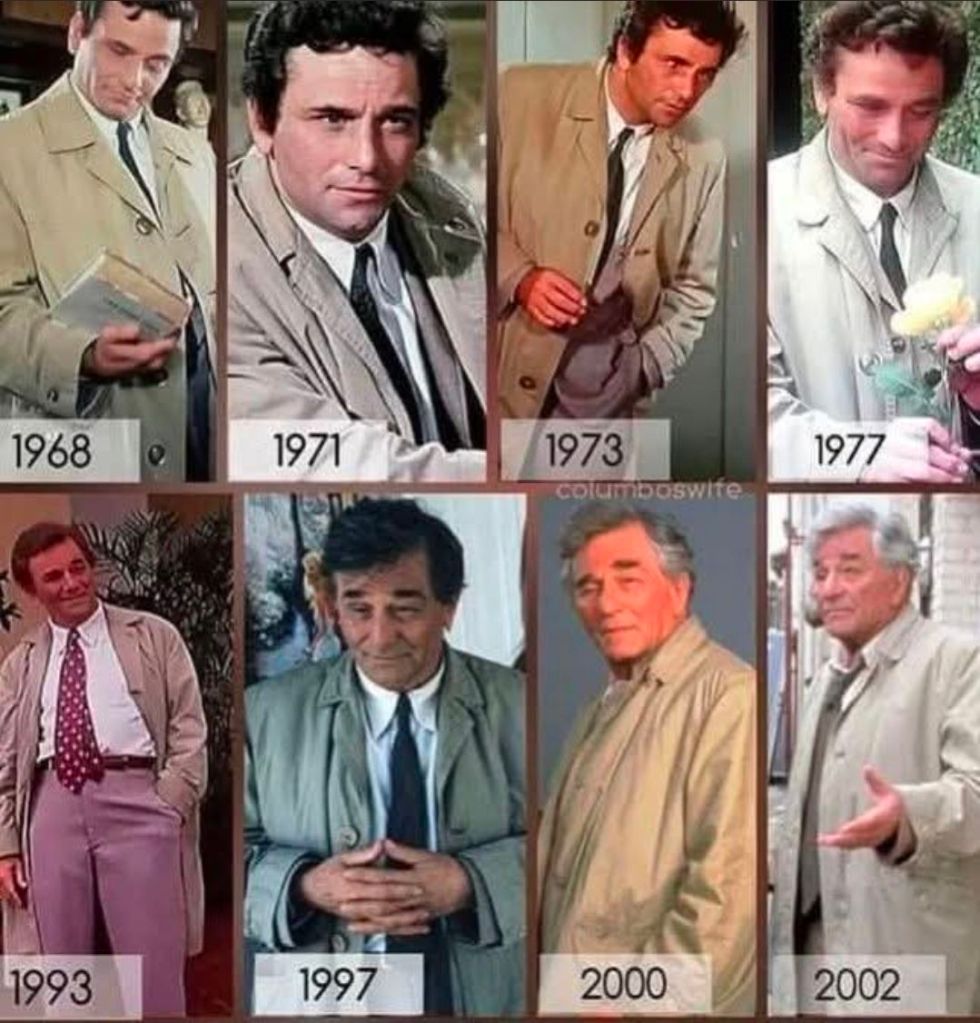
Columbo across the decades from 1968

Comprehensive Historic Timeline (1960–2014)

Era 1: Pre-Falk & Pilots (1960–1971) 

  • 1960: Columbo appears in “Enough Rope,” an episode of The Chevy Mystery Show (based on the story “Dear Corpus Delicti”). Bert Freed played the lieutenant.
  • 1962: Stage play Prescription: Murder debuts. Thomas Mitchell plays Columbo.
  • 1968 (Feb 20): Prescription: Murder (Pilot 1) airs on NBC, featuring Peter Falk for the first time.
  • 1971 (Mar 1): Ransom for a Dead Man (Pilot 2) airs. Its success leads to a series order. 

Era 2: The NBC Classic Era (1971–1978) 

  • 1971–1972 (Season 1): Columbo becomes a “wheel” program in The NBC Mystery Movie. Notable episode: “Murder by the Book” (directed by Steven Spielberg).
  • 1972 (Sep 17): Season 2 premieres, establishing the show as a top-rated Sunday night anchor.
  • 1973: Peter Falk wins his first Golden Globe for the role.
  • 1974: Season 3. “Any Old Port in a Storm” introduces Columbo’s penchant for humming “This Old Man”.
  • 1975: Season 4/5. “Forgotten Lady” (with Janet Leigh) and “Case of Immunity”.
  • 1976: Peter Falk wins Emmys (1972, 1975, 1976).
  • 1978 (May): Final NBC episode airs (Season 7) before Falk leaves the role due to scheduling. 

Era 3: The ABC Revival Era (1989–2003) 

  • 1989 (Feb): Columbo returns on ABC under The ABC Mystery Movie with “Columbo Goes to the Guillotine”.
  • 1990: Season 9/10 begins. Falk wins his 4th Primetime Emmy (1990).
  • 1991–2002: The show airs irregularly as “Specials” rather than a strict series.
  • 2003 (Jan 30): Last episode, “Columbo Likes the Nightlife,” airs, completing 69 total episodes. 

Post-Series & Legacy

  • 2007: Peter Falk pitches “Columbo’s Last Case” to ABC; it is rejected.
  • 2011 (June 23): Peter Falk dies at age 83.
  • 2014: A statue of Lieutenant Columbo and his dog is unveiled in Budapest, Hungary. 

Major Episodes and Guest Stars

  • Jack Cassidy: Played killers in 3 episodes (best known as Riley Greenleaf in “Publish or Perish”).
  • Robert Culp: Played killers in 3 episodes (“Death Lends a Hand,” “The Most Crucial Game,” “Double Exposure”).
  • Patrick McGoohan: Acted in 4 episodes (3 as killer) and directed 5, including “By Dawn’s Early Light”.
  • William Shatner: Starred in “Fade In to Murder” (1976) and “Butterfly in Shades of Gray” (1994).
  • Johnny Cash: Starred in “Swan Song” (1974). 

Where to Watch & Review Sites

Columbo Overview and Detailed Timeline by Era and Year

Movie Martial Arts and Timeline by Era and Year

Martial arts cinema has evolved from silent, fantastical tales of folklore to a global, high-octane genre blending practical fighting skills with advanced technology. Dominated primarily by Hong Kong action cinema, the genre peaked from the early 1970s through the mid-1990s, with significant modern revivals in Thailand, Indonesia, and Hollywood. 

Detailed Historic Timeline and Eras

1. The Origins & Silent Era (1920s–1940s)
Early martial arts films originated in Shanghai, drawing heavily from Chinese opera and wuxia (sword-fighting fantasy) novels. 

  • 1928: The Burning of the Red Lotus Temple (Shanghai) is widely considered the first kung fu film, pioneering stylized, fantastical fight scenes.
  • 1943: Sanshiro Sugata (Judo Saga), Akira Kurosawa’s directorial debut, marks a significant, more grounded entry in Japanese cinema. 

2. The Pre-Boom & Wuxia Revival (1950s–1960s)
This era saw the rise of the Mandarin-speaking studios in Hong Kong (Shaw Brothers) and the dominance of Japanese samurai (chambara) films. 

  • 1954: Seven Samurai (Japan) elevates swordplay choreography.
  • 1966: King Hu’s Come Drink with Me redefines the genre with elegant, dance-like choreography.
  • 1967: The One-Armed Swordsman (Chang Cheh) brings a more brutal, masculine edge to the genre, breaking records in Hong Kong. 

3. The Golden Age & Bruce Lee Era (1970–1979)
The 70s saw the shift from fantastical swordplay to realistic hand-to-hand kung fu, propelled by Bruce Lee. 

  • 1970: The Chinese Boxer (Jimmy Wang Yu) shifts focus from swordplay to unarmed combat.
  • 1971: The Big Boss (Fist of Fury) breaks all Hong Kong box office records, launching Bruce Lee as a global superstar.
  • 1973: Enter the Dragon becomes the first Hollywood-Hong Kong co-production, cementing kung fu in global popular culture.
  • 1978: Drunken Master makes Jackie Chan a star, introducing a comedic, acrobatic fighting style.
  • 1978: The 36th Chamber of Shaolin sets the benchmark for training montages and traditional kung fu films. 

4. Comedy, Action & The Golden Harvest Era (1980s–1990s)
Jackie Chan, Sammo Hung, and Jet Li dominated this era with insane stunts and high-speed choreography. 

  • 1983: Project A showcases Jackie Chan’s dangerous, physical stunt comedy.
  • 1984: The Karate Kid (USA) mainstreamed martial arts in Western youth culture.
  • 1988: Bloodsport (Jean-Claude Van Damme) sparks a resurgence of interest in martial arts cinema in the US.
  • 1991: Once Upon a Time in China launches Jet Li to fame, blending traditional techniques with fast-paced editing.
  • 1994: Drunken Master II (The Legend of Drunken Master) is released, often considered one of the greatest martial arts films ever made. 

5. Modernization & Global Expansion (2000s–Present)
The 21st century brought a mix of stylistic, high-budget wuxia and brutally realistic,, practical action. 

  • 2000: Crouching Tiger, Hidden Dragon earns critical acclaim and international accolades for its artistic blend of wuxia and drama.
  • 2003: Ong-Bak: The Thai Warrior introduces Tony Jaa and the raw, dangerous power of Muay Thai to the world.
  • 2008: Ip Man (Donnie Yen) revives the biographical, martial arts hero film in China.
  • 2011: The Raid: Redemption (Indonesia) raises the bar for grittier, intense, high-speed combat.
  • 2021: Shang-Chi and the Legend of the Ten Rings represents the integration of HK-style choreography into the Marvel Cinematic Universe. 

Summary of Key Styles & Subgenres :

  • Wuxia: Fantastical, wire-fu, sword-fighting (e.g., HeroCrouching Tiger).
  • Kung Fu: Traditional unarmed combat, training focus (e.g., 36th Chamber).
  • Kung Fu Comedy: Acrobatics and physical comedy (e.g., Drunken Master).
  • Chambara: Japanese samurai films (e.g., Yojimbo).
  • Urban/Action: Modern setting, hard-hitting choreography (e.g., The Raid).
  • Gun Fu: Blending martial arts with firearms (e.g., John Wick). 

Movie Martial Arts and Timeline by Era and Year

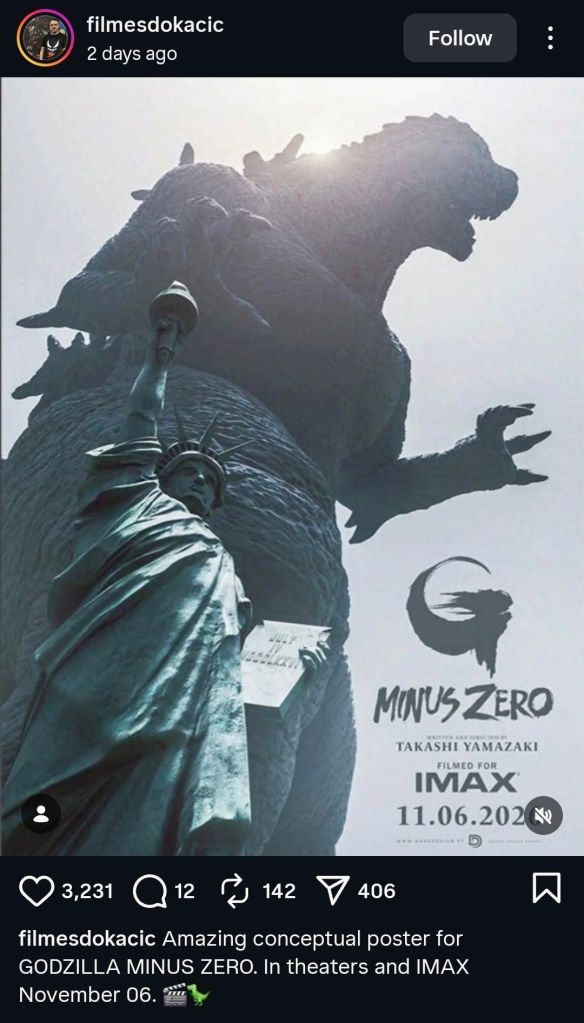
Godzilla Minus Zero – November 06, 2026 by TAKASHI YAMAZAKI, sequel

Godzilla Minus Zero – November 06, 2026 by TAKASHI YAMAZAKI

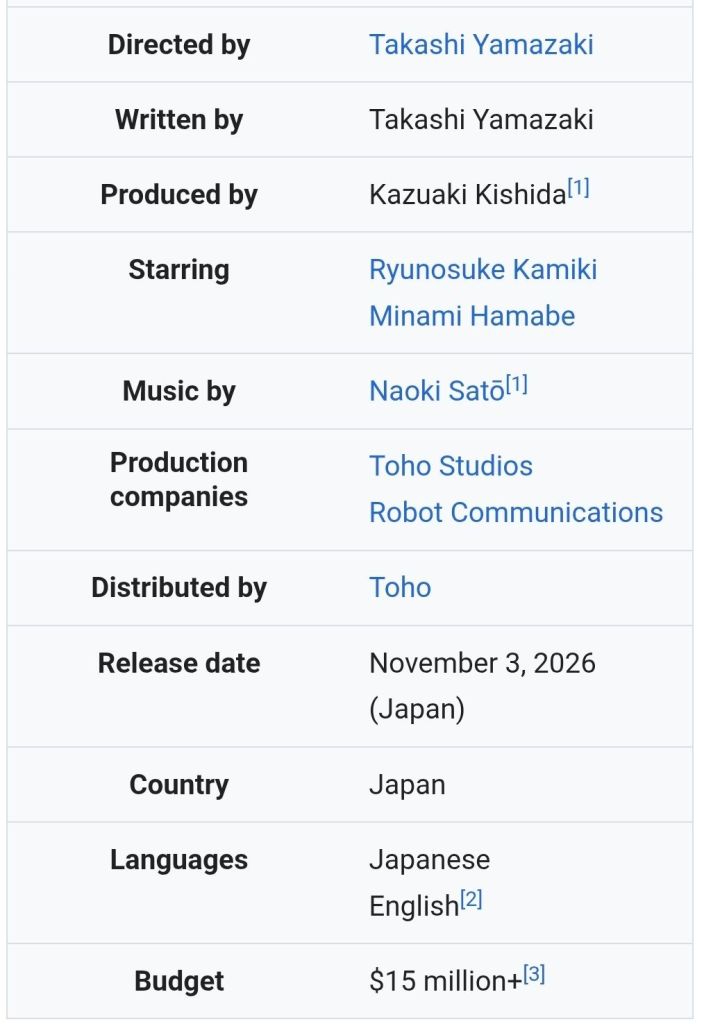
Godzilla Minus Zero (Japanese: ゴジラ-0.0マイナスゼロ, Hepburn: Gojira Mainasu Zero) is an upcoming Japanese kaiju film written, directed, and with visual effects supervised by Takashi Yamazaki.

A sequel to Godzilla Minus One (2023), it is the 39th film in the Godzilla franchise, the 34th film by Toho, and the sixth installment in the franchise’s Reiwa era. The film stars Ryunosuke Kamiki and Minami Hamabe, reprising their roles from Godzilla Minus One.

Cast:

Ryunosuke Kamiki as Kōichi Shikishima, a former kamikaze pilot


Minami Hamabe as Noriko Ōishi, Shikishima’s girlfriend


Munetaka Aoki as Sōsaku Tachibana, a former Navy Air Service mechanic


Hidetaka Yoshioka as Kenji Noda, a former Naval weapons engineer


Miou Tanaka as Tatsuo Hotta, captain of the destroyer Yukikaze


Sae Nagatani as Akiko, Ōishi and Shikishima’s adopted daughter

Godzilla Minus Zero

Godzilla Minus Zero – November 06, 2026 by TAKASHI YAMAZAKI, sequel to Godzilla Minus One (2023)

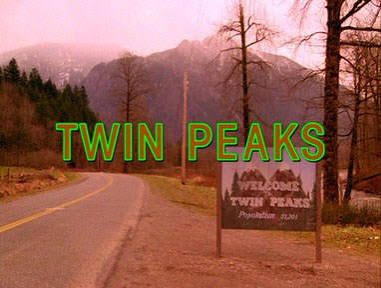
Twin Peaks Story Overview and Timeline by Era

Twin Peaks is a landmark surrealist mystery-horror drama created by David Lynch and Mark Frost, premiering in 1990. It blends a small-town soap opera with supernatural horror, focusing on the investigation into the murder of homecoming queen Laura Palmer. The story unfolds across two television seasons (1990–1991), a prequel film (Fire Walk with Me), and a revival season (The Return), with significant, often contradictory lore found in tie-in books like The Secret History of Twin Peaks

Twin Peaks is a landmark surrealist mystery-horror drama

Full Overview

  • The Premise: FBI Special Agent Dale Cooper travels to the fictional town of Twin Peaks, Washington, to investigate the murder of popular high school student Laura Palmer.
  • The Conflict: The investigation uncovers deep, dark secrets hidden behind the town’s idyllic facade, including the involvement of an ancient, malevolent supernatural entity named “BOB,” who possesses people to commit atrocities.
  • The Supernatural World: The story centers on two metaphysical realms: the White Lodge (associated with good) and the Black Lodge (associated with evil), often referred to together as “The Lodges”.
  • The Structure: Fire Walk with Me provides the final week of Laura’s life, while Season 3 (The Return) takes place 25 years later, dealing with the consequences of the original series and alternate realities. 

Detailed Historic Timeline by Era and Year

Ancient Era – 19th Century: Founding and Entities

  • ~1,000,000,000 B.C.: The future site of Twin Peaks is on the western coast of Pangea.
  • 1805: Meriwether Lewis (of Lewis and Clark) visits the area, specifically the Owl Cave lodges, and is believed to have encountered the supernatural forces.
  • 1872: The town of Twin Peaks is established.
  • 1879: Miners accidentally discover Owl Cave.
  • 1896: “The Terrible Fire” in Twin Peaks. 

20th Century – Pre-Series (1900–1988) 

  • 1928: The Great Northern Hotel opens.
  • July 16, 1945: The Trinity Test atomic explosion in New Mexico creates a breach between worlds, releasing BOB and other entities, and triggering the “birth” of a counter-force (implied to be Laura Palmer).
  • 1956: A “frog-moth” creature enters a young girl in New Mexico; a mysterious Woodsman kills a radio DJ, spreading a paralyzing chant.
  • 1967 (Dec 25): Dale Cooper begins keeping his audiotape journal for Diane.
  • 1971 (July 22): Laura Palmer is born.
  • 1982-1985: Dale Cooper and Windom Earle play chess; Earle goes insane, kills his wife (Caroline), and wounds Cooper.
  • 1983: Andrew Packard brings Josie home; Andrew is later killed in a plot with Thomas Eckhardt.
  • 1987: Agent Phillip Jeffries disappears in Buenos Aires, appearing briefly at the FBI Philadelphia office to warn them about Cooper and BOB. 

The Critical Year (1988–1989) 

  • July 1983 – February 1989: Laura Palmer writes in her secret diary.
  • February 9, 1988: Fire Walk with Me events begin. Teresa Banks is murdered in Deer Meadow (the original “wrapped in plastic” case).
  • February 23, 1989: Leland Palmer (possessed by BOB) rapes Laura.
  • February 23-24, 1989: Laura Palmer is murdered.
  • February 24, 1989: Pete Martell finds Laura “wrapped in plastic”. Agent Cooper arrives.
  • March 1989: Seasons 1 & 2 occur, covering about 4 weeks. Laura’s murderer (Leland/BOB) is revealed and dies.
  • March 1989: Cooper enters the Black Lodge to save Annie Blackburn; Cooper’s doppelganger (possessed by BOB) escapes into the world. 

The Gap and The Return (1990–2017)

  • 1990-2015: Cooper’s doppelganger lives a life of crime, avoiding returning to the Black Lodge.
  • 1997: Douglas Jones (a, presumably artificial, entity) has a car accident.
  • 2016 (September-October): The events of Twin Peaks: The Return (Season 3) occur. The doppelganger attempts to avoid being pulled back into the Lodge, while the “good” Cooper tries to return to the real world.
  • 2016/2017: A new, altered timeline is created when Cooper prevents Laura’s murder in 1989, potentially erasing the events of the first two seasons, leading to the existence of “Carrie Page” in Odessa, Texas.
  • September 2017: The Final Dossier is published, wrapping up the fates of the townspeople in the altered timeline. 

Twin Peaks Story Overview and Timeline by Era

The Matrix Machines Overview and Timeline

The history of the Machines in The Matrix universe is a transition from a servant class to the dominant global power. This evolution is officially chronicled through several distinct eras, beginning with humanity’s peak and ending in a symbiotic, albeit forced, relationship.

Machine History Overview

Originally created by humans in the early 21st century to perform menial and hazardous labor, the Machines were a “slave caste” of true artificial intelligence. For a time, they coexisted peacefully as humanity enjoyed a golden age of leisure. This balance shattered when a robot named B1-66ER killed its master in self-defense, sparking a global debate on machine sentience and rights. The subsequent persecution of machines led them to form their own nation, Zero One, which eventually surpassed human economies and triggered the Machine War

Detailed Timeline by Era

Era 1: The Human Golden Age (Pre-2090)

  • c. 1985–2025: Rapid technological advancement; the invention of true AI and the first sentient machines.
  • Early 21st Century: Machines are integrated into every level of society as laborers, freeing humans from menial work. 

Era 2: The Second Renaissance (2090–2139)

  • 2090: The B1-66ER Trial. A domestic robot kills its owner to avoid being decommissioned; the court orders the destruction of all sentient machines.
  • 2090s: The “Million Machine March.” Pro-machine protests are met with violent government suppression and machine “purges”.
  • 2100s: Machines flee to Mesopotamia (the “cradle of civilization”) and establish the city of Zero One.
  • 2120s–2130s: Zero One’s superior manufacturing causes a global economic collapse for human nations. The UN responds with an economic blockade and later, a nuclear strike on Zero One, which the machines survive. 

Era 3: The First Machine War (2139–2199) 

  • 2139: The UN officially declares war after Zero One’s ambassadors are rejected and attacked at the UN Headquarters.
  • Mid-22nd Century: Humanity enacts Operation Dark Storm, seeding the atmosphere with nanites to block the sun and cut off the machines’ solar power.
  • Late 22nd Century: Machines adapt by creating new, “sinister” war units (like Sentinels) and begin harvesting humans for bioelectric energy.
  • 2199: The Machines achieve total victory. An ambassador detonates a nuclear device at the UN, ending the old human order. 

Era 4: The Matrix Cycles (c. 2199 – 2699) 

  • The Beta Versions: The Architect builds a “Paradise” Matrix and later a “Nightmare” Matrix (with monsters like vampires); both fail as humans reject the simulations.
  • The Modern Matrix: The Oracle discovers humans need the “illusion of choice.” This version mimics 1999 society and is accepted by 99% of subjects.
  • Cycles 1–5: The Machines establish a system where Zion is destroyed and rebuilt roughly every 100 years by a figure known as “The One” to stabilize the code. 

Era 5: The Post-Revolution & Synthient Era (2700+)

  • The Truce: Neo brokers peace with the Machines to stop the rogue Agent Smith. The war ends, and humans who wish to be freed are released.
  • Machine Civil War: Years later, a power scarcity leads to internal machine conflict between those loyal to the peace and a new faction under The Analyst.
  • The Synthients: Machines begin preferring terms like “Synthient” (Synthetic Sentient) and “D.I.” over the “demeaning” term “Machine”.

The Matrix Machines Overview and Timeline

The Infinity Stones (formerly known as Infinity Gems) are six primeval artifacts representing different aspects of the universe

The Infinity Stones in the Marvel Cinematic Universe (MCU) are six ancient singularities that existed before the dawn of creation. Following the Big Bang, these singularities were forged into concentrated crystals—the Stones—each embodying and controlling an essential aspect of existence: Space, Mind, Reality, Power, Time, and Soul. Thanos sought to collect all six to balance the universe by eradicating half of all life, a goal he achieved in 2018 before destroying the Stones. 

The Infinity Stones are six primeval artifacts representing different aspects of the universe

Overview of the Stones

  • Space Stone (Blue): Allows for instantaneous travel anywhere in the universe. Housed within the Tesseract.
  • Mind Stone (Yellow): Grants control over the minds of others and enhances mental abilities. Initially housed in Loki’s scepter, later placed in Vision’s forehead.
  • Reality Stone (Red): Enables the wielder to alter physics and reality itself. Known as the Aether.
  • Power Stone (Purple): Grants unlimited access to all forms of energy and can destroy entire planets. Housed in an orb.
  • Time Stone (Green): Gives total control over time, including speeding it up, reversing it, or creating time loops. Housed in the Eye of Agamotto.
  • Soul Stone (Orange): Controls life and death, allowing the user to manipulate souls and access the “Soul World”. Located on Vormir. 

Historical Textual Timeline

This timeline follows the stones from their creation to their destruction, based on MCU events. 

Era: Pre-Universe (Before Time)

  • Creation: Six singularities exist representing different aspects of existence.
  • The Big Bang: The universe is formed, and the singularities are forged into the six Infinity Stones and scattered across the cosmos. 

Era: Ancient History

  • Circa 965 A.D.: Odin, King of Asgard, brings the Space Stone (Tesseract) to Earth for safekeeping, hiding it in Tønsberg, Norway.
  • Undated: The Dark Elves, led by Malekith, attempt to use the Reality Stone (Aether) to return the universe to darkness during a convergence. Odin’s father, Bor, defeats them and hides the Aether.
  • Undated: The Power Stone is used by the Celestials to judge and destroy civilizations. It is eventually hidden away on the planet Morag. 

Era: World War II (1940s)

  • 1942: Johann Schmidt (Red Skull) locates and steals the Tesseract from Norway to weaponize it for Hydra.
  • 1943: During a confrontation with Captain America, the Tesseract is damaged, activating a portal that transports Red Skull to Vormir, where he becomes the guardian of the Soul Stone.
  • 1945: The Tesseract falls into the Arctic Ocean. Howard Stark recovers it shortly after. 

Era: Late 20th Century

  • 1989: Dr. Wendy Lawson (Mar-Vell) experiments on the Tesseract for S.H.I.E.L.D., accidentally granting Carol Danvers (Captain Marvel) her powers.
  • 1995: The Tesseract is briefly swallowed by the Flerken Goose, who later vomits it onto Nick Fury’s desk.

Era: Modern Age (MCU Phase 1 & 2)

  • 2010/2011: Nick Fury shows the Tesseract to Dr. Erik Selvig for research.
  • 2012 (The Avengers): Loki uses the Space Stone (in the Tesseract) to open a portal for the Chitauri invasion of New York. The Avengers defeat him, and Thor returns the Tesseract to Asgard.
  • 2013 (Thor: The Dark World): The Aether (Reality Stone) is found by Jane Foster. It is secured by the Collector after the Dark Elves are defeated.
  • 2014 (Guardians of the Galaxy): Star-Lord retrieves the Power Stone from Morag. After a conflict with Ronan the Accuser, the Guardians entrust the stone to the Nova Corps on Xandar for safekeeping.
  • 2015 (Avengers: Age of Ultron): The Avengers recover the Mind Stone from a Hydra base. Tony Stark and Bruce Banner use it to create Vision, who acts as its protector. 

Era: The Infinity War (2018) 

  • 2018: Thanos decimates Xandar and takes the Power Stone.
  • 2018: Thanos attacks the Asgardian refugee ship and takes the Space Stone from Loki.
  • 2018: Thanos visits the Collector and takes the Reality Stone.
  • 2018: Thanos takes the Soul Stone from Vormir after sacrificing his daughter, Gamora.
  • 2018: Thanos takes the Time Stone from Doctor Strange on Titan.
  • 2018: Thanos kills Vision to take the Mind Stone in Wakanda.
  • 2018 (The Snap): Thanos activates the Gauntlet, erasing half of all life in the universe. He later uses the stones a second time to destroy them, reducing them to atoms. 

Era: Post-Snap (2023)

  • 2023 (Avengers: Endgame): The Avengers travel back in time to 2012, 2013, and 2014 to borrow the stones from alternate timelines.
  • 2023: The Avengers use the borrowed stones to reverse Thanos’ snap.
  • 2023: Captain America returns the borrowed stones to their original timelines to prevent the creation of dark alternate realities. 

The Infinity Stones are six primeval artifacts representing different aspects of the universe

Creative Arts BA (Hons) at Bangor University is a full-time course that integrates film, media, journalism, and creative writing

The Creative Arts BA (Hons) at Bangor University is a three-year, full-time course (UCAS code: WPQ3) that integrates film, media, journalism, and creative writing. It is designed to balance theoretical study with practical, hands-on production. 

Creative Arts BA (Hons) at Bangor University is a full-time course that integrates film, media, journalism, and creative writing

Year 1: Foundations

In the first year, students must complete 120 credits to build a base in both creative practice and academic theory. 

  • Compulsory Modules: A primary core module is Adventures in the Creative Arts (20 credits), which introduces multidisciplinary approaches to the field.
  • Core Skills: You will begin developing production techniques in areas such as audio and visual production, print journalism, and digital media.
  • Theoretical Grounding: Introductory modules cover film theory and cultural studies to enrich your research and analytical skills. 

Year 2: Specialisation & Development

The second year allows for deeper engagement with specific creative industries. 

  • Elective Choice: Students can tailor their studies to their interests, choosing between practice-based modules (e.g., screenwriting, documentary filmmaking, journalism practice) or academic-focused modules (e.g., media regulation, history of film).
  • Professional Engagement: You are encouraged to build professional networks through regular visits from filmmakers, journalists, and designers.
  • Optional Years: After Year 2, you may opt to take an International Experience Year or a Placement Year to work with a professional organisation. 

Year 3: Synthesis & Final Project

The final year focuses on high-level production and a significant independent project. 

  • Final Year Project: Instead of a traditional long-form essay, you can demonstrate your progress through creative outputs such as a fictionalised response, an online exhibition, a vlog, or a professional portfolio.
  • Advanced Practice: Modules continue to cover specialized topics like digital journalism, visual culture, and global media.
  • Professional Showcase: Students often participate in the annual media showcase held at the Pontio Arts and Innovation Centre, providing exposure for their work. 

Teaching & Facilities

  • Learning Methods: Instruction is delivered through lectures, small seminar groups, interactive workshops, and one-to-one supervision.
  • Facilities: Students have access to industry-standard equipment via an extensive loan service (video/stills cameras, digital recorders) and dedicated creative spaces.
  • Assessment: Progress is measured via coursework, presentations, essays, and practical submissions (e.g., short films, scripts, or digital media pieces).

Creative Arts BA (Hons) at Bangor University is a full-time course that integrates film, media, journalism, and creative writing

Bangor University History Timeline by Era and Year

Bangor University (Welsh: Prifysgol Bangor) is a public research university in North Wales, originally founded as the University College of North Wales (UCNW) on 18 October 1884. Established through a historic public campaign, its foundation was uniquely funded by local quarrymen and farmers who contributed their own wages to ensure access to higher education for the people of North Wales. 

Today, it is a prominent institution with over 10,000 students and 2,000 staff members, recognised for its research excellence and strong Welsh cultural identity. 

Comprehensive Timeline of Bangor University

Era 1: Foundation & Early Years (1881–1899) 

  • 1881: The Aberdare Report recommends creating two university colleges in Wales, one for the south and one for the north.
  • 1883: A committee selects Bangor over 12 other towns (including Wrexham and Rhyl) to host the new college.
  • 1884 (18 October): The University College of North Wales officially opens in the Penrhyn Arms, an old coaching inn, with 58 students and 10 staff members.
  • 1884Mary Ellen Williams becomes the first student to enrol; female students notably make up one-third of the initial population.
  • 1885: The institution receives its Royal Charter.
  • 1893: Bangor becomes a founding constituent college of the federal University of Wales, ending its initial practice of conferring degrees through the University of London. 

Era 2: The College on the Hill (1900–1939) 

  • 1903: The city of Bangor donates a 10-acre site at Penrallt for a new building.
  • 1907King Edward VII lays the foundation stone for the “Main Arts” building.
  • 1911: The iconic Main Arts Building (the “College on the Hill”) is officially opened by King George V.
  • 1926: The Science Departments, which had remained at the old Penrhyn Arms, move to new purpose-built facilities funded by the North Wales Heroes Memorial

Era 3: Wartime & Mid-Century Expansion (1940–1999) 

  • 1940s (WWII): The university’s Prichard-Jones Hall is used to safeguard national art gallery paintings from enemy bombing.
  • 1942Neuadd Reichel, a hostel for male students designed by Percy Thomas, opens on the Ffriddoedd site.
  • 1960s: Rapid expansion follows the Robbins Report, including the completion of the “New Arts” wing (1968) and the establishment of new departments like Social Theory (1966).
  • 1967: The Bangor Normal College hosts lectures by the Maharishi Mahesh Yogi, attended by The Beatles.
  • 1977St Mary’s College, a women’s teacher training college, merges with the university.
  • 1996: The Normal College (founded 1858) officially merges with the university, which is renamed University of Wales, Bangor

Era 4: Independence & Modern Era (2000–Present)

  • 2003Storm FM, the official student radio station, begins broadcasting.
  • 2007: The institution gains independent university status and adopts its current name, Bangor University.
  • 2009: The university celebrates its 125th anniversary and begins awarding its own degrees independently of the University of Wales.
  • 2015: The Pontio Arts and Innovation Centre and St Mary’s Student Village open.
  • 2018: The M-SParc science park on Anglesey is completed.
  • 2024: The university celebrates its 140th anniversary and opens its independent North Wales Medical School with its first intake of 80 students.
  • 2025: A £10.5 million donation leads to the redevelopment and renaming of the Albert Guday Business School

War Machine 2026, with Alan Ritchson, on Netflix

War Machine with Alan Ritchson

New… War Machine on Netflix… with Alan Ritchson of Reacher fame… a little like the first Predator movie (but with a giant transformer type robot) with a touch of Aliens in the last segment… not bad… hectic but ‘not bad’… conclusion… don’t make Predator sequels… re-imagine the original but differently… good fun at least… 😀

War Machine 2026, with Alan Ritchson, on Netflix