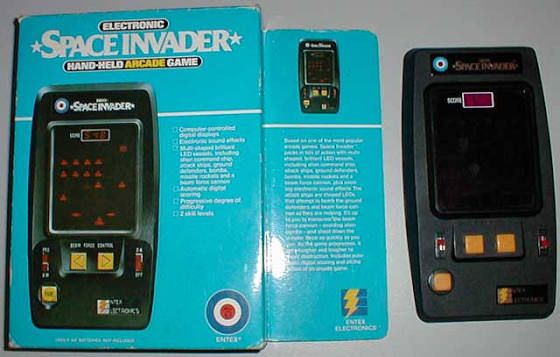
Entex Space Invader handheld electronic game

The Entex Space Invader handheld electronic game is a classic VHF-style portable arcade unit released in 1980. It is highly sought after by collectors of vintage 1980s electronics. I used to have one in the early eighties, my first taste of computing technology and gaming.

Design & Hardware

Entex Space Invader handheld electronic game
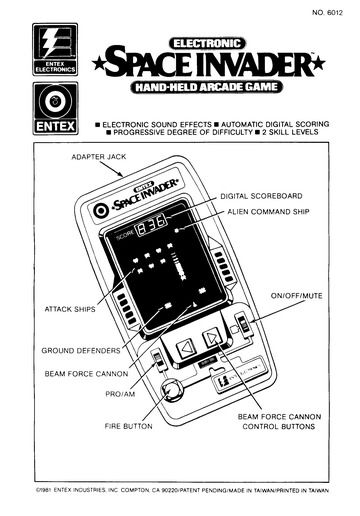
  • Form Factor: Large wedge-shaped black plastic tabletop/handheld console designed by Entex Tokyo.
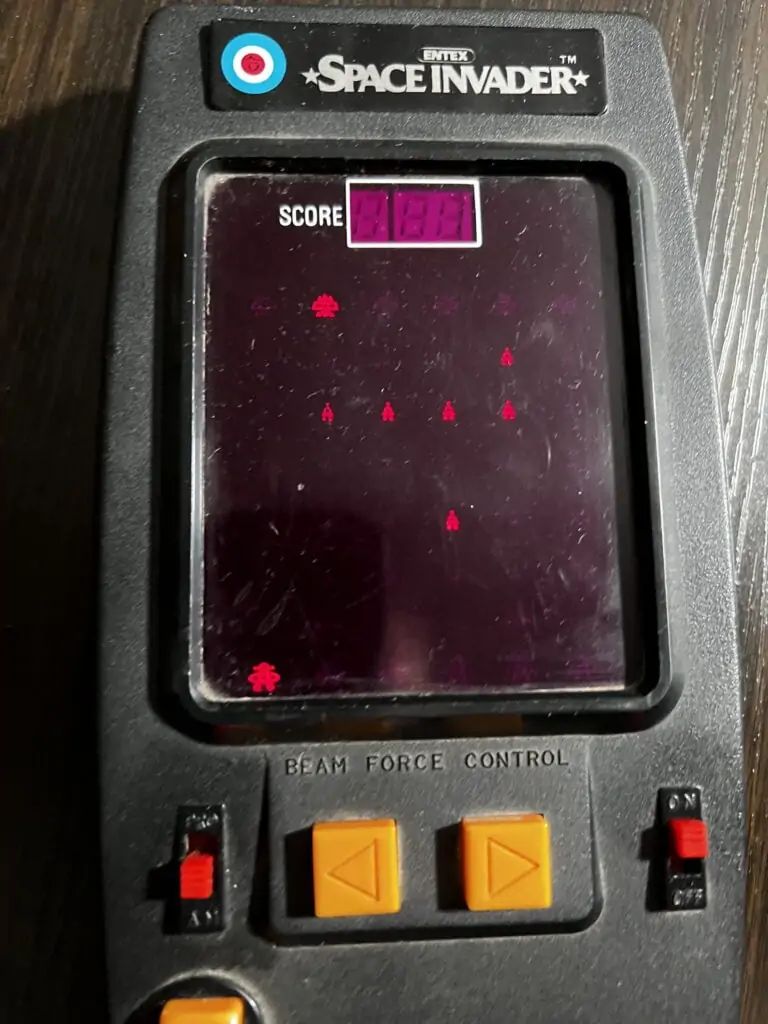
  • Display Type: Vibrant, bright-green Vacuum Fluorescent Display (VFD) that mimics retro arcade visuals.
  • Power Source: Requires 6 AA batteries or an external AC mains power adapter.
  • Controls: Physical mechanical buttons, including left and right directional keys and a dedicated fire button.
Entex Space Invader handheld electronic game, close up

Gameplay Mechanics

  • Objective: Move your laser cannon horizontally across the bottom of the screen to shoot down descending waves of alien invaders.
  • Layout: Displays four distinct lanes of action with columns of moving digital alien targets.
  • Scoring System: Tracks and displays electronic numeric scoring up to a maximum of 1,000 points.
  • Audio: Features simple built-in, synthesized electronic space sound effects for firing lasers and alien tracking.

Known Product Variants

  • 1980 Black Model: The original release featuring a dark case, designed and programmed natively in Japan by Entex Tokyo.
  • 1981 Grey Model: A re-programmed version developed by Rick Dyer & AMS featuring slightly adjusted gameplay. The distinct grey casing was actually the result of a factory paperwork typo that swapped two Pantone color codes.
Entex Space Invader handheld electronic game, back of box

Games Consoles Overview and Timeline by Era

This overview outlines the evolution of home video game consoles, structured by generational eras and key release years, covering major platforms from the 1970s to the 2020s. 

Overview of Console Eras (Generations)

  • First Generation (1972–1980): Birth of home gaming (dedicated, pre-built games).
  • Second Generation (1976–1984): Cartridge-based systems and the first “killer apps”.
  • Third Generation (1983–1990): 8-bit era, rescuing the industry from the 1983 crash.
  • Fourth Generation (1987–1996): 16-bit era, “console wars” (Sega vs. Nintendo).
  • Fifth Generation (1993–2001): 32/64-bit era, transition to 3D and CD-ROMs.
  • Sixth Generation (1998–2006): Online gaming, DVD support, and 3D perfection.
  • Seventh Generation (2005–2013): HD era and motion controls.
  • Eighth Generation (2012–2020): High-definition, integrated streaming, and hybrid gaming.
  • Ninth Generation (2020–Present): SSD, 4K resolution, and high framerates.

Detailed Historic Timeline (1972–2025)

Era 1: The Birth of Home Gaming (1970s) 

  • 1972: Magnavox Odyssey – The first home console. Lacked sound, color, and cartridges, relying on screen overlays.
  • 1975: Atari Home Pong – Dedicated console that brought arcade success to the home.
  • 1976: Fairchild Channel F – First programmable cartridge system, allowing new games without new hardware.
  • 1977: Atari 2600 (VCS) – Revolutionized gaming with popular cartridges (Space Invaders) and popularizing joysticks. 

Era 2: The Golden Age & The Crash (Early 1980s) 

  • 1979: Intellivision – Competed with Atari 2600 with better audio and graphics.
  • 1982: ColecoVision & Atari 5200 – Focused on superior graphics, leading to market saturation.
  • 1983: North American Video Game Crash – Caused by poor quality games (e.g., E.T.), low-cost home computers, and oversaturation.
  • 1983: Nintendo Famicom (Japan) – Revitalized the market in Japan. 

Era 3: 8-Bit Revolution (Mid-1980s) 

  • 1985: Nintendo Entertainment System (NES) – North American launch; saved the home industry with strict licensing and quality control.
  • 1986: Sega Master System – Competed with the NES but failed to gain top market share. 

Era 4: 16-Bit War (Late 1980s–Early 1990s) 

  • 1987: TurboGrafx-16 (PC Engine) – First “fourth gen” console, pushing 16-bit graphics.
  • 1988: Sega Genesis (Mega Drive) – Brought arcade hits and faster gameplay, challenging Nintendo.
  • 1990: Super Nintendo Entertainment System (SNES) – Nintendo’s 16-bit response, setting new standards for visuals and audio.
  • 1989: Nintendo Game Boy – Dominated the portable market with Tetris.

Era 5: The 3D & CD Revolution (Mid-1990s) 

  • 1993: 3DO & Atari Jaguar – Early, unsuccessful 32/64-bit entries.
  • 1994: Sony PlayStation – Entered the market, dominating with 3D polygon graphics and CD storage.
  • 1995: Sega Saturn – Focused on 2D and early 3D; suffered from a surprise, high-priced launch.
  • 1996: Nintendo 64 – Retained cartridges for fast loading, but lost market share to CDs. 

Era 6: Modern 3D & Online (Late 1990s–2000s)

  • 1998: Sega Dreamcast – First with built-in modem for online play; “the console without a generation”.
  • 2000: Sony PlayStation 2 – The best-selling console of all time; added DVD player capabilities.
  • 2001: Microsoft Xbox – Brought PC-like architecture and online gaming (Halo) to the living room.
  • 2001: Nintendo GameCube – Nintendo’s shift to mini-DVDs. 

Era 7: HD Era & Motion Controls (Mid-2000s–2010s)

  • 2005: Microsoft Xbox 360 – Perfected online multiplayer (Xbox Live) and high-definition gaming.
  • 2006: Sony PlayStation 3 – Introduced Blu-ray and cell processors.
  • 2006: Nintendo Wii – Revolutionized the industry with motion controls and the “casual” gamer market. 

Era 8: The Modern Powerhouses (2010s) 

  • 2012: Nintendo Wii U – Unsuccessful bridge console between 7th and 8th generation.
  • 2013: PlayStation 4 & Xbox One – Focused on social sharing, HD gaming, and app integration.
  • 2017: Nintendo Switch – A hybrid console designed to be both portable and home-based. 

Era 9: The Ninth Generation (2020s) 

  • 2020: PlayStation 5 & Xbox Series X/S – Focused on SSD storage for instant loading, ray tracing, and 4K graphics.
  • 2025: Nintendo Switch 2 (Scheduled) – Upcoming successor to the popular hybrid platform. 

Detailed Resources & Timeline Links

For a more detailed, visually-oriented timeline of consoles, you can refer to the following:

Games Consoles Overview and Timeline by Era

BASIC programming insight and detailed historical timeline by era and year

BASIC (Beginner’s All-purpose Symbolic Instruction Code) was designed to make computers accessible to non-technical users, revolutionising personal computing and software development. 

BASIC Historical Timeline

The Dartmouth Era (1964–1970s)

  • 1964: BASIC was created at Dartmouth College by John G. Kemeny and Thomas E. Kurtz. It first ran on 1 May 1964 on a GE-225 mainframe.
  • 1964: The Dartmouth Time-Sharing System (DTSS) was launched alongside BASIC, allowing multiple users to program simultaneously.
  • 1965: Added character string functionality and simplified mathematical support.
  • 1967: Approximately 2,000 Dartmouth students had learned to code in BASIC by this year.
  • Late 1960s: Hewlett-Packard launched the HP 2000 series, which ran a version of BASIC and brought the language to minicomputers. 

The Microcomputer Revolution (1975–1980s) 

  • 1975Bill Gates and Paul Allen developed a BASIC interpreter for the MITS Altair 8800, leading to the founding of Microsoft.
  • 1976: Steve Wozniak wrote Integer BASIC for the Apple I, which later became a staple of the Apple II.
  • 1977: BASIC became the de facto standard for the “1977 Trinity” of home computers: the Apple IICommodore PET, and TRS-80.
  • 1979Atari BASIC was released for Atari 8-bit computers.
  • 1981IBM PC launched with a BASIC interpreter in its firmware (ROM BASIC) and GW-BASIC for disk-based systems.
  • 1982: The BBC Micro launched with BBC BASIC, which introduced structured programming features like procedures and local variables to home users.
  • 1982: The Commodore 64 (and Sinclair ZX Spectrum) was released, eventually becoming the best-selling computer model, with BASIC as its primary user interface. 

Modern and Visual Era (1990s–Present)

  • 1991: Microsoft released Visual Basic, which introduced a graphical “drag-and-drop” interface for building Windows applications, revitalising the language for professional use.
  • 2001Visual Basic .NET was released, fully integrating BASIC into the modern object-oriented .NET framework.
  • Modern Day: Various modern dialects exist, such as XojoFreeBASIC, and QB64, while legacy-style BASIC remains popular in the hobbyist “retro-computing” community. 

Key Insights into BASIC

  • Democratisation of Coding: Before BASIC, programming required knowledge of complex assembly or scientific languages like FORTRAN. BASIC used simple English commands like PRINTGOTO, and IF...THEN to make coding accessible to everyone.
  • Immediate Feedback: Unlike “batch processing” where users waited hours for results, BASIC was designed for interactive use, providing immediate error messages and results.
  • Hardware Efficiency: Early BASIC versions were highly optimised to fit into the tiny memories (often as little as 4 KB) of 1970s microcomputers.
  • Cultural Impact: An entire generation of software engineers began by typing BASIC code into their home computers from hobbyist magazines.

BASIC (Beginners’ All-purpose Symbolic Instruction Code), first released in 1964, was designed to make computing accessible to non-scientists. While modern programming has evolved, the core technical insights and approaches remain the foundation for all software development. 

Technical Insights: The Building Blocks

Programs are constructed using universal building blocks that dictate how a machine processes data: 

  • Variables & Data Types: Containers that store values (e.g., integers, strings).
  • Control Flow (The Logic):
    • Sequence: The specific order in which instructions are executed.
    • Selection: Conditional “if-else” statements that determine the program’s path based on criteria.
    • Iteration (Loops): Repeating a section of code (e.g., FOR or WHILE loops) until a condition is met.
  • Functions & Subroutines: Blocks of reusable code designed to perform specific tasks, improving organization and readability.
  • Syntax: The “grammar” of a language (keywords, operators, punctuation) that must be followed for the machine to understand instructions. 

General Programming Approach

Mastering programming requires a systematic method for solving problems rather than just memorizing code. 

  1. Understand the Problem: Identify the necessary inputs, desired outputs, and any constraints before writing a single line of code.
  2. Design the Algorithm: Break the problem into smaller, manageable steps. Using flowcharts or pseudocode helps map out the logic without getting bogged down in syntax.
  3. Implementation: Translate your plan into the chosen language (e.g., Python, C++, or JavaScript).
  4. Test & Debug: Execute the code with sample data to ensure accuracy. Debugging is the process of identifying and fixing errors when the output doesn’t match expectations.
  5. Refine & Optimize: Improve the performance and maintainability of your code by reducing steps or using more efficient data structures.

BASIC programming language timeline history by year

BASIC (Beginner’s All-purpose Symbolic Instruction Code) was designed to make computing accessible to non-scientists, evolving from a simple teaching tool into the foundational language of the personal computer revolution. 

The Academic Era (1964–1974)

  • 1964: Invention at Dartmouth. John Kemeny and Thomas Kurtz created BASIC at Dartmouth College to allow students in non-technical fields to use computers.
  • 1964: First Execution. The first BASIC program ran on 1 May 1964, on a GE-225 mainframe.
  • Philosophy of Simplicity. It featured an intuitive, English-like syntax and was originally a “compile-and-run” language rather than a slow interpreter.
  • Time-Sharing. BASIC was designed for the Dartmouth Time-Sharing System (DTSS), allowing multiple users to program simultaneously from different terminals. 

The Home Computer Revolution (1975–1980s) 

  • 1975: Altair BASIC. Bill Gates and Paul Allen developed a BASIC interpreter for the MITS Altair 8800, which became Microsoft’s first product.
  • The “De Facto” Standard. By the late 1970s, BASIC was pre-installed in the ROM of almost every major home computer, including the Apple II, Commodore PET, and TRS-80.
  • Interpreted vs. Compiled. To save memory (often limited to 4KB), these versions were typically “interpreted,” meaning the computer translated code line-by-line during execution.
  • Hobbyist Culture. Magazines and books published “type-in” programs, allowing millions of users to learn coding by manually entering BASIC code. 

The Professionalization & Decline (Mid-1980s–1990)

  • Structured Evolution. Microsoft released QuickBASIC (1985), which introduced structured syntax (removing the need for line numbers) and a compiler for faster performance.
  • Rise of C and Pascal. Professional developers began shifting toward more powerful languages like C and Pascal as hardware became capable of supporting them.
  • Shift to Applications. As pre-written commercial software became common, the average user stopped writing their own programs in BASIC. 

The Visual & Enterprise Era (1991–Present)

  • 1991: Visual Basic (VB). Microsoft combined BASIC with a graphical user interface (GUI) designer, allowing developers to “drag and drop” buttons and forms.
  • Dominance in Business. By 1998, an estimated two-thirds of Windows business applications were built using Visual Basic 6.0.
  • 2002: Visual Basic .NET. Microsoft transitioned the language to the .NET framework, turning it into a fully object-oriented language.
  • Modern Status. While C# has surpassed it in popularity, VB.NET remains a stable, maintained language used heavily for maintaining legacy systems and Office automation. 

BASIC programming language timeline history by year

BBC Micro Home Computer and the Computer Project (CLP) timeline

The timeline of the BBC Micro and the Computer Project (CLP) represents a pivotal era in British computing, moving from early industrial machines to a generation-defining home computer

Pre-Launch & The Need for Literacy (1974–1980)

  • 1974: Ceefax launches as the world’s first teletext service, introducing interactive TV concepts.
  • 1978: Acorn Computers is founded in Cambridge; the BBC initiates its Computer Project to address the UK’s lack of digital preparedness.
  • 1979: A BBC report warns that the silicon chip will radically change the workplace, prompting the need for a national awareness campaign.
  • 1980: After the “New Brain” computer project fails to meet requirements, the BBC searches for a British manufacturer to build a custom machine. 
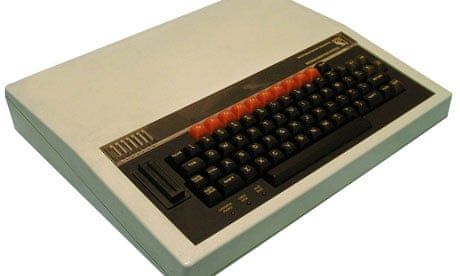
BBC Micro Home Computer

The Golden Era: The BBC Micro (1981–1985) 

  • 1981: Acorn wins the contract in March with its “Proton” prototype. The BBC Micro Model A (£299) and Model B (£399) are officially launched in December.
  • 1982: The BBC Computer Literacy Project (CLP) formally launches with the TV series The Computer Programme. Over 500,000 machines are sold this year as the “Beeb” enters most UK schools.
  • 1983: The Acorn Electron is launched in August as a budget-friendly home version of the BBC Micro. New series Making the Most of the Micro begins.
  • 1984: High-speed expansion continues; 1,000 dealers operate in the US, and production reaches thousands of units per month in India and Mexico.
  • 1985: The BBC Micro achieves its goal: at least one machine is present in every British school. 

Expansion & The Move to 16-Bit (1986–1990s)

  • 1986: Launch of the Domesday Project, a massive digital snapshot of Britain stored on Laservision discs and accessed via BBC Micros.
  • 1987: The Acorn Archimedes is launched, introducing the revolutionary RISC architecture (the precursor to modern ARM chips).
  • 1989: The official CLP project concludes after nearly a decade of programming and hardware releases. The domain bbc.co.uk is registered.
  • 1997: The BBC website is established, transitioning the corporation’s digital focus from hardware to the internet. 

The Modern Legacy (2016–Present)

  • 2016: The BBC micro:bit is released—a pocket-sized, programmable computer distributed free to one million Year 7 students to continue the legacy of coding literacy.
  • 2018: The BBC Computer Literacy Project Archive is made public, allowing users to watch old programmes and run original 8-bit software in modern browsers.

BBC Micro Home Computer and the Computer Project (CLP) timeline

Also…

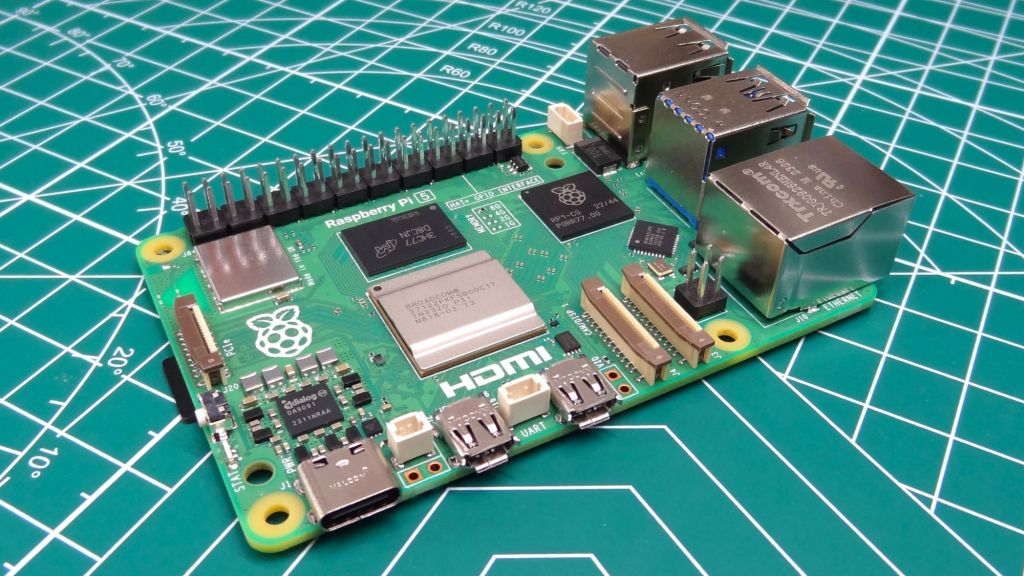
The Raspberry Pi is widely considered the spiritual successor to the BBC Micro. Created by the ⁠Raspberry Pi Foundation in Cambridge, the credit card-sized single-board computer was directly inspired by the 1980s educational computer.

Raspberry Pi
Raspberry Pi

It aimed to reverse declining enrollment in computer science by giving a new generation of students an affordable, highly accessible tool to learn coding and hardware engineering.

The BBC Micro Homage

  • Model A and Model B Names: The choice of “Model A” (lower spec, lower cost) and “Model B” (fully featured) names was a deliberate homage to the original ⁠Acorn Computers BBC Micro models.
  • The ARM DNA Connection: The original BBC Micro was built by ⁠Acorn Computers. Acorn later co-developed the ARM (Acorn RISC Machine) processor architecture. Centuries later, these same energy-efficient ARM chips power modern ⁠Raspberry Pi boards.
  • Educational Philosophy: Just as the BBC Micro introduced an entire generation of British school children to programming in the 1980s, the Raspberry Pi was launched in 2012 to renew interest in hands-on computer literacy and physical computing.

Core Differences

  • Affordability: While the BBC Micro Model B was highly aspirational and very expensive for its time (around £399 in 1983), the Raspberry Pi was engineered from the start to be remarkably cheap (originally launched at $25 to $35) so that schools and parents could easily afford it.
  • Exposed Hardware: The Raspberry Pi exposes its raw circuitry, chips, and General Purpose Input/Output (GPIO) pins directly to the user. This design choice makes it much simpler to interface with custom sensors, lights, and robotics.

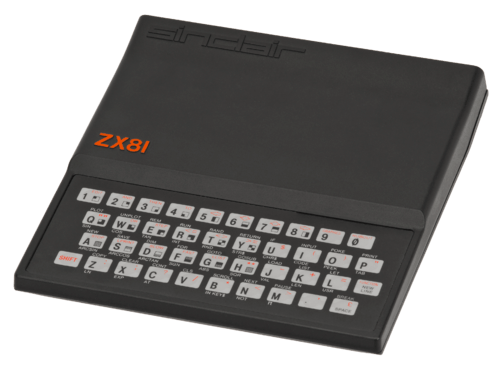
Sinclair ZX81 Home Computer timeline history

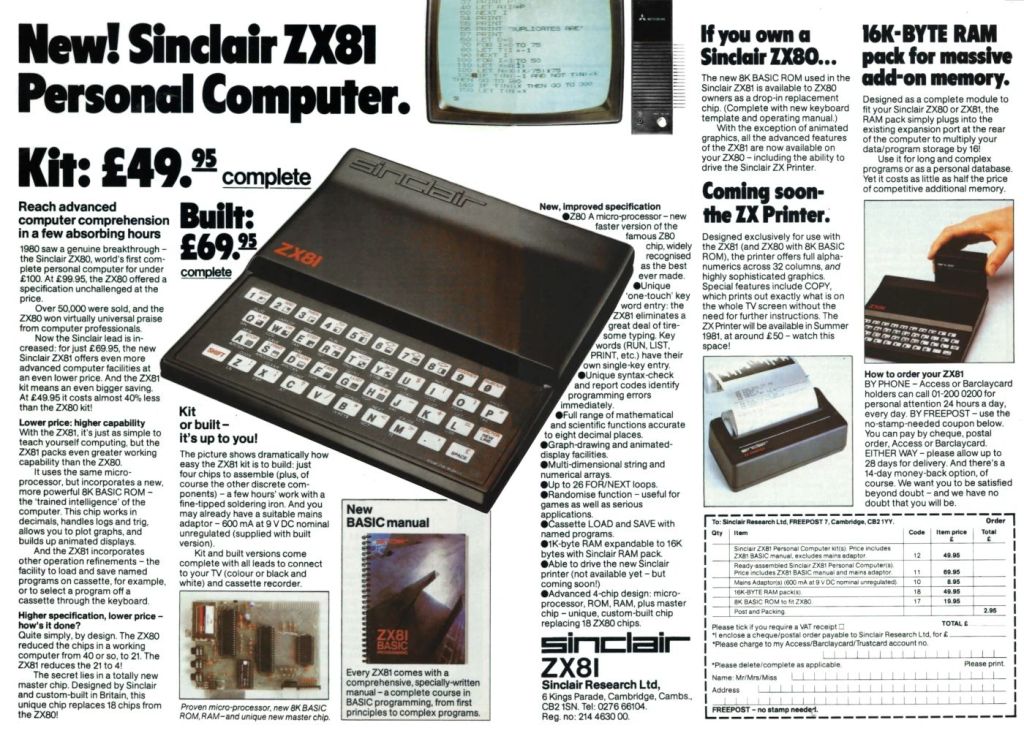
The Sinclair ZX81 was a seminal moment in home computing, launched in March 1981 as the successor to the ZX80. It was designed by Sinclair Research to be a low-cost entry point into computing, famously costing less than £70 (or £50 as a self-assembly kit). 

ZX81 Home Computer

Development & Launch (1980–1981) 

  • Autumn 1980: Most of the ZX81’s software was completed, with the remainder of the year spent writing the manual and finalizing hardware.
  • 5 March 1981: Official UK launch at an introductory price of £49.95 for the kit and £69.95 for the pre-assembled machine.
  • October 1981: Launched in the United States at $149.95 assembled and $99.95 in kit form.
  • November 1981: The ZX Printer was released for £49.95, expanding the system’s capabilities. 
ZX81 Home Computer article

Market Success & Expansion (1982)

  • January 1982: Over 300,000 units had been sold via mail order. American sales reached 15,000 units per month.
  • February 1982: Production reached 40,000 units per month to keep up with massive global demand.
  • July 1982Timex Sinclair 1000 launched in the US as a licensed version of the ZX81, featuring 2KB of RAM (double the original’s 1KB).
  • 1982 Peripheral Boom: Numerous third-party upgrades were released, including the Memopak 64K RAM expansion and various replacement “real” keyboards to solve the frustration of the original membrane design. 

The Shift to Spectrum & Decline (1982–1986) 

  • 23 April 1982: Sinclair launched the ZX Spectrum, the colour-capable successor that would eventually overshadow the ZX81.
  • 1983: Total production of the ZX81 surpassed 1.5 million units worldwide.
  • 1984: The ZX81 was officially discontinued as Sinclair focused on the Spectrum and the ill-fated Sinclair QL.
  • 7 April 1986: Following financial difficulties, Sinclair Research’s computer assets were sold to Amstrad for £5 million.

Sinclair ZX81 Home Computer timeline history

Home Computers, ZX Spectrum versus Commodore 64

The Commodore 64 (C64) and ZX Spectrum were the primary rivals of the 8-bit home computing era, particularly in the UK, where they defined a decade of “playground wars”. While the ZX Spectrum launched in April 1982 as an affordable entry into computing, the Commodore 64 followed in August 1982 with superior custom hardware for sound and graphics. 

1982: The Birth of the Icons 

  • January: Commodore unveils the Commodore 64 at CES in Las Vegas.
  • 23 April: Sinclair Research launches the Sinclair ZX Spectrum 16K/48K in the UK. It is marketed for its 15-colour palette and affordable price compared to the BBC Micro.
  • August: The Commodore 64 begins volume production and goes on sale in the US for $595.
  • Late 1982: Sinclair introduces the Issue 2 motherboard for the Spectrum to fix manufacturing defects. 

1983: Expansion and Price Wars

  • January: Commodore introduces the Commodore SX-64, the first commercial full-color portable computer.
  • July: The Timex Sinclair 2068, an enhanced US version of the Spectrum, is launched.
  • August: Spectrum sales in Britain and Europe exceed 500,000 units.
  • December: The millionth ZX Spectrum is manufactured.
  • Market Shift: Commodore begins aggressive price-cutting to underbid competitors, leading to the “Home Computer Price War”. 

1984–1985: New Iterations and Corporate Shifts

  • January 1984: Sinclair announces the Sinclair QL, intended as a professional successor to the Spectrum.
  • October 1984: Sinclair releases the Sinclair ZX Spectrum+, featuring a new QL-style case and a plastic injection-moulded keyboard to replace the original rubber keys.
  • January 1985: Commodore releases the Commodore 128, a successor that includes a dedicated “64 mode” for 100% compatibility with C64 software.
  • September 1985: The Sinclair ZX Spectrum 128 (codenamed “Derby”) is launched in Spain, featuring 128KB RAM and a three-channel sound chip. 

1986–1987: The Amstrad Era and Redesigns 

  • January 1986: The ZX Spectrum 128 is officially released in the UK.
  • 7 April 1986: Amstrad acquires the Sinclair brand and computer range for £5 million after Sinclair Research faces financial difficulties.
  • Late 1986: Commodore introduces the Commodore 64C, a redesigned model with a sleeker, light-coloured case matching the C128’s aesthetic.
  • Late 1986: Amstrad releases the ZX Spectrum +2, featuring a grey case and a built-in cassette recorder.
  • 1987: Amstrad launches the ZX Spectrum +3, which includes a built-in 3-inch floppy disk drive. 

1988–1994: The Twilight Years 

  • 1988: Amstrad releases the ZX Spectrum +2A, updating the +2 with the internal circuitry of the +3.
  • 1990: Commodore attempts to move into the console market with the Commodore 64 Games System (C64GS), a keyboard-less version of the C64 that ultimately fails commercially.
  • 1992: Amstrad officially discontinues all ZX Spectrum models after approximately 5 million total units sold.
  • April 1994: The Commodore 64 is officially discontinued as Commodore International enters bankruptcy. It remains the best-selling single computer model of all time with 12.5 to 17 million units sold. 

Home Computers, ZX Spectrum versus Commodore 64

Commodore 64 Home Computer Timeline Overview

The Commodore 64 (C64) is the best-selling single computer model of all time, with an estimated 12.5 to 30 million units sold during its 12-year production run

Commodore 64 Annual Timeline

  • 1981: Development Phase
    • January: Engineers at MOS Technology begin a project to design state-of-the-art video and sound chips (VIC-II and SID) for the next generation of games consoles.
    • November: The cutting-edge chips are completed, and Commodore decides to use them for a new home computer to succeed the VIC-20.
  • 1982: Launch and Early Expansion
    • January: The Commodore 64 is officially introduced at the Consumer Electronics Show (CES) with a starting price of $595.
    • August: The C64 begins shipping in the USA, featuring its iconic “breadbox” design.
    • Other Models: The Japan-only MAX Machine (a console version) and the Educator 64 (aimed at schools) are also released.
  • 1983: Price Wars and Portables
    • January: Commodore introduces the SX-64, the world’s first portable computer with a colour screen, retailing for approximately $1,600.
    • June: To dominate the market, Commodore slashes the C64 price to $300, triggering an intense price war that drives competitors like Texas Instruments out of the market.
  • 1984: Leadership Changes
    • January: Founder Jack Tramiel resigns from Commodore after a disagreement with chairman Irving Gould.
    • Expansion: The Commodore 16 and Plus/4 are introduced as low-cost alternatives, though they lack full C64 compatibility.
  • 1985: Peak Performance
    • C128 Release: Commodore launches the Commodore 128, which includes a dedicated C64 compatibility mode to leverage the existing library.
    • Gaming Dominance: The C64 becomes the primary platform for video games, with thousands of titles released by developers like System 3 and MicroProse.
  • 1986: The Redesign
    • May: The Commodore 64C is released, featuring a sleeker, flatter cream-coloured case similar to the Amiga 500.
    • Milestones: To celebrate selling one million units in Germany, a limited “Gold Edition” is presented at the BMW museum.
  • 1987–1989: Late-Era Variants
    • 1987: The C64 Aldi is sold through German supermarkets as a budget model.
    • 1988: The C64G is introduced, returning to the original breadbox shape but using the modern 64C internal hardware.
  • 1990: Consolidation and Consoles
    • C64 Games System (GS): Commodore attempts to enter the console market by releasing the C64 GS (a keyboardless C64), but it fails to compete with the rising 16-bit systems like the Sega Genesis.
  • 1994: The End of an Era
    • April: Despite reaching a final sales total of roughly 17–22 million units, Commodore International files for bankruptcy and the C64 is officially discontinued. 

Commodore 64 Home Computer Timeline Overview