Business Analysts and Artificial Intelligence AI, Future

Business Analysts and Artificial Intelligence AI Future
Business Analysts and Artificial Intelligence AI, future

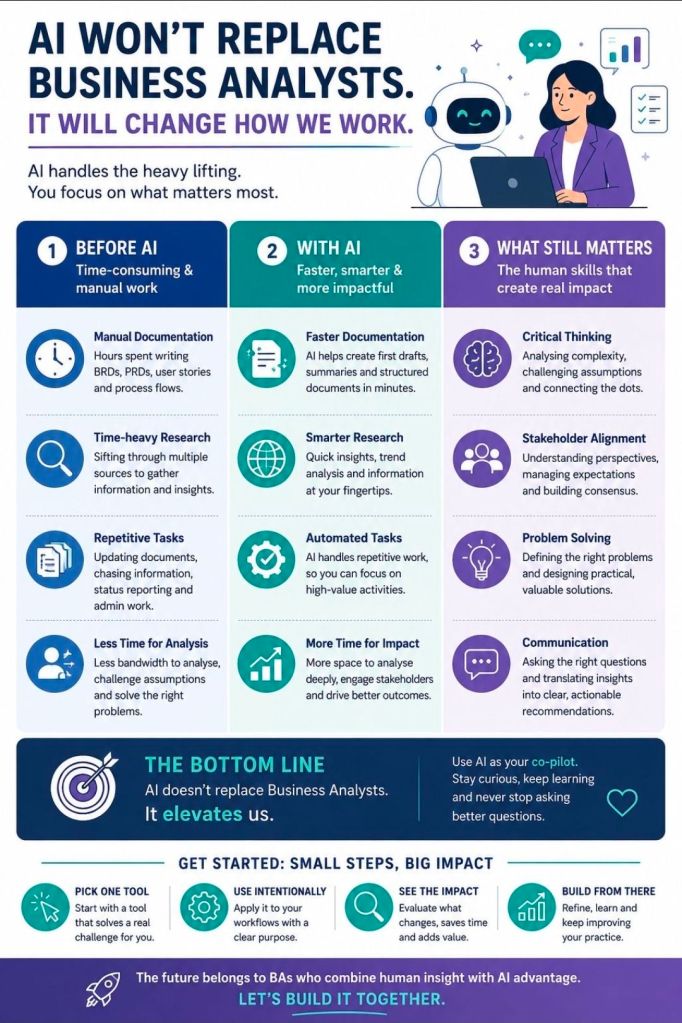
Artificial Intelligence (AI) is fundamentally shifting the role of the Business Analyst (BA) from a focus on routine data processing and documentation to more strategic, human-centric activities. While AI excels at identifying patterns and automating labor-intensive tasks, it currently lacks the contextual awareness and emotional intelligence required to manage complex stakeholder relationships.

Core AI Applications for Business Analysts

AI functions as a high-speed “copilot” that streamlines the traditional BA lifecycle.

  • Requirement Generation: AI can process meeting transcripts to draft an initial list of requirements, user stories, or a Business Requirements Document (BRD).
  • Data Analysis & Forecasting: Machine learning algorithms can identify subtle trends in large datasets and move analysis from descriptive (what happened) to predictive (what might happen).
  • Visual Modeling: Tools can now generate process flows, data models, and architecture diagrams from simple text descriptions, drastically reducing time spent on manual formatting.
  • Information Elicitation: Analysts can use AI to quickly extract key details from vast document repositories or prepare for stakeholder interviews by anticipating potential questions.

Skills That Remain Uniquely Human

As AI handles the “grunt work,” the most valuable BA skills are those that cannot be easily automated.

  • Strategic Thinking: Connecting big-picture organizational goals to specific technical solutions and defining the “why” behind an initiative.
  • Stakeholder Management: Navigating office politics, facilitating discussions to resolve disagreements, and building trust across teams.
  • Creative Problem Solving: Tackling ambiguous business challenges where there is no clear historical data for an AI to learn from.
  • Critical Evaluation: Fact-checking AI outputs to ensure they are accurate and free from “hallucinations” before they influence business decisions.

The Shift from “AI4BA” to “BA4AI”

A new perspective emerging in the field is that BAs shouldn’t just use AI, but should lead the organization’s AI adoption.

  • Guiding Implementation: BAs act as strategic enablers, ensuring that AI projects solve meaningful problems rather than just chasing technological trends.
  • Managing Risk: Analysts play a critical role in addressing ethical concerns, bias detection, and security risks associated with AI-driven systems.
  • Bridging the Gap: They serve as the essential link between technical AI teams and non-technical business leaders to ensure projects deliver tangible value.

Future Career Outlook

The consensus among industry experts is that AI will transform—rather than eliminate—the BA profession. The market for business analytics is projected to grow significantly through 2031. Analysts who successfully integrate AI into their workflow to enhance productivity are expected to replace those who do not.

AI Courses and Certifications for Project Managers

As of 2026, AI is transforming project management by automating scheduling, risk management, and reporting. The best AI courses for project managers (PMs) focus on practical application, generative AI, and AI governance.

Top AI Courses and Certifications for Project Managers

  1. PMI Certified Professional in Managing AI (PMI-CPMAI) (PMI)
    • Summary: The premier certification for managing AI projects from start to finish, including data prep and model deployment.
    • Best For: Advanced specialists managing AI projects.
  2. AI-Driven Project Manager (AIPM) Certification (APMG/Provek)
    • Summary: Focuses on leveraging AI tools for project efficiency and strategic management.
    • Best For: Global recognition and practical PM application.
  3. Generative AI for Project Managers Specialization (Coursera/Various)
    • Summary: A comprehensive series focusing on using Large Language Models (LLMs) to enhance project documentation, communication, and planning.
    • Best For: Understanding practical GenAI applications.
  4. AI Essentials for Project Managers Learning Path (LinkedIn Learning)
    • Summary: A practical, beginner-friendly path covering prompt engineering, AI productivity tools, and managing AI-driven teams.
    • Best For: Immediate productivity gains.
  5. Mastering AI for Digital Projects (The Digital Project Manager)
    • Summary: Covers AI for risk, stakeholder management, and project planning with real-world scenarios.
    • Best For: Digital and IT project managers.
  6. IBM AI Project Management Certificate (Coursera)
    • Summary: Explores AI foundations, data ethics, and using AI in project lifecycles using IBM frameworks.
    • Best For: Structured learning with strong enterprise focus.
  7. Generative AI Overview for Project Managers (PMI)
    • Summary: A free introduction by PMI covering AI project patterns and practical application.
    • Best For: Quick, foundational understanding.
  8. Artificial Intelligence Strategies for Project Managers (Learning Tree)
    • Summary: Focuses on AI governance, managing AI risks, and implementing AI technologies.
    • Best For: Technical PMs and IT governance.
  9. Google AI Essentials (Coursera)
    • Summary: A flexible, beginner course designed to boost productivity with AI tools.
    • Best For: General AI awareness and everyday productivity.
  10. Certified Generative AI Professional (GSDC)
    • Summary: Focuses on the implementation of Generative AI tools and techniques in project environments.
    • Best For: Budget-conscious learners.

Key Areas of Focus for 2026 PMs

  • AI Governance & Ethics: Ensuring compliance with data privacy, avoiding AI bias, and mitigating risks in project decisions.
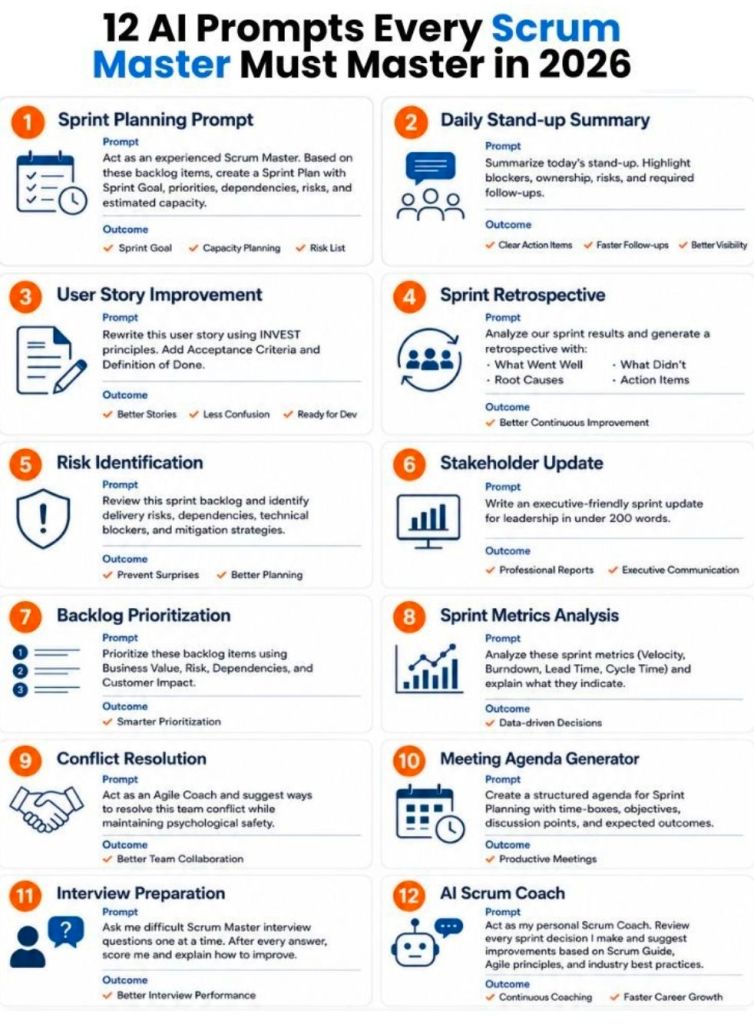
  • Prompt Engineering: Learning to interact with Generative AI (like ChatGPT/Copilot) to create schedules, project charters, and risk logs.
  • Automation: Using AI tools to handle administrative tasks, allowing PMs to focus on team collaboration and strategy.

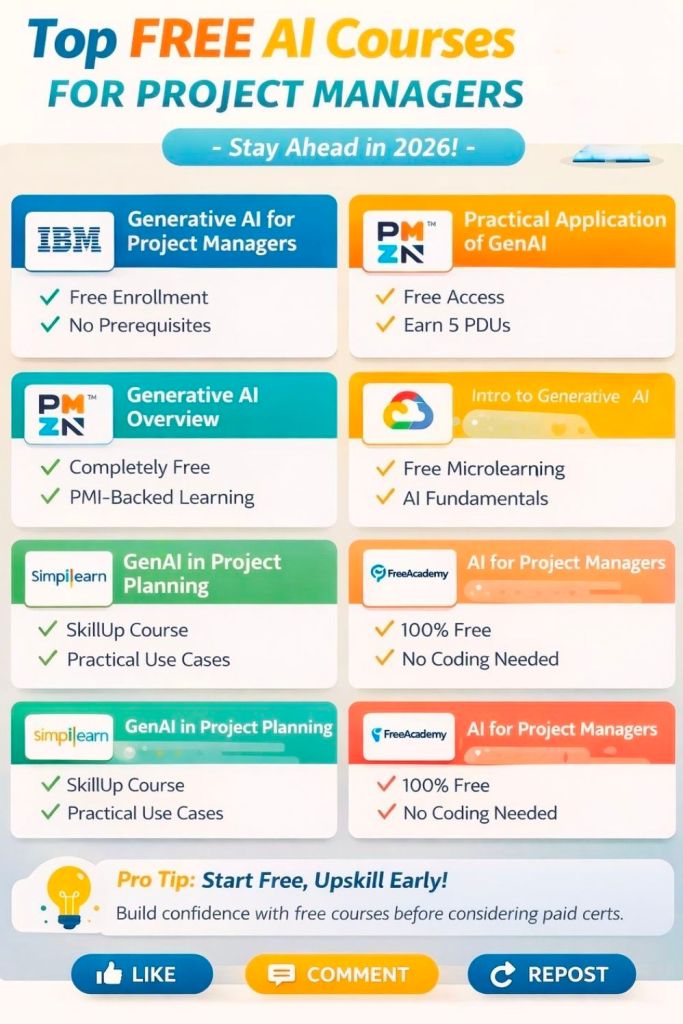
Free AI Courses for Project Managers

Top AI Courses and Certifications for Project Managers
Free AI Courses for Project Managers

Top FREE AI Courses for Project Managers

Top FREE AI Courses for Project Managers

Artificial Intelligence (AI) Overview and Detailed Timeline Evolution

Artificial Intelligence (AI) is the branch of computer science dedicated to creating systems capable of performing tasks that typically require human intelligence, such as reasoning, learning, problem-solving, and perception. As of 2026, AI has transitioned from experimental research to widespread deployment as foundational infrastructure, with focus shifting from mere generative models to agentic, autonomous systems capable of executing complex, multi-step workflows.

Detailed Overview of AI in 2026

  • Core Capabilities: Modern AI combines large language models (LLMs), multimodal understanding (text, image, audio), and autonomous agents that can plan, remember, and act independently.
  • Agentic AI: A significant shift is the proliferation of AI agents that act as “digital coworkers” rather than just tools, handling tasks within business environments.
  • Democratization & Open Source: The open-source movement has accelerated, placing powerful AI capabilities in the hands of many, reducing dependence on single providers.
  • Regulation and Ethics: Following frameworks like the EU AI Act, 2026 is marked by the implementation of laws focusing on safety, transparency, and accountability, including AI watermarking to curb misinformation.
  • Major Trends: Key trends include standardized AI performance benchmarks (e.g., Machine Intelligence Quotient), interoperability between different AI agents, and integration of AI into physical robotics.

Historic Timeline and Evolution of AI (1950–2026)

I. The Foundations (1950–1956)

II. Early Enthusiasm and First Winter (1960s–1970s)

  • 1966: Joseph Weizenbaum develops ELIZA, the first chatbot capable of simulating conversation.
  • 1970s: AI progress slows due to limited computer power, leading to reduced funding—known as the first “AI Winter”.

III. Expert Systems and Second Winter (1980s–1990s)

  • 1980: Expert systems (e.g., XCON) emerge, bringing AI back into commercial use.
  • 1986: Geoffrey Hinton and others popularize backpropagation, enabling neural network training.
  • 1997: IBM’s Deep Blue defeats world chess champion Garry Kasparov, showcasing the power of strategic AI.

IV. The Rise of Big Data and Deep Learning (2000s–2010s)

  • 2006: Geoffrey Hinton publishes work reigniting interest in neural networks through “deep learning”.
  • 2011: IBM Watson wins Jeopardy!, showcasing advances in natural language processing.
  • 2012: AlexNet wins the ImageNet competition, proving the efficiency of Convolutional Neural Networks (CNNs).
  • 2014: Ian Goodfellow invents Generative Adversarial Networks (GANs), enabling AI to create realistic images.
  • 2016: DeepMind’s AlphaGo defeats Lee Sedol, mastering the complex game of Go.
  • 2017: Google researchers introduce Transformers, the architecture underpinning modern LLMs.

V. Generative AI and Agentic Era (2020s–2026)

  • 2020: OpenAI releases GPT-3, demonstrating unprecedented language generation capabilities.
  • 2022: The public release of ChatGPT marks the mainstream breakthrough of Generative AI.
  • 2024: OpenAI releases o1 (formerly Strawberry), focusing on advanced reasoning.
  • 2025–2026: AI becomes “Agentic,” shifting from chatbots that create content to autonomous agents that plan, execute, and interact across software systems.

Key References for Further Reading

Artificial Intelligence (AI) Overview and Detailed Timeline Evolution

From SEO to AI Visibility

From SEO to AI Visibility

How AI Artificial Intelligence is Evolving in Project Management Career

How AI Artificial Intelligence is Evolving in Project Management Career

AI – ChatGPT vs Perplexity vs Claude

ChatGPT vs Perplexity vs Claude
ChatGPT vs Perplexity vs Claude, AI

Agentic AI Strategy Pack, read about Agentic AI in 2026

Agentic AI Strategy Pack, read about Agentic AI in 2026

Every Artificial Intelligence AI Agent Explained

Every Artificial Intelligence AI Agent Explained

Agentic Artificial Intelligence AI Explained

Agentic Artificial Intelligence AI Explained

AI Projects and Methodologies for Managing AI Projects

Artificial intelligence (AI) is transforming project management through two distinct but related paths: the use of AI-powered tools to manage general projects and the specialized methodologies required to manage AI development itself

1. Methodologies for Managing AI Projects

Traditional software development methods (like Waterfall) often fail for AI because these projects are experimental and non-linear. Specialized frameworks have emerged to handle the “data-first” nature of AI: 

  • CPMAI (Cognitive Project Management for AI): A leading methodology that combines Agile principles with data-centric phases: Business Understanding, Data Understanding, Data Preparation, Model Development, Model Evaluation, and Model Operationalization.
  • Agile-AI Hybrid: Adapts standard Agile by using “short-boxed” iterations for model training and allowing for a “flexible scope” because model performance is unpredictable until tested.
  • Data Driven Scrum: A variation of Scrum that prioritizes work based on data availability and experimental results rather than just feature backlogs.
  • MLOps (Machine Learning Operations): An operational framework focused on the continuous integration, deployment, and monitoring of models to prevent “model drift” after a project officially “ends”. 

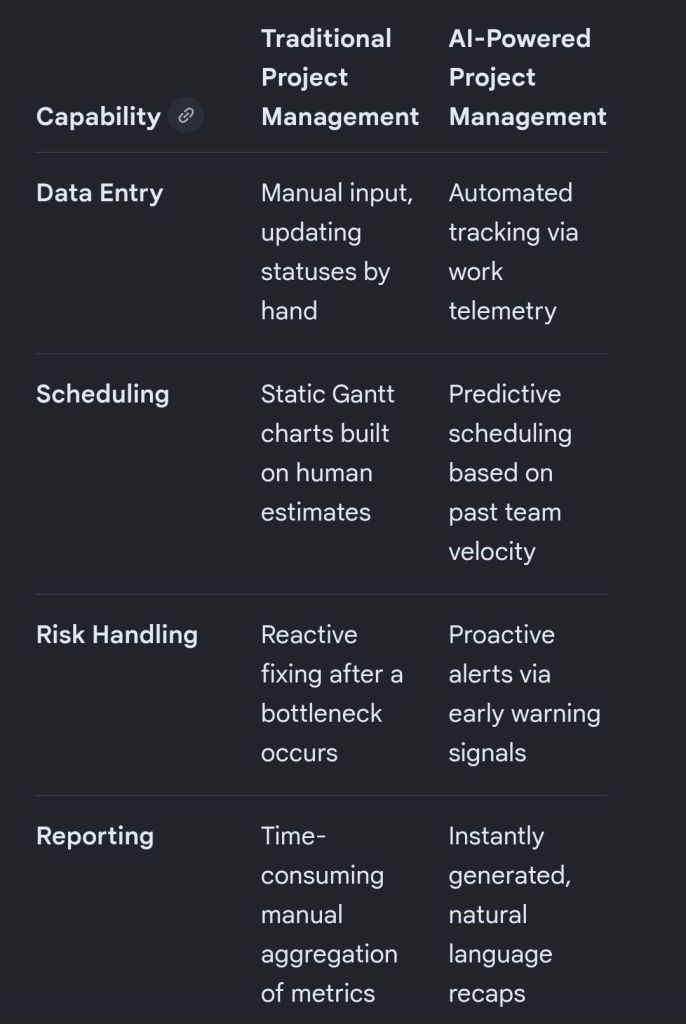
2. AI-Augmented Project Management (The “AI Copilot”)

For non-AI projects, AI acts as an intelligent assistant to automate administrative tasks and provide predictive insights. 

3. Implementation Strategy

Experts recommend a phased approach to integrating AI into management workflows: 

  1. Assess Inefficiencies: Identify repetitive tasks (e.g., status reporting) that can be automated first.
  2. Data Governance: Ensure project data is clean and centralized; AI is only as good as the data it consumes (“Garbage In, Garbage Out”).
  3. Human-in-the-Loop: Use AI for data-heavy lifting, but retain human judgment for high-stakes leadership, ethics, and stakeholder empathy.

AI Projects and Methodologies for Managing AI Projects

AI history of artificial intelligence by era

The history of artificial intelligence is defined by cycles of extreme optimism followed by “winters” of reduced funding and interest. It has evolved from a theoretical branch of mathematics into a pervasive modern technology. 

The Foundations (Pre-1950)

Before AI was a formal field, it existed in science fiction and early mechanical concepts. 

  • 1921: The term “robot” is coined by Karel Čapek in the play Rossum’s Universal Robots.
  • 1943: Warren McCulloch and Walter Pitts publish the first mathematical model of a neural network.
  • 1949: Edmund Berkeley’s book Giant Brains proposes that machines can think. 

The Birth of AI (1950–1956)

This era shifted AI from mythology to a serious academic discipline. 

  • 1950Alan Turing publishes “Computing Machinery and Intelligence,” introducing the Turing Test to measure machine intelligence.
  • 1952Arthur Samuel creates the first self-learning checkers program.
  • 1955-1956John McCarthy coins the term “Artificial Intelligence” during the proposal for the Dartmouth Workshop, which officially launched the field. 

The Golden Years & First AI Winter (1957–1979) 

Initial successes led to over-promising and a subsequent crash. 

  • 1958Frank Rosenblatt develops the Perceptron, the foundation for modern neural networks.
  • 1966Joseph Weizenbaum creates ELIZA, the first “chatterbot”.
  • 1973-1974: The Lighthill Report in the UK and subsequent funding cuts by DARPA lead to the First AI Winter due to limited computing power and unmet expectations.

The Expert Systems Boom & Second Winter (1980–1993)

AI found commercial success through specialized knowledge bases before another decline. 

  • 1980XCON (expert configurer) becomes the first commercially successful expert system, saving Digital Equipment Corporation millions.
  • 1981: Japan launches the Fifth Generation Computer project with $850 million to create human-level reasoning.
  • 1987-1993: The Second AI Winter occurs as specialized AI hardware (Lisp machines) becomes obsolete compared to cheaper personal computers from Apple and IBM. 

The Age of Agents & Narrow AI (1993–2011) 

AI began achieving superhuman performance in specific, “narrow” tasks. 

  • 1997: IBM’s Deep Blue defeats world chess champion Garry Kasparov.
  • 2002: iRobot releases the Roomba, bringing autonomous AI into the home.
  • 2011: IBM’s Watson wins Jeopardy! against human champions, and Apple releases Siri

The Deep Learning Revolution (2012–2021)

A massive surge in data and GPU power transformed the field. 

  • 2012AlexNet wins the ImageNet competition, proving the power of deep convolutional neural networks.
  • 2016: Google DeepMind’s AlphaGo defeats world Go champion Lee Sedol.
  • 2017: Researchers at Google propose the Transformer architecture, which becomes the backbone of modern large language models. 

The Generative AI Boom (2022–Present)

AI has entered the mainstream, moving toward Agentic AI that can plan and act autonomously. 

  • 2022: OpenAI releases ChatGPT, sparking global interest in generative AI.
  • 2023-2024: Focus shifts toward Multimodal AI (images, video, and text) and Agentic AI capable of completing complex workflows across multiple tools. 

AI history of artificial intelligence by era

Artificial Intelligence AI Terms Explained, an Overview

AI Artificial Intelligence Terms Explained, an Overview

Centiun MS Business Applications and AI Specialists

Centiun Company Overview

Centiun is a British IT services consulting company and Microsoft Partner, helping enterprise public and private sector organisations achieve digital transformation excellence through the Microsoft cloud.

We specialise in Microsft Dynamics 365, Power Platform, and Micrisoft 365, delivering expert consultancy, solution architecture, implementation, and managed services that enable organisations to modernise operations, improve service delivery, and unlock greater value from their technology investment.

Centiun MS Business Applications and AI Specialists

From CRM transformation and business process automation to secure collaboration, data-driven decision making, and AI enabled innovation, Centiun supports customers to build smarter, faster and more resilient ways of working.

Our approach combines deep Microsoft expertise with a practical focus on outcomes – designing and delivering solutions that are scalable, compliant, and tailored to the needs of complex organisations.

Whether you’re starting your digital journey or optimising an existing platform, Centiun is your trusted Microsoft for long-term transformation and support.

Websitehttps://centiun.com

On LinkedInhttps://www.linkedin.com/company/centiun/

Email: info@centiun.com

Centiun MS Business Applications and AI Specialists

Centiun Limited is a UK-based technology consultancy that specialises in digital transformation and Microsoft Business Applications. Incorporated on 30 October 2025, the company operates as a Microsoft AI Cloud Partner, helping organisations modernise infrastructure and adopt AI-driven workflows. 

Core Services

Centiun provides a range of strategic and technical services focused on the Microsoft ecosystem: 

  • Business Applications: Implementing and automating processes using Microsoft Dynamics 365 and Power Platform.
  • Cloud Migration: Transitioning legacy systems to secure cloud environments to enhance scalability.
  • AI Readiness: Preparing businesses to integrate tools like Microsoft Copilot and agentic AI for sales and customer service.
  • Managed Services: Providing ongoing support, maintenance, and technical governance. 

Target Industries

The firm tailors its solutions for several sectors, including:

  • Public Sector: Central government and non-departmental public bodies.
  • Healthcare: Public and private healthcare project delivery.
  • Nonprofit: Cost-effective digital solutions for charitable organisations.
  • Financial Services: Fintech, insurance, and banking services requiring high regulatory precision. 

Key Company Facts

  • Location: Headquartered at Cheadle Royal Business Park, Cheshire, England.
  • Leadership: Directed by Kieran Gerard Holmes.
  • Compliance: Registered with the Information Commissioner’s Office (ICO) for data protection and holds Cyber Essentials certification.

Centiun is a specialized Microsoft AI Cloud Partner that focuses on modernizing business operations through the Microsoft Business Applications stack, primarily Microsoft Dynamics 365 and the Power Platform. Based in Cheshire, UK, they provide a range of services from AI readiness and digital transformation to managed support for small and medium-sized enterprises (SMEs). 

……….

Centiun Microsoft Dynamics Overview

Centiun offers tailored implementation and support for the full suite of Microsoft Dynamics 365 applications, which unify CRM (Customer Relationship Management) and ERP (Enterprise Resource Planning) capabilities. 

  • Core Applications Supported:
    • Sales & Marketing: Tools like Dynamics 365 Sales and Customer Insights to manage leads, automate marketing journeys, and provide a 360-degree view of customer data.
    • ServiceCustomer Service and Field Service modules to improve resolution efficiency and enhance overall customer experience.
    • ERP & Operations: Streamlining finance, supply chain, and HR processes using scalable cloud environments.
  • Key Service Pillars:
    • Digital Transformation: Modernising legacy systems and digitising paper forms into secure digital records.
    • AI Integration: Implementing Microsoft Copilot and predictive analytics to automate routine tasks and enhance decision-making.
    • Data Governance: Ensuring all customer interactions are GDPR compliant and stored in secure, audit-ready systems.
    • Managed Services: Providing SLA-compliant support and maintenance to ensure systems remain evergreen and secure. 

Centiun Partner Timeline (2025–2026) 

While Centiun’s experts have over 20 years of combined experience with Microsoft applications, the company itself reached several major official milestones recently: 

  • 2025
    • August: Published guidance on Digitising Paper Forms to help organisations move away from manual processes.
    • September: Centiun officially registered with the Information Commissioner’s Office (ICO) to ensure data protection compliance.
    • October: Achieved the nationally recognised Cyber Essentials Certification, demonstrating commitment to cybersecurity.
    • October: Centiun Limited was officially incorporated as a private limited company.
    • November: Appointed as an official Crown Commercial Service Supplier, allowing them to provide services to the UK public sector.
    • December: Announced a strategic partnership with Pax8 to further enhance their cloud-based solution delivery.
  • 2026
    • January: Launched specialized App Modernisation services to help businesses revitalize legacy infrastructure.
    • February: Reaffirmed their mission as a digital partner for sustainability and efficiency for SMEs. 

Microsoft Power Platform Development Timeline Overview

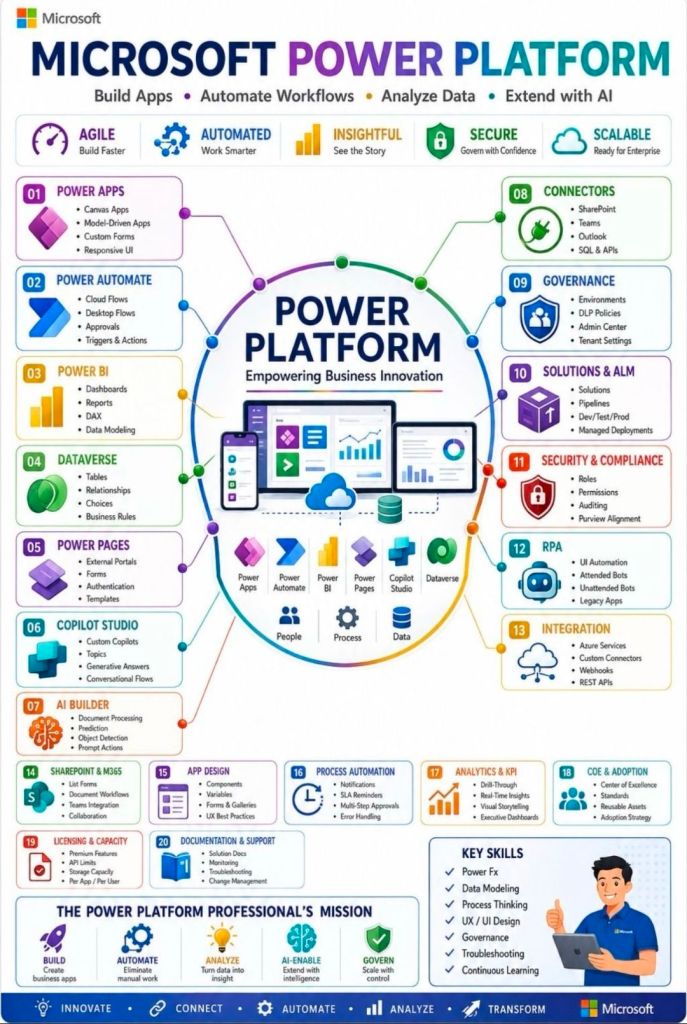
Microsoft Power Platform is a suite of low-code tools designed to help organizations analyze data, build custom solutions, automate processes, and create AI-powered agents. It enables both professional developers and “citizen developers” (business users) to rapidly build end-to-end business applications that integrate with the broader Microsoft Cloud ecosystem

Microsoft Power Platform

Core Product Areas

The platform consists of five primary applications: 

  • Power BI: A business analytics tool for data visualization and interactive reporting.
  • Power Apps: A low-code development environment for building custom web and mobile business applications.
  • Power Automate: A service for workflow automation and robotic process automation (RPA).
  • Power Pages: A platform for creating and hosting secure, external-facing business websites.
  • Copilot Studio: A graphical tool for building and customizing AI-powered agents and chatbots. 

Underlying Capabilities

The platform’s strength lies in its shared infrastructure: 

  • Microsoft Dataverse: A secure, cloud-scale data store that provides a common data model for all Power Platform apps.
  • Connectors: Over 1,000 prebuilt integrations that allow apps to communicate with external data sources like SAP, Salesforce, and Google Analytics.
  • AI Builder: A capability that allows users to add AI models (e.g., sentiment analysis or object detection) to their apps and flows without writing code.
  • Power Fx: A low-code, strongly-typed programming language used for expressing logic across the platform.

The Microsoft Power Platform has evolved from individual components like Power BI and Power Apps into a unified suite, now heavily integrated with Copilot and AI

Origins & Early Growth (2013–2018)

  • 2013Power BI is first released as an Excel add-in before becoming a standalone service in 2015.
  • 2015Power Apps enters public preview as a low-code tool for building business applications.
  • 2016Microsoft Flow (now Power Automate) is launched to provide workflow automation across apps and services.
  • 2018: The term “Microsoft Power Platform” is officially introduced to unify Power BI, Power Apps, and Flow. 

Expansion & Rebranding (2019–2022)

  • 2019Power Virtual Agents is added to the suite for creating no-code chatbots. Microsoft Flow is rebranded as Power Automate.
  • 2020: Launch of Power BI Premium per user and the Dataverse (formerly Common Data Service) rebranding.
  • 2021Power Fx, an open-source formula language based on Excel, is introduced as the standard language across the platform.
  • 2022Power Pages is launched as the fifth standalone product for building secure, low-code business websites. 

The AI & Copilot Era (2023–Present)

  • 2023: Integration of Copilot across all Power Platform products, allowing users to build apps, flows, and reports using natural language.
  • 2024: Introduction of Timeline Highlights in Power Apps to provide AI-generated summaries of record activities.
  • 2025: Microsoft announces the retirement of the Power Apps per app plan (January) and ends support for contact tracking in the Dynamics 365 App for Outlook (October).
  • 2026: The 2026 Release Wave 1 begins (April–September), focusing on deeper Role-based Copilot offerings and enhanced security agents.
Microsoft Power Platform Milestone Summary

The Microsoft Power Platform originated from Microsoft’s effort to democratise data and app development by evolving its existing business tools into a unified low-code ecosystem

Origins and Evolution (2003–2015)

The platform’s roots trace back to early business solutions that were eventually merged into the modern suite: 

  • Dynamics CRM 1.0 (2003): The foundation for what became the Microsoft Dataverse (formerly Common Data Service), providing a secure relational database.
  • Project Siena (2013): A “garage project” at Microsoft aimed at building web apps without professional coding tools. This project eventually became Power Apps.
  • Power BI Launch (2015): Originally “Project Crescent” for SQL Server, Power BI was the first of the modern “Power” services to be delivered, entering preview in January 2015. 

Expansion and Formalisation (2016–2019) 

Microsoft transitioned from individual tools to an integrated platform: 

  • Power Apps and Flow (2016): Power Apps and Microsoft Flow (later renamed Power Automate) became generally available in November 2016.
  • Common Data Service (2016): Introduced to provide a shared data platform across Dynamics 365 and the new “Power” tools.
  • Official Branding (2018–2019): The term “Microsoft Power Platform” was officially established as an umbrella brand for the suite of tools. In 2019, Microsoft Flow was rebranded to Power Automate to align with the platform’s naming convention. 

Modern Era and AI Integration (2020–Present) 

The platform has shifted toward “AI-first” development and expanded its core pillars: 

  • New Components: Power Virtual Agents (now Copilot Studio) and Power Pages (for external websites) were added to the core lineup.
  • Acquisitions: Microsoft acquired Softomotive (2020) and Minit (2022) to bolster Power Automate with Robotic Process Automation (RPA) and process mining capabilities.
  • Generative AI: Recent updates have focused on integrating Copilots across all products, allowing users to build apps and automations using natural language. 

Microsoft Power Platform Development Timeline Overview

Microsoft Dynamics 365 Timeline

Centiun Microsoft Business Applications and AI Specialists

Websitehttps://centiun.com

Centiun Microsoft Business Applications and AI Specialists

Centiun Overview

Centiun is a British IT services consulting company and Microsoft Partner, helping enterprise public and private sector organisations achieve digital transformation excellence through the Microsoft cloud.

We specialise in Microsft Dynamics 365, Power Platform, and Micrisoft 365, delivering expert consultancy, solution architecture, implementation, and managed services that enable organisations to modernise operations, improve service delivery, and unlock greater value from their technology investment.

From CRM transformation and business process automation to secure collaboration, data-driven decision making, and AI enabled innovation, Centiun supports customers to build smarter, faster and more resilient ways of working.

Our approach combines deep Microsoft expertise with a practical focus on outcomes – designing and delivering solutions that are scalable, compliant, and tailored to the needs of complex organisations.

Whether you’re starting your digital journey or optimising an existing platform, Centiun is your trusted Microsoft for long-term transformation and support.

Website: https://centiun.com

On LinkedIn: https://www.linkedin.com/company/centiun/

Email: info@centiun.com

Centiun services
Centiun Microsoft Business Applications and AI Specialists

AI Skills to Learn in 2026

AI Skills to Learn in 2026

Agentic AI Artificial Intelligence, Layers of Capability Explained

Agentic AI Artificial Intelligence, Layers of Capability Explained

Azure AI vs Google Cloud AI vs AWS AI vs IBM Watson vs Alibaba Qwen

Azure AI vs Google Cloud AI vs AWS AI vs IBM Watson vs Alibaba Qwen