Download Templates for PROject Management | FREE Upgrades & Additions
Author: Mark Whitfield
Welcome to my site!
After graduating in Computing in 1990, I accepted a position as a programmer at a Runcorn based software house specialising in electronic banking software, namely sp/ARCHITECT-BANK on Tandem Computers (now HPE NonStop). This was before the internet became more prevalent and so the notion of enabling desktop access to company accounts for inter-account transfers and book keeping was still quite a cutting edge idea (and smartphones only ever hinted at in Space 1999). The company was called The Software Partnership (which was taken over by Deluxe Data in 1994).
I spent 5 years in Runcorn developing code for SP/ARCHITECT for various banks like TSB, Bank of Scotland, Rabobank and Girofon (Denmark) to name but a few. I then moved onto a software house in Salford Quays for further bank facing projects. After a further 23 years in the IT industry and now a Senior IT Project Manager (both Agile and Waterfall delivery), I thought I would echo out my Career Profile in this corner of the internet for quick and easy access.
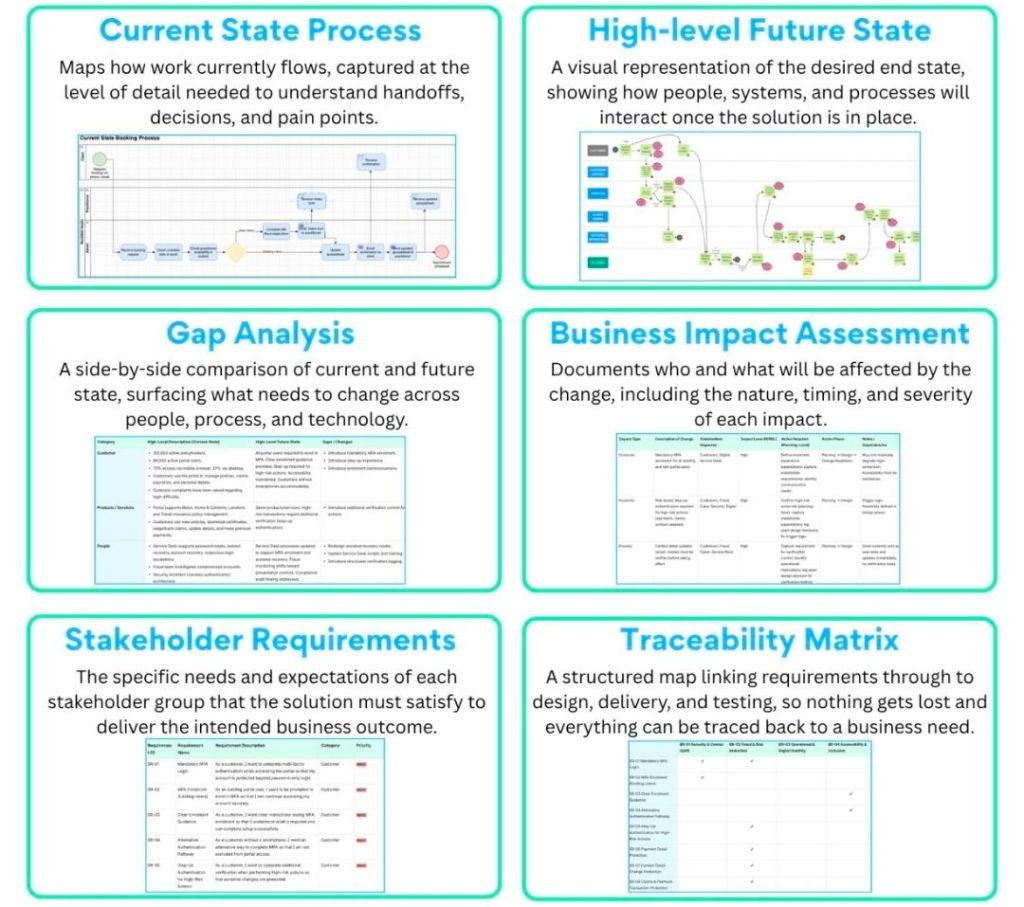
In the project planning phase, a Business Analyst (BA) focuses on establishing the project’s strategic alignment, defining the baseline scope, mapping stakeholders, and structuring the business analysis methodology.
The critical BA deliverables generated during this phase ensure clarity and alignment across technical and business teams before execution begins.
Strategic & Scope Foundations
Business Problem Statement: Defines the core issue being addressed, why it matters to the organisation, and the downstream impact if no action is taken.
Business Case: Outlines the shortlisted, viable operational choices alongside a comprehensive cost-benefit analysis to justify financial investment.
Project Vision & Scope: A high-level description outlining system boundaries, project objectives, and structural constraints to prevent eventual scope creep.
Stakeholder & Communication Frameworks
Stakeholder Map: Visually identifies all internal and external parties who are involved in, impacted by, or influential to the initiative.
Stakeholder Analysis Matrix: Assesses stakeholder interest and decision-making power to customize communication and engagement strategies.
Business Glossary: A standardized registry defining critical business terminology to maintain consistent vocabulary across different teams.
Process & Data Models
Current State Discovery (“As-Is” Models): A structured overview detailing exactly how today’s workflows, processes, and operating models currently function.
High-Level Context Diagram: Maps the structural boundaries of the proposed project, showing how the internal system will interact with external users and data systems.
Data Flow Diagram (DFD): Illustrates how information travels visually across different processes, storage points, actors, and functional areas.
BA Execution Planning
Business Analysis Approach: Outlines the core delivery methodology (e.g., Predictive/Waterfall or Adaptive/Agile), specifying the timelines, techniques, and governance processes to be used.
Requirements Management Plan: Defines the tools for managing requirements, access protocols, configuration control, and how changes to the baseline will be systematically approved.
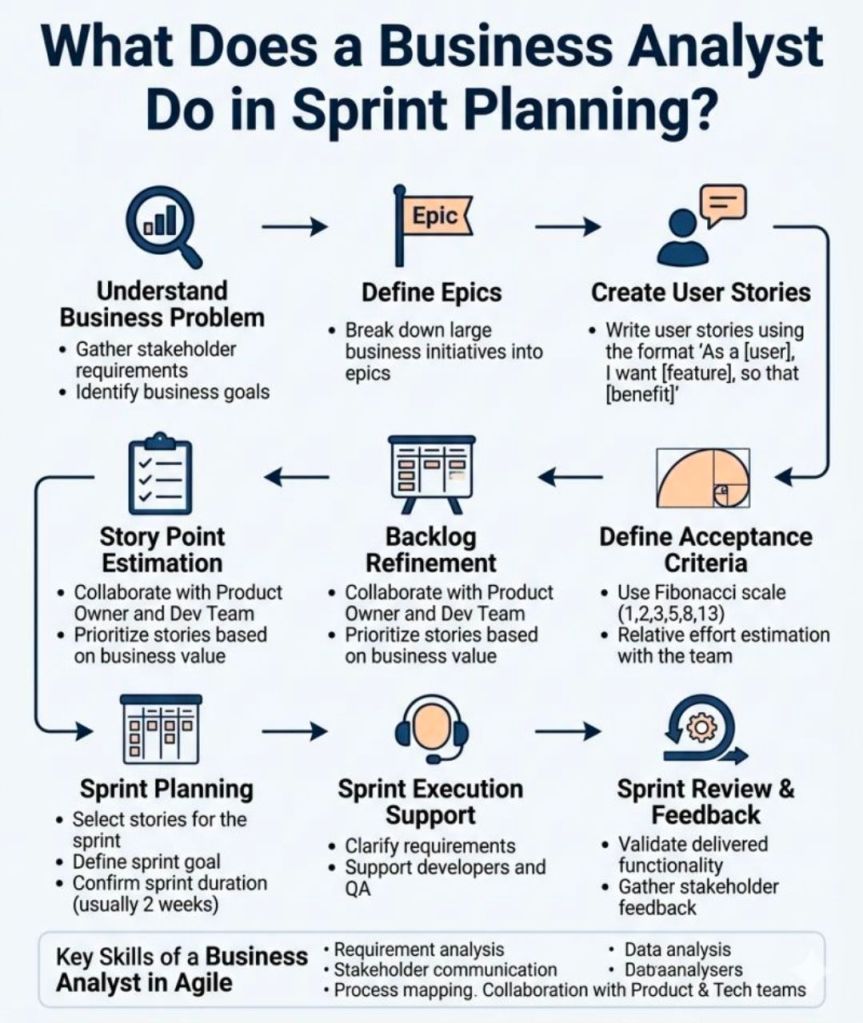
In Agile and Scrum frameworks, the Business Analyst (BA) bridges the gap between high-level business vision and tactical development execution. During Sprint Planning, a BA’s primary focus is to ensure that the development team has absolute requirement clarity, eliminating assumptions before a single line of code is written.
The exact focus areas of an Agile Business Analyst are divided into pre-planning readiness, active session support, and look-ahead risk management.
1. Requirements Readiness (Definition of Ready)
The primary pre-planning objective for a BA is ensuring that the top of the Product Backlog satisfies the team’s “Definition of Ready” (DoR).
INVEST Criteria: Verifying that each Product Backlog Item (PBI) is Independent, Negotiable, Valuable, Estimable, Small, and Testable.
Acceptance Criteria: Drafting robust, edge-case-tested functional parameters (often using the Given-When-Then format) to govern testing.
Business Rules & Models: Mapping complex data models, workflows, and process rules so developers have clear visuals alongside text.
2. Guarding the Business Value and Sprint Goal
While the Product Owner (PO) sets the priority, the BA confirms that the selected sprint backlog items align logically to form a cohesive target.
Sprint Goal Formulation: Supporting the PO in defining a functional, clear objective for the iteration rather than a random collection of tickets.
Value Justification: Serving as the “voice of the user,” reminding the technical team why a feature is being built and how it affects the end-user journey.
3. Technical and Functional Bridging
During the actual planning meeting, developers break down stories into sub-tasks and estimate effort. The BA provides live context.
Assumption Removal: Answering immediate clarifications regarding data constraints, legacy dependencies, or UI expectations.
Sizing Support: Assisting the team during story-point estimation by highlighting hidden functional complexities that impact effort.
Scope Trimming: Helping break down massive User Stories (Epics) into bite-sized, single-sprint tasks if an item is deemed too large.
4. Dependency and Risk Mitigation
A critical focus for the BA is ensuring the upcoming sprint does not get blocked by outside factors.
Cross-Team Alignment: Identifying if a story relies on an API or data feed managed by an external team, ensuring those pieces are unblocked.
Non-Functional Requirements (NFRs): Catching frequently missed parameters, such as specific security protocols, compliance standards, or localization requirements, before work kicks off.
Insider Technologies Limited is a specialized UK-based software house and service provider that engineers high-availability monitoring, tracking, and cybersecurity solutions for business-critical, 24/7 mission-critical architectures. I worked at ITL in Salford Quays from 1995 through to 2013.
Attending an EBUG conference (European BASE24 User Group)
Foreground, attending a British Isles TANDEM User Group (BITUG)
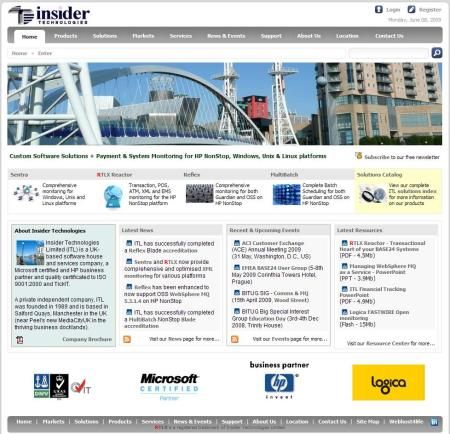
Insider Technologies Limited (website author in 2009)
CompanyOverview
🏢 Corporate Identity & Status
Legal Name: Insider Technologies Limited
Founded:27 February 1989
Headquarters: Manchester, UK (Albert Street, Eccles)
Ownership: Operating as a private independent software company, recently integrated as part of PartnerOne.
Strategic Partnerships: Certified Microsoft Gold Partner for Application Development and long-standing Hewlett Packard Enterprise (HPE) partner.
Insider Technologies Limited (ITL) in 2001, Salford Quays, Chandlers Point
🌐 Core Domain & Industries Served
The company delivers real-time, event-driven diagnostic, tracking, and compliance middleware solutions across three main highly-regulated global verticals:
Government & Defence: Secure enterprise military messaging tracking and digital evidence handling.
Telecommunications: Tracking data traffic and critical infrastructure middleware.
🛠️ Core Technology Stack & Competencies
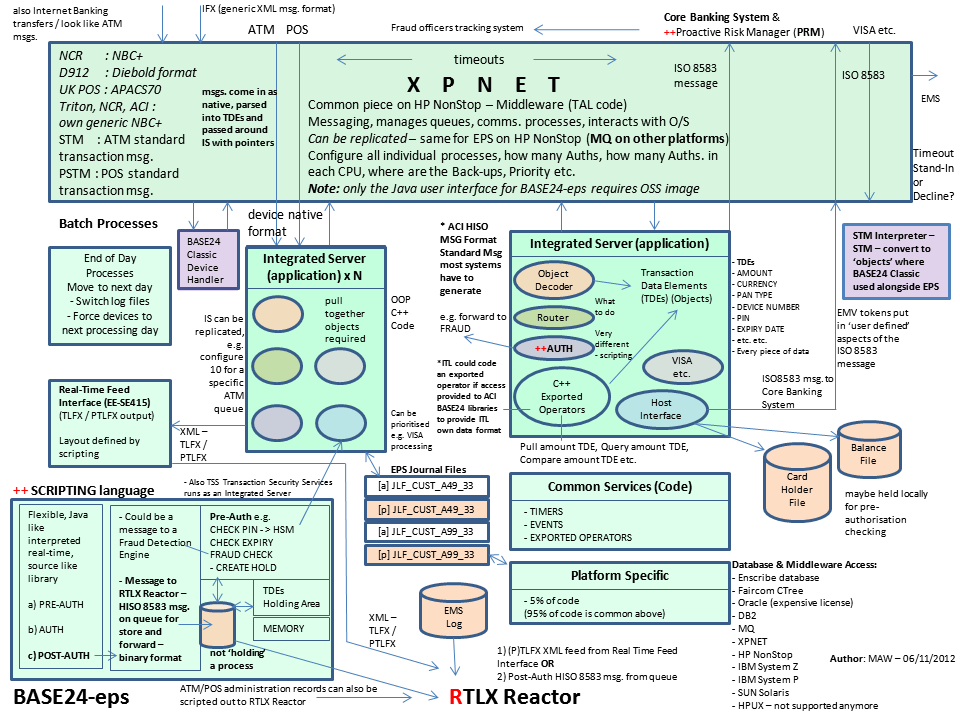
Insider Technologies specializes in niche high-availability operating environments—specifically HPE NonStop (historically Tandem Computers and HP NonStop) running Guardian and Open System Services (OSS) environments—alongside enterprise Windows, Linux, and Unix systems. Their expertise spans database transaction management, BASE24 XPNET monitoring, IBM WebSphere MQ tracking, and low-level development (SQL, TAL, TACL, COBOL85, C++, Pathway).
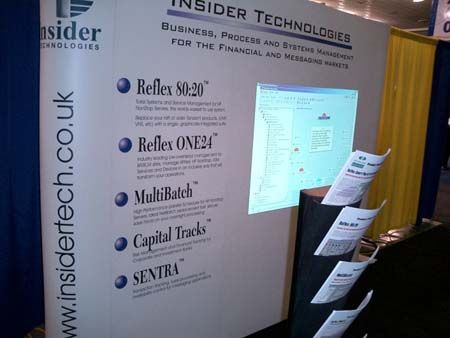
Insider Technologies – Core products in 2003
In-Depth Product & Political-Technical Timeline
This timeline breaks down how Insider Technologies evolved its software suite. It demonstrates how their technical development directly responded to shifting geopolitical landscapes—ranging from late-Cold War military messaging security to post-9/11 financial regulations and modern European cloud autonomy initiatives.
🔹 The Foundation & Legacy Tandem Era (1989–1999)
Political Context: The final years of the Cold War and the 1990s globalization boom demanded high-security, fault-tolerant mainframes for NATO-aligned military communications and early global banking clearing networks.
Technical Context: Tandem Computers dominated the un-interruptible 24/7 market. Software was required to monitor these platforms without causing processing overhead.
1989
Company Incorporation: Insider Technologies is incorporated in the UK to engineer bespoke software for highly robust technical ecosystems.
1990–1995
Reflex (Core Release): Release of Reflex, a foundational service management and real-time transaction diagnostic tool built specifically for the Tandem Guardian operating system.
1996–1999
MultiBatch Software: Further Develop and Extend MultiBatch to orchestrate and safely automate complex batch processing on Tandem machines alongside the evolution into HP NonStop computing frameworks.
Y2K Compliance Focus: Technical adjustments were deployed across Reflex and MultiBatch to assure financial institutions that automated transaction logging would not fail during the millennium rollover.
🔸 The Multi-Platform & Financial Compliance Era (2000–2015)
Political Context: Following the September 11 attacks, global anti-money laundering (AML) and counter-terrorism financing (CTF) frameworks heavily expanded. Financial regulators demanded exact, audible end-to-end payment tracking.
Technical Context: Enterprises began migrating away from single-architecture mainframes toward heterogeneous IT environments, requiring tools that could jump across Windows, Unix, and Linux simultaneously.
2002–2004
Sentra Development: Launch of Sentra, expanding the firm’s portfolio beyond HPE NonStop into cross-platform environment monitoring for Windows, Linux, and Unix systems.
Reflex 80:20 & Reflex ONE24: Advanced variations of the Reflex tracking system were built to cater to specialized real-time electronic payment flows like BASE24 with XPNET.
2005–2010
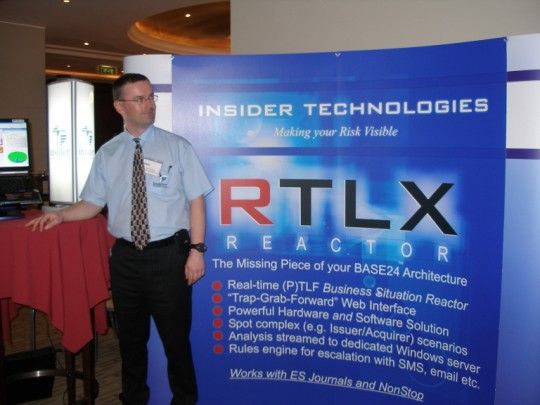
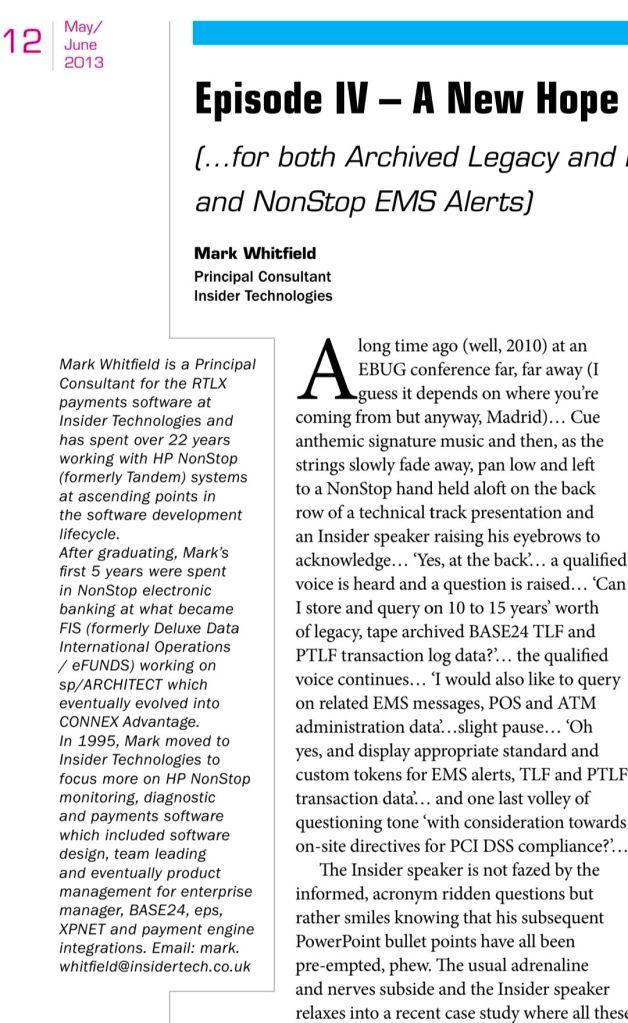
RTLX Reactor (page 12) and Middleware Monitoring: The release of RTLX Reactor provided message tracking capabilities tailored for IBM WebSphere MQ, allowing institutions to trace various payment and other data through complex middleware chains.
Corporate Structuring: The creation of Insider Technologies (Holdings) Limited reinforced corporate expansion as the company deepened its footprint in secure military messaging for government defense bodies.
🔹 The Cyber Autonomy & Sovereignty Era (2016–Present)
Political Context: Escalating nation-state cyber warfare, strict GDPR regulations, and the UK/EU push for technological sovereignty and domestic digital ecosystem resilience heightened the reliance on trusted, onshore technology suppliers.
Technical Context: High-threat environments demand zero-trust visualization, time-accurate logging across digital evidence files, and advanced protection against internal exfiltration vectors.
2019
30-Year Milestone & Modernization: The company celebrates its 30th year, accelerating development on modern mobile application extensions to permit real-time, remote secure alerts for operations teams.
2022–2025
PartnerOne Integration: Insider Technologies aligns its operations under the PartnerOne portfolio, preserving its UK identity while supercharging its enterprise-scale data infrastructure solutions.
Corporate Integration combines Insider’s expertise with PartnerOne’s portfolio to deliver advanced analytics and secure messaging systems to banking, defence, and telecommunications markets.
Defense and Public Safety Porting: Technical deployment of specialized capabilities covering digital evidence security, timekeeping tracking, and legacy virtualization modules aimed explicitly at helping the UK Government maintain its historical tech stacks safely.
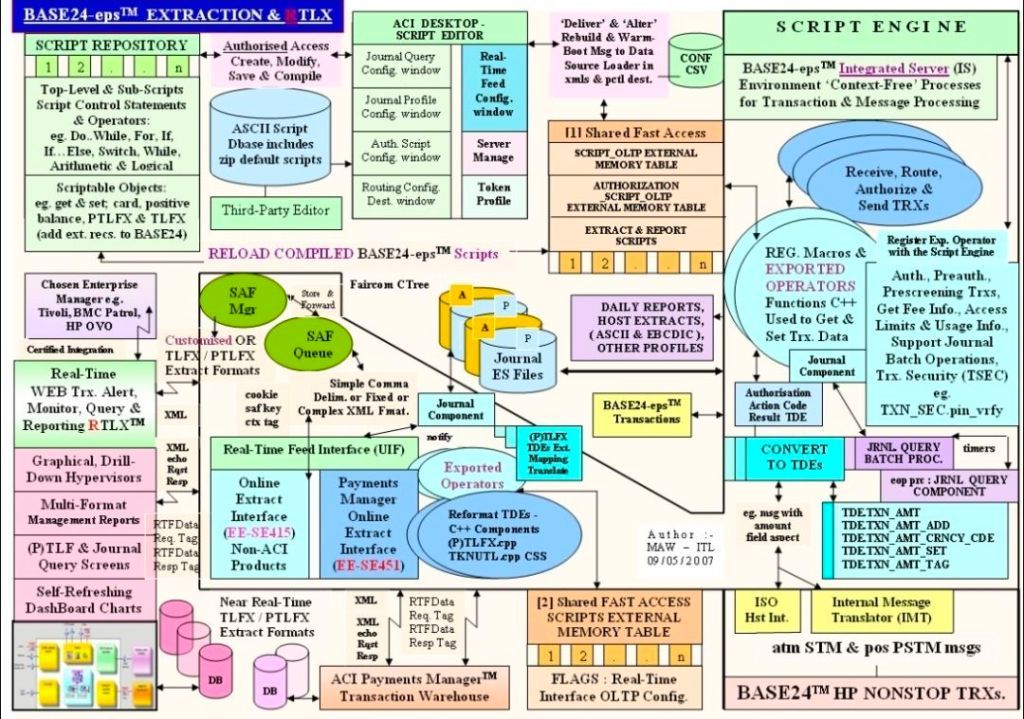
RTLX Reactor (in 2012) for tracking BASE24-eps & BASE24 XPNET transactions
Insider Technologies Limited (ITL), Company Overview and Timeline by Year
The Insider RTLX product at ETI-NET is now called C-Deep for Transaction Monitoring;
ProjectTemplatesSoft on Etsy is a highly rated, UK-based digital storefront specializing in professional-grade project management spreadsheets and presentation documents. Founded by Mark Whitfield, a veteran Senior Project Manager with over 30 years of delivery experience in IT and the Software Development Lifecycle (SDLC), the shop bridge the gap between heavy enterprise software and simple, flexible spreadsheets.
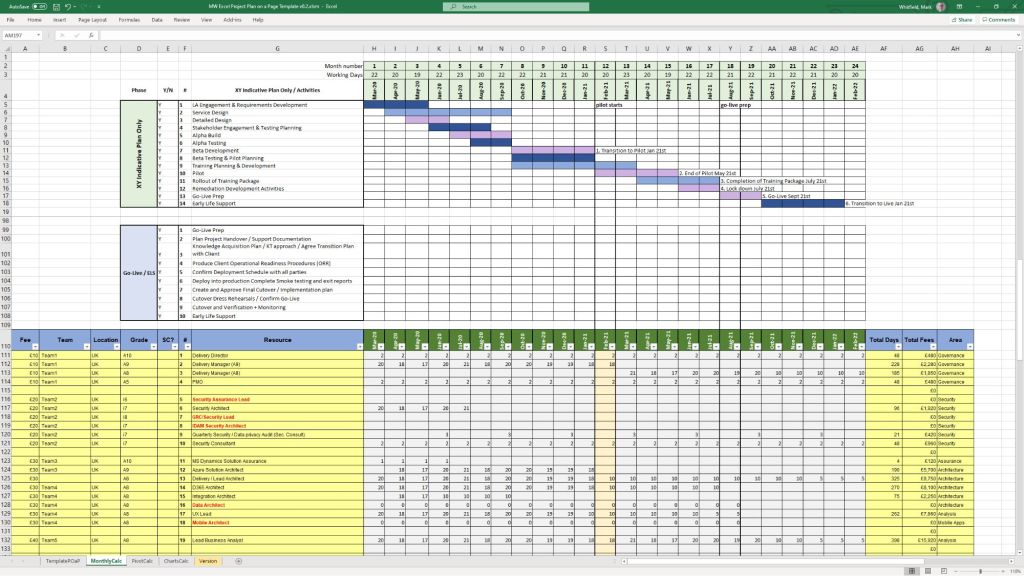
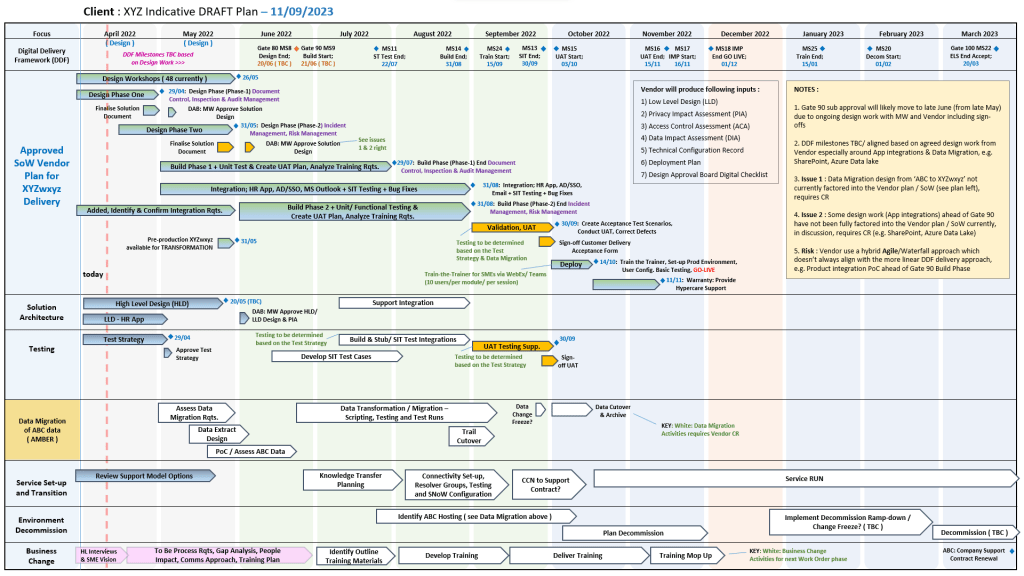
Example POaP PPT and XLS plan project templates (200+ in all)
The products are distinctively built around core professional methodologies including PRINCE2 Waterfall and Agile Scrum frameworks. A key differentiator for this storefront is its customer lifetime model: all template upgrades and functional versions are 100% free after a single purchase by contacting the seller directly. The tools are fully unlocked, editable, and act as a portable alternative for teams or clients without expensive Microsoft Project licensing.
Product Breakdown by Category Focus
📊 1. Schedule Planning & Waterfall Templates
These tools target timeline generation, resource distribution, and critical path management for traditional structured delivery.
Waterfall Project Planner & Cost Tracker: An advanced interactive timeline engine that acts as a localized alternative to MS Project. It allows teams to map out milestones while calculating live run-rate expenditures.
Plan on a Page (POaP) Blueprint: A high-level stakeholder alignment presentation tool crafted in Microsoft Excel and PowerPoint designed to condense multi-layered delivery milestones into one scannable executive slide.
Work Breakdown Structure (WBS) Matrix: Structural templates built to parse complex client scopes into manageable, sequential project tasks.
🔄 2. Agile & Scrum Framework Toolkits
Tailored for modern software development environments executing iterative design, rapid deployments, and sprint-based task management.
Agile Scrum Master Pack: Complete tracking logs optimizing sprint velocities, backlog grooming sessions, and team capacity limits.
Built for Programme Management Offices requiring cross-project transparency, strict risk mitigation, and central staff scheduling.
Central RAID Log: A classic, comprehensive spreadsheet designed to track project Risks, Assumptions, Issues, and Dependencies under strict corporate governance standards.
Resource Absence & Sickness Tracker: A centralized planner for operations managers to log annual leave, sickness intervals, and alternative project allocations.
Project Team Kick-Off Decks: Professionally designed slide blueprints that outline scope definitions, stakeholder communication channels, and milestone objectives during initiation phases.
Essential Shop & Resource Hyperlinks
To explore the complete range of toolkits, check out the official ProjectTemplatesSoft Etsy Shop Page.
To access detailed execution frameworks, read customer documentation, or seek professional delivery guidance, visit the developer’s hub at Mark Whitfield’s Project Management Blog.
Improving SEO on WordPress requires a mix of technical configuration, content strategy, and optimization plugins. WordPress is naturally SEO-friendly, but you must configure it correctly to maximize search engine visibility.
Overview of WordPress SEO
WordPress SEO focuses on three main pillars:
Technical SEO: Ensuring search engines can crawl and index your site quickly.
On-Page SEO: Creating high-quality content optimized for specific user search terms.
Performance: Delivering a fast, secure, and mobile-friendly user experience.
Structured Breakdown by Focus Area
1. Core Technical Configuration
Search Engine Visibility
Ensure the “Discourage search engines from indexing this site” box is unchecked in your Reading settings.
Permalinks
Change the URL structure to “Post Name” for clean, keyword-rich web addresses.
WWW vs. Non-WWW
Choose one format in General Settings and ensure the other redirects to it consistently.
2. Specialized Plugins & Indexing
SEO Plugin Deployment
Install Yoast SEO, Rank Math, or All in One SEO to manage meta data.
XML Sitemaps
Generate a dynamic XML sitemap via your SEO plugin and submit it to Google Search Console.
Robots.txt Optimization
Edit this file to block search bots from crawling sensitive core admin folders.
3. On-Page Content Optimization
Keyword Placement
Add your target keyword to the title, first paragraph, headings, and URL slug.
Meta Titles & Descriptions
Write catchy, character-limited titles and summaries for every post to boost click-through rates.
Heading Structure
Use exactly one H1 tag per page for the title, followed by logical H2 and H3 tags.
Image Optimization
Compress image files before uploading and write descriptive Alt Text containing relevant keywords.
4. Performance & Security
Site Speed
Use a caching plugin like LiteSpeed Cache or WP Rocket to decrease page load times.
Hosting Quality
Migrate to a managed WordPress host to ensure high server uptime and fast response rates.
SSL Certificate
Activate HTTPS encryption through your host to establish data security and gain search trust.
5. Link Management
Internal Linking
Link new articles to older, relevant posts to distribute page authority across your site.
Broken Link Prevention
Install a redirection plugin to fix 404 errors and guide users away from dead pages.
Permalinks Consistency
Never change an existing post URL without setting up a permanent 301 redirect.
Mark Whitfield is a Greater Manchester-based Senior IT Project and Engagement Manager.
With over 30 years in the IT and software development industry, he has continuously upskilled in project delivery, Agile methodologies, cloud platforms, and cyber security.
Phase 1: Foundational Education
1985 – 1988: Leigh College, UK
Focus: Computer Science and Biology (‘A’ Levels)
1988 – 1990: University of Greater Manchester (formerly Bolton Institute of Higher Education, BIHE)
Focus: Higher National Diploma (HND) in Computer Studies (Graduated with Distinction; First overall in the year)
Key Modules: System Analysis, Programming Methodology, Database Architecture, and Business Information Systems
Phase 2: Project Management & Professional Training
2000 – 2006: Industry Integration & Early Methodologies
Focus: Service-Oriented Architecture (SOA), Agile, Sales, and early project management
Courses/Certifications: Sales and Marketing (In-house Outsource, 2001), Web Services and SOA (Insider Technologies, 2005), PRINCE2 Foundation (2006), Designing Good Marketing Literature (SkillPath Seminars, 2006)
2009: Digital & Communications
Focus: Digital marketing and content
Courses: Writing for the Web, and Website Promotion and Visibility by Design (iTrain Education)
2011: Structured Frameworks
Focus: Formal project frameworks and delivery methodologies
Courses/Certifications: PRINCE2 Foundation & Practitioner (ILX Group), Agile Scrum (RADTAC)
2012: Operational Management
Focus: Service management best practices
Courses/Certifications: ITIL Foundation
Phase 3: Advanced Engagement & Enterprise Training
2017 – 2019: Capgemini Engagement & Compliance
Focus: High-level engagement management and corporate governance
Courses/Certifications: Advanced Engagement Management Certification (Level 2), Group Anti-Corruption, and Intellectual Property Rights (IPR) Training
2022: Cloud Modernization
Focus: Enterprise cloud computing fundamentals
Courses/Certifications: AZ-900 Microsoft Certified Azure Fundamentals