

In the project planning phase, a Business Analyst (BA) focuses on establishing the project’s strategic alignment, defining the baseline scope, mapping stakeholders, and structuring the business analysis methodology.
The critical BA deliverables generated during this phase ensure clarity and alignment across technical and business teams before execution begins.
Strategic & Scope Foundations
- Business Problem Statement: Defines the core issue being addressed, why it matters to the organisation, and the downstream impact if no action is taken.
- Business Case: Outlines the shortlisted, viable operational choices alongside a comprehensive cost-benefit analysis to justify financial investment.
- Project Vision & Scope: A high-level description outlining system boundaries, project objectives, and structural constraints to prevent eventual scope creep.
Stakeholder & Communication Frameworks
- Stakeholder Map: Visually identifies all internal and external parties who are involved in, impacted by, or influential to the initiative.
- Stakeholder Analysis Matrix: Assesses stakeholder interest and decision-making power to customize communication and engagement strategies.
- Business Glossary: A standardized registry defining critical business terminology to maintain consistent vocabulary across different teams.
Process & Data Models
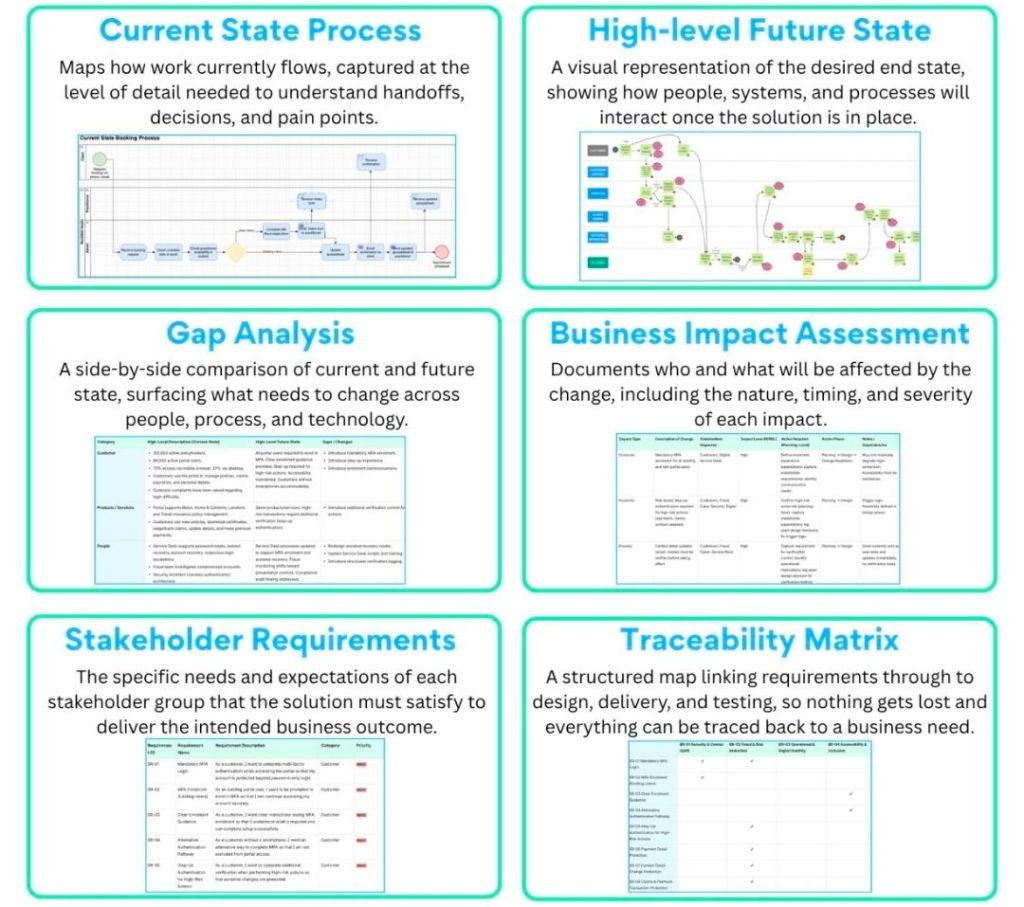
- Current State Discovery (“As-Is” Models): A structured overview detailing exactly how today’s workflows, processes, and operating models currently function.
- High-Level Context Diagram: Maps the structural boundaries of the proposed project, showing how the internal system will interact with external users and data systems.
- Data Flow Diagram (DFD): Illustrates how information travels visually across different processes, storage points, actors, and functional areas.
BA Execution Planning
- Business Analysis Approach: Outlines the core delivery methodology (e.g., Predictive/Waterfall or Adaptive/Agile), specifying the timelines, techniques, and governance processes to be used.
- Requirements Management Plan: Defines the tools for managing requirements, access protocols, configuration control, and how changes to the baseline will be systematically approved.


