

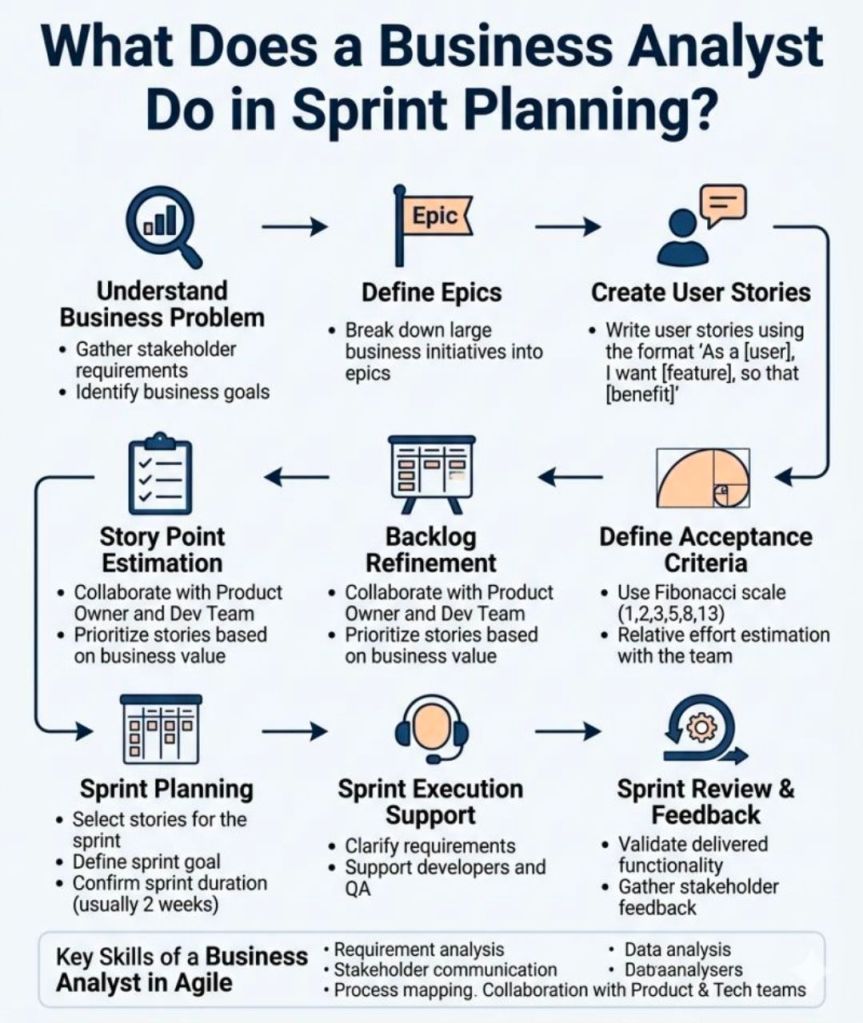
In Agile and Scrum frameworks, the Business Analyst (BA) bridges the gap between high-level business vision and tactical development execution. During Sprint Planning, a BA’s primary focus is to ensure that the development team has absolute requirement clarity, eliminating assumptions before a single line of code is written.
The exact focus areas of an Agile Business Analyst are divided into pre-planning readiness, active session support, and look-ahead risk management.
1. Requirements Readiness (Definition of Ready)
The primary pre-planning objective for a BA is ensuring that the top of the Product Backlog satisfies the team’s “Definition of Ready” (DoR).
- INVEST Criteria: Verifying that each Product Backlog Item (PBI) is Independent, Negotiable, Valuable, Estimable, Small, and Testable.
- Acceptance Criteria: Drafting robust, edge-case-tested functional parameters (often using the Given-When-Then format) to govern testing.
- Business Rules & Models: Mapping complex data models, workflows, and process rules so developers have clear visuals alongside text.
2. Guarding the Business Value and Sprint Goal
While the Product Owner (PO) sets the priority, the BA confirms that the selected sprint backlog items align logically to form a cohesive target.
- Sprint Goal Formulation: Supporting the PO in defining a functional, clear objective for the iteration rather than a random collection of tickets.
- Value Justification: Serving as the “voice of the user,” reminding the technical team why a feature is being built and how it affects the end-user journey.
3. Technical and Functional Bridging
During the actual planning meeting, developers break down stories into sub-tasks and estimate effort. The BA provides live context.
- Assumption Removal: Answering immediate clarifications regarding data constraints, legacy dependencies, or UI expectations.
- Sizing Support: Assisting the team during story-point estimation by highlighting hidden functional complexities that impact effort.
- Scope Trimming: Helping break down massive User Stories (Epics) into bite-sized, single-sprint tasks if an item is deemed too large.
4. Dependency and Risk Mitigation
A critical focus for the BA is ensuring the upcoming sprint does not get blocked by outside factors.
- Cross-Team Alignment: Identifying if a story relies on an API or data feed managed by an external team, ensuring those pieces are unblocked.
- Non-Functional Requirements (NFRs): Catching frequently missed parameters, such as specific security protocols, compliance standards, or localization requirements, before work kicks off.


