BASE24 and core Networking Component XPNET timeline

The technical timeline for BASE24 and its core networking component, XPNET, reflects the evolution of high-availability payment switching on HP NonStop (Tandem) systems.

Technical Evolution Timeline

  • 1980s: The Foundation
    • BASE24 Release: Originally developed by Applied Communications Inc. (now ACI Worldwide), BASE24 was built for the Tandem Guardian operating system.
    • XPNET Introduction: Developed as the Message-Oriented Middleware (MOM) to handle all transaction routing and communications. It introduced a multi-node architecture allowing different “satellite” processes (ATM, POS, Host) to communicate.
  • 1990s: Scale and Maturity
    • Classic Era: BASE24 “Classic” became the industry standard for ATM and POS switching.
    • XPNET 3.x: Enhanced to support larger networks and more complex auditing through NCPCOM.
    • Language & DB: The system relied on TAL (Tandem Application Language), COBOL, and the Enscribe database.
  • 2000s: The Shift to BASE24-eps
    • 2003–2005: ACI introduced BASE24-eps (Electronic Payment Systems). This was a re-architecture using C++ and Java to provide platform independence.
    • XPNET 4.1: Released to support the transition, adding features like Common Transport Subsystem (CTS) for better Pathway integration and support for external processes.
    • z/OS Support: By 2009, BASE24-eps was fully ported to IBM z/OS using CICS and VSAM.
  • 2010s – Present: Modernisation & Cloud
    • 2014–2017: Continued updates to BASE24 Classic R6.0, maintaining its relevance for legacy users.
    • Cloud Enablement: Recent versions of BASE24-eps focus on REST API integration via tools like LightWave, allowing legacy XPNET paths to be exposed as web services.
    • Active/Active Environments: Modern implementations focus on “continuous availability” using GoldenGate for data replication between sites. 

Key Technical Components

  • NMM (Network Management Module): The core process of XPNET that manages the configuration of lines, stations, and links.
  • LCONF: The Logical Network Configuration File used by XPNET to define how messages route between processes.
  • Auditing: XPNET provides the primary transaction auditing mechanism, which is still utilized by both Classic and eps versions.

BASE24 and core Networking Component XPNET

Betfred Historical timeline

Betfred’s journey from a single shop in Salford to a global betting powerhouse is marked by bold innovations and high-profile acquisitions. 

Historical Timeline

  • 1967: Brothers Fred and Peter Done open their first betting shop in Salford, Greater Manchester, using winnings from a bet on England to win the 1966 World Cup.
  • 1984: Launch of the Lucky 15 bet, a major industry innovation that remains popular today.
  • 1997: The company expands to over 100 shops.
  • 1998: Fred Done becomes the first bookmaker to pay out early, paying on Manchester United to win the Premier League (only for Arsenal to win the title instead).
  • 1999: First major acquisition, purchasing 40 shops from the Demmy Racing Group.
  • 2004: The business is officially rebranded to Betfred. The company also launches its online betting site this year.
  • 2006: Betfred launches one of the industry’s first mobile betting platforms.
  • 2011: Wins the auction to buy The Tote from the UK government for £265 million.
  • 2016: Acquires 322 shops from Ladbrokes and Coral following their merger.
  • 2021: Fred Done steps down as CEO to become Chairman, with Joanne Whittaker taking over the CEO role.
  • 2024–2026: Significant global expansion, establishing a presence in South Africa and the United States, though later scaling back some US online operations in late 2025.

Operational Timelines (Payment & Payouts)

If you are looking for current service timelines for transactions, here are the standard processing windows as of February 2026:

  • Withdrawal Processing: Betfred aims to approve requests within 48 hours.
  • Fastest Methods: Visa Direct and certain E-wallets (PayPal, Skrill) often arrive within 4 to 6 hours.
  • Standard Methods: Bank transfers typically take 2 to 5 working days.
  • Free Bet Credit: Usually credited within 10 hours of a qualifying bet being settled.
My time at Betfred, Wigan

Betfred Historical timeline

Wincor Nixdorf timeline

Wincor Nixdorf’s journey spans from a mid-century German startup to its 2016 merger with Diebold, forming a global leader in banking and retail technology. 

The Early Years (1952–1990)

  • 1952: Heinz Nixdorf founds Labor für Impulstechnik in Paderborn, Germany.
  • 1964: Launches the System 820, a pioneering programmable small computer.
  • 1968: Renamed Nixdorf Computer AG after acquiring Wanderer-Werke.
  • 1980s: Becomes a market leader in European mid-range computing and retail banking systems.
  • 1986: Heinz Nixdorf dies; the company faces financial challenges shortly after. 

Siemens Era & Rebirth (1990–1999) 

  • 1990: Siemens AG acquires the company, forming Siemens Nixdorf Informationssysteme (SNI).
  • 1998: Siemens refocuses the unit exclusively on banking and retail, spinning it off as Siemens Nixdorf Retail and Banking Systems GmbH.
  • 1999: Venture capital firms KKR and Goldman Sachs acquire the unit, rebranding it as Wincor Nixdorf

Expansion & Independence (2000–2015)

  • 2004: Wincor Nixdorf goes public with a successful IPO on the Frankfurt Stock Exchange.
  • 2000s: Expands into IT outsourcing and gains significant global market share in the ATM and EPOS markets.
  • 2015: Carves out its cashless payments unit into a new entity called AEVI

The Merger Era (2016–Present)

  • 2016: American rival Diebold Inc. completes a $1.8 billion acquisition of Wincor Nixdorf, forming Diebold Nixdorf.
  • 2023: After struggling with debt, Diebold Nixdorf files for and successfully emerges from Chapter 11 bankruptcy, restructuring its finances.

HP HPE NonStop NSK Himalaya Tandem Date Timeline

The HP NonStop (originally Tandem) timeline spans over 50 years of evolution in fault-tolerant computing, beginning with the vision of James Treybig and transitioning through several major corporate owners. 

Founding and Initial Growth (1974–1980s)

  • 1974: Tandem Computers Incorporated is founded by James (Jimmy) Treybig in Cupertino, CA.
  • 1976: The first NonStop I (T/16) servers are shipped to Citibank, introducing the “fail-fast” architecture.
  • 1981: NonStop II is introduced, adding 32-bit addressing support to the 16-bit registers.
  • 1983: NonStop TXP (Tandem Extended Processor) debuts, featuring the first use of cache memory and a native Transaction Monitoring Facility (TMF).
  • 1986: NonStop VLX (Very Large eXtension) is released, introducing 32-bit data paths and the first fault-tolerant SQL database, NonStop SQL.
  • 1987: NonStop CLX is launched as a low-cost, office-ready minicomputer system.
  • 1989: NonStop Cyclone is introduced for high-end mainframe workloads, alongside the Integrity line of Unix-based servers. 

Architecture Transitions (1990s–2000s)

  • 1991: Cyclone/R (CLX/R) marks the start of the TNS/R migration to MIPS microprocessors.
  • 1993: NonStop Himalaya K-series is released, featuring native-mode Guardian OS on MIPS R4400 processors.
  • 1994: Open System Services (OSS) adds a POSIX-compliant environment to the NonStop Kernel.
  • 1997: NonStop Himalaya S-Series introduces ServerNet, replacing older bus technologies with high-speed point-to-point connections.
  • 1997: Compaq acquires Tandem Computers to bolster its high-end enterprise server offerings.
  • 2002: Hewlett-Packard (HP) acquires Compaq, bringing Tandem technology under the HP banner as the NonStop Enterprise Division.
  • 2005: The HP Integrity NonStop (TNS/E) series is launched, migrating the architecture from MIPS to Intel Itanium processors. 

The Modern Era (2010s–Present)

  • 2014: NonStop X (TNS/X) is introduced, transitioning the platform to standard Intel x86-64 processors.
  • 2015: HP splits into HP Inc. and Hewlett Packard Enterprise (HPE); the NonStop line moves to HPE.
  • 2017: Virtualized NonStop (vNS) is introduced, allowing the system to run in software-defined data centres and cloud environments.
  • 2020: HP ends sales of Itanium-based systems in July, completing the transition to the x86 platform.
  • 2024: The NonStop community celebrates 50 years of Tandem/NonStop technology. 
HP HPE NonStop NSK Himalaya Tandem Date Timeline

MediaCityUK BBC North Photographic Build Timeline Journal, Salford Quays

https://mark-whitfield.com/gallery/mediacityuk/

MediaCityUK BBC North Photographic Build Timeline Journal, Salford Quays

https://www.manchestereveningnews.co.uk/incoming/gallery/photographer-documents-rise-mediacityuk-15000-782727

https://www.manchestereveningnews.co.uk/news/greater-manchester-news/photographer-documents-the-rise-of-mediacityuk-with-15000-899834

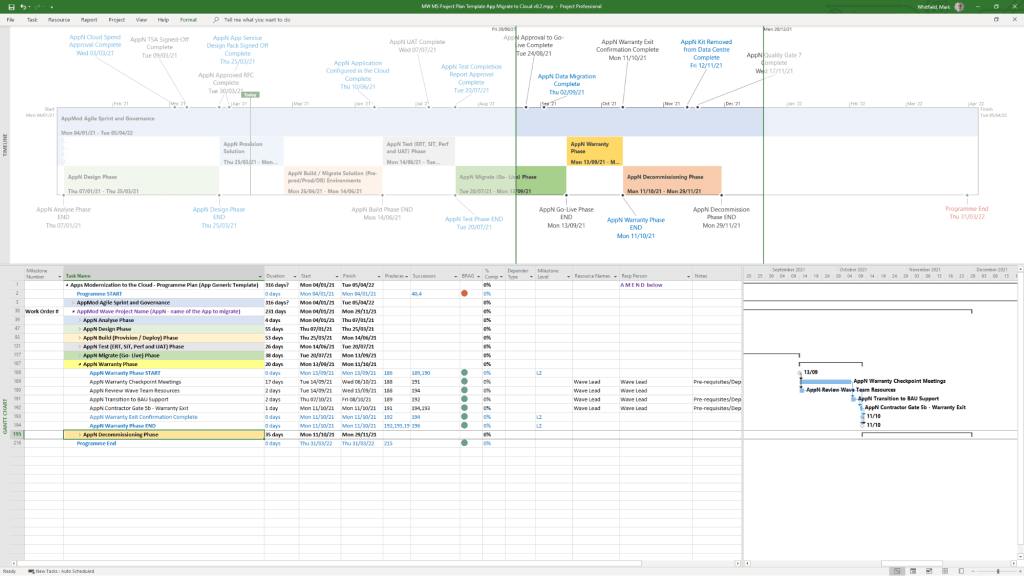
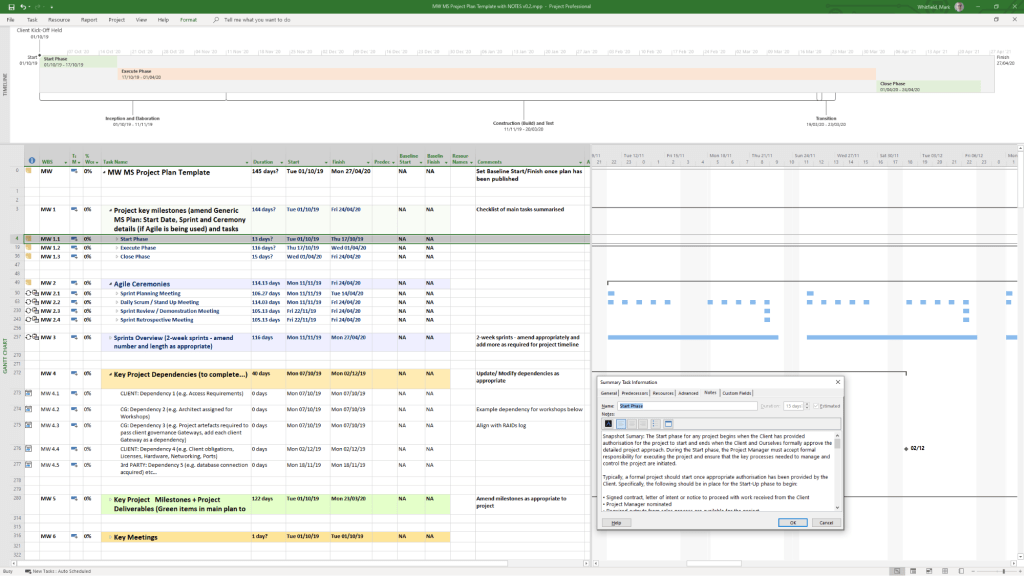
Project Plan Considerations for Producing a Timeline

Project Plan Considerations for Producing a Timeline

Timeline History of Agile Scrum Evolution, Development

Timeline History of Agile Scrum Evolution, Development

PMBOK Evolution Timeline – 1996 to 2025

PMBOK Evolution Timeline – 1996 to 2025

Marvel Cinematic Universe (MCU) Movies in Timeline Order for Watching

Marvel Cinematic Universe (MCU) Movies in Timeline Order for Watching | Image Courtesy of Marvel Entertainment
  1. Captain America: The First Avenger (1942)
  2. Captain Marvel (1995) – but don’t watch the post-credits scene until you’ve watched Infinity War… #spoilers
  3. Iron Man (2008)
  4. Iron Man 2 (2011)
  5. The Incredible Hulk (2011)
  6. Thor (2011) – six months before Avengers
  7. The Avengers (2012)
  8. Iron Man 3 (2012) – six months after The Avengers
  9. Thor: The Dark World (2013) – after Avengers but before Ultron
  10. Captain America: The Winter Soldier (2014) – after Avengers but before Ultron
  11. Guardians of the Galaxy (2014)
  12. Guardians of the Galaxy 2 (2014)
  13. Avengers: Age of Ultron (2015)
  14. Ant-Man (2015)
  15. Captain America: Civil War (2016) – after Ultron and before Infinity War
  16. Black Widow (2016, excluding post-credits scene) – right after Civil War
  17. Spider-Man: Homecoming (2016) – after Civil War and before Infinity War
  18. Doctor Strange (2016-2017)
  19. Black Panther (2017)
  20. Thor: Ragnarok (2017) – after Ultron and before Infinity War
  21. Avengers: Infinity War (2017)
  22. Ant-Man and the Wasp (2017) – takes place at the same time as Infinity War since the post-credit scene takes place during the snap
  23. Avengers: Endgame (2017-2022)
  24. Shang-Chi and the Legend of the Ten Rings (2023)
  25. Spider-Man: Far From Home (2023)
  26. Eternals (2023, excluding flashbacks)
  27. Spider-Man: No Way Home (2024)
  28. Dr. Strange in the Multiverse of Madness (2025)
  29. Thor: Love and Thunder (2025)
  30. Black Panther: Wakanda Forever (2025)
  31. Ant-Man: Quantumania (2026)
  32. Guardians of the Galaxy: Vol 3 (2026)
  33. The Marvels (2026)
  34. Deadpool & Wolverine (Outside of time, watch whenever you like)
  35. Captain America: Brave New World (2027)
  36. Thunderbolts (2027)
  37. Fantastic Four (2028… but also the 1960s, maybe)
  38. Avenger’s Doomsday (2028)