Columbo Overview and Detailed Timeline by year

Columbo is one of television’s most celebrated crime dramas, spanning 35 years, 69 episodes, and two major television networks. Starring Peter Falk in his four-time Emmy-winning role, the show completely upended standard detective tropes with its signature “inverted detective story” structure.

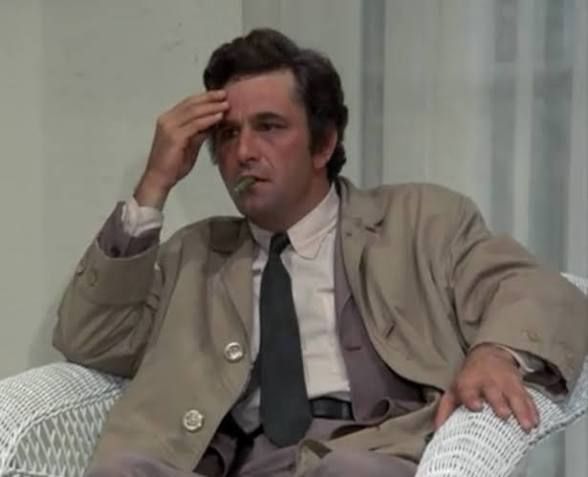
Columbo Peter Falk
Peter Falk, Columbo

The following guide breaks down the core characteristics of the series, followed by a comprehensive, year-by-year chronological timeline of its production and broadcasting history.


Detailed Description of the Series

The Inverted “Whodunit” (The Howcatchem)

Unlike standard mystery shows where the audience tries to guess the killer, Columbo is an inverted detective story. Every episode begins by showing the audience exactly who the murderer is, their motive, and the elaborate steps they take to craft an “airtight” alibi. The true tension and entertainment lie in the psychological cat-and-mouse game between the killer and Lieutenant Columbo, watching him slowly pick apart their flawless crime.

The Character of Lieutenant Columbo

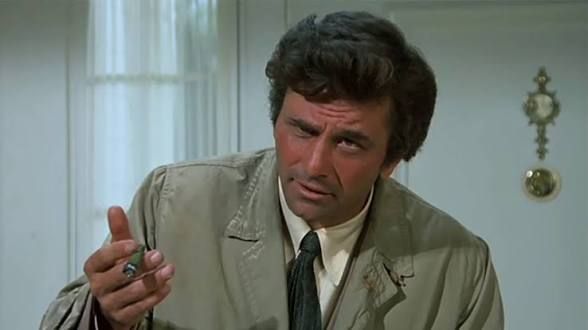
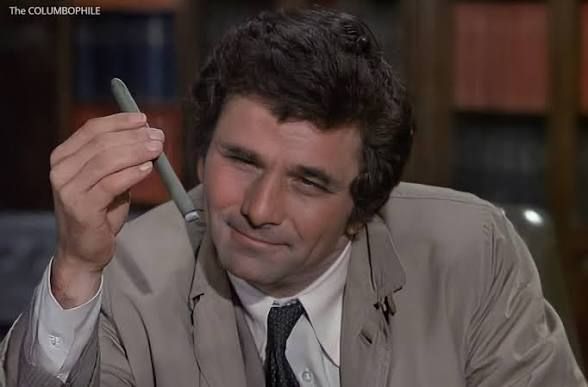
  • The Appearance: Columbo is famously dishevelled. He wears a rumpled, beige raincoat over a wrinkled suit, drives a battered 1959 Peugeot 403 convertible, and frequently chomps on a half-burned cigar.
  • The Tactics: He acts incredibly humble, forgetful, and easily distracted. This is a deliberate ploy to make the high-society killers underestimate him, causing them to let their guard down and talk too much.
  • The Catchphrase: Just as a suspect believes Columbo is leaving and they have gotten away with murder, he stops, turns around, scratches his head, and delivers his iconic phrase: “Just one more thing…”
  • Personal Quirks: He works for the Los Angeles Police Department (LAPD), never carries a gun, loves chili with crackers, owns an incredibly lazy basset hound simply named “Dog”, and constantly references his unseen wife, Mrs. Columbo.

Detailed Production & Broadcast Timeline

The history of Columbo spans across two distinct network eras: the NBC Era (the original 1970s run) and the ABC Era (the late 1980s revival through to the final specials).

Pre-Falk Origins (1960 – 1962)

  • 1960: Writers Richard Levinson and William Link introduce the character of “Lieutenant Columbo” in an episode of the anthology series The Chevy Mystery Show titled “Enough Rope”, played by actor Bert Freed.
  • 1962: The writers adapt the story into a stage play named Prescription: Murder, where Columbo is portrayed by Oscar-winner Thomas Mitchell.

The NBC Series Era (1971 – 1978)

During this run, Columbo does not air weekly. Instead, it serves as a rotating program on The NBC Mystery Movie alongside shows like McCloud and McMillan & Wife.

  • 1971: Season 1 begins. The official premiere episode, “Murder by the Book”, is directed by a young, pre-fame Steven Spielberg.
  • 1972: Season 1 concludes, and Season 2 premieres in September. This season includes classics like “Etude in Black”.
  • 1973: Season 2 ends, and Season 3 launches, introducing “Any Old Port in a Storm”, which features Donald Pleasence and is widely considered one of the best episodes of the series.
  • 1974: Season 3 wraps up, and Season 4 premieres. It features Johnny Cash in “Swan Song” and Dick Van Dyke in “Negative Reaction”.
  • 1975: Season 4 concludes, and Season 5 debuts in the autumn, featuring the episode “Forgotten Lady”.
  • 1976: Season 5 ends. Season 6 premieres in October with a shortened, three-episode order as Peter Falk begins negotiating fiercely over his contract and salary.
  • 1977: Season 6 wraps up. Season 7 launches in November, highlighting the fan-favourite episode “Try and Catch Me” starring Ruth Gordon.
  • 1978: The final NBC episode, “The Conspirators”, airs in May. Burnt out by the rigorous schedule and wanting to pursue feature films, Peter Falk walks away from the character, ending the original run.

The Hiatus & Spin-Off (1979 – 1988)

  • 1979: NBC attempts to keep the brand alive without Falk by launching a spin-off series, Mrs. Columbo, starring Kate Mulgrew. It is heavily rejected by fans and swiftly cancelled.
  • 1980–1988: Columbo remains entirely dark for nearly a decade.

The ABC Revival Era (1989 – 2003)

ABC successfully strikes a deal with Peter Falk to bring the detective back for a series of premium, two-hour television movies.

  • 1989: After an 11-year absence, Columbo returns to television with Season 8. Later that year, Season 9 launches.
  • 1990: Season 9 concludes in May. ABC abandons the rigid, seasonal formatting, shifting the series into occasional, high-budget “TV Specials”. Season 10 officially begins with “Columbo Goes to College” in December.
  • 1991: Three major movie specials are broadcast: “Caution: Murder Can Be Hazardous to Your Health”, “Columbo and the Murder of a Rock Star”, and “Death Hits the Jackpot”.
  • 1992: Two movie specials air: “No Time to Die” (a rare episode where Columbo solves a kidnapping rather than a murder) and “A Bird in the Hand…”.
  • 1993: Only one special is produced and broadcast this year: “It’s All in the Game”, written by Peter Falk himself.
  • 1994: Two movie specials air: “Butterfly in Shades of Grey” (featuring William Shatner’s second appearance as a Columbo villain) and “Undercover”.
  • 1995: A single movie special is broadcast: “Strange Bedfellows”, co-starring George Wendt.
  • 1997: Following a brief hiatus, “A Trace of Murder” airs to celebrate the 30th anniversary of the franchise.
  • 1998: The movie special “Ashes to Ashes” is broadcast, featuring Patrick McGoohan, who also directed several episodes of the series.
  • 2001: “Murder With Too Many Notes” airs after a multi-year delay in production.
  • 2003: The 69th and final episode, “Columbo Likes the Nightlife”, airs on 30 January. This concludes the historic run of the franchise, as Peter Falk formally retires from playing the character before his passing in 2011.

Columbo Overview and Detailed Timeline by year

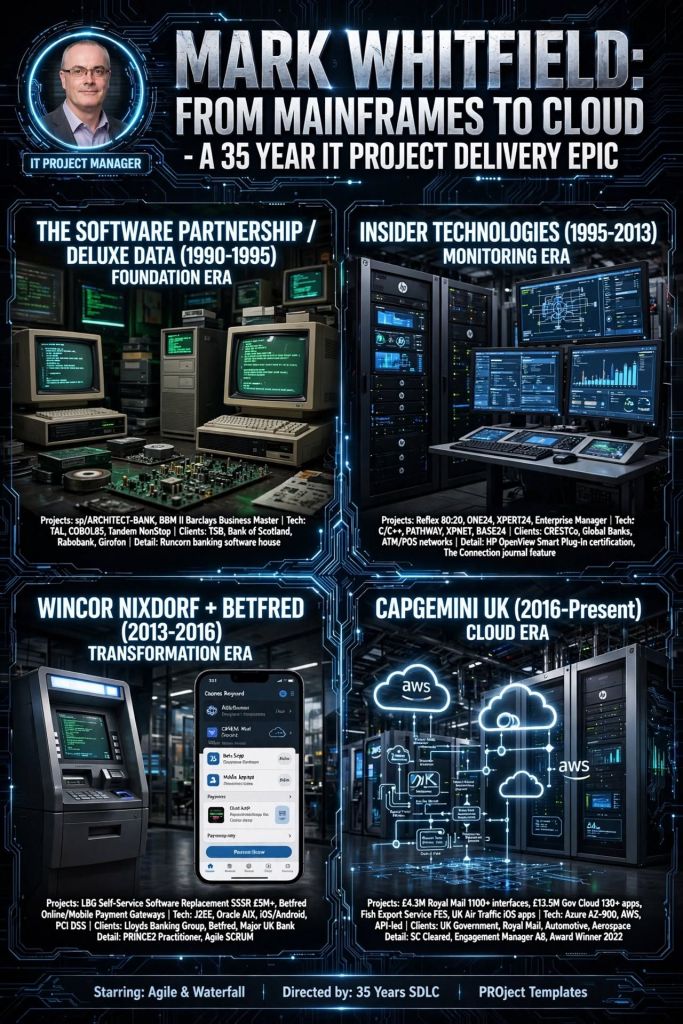
Mark Whitfield – projects timeline history from 1990

Mark Whitfield is an SC-cleared Senior IT Project Manager with over 30 years of experience delivering high-availability financial, cloud, and digital transformation projects. Over his career, he has transitioned from deep technical engineering on HPE NonStop (Tandem) mainframe systems to leading major corporate and public sector Agile and Waterfall software rollouts.

A comprehensive, year-by-year timeline breakdown of his project history and clients since 1990 is outlined below.

💻 The Technical Era (1990–1995)

During this period, Whitfield worked as a Programmer and Lead Analyst for The Software Partnership (acquired by Deluxe Data in 1994). He focused on electronic banking software (sp/ARCHITECT-BANK) on Tandem Mainframe Computers.

  • 1990–1992: Barclays Bank – Placed on-site at Knutsford, Cheshire to design and code software for the high-profile Barclays Business Master II (BBM II) electronic desktop banking project.
  • 1992–1993: Girofon (Denmark) – Developed a touch-tone phone banking suite. This allowed clients to use automated voice/menu-driven systems via a Periphonics VRAM device to fetch live balances from back-end mainframes.
  • 1993–1994: TSB & Bank of Scotland – Conducted early-era digital investigations, logic design, and mainframe coding for inter-account desktop money transfers.
  • 1994–1995: Rabobank – Headed software optimization, custom electronic coding patches, and on-site deployment validation for international operations.

🛡️ Monitoring & Infrastructure Era (1995–2013)

Whitfield joined Insider Technologies Limited (ITL) in Salford Quays, specializing in platform diagnostics, transaction monitoring, and financial logging systems for mission-critical infrastructure.

  • 1995–1996: Internal ITL Product R&D – Core developer on the Reflex monitoring suite (Reflex 80:20), creating platform health and diagnostic plug-in modules.
  • 1997–1998: CRESTCo (now Euroclear) – Brought in as a technical infrastructure consultant to run benchmark tests on newly released Tandem S7000 processing hardware nodes.
  • 1999–2001: Bank of England / Deutsche Bank – Deployed real-time tracking protocols utilizing ITL’s MultiBatch scheduling architectures and file monitors.
  • 2002–2003: Hewlett-Packard (HP) – Successfully managed the rigorous certification process for the first HP OpenView Operations (OVO) Smart Plug-In built for the NonStop mainframe environment.
  • 2004–2007: Alliance & Leicester (now Santander) / HSBC – Implemented transaction log extraction protocols (RTLX and Sentra) to audit automated teller machine (ATM) logs.
  • 2008–2010: Saudi Arabian Retail Bank – Acted as Project Manager overseeing the cross-border rollout of a high-volume ATM and Point-of-Sale (POS) monitoring system.
  • 2011–2013: Global Payments / Standard Chartered – Integrated transaction monitoring capabilities with external corporate frameworks such as TIVOLI and XPERT24 using ACI’s XPNET architecture.

🏦 Senior Project Management & Retail Banking (2013–2016)

This timeframe marked a total transition into senior contract project management, dealing directly with multi-million-pound programs.

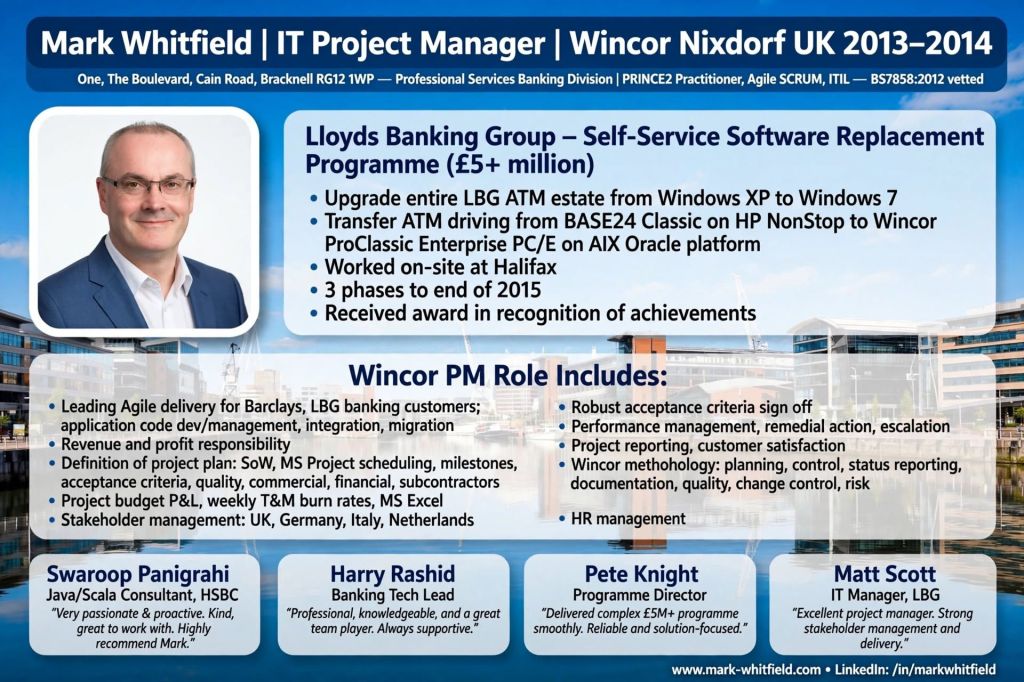
  • 2013–2014: Lloyds Banking Group (LBG) – Augmented into Wincor Nixdorf as the IT Project Manager leading a £5+ million workstream. This was part of LBG’s comprehensive Self-Service Software Replacement (SSSR) initiative to modernise legacy ATM software.
  • 2014–2016: Betfred – Senior IT Project Manager inside an Agile Scrum structure. Directed cross-functional software vendors to deliver updates for mobile apps (iOS/Android), fraud detection systems, and payment gateways for their digital sportsbook platforms.

🌐 Enterprise Consulting & Cloud Transformations (2016–Present)

In January 2016, Whitfield joined global consultancy firm Capgemini as a Senior client-facing Engagement/Delivery Manager.

  • 2016–2017: Aerospace & Defence Client – Managed an enterprise-level integration project to deploy a Salesforce-driven Single Customer View (SCV) portal platform.
  • 2017–2018: Jaguar Land Rover (JLR) – Served as Project Manager for the iFAB Middleware Project, a complex 12-month architecture development program linking global manufacturing supply components.
  • 2018–2019: MuleSoft (A Salesforce Company) – Augmented directly into MuleSoft’s London headquarters as a Delivery Manager, spearheading API-led connectivity deployments via the Anypoint Platform.
  • 2019–2021: UK Government Agency (UK Gov) – Commanded a major Hybrid Cloud Migration initiative to refactor, re-host, and re-platform 130 legacy agency software applications directly to cloud servers.
  • 2022: UK Utility Sector (Welsh Water / Scottish Water) – Dual-management lead executing a £0.5 million contract to migrate an aging, on-premise document management program (EQS) onto the Microsoft Azure cloud via Enablon.
  • 2023–2026: Public Sector & Core Tooling (Current) – Managing high-value middleware and API integrations for entities like the Royal Mail Group (RMG), NATS, and regional government bodies. Concurrently authors a widely used portfolio of commercial project management templates (RAID logs, RACI matrixes, and MS Project MPP layouts) published via PROject Templates.

Wincor Nixdorf Overview & Timeline by Era and Year

Wincor Nixdorf was a premier global provider of IT solutions, hardware, software, and services tailored for retail banks and the retail industry.

Headquartered in Paderborn, Germany, the company historically commanded roughly 35% of the global automated teller machine (ATM) market and stood as a dominant force in electronic point-of-sale (EPOS) systems.

Its operations focused deeply on business process optimisation, automated cash handling, and retail self-checkout systems. In 2016, Wincor Nixdorf merged with its US rival Diebold, Inc., creating the modern consolidated market leader, Diebold Nixdorf.

Detailed Historical Timeline

The history of Wincor Nixdorf spans several distinct strategic eras, tracing its evolution from a post-war calculator workshop into a modern global fintech titan.

Era 1: The Founding & Decentralised Computing (1952–1989)

This era was defined by entrepreneur Heinz Nixdorf, who pioneered small-to-medium business computing and electronic banking terminals across Europe.

  • 1952: Heinz Nixdorf establishes Labor für Impulstechnik in Paderborn, Germany. The small enterprise builds electronic calculators for businesses rebuilding in post-war Europe.
  • 1964: The company shifts from acting as a third-party component supplier to marketing office calculators and billing systems under its own brand name. []
  • 1968: Following corporate acquisitions, the company officially rebrands as Nixdorf Computer AG and develops some of the world’s earliest decentralized minicomputers.
  • 1969: The firm enters the North American market by purchasing the electronics division of the US office equipment manufacturer Victor Comptometer.
  • 1971: Secures its first landmark international banking contract, supplying 1,000 terminals to the Swedish banking industry.
  • 1978: Global sales cross DEM 1 billion, and the workforce grows to over 10,000 employees globally.
  • 1982: Expands its engineering breadth by forming a dedicated corporate telecommunications division.
  • 1984: Launches its initial public offering (IPO), floating shares publicly on the Frankfurt Stock Exchange.
  • 1986: Founder Heinz Nixdorf suddenly dies of a heart attack at a corporate event. The company struggles to pivot from hardware-locked minicomputers to emerging open personal computer architectures.
  • 1989: Amid intensifying global hardware margins and strategic missed steps, corporate financial losses top DEM 1 billion.

Era 2: The Siemens Integration & Corporate Carve-Out (1990–1998)

During this stage, corporate giant Siemens rescued and absorbed the distressed business, later reorganizing its retail and banking assets into a specialized standalone vehicle.

  • 1990: Siemens AG steps in to purchase the shares of Nixdorf Computer AG, officially merging it with its own Data Information Services division to create Siemens Nixdorf Informationssysteme (SNI) AG.
  • 1992: SNI expands heavily across European IT markets, operating as a distinct, specialized computing arm under the Siemens umbrella.
  • 1996: Becomes the largest IT company in Germany and the second largest across the European continent.
  • 1998: Siemens restructures its computing strategy; it sells its personal computer division to Acer and spins off the highly profitable banking and retail segments into a new unit: Siemens Nixdorf Retail and Banking Systems GmbH.

Era 3: Private Equity Buyout & The Rise of Wincor Nixdorf (1999–2015)

This period marked the official birth of the independent “Wincor Nixdorf” brand, characterized by aggressive global expansion, software-driven solutions, and public market listing.

  • 1999: Private equity firms Kohlberg Kravis Roberts (KKR) and Goldman Sachs Capital Partners complete a buyout of the Siemens unit. The company is formally renamed Wincor Nixdorf GmbH.
  • 2000: Launches major end-to-end IT outsourcing and infrastructure managed services alongside its standard terminal hardware.
  • 2004: On 19 May, Wincor Nixdorf successfully returns to the public markets, listing as Wincor Nixdorf AG on the Frankfurt Stock Exchange via a high-performing IPO.
  • 2006: Longtime Chief Executive Officer Karl-Heinz Stiller resigns from the board, leaving a structurally sound company expanding deep into automated cash recycling and software.
  • 2009–2014: Deploys multi-vendor banking software and automated checkout machines worldwide, expanding operations across roughly 100 countries.
  • 2015: Reports global revenues of €1.8 billion, split roughly 65% in banking services and 35% in retail point-of-sale solutions. On 23 November, US rival Diebold announces a formal business combination agreement to acquire the company.

Era 4: The Diebold Nixdorf Consolidation (2016–Present)

This current era represents the unification of American and European ATM powerhouses to navigate shifting brick-and-mortar financial landscapes.

  • 2016: Diebold Inc. officially completes its $1.8 billion voluntary public takeover of Wincor Nixdorf AG on 15 August. The consolidated global giant begins unified operations as Diebold Nixdorf on 16 August.
  • 2017: The UK Competition and Markets Authority (CMA) formally clears the merger following a comprehensive antitrust review, requiring Diebold to divest its legacy UK customer ATM operation to avoid localized market monopoly.
  • 2021: Capitalizing on self-checkout shifts accelerated by the pandemic, the combined entity launches its next-generation DN Series™ EASY self-service retail product line.
  • 2023: Burdened by legacy debt structures, supply chain disruptions, and pandemic operational challenges, Diebold Nixdorf files for a prepackaged Chapter 11 bankruptcy protection in June. The restructuring swiftly sheds $2.1 billion in debt. By August, it successfully emerges from bankruptcy, resuming trading on the New York Stock Exchange (NYSE).
  • 2024–2026: The restructured firm shifts its focus from low-margin hardware to high-margin managed services and cloud software, stabilizing its global operations with annual revenues reaching $3.75 billion.
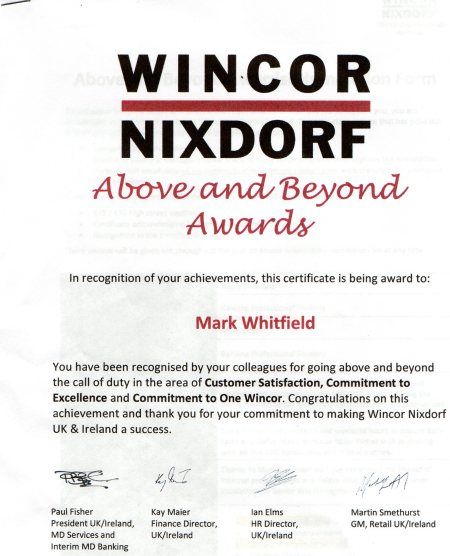
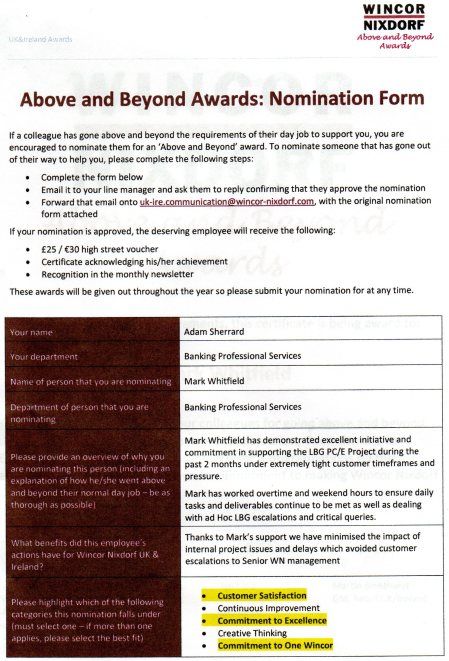
Wincor Nixdorf, Mark Whitfield, above and beyond awards, Customer Satisfaction and Commitment to Excellence
Mark Whitfield, above and beyond awards, Customer Satisfaction and Commitment to Excellence, Wincor Nixdorf

Diebold Wincor Nixdorf Overview & Timeline by Era and Year

PRINCE2 Overview and Evolution Timeline by year

PRINCE2 (Projects IN Controlled Environments) is a globally recognized, process-driven project management methodology. It provides a structured, scalable approach to manage projects from start to finish. It is built on 7 core principles, 7 themes, and 7 step-by-step processes.

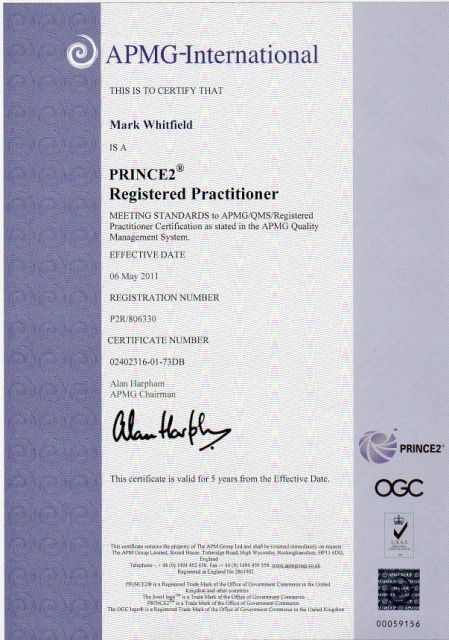
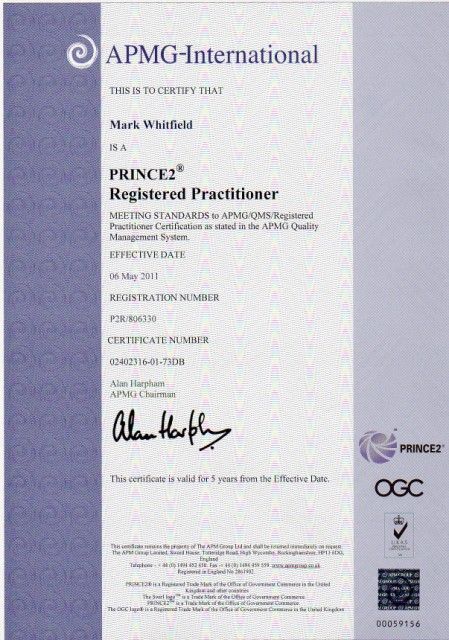
May 2011 – Mark Whitfield, Registered PRINCE2 Practitioner with ILX
May 2011 – Registered PRINCE2 Practitioner with ILX

The 7 Pillars of PRINCE2

To truly grasp PRINCE2, you should be familiar with its three core elements:

  • 7 Principles: Continued business justification, learn from experience, defined roles and responsibilities, manage by stages, manage by exception, focus on products, and tailor to suit the project environment.
  • 7 Themes: Business Case, Organization, Quality, Plans, Risk, Change, and Progress.
  • 7 Processes: Starting Up, Directing, Initiating, Controlling a Stage, Managing Product Delivery, Managing a Stage Boundary, and Closing a Project.
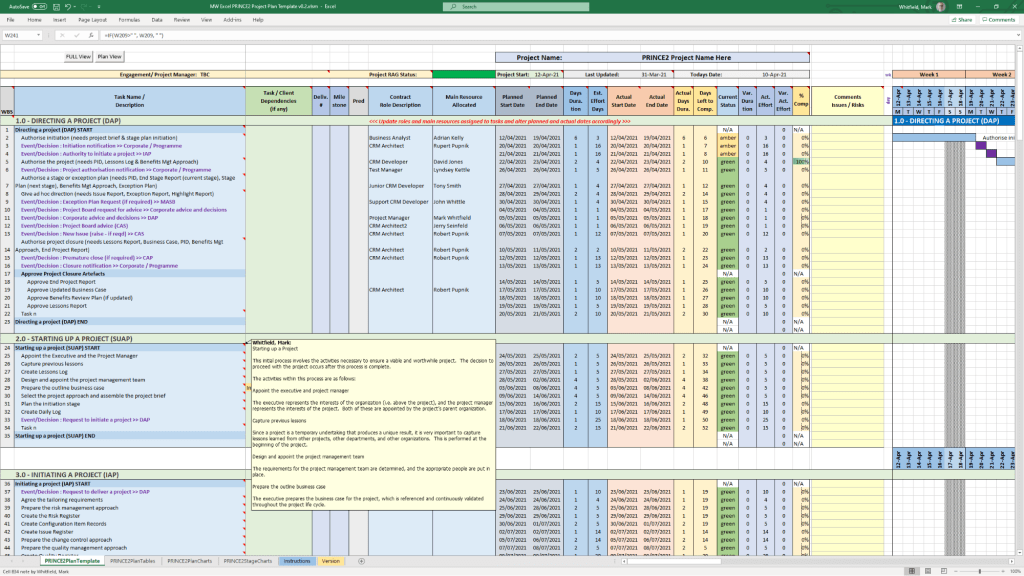
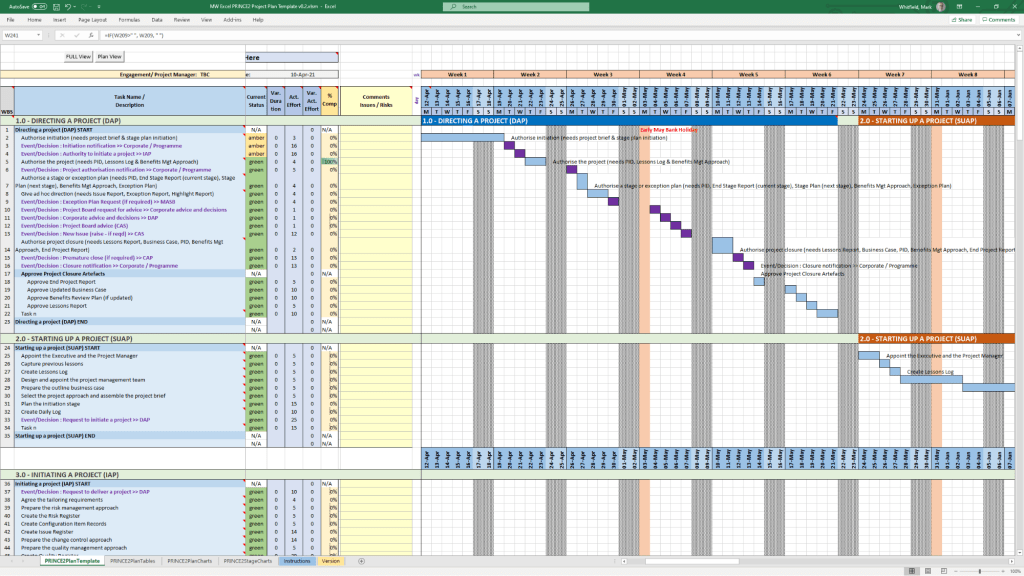
Example MS Excel PRINCE2 template (available on this website)

Detailed Timeline Breakdown by Year

The evolution of PRINCE2 spans over 50 years, transitioning from an internal UK IT standard into a global, flexible methodology.

  • Mid-1970s: Simpact Systems Limited creates the PROMPT methodology (Project, Resource, Organization, Management, and Planning Technique).
  • Early 1980s: The Central Computer and Telecommunications Agency (CCTA) in the UK licenses PROMPT to manage complex IT overruns.
  • 1989: CCTA enhances the PROMPT method, renames it to PRINCE (PROMPT in the CCTA Environment), and mandates it for UK IT projects.
  • 1990: PRINCE is released into the public domain and experiences widespread private and public sector adoption.
  • 1996: The UK Cabinet Office officially publishes PRINCE2 and its global certifications. The acronym is updated to PRojects IN Controlled Environments and adapted to fit any industry or project type (not just IT).
  • 2000: Ownership transfers to the newly formed Office of Government Commerce (OGC) in the UK.
  • 2002/2005: Manual structure undergoes major revisions to strengthen the methodology’s “product-based planning” approach.
  • 2009: A massive “Refresh” is released. This update simplifies the framework, introduces the foundational 7 principles, and significantly improves customization.
  • 2013: Ownership transitions to AXELOS Ltd, a joint venture between the UK Government and Capita.
  • 2017: AXELOS publishes the PRINCE2 2017 Update (later designated the 6th Edition). This update places heavy focus on tailoring the method to project scale, flexibility, and practical execution.
  • 2018: PRINCE2 Agile is launched, combining the traditional, controlled PRINCE2 governance model with agile delivery methods.
  • 2021: PeopleCert, a global examination provider, acquires AXELOS and takes full ownership of the PRINCE2 methodology.
  • 2023–Present: PeopleCert releases the PRINCE2 7th Edition, which brings modernizations, digital improvements, and greater sustainability tracking, branding the framework simply as “PRINCE2 Project Management”.

To explore the latest resources, certification paths, or officially recognized guides, you can visit the PRINCE2 Official Website or the community-driven PRINCE2 Wiki.

PRINCE2 Overview and Evolution Timeline by year

HPE NonStop MultiBatch Batch Job Scheduling Overview and Timeline

Overview

MultiBatch is a robust enterprise workload automation and job scheduling tool designed specifically for the HPE NonStop parallel architecture. Developed originally by Insider Technologies and subsequently managed/distributed alongside partners like ETI-NET, it enables organization-wide task automation.

MultiBatch provides high-performance, concurrent execution of batch schedules across multiple nodes. It natively supports both Guardian and OSS environments. By utilizing modern graphical user interfaces (GUIs) alongside traditional Pathway components, it eliminates the need for complex, manual, and high-maintenance TACL or JCL scripts.

Core Technical Capabilities

  • Parallel Execution: Uses NonStop architecture to execute batch workloads concurrently across one or multiple nodes.
  • Advanced Scheduling: Drives automated tasks based on time parameters, complex intervals, custom calendars, and direct cross-job dependencies.
  • Reusable Infrastructure: Environment classes—including PARAM, ASSIGN, DEFINE, FD, and environmental variables—can be configured once and safely shared across various jobs.
  • Inbuilt Disaster Recovery: Features automated, built-in monitor recovery mechanisms to preserve execution integrity during hardware or connection failures.
  • Seamless Migration: Simplifies moving production workloads between environments via a deep migration utility that automatically handles environmental translation without manual intervention.

Timeline Breakdown by Year and Version

The evolution of MultiBatch highlights its transition toward broader configuration capacities, simplified environment integrations, and eventual product lifecycle milestones.

2020: Operational and Security Consolidation

  • Version Focus: Pre-v10 Infrastructure (Enterprise Deployments)
  • Key Enhancements:
    • Formalized rigid separation of internal user roles, establishing MBAT.OPS for view-only status monitoring and MBAT.CONFIG for structural schedule maintenance.
    • Refined the “Migrator” module, eliminating manual TACL operations when extracting and inserting batch definitions across network test and production nodes.
    • Added capabilities allowing all MultiBatch jobs to execute securely under the system Batch Monitor Process (BMON) owner or explicitly assigned application user IDs.

2022 (November): MultiBatch Version 10.0 Launch

  • Version Focus: Architecture Restructuring
  • Key Enhancements:
    • Define Classes: Introduced reusable Define Classes to group environments cleanly.
    • Scale Upgrades: Upgraded the main Batch Monitor (BMON) subsystem to actively scale up to 2,500 jobs concurrently.
    • Parameterization: Modified the core configuration boundaries and decoupled utility processes (MBPARHK) to seamlessly process non-step related records across database structures.
    • Clean Up: Formally deprecated legacy components including UTCSV to reduce technical debt.

2023 (February): MultiBatch Version 10.1 Refinement

  • Version Focus: OSS Overhaul & Operational Control
  • Key Enhancements:
    • OSS Reworking: Re-engineered and optimized support for Open System Services (OSS) processes, granting them equal parity with traditional Guardian tasks.
    • On-Demand Execution: Enabled ad-hoc “On Demand Job” invocation directly through user channels without altering master schedules.
    • Conditional Variables: Extended character limits for Conditional Parameter values up to 100 characters.
    • Subsystem Unification: Consolidated Event Timer processing and Conditional Parameters fully into standard MultiBatch menus, auditing frameworks, and security tracking.
    • Control Commands: Integrated the SWITCH BMON command line directive to easily pass control between operational monitors.
    • Interface Upgrade: Rolled out an entirely new Ops GUI Server to modernize scheduling visibility.

Current Era: Version 10.2 Maintenance & Commercial Sunset

  • Version Focus: Version 10.2 / Product Lifecycle Transition
  • Key Milestones:
    • MultiBatch 10.2: Operates as the current, stable production tier delivered via ETI-NET, featuring deep parameterization and centralized network deployment protocols.
    • Commercial End of Life: As of March 1, 2026, new software licenses for Multi-Batch are no longer available for purchase. The software has officially reached the end of its commercial sales life.
    • Ongoing Support: Existing license holders retain full permission to execute, maintain, and run the product inside their environments according to their long-term licensing agreements.

HPE NonStop MultiBatch Batch Job Scheduling Overview and Timeline

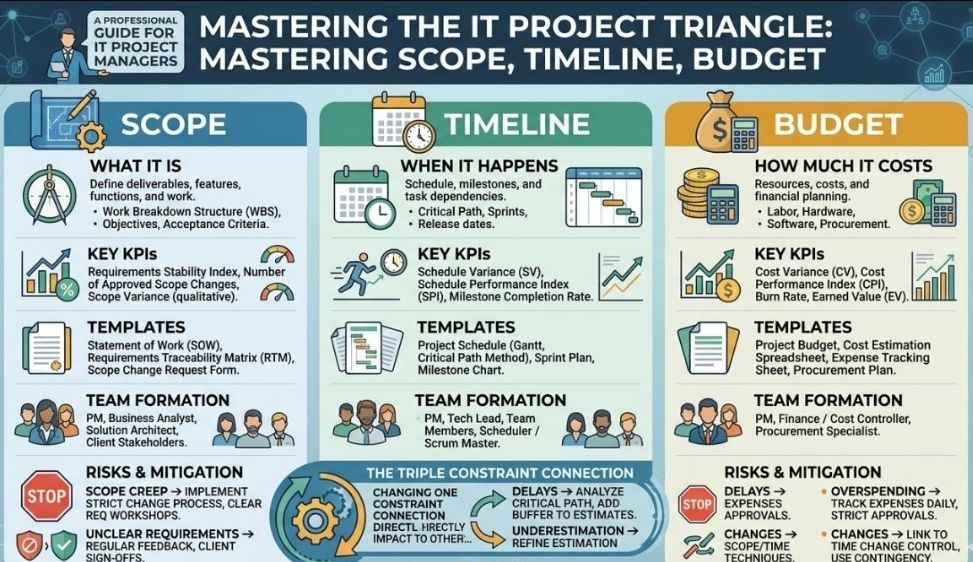
IT Project Triangle, Scope, Timeline and Budget

IT Project Triangle, Scope, Timeline and Budget

PRINCE2 (PRojects IN Controlled Environments) Overview and Evolution Timeline

PRINCE2 (PRojects IN Controlled Environments) is a structured, process-driven project management method used internationally to deliver projects within time, cost, and quality constraints. Originally developed for IT projects, it has evolved into a generic, flexible, and scalable framework applicable to any type of project, now owned by PeopleCert.

Detailed Overview of PRINCE2 (2026 Framework)

As of 2026, the current framework is PRINCE2 7th Edition, launched in late 2023. It is characterized by its focus on people, digital tools, and sustainability, while retaining its core focus on governance.

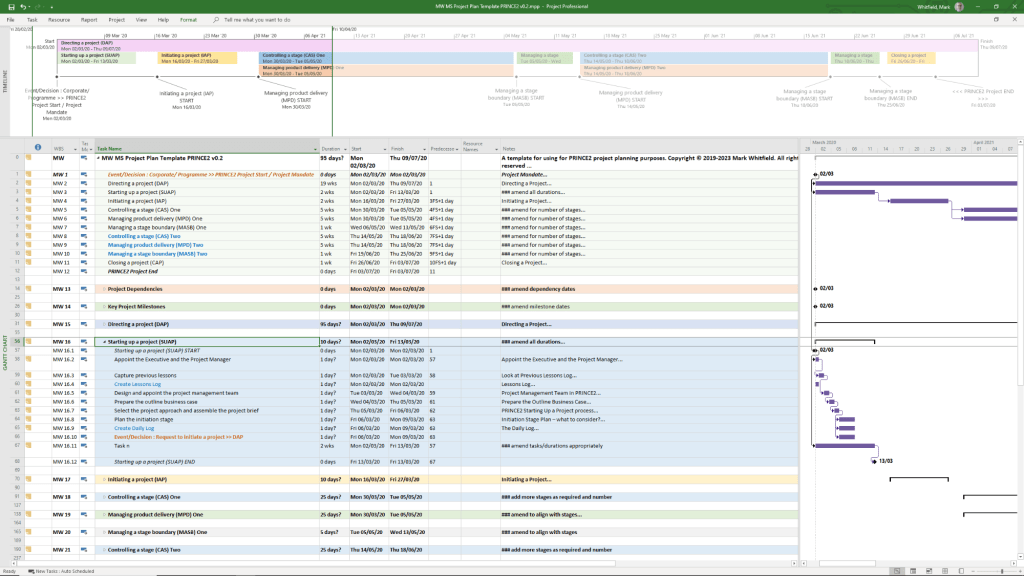
MS Project MPP template example

1. The Seven Principles (Why PRINCE2 is used)

  • Continued Business Justification: A project must have a valid business case.
  • Learn from Experience: Lessons are documented and used.
  • Defined Roles and Responsibilities: Clear organizational structure.
  • Manage by Stages: Projects are broken into manageable chunks.
  • Manage by Exception: Empowerment given to managers to act within tolerances.
  • Focus on Products: Focus on deliverables rather than activities.
  • Tailor to Suit the Project: Adapted to suit the project’s size, environment, and complexity.

2. The Seven Themes (What must be managed)

  • Business Case
  • Organization
  • Quality
  • Plans
  • Risk
  • Change
  • Progress

3. The Seven Processes (How to manage)

  • Starting up a Project
  • Directing a Project
  • Initiating a Project
  • Controlling a Stage
  • Managing Product Delivery
  • Managing a Stage Boundary
  • Closing a Project

4. Certification Levels

  • Foundation: Confirms basic knowledge of the methodology.
  • Practitioner: Tests the ability to apply and tailor the method to scenarios.

Detailed Timeline Evolution by Era and Year

PRINCE2 has evolved from a niche IT methodology to a global standard through three major revisions.

Era 1: The Foundations (1975–1989)

  • 1975: Simpact Systems Ltd. creates the PROMPT (Project, Resource, Organization, Management, and Planning Technique) methodology.
  • Early 1980s: UK Central Computer and Telecommunications Agency (CCTA) licenses PROMPT.
  • 1989: CCTA enhances PROMPT II, renaming it PRINCE (PROMPT in the CCTA Environment), mandated for UK IT projects.

Era 2: Launch and Public Adoption (1990–2005)

  • 1990: PRINCE is released into the public domain.
  • 1996: PRINCE2 is released by CCTA, designed for a broader range of projects (non-IT).
  • 2000: Ownership transfers to the UK Office of Government Commerce (OGC).
  • 2002/2005: Major revisions to the manual structure, strengthening the “product-based planning” approach.

Era 3: Modernization & Privatization (2009–2021)

  • 2009: Major “Refresh” released, introducing the seven principles, themes, and processes. Focuses on simplicity and customizability.
  • 2013: Ownership transfers to AXELOS Ltd, a joint venture between the UK Government and Capita.
  • 2017: PRINCE2 2017 Update (6th Edition) is released, focusing on enhanced flexibility and tailoring guidance.
  • 2018: Launch of PRINCE2 Agile.
  • 2021: PeopleCert acquires AXELOS, taking full ownership of the methodology.

Era 4: The 7th Edition (2023–Present/2026)

  • September 2023: Launch of PRINCE2 7th Edition.
  • 2024: PRINCE2 is branded as “PRINCE2 Project Management”.
  • 2026 (Current): Focus on hybrid delivery, digital transformation, and sustainability within the 7th edition framework.
Mark Whitfield, May 2011 – Registered PRINCE2 Practitioner with ILX
May 2011 – Registered PRINCE2 Practitioner with ILX, Mark Whitfield
Prince2, Plan On a Page POaP, MS Excel Template

Agile Scrum Overview and Evolution Timeline

Agile Scrum is a widely adopted, iterative, and incremental framework designed to manage complex product development and software projects.

It breaks down large, daunting projects into small, manageable units called sprints—fixed-length iterations typically lasting 1–4 weeks—to deliver functional components faster and adapt to changing requirements.

Detailed Summary of the Scrum Framework

Scrum relies on three pillars—transparency, inspection, and adaptation—and is defined by specific roles, events, and artifacts.

1. The Scrum Team (Roles)

  • Product Owner (PO): Maximizes the value of the product by managing the Product Backlog. They define “what” is built.
  • Scrum Master: A servant-leader who helps the team follow Scrum theory and removes impediments.
  • Developers: The cross-functional team members responsible for creating the increment each sprint.

2. Scrum Events (Ceremonies)

  • Sprint Planning: Defines the Sprint Goal and the work to be done during the sprint.
  • Daily Scrum: A 15-minute daily meeting for developers to synchronize activities and plan the next 24 hours.
  • Sprint Review: Held at the end of the sprint to showcase the increment to stakeholders and gather feedback.
  • Sprint Retrospective: The team reflects on the process and identifies improvements for the next sprint.

3. Scrum Artifacts

  • Product Backlog: An ordered list of everything required in the product.
  • Sprint Backlog: The set of Product Backlog items selected for the sprint, plus the plan for delivering them.
  • Increment: The usable, working product increment produced at the end of a sprint.

Evolution of Scrum Over the Years

Scrum was developed in the early 1990s as a response to the failures of the linear “waterfall” approach.

  • 1986 (Concept Origins): Takeuchi and Nonaka publish “The New New Product Development Game,” comparing traditional relay-race product development to a rugby “scrum” team.
  • 1993 (First Implementation): Jeff Sutherland, John Scumniotales, and Jeff McKenna implement the first Scrum team at Easel Corporation.
  • 1995 (Public Introduction): Ken Schwaber and Jeff Sutherland formalize Scrum and present “The Scrum Development Process” at the OOPSLA ’95 conference.
  • 2001 (Agile Manifesto): Sutherland and Schwaber become signatories of the Agile Manifesto, cementing Scrum as a major Agile methodology.
  • 2010 (The Scrum Guide): The first official Scrum Guide is released to standardize the framework worldwide.
  • 2011–2017 (Refinements): The guide is updated to clarify roles and events, including strengthening the role of the Scrum Master and introducing self-organizing teams.
  • 2020 (The Modern Scrum Guide): A major update makes the guide less prescriptive, focusing on a single Scrum Team (removing “development team” and “scrum team” split), introducing the Product Goal for long-term focus, and focusing on one team working towards one product.

Key Resources and Links

Agile Scrum Overview and Evolution Timeline