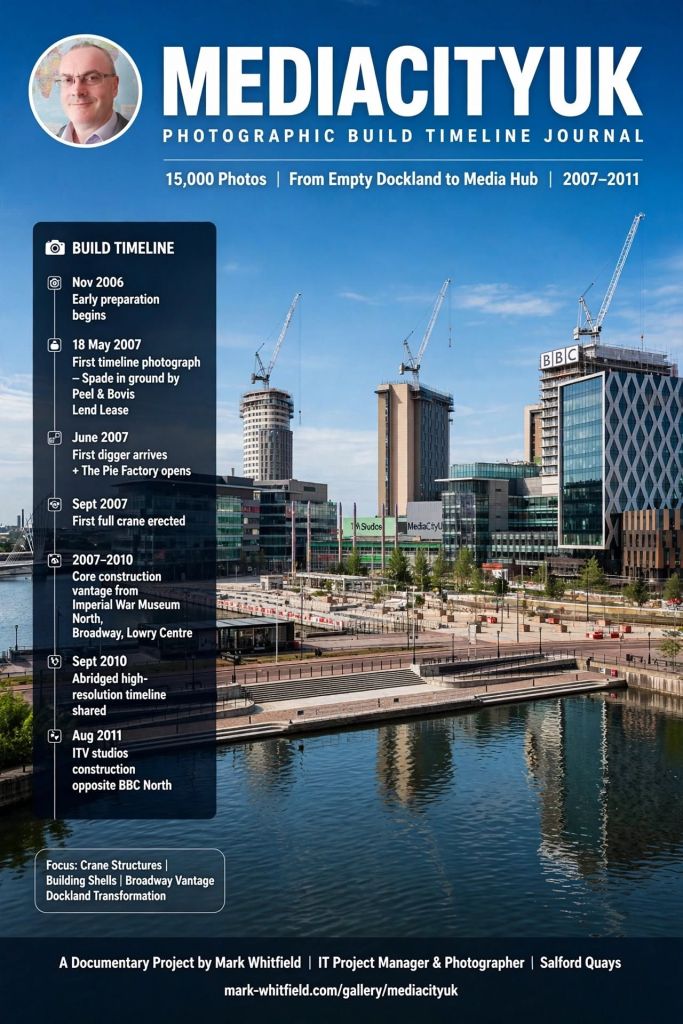
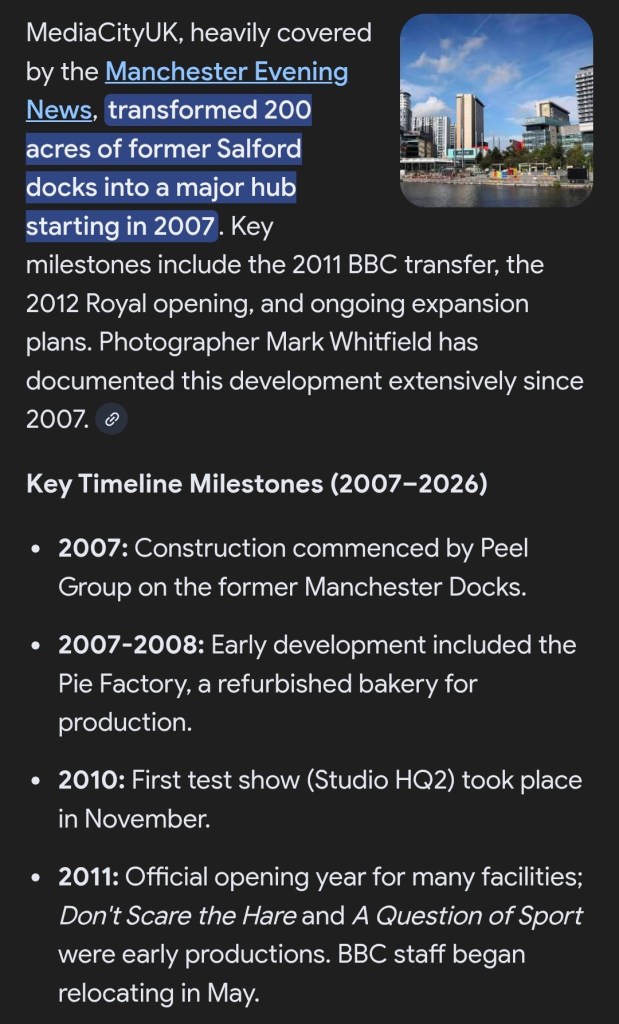
The MediaCityUK Photographic Build Timeline Journal is an extensive, long-term documentary project created by IT Project Manager and photographer Mark Whitfield. Working nearby in Salford Quays, Whitfield used his close proximity to methodically document the area’s massive transformation from an empty dockland into a major UK media hub.
Mark Whitfield | MediaCityUK Photographic Build Timeline Journal
The project captured over 15,000 photos over its lifespan, focusing heavily on the phase 1 construction lifecycle from the ground up.
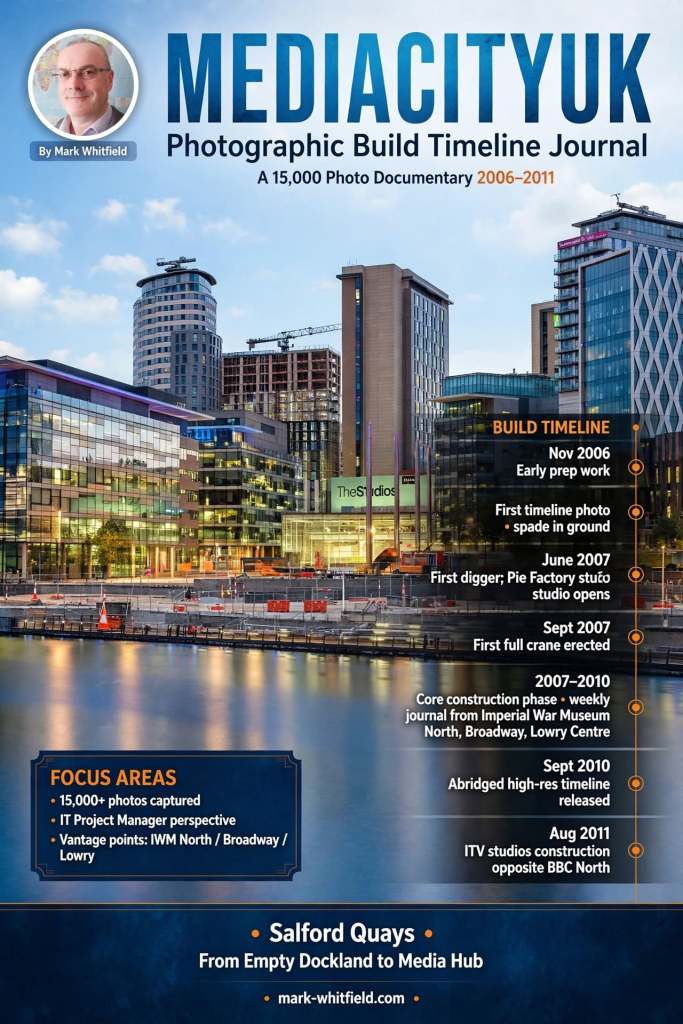
Key Project Timeline & Milestones
November 2006: Early preparation work and digging begins around the site. Temporary cabins are placed off Broadway to house the initial project staff and BBC contingents.
18 May 2007: Mark Whitfield captures his first timeline photograph, marking the formal start of his build documentation. This coincides with the official “spade in the ground” by Peel Group and Bovis Lend Lease.
June 2007: Visible ground development scales up as the first digger arrives on-site. Concurrently, “The Pie Factory” (a refurbished bakery) opens as the first working studio space.
September 2007: Construction advances rapidly with the erection of the first full-sized crane on the development site.
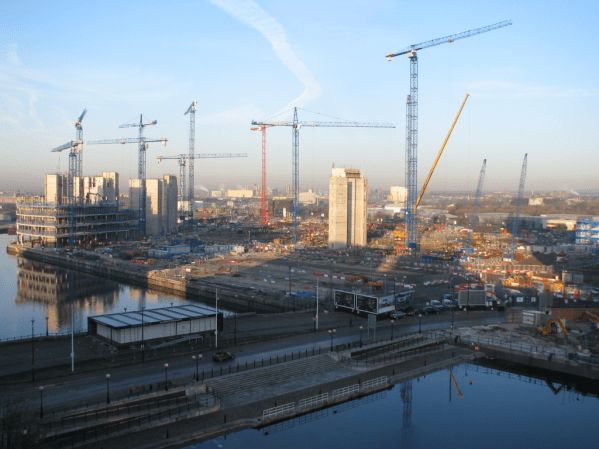
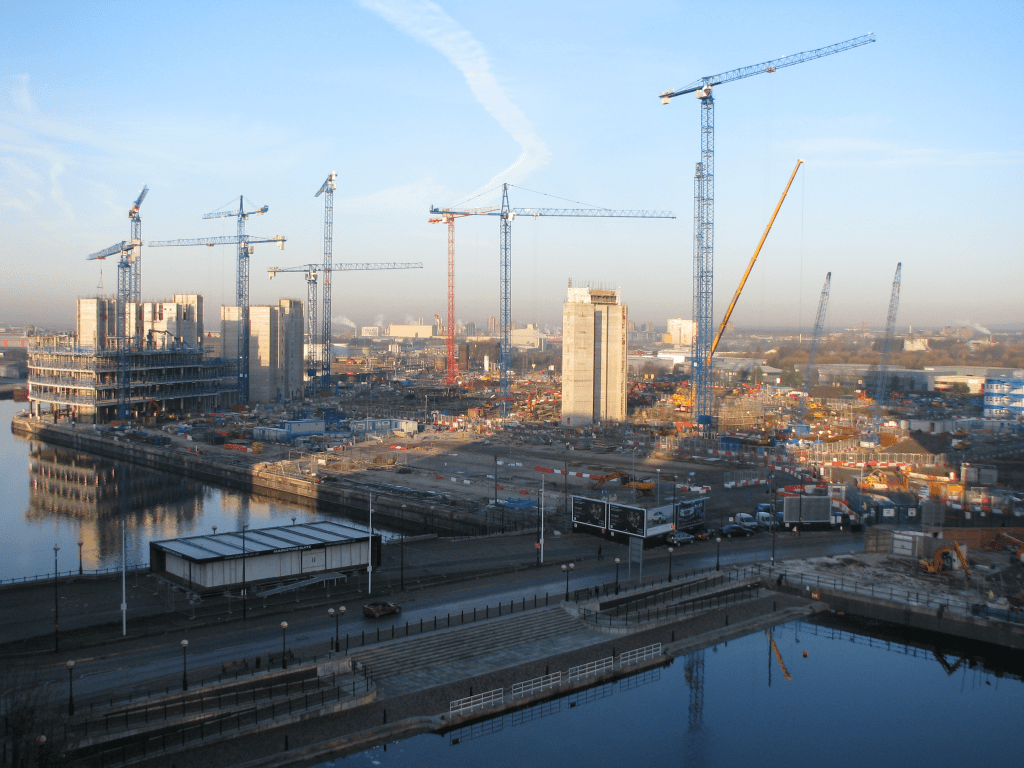
2007–2010: The core construction phase takes place. Whitfield systematically updates his weekly journal from vantage points like the Imperial War Museum North, Broadway, and the Lowry Centre side, capturing the rising crane structures and building shells.
September 2010: As the main grassland is replaced by the finished media campus, Whitfield shares an abridged public high-resolution timeline containing a curated selection of his massive archive.
August 2011: Documentation expands to capture the next steps of growth, including the initial construction phases of the ITV studios situated directly opposite BBC North.
Exploring the Photo Journal
The full history and comprehensive photo collections can be found across Mark Whitfield’s active journals:
The transformation of Salford Quays from a major industrial inland port into a vibrant cultural, residential, and digital hub is one of the most successful urban regeneration stories in the UK.
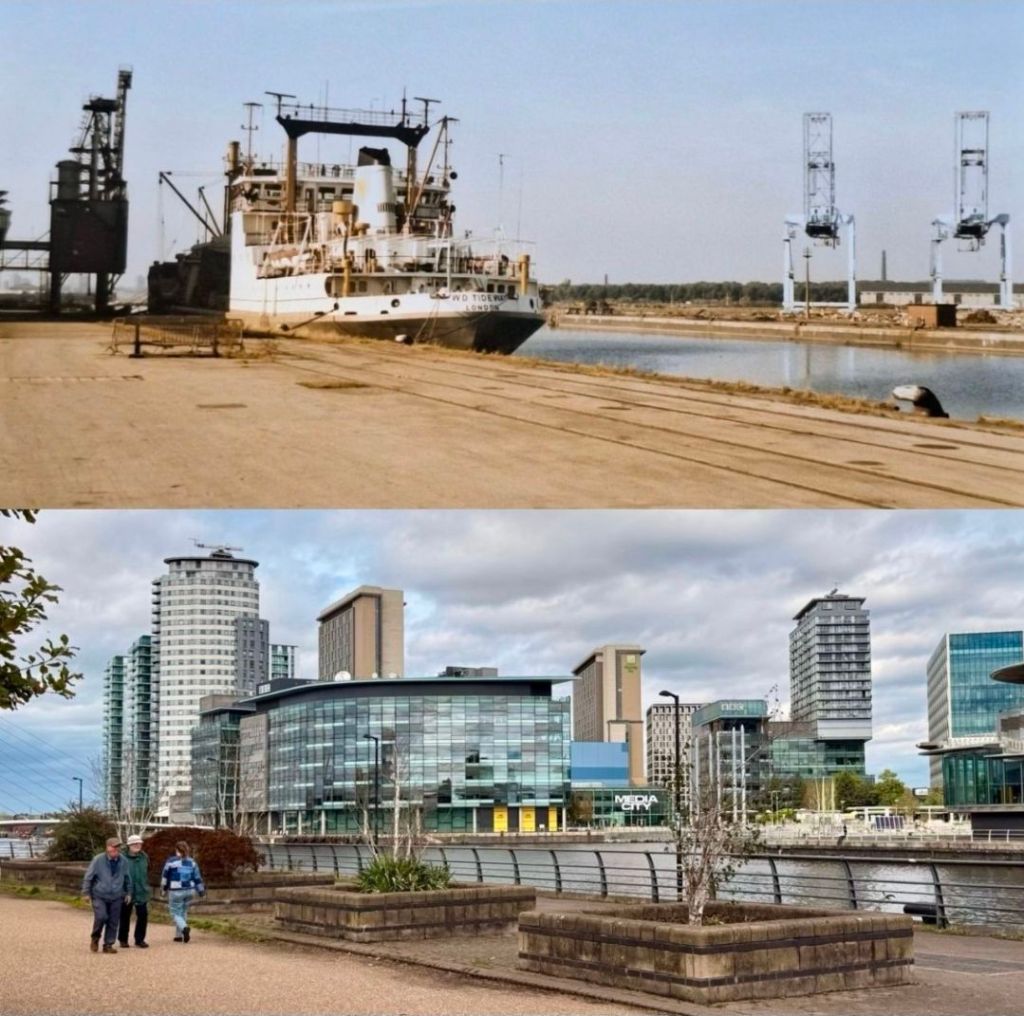
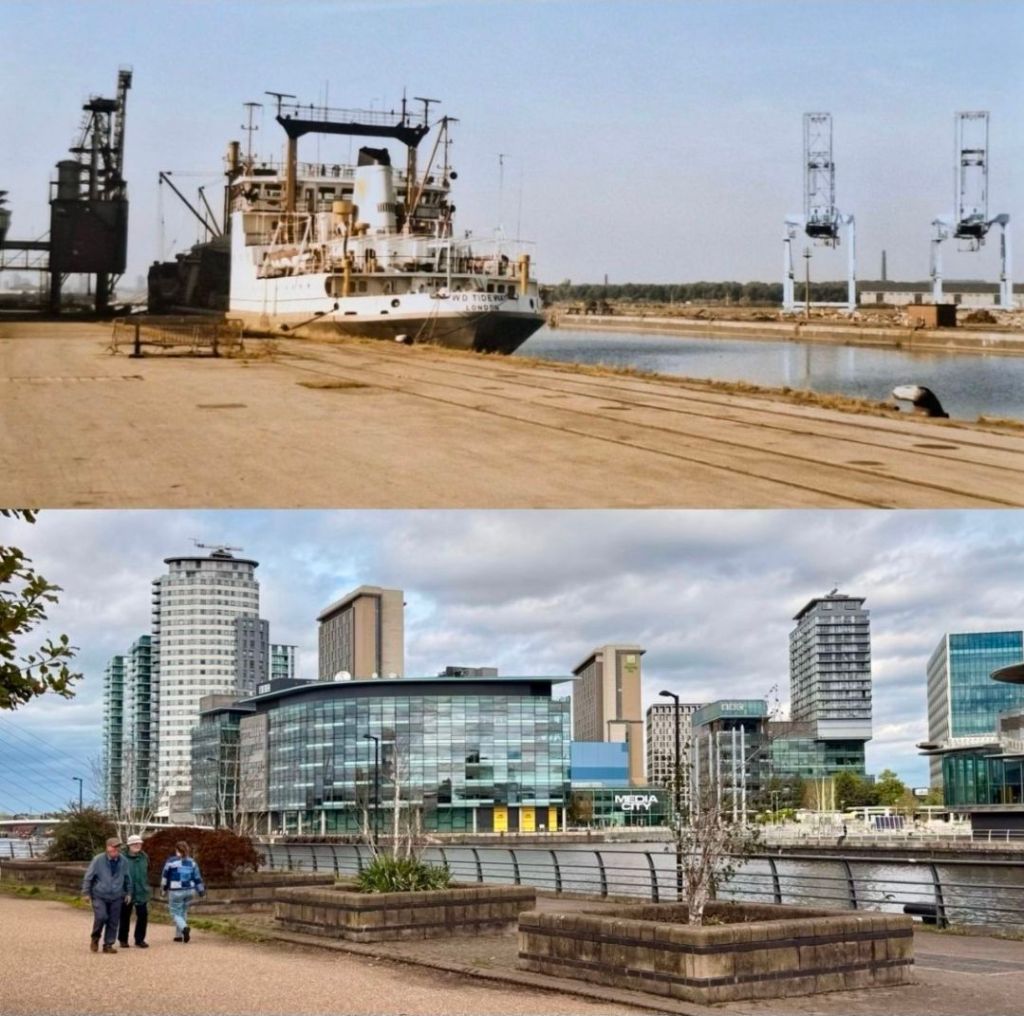
Salford Quays in 1983 and 2026
Here is the detailed timeline of Salford Quays, broken down by era, year, and key milestones.
⚓ The Industrial & Docks Era (1894–1982)
Before the late 19th century, the area was largely empty space, occupied only by a medieval hall and a racecourse. The construction of the Manchester Ship Canal fundamentally altered the landscape, making the inland region accessible to ocean-going ships.
1894: Queen Victoria officially opens the Manchester Ship Canal and the Manchester Docks. Four of the largest docks (Docks 6, 7, 8, and 9) are built on the Salford side of the canal.
1905: King Edward VII opens Dock No. 9, which becomes the largest and most crucial dock in the Salford cluster.
1947–1948: Owing to heavy damage suffered by rival ports like Hull during the World War II Blitz, Salford and Manchester Docks temporarily peak to become Britain’s third busiest port.
1952–1974: The golden era of operations. Over 16 million tonnes of cargo and 5,000 ships pass through the canal annually.
1970s: The rapid rise of standardized maritime containerization triggers a sharp decline. Newly built global freight vessels grow too large to navigate the tight locks of the Ship Canal.
1982: Traffic dries up completely. The historic docks officially close down, resulting in 3,000 immediate job losses and leaving behind 120 acres of heavily contaminated, derelict land.
🏗️ The Reclamation & Infrastructure Era (1983–1999)
With the area decaying into an unsafe, heavily polluted “no-go zone,” local government took a bold, unprecedented approach to urban reclamation.
1983: Salford City Council buys the derelict docks from the Manchester Ship Canal Company. See photo above.
1984: The council secures a Derelict Land Grant to finance total land reclamation. The territory is officially rebranded as Salford Quays.
1985: The Salford Quays Development Plan is formally adopted, laying out a master plan for commercial, residential, and leisure zoning. Dams are constructed to isolate the stagnant dock basins from the heavily polluted main canal.
1987: To fix severe water pollution, an innovative compressed air mixing aeration system is installed. Oxygen levels bounce back, allowing scientists to successfully introduce 12,000 coarse fish into the re-engineered ecosystem.
1988: The council publishes a development review expanding the vision to highlight massive tourism, leisure, and cultural landmarks. The early concept for a performing arts center (later known as The Lowry) is drafted.
1990: By this year, the initial infrastructure push transforms the landscape. Roads, promenades, bridges, and the first wave of offices, hotels, and houses are constructed across Piers 5, 6, and 7.
1999: Major pedestrian and structural bridge works conclude. Crucially, the Metrolink tram system extension opens, instantly linking Salford Quays directly to Manchester City Centre.
🎭 The Cultural Landmark Era (2000–2005)
With the environmental clean-up and transit links secured, the focus shifted to turning the Quays into a premier leisure destination.
2000: The Lowry arts centre officially opens to the public, housing a major theatre and art gallery dedicated to local artist L.S. Lowry.
2001: The retail landscape arrives with the opening of the Lowry Outlet Mall (now known as Quayside MediaCityUK). The Salford Community Water Sports Centre opens to take advantage of the clean waters.
2002: The striking architectural landmark Imperial War Museum North (IWM North) opens directly across the water. The dock lock gates reopen, linking the Quays back into the national canal network.
2004: The BBC begins looking at Salford Quays as a prime option for decentralized office relocation outside of London.
📺 The MediaCityUK & Residential Boom Era (2006–Present)
The modern era established Salford Quays as a powerhouse for the UK’s creative, digital, and high-rise residential sectors.
2006: Salford Quays is officially selected over competing sites to host the massive MediaCityUK development project.
2011: Phase One of MediaCityUK completes. Broadcasters like the BBC and ITV relocate massive operations, studios, and staff here alongside the University of Salford’s media campus.
2012–2020: The region experiences a massive economic boom. The wider borough sees average property values double over eight years as young professionals flood the high-rise apartments flanking the waterfront.
2023: Vertical expansion continues as Eda (Erie Dock Apartments), a prominent 29-storey residential skyscraper, is completed.
2026 (Present): Salford Quays is currently undergoing a massive ongoing £1 billion expansion approved by the local council to double its development footprint, headlined by high-density projects like the four-tower X1 Michigan Towers reaching up to 46 storeys.
The MediaCityUK Photographic Build Timeline Journal is an extensive, long-term documentary project created by Mark Whitfield. It captures the transformation of Salford Quays from an empty dockland into a major UK media hub.
Working nearby as an IT Project Manager, Whitfield utilized his close proximity to the site to methodically photograph the construction lifecycle literally from the ground up.
MediaCityUK Photographic Build Timeline Journal is an extensive, long-term documentary project created by Mark Whitfield
Project Overview and Scope
Timeframe: The photographic project formally spans from May 2007 through 2010 for its core construction phase, with continuous updates extending into later developments.
Volume: The total project comprises a massive archive of over 15,000 to 16,000 photographs.
Curated Journal: An abridged timeline consisting of roughly 200 high-resolution selections was published to highlight key structural milestones chronologically.
Perspectives: Photos were captured weekly from multiple high-vantage reference points, including the Imperial War Museum North, the local Designer Outlet, and Broadway.
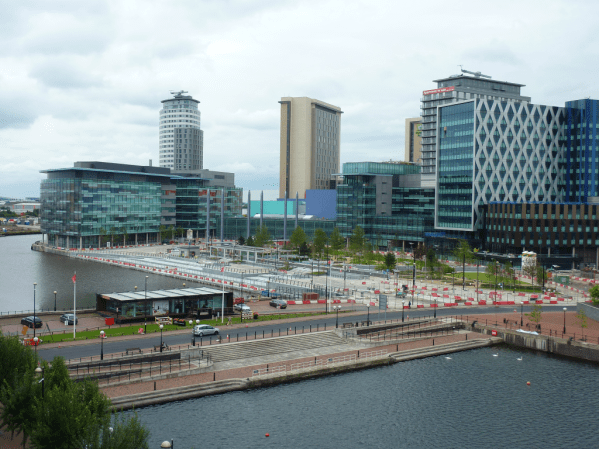
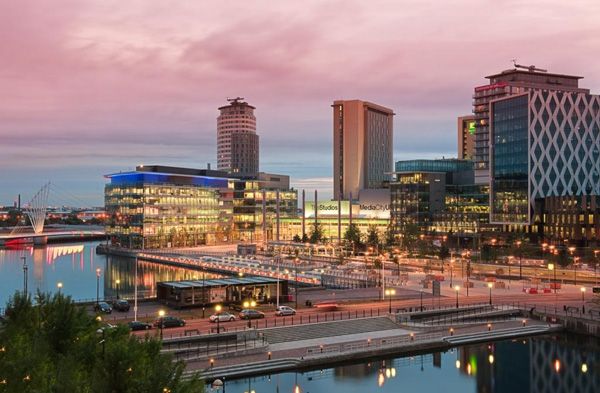
MediaCityUK BBC North, Salford Quays
Core Phases Documented
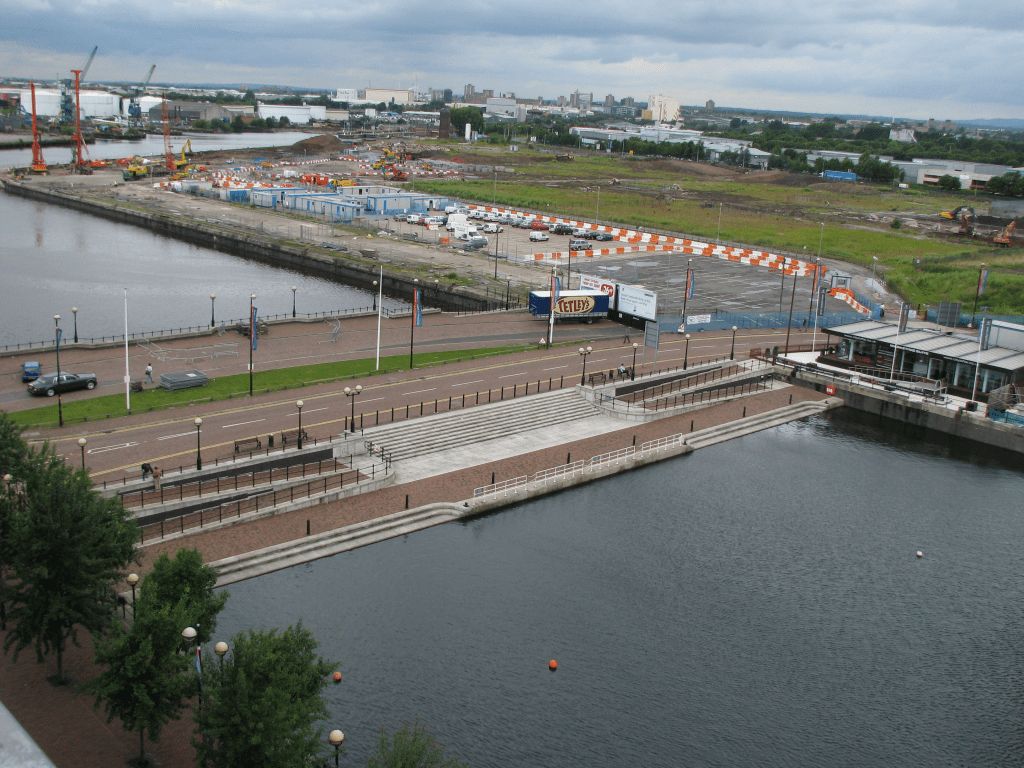
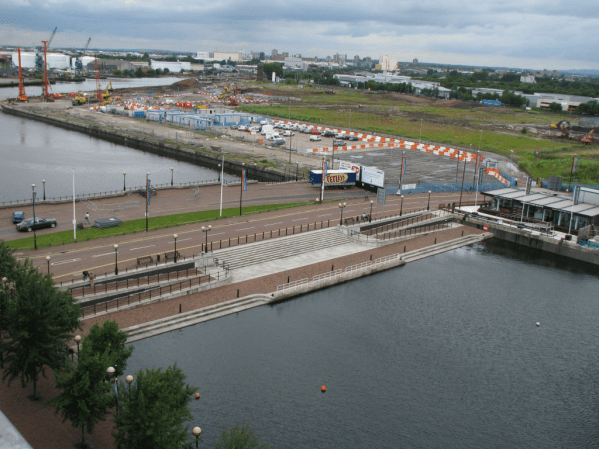
The Blank Canvas (Mid-2007): Captures the initial flat, unused grassland and docklands just before the first diggers arrived on site in June 2007.
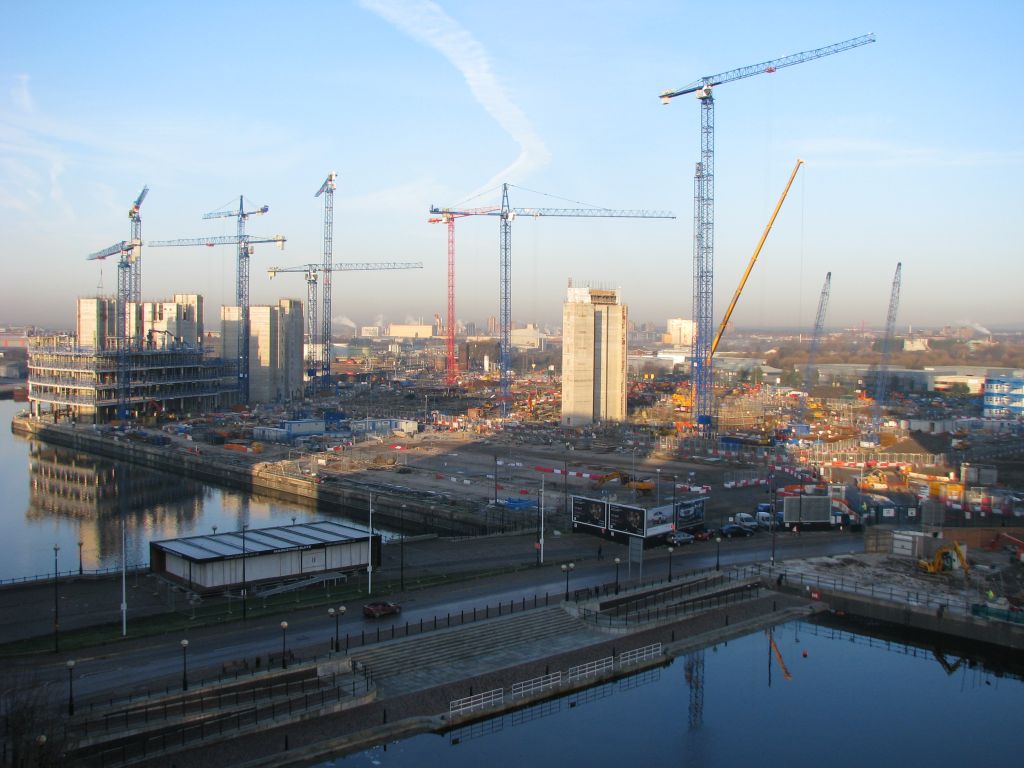
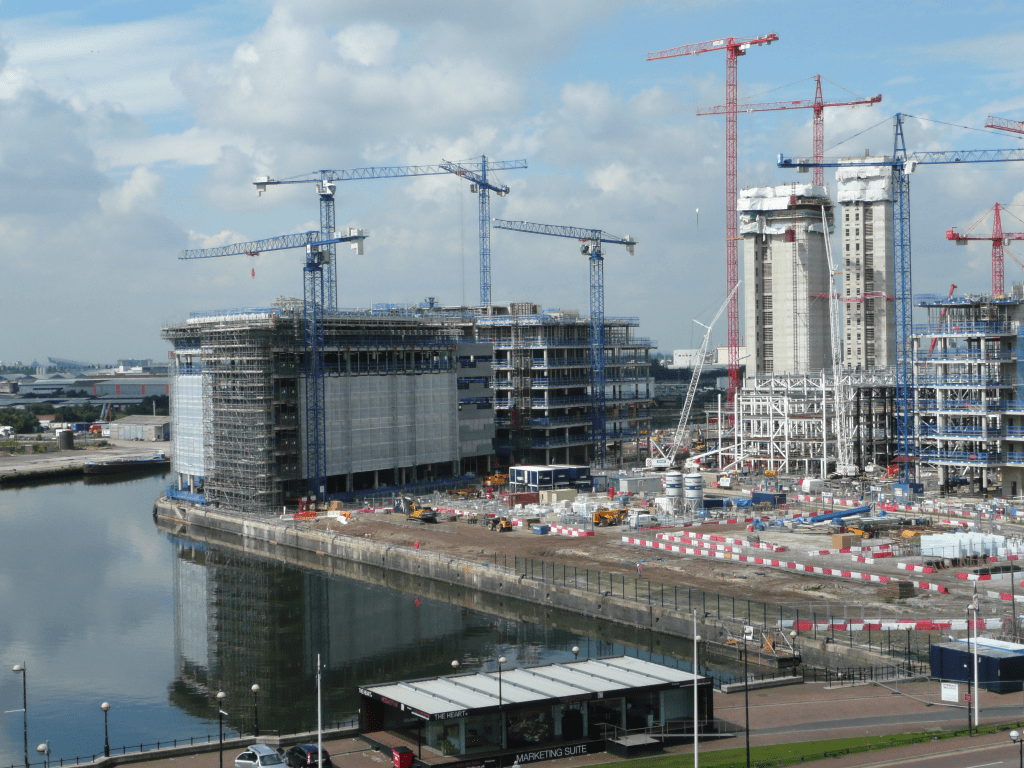
The Structural Rise (2008–2009): Documents the erection of massive tower cranes and the core framework of the studio blocks rising over Salford Quays.
The Final Fit and Branding (2010–2011): Details the external completion of the main blocks, the installation of the iconic BBC North logos, the construction of the public piazza, and the implementation of the media tram stop.
Community and Media Discussions
Whitfield’s timeline served as a primary public and professional visual archive during the build. He actively managed a linked professional LinkedIn Group that grew to thousands of members. This space was widely used by industry professionals, media researchers, and regional planners to discuss ongoing jobs, architectural layouts, and local infrastructure impacts.
His updates were also featured directly on BBC corporate blogs to give incoming staff an authentic glimpse of their new northern headquarters.
Mark Whitfield | MediaCityUK Photographic Build Timeline Journal
Mark Whitfield is a photographer who has documented the development of MediaCityUK in Salford Quays through an extensive “Photographic Build Timeline Journal”. His collection includes over 15,000 images that capture the site’s transformation from a derelict dockland into a global media hub.
1983 and 2026 respectively
MediaCityUK Photo Timeline
Mark Whitfield: Photography Overview
Project Focus: Whitfield began documenting the rise of MediaCityUK in May 2007, specifically focusing on the construction of the BBC’s new northern home.
Visual Documentation: His work is described as a unique photo timeline that charts the incredible structural changes at the site over several years.
Background: Beyond his photography, Whitfield has a background in IT project management and has worked in Salford Quays for over 15 years.
Galleries: Much of his work is hosted on his personal website, mark-whitfield.com, and he has shared specific milestones on platforms like Flickr and Instagram.
MediaCityUK site in 2007
Historical Timeline of MediaCityUK
The following timeline integrates key development milestones with Whitfield’s photographic journey:
2004–2006: Pre-Construction Phase
The BBC signals its intention to move jobs to Manchester (2004).
Salford Quays is officially chosen as the site for the new development (June 2006).
2007: Construction Begins
May 18, 2007: Mark Whitfield captures his first timeline photo, marking the start of the build.
The first “spade in the ground” occurs as Peel Group and Bovis Lend Lease begin work.
The Pie Factory, a refurbished bakery, opens as the first working studio complex.
2008–2009: Structural Growth
Whitfield continues extensive documentation; photos from April 2008 and February 2009 capture the rising concrete frames of the main buildings.
The high-rise 2,116-space multi-storey car park is completed (August 2009).
2010: Infrastructure Milestones
The MediaCityUK Metrolink station opens (September 20), connecting the site to the wider Manchester tram network.
First trial show is recorded in Studio HQ2 (November), featuring a simulated power failure and evacuation.
Initial infrastructure is completed by December.
2011: Operational Launch
January 2011: Dock10 studios become operational.
February 2011: The first program, Don’t Scare the Hare, is filmed at MediaCityUK.
May 2011: BBC staff begin moving into three dedicated buildings: Bridge House, Dock House, and Quay House.
October 2011: The University of Salford opens its new media academy at the site.
2012–2014: Full Integration
April 2012: The Queen and Duke of Edinburgh officially open MediaCityUK.
March 2013: ITV completes its move to the site.
January 2014:Coronation Street records its first episode at the new production facility on Trafford Wharf.
2015–2021: Expansion & Sustainability
2016: Completion of “Tomorrow,” the final building in Phase One.
2020: The Pie Factory closes and is demolished to make way for Phase Two.
2021: MediaCityUK buildings become the first in the UK to achieve net-zero carbon status.
MediaCityUK building beginning to take shape in late 2008
MediaCity UK Photographic Time-lapse Video – 2007 thru 2010
During my time working in Salford Quays as an IT Project Manager, I took a good number of photos and movies of the MediaCity build (literally from the ground up). The pictures were taken from 2007 when the dockland was flat and unused, through to 2010. MediaCity UK is now home to the BBC (BBC North), ITV in the North West and the University of Salford.
The 200 or so pictures in this movie represent an abridged timeline of the build selected from a few thousand photos starting from 2007.
Music soundtrack accompanying movie timeline is by John Barry and from the film –