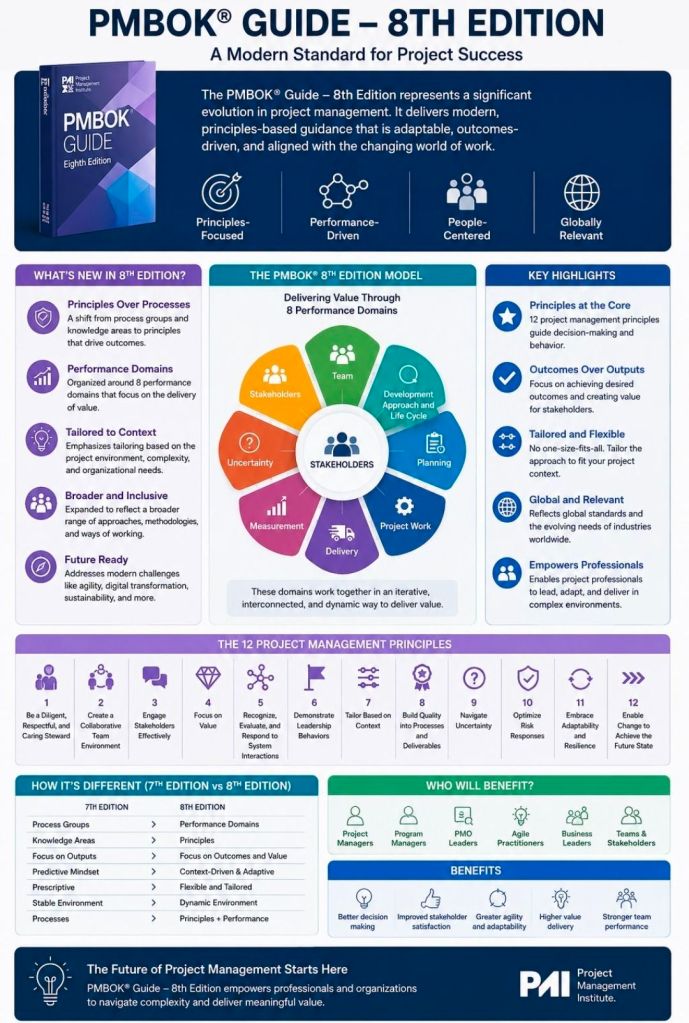
PMBOK Guide 8th Edition

PMBOK Guide 8th Edition

The PMBOK Guide 8th Edition is an integrated, value-driven framework that bridges the high-level principles of the 7th edition with the practical, process-oriented structure of older editions. It reintroduces 40 non-prescriptive processes alongside six core principles and seven performance domains.

📚 The Structure: Two Books in One

Similar to its predecessors, the printed volume of the 8th Edition includes two integrated publications:

  1. The Standard for Project Management: An official ANSI standard that focuses on strategic alignment, value delivery systems, and global applicability.
  2. A Guide to the Project Management Body of Knowledge (PMBOK Guide): The practical handbook containing the processes, tools, techniques, and tailoring considerations.

🟢 The 6 Core Principles

The 8th Edition streamlines the 12 principles from the 7th edition into six actionable pillars designed to guide professional behavior and mindset:

  • Adopt a Holistic View: Think in terms of systems and understand how a project integrates with organizational strategy.
  • Focus on Value: Direct efforts toward long-term outcomes and net-positive benefits rather than just output production.
  • Build Accountable Leadership: Cultivate a culture of transparency, clear responsibilities, and high-performance teamwork.
  • Embed Quality: Ensure quality processes and continuous improvement are woven into every phase of the work.
  • Integrate Sustainability: Consider the long-term environmental, social, and economic impacts of project delivery.
  • Build Empowered Teams: Foster environments where team members are supported, trusted, and empowered to solve problems.

🔵 The 7 Performance Domains

These represent key areas of practice, serving as the technical “what” of your project:

  1. Governance: Setting the rules, decision frameworks, and oversight mechanisms.
  2. Scope: Defining boundaries, deliverables, and requirements.
  3. Schedule: Managing timeframes, milestones, and critical paths.
  4. Finance: Budgeting, forecasting, and cost management.
  5. Stakeholders: Managing expectations, engagement, and communications.
  6. Resources: Allocating people, equipment, and physical/material assets.
  7. Risks: Identifying, analyzing, and mitigating uncertainties.

🟠 The 40 Evolved Processes & Focus Areas

A highly praised update in the 8th edition is the return of process guidance. To offer structured “how-to” guidance without becoming rigid, the processes are grouped into five Focus Areas (replacing the traditional Process Groups):

  • Initiating
  • Planning
  • Executing
  • Monitoring & Controlling
  • Closing

Across these five focus areas, there are 40 non-prescriptive processes that detail the typical inputs, tools, techniques, and outputs (ITTOs). The guide includes explicit tailoring advice on how to adapt these processes for predictive, hybrid, and agile environments.


💡 Key Modern Additions

Reflecting over 48,000 global practitioner data points, the 8th Edition expands coverage into modern project environments:

  • Artificial Intelligence (AI): Guidance on using AI and data analytics in project management.
  • Project Management Offices (PMOs): Expanded focus on PMO structures and strategic value alignment.
  • Procurement & Contracting: Modernized contracting types, dispute resolution, and vendor management.

📝 PMP Exam Note

If you are planning to take the PMP exam, make sure to check the official PMI PMP Certification Overview for the most up-to-date Exam Content Outline (ECO). The exam relies heavily on the ECO, and the 8th Edition guide serves as foundational reference material.
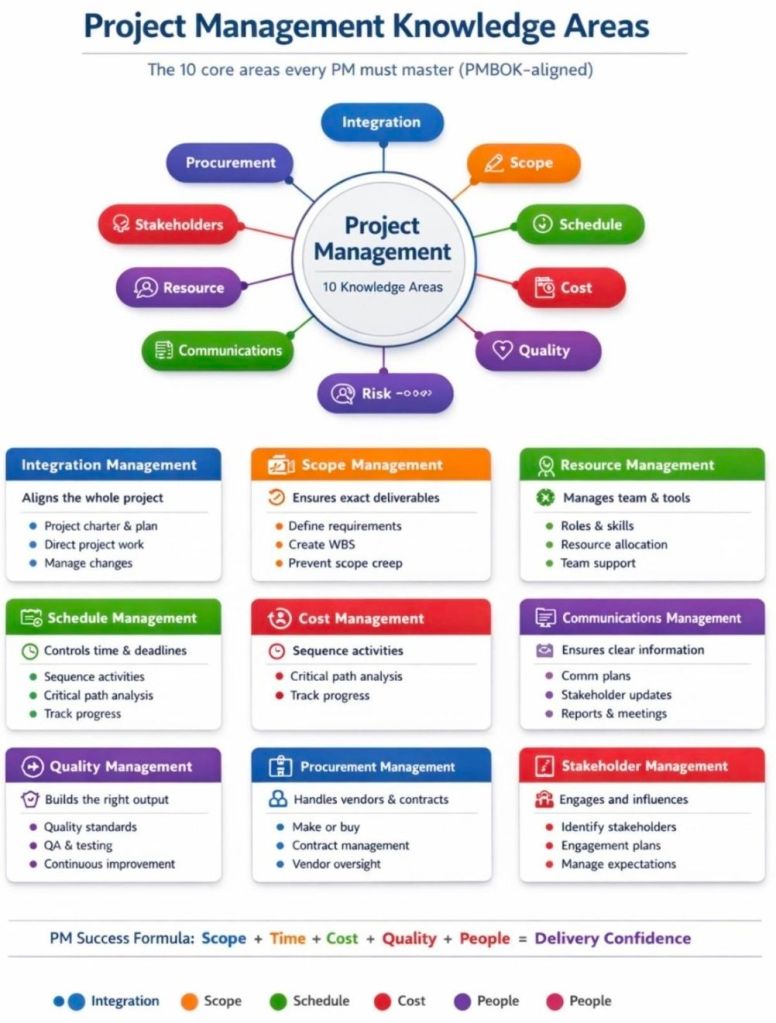
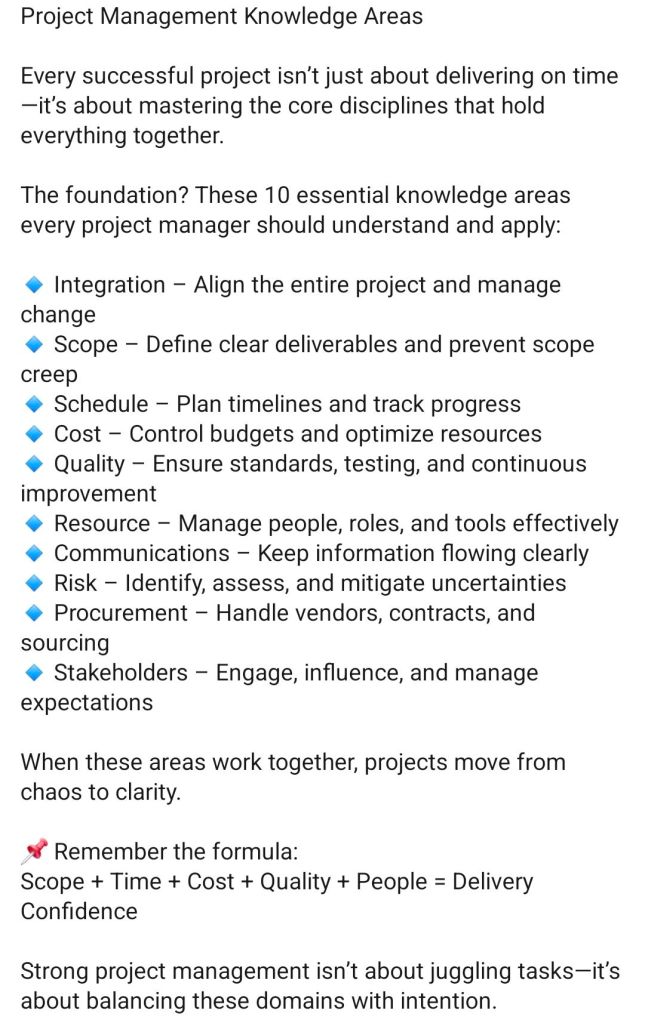
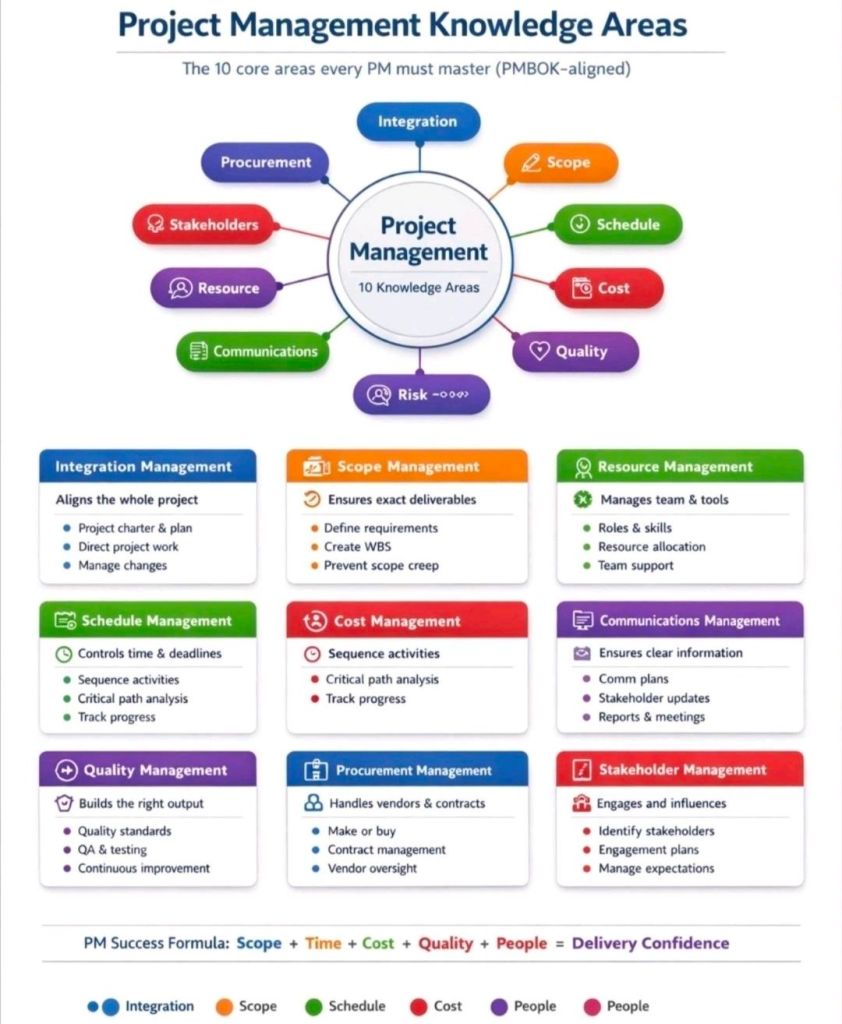
Project Management Core Knowledge Areas PMBOK Aligned

Project Management – Core Knowledge Areas, PMBOK Aligned
Project Management – Knowledge Areas – PMBOK Aligned

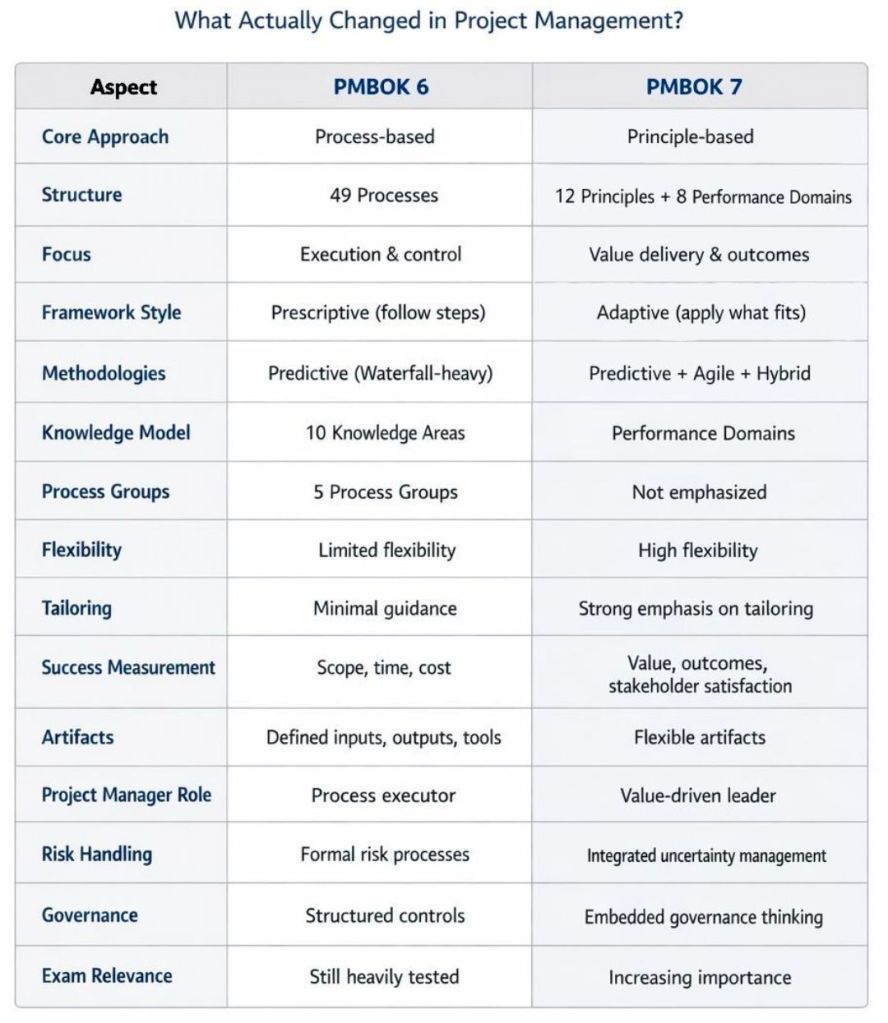
PMBOK 6 vs PMBOK 7, what changes are there between version 6 and 7

What changes are there between PMBOK version 6 and 7

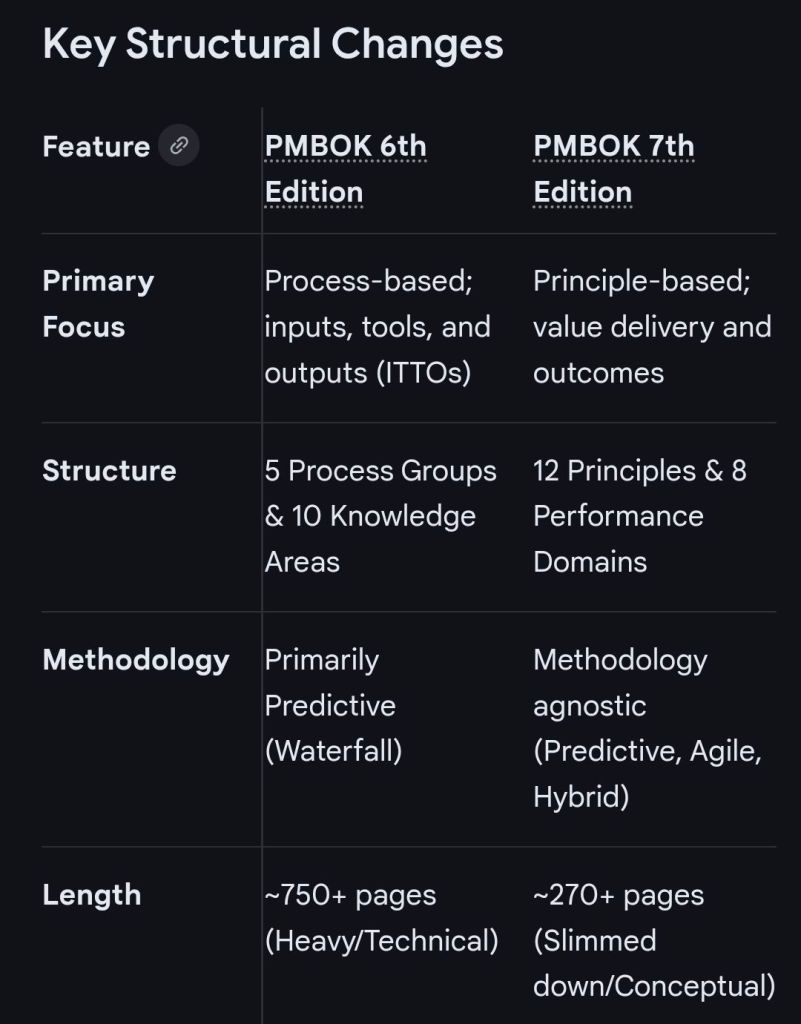
The transition from the PMBOK Guide 6th Edition to the 7th Edition represents a fundamental shift from a prescriptive, process-oriented framework to a flexible, principles-based one. While the 6th Edition focused on “how” to manage projects through specific steps, the 7th Edition focuses on “why” and “what” outcomes are being achieved. 

Key PMBOK structural changes

Major Insights into the Changes

  • From Processes to Principles: PMBOK 7 replaces the 49 prescriptive processes with 12 Project Management Principles (e.g., Stewardship, Team, Stakeholders, Value, Tailoring) that serve as foundational guidelines for behavior and decision-making in any environment.
  • Performance Domains: The 10 Knowledge Areas are replaced by 8 Performance Domains (Stakeholders, Team, Development Approach, Planning, Project Work, Delivery, Measurement, and Uncertainty). These domains focus on critical activity groups for delivering outcomes rather than step-by-step tasks.
  • Value Delivery System: The 7th Edition introduces a “system for value delivery,” shifting focus from just managing project deliverables to how projects contribute to an organization’s overall strategy and business goals.
  • Tailoring: While always part of project management, tailoring is now a core principle and has its own dedicated chapter in PMBOK 7. It encourages project managers to adapt their approach based on the specific project context, complexity, and organizational needs.
  • Agile and Hybrid Integration: PMBOK 7 fully integrates agile and hybrid practices into the core text, whereas PMBOK 6 largely treated them as an appendix or a separate guide.
  • Models, Methods, and Artifacts: The rigid ITTO structure of PMBOK 6 is replaced by a broader section on Models, Methods, and Artifacts. This provides a high-level grouping of tools without prescribing exactly when or how they must be used. 

PMP Exam Context

PMBOK 7 does not make PMBOK 6 obsolete. For the Project Management Professional (PMP) exam, both editions remain relevant reference materials. PMBOK 6 provides the technical workflow “checklist,” while PMBOK 7 provides the “mindset” and measurement strategies for modern, complex projects. 

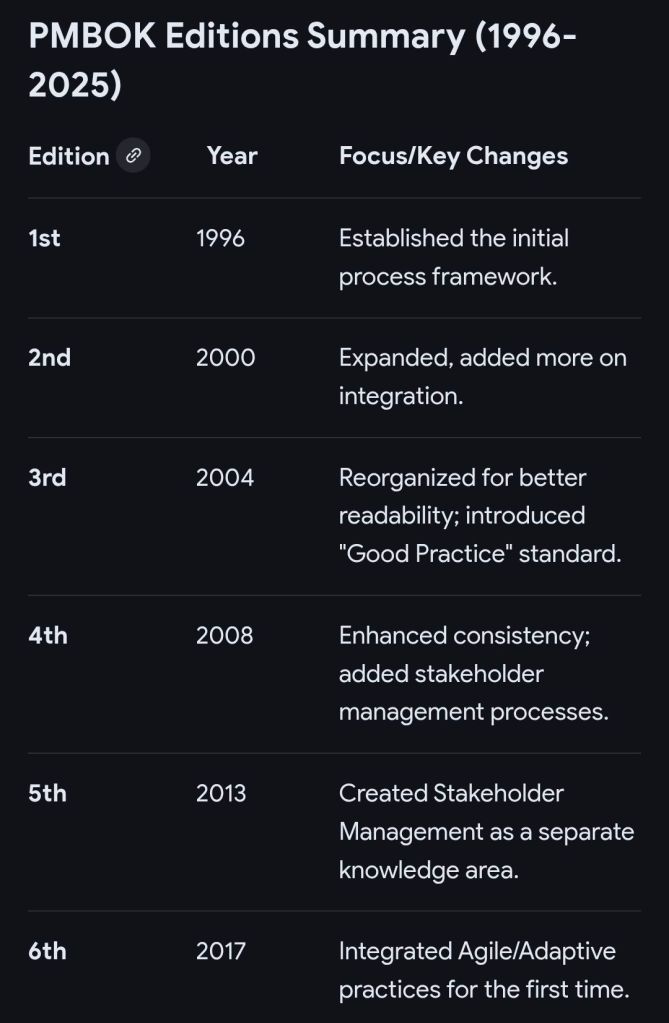
PMBOK Project Management Body of Knowledge summary and detailed historical timeline by era and year

The PMBOK (Project Management Body of Knowledge) Guide, published by the Project Management Institute (PMI), is the globally recognized standard for project management best practices. Its evolution reflects the shift from rigid, industrial-era scheduling to flexible, value-driven, and hybrid methodologies. 

Summary of PMBOK Evolution

  • 1980s (Origins): PMI sought to standardize knowledge, starting with a white paper in 1983 and the first “Body of Knowledge” document in 1987.
  • 1996 (1st Edition): The first official PMBOK Guide was published, introducing a foundational process framework.
  • 2000s (Expansion): The 2nd (2000) and 3rd (2004) editions expanded on integration and finalized the standard for project management.
  • 2010s (Integration): The 4th (2008) and 5th (2012) editions added stakeholder management and aligned with enterprise needs. The 6th Edition (2017) formally bridged predictive (waterfall) and agile practices.
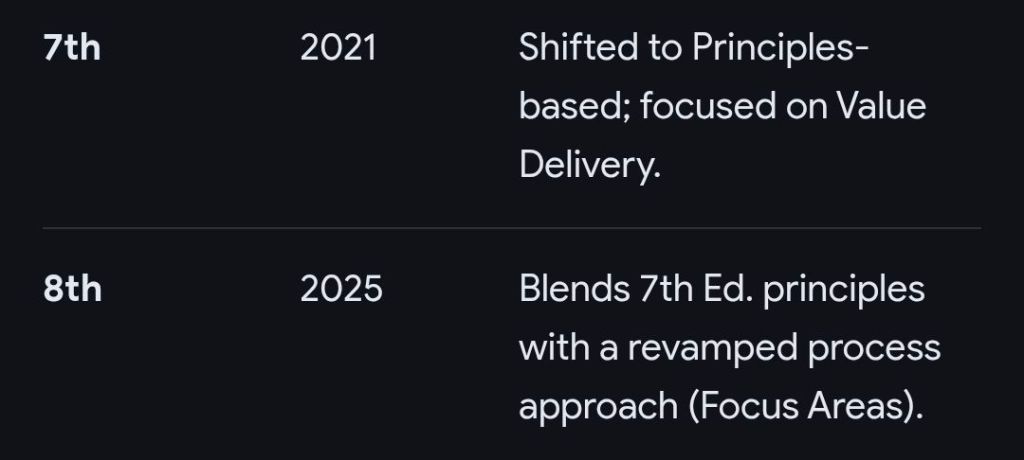
  • 2020s (Transformation): The 7th Edition (2021) marked a massive shift from process-based to principle-based, focusing on project outcomes rather than just outputs. The 8th Edition (2025) reintroduces practical, tailored process guidance alongside principles. 

Detailed Historical Timeline by Era and Year

Ancient Era to Pre-Modern (Before 1950s)

  • 2570 BC: Completion of the Great Pyramid of Giza, requiring complex organization, planning, and control.
  • 208 BC: Construction of the Great Wall of China, demonstrating massive, orchestrated labour management.
  • 1917: Henry Gantt developed the Gantt chart, a foundational scheduling tool still used today.

The Foundation Era (1950s – 1960s) 

  • 1956: American Association of Cost Engineers (now AACE International) formed.
  • 1957: Critical Path Method (CPM) invented by Dupont.
  • 1958: Program Evaluation and Review Technique (PERT) developed by the U.S. Navy for the Polaris missile program.
  • 1962: U.S. Dept of Defense mandated the Work Breakdown Structure (WBS) approach.
  • 1969: Project Management Institute (PMI) founded to promote the profession and set standards. 

The Formalization Era (1970s – 1980s) 

  • 1975: PROMPTII method created (later becoming PRINCE).
  • 1984: Dr. Eliyahu M. Goldratt introduced the Theory of Constraints (TOC) in his book “The Goal”.
  • 1986: Scrum named as a project management style.
  • 1987: First PMBOK Guide published by PMI as a white paper, attempting to standardize practices. 

The Standardization Era (1990s – 2000s)

  • 1991: Navy A-12 Avenger II Program cancelled due to poor performance detected by EVM.
  • 1996: 1st Edition of the PMBOK Guide released, establishing it as the foundational standard.
  • 1997: Critical Chain Project Management (CCPM) invented.
  • 1998: PMBOK recognized as a standard by ANSI (American National Standards Institute) and IEEE.
  • 2000: 2nd Edition of the PMBOK Guide released, adding more practical, in-depth material.
  • 2001: Agile Manifesto written, focusing on adaptability in software development.
  • 2004: 3rd Edition of the PMBOK Guide released, changing focus from “generally accepted” to “good practice”. 

The Modern Age & Agility Era (2010s – Present)

  • 2008: 4th Edition of the PMBOK Guide released, improving consistency and introducing new processes.
  • 2012: 5th Edition of the PMBOK Guide released, introducing the 10th Knowledge Area: Project Stakeholder Management.
  • 2017: 6th Edition of the PMBOK Guide released, incorporating Agile, Iterative, and Adaptive methodologies into every knowledge area.
  • 2021: 7th Edition of the PMBOK Guide released, a major shift towards a principle-based, value-delivery approach.
  • 2025: 8th Edition of the PMBOK Guide released, reintroducing tailored, practical processes along with principles.

PMBOK Project Management Body of Knowledge summary and detailed historical timeline by era and year

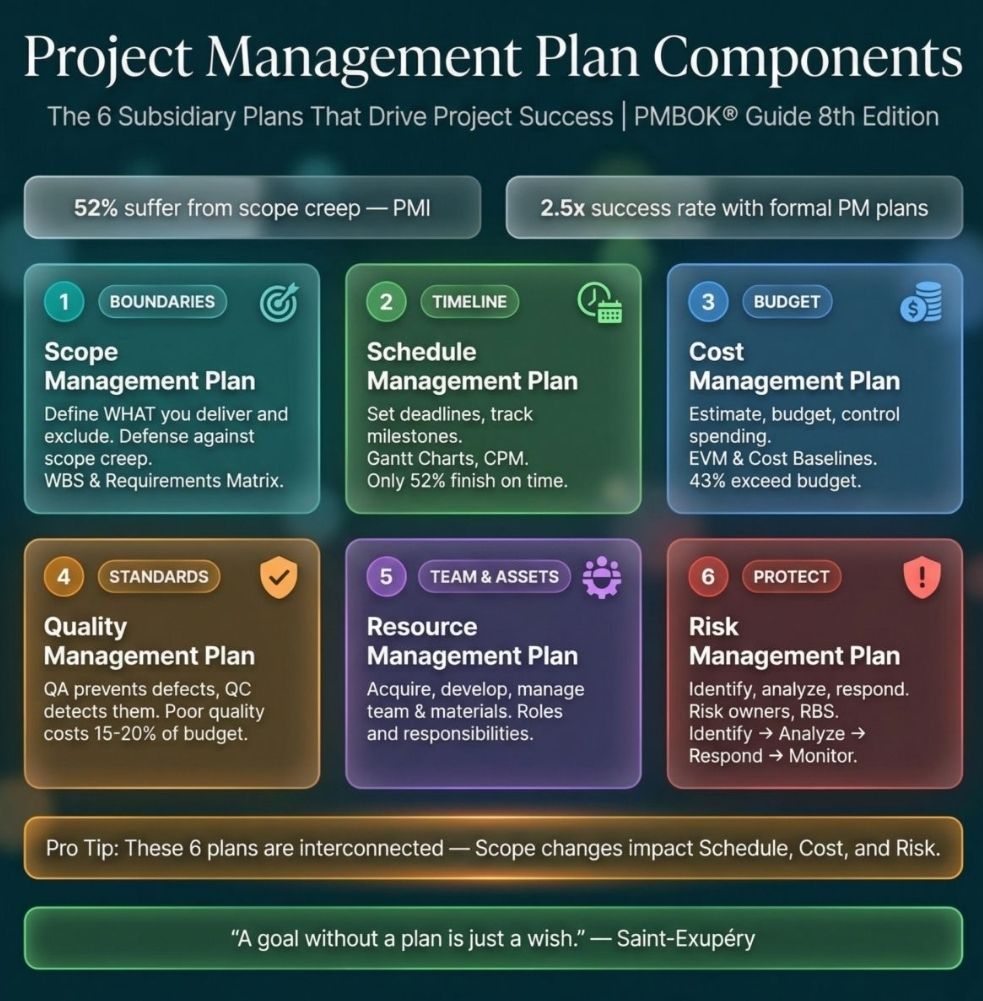
Project Management Plan Components, PMBOK

Project Management Plan Components, PMBOK

Project Management Knowledge Areas PMBOK aligned

Project Management Knowledge Areas PMBOK aligned

Governance in PMBOK 8th Edition – Simplified and Powerful

Governance in PMBOK 8th Edition – Simplified and Powerful

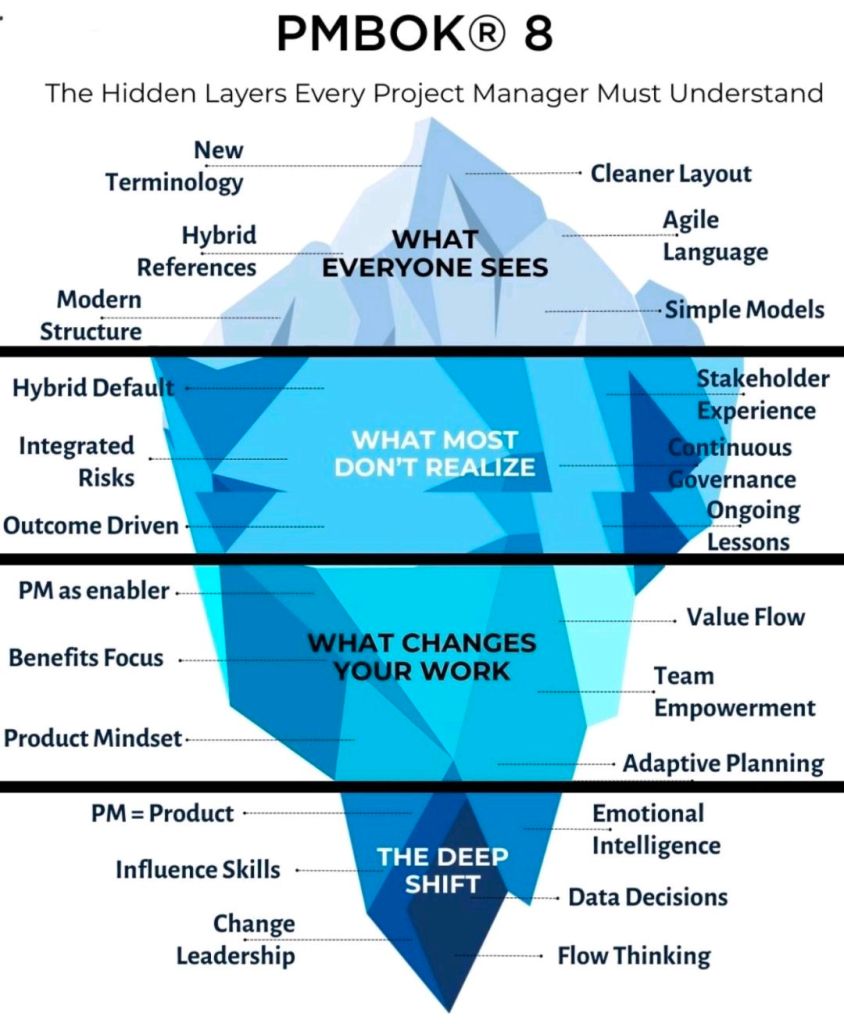
PMBOK 8 – The Hidden Layers

PMBOK 8 – The Hidden Layers

Aligning PMO with PMBOK 8

Aligning PMO with PMBOK 8

PMBOK Evolution Timeline – 1996 to 2025

PMBOK Evolution Timeline – 1996 to 2025

PMBOK 7TH VS PMBOK 8TH EDITION COMPARISON

PMBOK 7TH VS PMBOK 8TH EDITION COMPARISON

PMBOK 7 versus PMBOK 8 – Key Comparative Overview

PMBOK 7 versus PMBOK 8 – Key Comparative Overview

PMBOK 7th Edition, 12 Project Management Principles

PMBOK 7th Edition, 12 Project Management Principles

Key Processes, PMBOK Guide – 7th Edition

Key Processes, PMBOK Guide – 7th Edition

1. Identify Stakeholders

2. Plan Stakeholder Engagement

3. Manage Stakeholder Engagement

4. Monitor Stakeholder Engagement