Mark Whitfield served as an IT Senior Digital Project Manager (often operating in product and application delivery roles) within the Online and Mobile Division at Betfred from December 2014 to January 2016.
During this era, his responsibilities crossed the boundary between project management and digital product delivery. He was heavily focused on shifting legacy digital footprints toward modern mobile, web, and multi-vendor integrations.
Below are the focus areas and technical outputs from his tenure at Betfred, grouped by operational era and delivery cycle:
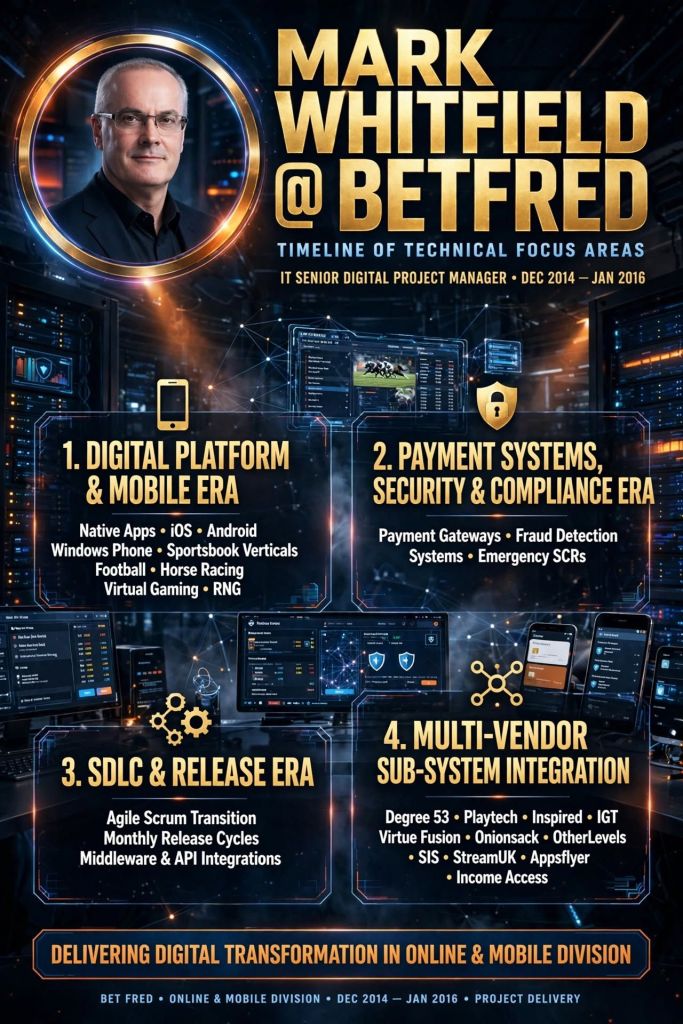
📱 1. Digital Platform & Mobile Era (Core Product Delivery)
This area focused on the rapid evolution of the sportsbook and the deployment of consumer-facing native and web applications.
- Focus Areas: Mobile product lifecycle management, multi-platform deployment, and real estate feature upgrades for
.COMand.mobichannels. - Technical Output:
- Native Applications: Delivered and updated native mobile applications across iOS, Android, and Windows Phone.
- Sportsbook Verticals: Built, optimized, and deployed major UI/UX updates for the football and horse racing sportsbooks.
- Virtual Gaming: Integrated online, computer-generated virtual gaming modules and RNG (Random Number Generator) components into the digital ecosystem.
🔒 2. Payment Systems, Security, & Compliance Era
A major focus was placed on building high-throughput payment pipelines and establishing robust compliance mechanics to handle compromised trading environments.
- Focus Areas: Fraud mitigation, multi-currency processing, payment gateway migrations, and strict adherence to gambling regulations.
- Technical Output:
- Payment Gateways: Delivered end-to-end payment gateway mechanisms supporting diverse credit/debit, e-wallet, and localized payment methods.
- Fraud Detection Systems: Integrated advanced fraud detection and risk analysis modules into backend transactional pathways.
- Emergency System Change Requests (SCRs): Architected and executed critical hotfixes for compliance directives, regulatory alignment, and security mitigations.
🔄 3. Software Development Lifecycle (SDLC) & Release Era
This era was characterized by a massive transition away from rigid legacy setups into continuous delivery models.
- Focus Areas: Transitioning environments from Waterfall to the Agile Scrum framework, managing distributed cross-functional teams, and stabilizing deployment cadences.
- Technical Output:
- Monthly Release Cycles: Structured and executed the monthly internet software release train to stabilize production code across the web real estate.
- Middleware & API Integrations: Managed complex integrations connecting frontend frameworks with heavy transactional middleware and core banking/wallet ledgers.
🤝 4. Multi-Vendor Sub-System Integration
Because Betfred’s tech stack relied heavily on third-party niche solutions, Whitfield acted as the technical delivery anchor across an extensive network of specialized vendors.
- Focus Areas: Vendor middleware alignment, technical contract delivery, and cross-platform SLA monitoring.
- Technical Output:
- Frontend & UX: Coordinated front-end developments with agencies like Degree 53.
- Core Gaming & Content Systems: Integrated third-party components from industry staples including Playtech, Inspired, IGT, and Virtue Fusion.
- Data Feeds & Push Tech: Managed real-time data ingestion and notification engines built by Onionsack, OtherLevels, Satellite Information Services (SIS), and StreamUK.
- Analytics & Performance: Integrated user attribution and marketing pipelines utilizing Appsflyer, Income Access, and Activewin.