Agile Scrum Master’s Checklist for Program Increment
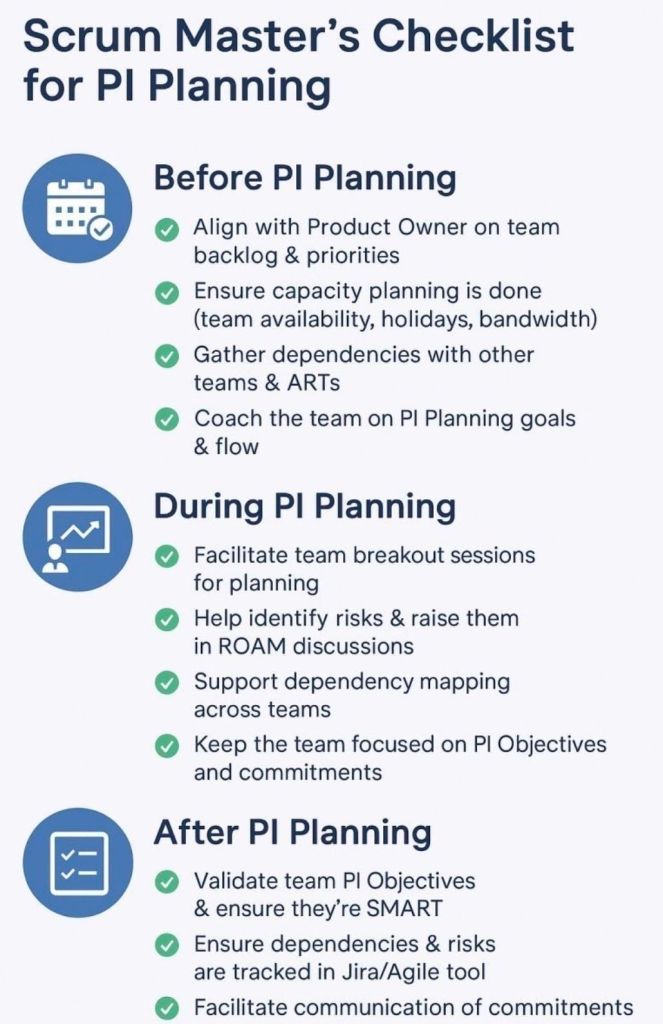
An Agile Scrum Master’s checklist for a Program Increment (PI)ensures your team is aligned, dependencies are resolved, and a realistic delivery plan is established for the upcoming 8–12 weeks of work. As a facilitator and coach, you support the team across three core phases: Pre-PI Planning, During PI Planning Events, and Post-PI Execution.
Here is a comprehensive checklist structured across the lifecycle of a Program Increment.
📅 Phase 1: Pre-PI Planning Readiness
Establish Sprint Cadence: Define exact start/end dates for every sprint within the upcoming PI.
Calculate Team Capacity: Factor in vacations, public holidays, corporate events, and historic team velocity.
Refine the Backlog: Collaborate with the Product Owner to ensure top features meet the Definition of Ready (DoR).
Encourage Feature Decomposition: Guide developers to begin breaking down high-priority features into draft user stories.
Prepare Digital Tooling: Set up virtual whiteboards like Miro or MURAL, and structure project boards in systems like Jira.
Align Engineering Standards: Review architectural patterns with system architects to prevent technical blockers.
🛠️ Phase 2: During the PI Planning Event
Day 1 Breakout Management: Facilitate your team’s breakdown of features into actionable, estimated sprint user stories.
Map Dependencies: Identify files, data, or logic needed from external teams and link them on the program board.
Draft PI Objectives: Help the team write clear, outcome-oriented, and SMART goals based on their planned work.
Surface Program Risks: Collaboratively categorize all technical or resource hurdles using the ROAM framework (Resolved, Owned, Accepted, Mitigated).
Day 2 Plan Finalization: Ensure uncommitted objectives are preserved for high-risk items requiring external prerequisites.
Conduct Confidence Votes: Run an anonymous digital vote to gauge psychological safety and realistic alignment before final team commitment.
🚀 Phase 3: Post-PI & Execution Tracking
Sync the Agile Tooling: Move sticky notes and analog mappings directly into active Jira epics or tracking backlogs.
Establish Sprint Tracking: Distribute automated calendar sequences for recurring Daily Scrums, Sprint Plannings, and Sprint Reviews.
Monitor Cross-Team Risks: Attend standard Scrum of Scrums (SoS) meetings to report on blockers and coordinate incoming dependency tracks.
Protect the WIP Limits: Enforce explicitly defined work-in-progress (WIP) boundaries to prevent team burnout over mid-increment changes.
Inspect and Adapt (I&A): Facilitate the final evaluation comparing actual value delivered against initial PI targets to feed process enhancements back into the train.
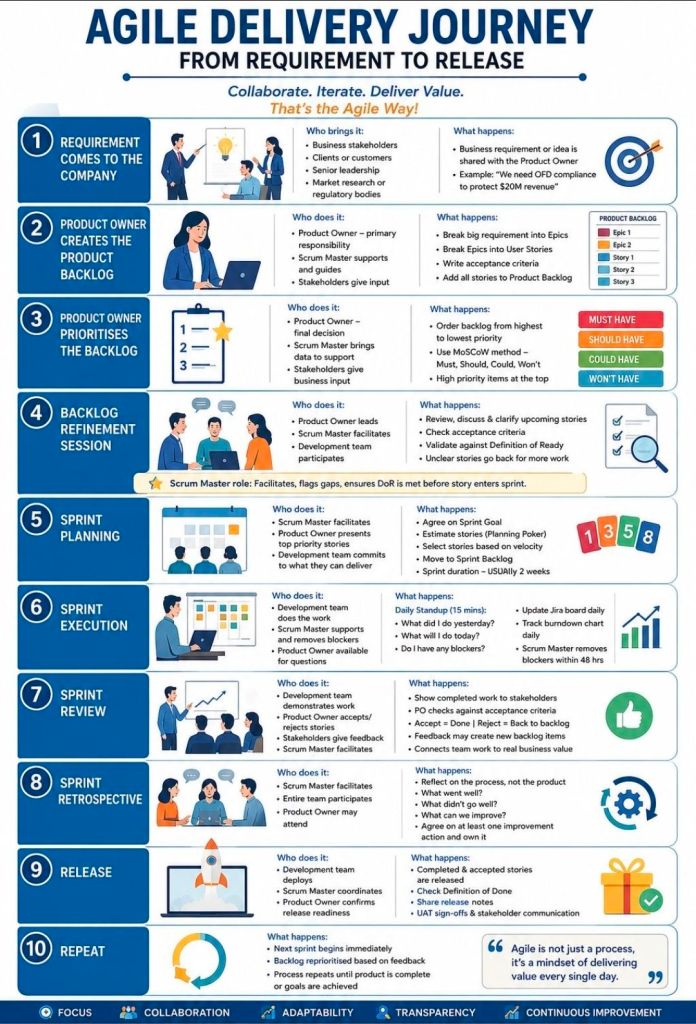
Agile delivery is an iterative approach to project management that focuses on delivering value early, frequently adapting to change, and maintaining continuous customer feedback. Rather than executing a project sequentially, teams break work into small increments to maximize flexibility and product quality.
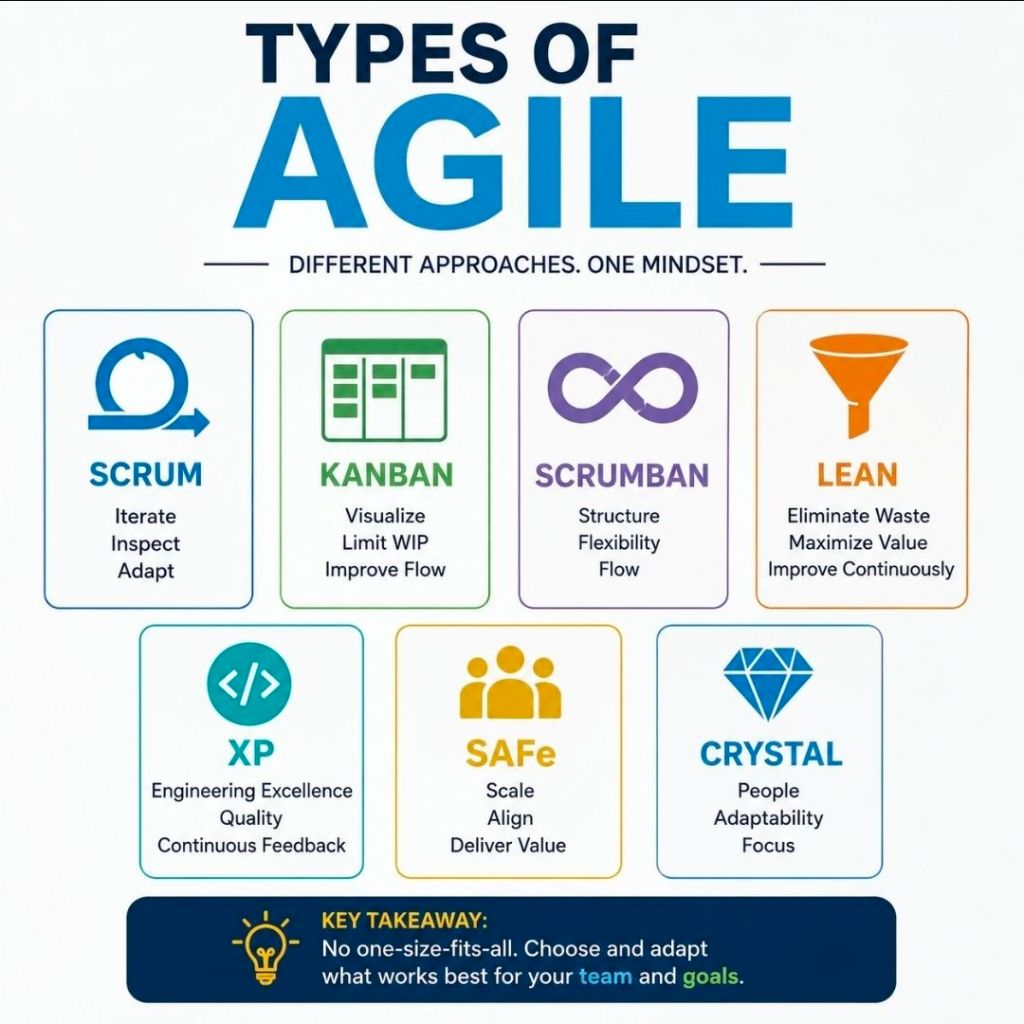
The most common types and frameworks of agile delivery include the following structured methodologies:
1. Scrum
Scrum is the most widely used agile framework, characterized by highly structured, time-boxed iterations called Sprints (typically 1 to 4 weeks long).
Key Concept: Teams work toward a single, actionable goal during each sprint.
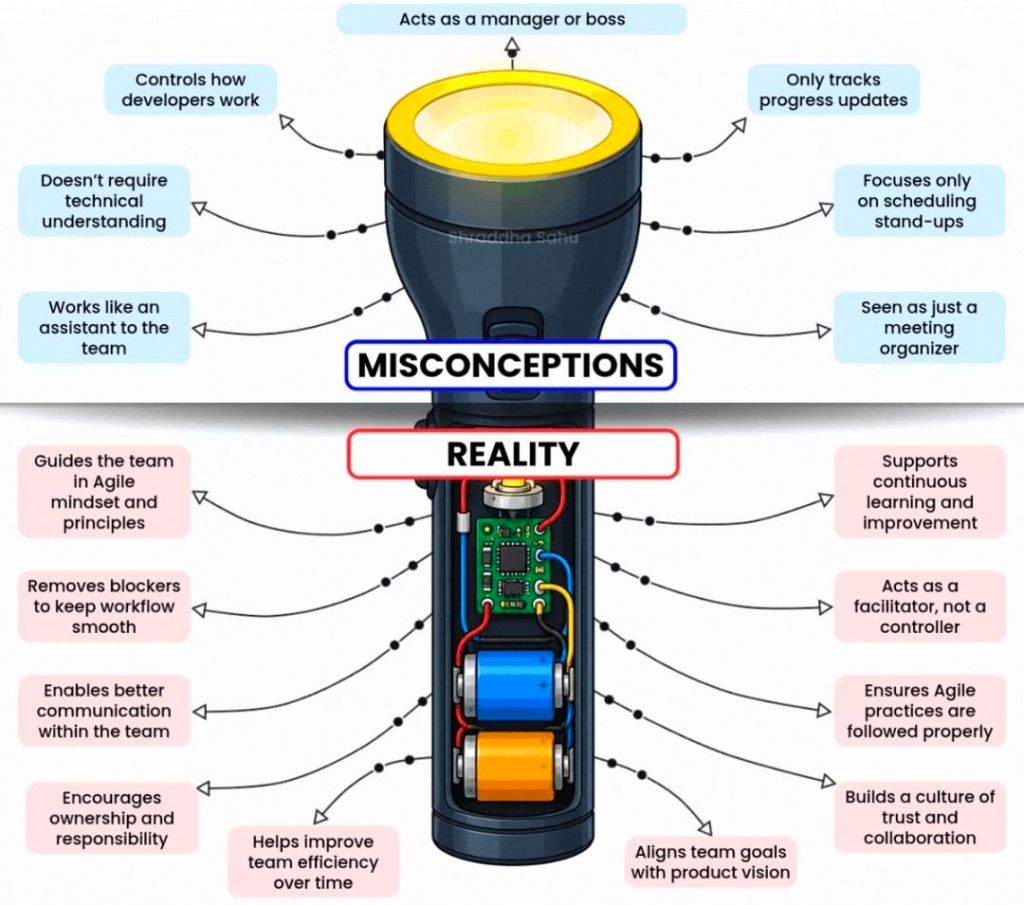
Key Roles: Product Owner (represents the customer), Scrum Master (removes obstacles and enforces the framework), and Developers.
Best For: Projects where requirements change frequently and close collaboration with clients is required.
2. Kanban
Kanban is a visual workflow management system that emphasizes continuous delivery and transparency without strict time-boxed iterations.
Key Concept: Work is tracked on a Kanban board divided into columns (e.g., “To Do,” “In Progress,” “Done”).
Key Roles: Self-organizing teams with a pull-based approach.
Best For: Operational workflows, support/maintenance teams, and organizations that need to limit “work in progress” (WIP) to prevent bottlenecks.
3. Lean Software Development
Adapted from Toyota’s lean manufacturing principles, Lean focuses on maximizing customer value while minimizing waste.
Key Concept: Focuses on “eliminating waste” (anything that doesn’t add value to the end user), amplifying learning, and delivering as fast as possible.
Best For: Optimizing overall organizational workflows and reducing overhead.
4. Extreme Programming (XP)
XP focuses heavily on technical excellence and software engineering practices to boost product quality and responsiveness.
Key Concept: Uses practices like pair programming, test-driven development (TDD), and continuous integration.
Best For: Development teams that need to release updates frequently while maintaining strict quality and low bug rates.
5. Feature-Driven Development (FDD)
FDD is a model-driven approach that is highly structured and focuses on building software in short, feature-by-feature iterations.
Key Concept: Work revolves around creating detailed software models and planning by specific features, which are built one by one.
Best For: Teams that prefer structured, step-by-step processes or environments with traditional hierarchical structures.
6. Scaled Agile Framework (SAFe)
SAFe is designed for larger enterprises that need to align cross-functional, multiple Agile teams toward a single business strategy.
Key Concept: Blends Lean, Agile, and DevOps principles to coordinate alignment, governance, and delivery across a massive scale.
Best For: Large organizations and complex projects requiring multiple teams to coordinate efforts.
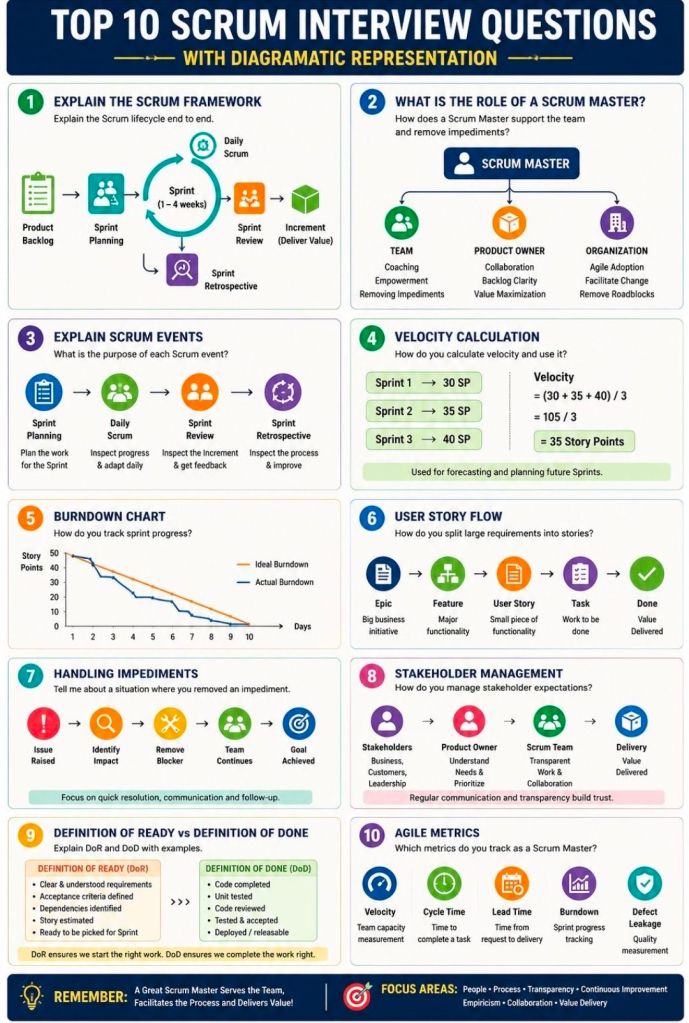
Preparing for an Agile Scrum interview requires a mix of theoretical knowledge, situational problem-solving, and a clear understanding of your specific role (Scrum Master, Product Owner, or Developer). Be ready to discuss the Scrum framework, roles, artifacts, ceremonies, and how you foster self-organization and continuous improvement.
Review these common Agile Scrum interview questions, categorized by topic:
1. Fundamentals & Frameworks
What is the difference between Agile and Scrum? Agile is an overarching project management philosophy focused on iterative development and flexibility. Scrum is a specific, lightweight framework within Agile that uses set roles, artifacts, and timeboxed “sprints” (usually 1-4 weeks).
What are the core roles on a Scrum Team? The three primary roles are the Product Owner (maximizes value, owns the backlog), the Scrum Master (servant-leader, removes impediments, ensures Scrum rules are followed), and the Developers (cross-functional team that delivers the increment).
What is a “Spike”? A spike is a timeboxed research or exploration task used to reduce uncertainty, figure out a technical approach, or better understand a requirement before development begins.
2. Scrum Ceremonies (Events)
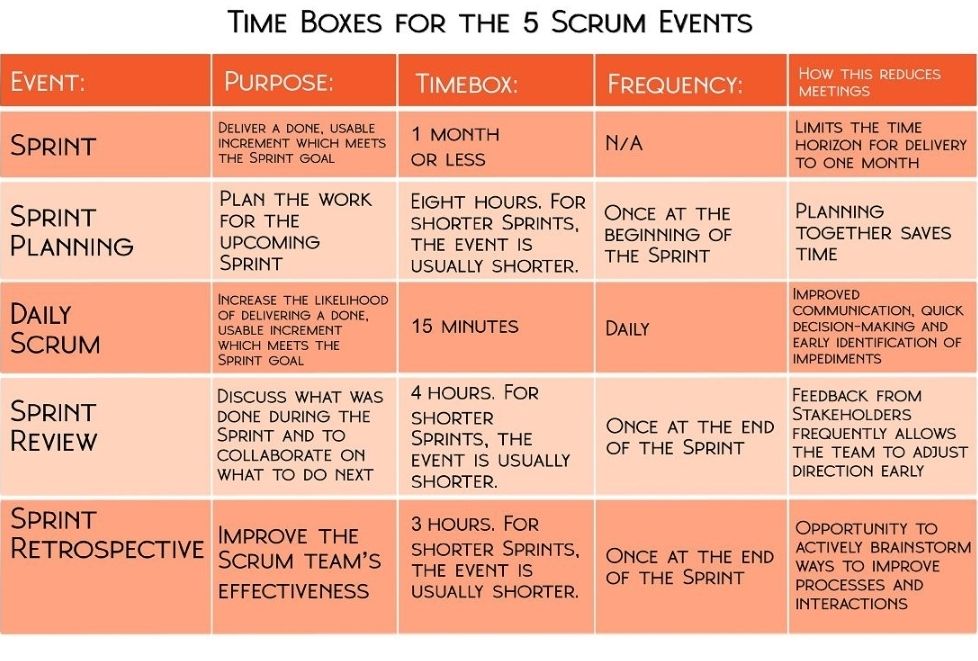
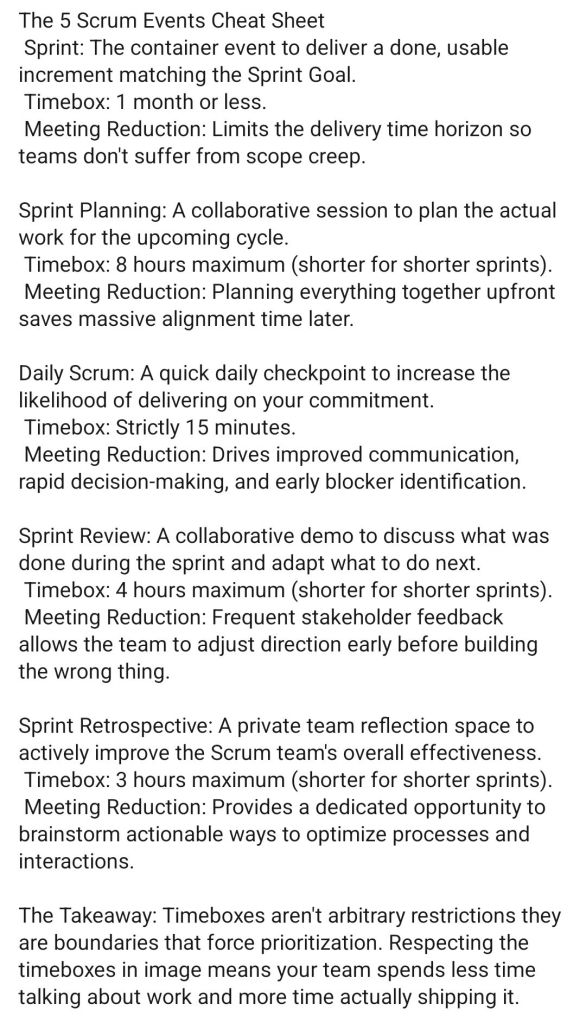
What happens during a Sprint Planning meeting? The team collaborates to determine what work can be delivered in the upcoming sprint and creates a plan (the Sprint Backlog) for how to achieve this Product Goal.
Can you give a 2-3 minute overview of the Daily Scrum? It is a 15-minute timeboxed event for the Developers to inspect progress toward the Sprint Goal and adapt the upcoming work. It is not a status report to management; it is for the team to synchronize and plan the next 24 hours.
What is the purpose of a Sprint Retrospective? Held at the end of every sprint, the team inspects the past sprint regarding people, relationships, processes, and tools. The goal is to identify what went well and create a plan for implementing improvements.
What is the difference between a Sprint Review and a Retrospective? The Review inspects the software/product increment to adapt the Product Backlog. The Retrospective inspects the team’s process and working environment.
3. Artifacts & Estimation
What is the Definition of Done (DoD)? It is a shared, clear checklist of criteria that must be met for a product increment to be considered ready for release. It ensures consistency and quality across the team.
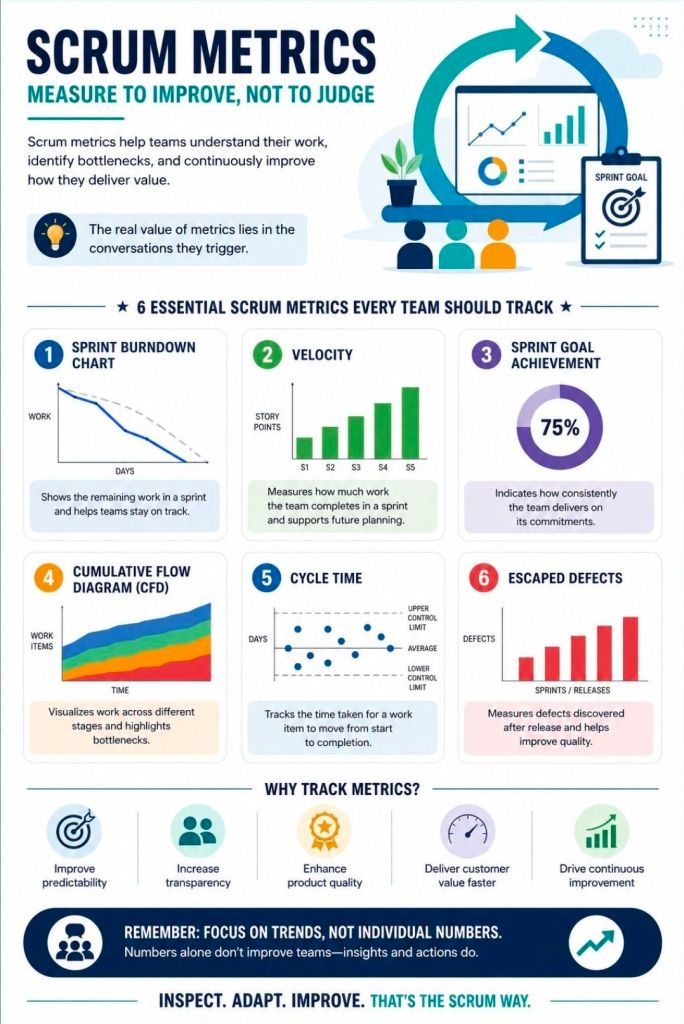
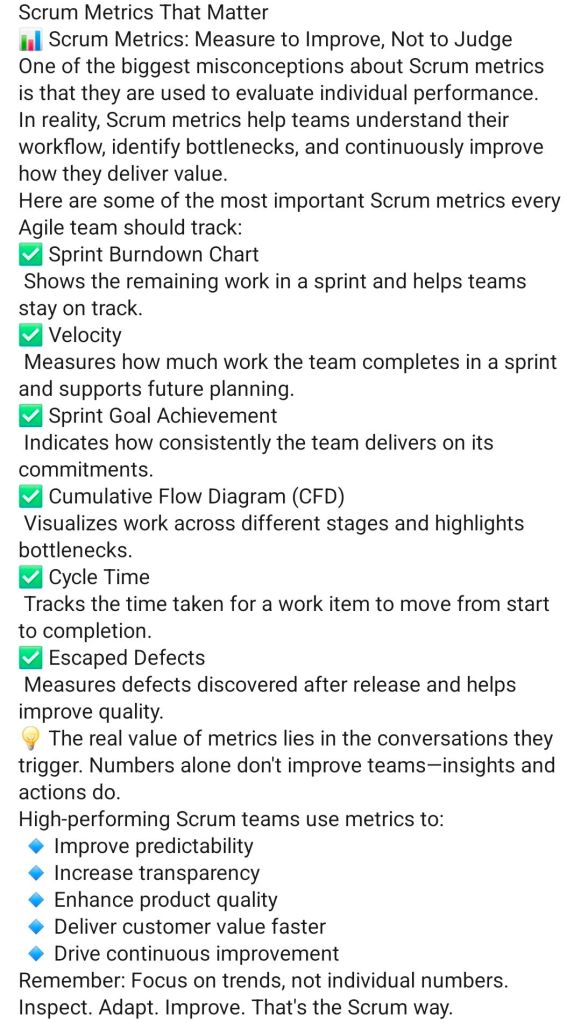
What is Velocity? Velocity measures the total amount of work (usually in Story Points) a Scrum Team can deliver during a single sprint. It is typically calculated as an average over the last 3-4 sprints and helps predict future delivery.
How do you handle scope creep? Emphasize that in Scrum, the sprint scope is locked once the sprint starts. If new work is urgent, it should go to the Product Backlog for future planning, or the team can negotiate with the Product Owner to remove an equally sized task from the current sprint to make room.
What do you do if a manager tries to dictate or assign tasks to the team? Coach the manager on Scrum principles (self-management) and act as a shield to protect the team from outside interference, allowing them to focus on the Sprint Goal.
How do you build trust with your team? Focus on empathy, transparency, consistency, and active listening. Build a safe space where the team can fail forward, experiment, and voice concerns without fear of retaliation.
How do you handle conflict within the team? Encourage the team to resolve conflicts themselves first, stepping in only if it affects the sprint goals. Facilitate open dialogue focusing on the issue (the process/problem), not the person.