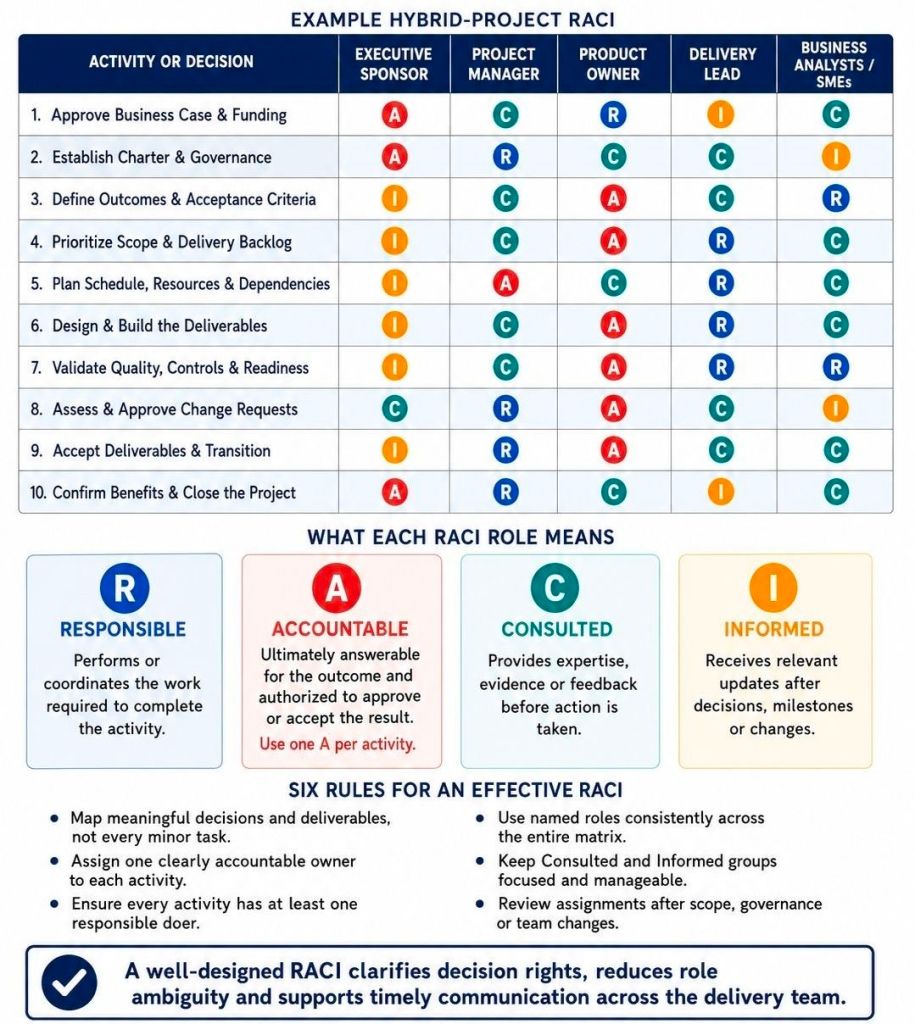
RACI Matrix, Example Hybrid Project RACI

RACI Matrix Example Hybrid Project RACI
RACI Matrix – Example Hybrid Project RACI

A RACI matrix for a hybrid project bridges the gap between structured predictive governance (Waterfall) and flexible iterative delivery (Agile). Because hybrid projects mix distinct management styles, a RACI matrix is essential to clarify who owns high-level deliverables versus who manages sprint-level execution.

The Hybrid RACI Challenge

In pure Agile/Scrum, a RACI is often redundant because roles like Product Owner and Scrum Master have built-in accountability. However, in a hybrid environment, conflicts arise at the intersection points—such as when a traditional Project Manager interacts with a self-organizing Scrum Team, or when a cross-functional sprint output requires steering committee or regulatory sign-off.

The golden rule remains: Every task must have exactly one Accountable (A) owner to prevent costly decision delays.

  • R = Responsible (Does the work)
  • A = Accountable (Final decision maker/approver; only one per row)
  • C = Consulted (Two-way communication before the task)
  • I = Informed (One-way notification after completion)

Best Practices for Hybrid RACIs

  • Focus on Deliverables, Not Micro-tasks: Map out macro phases, key milestones, and critical cross-framework decision points rather than granular daily duties.
  • Delineate the PM and PO Roles: The Project Manager is typically Accountable for overall project timelines, budgets, and predictive governance. The Product Owner holds Accountability for product requirements, value delivery, and sprint goals.
  • Avoid Dual-Accountability Pitfalls: Never assign “A” to both the PM and the PO for the same item. If a task feels like it belongs to both, split it into separate lines (e.g., split “Product Deployment” into “Feature Validation” and “Release Governance”).
  • Keep the Sprints Agile: Do not write a RACI for inside a sprint. Trust the Scrum Guide for development cycles, and use the RACI strictly to manage how those cycles plug back into the larger corporate structure.
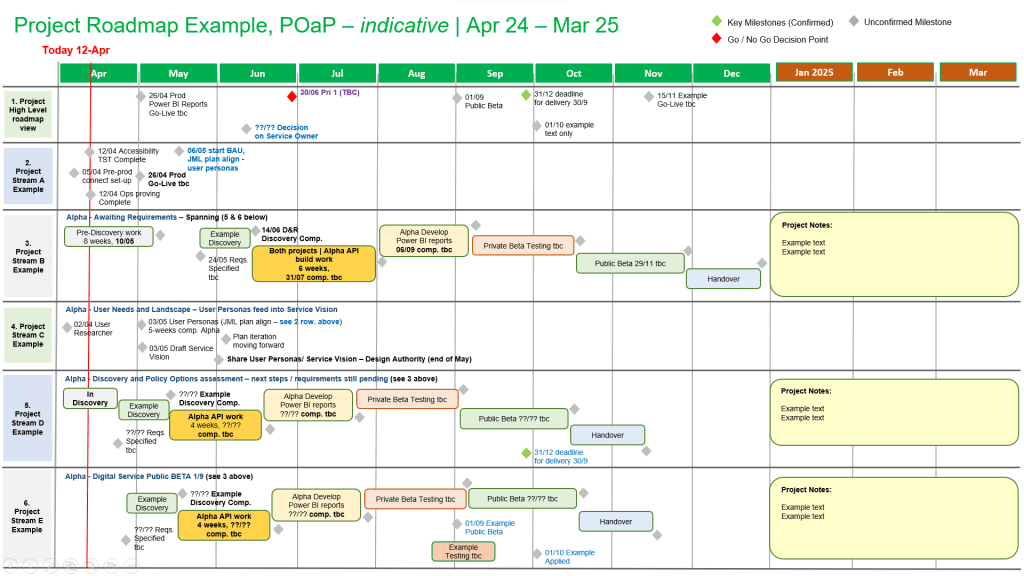
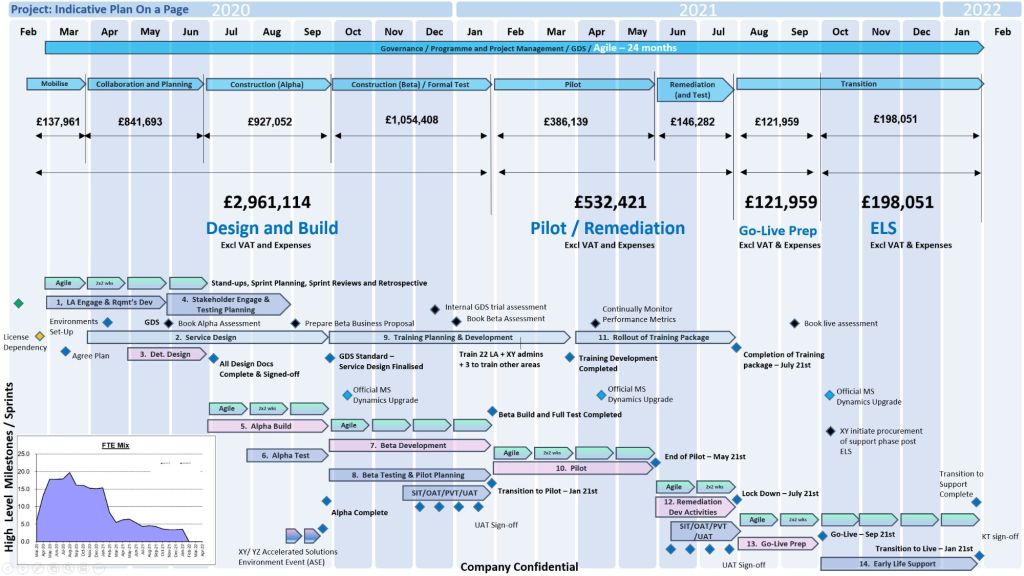
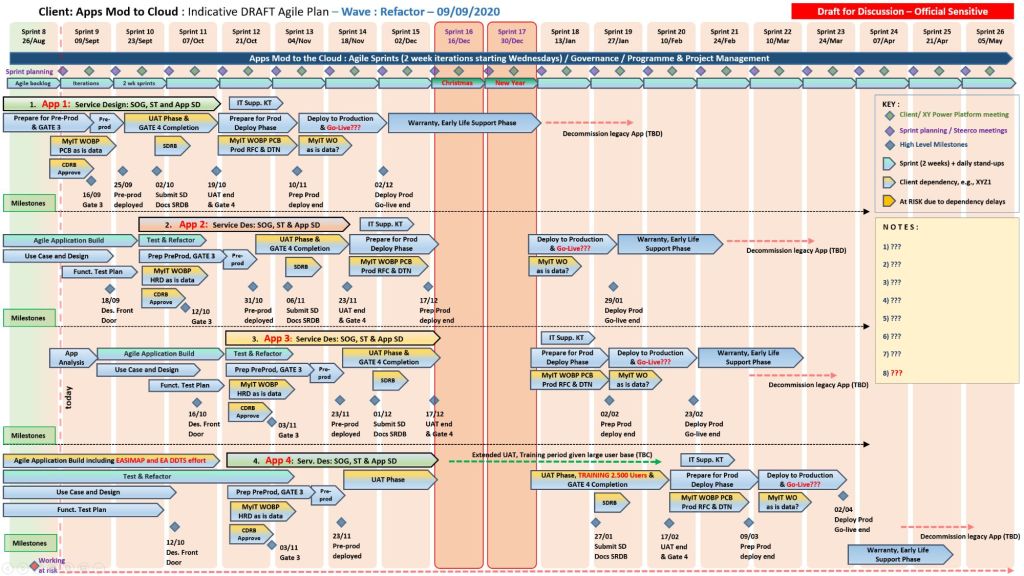
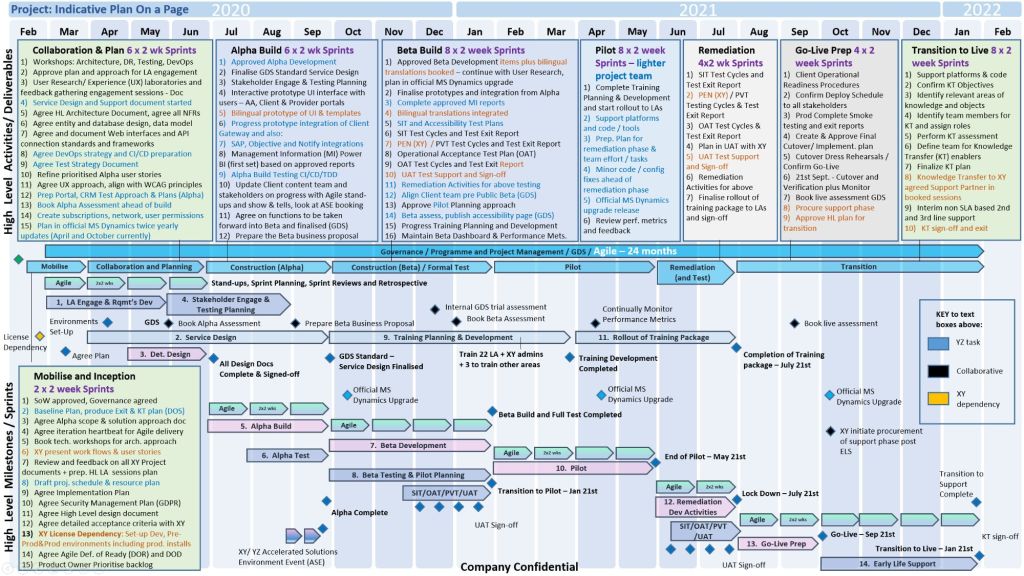
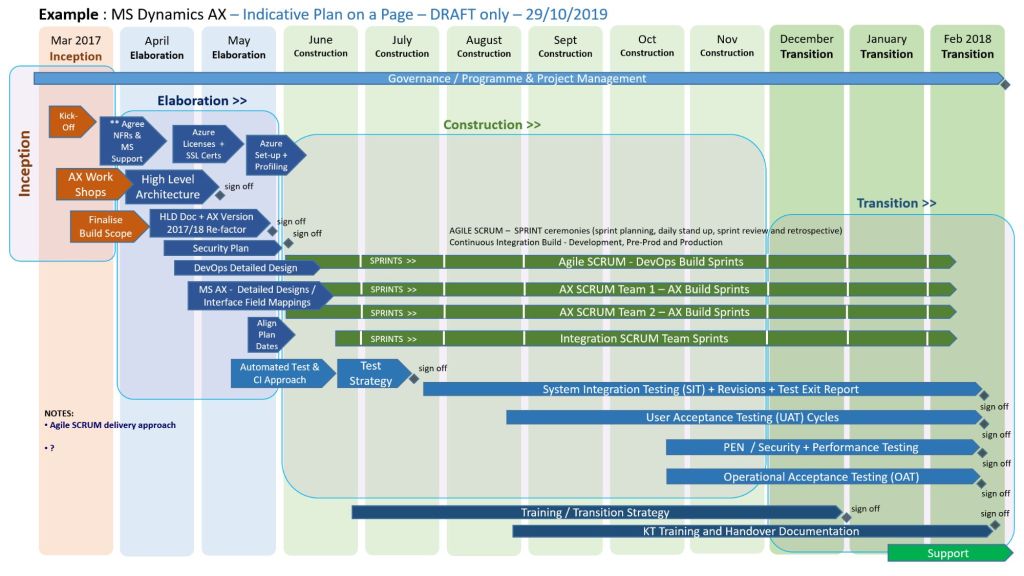
POAP Plan On a Page Example Templates for Download

Available for download here.

Plan on a page POaP example 1
POaP example 1
Plan on a page POaP example 2
POaP example 2
Plan on a page POaP example 3
POaP example 3
Plan on a page POaP example 4
POaP example 4
Plan on a page POaP example 5
POaP example 5
Plan on a page POaP example 6
POaP example 6
Plan on a page POaP example 7
POaP example 7

Many more examples available in download pack.

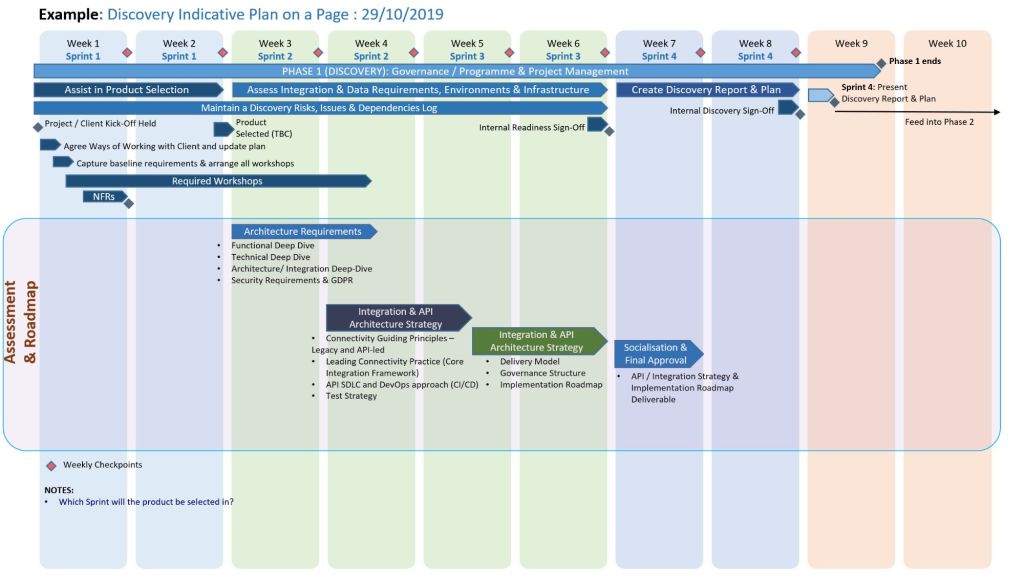
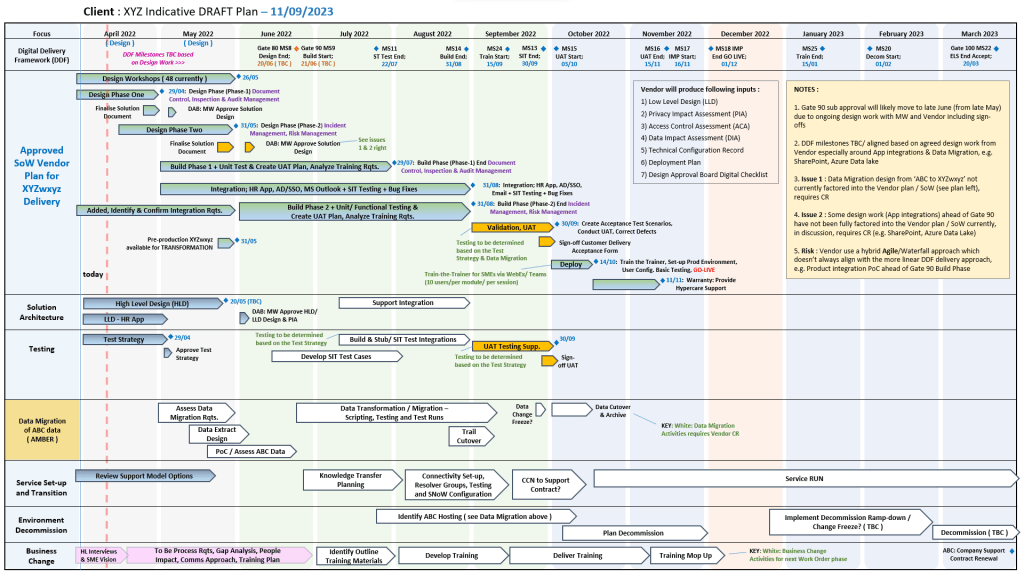
A Plan on a Page (POaP) is a concise, high-level visual summary of a project used to communicate timelines, milestones, and strategic objectives to stakeholders and executives. It condenses detailed data into an easy-to-digest, single-page format.

Core Components of a POaP

An effective POaP cuts out the noise of day-to-day task lists and focuses purely on headline information. It typically includes:

  • Project Overview: Title, project manager, and the overarching business objective.
  • Timeline & Milestones: A horizontal, time-phased bar chart mapping the project’s key phases.
  • Key Deliverables: 4 to 6 major outputs or goals required for success.
  • Risks & Dependencies: Critical blockers that require executive attention.

Why and When to Use It

  • Steering Committees: Ideal for Steering Committee meetings (Steerco) where executives need to see progress at a glance.
  • Stakeholder Alignment: Keeps teams focused on strategic vision rather than getting “lost in the weeds” of daily operations.
  • Client Updates: Acts as an excellent executive summary for clients without overwhelming them with micro-details

POAP Plan On a Page Example Templates for Download

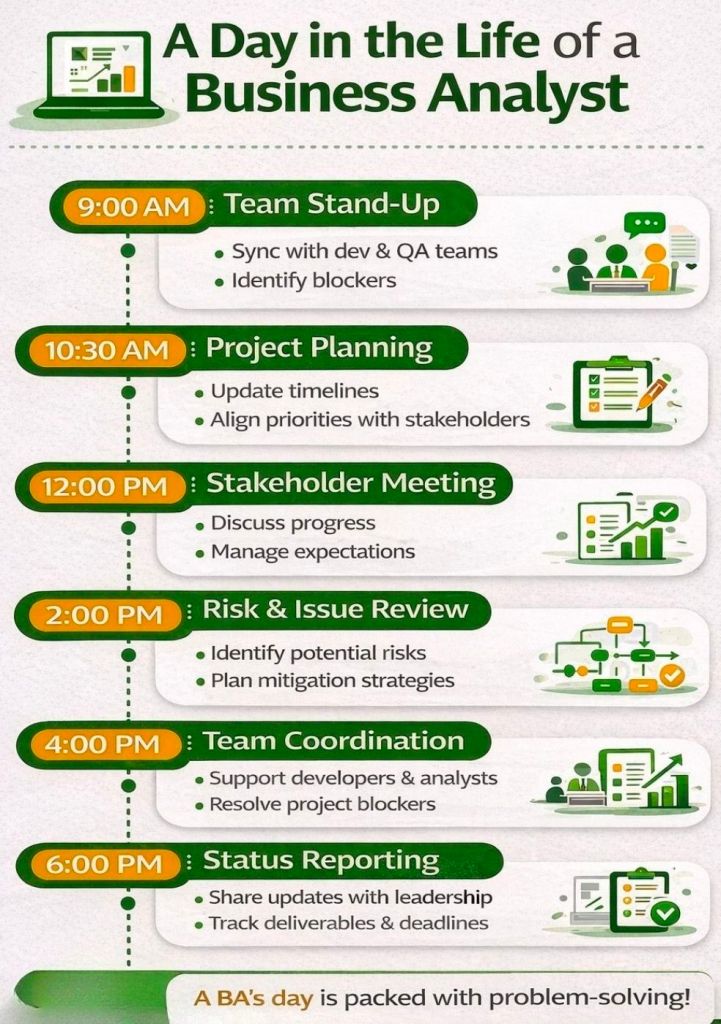
Business Analyst typical day example

Business Analyst typical day example

Third Normal Form 3NF Development Timeline and Example

The Third Normal Form (3NF) is a standard for database design that ensures data integrity by removing transitive dependencies. Its development was part of the foundational era of the relational model. 

Comprehensive Timeline of 3NF and Normalization

  • 1970 — The Birth of Relational Theory: Dr. E.F. Codd, a researcher at IBM, published his seminal paper, “A Relational Model of Data for Large Shared Data Banks.” This introduced the concepts of First Normal Form (1NF) and the initial framework for normalization.
  • 1971 — Official Definition of 3NF: Codd formally defined Third Normal Form in his paper “Further Normalization of the Data Base Relational Model.” He also refined Second Normal Form (2NF) in this same period.
  • 1971 (August) — Technical Specification: The specific requirements for 3NF were further detailed in the IBM Research Report RJ909, solidifying the mathematical rules for removing transitive functional dependencies.
  • 1974 — Extension to Boyce-Codd Normal Form (BCNF): Together with Raymond F. Boyce, Codd introduced BCNF. Often considered a stronger version of 3NF, it addresses certain anomalies that 3NF might still permit.
  • 1977–1979 — Higher Normal Forms: Ronald Fagin introduced Fourth Normal Form (4NF) in 1977 and Fifth Normal Form (5NF) in 1979 to address multi-valued and join dependencies, respectively.
  • 1980s–Present — Industry Standard: 3NF became the most commonly used level of normalization for Relational Database Management Systems (RDBMS) because it strikes an ideal balance between reducing redundancy and maintaining query performance.
  • 2002 — 6NF Definition: C.J. Date, Hugh Darwen, and Nikos Lorentzos defined Sixth Normal Form (6NF) specifically for temporal databases. 

3NF Requirement Summary

To reach 3NF, a table must follow a cumulative progression: 

  1. 1NF: Each cell must contain atomic values, and there should be no repeating groups.
  2. 2NF: The table must be in 1NF, and every non-key attribute must depend on the entire primary key (no partial dependencies).
  3. 3NF: The table must be in 2NF, and every non-key attribute must depend only on the primary key (no transitive dependencies). 

To reach Third Normal Form (3NF), a database table must first satisfy the requirements of 1NF and 2NF. The primary goal of 3NF is to ensure that all non-key columns depend only on the primary key, effectively eliminating “transitive dependencies”. 

Step-by-Step Process

  1. Verify Second Normal Form (2NF)
    • Ensure the table has a primary key.
    • Confirm all non-key attributes depend on the entire primary key (no partial dependencies).
  2. Identify Transitive Dependencies
    • Look for “hidden” relationships where a non-prime attribute depends on another non-prime attribute.
    • Logic: If Attribute A (Primary Key) → Attribute B, and Attribute B → Attribute C, then Attribute C has a transitive dependency on the Primary Key through B.
  3. Remove the Dependent Attributes
    • Select the attributes that do not directly depend on the primary key.
    • Move these attributes into a new, separate table.
  4. Establish Relationships
    • In the original table, keep the attribute that served as the “determinant” (the non-key attribute that others depended on) to act as a foreign key.
    • In the new table, set that same attribute as the primary key. 

Practical Example

Consider a Student table with: StudentID (PK), StudentName, ZipCode, and City. 

  • Problem: City depends on ZipCode, and ZipCode depends on StudentID. This is a transitive dependency (StudentID → ZipCode → City).
  • 3NF Solution:
    • Table 1 (Students): StudentID (PK), StudentName, ZipCode (FK).
    • Table 2 (Locations): ZipCode (PK), City. 

By following these steps, you eliminate data redundancy and prevent update anomalies where changing a city name would otherwise require updating every student record in that zip code. 

Third Normal Form 3NF Development Timeline and Example