PRINCE2 and Waterfall, an Overview and Comparison

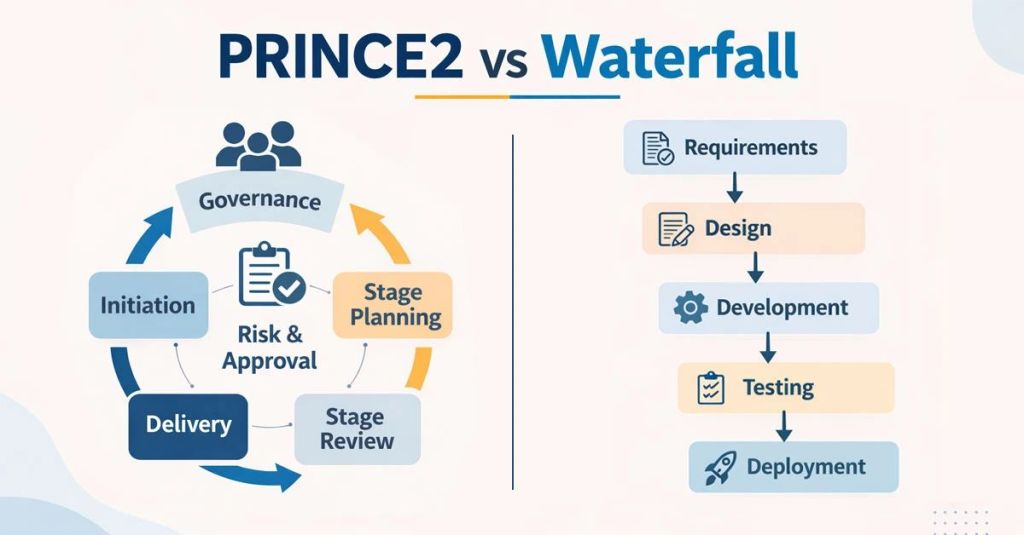
PRINCE2 is a structured project management framework, whereas Waterfall is a linear-sequential software development lifecycle (SDLC) methodology. While people often compare them, they are not mutually exclusive. PRINCE2 tells you how to manage a project, while Waterfall defines how to build the product.
PRINCE2 & Waterfall Overview and Comparison
PRINCE2 & Waterfall –
Overview and Comparison

Here is a detailed overview and comparison of both.


Overview of PRINCE2

PRINCE2 (PRojects IN Controlled Environments) is a process-based method for effective project management. It provides a highly structured framework that focuses on business justification and clear roles.

  • Core Logic: Divided into 7 Principles, 7 Themes, and 7 Processes.
  • Structure: Focuses on high-level management, governance, and organization.
  • Flexibility: Product-based planning allows it to wrap around any delivery method.
  • Roles: Explicitly defines responsibilities (Project Board, Project Manager, Team Manager).

Overview of Waterfall

Waterfall is a traditional development methodology where a project moves sequentially through distinct phases. Each phase must be completed before the next one begins.

  • Core Logic: Requirements → Design → Implementation → Verification → Maintenance.
  • Structure: Linear, rigid, and heavily reliant on early stage documentation.
  • Flexibility: Extremely low; changes to requirements are costly once development begins.
  • Roles: Focuses on execution roles (Business Analysts, Developers, QA Testers).

Key Structural Differences
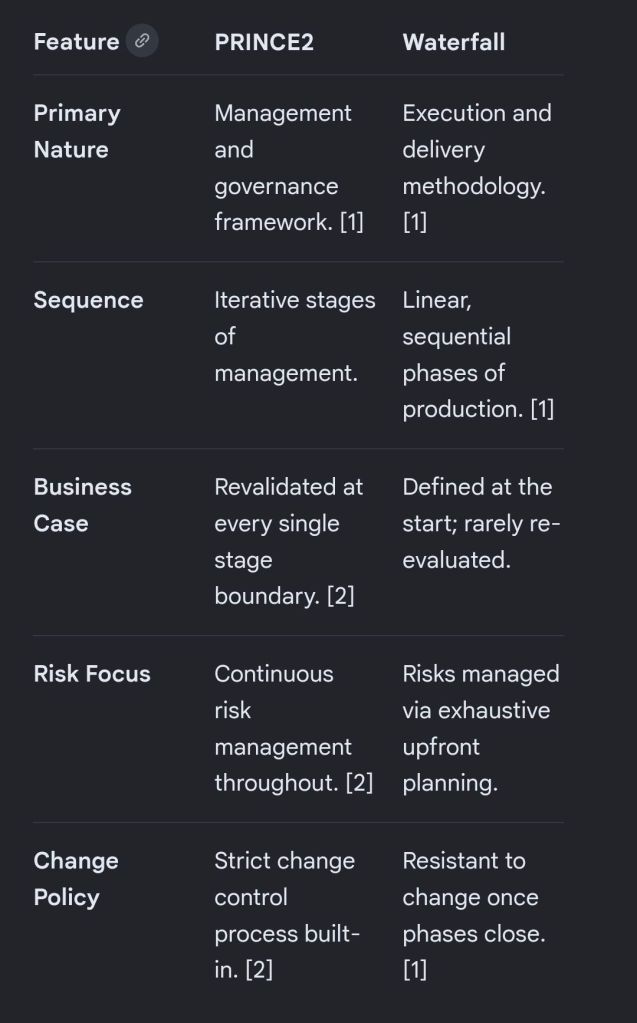
PRINCE2 and Waterfall, an Overview and Comparison

How They Work Together

PRINCE2 is frequently used to govern Waterfall projects.

  • The Management Layer: The Project Board uses PRINCE2 to manage budgets, risks, and business justification.
  • The Specialist Layer: The technical team uses Waterfall to execute work packages (e.g., designing, coding, testing).

Which One Should You Choose?

  • Choose PRINCE2 if: You need robust corporate governance, clear stakeholder accountability, and a way to manage high-budget, high-risk projects.
  • Choose Waterfall if: Your product requirements are completely fixed, the technology is well-understood, and the physical architecture cannot be easily changed (e.g., construction).
PRINCE2 Overview and Evolution Timeline by year

PRINCE2 (Projects IN Controlled Environments) is a globally recognized, process-driven project management methodology. It provides a structured, scalable approach to manage projects from start to finish. It is built on 7 core principles, 7 themes, and 7 step-by-step processes.

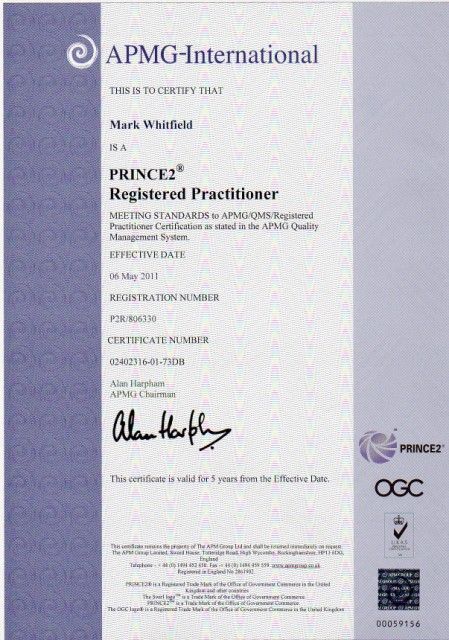
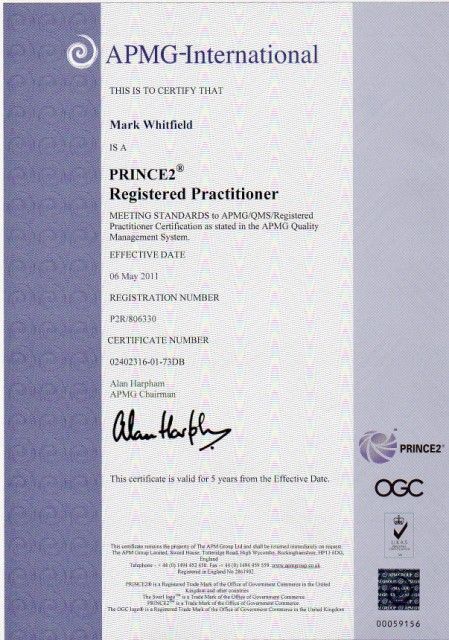
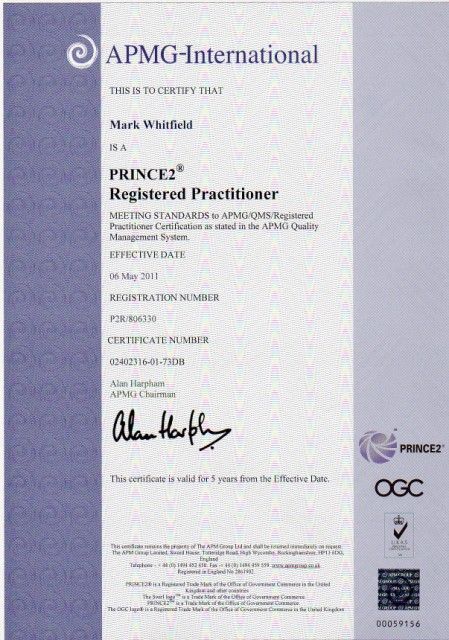
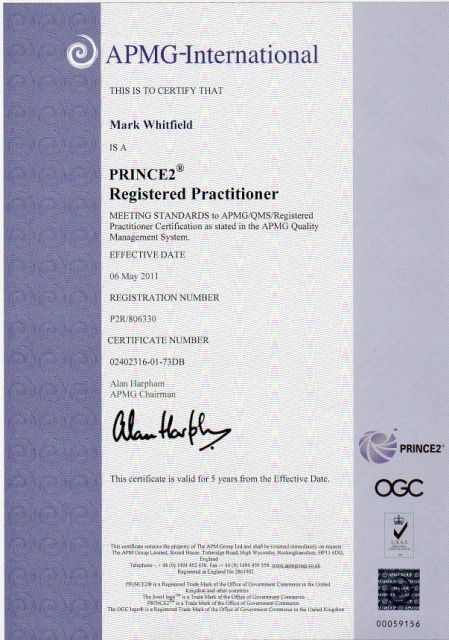
May 2011 – Mark Whitfield, Registered PRINCE2 Practitioner with ILX
May 2011 – Registered PRINCE2 Practitioner with ILX

The 7 Pillars of PRINCE2

To truly grasp PRINCE2, you should be familiar with its three core elements:

  • 7 Principles: Continued business justification, learn from experience, defined roles and responsibilities, manage by stages, manage by exception, focus on products, and tailor to suit the project environment.
  • 7 Themes: Business Case, Organization, Quality, Plans, Risk, Change, and Progress.
  • 7 Processes: Starting Up, Directing, Initiating, Controlling a Stage, Managing Product Delivery, Managing a Stage Boundary, and Closing a Project.
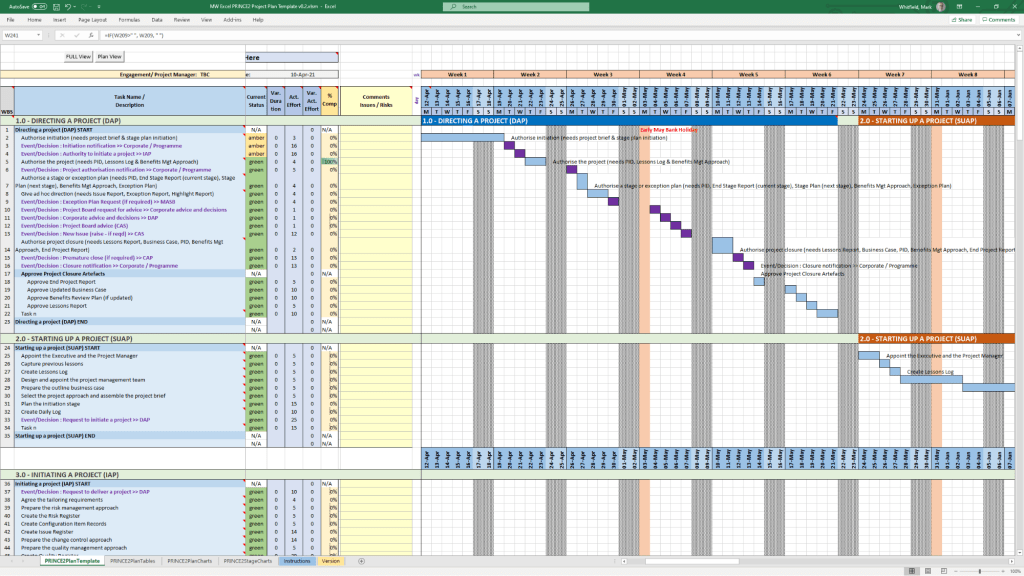
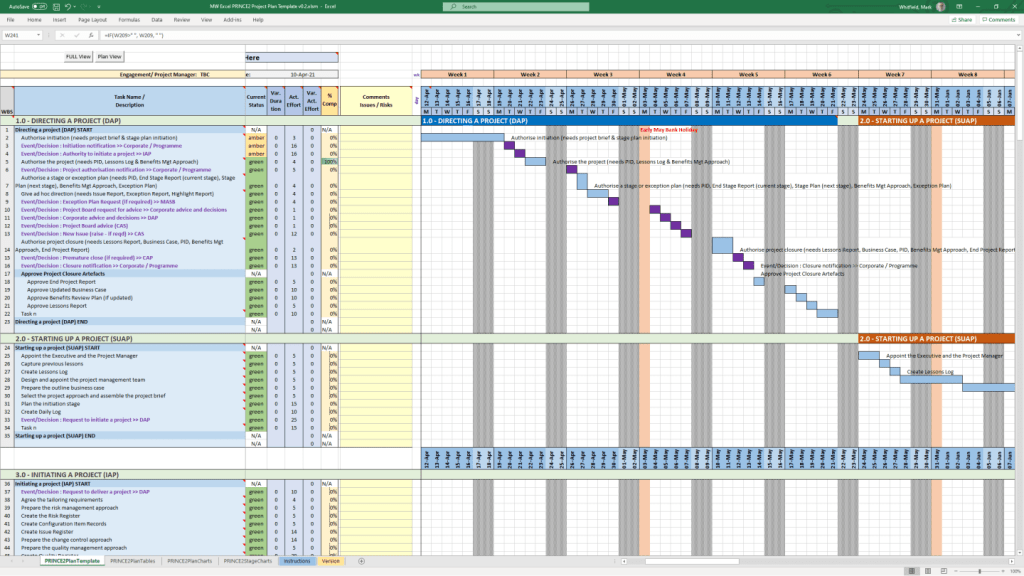
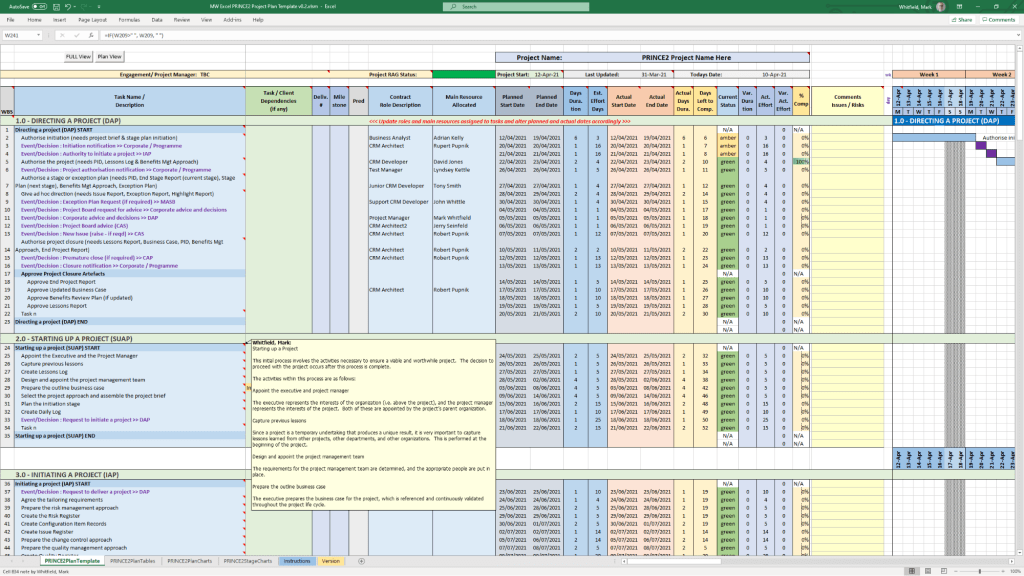
Example MS Excel PRINCE2 template (available on this website)

Detailed Timeline Breakdown by Year

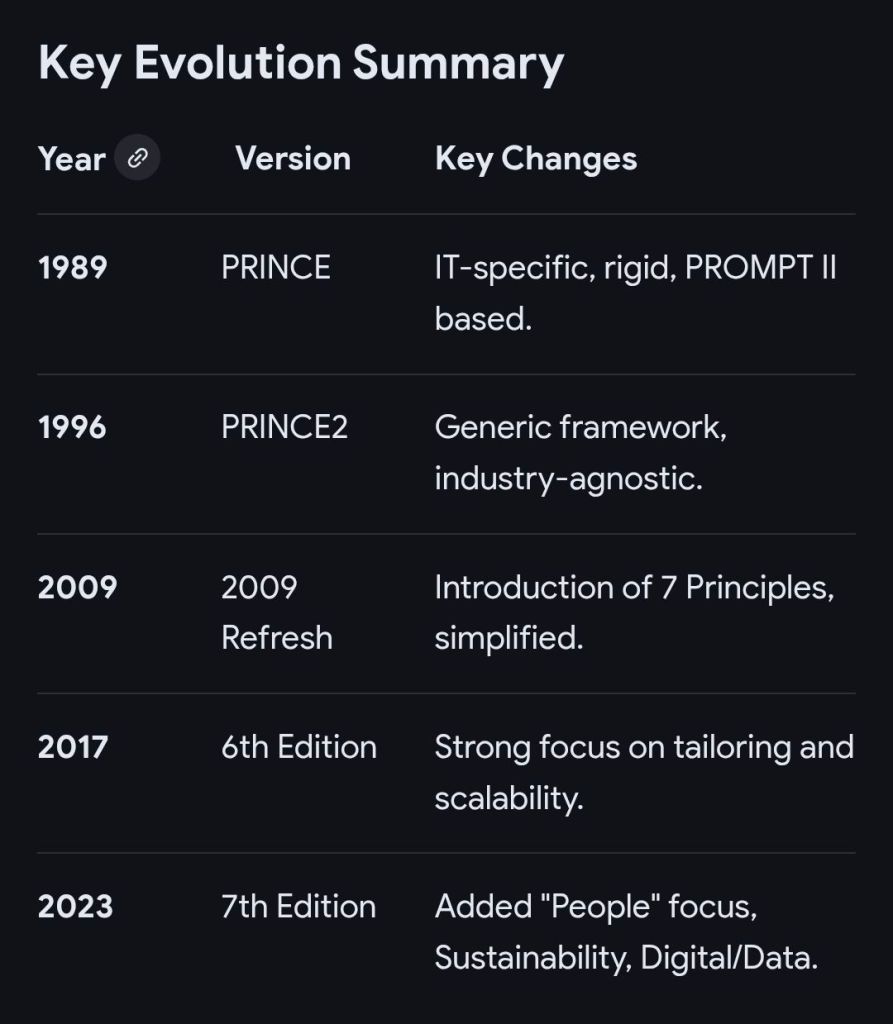
The evolution of PRINCE2 spans over 50 years, transitioning from an internal UK IT standard into a global, flexible methodology.

  • Mid-1970s: Simpact Systems Limited creates the PROMPT methodology (Project, Resource, Organization, Management, and Planning Technique).
  • Early 1980s: The Central Computer and Telecommunications Agency (CCTA) in the UK licenses PROMPT to manage complex IT overruns.
  • 1989: CCTA enhances the PROMPT method, renames it to PRINCE (PROMPT in the CCTA Environment), and mandates it for UK IT projects.
  • 1990: PRINCE is released into the public domain and experiences widespread private and public sector adoption.
  • 1996: The UK Cabinet Office officially publishes PRINCE2 and its global certifications. The acronym is updated to PRojects IN Controlled Environments and adapted to fit any industry or project type (not just IT).
  • 2000: Ownership transfers to the newly formed Office of Government Commerce (OGC) in the UK.
  • 2002/2005: Manual structure undergoes major revisions to strengthen the methodology’s “product-based planning” approach.
  • 2009: A massive “Refresh” is released. This update simplifies the framework, introduces the foundational 7 principles, and significantly improves customization.
  • 2013: Ownership transitions to AXELOS Ltd, a joint venture between the UK Government and Capita.
  • 2017: AXELOS publishes the PRINCE2 2017 Update (later designated the 6th Edition). This update places heavy focus on tailoring the method to project scale, flexibility, and practical execution.
  • 2018: PRINCE2 Agile is launched, combining the traditional, controlled PRINCE2 governance model with agile delivery methods.
  • 2021: PeopleCert, a global examination provider, acquires AXELOS and takes full ownership of the PRINCE2 methodology.
  • 2023–Present: PeopleCert releases the PRINCE2 7th Edition, which brings modernizations, digital improvements, and greater sustainability tracking, branding the framework simply as “PRINCE2 Project Management”.

To explore the latest resources, certification paths, or officially recognized guides, you can visit the PRINCE2 Official Website or the community-driven PRINCE2 Wiki.

PRINCE2 Overview and Evolution Timeline by year

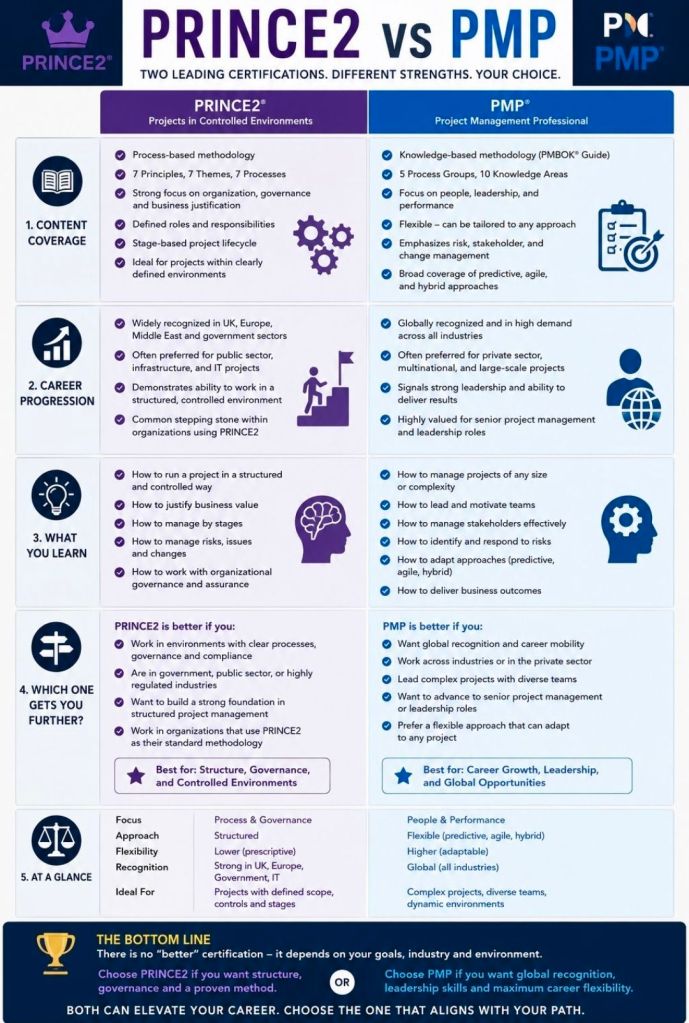
Prince2 or PMP Overview

Prince2 or PMP Overview

Choosing between PRINCE2 and PMP depends on your career goals and location. PMP is a global, experience-based standard highly valued in the US and multinational corporations. PRINCE2 is a process-based methodology heavily favored in the UK, Europe, and government/public sectors.

A high-level text overview highlights the following core differences:

Project Management Professional (PMP)

  • What it is: A globally recognized framework and body of knowledge (PMBOK) that certifies a manager’s broad project leadership skills.
  • Focus: People, processes, and business domains. It is highly flexible and covers predictive (waterfall), agile, and hybrid methodologies.
  • Requirements: Strict prerequisites. Requires 36–60 months of project management experience and 35 hours of project management education before you can take the 180-question exam.
  • Best for: Experienced project managers seeking global mobility and opportunities in corporate and private sectors.
  • Official Hub: Learn more and apply via the Project Management Institute.

PRINCE2 (PRojects IN Controlled Environments)

  • What it is: A structured, prescriptive methodology that gives you a step-by-step guide on how to run a project from start to finish.
  • Focus: Governance, defined roles, continuous business justification, and documentation. It uses a scaleable “Tailoring Approach” so it can be adapted to projects of varying sizes.
  • Requirements: No mandatory experience needed for the Foundation level, making it accessible to beginners. The Practitioner level tests your ability to apply the framework.
  • Best for: Early-to-mid career professionals and those targeting government, NHS, or public sector roles within the UK and Europe.
  • Official Hub: Browse certification pathways via Axelos.

PRINCE2 Agile Outline

PRINCE2 Agile combines the structured governance of PRINCE2 with the flexibility of agile methods (like Scrum and Kanban) to manage projects effectively. It focuses on maintaining control, transparency, and high-quality delivery while empowering teams, making it ideal for fast-paced environments.

Key Aspects of PRINCE2 Agile:

  • Structure + Flexibility: It provides the framework to guide projects, while allowing the use of agile techniques to build the product.
  • Key Focus Areas:
    • The Agilometer: Assesses the level of risk and agility in a project.
    • Requirements: Prioritized to ensure the most valuable features are delivered first.
    • Rich Communication: Emphasizes face-to-face interaction and team rooms.
    • Frequent Releases: Ensures regular delivery and feedback loops.
  • Tailored Governance: Allows projects to remain aligned with organizational goals while keeping the flexibility needed for innovation.
  • Compatibility: Works well with various agile methods including Scrum, Kanban, and Lean Startup.

Main Benefits:

  • Increased Flexibility: Enables faster adaptation to changes and new information.
  • Improved Quality: Focuses on delivering high-quality products that meet client needs.
  • Enhanced Control: Provides necessary governance for project success.

When to Use:

  • Projects requiring both structure and high responsiveness.
  • Teams using Agile techniques who need to satisfy governing bodies.
  • Situations demanding regular, iterative delivery of results.

For more in-depth knowledge, consider exploring the PRINCE2 Agile Wiki and Good e-Learning articles.

PRINCE2 (PRojects IN Controlled Environments) Overview and Evolution Timeline

PRINCE2 (PRojects IN Controlled Environments) is a structured, process-driven project management method used internationally to deliver projects within time, cost, and quality constraints. Originally developed for IT projects, it has evolved into a generic, flexible, and scalable framework applicable to any type of project, now owned by PeopleCert.

Detailed Overview of PRINCE2 (2026 Framework)

As of 2026, the current framework is PRINCE2 7th Edition, launched in late 2023. It is characterized by its focus on people, digital tools, and sustainability, while retaining its core focus on governance.

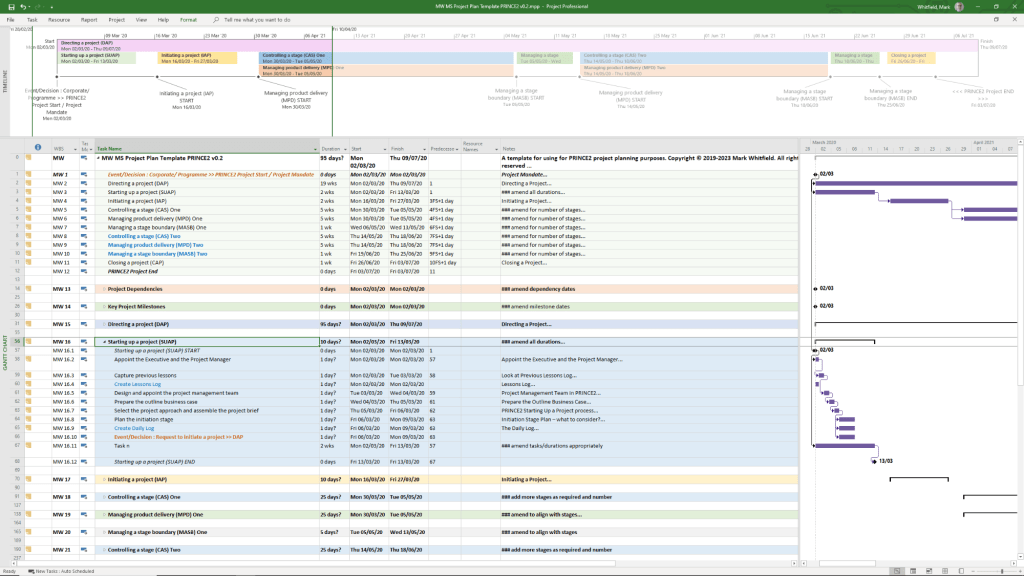
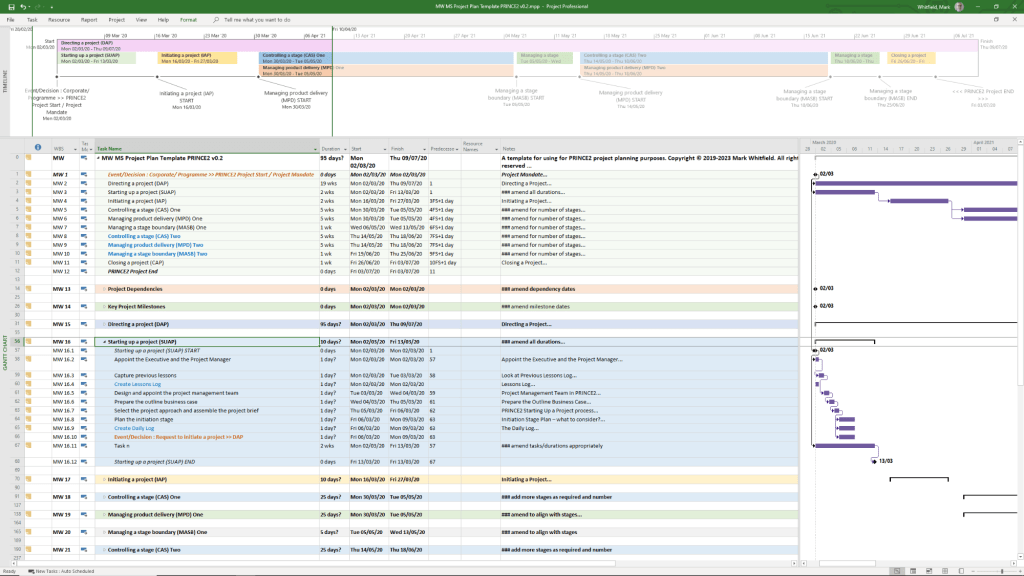
MS Project MPP template example

1. The Seven Principles (Why PRINCE2 is used)

  • Continued Business Justification: A project must have a valid business case.
  • Learn from Experience: Lessons are documented and used.
  • Defined Roles and Responsibilities: Clear organizational structure.
  • Manage by Stages: Projects are broken into manageable chunks.
  • Manage by Exception: Empowerment given to managers to act within tolerances.
  • Focus on Products: Focus on deliverables rather than activities.
  • Tailor to Suit the Project: Adapted to suit the project’s size, environment, and complexity.

2. The Seven Themes (What must be managed)

  • Business Case
  • Organization
  • Quality
  • Plans
  • Risk
  • Change
  • Progress

3. The Seven Processes (How to manage)

  • Starting up a Project
  • Directing a Project
  • Initiating a Project
  • Controlling a Stage
  • Managing Product Delivery
  • Managing a Stage Boundary
  • Closing a Project

4. Certification Levels

  • Foundation: Confirms basic knowledge of the methodology.
  • Practitioner: Tests the ability to apply and tailor the method to scenarios.

Detailed Timeline Evolution by Era and Year

PRINCE2 has evolved from a niche IT methodology to a global standard through three major revisions.

Era 1: The Foundations (1975–1989)

  • 1975: Simpact Systems Ltd. creates the PROMPT (Project, Resource, Organization, Management, and Planning Technique) methodology.
  • Early 1980s: UK Central Computer and Telecommunications Agency (CCTA) licenses PROMPT.
  • 1989: CCTA enhances PROMPT II, renaming it PRINCE (PROMPT in the CCTA Environment), mandated for UK IT projects.

Era 2: Launch and Public Adoption (1990–2005)

  • 1990: PRINCE is released into the public domain.
  • 1996: PRINCE2 is released by CCTA, designed for a broader range of projects (non-IT).
  • 2000: Ownership transfers to the UK Office of Government Commerce (OGC).
  • 2002/2005: Major revisions to the manual structure, strengthening the “product-based planning” approach.

Era 3: Modernization & Privatization (2009–2021)

  • 2009: Major “Refresh” released, introducing the seven principles, themes, and processes. Focuses on simplicity and customizability.
  • 2013: Ownership transfers to AXELOS Ltd, a joint venture between the UK Government and Capita.
  • 2017: PRINCE2 2017 Update (6th Edition) is released, focusing on enhanced flexibility and tailoring guidance.
  • 2018: Launch of PRINCE2 Agile.
  • 2021: PeopleCert acquires AXELOS, taking full ownership of the methodology.

Era 4: The 7th Edition (2023–Present/2026)

  • September 2023: Launch of PRINCE2 7th Edition.
  • 2024: PRINCE2 is branded as “PRINCE2 Project Management”.
  • 2026 (Current): Focus on hybrid delivery, digital transformation, and sustainability within the 7th edition framework.
Mark Whitfield, May 2011 – Registered PRINCE2 Practitioner with ILX
May 2011 – Registered PRINCE2 Practitioner with ILX, Mark Whitfield
Prince2, Plan On a Page POaP, MS Excel Template

Mark Whitfield IT Project Manager, Brief Summary

Mark Whitfield is a highly experienced, SC-cleared Senior Project Manager and IT professional with over 31 years of experience in both public and private sectors, specializing in software development, cloud migration, and IT systems delivery.

He is currently associated with Capgemini (since 2016) and runs a project management resource website, PROject Templates.

Joined Capgemini in 2016 having worked at ascending points in software development lifecycle projects for over 31 years

Key Qualifications & Experience:

  • Roles: Senior Project Manager, Engagement Project Manager, Delivery Manager, and former programmer.
  • Methodologies: PRINCE2 Practitioner, skilled in both Waterfall and Agile (SCRUM) approaches.
  • Sector Experience: Extensive experience in finance and banking, including ATM software swap-outs, cloud migration (Azure, AWS, Power Platform), and POS monitoring systems.
  • Background: Graduated in Computing in 1990; worked as a developer (COBOL, SQL, Tandem / HPE NonStop) before transitioning to project management.
PRINCE2 Practitioner, skilled in both Waterfall and Agile (SCRUM) approaches

Professional Highlights:

  • Delivered major projects for clients such as Barclays, Bank of England, HSBC, Royal Mail Group, UK & Welsh Government, Heathrow, and Jaguar Land Rover.
  • Led complex IT infrastructure projects and business transformations.
  • Maintains mark-whitfield.com, offering over 200 project management templates, trackers (RAID, budget, benefit, cost etc.), and many plans for Agile / Waterfall projects including 30+ Plan On a Page (POaP) and MS Project MPP examples (click on Blog above for a summary).
  • Provides specialized templates for PRINCE2 7th edition and MS Project (MPP).
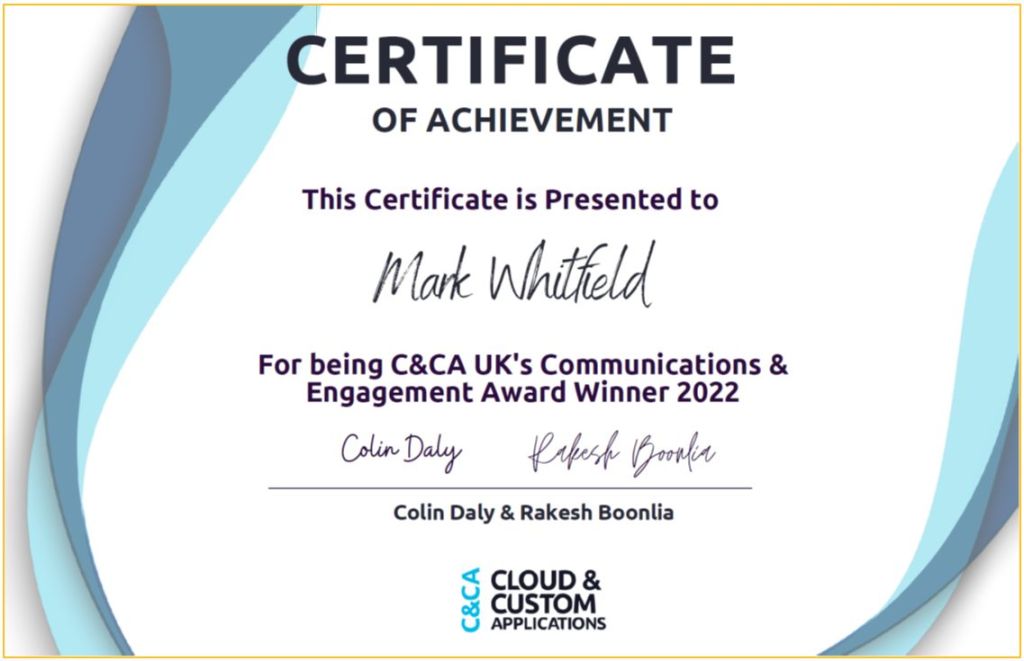
December 2022 – C&CA UK’s Communications & Engagement Award Winner – Cloud & Custom Applications – Capgemini UK
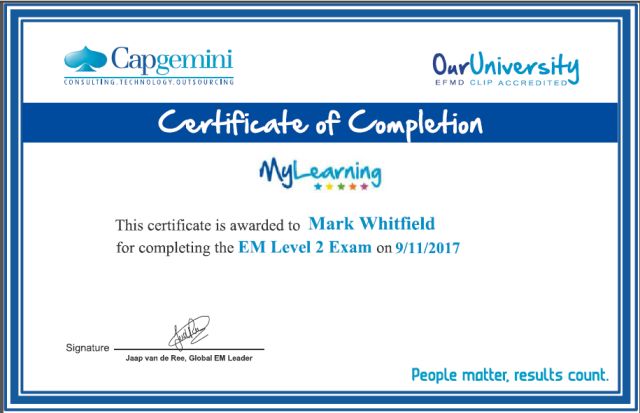
November 2017 – Advanced Engagement Management Course – Level 2 Exam
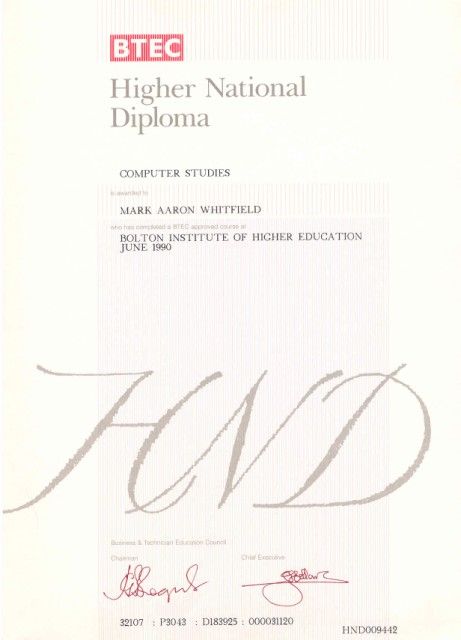
June 1990 – Higher National Diploma in Computer Studies (DISTINCTION – overall top) – BIHE
June 1990 – Higher National Diploma in Computer Studies, Distinction

Read more…

PRINCE2 (PRojects IN Controlled Environments) Overview and Timeline by Year

PRINCE2 (PRojects IN Controlled Environments) is a structured, process-based project management methodology focusing on organization, control, and business justification. Originating from UK government IT standards in the 1970s, it has evolved into a globally recognized, tailorable standard used in over 150 countries for projects across various industries. 

PRINCE2 Project Management Summary

  • Core Philosophy: Continued Business Justification (projects must make sense financially), Manage by Exception (delegating authority within limits), and Product-Based Planning.
  • Seven Principles: Projects must have continued business justification, learn from experience, define roles and responsibilities, manage by stages, manage by exception, focus on products, and tailor to suit the project.
  • Seven Processes: Starting a Project, Directing a Project, Initiating a Project, Controlling a Stage, Managing Product Delivery, Managing a Stage Boundary, and Closing a Project.
  • Key Themes: Business Case, Organization, Quality, Plans, Risk, Change, and Progress.
  • Main Benefits: Provides a common language, clear accountability, defined roles, and tailored, consistent documentation. 

Detailed Historical Timeline (1975–2023+)

Era 1: The PROMPT Origins (1975–1988) 

  • 1975: Simpact Systems Ltd develops PROMPT (Project Resource Organisation Management and Planning Techniques) in response to IT projects running over time and budget. PROMPT II introduces a phased approach (Initiation, Specification, Design, Development, Installation, Operation). 

Era 2: The PRINCE Birth (1989–1995)

  • April 1989: The UK Central Computer and Telecommunications Agency (CCTA) adopts PROMPT II as the standard for IT projects, renaming it PRINCE (initially “PROMPT II IN the CCTA Environment”).
  • 1990: PRINCE is released into the public domain and widely adopted by the private sector for non-IT projects, although it is perceived as too rigid for small projects. 

Era 3: The Birth of PRINCE2 (1996–2008) 

  • 1996: PRINCE2 is published by the CCTA. It is rewritten for broader use (not just IT), removing jargon to become a generic project management framework.
  • 1998: PRINCE2 begins undergoing revisions based on user feedback.
  • 2000: The Office of Government Commerce (OGC) becomes the owner of PRINCE2.
  • 2002: The international user community begins consultative updates to the method. 

Era 4: The Modern Revision Era (2009–2022) 

  • 2009: PRINCE2: 2009 Refresh is released by the OGC. This major revision simplifies the method, makes it more customizable, and introduces the seven core principles.
  • 2013: Ownership transfers from the UK Cabinet Office to AXELOS Ltd, a joint venture between the UK Government and Capita.
  • 2017: PRINCE2 2017 Update is published, focusing on increased flexibility, scalability, and better tailoring guidance.
  • 2018: PRINCE2 Agile is launched, bringing a governance layer to agile delivery methods like Scrum and Kanban.
  • 2020: PRINCE2 2017 is renamed “PRINCE2 6th Edition”.
  • 2021: PeopleCert becomes the sole owner of AXELOS and PRINCE2. 

Era 5: The Current Era (2023–Present) 

  • September 2023: PRINCE2 7th Edition is released. The update introduces a “People” element, focusing on change management and team leadership, along with new guidance on Sustainability, Commercial, and Digital & Data management. 
PRINCE2 Key Evolution Summary
May 2011 – Registered PRINCE2 Practitioner with ILX, Mark Whitfield

PRINCE2 (PRojects IN Controlled Environments) Overview and Timeline by Year

Waterfall project management is a linear, sequential methodology

Waterfall project management is a linear, sequential methodology where progress flows steadily downward through defined phases, much like a physical waterfall. In this model, each stage—such as requirements, design, implementation, and testing—must be fully completed and approved before the next one begins. 

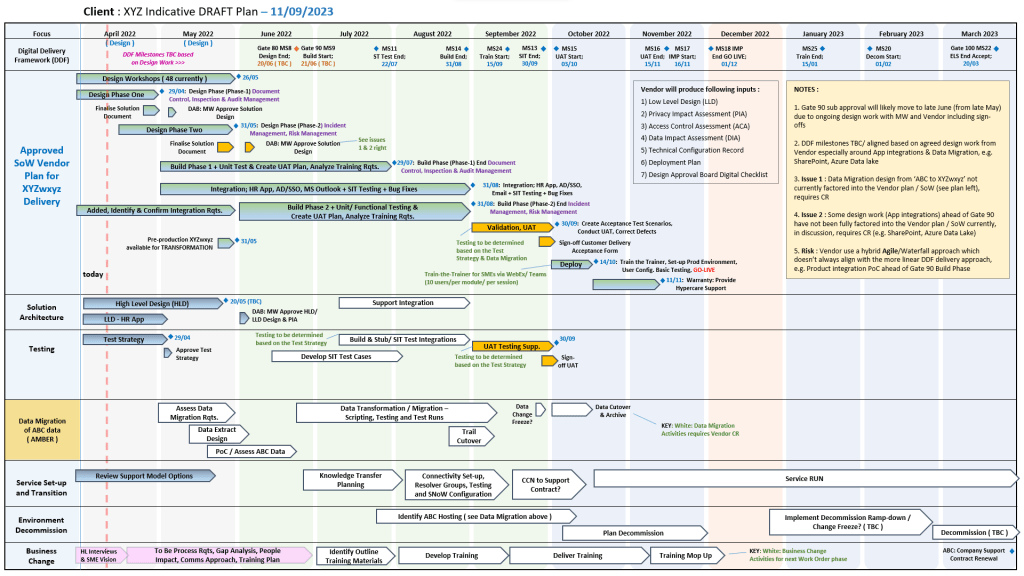
Waterfall Project Plans, .xls and .mpp file formats respectively

Core Characteristics

  • Sequential Design: No overlapping phases; each “cascades” into the next.
  • Documentation-Driven: Extensive upfront planning and detailed records are required at every step.
  • Fixed Scope: Requirements are gathered at the start, making the project’s timeline and budget highly predictable but difficult to change.
  • Specialised Use: Best suited for regulated industries like aerospace, construction, and healthcare, where changes are costly or safety is paramount. 

Historical Timeline by Era and Year

The following timeline tracks Waterfall from its origins in post-WWII engineering to its current role in hybrid project management.

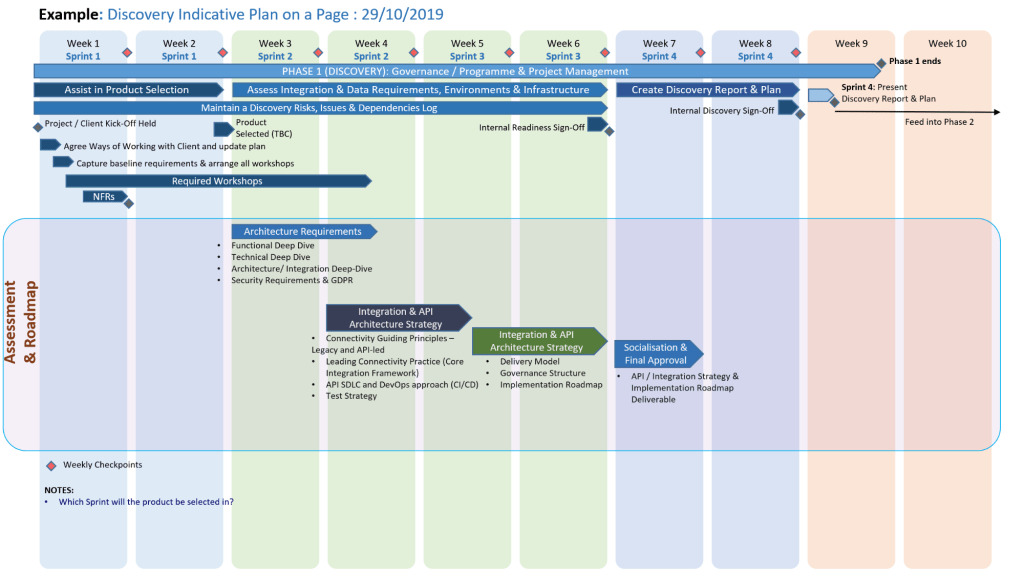
Examples, Waterfall Plan On a Page POaP in MS PowerPoint format

The Pre-Formal Era (1950s – 1969)

Software development adopted structured, sequential approaches from engineering, largely driven by complex, high-risk projects. 

  • 1956Herbert D. Benington documented a sequential process for the SAGE project, establishing the technical roots.
  • Late 1960sNASA applied linear, rigid methodologies to Apollo missions, setting a precedent for high-stakes, documentation-heavy development.
  • 1968: The NATO Software Engineering Conference highlighted the “software crisis,” prompting a push for formal, disciplined development models. 

The Formalisation Era (1970 – 1979)

The model was officially, yet ironically, described and named. 

  • 1970Dr. Winston W. Royce published his foundational paper on managing large software systems, often cited as the origin of the “Waterfall” model, though he originally presented it as a cautionary, flawed approach.
  • 1976T.E. Bell and T.A. Thayer likely first used the term “Waterfall” in literature. 

The Institutional Era (1980 – 1999)

Waterfall became the mandatory standard for large-scale, complex projects. 

  • 1985: The U.S. DoD mandated DOD-STD-2167, cementing Waterfall as the standard for military software.
  • 1989: The UK Government introduced PRINCE2, deeply influenced by Waterfall principles.
  • 1994: The U.S. DoD formally abandoned strict Waterfall mandates for more flexible methods. 

The Modern & Hybrid Era (2000 – Present)

Waterfall transitioned from the default standard to a specialised methodology. 

  • 2001: The Agile Manifesto marked a shift toward iterative development, reducing Waterfall’s dominance.
  • Present Day: It remains vital in regulated sectors (e.g., aerospace) and is often combined with Agile in hybrid approaches.

Waterfall project management is a linear, sequential methodology

Click on the link in the website banner above to purchase example, editable template project plans shown and many others.