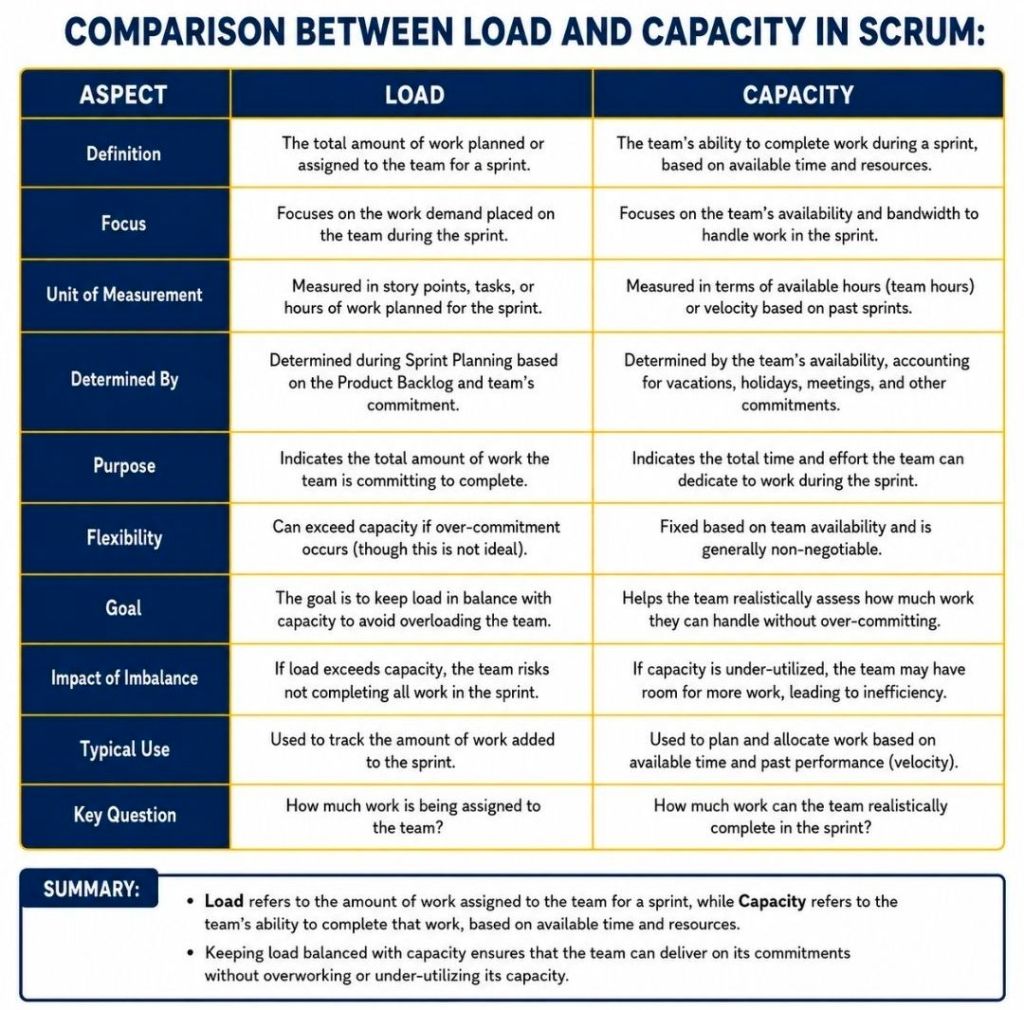
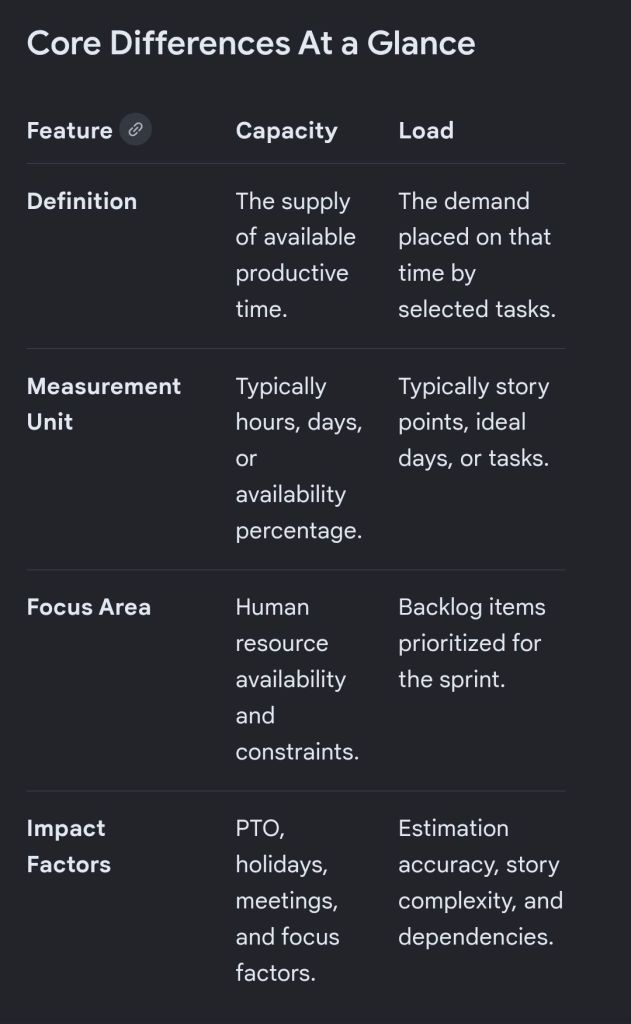
In Scrum, capacity represents the total amount of available work time a team has for an upcoming sprint, while load is the actual amount of work the team pulls into that sprint.
Comparison Between Load & Capacity in Scrum
Understanding Capacity
Capacity acts as your ceiling. It is a forward-looking calculation performed right before sprint planning. It accounts for the reality of the upcoming calendar cycle.
To find a team’s capacity, you multiply total working days by the number of team members.
You then subtract non-productive time like public holidays, planned vacation days, and standard company meetings.
Finally, you apply a focus factor (typically around 70% to 80%) to account for daily distractions and context switching.
Understanding Load
Load represents the weight of the commitments made by the developers. It is the cumulative volume of user stories and tasks that the team intends to deliver during the sprint.
Load is entirely determined by how the team estimates the product backlog items pulled into the sprint.
Unlike capacity (which is restricted by time), load can theoretically be pushed to any level, though overloading creates major delivery risks.
Balancing the Relationship
The ultimate goal of a Scrum Master is to help the team balance load against capacity to maintain a sustainable pace.
The Safe Zone: Best practices dictate keeping your load at 10% to 20% below your absolute capacity. This visual buffer creates room for unexpected blockers or minor illness.
The Danger Zone (Overcommitment): An exact match where load equals capacity is considered an anti-pattern in Agile frameworks. It strips the team of flexibility, spikes burnout, encourages poor-quality code, and almost always leads to missed sprint goals.
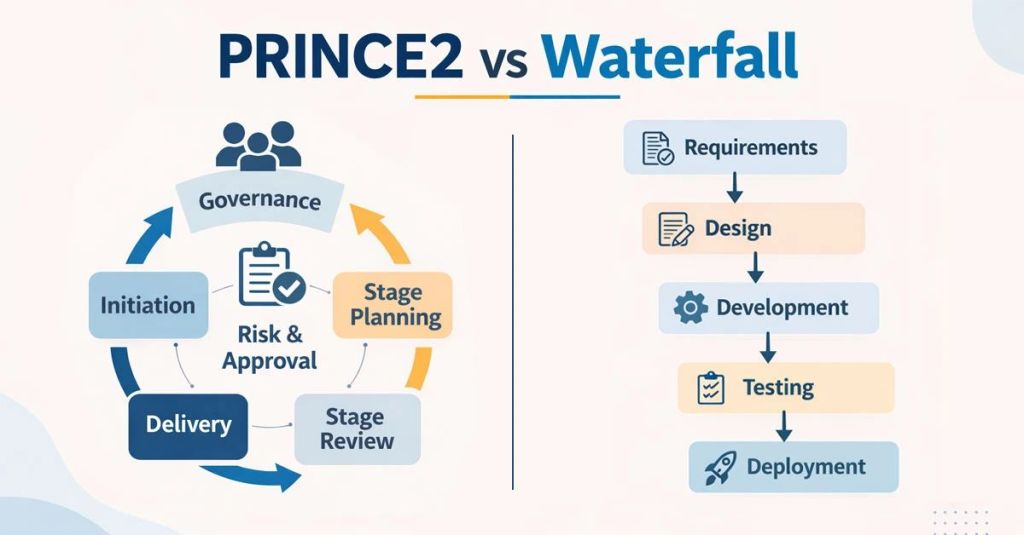
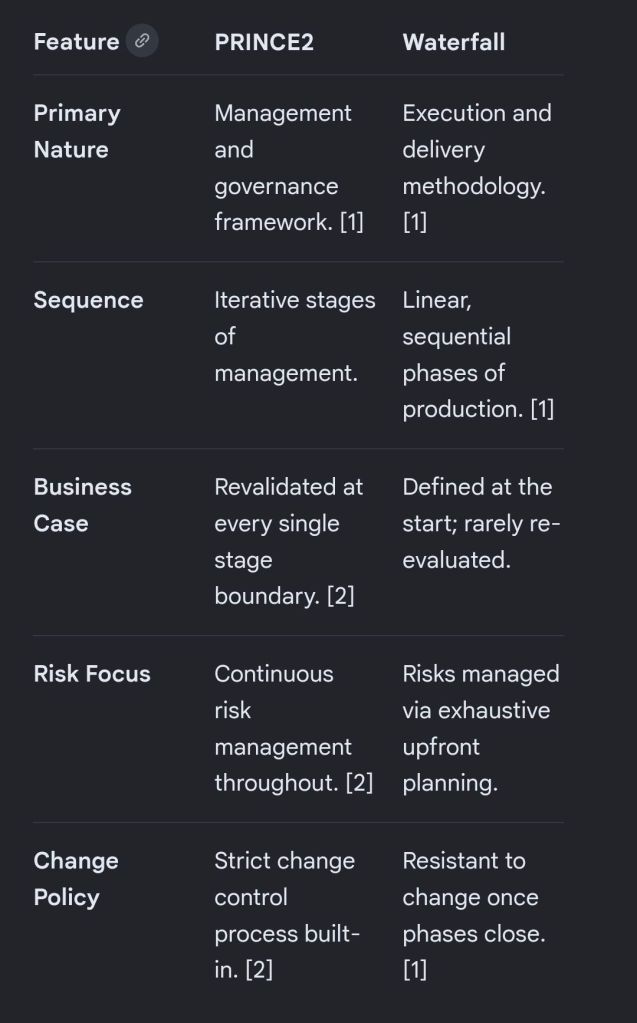
PRINCE2 is a structured project management framework, whereas Waterfall is a linear-sequential software development lifecycle (SDLC) methodology. While people often compare them, they are not mutually exclusive. PRINCE2 tells you how to manage a project, while Waterfall defines how to build the product.
PRINCE2 & Waterfall – Overview and Comparison
Here is a detailed overview and comparison of both.
Overview of PRINCE2
PRINCE2 (PRojects IN Controlled Environments) is a process-based method for effective project management. It provides a highly structured framework that focuses on business justification and clear roles.
Core Logic: Divided into 7 Principles, 7 Themes, and 7 Processes.
Structure: Focuses on high-level management, governance, and organization.
Flexibility: Product-based planning allows it to wrap around any delivery method.
Roles: Explicitly defines responsibilities (Project Board, Project Manager, Team Manager).
Overview of Waterfall
Waterfall is a traditional development methodology where a project moves sequentially through distinct phases. Each phase must be completed before the next one begins.
Structure: Linear, rigid, and heavily reliant on early stage documentation.
Flexibility: Extremely low; changes to requirements are costly once development begins.
Roles: Focuses on execution roles (Business Analysts, Developers, QA Testers).
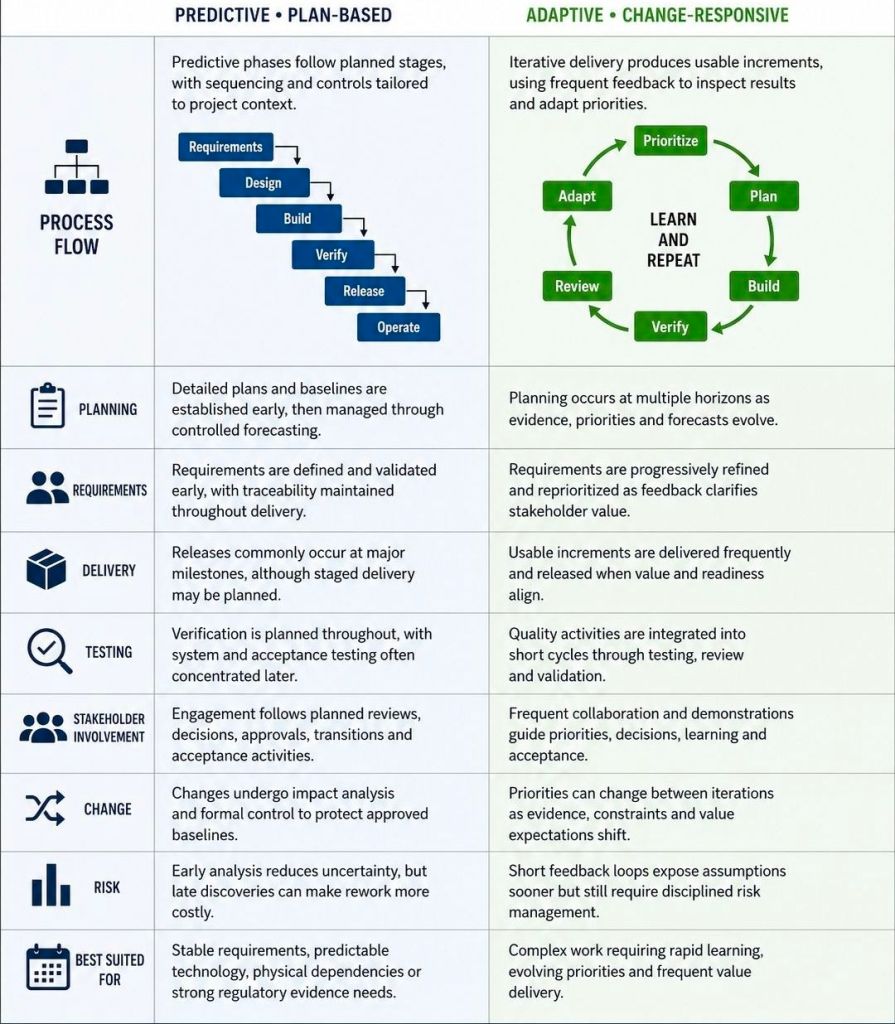
Key Structural Differences
PRINCE2 and Waterfall, an Overview and Comparison
How They Work Together
PRINCE2 is frequently used to govern Waterfall projects.
The Management Layer: The Project Board uses PRINCE2 to manage budgets, risks, and business justification.
The Specialist Layer: The technical team uses Waterfall to execute work packages (e.g., designing, coding, testing).
Which One Should You Choose?
Choose PRINCE2 if: You need robust corporate governance, clear stakeholder accountability, and a way to manage high-budget, high-risk projects.
Choose Waterfall if: Your product requirements are completely fixed, the technology is well-understood, and the physical architecture cannot be easily changed (e.g., construction).