

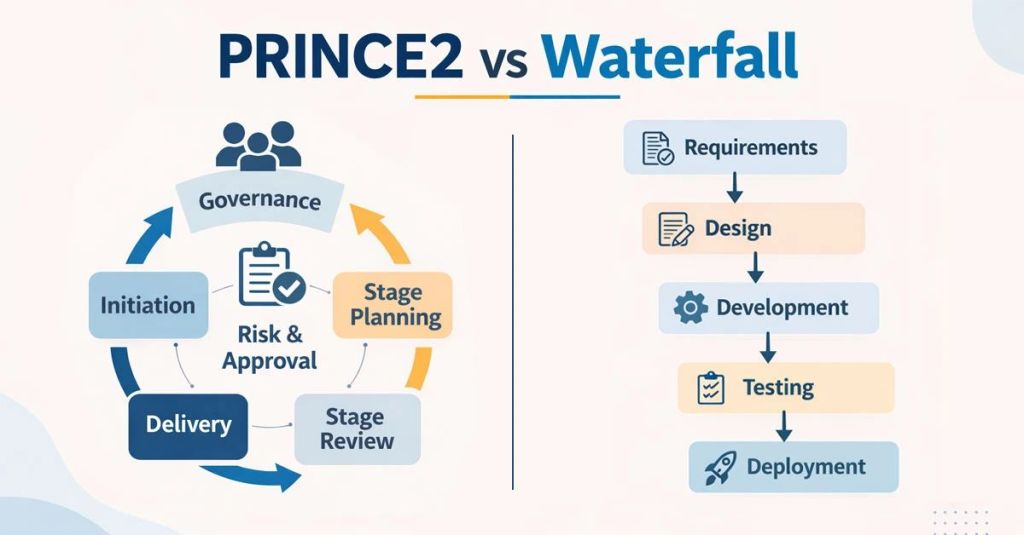
PRINCE2 is a structured project management framework, whereas Waterfall is a linear-sequential software development lifecycle (SDLC) methodology. While people often compare them, they are not mutually exclusive. PRINCE2 tells you how to manage a project, while Waterfall defines how to build the product.
Overview and Comparison
Here is a detailed overview and comparison of both.
Overview of PRINCE2
PRINCE2 (PRojects IN Controlled Environments) is a process-based method for effective project management. It provides a highly structured framework that focuses on business justification and clear roles.
- Core Logic: Divided into 7 Principles, 7 Themes, and 7 Processes.
- Structure: Focuses on high-level management, governance, and organization.
- Flexibility: Product-based planning allows it to wrap around any delivery method.
- Roles: Explicitly defines responsibilities (Project Board, Project Manager, Team Manager).
Overview of Waterfall
Waterfall is a traditional development methodology where a project moves sequentially through distinct phases. Each phase must be completed before the next one begins.
- Core Logic: Requirements → Design → Implementation → Verification → Maintenance.
- Structure: Linear, rigid, and heavily reliant on early stage documentation.
- Flexibility: Extremely low; changes to requirements are costly once development begins.
- Roles: Focuses on execution roles (Business Analysts, Developers, QA Testers).
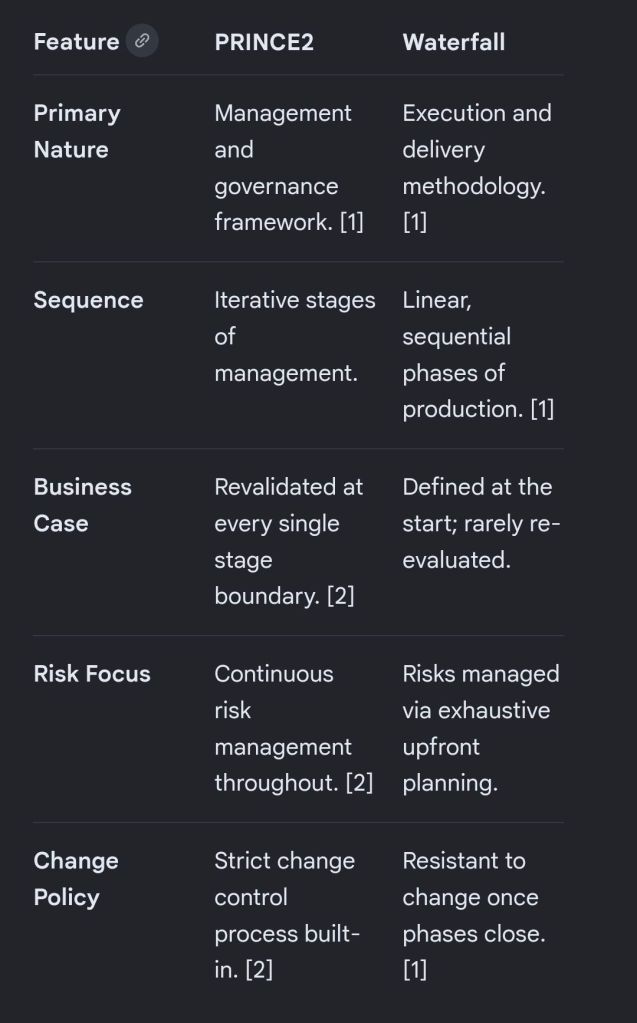
Key Structural Differences
How They Work Together
PRINCE2 is frequently used to govern Waterfall projects.
- The Management Layer: The Project Board uses PRINCE2 to manage budgets, risks, and business justification.
- The Specialist Layer: The technical team uses Waterfall to execute work packages (e.g., designing, coding, testing).
Which One Should You Choose?
- Choose PRINCE2 if: You need robust corporate governance, clear stakeholder accountability, and a way to manage high-budget, high-risk projects.
- Choose Waterfall if: Your product requirements are completely fixed, the technology is well-understood, and the physical architecture cannot be easily changed (e.g., construction).


