Prince2 or PMP Overview

Prince2 or PMP Overview

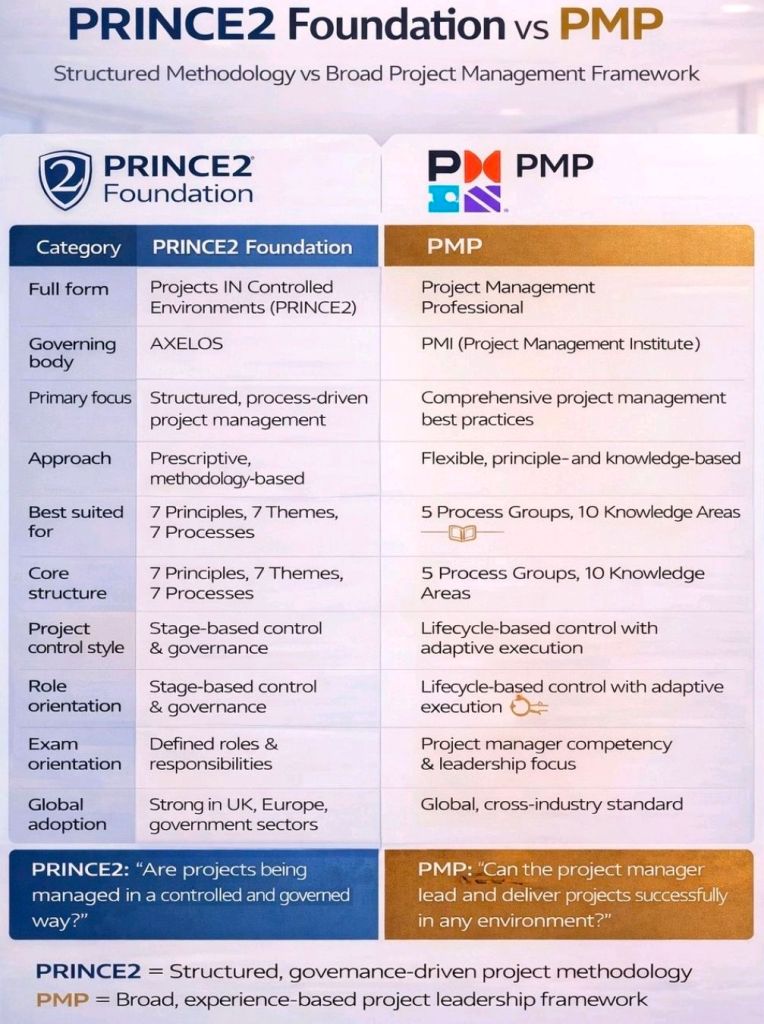
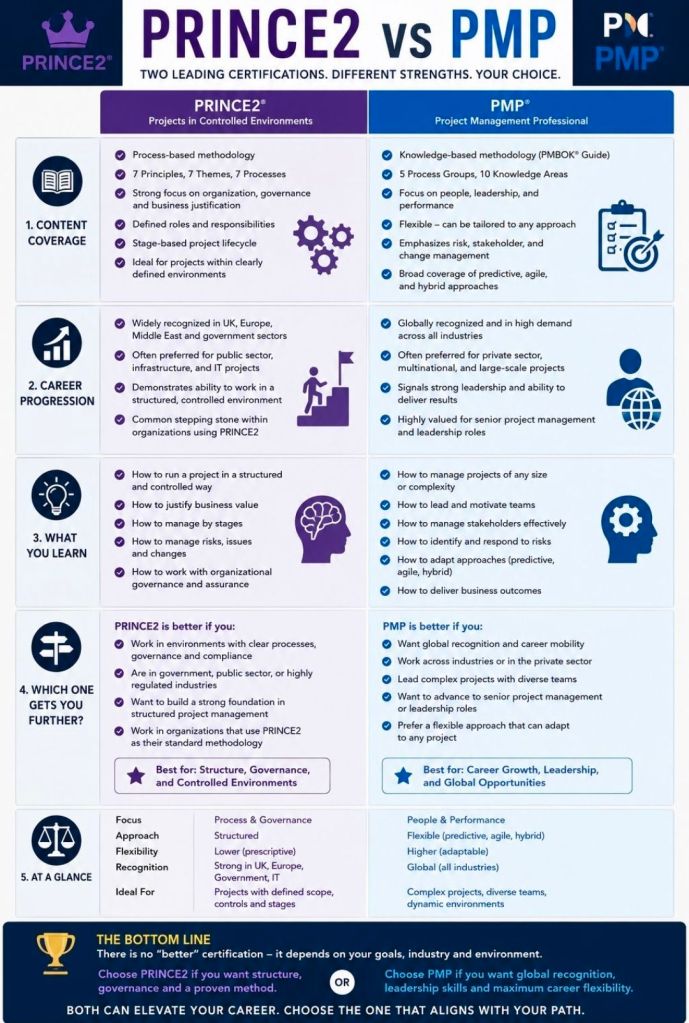
Choosing between PRINCE2 and PMP depends on your career goals and location. PMP is a global, experience-based standard highly valued in the US and multinational corporations. PRINCE2 is a process-based methodology heavily favored in the UK, Europe, and government/public sectors.

A high-level text overview highlights the following core differences:

Project Management Professional (PMP)

  • What it is: A globally recognized framework and body of knowledge (PMBOK) that certifies a manager’s broad project leadership skills.
  • Focus: People, processes, and business domains. It is highly flexible and covers predictive (waterfall), agile, and hybrid methodologies.
  • Requirements: Strict prerequisites. Requires 36–60 months of project management experience and 35 hours of project management education before you can take the 180-question exam.
  • Best for: Experienced project managers seeking global mobility and opportunities in corporate and private sectors.
  • Official Hub: Learn more and apply via the Project Management Institute.

PRINCE2 (PRojects IN Controlled Environments)

  • What it is: A structured, prescriptive methodology that gives you a step-by-step guide on how to run a project from start to finish.
  • Focus: Governance, defined roles, continuous business justification, and documentation. It uses a scaleable “Tailoring Approach” so it can be adapted to projects of varying sizes.
  • Requirements: No mandatory experience needed for the Foundation level, making it accessible to beginners. The Practitioner level tests your ability to apply the framework.
  • Best for: Early-to-mid career professionals and those targeting government, NHS, or public sector roles within the UK and Europe.
  • Official Hub: Browse certification pathways via Axelos.
PMP Project Management Professional summary and detailed historical timeline by era and year

Project Management Professional (PMP) history, as guided by the Project Management Institute (PMI), tracks the evolution from ancient craft systems to a modern, standardized profession combining predictive, agile, and hybrid approaches. Modern project management as a formal discipline emerged in the 1950s, with PMP certification officially launching in 1984. 

Summary of Project Management Eras

  • Pre-1950s (Craft Era): Large-scale construction (Pyramids, Great Wall) relied on master builders, intuitive planning, and heavy labor.
  • 1950s-1960s (Birth of Modern PM): Scheduling tools (CPM, PERT) and the Work Breakdown Structure (WBS) were developed for defense and construction.
  • 1969-1980s (Standardization Era): PMI was founded, and the PMP certification was introduced to create a shared professional language.
  • 1990s-2000s (Digital & Agile Era): Project software matured, the PMBOK Guide was published, and Agile techniques began reshaping software development.
  • 2010s-Present (Hybrid & AI Era): Focus on flexibility, stakeholder management, hybrid approaches, and AI integration. 

Detailed Historical Timeline

Ancient to Early 20th Century: Foundations

  • 2570 BC: Completion of the Great Pyramid of Giza, showing advanced resource planning.
  • 208 BC: Construction of the Great Wall of China, demonstrating large-scale logistical management.
  • 1917: Henry Gantt develops the Gantt Chart, a cornerstone of project scheduling. 

1950s-1960s: Birth of Modern Project Management 

  • 1957-1958: Development of key scheduling tools, Critical Path Method (CPM) and Program Evaluation Review Technique (PERT).
  • 1962: WBS approach mandated by the U.S. Department of Defense.
  • 1969: Project Management Institute (PMI) founded in Pennsylvania to standardize the profession. 

1970s-1980s: Professionalization and Certification 

  • 1975: Publication of The Mythical Man-Month by Fred Brooks, identifying software project risks.
  • 1984: First PMP certification exam administered by PMI.
  • 1986: Takeuchi and Nonaka introduce “Scrum” as a project management style.
  • 1987: First PMBOK Guide published as a white paper. 

1990s: PMBOK and Formalization 

2000s-2010s: Agile and Global Expansion 

  • 2001: Agile Manifesto written, emphasizing flexibility.
  • 2003: PMP exam revised to incorporate Agile techniques.
  • 2017: PMBOK 6th Edition released, integrating Agile and adaptive environments. 

2020s-Present: Modernization and AI

  • 2021: PMBOK 7th Edition released, shifting from process-based to principle-based standards.
  • 2024: PMI launches initiatives to incorporate Generative AI (PMIxAI) into project management. 

Key Evolution Trends

  1. From Craft to Science: Moving from intuitive, “master builder” approaches to structured, data-driven methodologies (PERT/CPM).
  2. From Fixed to Adaptive: Transitioning from rigid “waterfall” plans to iterative Agile and Hybrid approaches.
  3. Standardization: The PMP credential has shifted from solely construction/engineering focus to a global, cross-industry benchmark.
  4. Technology Integration: The rise of Artificial Intelligence (AI) and automated tools for risk management and scheduling.

PMP Project Management Professional summary and detailed historical timeline by era and year

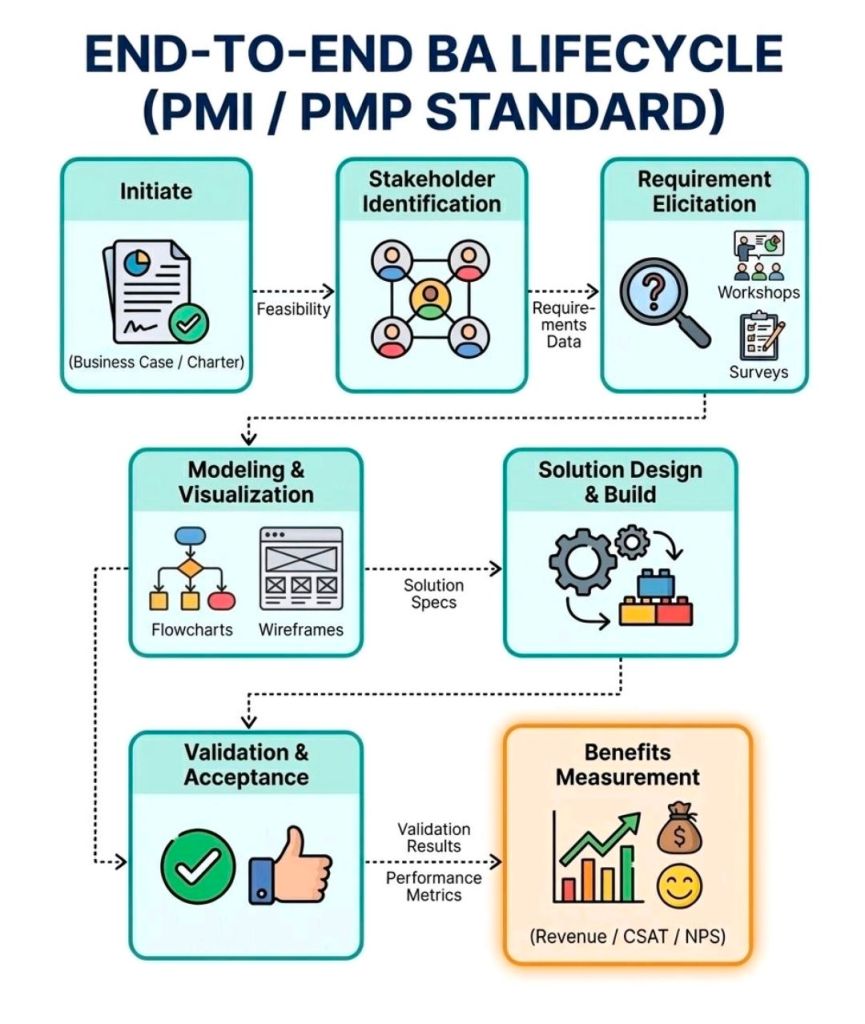
End-to-End BA Life Cycle PMI PMP Standard

End-to-End BA Life Cycle PMI PMP Standard

PRINCE2 Foundation vs PMP

Projects IN Controlled Environments PRINCE2 vs Project Management Professional PMP

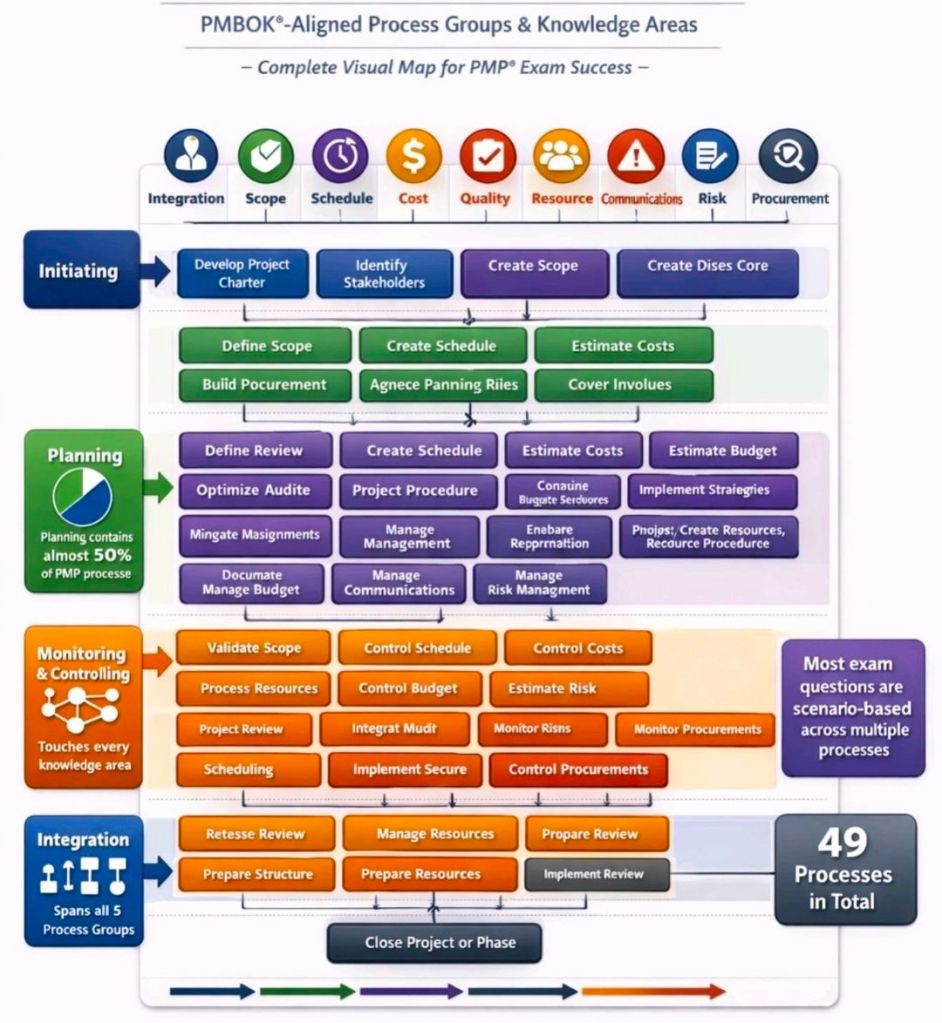
PMP 49 Process Chart – Aligned Process Groups and Knowledge Areas – Complete Visual Map

PMP 49 Process Chart – Aligned Process Groups and Knowledge Areas – Complete Visual Map

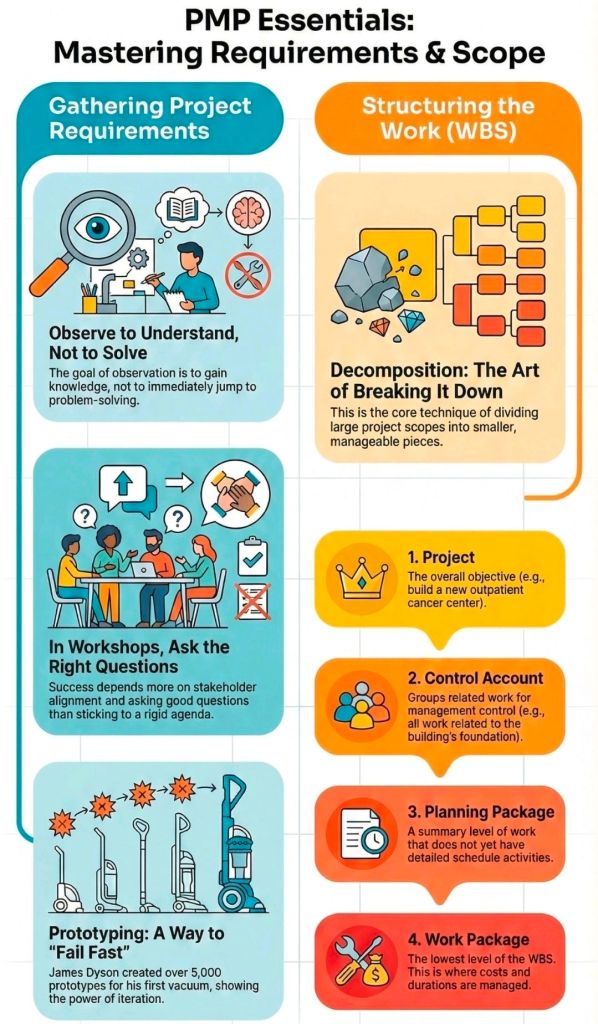
PMP Essentials, Mastering Requirements and Scope

PMP Essentials, Mastering Requirements and Scope

Difference between PRINCE2 and PMP

Difference between PRINCE2 and PMP