PRINCE2 Management Products Templates Overview and Historical Timeline

PRINCE2 management products are the 26 standard documents (templates) used to manage a project throughout its lifecycle. They are categorised into Baselines (plans and definitions), Records (registers and logs), and Reports (periodic updates). 
PRINCE2 Microsoft Project & Excel templates

Management Products Overview

The core templates provided in the methodology ensure consistent project control. Official templates are often available through accredited providers, this website or the official AXELOS website. 

  • Baselines: Used to define the project foundation (e.g., Business Case, Project Initiation Document, Plan).
  • Records: Dynamic logs to track day-to-day data (e.g., Risk Register, Issue Register, Lessons Log).
  • Reports: Snapshots of progress or specific events (e.g., Highlight Report, Checkpoint Report, Exception Report). 

Historical Timeline of Templates & Methodology

The evolution of these products reflects a shift from rigid, IT-specific documents to flexible, industry-agnostic templates. 

The Pre-PRINCE Era (1975 – 1988) 

  • 1975PROMPT II (Project Resource Organisation Management and Planning Techniques) was developed by Simpact Systems Ltd.
  • Key Focus: Introduced the concept of project phases (Initiation, Specification, Design) but was strictly for IT. 

The PRINCE Era (1989 – 1995) 

  • 1989PRINCE (PROMPT II in the CCTA Environment) launched by the UK Government’s CCTA.
  • Key Focus: Added Critical Path Analysis and formal management roles, but remained IT-heavy and rigid. 

The PRINCE2 Emergence (1996 – 2008)

  • 1996PRINCE2 (1st Edition) was released as a generic framework.
  • Key Change: IT-specific jargon was removed to make templates applicable to any industry.
  • 2002/2005: Minor updates (3rd and 4th Editions) focused on minor refinements based on user feedback. 

The Revision Era (2009 – 2022)

  • 2009PRINCE2:2009 Refresh (5th Edition) introduced the seven core principles.
  • Key Change: Templates were simplified and made more customisable to reduce “prowess-driven” bureaucracy.
  • 2017PRINCE2 6th Edition (formerly the 2017 Update) launched.
  • Key Change: Emphasis on Tailoring and scalability for different project sizes. 

The Modern Era (2023 – Present)

  • 2023PRINCE2 7th Edition was released.
  • Key Change: Added a “People” element and introduced three new management approaches: SustainabilityCommercial, and Digital & Data

Template Kits & Resources

For those seeking pre-formatted digital versions:

  • PRINCE2 7th Edition Template Bundle: Comprehensive sets including MS Project MPP, Excel Gantt charts, and Word artifacts are available at Etsy and eBay.
  • Specialised Packs: Focused collections like the PRINCE2 Control & Monitoring Pack can be found at WorkFlo Design.
  • Individual Documents: Individual templates like the Project Initiation Document (PID) are often sold separately for specific project needs. 
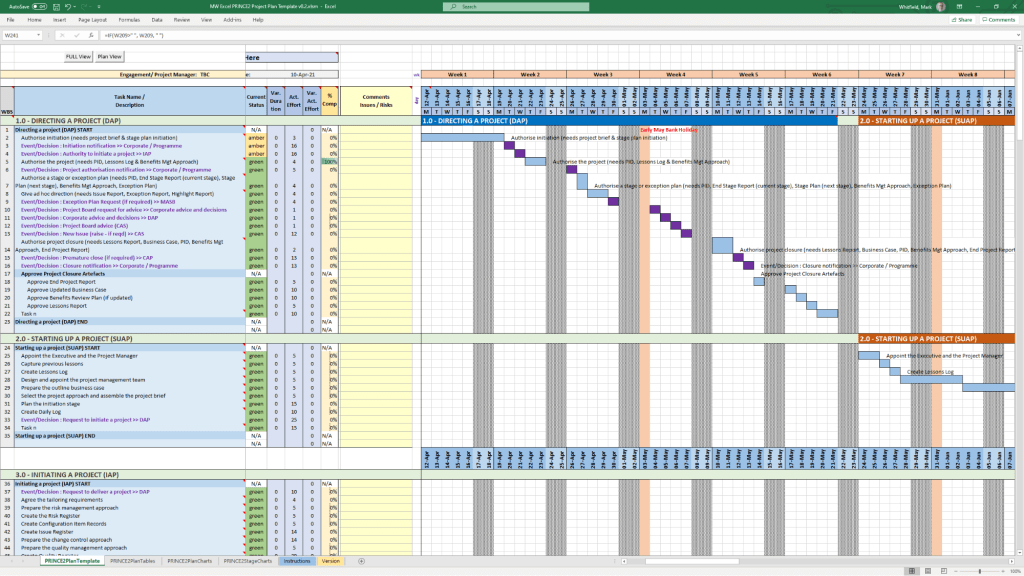
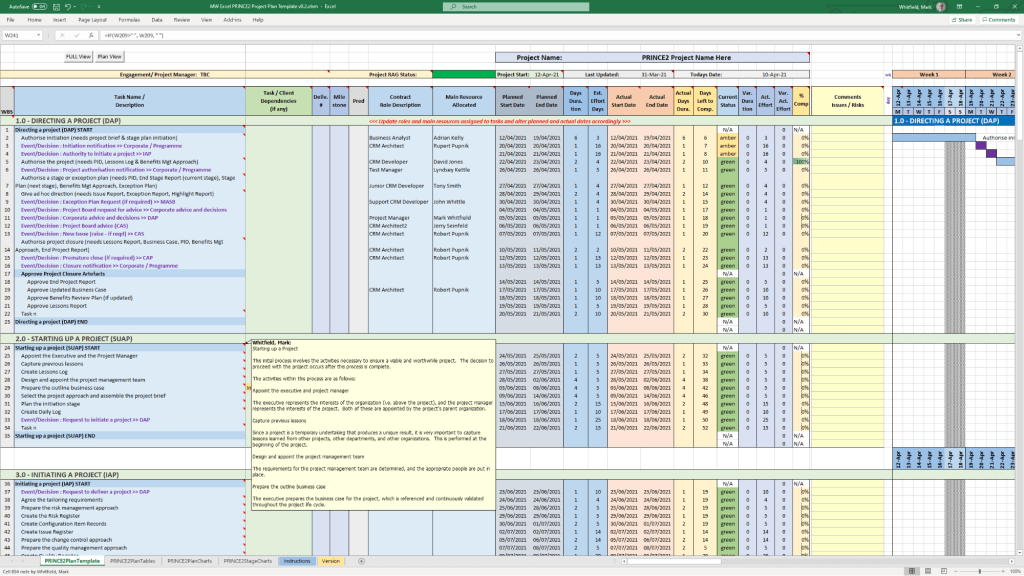
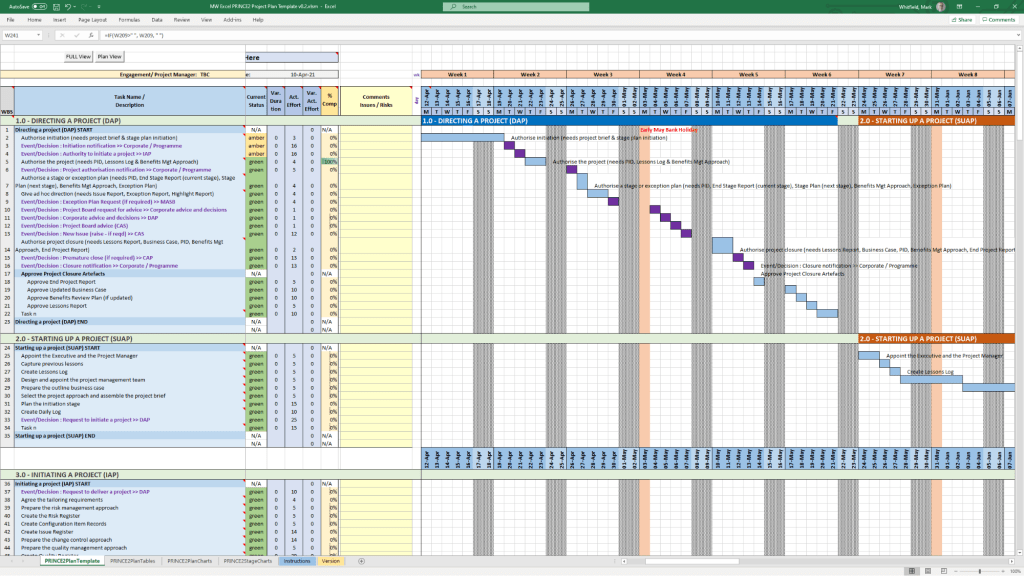
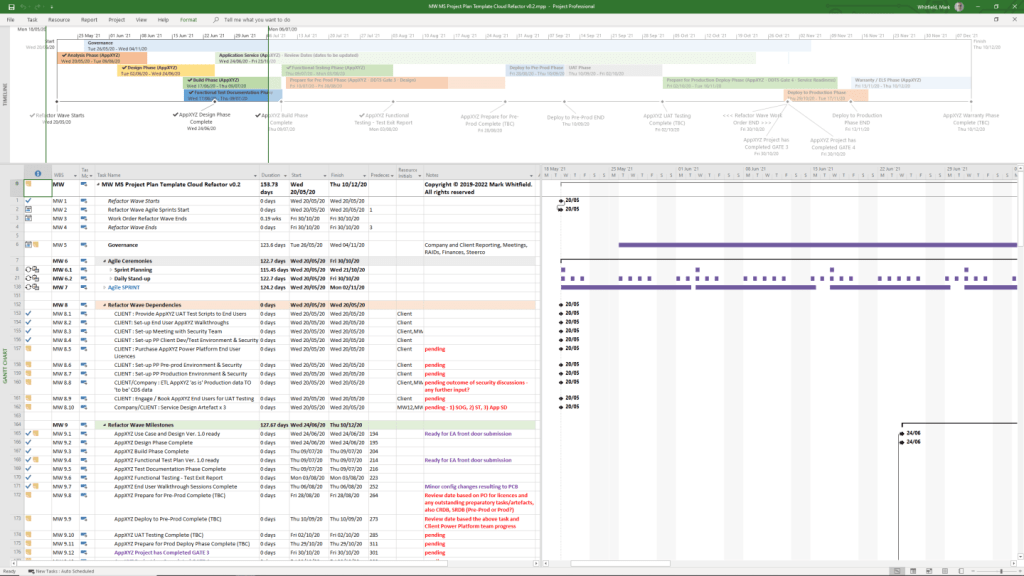
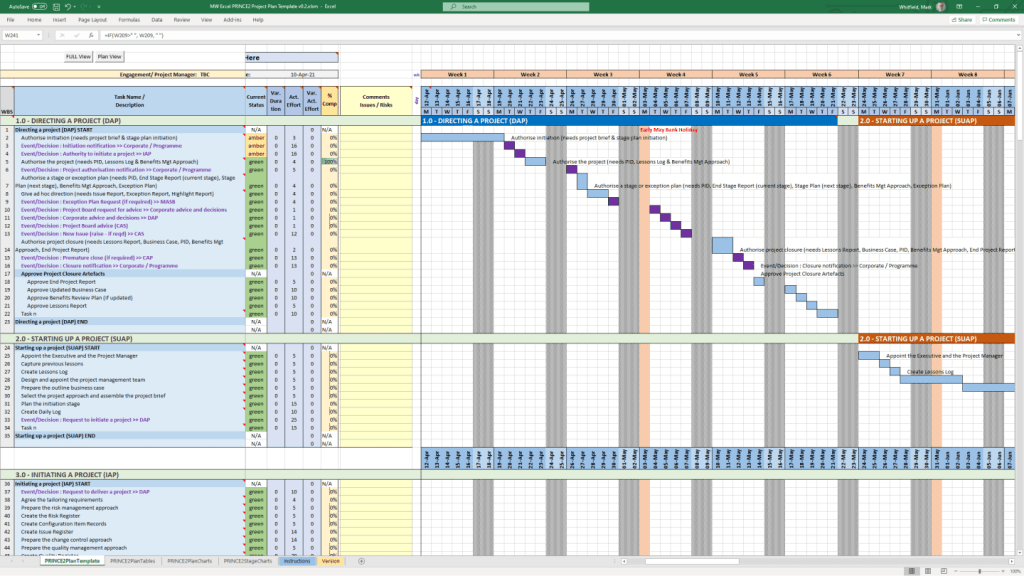
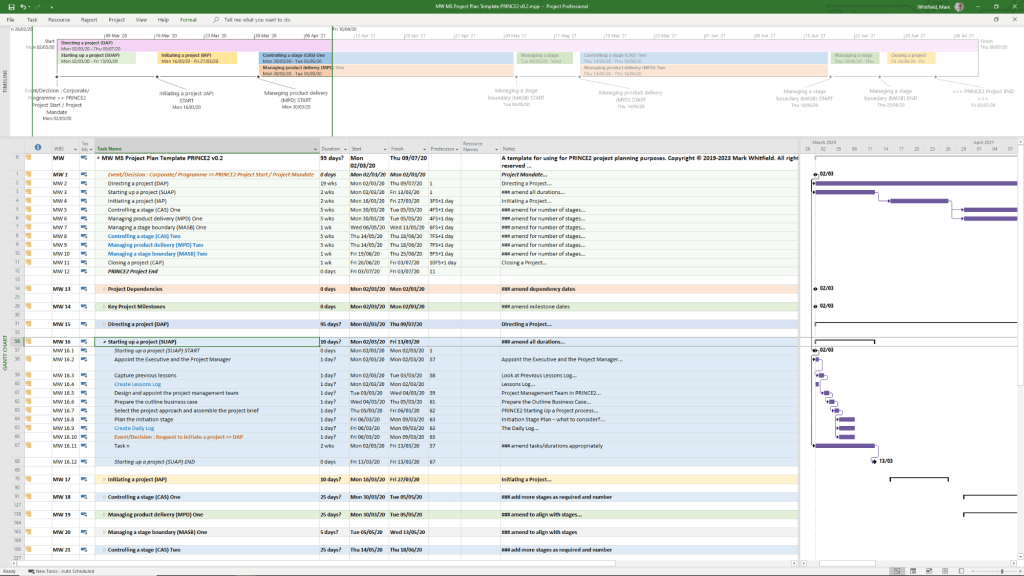
  • PRINCE2 Templates can be purchased directly from this website including a Microsoft Project Plan in MPP format and also a Microsoft Excel Project Plan in XLS format, see below and website link.

PRINCE2 Management Products Templates Overview and Historical Timeline
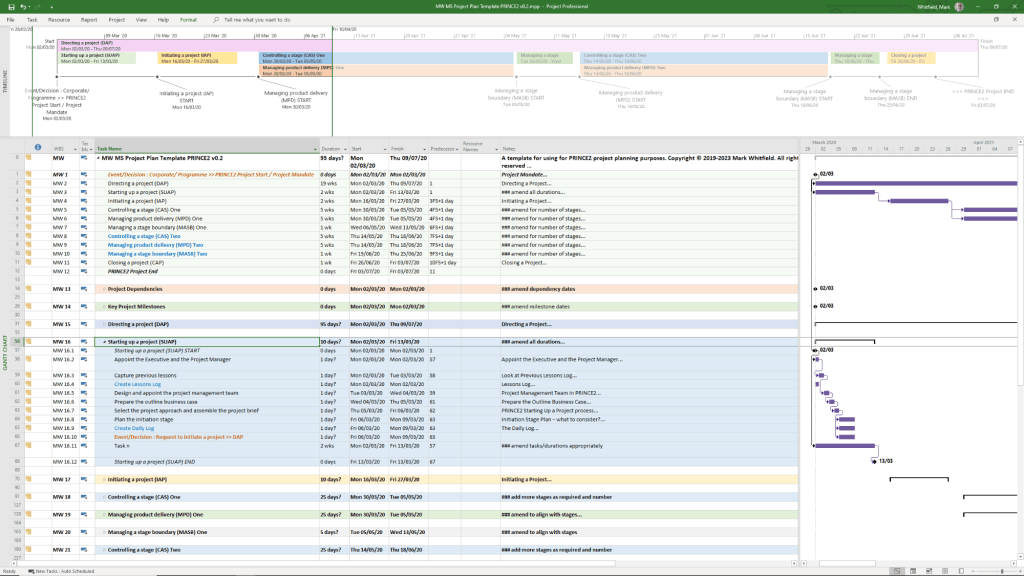
PRINCE2 Microsoft Project MPP file template
PRINCE2 Microsoft Excel XLS template 1
PRINCE2 Microsoft Excel XLS template 2

PRINCE2 and Agile Project Management Templates Gallery

A gallery and inventory of screenshots for the Project Management Templates (both Agile and PRINCE2 waterfall projects) that are all available to be purchased as a bundle from this website link (note: upgrades to the latest template package after purchase, are totally FREE).

PRINCE2 & Agile PM Templates Gallery

PM templates include MS Project MPP and MS Excel detailed plans including PRINCE2 and Agile delivery, Gantt Plan on a Page examples (POaP), finance trackers, status reports, RAID logs (Risk, Issue, Assumption, Dependency log), RACI tracker (Responsible, Accountable, Consulted, Informed), agile burn down chart and burn up chart, resource tracker, benefits realization plan etc. etc.

(Download the Template Inventory PDF file – 15MB)

Join the FREE PM templates related Facebook Group (LIKE Facebook page) and LinkedIn Group.

PRINCE2 and Agile Project Management Templates Gallery examples

MPP Microsoft Project Plan Examples
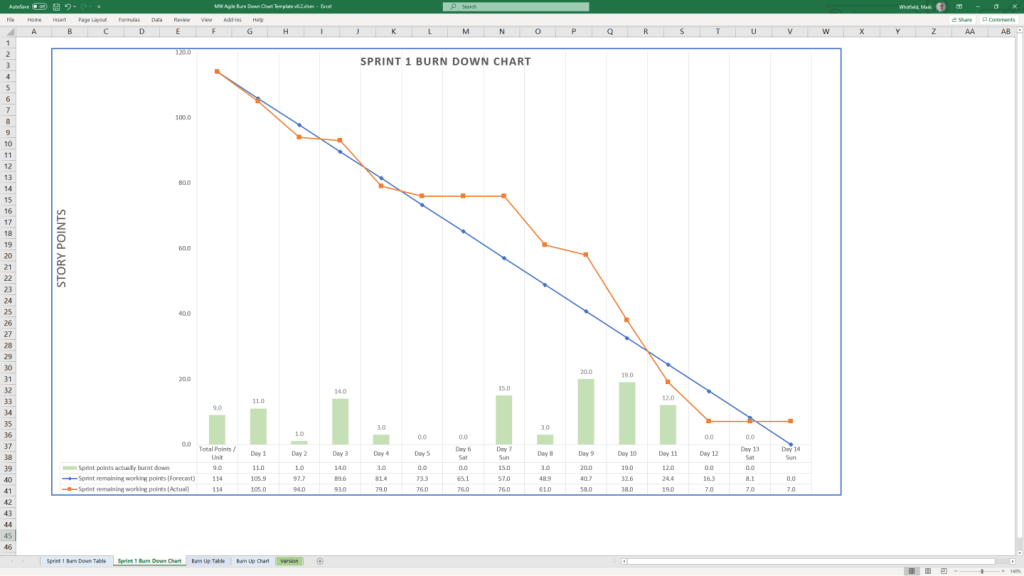
Agile Scrum Burn Down (and Up) Chart in Microsoft Excel
Example Microsoft Excel Spreadsheet Examples for Project Planning

PRINCE2 & Agile PM Templates Gallery

PRINCE2 Management Stages Overview

In PRINCE2, a project is managed through a series of management stages, which are discrete sections of a project that the Project Board authorises at specific decision points. Every PRINCE2 project must have at least two stages: an initiation stage and at least one further delivery stage

PRINCE2 Management Stages Overview

A detailed breakdown of these stages, aligned with the seven core PRINCE2 processes, is provided below. 

1. Starting Up a Project (SU)

This is a pre-project process designed to determine if the project is viable and worthwhile before committing significant resources. 

  • Key Activities:
    • Appointing the Executive and Project Manager.
    • Developing an Outline Business Case.
    • Creating a Project Brief which defines objectives and scope.
    • Planning the initiation stage itself. 

2. Initiating a Project (IP)

This represents the first management stage of the project. It establishes the firm foundation for the project’s execution. 

  • Key Activities:
    • Creating the Project Initiation Documentation (PID), which includes the full Business Case, Project Plan, and management strategies for risk, quality, and communication.
    • Setting up project controls and refining the project approach.
    • Securing formal approval from the Project Board to proceed. 

3. Directing a Project (DP)

This is an ongoing process that spans the entire project lifecycle, focusing on high-level decision-making by the Project Board. 

  • Key Activities:
    • Authorising the project to start and approving each subsequent stage.
    • Giving ad hoc direction and advice to the Project Manager.
    • Making the final “stop/proceed” decisions at stage boundaries.

4. Controlling a Stage (CS)

This covers the day-to-day management of each delivery stage by the Project Manager. 

  • Key Activities:
    • Assigning work to teams via Work Packages.
    • Monitoring progress and managing risks and issues.
    • Reporting status to the Project Board through Highlight Reports

5. Managing Product Delivery (MP)

This process manages the link between the Project Manager and the Team Managers who are actually building the products

  • Key Activities:
    • Teams accepting and executing Work Packages.
    • Ensuring work meets the specified quality standards.
    • Delivering completed and tested products back to the Project Manager. 

6. Managing a Stage Boundary (SB)

This occurs at the end of each stage (except the final one) to help the Project Board decide whether to continue. 

  • Key Activities:
    • Reporting on the performance of the current stage.
    • Creating a detailed Stage Plan for the next stage.
    • Updating the overall Project Plan and Business Case with the latest information. 

7. Closing a Project (CP)

This is the final part of the last management stage, ensuring the project is shut down in a controlled manner. 

  • Key Activities:
    • Confirming all products have been accepted by the customer.
    • Capturing Lessons Learned for future projects.
    • Preparing an End Project Report to evaluate performance against the original plan.

PRINCE2 Management Stages Overview

PRINCE2 7 Themes / Practices of PRINCE2

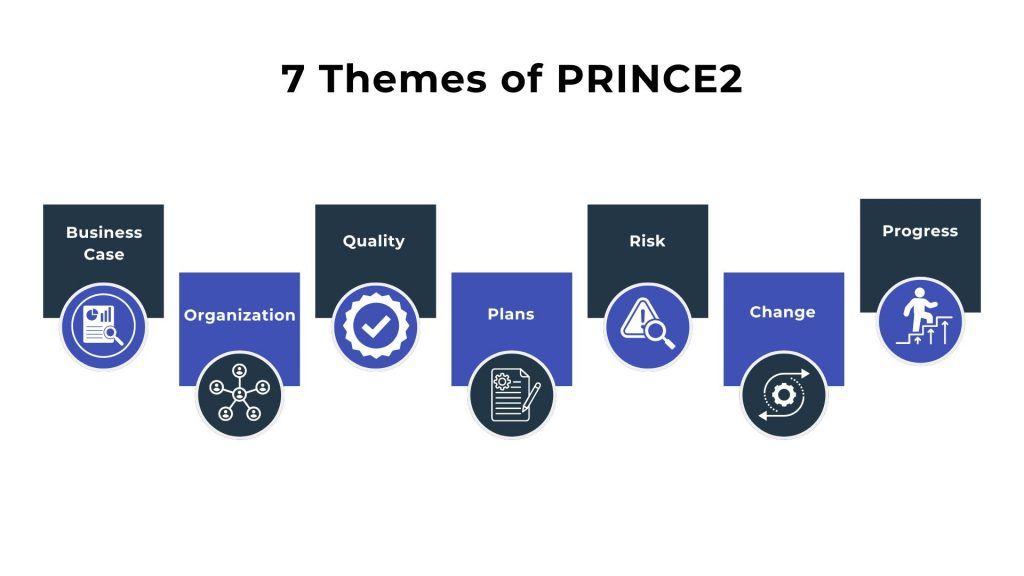
In the PRINCE2 project management methodology, Themes (renamed to Practices in the 7th edition released in 2023) are the seven functional areas of project management that must be addressed continuously throughout the project lifecycle. They provide a structured framework for managing key aspects like cost, risk, and quality to ensure the project remains on track. 

7 Themes / Practices of PRINCE2

Overview of the Seven Themes (Practices)

  • Business Case: Focuses on the “Why” of the project. It establishes the justification for the investment and ensures the project remains desirable, viable, and achievable.
  • Organisation: Addresses the “Who” by defining the project’s structure of accountability and responsibilities. It identifies key stakeholders and establishes the project management team.
  • Quality: Focuses on the “What” by defining the user’s requirements and quality standards. It ensures that deliverables are fit for purpose and meet stakeholder expectations.
  • Plans: Describes the “How,” “How Much,” and “When”. This theme provides techniques for creating project, stage, and team plans to facilitate communication and control.
  • Risk: Manages the “What If” by identifying, assessing, and controlling uncertainties that could impact the project’s objectives, whether they are threats or opportunities.
  • Change (Issues): Deals with the impact of changes and unexpected events. It provides a formal process for capturing, assessing, and controlling requests for change to project baselines.
  • Progress: Evaluates “Where are we now?” versus “Where are we going?”. It establishes mechanisms to monitor actual achievements against planned outcomes and manage deviations through tolerances. 

Key Concepts and Terminology

  • Continuous Application: Unlike processes, which follow a sequence, themes are applied simultaneously throughout the project.
  • Tolerances: Each theme uses tolerances (allowable deviations for time, cost, quality, etc.) to support the principle of Manage by Exception.
  • PRINCE2 7 Updates: The latest edition introduces Sustainability as a 7th performance target and emphasizes People as a core element alongside Principles, Practices, and Processes.

PRINCE2 Process Model Overview

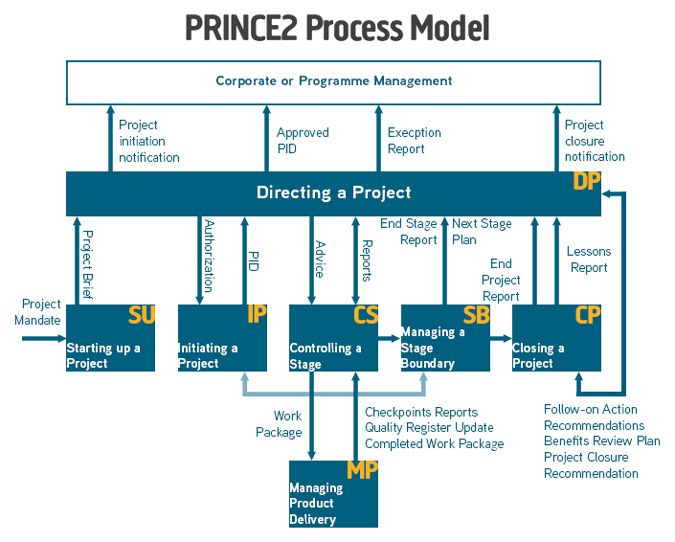
PRINCE2 Process Model

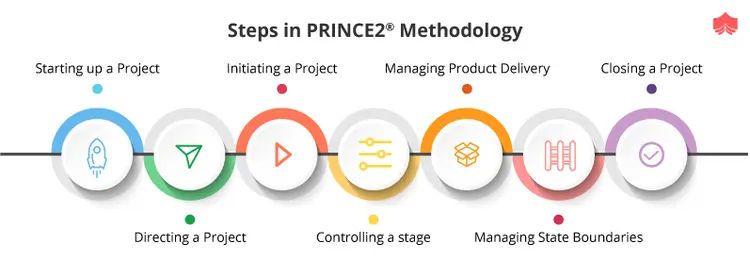
The PRINCE2 process model provides a structured, process-driven roadmap for managing a project from its initial conception to formal closure. It consists of seven core processes that define specific activities, responsibilities, and decision points across the project lifecycle. 

The 7 PRINCE2 Processes

The processes are designed to ensure control and align with the project’s management levels: 

  • Starting Up a Project (SU): A pre-project process that filters out unviable ideas. It focuses on confirming if there is a “viable and worthwhile” business case and appoints the Project Manager and Executive.
  • Directing a Project (DP): Spans the entire project from start to finish. It is the responsibility of the Project Board, which provides strategic oversight, makes key decisions (e.g., authorising stages), and manages by exception.
  • Initiating a Project (IP): Occurs during the first management stage. It involves detailed planning to establish solid foundations, resulting in the Project Initiation Documentation (PID), which includes the project plan, risk management approach, and full business case.
  • Controlling a Stage (CS): Focuses on the Project Manager’s day-to-day management of a stage. This includes assigning work to teams, monitoring progress, and dealing with issues or risks within agreed tolerances.
  • Managing Product Delivery (MP): Governs the link between the Project Manager and Team Managers. It is where the “specialist products” (actual deliverables) are created, quality-checked, and delivered.
  • Managing a Stage Boundary (SB): Occurs at the end of each management stage (except the final one). The Project Manager reviews the current stage, updates the project plan and business case, and plans the next stage for Board approval.
  • Closing a Project (CP): Ensures an orderly end to the project. It confirms that objectives have been met, products have been accepted by the user, and lessons are captured before the project is formally disbanded. 

Hierarchy of Management Levels

The process model operates across four distinct levels of authority: 

  1. Corporate or Programme Management: Sets the initial project mandate.
  2. Directing (Project Board): Responsible for overall governance and major decisions (Directing a Project).
  3. Managing (Project Manager): Handles daily management and stage control (Controlling a Stage, Initiating a Project).
  4. Delivering (Team Members/Managers): Focuses on creating the physical products (Managing Product Delivery). 

Key Characteristics

  • Management Stages: Projects are broken into at least two stages (Initiation and at least one Delivery stage) to provide “stop/go” decision points.
  • Triggers: Each process is activated by a specific trigger, such as a “Project Mandate” from corporate management to start the SU process.
  • Management Products: These are documents like the Business CaseProject Brief, and Highlight Reports used to facilitate control and communication.

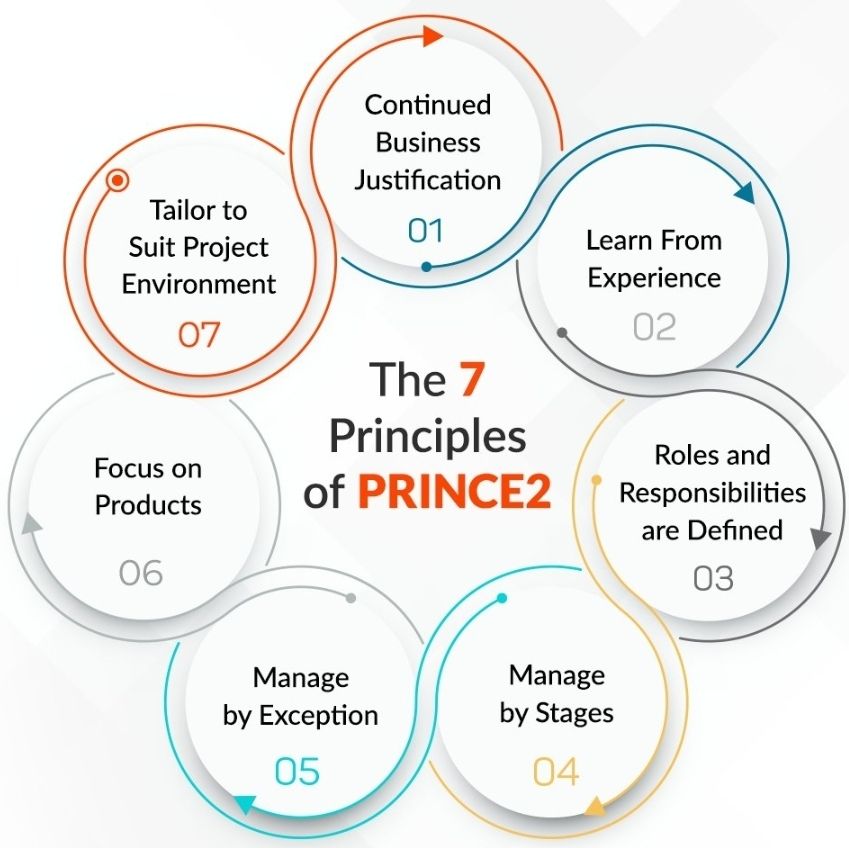
PRINCE2 (PRojects IN Controlled Environments) framework is built on seven core principles

PRINCE2 framework is built on seven core principles

The PRINCE2 (PRojects IN Controlled Environments) framework is built on seven core principles that serve as guiding obligations for any project using this methodology. For a project to be considered a “PRINCE2 project,” all seven must be applied. 

  • Continued Business Justification: A project must have a valid reason to start and must remain justified throughout its lifecycle. This is documented in a Business Case, which is regularly reviewed to ensure the project remains viable, desirable, and achievable.
  • Learn from Experience: Project teams are required to seek out lessons from previous projects and record new lessons as the current project progresses. A Lessons Log is typically used to capture these insights.
  • Defined Roles and Responsibilities: Every person involved must understand what is expected of them and who is responsible for specific tasks. PRINCE2 defines a clear management hierarchy: Project Board (Direction), Project Manager (Management), and Team Manager (Delivery).
  • Manage by Stages: Projects are broken down into manageable chunks called management stages. Each stage acts as a “stop/continue” decision point for the Project Board to assess progress before committing more resources.
  • Manage by Exception: Senior management (Project Board) only intervenes when the project deviates beyond agreed tolerances for time, cost, quality, scope, risk, or benefits. This empowers the Project Manager while ensuring efficient use of executive time.
  • Focus on Products: The methodology prioritizes the definition and delivery of high-quality products (outputs) rather than just completing activities. Product descriptions specify the quality criteria and requirements for each deliverable.
  • Tailor to Suit the Project: PRINCE2 is not a rigid “one-size-fits-all” approach; it must be adapted to the project’s specific scale, complexity, and environment. Tailoring ensures that the controls are appropriate for the level of risk involved. 

PRINCE2 – PRojects IN Controlled Environments – Timeline

PRINCE2 (PRojects IN Controlled Environments) has evolved from a rigid, IT-specific framework into a globally recognised, flexible project management standard. 

Historical Evolution Timeline

  • 1975: PROMPT Origins – Simpact Systems Ltd developed PROMPT (Project Resource Organisation Management and Planning Techniques) to address IT project overruns.
  • 1989: The Birth of PRINCE – The UK’s Central Computer and Telecommunications Agency (CCTA) licensed PROMPT, renaming it PRINCE (originally “PROMPT II IN the CCTA Environment”).
  • 1996: PRINCE2 Launch – Developed with input from 150 European organisations, PRINCE2 was released as a generic, scalable framework suitable for any industry.
  • 2000–2013: Ownership Shifts – Ownership moved from the CCTA to the Office of Government Commerce (OGC) in 2000, then to AXELOS Ltd (a joint venture) in 2013.
  • 2009: Major “Refresh” – Introduced the seven core principles and made the method more customisable.
  • 2017: 6th Edition Update – Formerly known as the “2017 Update,” this version focused heavily on scalability and tailoring to specific project needs.
  • 2021–Present: PeopleCert Era – PeopleCert acquired AXELOS in 2021. In 2023, PRINCE2 7 was launched, introducing a greater emphasis on people management and sustainability. 

Comprehensive Project Timeline Breakdown

A standard PRINCE2 project follows a lifecycle defined by seven processes

  1. Pre-Project: Starting up a Project (SU)
    • Ensures the project is viable and worthwhile.
    • Key Output: Project Brief.
  2. Initiation: Initiating a Project (IP)
  3. High-Level Oversight: Directing a Project (DP)
    • An ongoing process where the Project Board provides guidance and makes key decisions without managing day-to-day tasks.
  4. Day-to-Day Management: Controlling a Stage (CS)
    • The Project Manager monitors work, manages risks, and reports progress for each individual stage.
  5. Technical Delivery: Managing Product Delivery (MP)
    • The Team Manager ensures products (deliverables) are created, tested, and handed over according to specifications.
  6. Transition: Managing a Stage Boundary (SB)
  7. Finalisation: Closing a Project (CP)
    • The formal decommissioning of the project, ensuring all products are accepted and lessons are documented. 

PRINCE2 – PRojects IN Controlled Environments

PRINCE2 7 Process Model, 2026 – 7th Edition

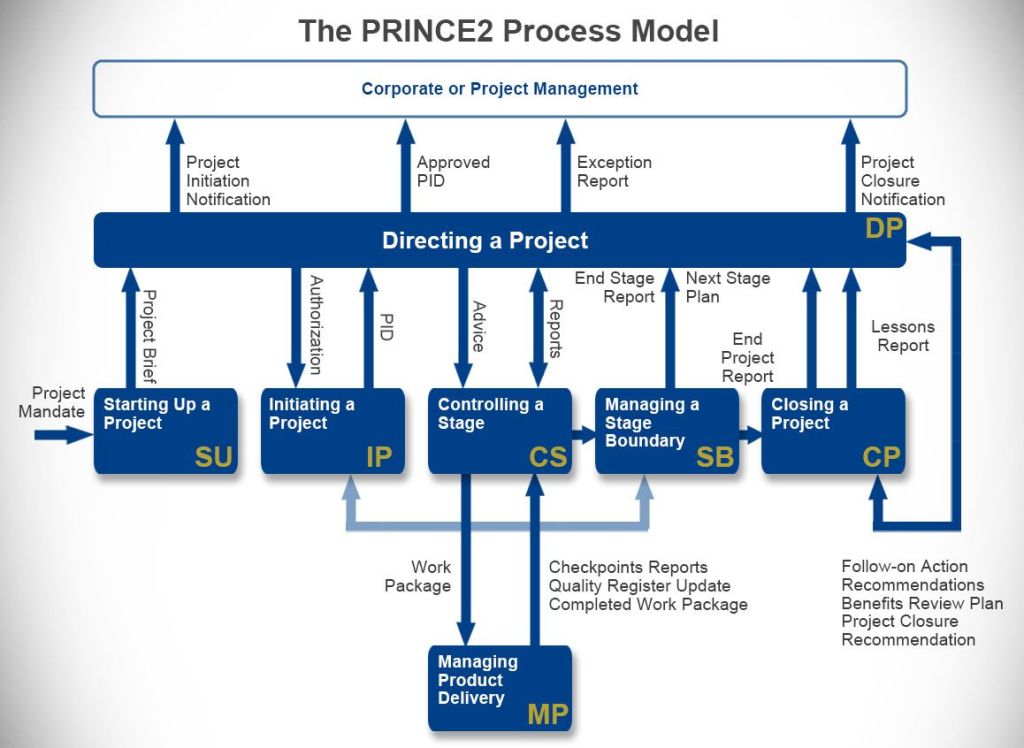
In 2026, the PRINCE2 7 (7th Edition) remains the current global standard for the methodology. The core diagram, known as the PRINCE2 Process Modelillustrates how the 7 processes interact across the four management levels: Corporate, Direction, Management, and Delivery

The PRINCE2 7 Process Model

The diagram typically visualises the project lifecycle from a “Project Mandate” to “Project Closure” through these processes: 

  • Starting Up a Project (SU): The pre-project process where a mandate is converted into a project brief.
  • Directing a Project (DP): The Project Board’s high-level oversight, running from project start to finish.
  • Initiating a Project (IP): Establishing firm foundations, including the Project Initiation Documentation (PID) and the Business Case.
  • Controlling a Stage (CS): The daily management of a stage by the Project Manager.
  • Managing Product Delivery (MP): The link between the Project Manager and Team Managers to ensure products are built.
  • Managing a Stage Boundary (SB): Occurs at the end of each management stage to plan the next one and review the current.
  • Closing a Project (CP): The final process for a formal decommissioning of the project. 
PRINCE2 7 Process Model, 2026 – 7th Edition