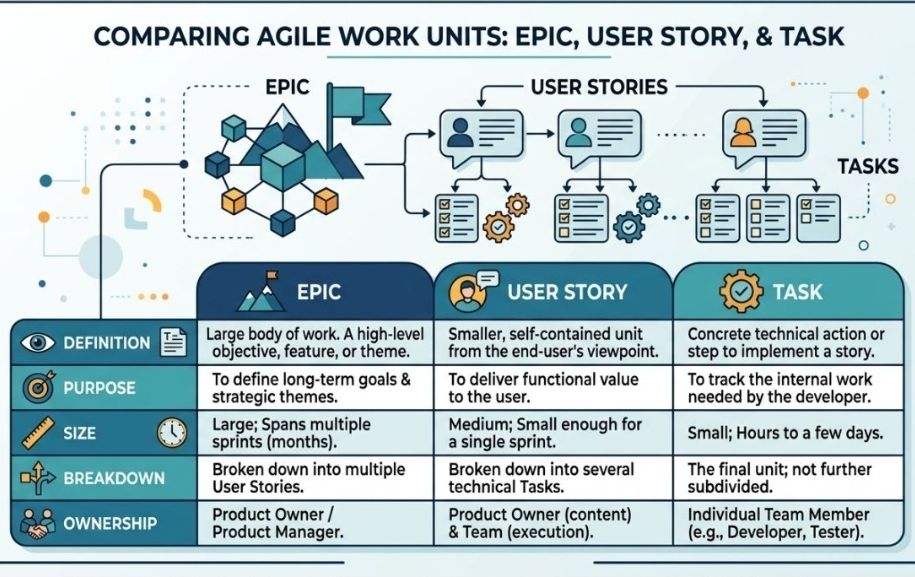
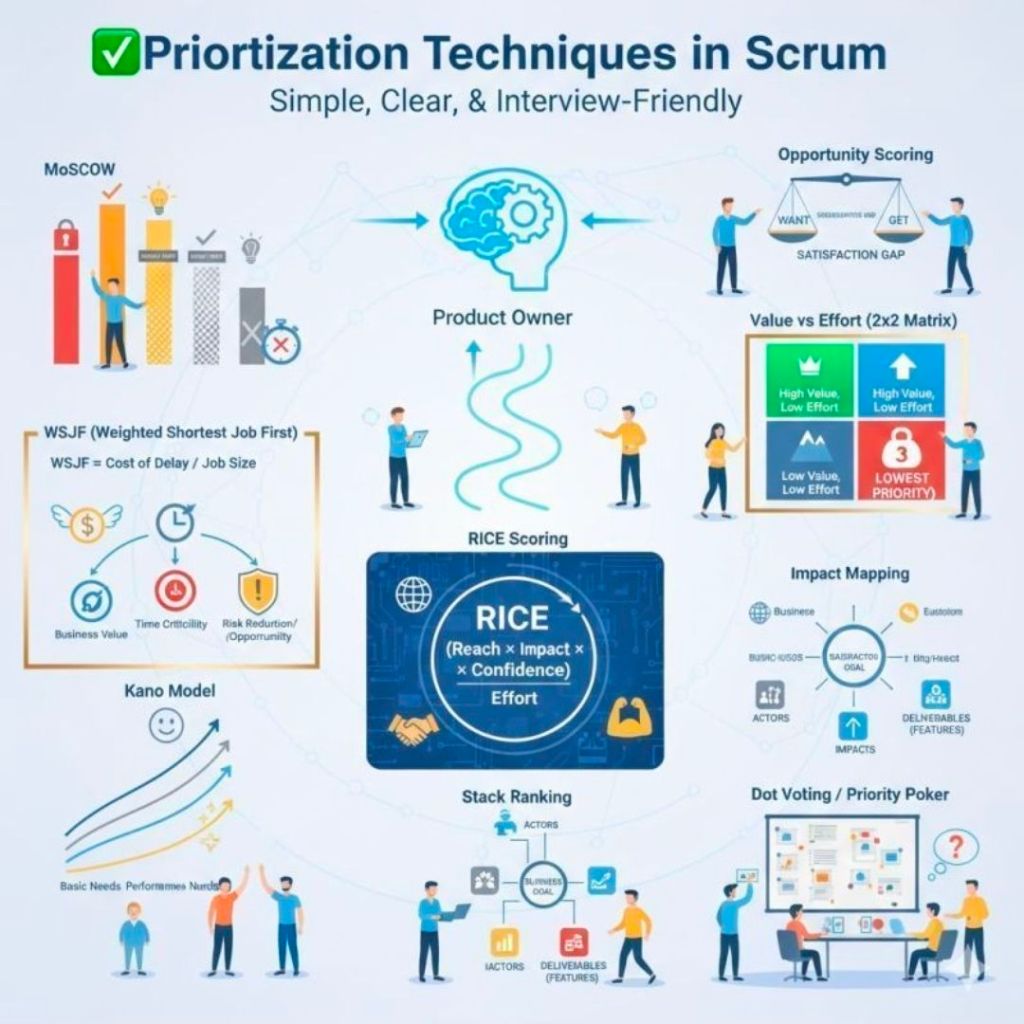
Prioritization in AgileScrum is the systematic process of ordering Product Backlog items to maximize value delivery. These techniques are generally categorized by their primary focus: customer satisfaction, business value and economics, or collaborative consensus.
Category 1: Customer-Centric Frameworks
These methods prioritize features based on how they impact the end-user’s experience and satisfaction.
Kano Model: Categorizes features into three main types: Basic Needs (expected essentials), Performance Features (linear satisfaction), and Excitement Needs (unexpected “delighters”).
User Story Mapping: Visualizes the entire user journey to identify the most critical paths and “skeletal” features needed for a Minimum Viable Product (MVP).
Opportunity Scoring: Uses customer research to find gaps where importance is high but current satisfaction is low, identifying high-potential opportunities.
Category 2: Economic & Quantitative Models
These data-driven techniques use formulas to balance value against implementation costs or risks.
Weighted Shortest Job First (WSJF): Prioritizes tasks by dividing the Cost of Delay (value, urgency, and risk reduction) by Job Size (effort). The goal is to deliver the most value in the shortest time.
RICE Scoring: Calculates a score based on Reach (number of users), Impact, Confidence (certainty in estimates), and Effort.
Cost of Delay (CoD): Measures the economic impact or potential revenue loss of not delivering a feature within a specific timeframe.
Category 3: Stakeholder & Team-Based Consensus
These collaborative methods are used to reach agreement among diverse stakeholders or team members.
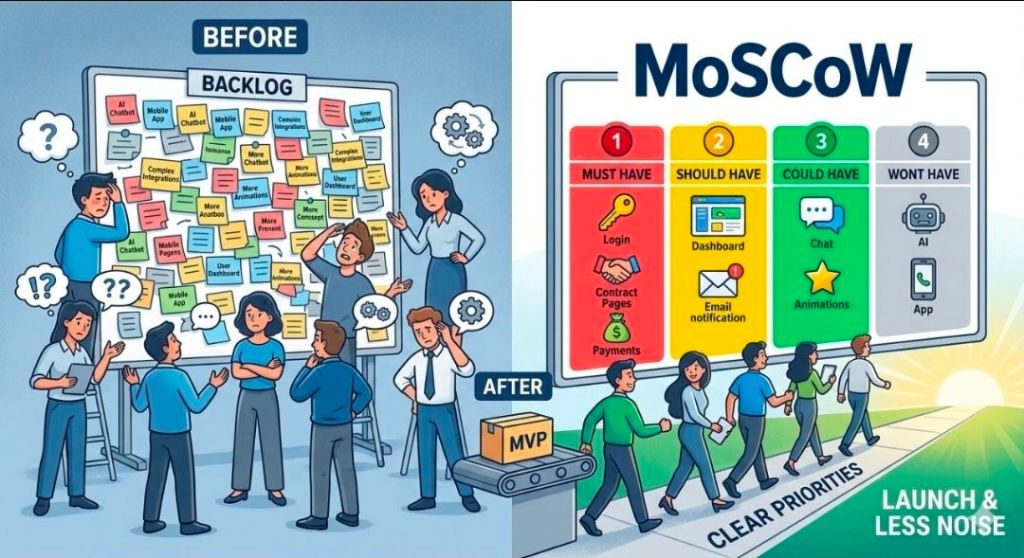
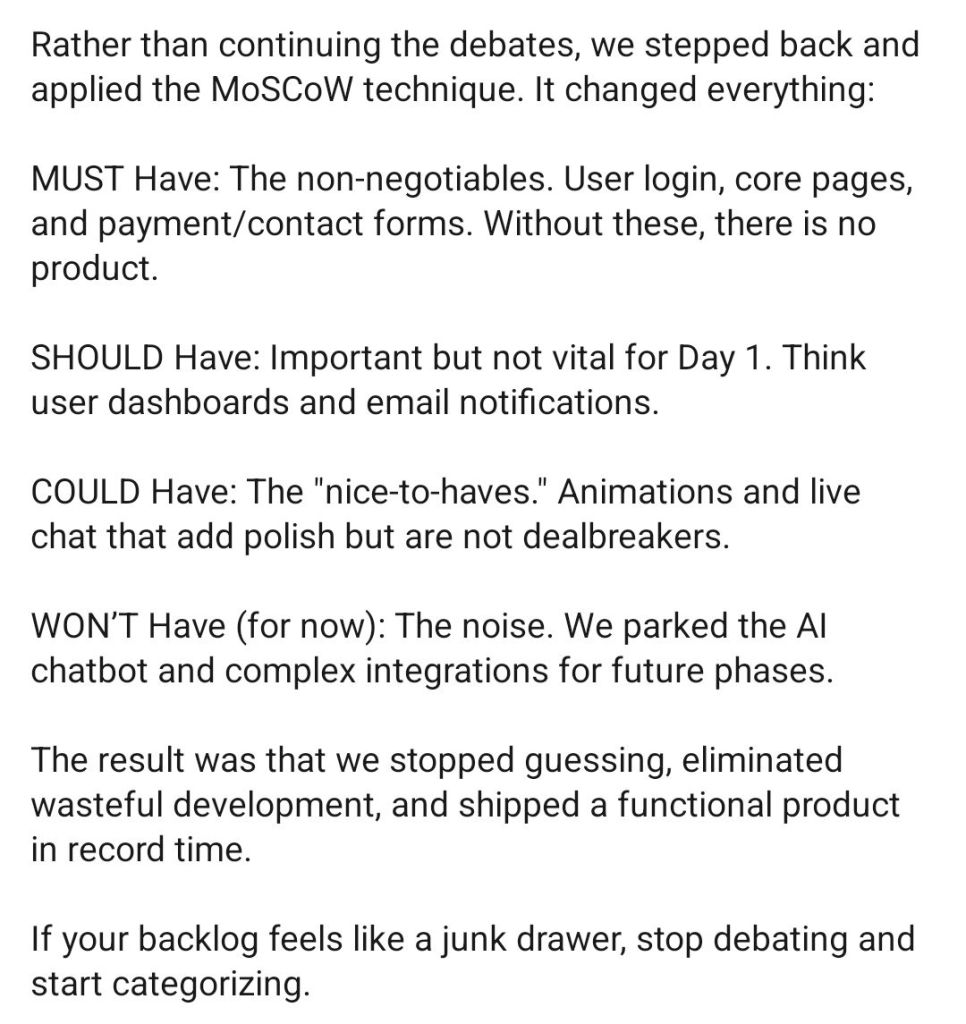
MoSCoW Method: A qualitative technique that buckets items into Must-Have, Should-Have, Could-Have, and Won’t-Have for a specific release cycle.
100-Dollar Test: Participants are given a hypothetical $100 to “spend” on features, revealing what they value most through resource allocation.
Priority Poker: A gamified, collaborative approach where team members anonymously vote on an item’s priority level to remove bias and foster discussion.
Category 4: Structural & Visual Matrixes
These tools help teams visualize trade-offs, typically using 2×2 grids.
Value vs. Effort Matrix: Plots tasks on two axes to identify Quick Wins (high value, low effort) and Major Projects (high value, high effort) while avoiding “thankless tasks”.
Risk/Value Matrix: Balances potential business rewards against technical or project risks to decide which high-value but high-risk items to tackle early.
Stack Ranking: A “forced ranking” method where every item has a unique, linear position (1 to N), preventing the “everything is high priority” trap.
Degree 53 is a Manchester-based digital agency specializing in user experience (UX), design, and software development, primarily for the online gambling and sports betting industries.
Founded by Andrew Daniels in 2013, the agency has built a reputation for developing high-stakes transactional mobile apps and websites for major operators like Betfred and Scientific Games.
Following its acquisition by Bally’s Corporation in 2021, it now serves as the Sports Product Studio for Bally’s Interactive, focusing on North American gaming products.
Comprehensive Evaluation Timeline
2013: Founding and Launch
Andrew Daniels, a former Betfred employee, founded Degree 53 Limited on May 21, 2013, with initial backing from Betfred founder Fred Done.
The agency initially established its office at The Sharp Project in Manchester.
2015: Regulatory Milestone
In April 2015, the agency secured a Remote Gambling Software license from the UK Gambling Commission, a rare credential for a digital agency that allowed them to build bespoke transactional gambling platforms.
2016 – 2017: Rapid Expansion
In 2017, the agency moved to a new HQ in Steam Packet House, Manchester, after recruiting over 30 new staff members, bringing its total headcount to 75.
The firm diversified its portfolio during this period, developing products for non-gambling clients like Vibe Tickets.
2020: Sharp Gaming Spin-Off
Founder Andrew Daniels launched Sharp Gaming, a B2B gambling technology business, with £25 million in investment from Fred Done.
While Sharp Gaming focused on full-stack platform services, Degree 53 continued its focus on UX and front-end development under new Managing Director Richard Wagstaff.
The team of 54 experts was integrated into Bally’s Interactive but remained based in their Manchester studio.
2024 – 2026: Consolidation and Leadership Changes
The agency remains an active subsidiary of Bally’s. Recent regulatory filings indicate leadership transitions, such as the appointment of Raja B-Sheikh as a director in August 2025.
Summary of Key Services
Bespoke Development: Building native mobile applications (iOS, Android) and responsive web platforms.
UX/UI Specialization: User-centered design approach, including mapping customer journeys and conducting user testing.
Industry Expertise: Complex system integrations, data feed management, and API development specifically for the betting, gaming, and lottery sectors.
Key Areas Summarised
Core Focus: High-quality digital solutions for complex, regulated industries.
Key Services: UX/UI Design, Native iOS & Android Apps, Web Development, API Integrations, and Digital Strategy.
Strengths: Strong focus on user journey and engagement, particularly in betting platforms. They are noted for bringing high-quality digital solutions at competitive prices.
Impact: A significant player in the Manchester digital scene, moving to larger premises to accommodate growth from 50 to 75+ staff between 2014 and 2017.
Acquisition: In 2021, Degree 53 became the Sports Product Studio for Bally’s Interactive, supporting its North American expansion.
Key Clients and Projects
Betfred/Totesport: Mobile betting apps and websites.
Bally’s Interactive: Currently developing sports products.
Vibe Tickets: Developed a secure ticket-selling app.
Sofology: ‘My Account’ functionality.
Other projects: Ready for School, Football Acca, Horse Tracker.
Degree 53 Logo
Key Company Facts
Acquisition: Acquired by Bally’s Corporation in October 2021 to advance its global sportsbook and mobile platforms.
Specialties: Mobile app development, UX/UI design, Bespoke .NET development, and API integrations.
Major Clients: Historically has worked with Betfred, Scientific Games, and Gamesys brands like Rainbow Riches.
Office Location: They are currently based at 60 Spring Gardens in Manchester city centre. Previous locations included Steam Packet House and The Sharp Project.
Mark Whitfield involvement 2014 – 2015 :
In late 2014, I joined Betfred as a Senior IT Project Manager in the Gambling and Casinos industry delivering multiple projects for both Betfred online and mobile (iOS, Android and Windows) using the Agile SCRUM framework. Project deliveries covered payment gateways and methods, sportsbook for football and horse racing amongst others and the online virtual (computer generated) gaming components.
As a major part of this allocation, I also linked into Degree 53 for project/ app status and aid in the setting of priorities for their Betfred specific software delivery.
at Degree 53 Manchester office, 2015
Projects varied in size and cost and extended over multiple phases requiring the management of many software suppliers, each delivering different aspects of the solution from fraud detection, frontend, middleware, payment services and mobile apps.
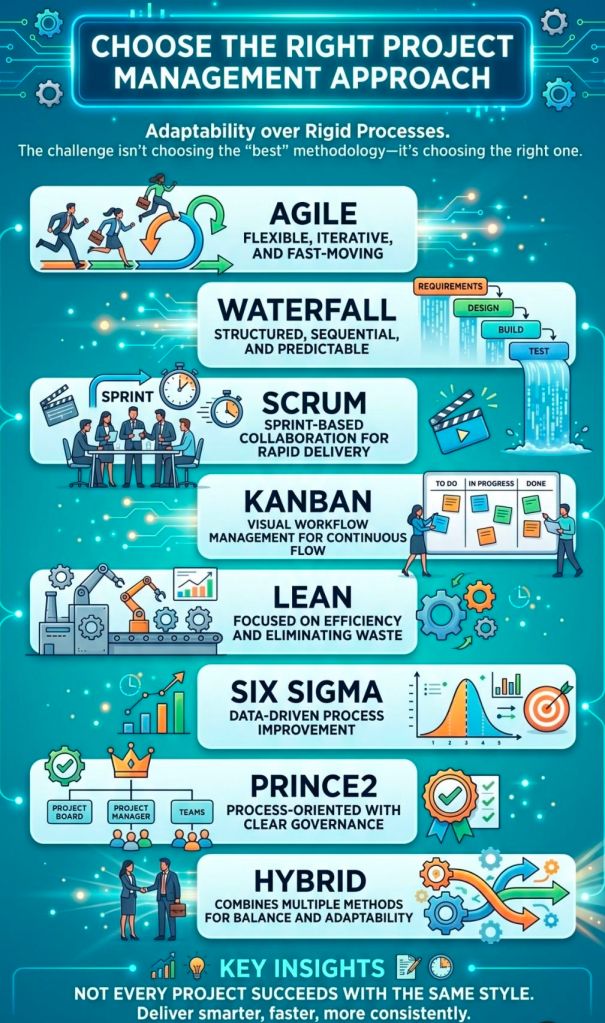
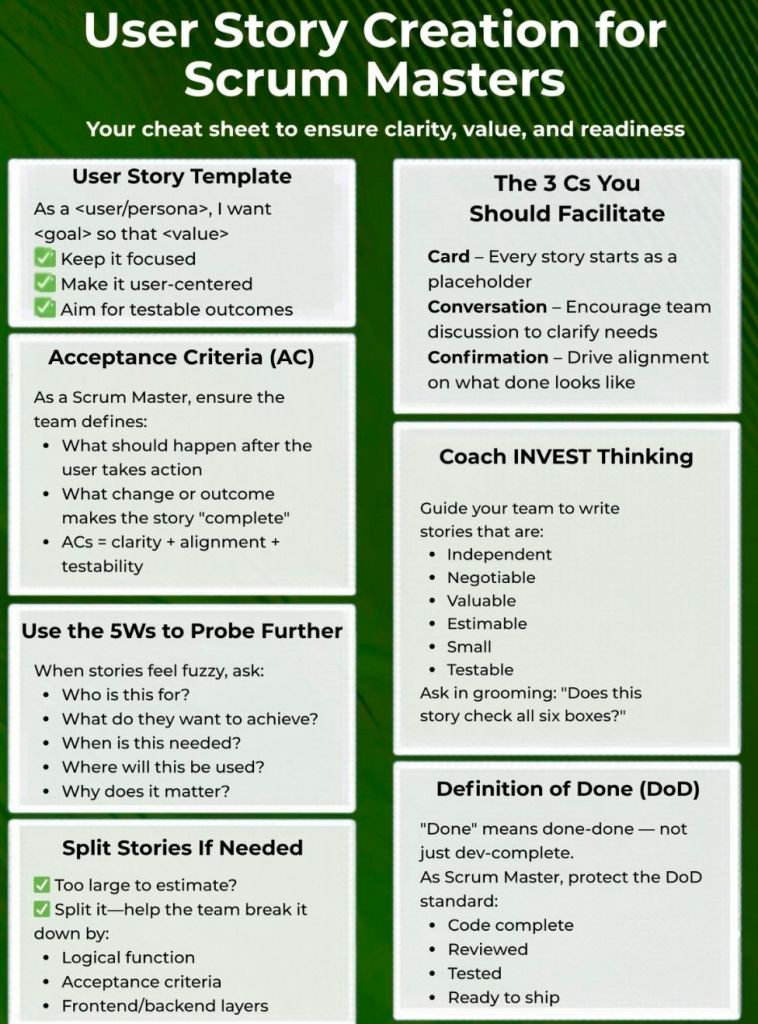
Agile Scrum is a widely adopted, iterative, and incremental framework designed to manage complex product development and software projects.
It breaks down large, daunting projects into small, manageable units called sprints—fixed-length iterations typically lasting 1–4 weeks—to deliver functional components faster and adapt to changing requirements.
Detailed Summary of the Scrum Framework
Scrum relies on three pillars—transparency, inspection, and adaptation—and is defined by specific roles, events, and artifacts.
1. The Scrum Team (Roles)
Product Owner (PO): Maximizes the value of the product by managing the Product Backlog. They define “what” is built.
Scrum Master: A servant-leader who helps the team follow Scrum theory and removes impediments.
Developers: The cross-functional team members responsible for creating the increment each sprint.
2. Scrum Events (Ceremonies)
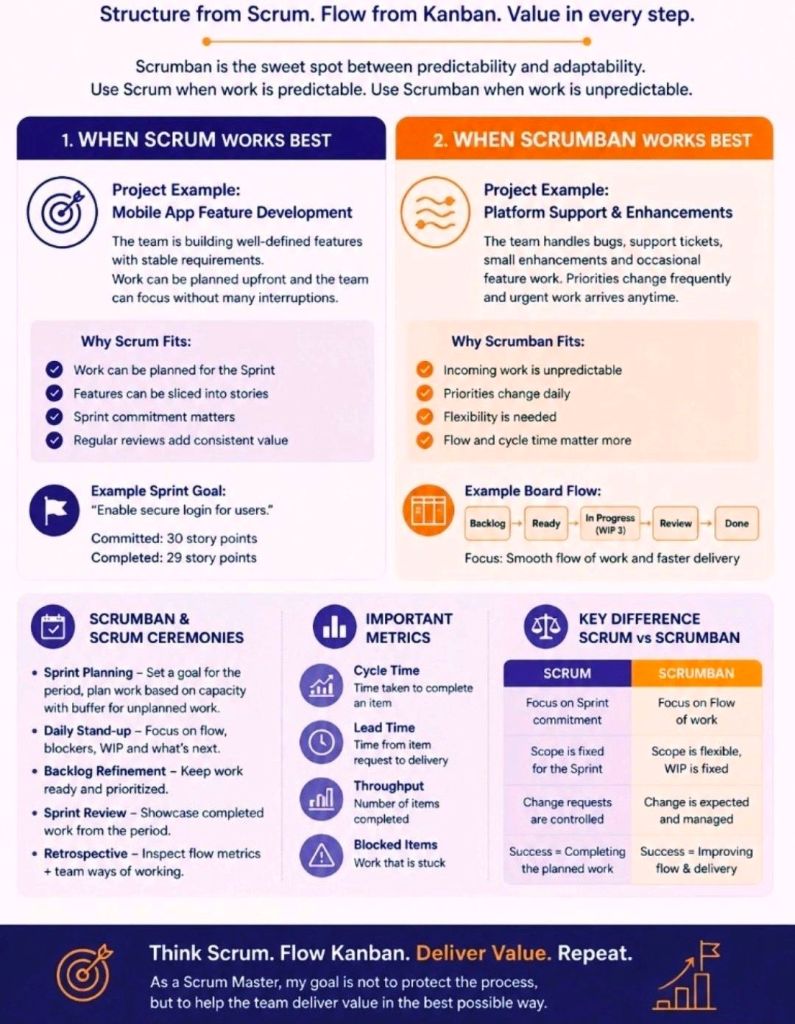
Sprint Planning: Defines the Sprint Goal and the work to be done during the sprint.
Daily Scrum: A 15-minute daily meeting for developers to synchronize activities and plan the next 24 hours.
Sprint Review: Held at the end of the sprint to showcase the increment to stakeholders and gather feedback.
Sprint Retrospective: The team reflects on the process and identifies improvements for the next sprint.
3. Scrum Artifacts
Product Backlog: An ordered list of everything required in the product.
Sprint Backlog: The set of Product Backlog items selected for the sprint, plus the plan for delivering them.
Increment: The usable, working product increment produced at the end of a sprint.
Evolution of Scrum Over the Years
Scrum was developed in the early 1990s as a response to the failures of the linear “waterfall” approach.
1986 (Concept Origins): Takeuchi and Nonaka publish “The New New Product Development Game,” comparing traditional relay-race product development to a rugby “scrum” team.
1993 (First Implementation): Jeff Sutherland, John Scumniotales, and Jeff McKenna implement the first Scrum team at Easel Corporation.
1995 (Public Introduction): Ken Schwaber and Jeff Sutherland formalize Scrum and present “The Scrum Development Process” at the OOPSLA ’95 conference.
2001 (Agile Manifesto): Sutherland and Schwaber become signatories of the Agile Manifesto, cementing Scrum as a major Agile methodology.
2010 (The Scrum Guide): The first official Scrum Guide is released to standardize the framework worldwide.
2011–2017 (Refinements): The guide is updated to clarify roles and events, including strengthening the role of the Scrum Master and introducing self-organizing teams.
2020 (The Modern Scrum Guide): A major update makes the guide less prescriptive, focusing on a single Scrum Team (removing “development team” and “scrum team” split), introducing the Product Goal for long-term focus, and focusing on one team working towards one product.